1. Introduction: open access fishery
Many communities in the developing world depend on renewable natural resources for survival. Common property in a context of weak institutions and poverty often results in a degraded resource that barely provides for the people that use it. A ‘tragedy of the commons’ (TOC) may emerge from this situation, as too many resource users drive a resource stock to inefficiently low levels. Two connected, brackish-water lagoons on the Northern Coast of Honduras provide an interesting case study of an open access fishery used by poor agricultural households with a limited ability to regulate use of the fishery.
Managing a common resource requires reducing the amount of effort allocated to extracting the resource. Natural resource economists have offered resource rationalization (through privatization, community catch shares, access rights, etc.) as a way to improve the quality of over-used common property. However, in a developing country context, rationalization remains problematic since excluding labor from a resource can leave people without means of support and create incentives to break management rules.
It could be effective to incentivize current resource users to exit a commons by creating economic opportunities in other sectors (e.g., agriculture, tourism or construction). The general equilibrium impacts of increasing wages in an economy are not straightforward, however, because increasing the opportunity costs of fishing can draw labor out of an open access resource sector, while simultaneously increasing local incomes and the demand for the resource products. Understanding these cross-sector economic linkages requires a thorough examination of how natural resource users make decisions regarding resource use.
In this paper, we explore the implications of agricultural market integration for effort allocated to an open access fishery in rural Honduras, near the city of Tela.Footnote 1 The communities studied are located within the buffer zone of the national parks Jeannette Kawas and Punta Isopo (henceforth referred to as JKPI). The fishery consists of two brackish lagoons (Los Micos and Quemada) that periodically connect to Tela Bay (depending on the location of sand bars). Fish species include Common Snook, Mackerel, and Mullet. Large-scale fishing boats are prohibited within 3 km of the shoreline, creating a space for artisanal fishermen. Many of the local fishermen also participate in other economic activities, including farming, construction and tourism.
Attempts to formally regulate users of the fishery have largely failed due to entry of fishermen and inconsistent enforcement of rules. Gear restrictions, including net size limits and periodic lagoon closures (during the months of May and JuneFootnote 2 ), have not effectively limited fishing effort. Many fishermen lack alternatives, and hence are compelled to ignore fishery closures.Footnote 3 Efforts by local fishermen to organize have also failed, since outside users cannot be controlled. As a result, the fish stocks in the fishery remain at low levels and the average sizes of fish caught are small (many fishermen use nets with smaller meshes than the allowed 2 inches).
Fishery rationalization seems unlikely in the current setting due to the political and economic circumstances that make exclusion of local fishermen challenging. The absence of exclusive use-rights at any level and ineffective management mean the fishery experiences a TOC with inefficiently low fish stocks. This results in fishermen spending long hours fishing while barely earning their opportunity cost.
Because a fisherman's opportunity cost includes community-level wages and earnings in other sectors (e.g., agriculture or tourism), other-sector activities may play a role in determining the amount of effort allocated to the open access fishery. These connections are highlighted by Cinner et al. (Reference Cinner, Daw and McClanahan2008); they show that 38 per cent of fishermen in a Kenyan artisanal fishery entered the fishery because returns were higher there than in previous jobs. Eleven per cent of former fishermen in the area left because of better opportunities elsewhere.
JKPI communities have begun to experience the benefits of market integration in African Palm, which recently has generated higher output prices for farmers. As a result, there has been a shift from staple crops and fruit (with one to two harvests per year) to African Palm (with year-round harvests) and other products exported from the communities.
To explore the impacts of this market integration on resource use, we develop a model that highlights the linkages from agricultural market integration and price changes to effort allocated to an open access fishery. More generally, we seek to answer the question of whether and when price changes in other sectors (agriculture, tourism, etc.) can provide a second-best way of improving incomes and resource quality in an open access fishery. This could be especially important in developing countries where solving the TOC may not be a feasible option in the short-run but there is still a desire to conserve resource stocks and improve livelihoods.
Other studies have pointed out that natural resources have connections with other sectors (e.g., agriculture) in a community. Labor allocation to a fishery depends on returns in other sectors. Baland and Francois (Reference Baland and Francois2005) and Béné et al. (Reference Béné, Hersoug and Allison2010) point out that resources may serve as insurance or portfolio diversification when formal insurance markets do not exist. Takasaki et al. (Reference Takasaki, Barham and Coomes2004) and Pattanayak and Sills (Reference Pattanayak and Sills2001) demonstrate that households in the Amazon respond to (negative) shocks by increasing their use of non-timber forest products.
The current paper contributes to the environmental and development economics literature in several ways. First of all, it emphasizes the importance of considering economic linkages across sectors when thinking about managing effort in an open access resource sector. Placing the resource sector within a broader economy reveals additional policies that could reduce extraction effort in resource commons and generates hypotheses that can be tested empirically. Second, it proposes a method that allows for the quantification of impacts of economic development on natural resource stocks. Finally, it points to significant data shortages in developing country fisheries and provides guidance for future data collection.
The rest of this section describes important features of the JKPI fishery. In the following section, a theoretical model demonstrates that agricultural price changes impact labor allocated to an open access fishery in unexpected ways. Under certain market conditions, agricultural price increases can produce ambiguous impacts in the fishery, as competing effects both pull labor out of and push it back into the fishery. We calibrate a community-wide model to household survey data from the JKPI communities to simulate the net impact of agricultural price changes in the parks. Finally, we discuss policy recommendations and conclude.
1.1. The tragedy of the commons
In JKPI, fishing represents one of many possible activities in which households participate. This implies an opportunity cost to allocating effort to the common fishery; thus, fishermen have not driven the average product of the fishery to zero (as in Hardin, Reference Hardin1968). Instead, as people enter into the fishery and drive the average product of effort down to its opportunity cost, the resource rent (but not the resource average productivity) goes to zero. Importantly, increasing the opportunity costs of time (while holding the resource price constant) means less labor in the fishery, allowing the fish stock to reach equilibrium at a higher level, despite the persistence of the TOC.
Ostrom (Reference Ostrom1990, Reference Ostrom2008, Reference Ostrom2009) explores how different societies and communities have managed community resources by restricting effort in order to sustain higher resource productivity. Ostrom and colleagues' research has shown that the TOC may be avoided by creating local governance institutions. In many cases, however, it may be challenging to create the conditions that lead to successful resource management. Indeed, the JKPI communities have not successfully solved the TOC.
Restricting the amount of labor in the JKPI fishery would cause an increase in the fish stock that could generate resource rents. But without secure property rights, these rents would create an incentive for individuals to capture more than their allowable share, because individual returns to labor would exceed opportunity costs. Weak institutions and povertyFootnote 4 make effort-reducing rule enforcement especially difficult in this context. Officials in charge of enforcing fishery rules in practice do not have the financial resources necessary to conduct regular inspections or enforce rules when infractions are identified.
Another barrier to fishery rationalization is its effects on wages and the distribution of income within fishing communities. While the overall value of production from effort in an economy with a rationalized resource must exceed the common-property value, Scott (Reference Scott, Turvey and Wiseman1957) showed that fishery rationalization lowers wages across the economy (for fishermen and wage workers in other sectors) even after the fish stock recovers to efficient levels (see also Samuelson, Reference Samuelson1974; Weitzman, Reference Weitzman1974). This happens because economy-wide labor demand decreases with fishery rationalization. The winners from fishery rationalization are those who receive the rights to continue fishing, but excluded fishermen and agricultural laborers lose because of lower wages.
1.2. Economic development as resource management
The challenges associated with rationalization in developing country settings suggest a need to better understand the incentives fishermen face. Because the opportunity cost of fishing greatly affects the amount of fish caught, changing that opportunity cost may provide a way to increase the fish stock. On the other hand, increasing local incomes may increase local demand for fish.
Liese et al. (Reference Liese, Smith and Kramer2007) discuss the importance of input and output market integration for open access fisheries. They demonstrate that labor market structure matters for understanding potential development impacts on open access resources.
Agricultural market integration that increases prices may provide a tool for policy makers to increase fish stocks, but the consequences are not straightforward. Under some circumstances, promoting agricultural market integration can be a feasible second-best alternative (or complement) to rationalization. In areas like Northern Honduras, where traditional fisheries management has had limited success, investment in private sectors may provide a way to reduce fishing effort in the area. We now investigate the likely impacts of agricultural price changes on fish stocks in the JKPI communities.
2. A general equilibrium model of open access labor allocation
The potential impacts of agricultural price changes on fishing in JKPI can be illustrated using a two-sector general equilibrium model with a labor market linking two production sectors: agriculture and fishing. Our model has a representative consumer that consumes the output from production. The consumer (a representative community household) supplies labor, the only input, to both activities. The different output sectors and labor market may or may not trade with the outside world, depending on market integration. For simplicity, we assume interior solutions to the model.
2.1. Production
The first production sector is agriculture. A scarce factor (land) implies decreasing marginal returns to labor in production. The production function takes the following form:
 $$q_A = aL_A - {1 \over 2}bL_A^2$$
with a, b > 0. q A is the quantity of agricultural output and L A is the number of days spent working in agriculture. The representative agricultural producer solves the following optimization problem:
 $$\max_{L_A} P_A \left(aL_A - {1 \over 2} bL_A^2 \right)- L_Aw\comma \;$$
where w is the economy-wide wage paid to labor and P A the agricultural output price. The profit maximizer sets the value of the marginal product (VMP) of labor equal to the wage, resulting in the following demand for labor:
 $$L_A^{\ast} = {P_Aa-w \over P_Ab}.$$
Individual profit maximizers in the open access fishery sector create an outcome that does not maximize profit in the sector. Instead, homogenous labor enters into the sector as long as the value of the average product exceeds the wage. Given the steady-state production function, where q F is the quantity of fishery output and L F is the number of days spent fishing,
 $$q_F = mL_F - {1 \over 2} nL_F^2.$$
With m, n > 0 and price of fish equal to P F , the average product in the fishery equates with the community wage such that
 $$L_F^{\ast} = {P_Fm-w \over {1 \over 2}P_Fn}.$$
The economy is inefficient, since less fishery labor would result in a (long run) higher value of production from labor. The values of m and n in the fishery production function come from logistic growth dynamics of a fish population and a Schafer production function in a given period (see Appendix A for a description of this relationship). All results from this model apply to long-run or steady-state outcomes.
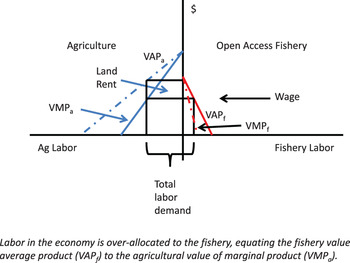
Figure 1 illustrates the inefficiency in production that comes from the TOC in the open access fishery. By competing rents away (rents should be paid because biological productivity is a scarce input, like land), the average product of labor in the fishery equates to the wage. The labor market connects the two sectors together as the VMP of labor in agriculture equates to the average value of labor in the fishery.
Inefficiency of open access fishery as value of average product equates with wage

2.2. Consumption
The consumer maximizes utility from consuming the output of the fishery and agricultural sectors. His constrained maximization problem takes the following form:
 $$\eqalign{&\max_{x_F\comma x_A\geq 0} U\lpar x_F\comma \; x_A\rpar s.t. P_Ax_A + P_F x_F \cr &\quad \le P_Aq_A - wL_A + P_Fq_F - wL_F + w\bar{L} + y.}$$
The budget constraint requires that the value of what the consumer buys must not exceed profits from production plus the value of the endowment of labor,
 $w\bar{L}$
, and exogenous income, y. L
A
and L
F
potentially contain local and outside labor. Because labor can be traded in some market scenarios, labor supplied to each activity by the representative consumer does not have to equal total labor in each activity. For now, we ignore the value of leisure. Assuming Cobb–Douglas utility with budget share parameter α for the agricultural good, demand functions take the following form:
 $$x_A^{\ast} = \left({P_Aq_A - wL_A + P_Fq_F - wL_F + w\bar{L} + y \over P_A} \right)\ast \alpha\comma \;$$
 $$x_F^{\ast} = \left({P_Aq_A - wL_A + P_Fq_F - wL_F + w\bar{L} + y \over P_F} \right)\ast \lpar 1 - \alpha\rpar.$$
Consumption thus depends on the profits from production activities and prices, which could be endogenous or exogenous. If a good is traded, the amount consumed does not necessarily equal the amount produced.
2.3. Market clearing
Market clearing rules depend on the nature of trade with the outside world.
2.3.1. Both outputs and labor traded
In the simplest case, all prices, including the wage, come from outside the economy, and agents trade all goods and labor with the rest of the world. The input and output demand functions presented above provide enough information to know the amounts of each good consumed and produced. The only constraint for the economy is that total purchases from the rest of the world cannot exceed total sales.
The JKPI communities do not have perfectly integrated markets and so other scenarios are relevant.
2.3.2. Tradable agriculture, non-tradable fish and laborFootnote 5
This scenario applies to household labor in JKPI because new families cannot move to the national parks. This means family labor is fixed and a wage will emerge that equates labor supply with labor demand in the economy. Holding output prices fixed for now,
 $$w^{\ast} = {P_AP_F\left({1 \over 2}an + bm - {1 \over 2}bn\bar{L}\right)\over {1 \over 2}P_Fn + P_Ab}.$$
This equation highlights the economic linkages between sectors when labor is fixed within an economy. Price increases in agriculture and fishing affect the wage in the entire economy. Labor allocation to the agricultural sector is:
 $$L_A^{\ast} = {P_Aa - P_F \left(m - {1 \over 2}n\bar{L} \right)\over {1 \over 2}P_Fn + P_Ab}.$$
Because the economy has a fixed labor supply, labor not demanded in agriculture goes into the fishery:
 $$L_F^{\ast} = \bar{L} - {P_Aa - P_F \left(m - {1 \over 2}n\bar{L}\right)\over {1 \over 2}P_Fn + P_Ab}.$$
Since local producers do not trade fish directly with the rest of the economy (due to the high perishability of fresh fish and high transport costs), there is an additional market clearing condition determining the endogenous price of fish.Footnote 6
 $$x_F^{\ast} = q_F^{\ast}$$
 $$\left({P_A q_A - w^{\ast}L_A^{\ast} + P_F q_F - w^{\ast} L_F^{\ast} + w^{\ast}\bar{L} + y \over P_F} \right)\ast \lpar 1 - \alpha\rpar = mL_F^{\ast} - {1 \over 2} nL_F^{\ast 2}\comma \;$$
where L
A
* and L
F
* represent the optimal labor allocation between the two activities. This equality implicitly defines the equation for the price of fish as a function of parameters
 $a\comma \; b\comma \; m\comma \; n\comma \; \bar{L}\comma \; \alpha\comma \; y$
and P
A
.
2.3.3. Tradable labor and agricultural production, non-tradable fish
In reality, fishing and farming require multiple inputs. To reflect the accessibility of the JKPI fishery to outsiders, labor could be tradable as well. Without external trade in fish, the price of fish is determined by the market clearing condition in case 2 but with a constant wage. Only exogenous parameters determine agricultural decisions, so the solutions for agricultural production in this case match the results from case 1.
2.4. The impact of an agricultural price change
Using the theoretical model, we can simulate the impact on the fishery of an exogenous price increase in agriculture as is occurring in our Honduran case study. JKPI households produce palm oil for export and fish to sell locally. The price of palm oil is linked to the price of petroleum, a substitute. Recent palm oil market integration has resulted in a rapid increase in the price of palm oil in this economy. We explore analytically the impacts of this increase in price of palm oil in the two-sector model under each of the three market scenarios discussed above.
2.4.1. Both outputs and labor traded
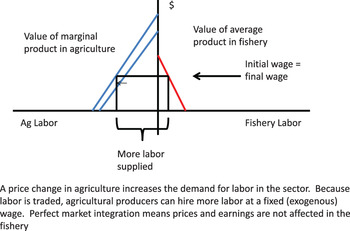
In this hypothetical context, an increase in the agricultural price increases the VMP of labor in agriculture. This triggers an outward shift and steepened slope of the VMP curve in figure 1. Since this economy trades labor with the outside world, more labor works in the local economy, and agricultural production increases. The exogenous wage does not change. An exogenous fishery price means that no change occurs in the fishery. Comparative statics reveal these results:
 $${dL_A^{\ast} \over dP_a} = {w \over bP_A^2} \gt 0$$
and
 $${dL_F^{\ast} \over dP_a} = 0.$$
Figure 2 illustrates the impact of a price increase with all prices exogenous.
Effect of agricultural price increase with exogenous prices and wage

An alternative market structure that would produce the same results described here is in an economy with unemployment and an institutionally set wage, as in Lewis (Reference Lewis1954). Then, increases in labor demand come at no opportunity cost. The wage remains stable at the subsistence level, and increases in labor demand simply pull labor out of unemployment. In this scenario price changes in agriculture do not transmit to the open access fishery.
2.4.2. Tradable agriculture, non-tradable fish and laborFootnote 7
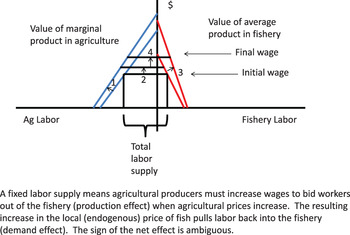
In the second case, results become analytically less clear. As before, an increase in agricultural price shifts the VMP of labor outward and increases labor demand (arrow 1 in figure 3 ), exerting upward pressure on the wage and pulling labor out of the fishery (arrow 2).Footnote 8 This ‘production effect’ would be the only effect with an exogenous fish price. With an endogenous fish price, richer farmers and workers demand more fish, and this increases the price of fish, shifting the value of the average product in the fishery outward (arrow 3), pulling labor back into the fishery, and further increasing the wage (arrow 4). This ‘demand effect’ counteracts the production effect and may even cancel it out. Numerical simulations show the net effect to be ambiguous, meaning the impact on the fish stock is also ambiguous.
Effect of agricultural price increase with non-tradable fish and non-tradable labor

2.4.3. Tradable labor and agricultural production, non-tradable fish
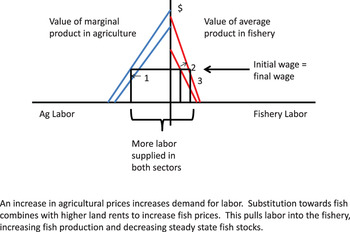
In the final case the results become relatively straightforward – and alarming from a conservation point of view. In figure 4, an increase in the price of agriculture increases the VMP of agriculture (arrow 1) and labor demand. Profits increase, stimulating local demand for fish and putting upward pressure on the fish price; this shifts out the value of the average product in the fishery (arrow 2). Since the wage is exogenous in this scenario, more labor enters the fishery (arrow 3). If this extra labor is drawn from local unemployed workers, the effect on the price of fish becomes magnified by a demand effect. If the labor comes from outside the local economy, only the profit effect increases the local demand for fish. Either way, an increase in the price of agriculture leads to an increase in labor in the fishery and a decreased fish stock. In general, then, a price change in agriculture has ambiguous impacts on the status of the resource.
Effect of agricultural price increase with an endogenous demand for fish and exogenous wage

This model shows potential impacts of agricultural price changes on fishing and fish stocks in the long run. It also highlights the types of market structures that allow agricultural price changes to help or harm an open access fishery, and it demonstrates that the economic circumstances for fishermen (and the fish stock) may improve without eliminating the TOC. The dissipation of scarcity rent persists in these scenarios. Ideally, this inefficiency should be addressed; however, in the meantime agricultural price changes can impact wages and fish stocks.
Understanding how this model applies to the real world requires a more detailed calibration that captures actual connections between fishing, agriculture and other sectors and allows for different market structures for each output and input. In the next section we simulate impacts in a local economy-wide model calibrated with micro field data for our Honduran case study.
3. LocalizedFootnote 9 economy-wide impact evaluation with an open access resource: the case of a Northern Honduran artisanal fishery
We calibrate a generalized version of the analytical model presented above using survey data collected from JKPI communities. Due to a lack of roads, communities remain isolated and their markets are not fully integrated with the rest of Honduras. Also, restrictions on who can live within the national parks determine a pool of local labor. The communities rely heavily on artisanal fishing, with 30 per cent of the local-economy GDP coming from fishing and fish sales.
This is an ideal site in which to assess the potential for agricultural price changes to increase fish stocks because the chief agricultural activity in the region is the production of palm oil, a tradable output. Many households are in the process of converting fields from staples such as beans and corn to African Palm. The VMP of labor should increase with the palm oil price, and theory shows that this increases the demand for labor, which could be drawn from the fishery.Footnote 10
3.1. The data
Our data come from fieldwork carried out in the Spring of 2012. Households in the 14 communities in the national parks were randomly selected and surveyed by the lead author and two local surveyorsFootnote 11 hired from PROLANSATE (the non-profit foundation that administers the national parks). At least 10 households were surveyed in each community. The total area surveyed covered approximately 17,000 people in 3,000 households. The sample size was 154 households. A few (<5) of the randomly selected households were not available to be interviewed. Results were weighted to reflect each household's probability of being surveyed.
The survey collected information about demographics, income, employment, expenses and production activities. Economic activity took place both in the communities and in the town of Tela. The survey section on fishing contained additional questions that explored the institutions that govern the fishery and its recent evolution. This qualitative information informed modeling choices.
The household data were aggregated into one local economy and used to construct a Social Accounting Matrix (SAM) for the coastal villages (SAM available upon request). Agricultural products were aggregated by value. The SAM represents a snapshot of the flows of money through the community economy during the year targeted by the survey (2011). The community SAM highlights the linkages among sectors, markets and the rest of the world and includes sector accounts for local trade, trade with the rest of the world, and government tax and expenditures, based on the village modeling methodology of Taylor and Adelman (Reference Taylor and Adelman2003).
3.2. The model
The model includes seven production activities, six factors of production, and one representative household that consumes output from the local economy and from the rest of the world. In addition, there is a government account and external trade. Cobb–Douglas production functions are assumed for each activity and demand is derived from Cobb–Douglas utility. The model was calibrated using the data from the community SAM and constructed using Generalized Algebraic Modeling System (GAMS). Budget shares were obtained from the household column in the SAM, which contains expenditures on each good obtained within the community and from the outside. All prices in the base calibration of the model are set to one. Units in the model adjust to this commodity price. For example, if agricultural output is 20 tons and revenue in the sector is 200 dollars (in the SAM), then the price is 10 dollars per ton. Therefore, the units of agricultural output will be in tenths of a ton, which have a price of one dollar.
Cobb–Douglas production functions were calibrated from the activity columns in the SAM. Cobb–Douglas exponents are calculated as the share of payment to each factor in total value-added (or sum of payments to all factors) in each activity, as implied by profit maximization. Intermediate inputs other than factors are modeled with Leontief coefficients; their demand is a constant fraction of total output.
Exogenous actors buy the marketed surplus (MS) of tradable local production or sell to the community if MS < 0.
3.3. Family versus hired labor
The model separates hired from family labor in the communities because of their significant differences in productivity in the agricultural sector. F-tests easily reject the null hypothesis that hired and family labor have the same marginal productivity on the farm (F-value (1, 48) = 49.15). Interestingly, the same test in the fishery does not reject the null hypothesis (F(1, 148) = 0.52) that the two marginal productivities are equal.Footnote 12 We model family labor as fixed in the economy due to the isolated nature of the site and restrictions on settlement in the park. Hired labor does not substitute easily for family labor on the farm while, in the fishery, hired labor represents a closer substitute for family labor; thus, hired labor can replace some of the family labor drawn out by higher returns in other sectors.
3.4. The fishery
Fully parameterizing the fishery sector is always a challenge because one important input is difficult to measure, namely the amount of fish in the water. Fish in the water represent an important input to fish on the dock, the output of the fishery sector. In an open access setting like our study site, fishermen make no payment to this input (the only cost is a relatively cheap annual license), resulting in its overuse. Inasmuch as the fish stock is unknown, the observed amount of labor and capital allocated to the fishery are assumed (for calibration) to represent the open access steady-state amounts of effort. The open access resource stock adjusts with fishing effort.
To capture the open access nature of the fishery, diminishing returns to scale are assumed in the fishery in the short run, as in Persson and Munasinghe (Reference Persson and Munasinghe1995). The fishery has three inputs in the community SAM: capital and two types of labor. If the production function included the fish population, it would seem reasonable to assume constant returns to scale. Without modeling the resource stock, which shrinks as effort increases in the fishery, we assume that the fishery exhibits decreasing returns in labor and capital. More effort in the fishery causes each unit of effort to be less productive, as more fishermen compete for fewer fish. Due to lack of data, the resource stock contribution to the value of production is specified as 0.4 and sensitivity analysis is performed. The remaining 60 per cent of the value of production is assumed to come from labor and capital. Because of the open access nature of the fishery, individual fishermen do not choose the resource stock in their optimization problem; they take it as given. Appendix B contains the details of the fishery sector calibration. Because of these assumptions, this exercise provides useful qualitative results but not necessarily accurate predictions of exact impacts.
3.5. Policy simulations
The Tela Bay area economy is modeled with two tradable goods (agricultural output and fish resell). Other sectors (retail, services, fishing and production) have locally determined prices because of the transportation costs required to access the remote communities to provide goods and services. Most (62 per cent) of retail consists of intermediate inputs which are tradable with exogenous prices; thus, to a large extent retail represents an import sector for the local economy. High-skilled labor (doctors, lawyers, teachers, etc.) and low-skilled labor (farmers, fishermen, etc.) have exogenous wages; workers commute to and from the communities for wage work. Family labor is fixed within the community (because of limitations on who can live within national park boundaries), but can shift from one occupation to another (e.g., from fishing to farming). Many people from surrounding areas come to work on palm plantations and to exploit the fishery. An infinitely elastic supply of hired labor resembles scenario 3 from the modeling exercise above. The fixed amount of family labor corresponds more to scenario 2. Simulations demonstrate how the different factor market structures interact to produce the final impact on the fishery.
3.6. An increase in the price of agricultural production
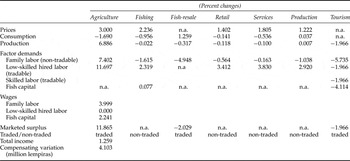
Recent agricultural price increases result from increases in the price of African palm and decreases in transportation costs. We simulate a 3 per cent increase in the price of agricultural outputFootnote 13 and find that family labor leaves the fishery to take advantage of the higher agricultural price, but hired labor from outside the communities enters the fishery to exploit the increased local demand for fish. The increase in outside labor represents a pure demand effect while the decrease in local labor is the result of both a production and demand effect from the non-traded input. The increase in agricultural price increases local land rents and causes an increase in labor demand in the agricultural sector (table 1, column 1), which pulls family labor out of the fishery and puts upward pressure on incomes. This increases the local demand for fish, pushing the price of fish upward.
Three percent increase in agricultural output price

The demand effect, in turn, pulls some of the family labor back into the fishery, but not enough to cancel out the initial production effect (column 2). More fishermen come from outside the community, as returns to fishing increase and fewer local fishermen leave the fishery than would without the demand effect. Overall, there is less fish production than before the price change ( table 1 ), implying an increasing stock of fish.
In this empirical exercise, a hybrid of scenarios 2 and 3 above, the increase in agricultural price leads to more labor in agriculture, but a supply of labor from other areas allows increased hiring without increasing wages for hired labor (consistent with scenario 3 above). This means labor can increase in the fishery as returns to fishing increase. Because agriculture in the Tela Bay area is labor intensive, the increase in output price causes landowners to hire extra labor from outside the communities to increase production. Over the past several years, many farmers have shifted from subsistence production of corn and beans to production of African Palm with more hired labor.
3.7. The importance of market structure
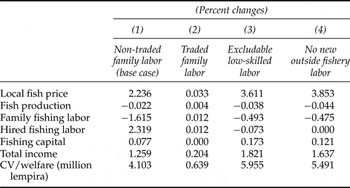
The results are different under alternative assumptions concerning market structure. Three cases relevant to the JKPI communities are simulated for comparison. First of all (column 2 of table 2 ), if park boundaries are not well enforced, family labor could become tradable, meaning an exogenous wage for family labor as outsiders move in. This scenario corresponds closely to modeling scenario 3. As expected, the demand effect dominates; agricultural price increases result in an increase in fishing and a decrease in the steady-state fish stock.
Comparison of fishery impacts under different market scenarios

Because the communities are located within national parks, it may be desirable to limit the number of people from outside who can use the resources of the park. One possible scenario would be to restrict new low-skilled labor from entering the parks (column 3). Restricting the community labor supply allows the production effect to dominate the demand effect even more than in the base case. Scarce labor means that landowners must bid workers out of the fishery. This results in higher community wages and less fishing effort. The increased wealth leads to a small local fish-price increase, but it is not enough to fully counteract the production effect pulling labor out of the fishery. This scenario (like the base case) counterintuitively results in fish price increases and a decrease in production of fish. While this is unexpected in partial equilibrium models, the general equilibrium framework explains why this would occur. This scenario suggests that there may be both environmental and (local) economic gains to limiting the number of people eligible to work and fish within a national park.
Another policy regarding access to park resources might be to restrict hired labor in the fishery to not exceed current levels (column 4). This policy achieves all the reduction in fishery effort that occurs when excluding all new labor from the park. As a result, fish stocks improve in the long run, and at the same time agricultural producers increase production by hiring labor from outside the communities.
Sensitivity analysis found that these results are generally robust to changes in parameters including the elasticity of input supplies and contribution of fish stock to fish production. This information is available upon request.
4. Discussion, policy implications and caveats
The localized general-equilibrium approach offers insights into the incentives that current and potential fishermen face and the potential impacts of agricultural price changes on fishing. In the context of the Northern Honduran Fishery, agricultural price increases result in a slight reduction in effort allocated to the fishery. The reduction is mitigated by labor entering from outside JKPI. Less effort means a higher steady-state fish stock.
With an agricultural price change, limiting the amount of labor entering the economy from outside can augment the local benefits associated with the price change. As seen in table 2, community welfare increases more with limited labor than when labor can be hired from outside the economy.Footnote 14 With limited labor, wages increase more in the community economy and the fish stock in the lagoon increases, leading to a higher average product of family labor in the fishery.
A direct policy deriving from this result is to craft ways to exclude labor from outside the national parks or Tela Bay area. For example, local communities could charge outsiders a boat-launch fee. Revenues from such initiatives could help maintain infrastructure in the communities and facilitate enforcement. A more extreme policy might include the national government giving exclusive use-rights to the national park communities. This is a challenging policy to implement, as Honduran law currently considers the country's fish resources as patrimonio nacional and cannot restrict access rights to fisheries.
While this modeling framework provides useful insights, it has a few shortcomings. First of all, we have modeled the communities with a representative consumer and thus do not fully capture the distributional implications of price changes. In a more heterogeneous world, winners and losers emerge as local prices increase and decrease. An agricultural price increase might help farmers while hurting households that buy agricultural output. A more complete disaggregation of communities into different household types may reveal more about the distribution of impacts discussed in this paper. We leave this exercise to future work.
The results of our analysis turn on the existence and strength of economic linkages reflected in the SAM. In reality these linkages may be stronger or weaker than assumed in this modeling exercise. Fishermen may resist transitioning into other sectors. On the other hand, fishing is a dangerous and volatile income source, and the prospect of better-paying, more stable jobs might quickly pull people out of this activity. Different economic activities may be carried out at different times of the year, and intra-annual variation in labor demand may diminish the ability of one sector to draw labor from another. Future empirical work aims to identify the existence and strength of linkages between other-sector price changes and natural resource use.
A final concern is the land-use implications of higher agricultural prices. We model agricultural land as fixed, given that it lies within a national park. This assumption relies on the ability of national park officials to successfully contain encroachment into the park from private farmers. Otherwise, the forest resources of the park will face increased pressure. In addition, large-scale agriculture like palm plantations use chemical pesticides and fertilizers, which may cause harm to local forest and marine ecosystems. Local governments must create and enforce rules limiting the use of harmful chemicals in or near the national parks.
This exercise has shown the potential to improve livelihoods and conserve fish stocks but has not shown a way of achieving a first-best result, which would equalize the marginal product of effort in the fishery with its opportunity cost (e.g., the wage in agriculture). Achieving this would require accounting for the contribution of the fish stock to current and future production. Agricultural price changes can draw labor out of an open access fishery, but labor may move in from outside to fill the gap. The capacity to exclude future users may represent an important first step towards addressing the TOC (and allow current fishermen to more easily rationalize the fishery).
In the long run, achieving efficiency will require reducing current users' incentives to over-fish as well, e.g., by rationalizing the fishery through tradable quotas or exclusive use-rights granted to a cooperative of fishermen. Other informal institutions may perform similarly. A key concern in this area includes the distribution of the resource rents created as a result of rationalization. Ensuring the rents reach broadly into the communities goes hand-in-hand with the creation and maintenance of these institutions. In the future we plan to extend the current model to simulate privatization and its potential impacts on the level and distribution of community wealth.
The current model could be used to simulate impacts of price changes in other sectors, including tourism. Tourism development could reduce pressure on the fishery in the short term as fishing capital (boats) is diverted to tourism activities. In the case study examined here, tourists are transported to the national parks from Tela in boats, creating a new use for boats traditionally used for fishing.
5. Conclusion
In this paper, we show theoretically how economic linkages connect an open access fishery to the rest of a developing economy and explain how the existence and strength of these linkages depend on market structure and on whether prices are endogenous or exogenous to the local economy. If all prices are determined exogenously, there are no local linkages between sectors. On the other hand, if transaction costs create isolated markets, endogenous prices and wages can form linkages between the resource and other sectors. In this context, price changes in other sectors have ambiguous impacts on effort allocated to an open access fishery. The net impact depends on the relative strength of two effects that pull in opposite directions.
The findings from our general equilibrium model demonstrate the consequences of agricultural price changes brought about by globalization for an isolated open access fishery in Northern Honduran coastal communities. Agricultural price increases can pull local labor out of the open access fishery, but this effect is mitigated by an increasing local price for fish and labor entering the fishery from outside the community. In the case modeled here there is a slight reduction in total fishing effort, implying a higher steady-state fish population.
Findings from this Honduran case study highlight pathways through which agricultural market integration can influence resource stocks when some factors of production have limited supplies. Providing resource users with alternative labor opportunities can reduce incentives to drive resources to low levels. On the other hand, increasing demand for open access resources can accelerate the depletion of those resources, especially if outsiders have easy access to the resource.
An important contribution of this paper is the generation of hypotheses regarding the strength and qualitative nature of economic linkages between open access fisheries and other sectors, including agriculture. These hypotheses can provide a basis for future fieldwork to test impacts predicted by the general equilibrium model. Our findings point to the importance of collecting data with cross-sectional variation in economic variables together with time-series data on fish biology and prices. Collecting these data in developing country fisheries would facilitate a more accurate calibration of models for economy-wide impact analysis in economies with open access resources. This would lead to a more reliable description of how open access fisheries fit within broader, local economies.
The results of this paper demonstrate the importance of considering general equilibrium linkages when studying developing-world renewable resource sectors. We show how price changes that result from agricultural market integration impact the welfare of local, open access fishermen. We also discuss the implications of this for the conservation of fish stocks. The modeling exercise highlights the market structures that most favor drawing natural resource users out of an open access resource sector by creating employment alternatives. Establishing use-rights alongside integration can lead to larger gains in the short run and potentially lower the costs of implementing a first-best management policy in the medium term.
A better understanding of how resource users decide to extract a resource permits identification of the impacts of market integration and price changes in other sectors. Micro general equilibrium modeling can differentiate between areas where both environmental and economic gains are possible and those where economic development is likely to further erode environmental resources. This could focus sustainable rural development efforts on economies with open access resources in which there is space for both environmental and economic gains for resource users. Conventional management policies could then concentrate on areas where development will lead to increased pressure on local resources.
Appendix A: A long-run model of a dynamic fishery system
Given a Shaffer production function for fish in time t,
 $$q_{F\comma t} = qL_{F\comma t}x_{t}\comma \;$$
where q F, t is the quantity of fish caught in time t, x t is the level of fish stock in t, and q is a catchability coefficient. The fish population exhibits logistic growth of the following form:
 $$x_{t + 1} = x_{t} + rx_{t} \left(1 - {x_{t} \over K} \right)- qL_{F\comma t} x_{t}$$
where r is the intrinsic growth rate of the population and K is the carrying capacity. And the steady-state level of fish comes from setting x t+1 = x t = x and solving for x:
 $$x_{ss} = K - {qK \over r} L_{ss}.$$
Substituting this level of x back into the original production function gives this steady-state production function:
 $$\eqalign{q_{F\comma ss} & =qKL_{F\comma ss} - {q^2 K \over r} L_F^2 \cr & = mL_F - {1 \over 2} nL_F^2}$$
where m = qK and
 $n = 2{q^2 K \over r}$
.
Appendix B: Description of fishery calibration
The true fishery production function takes the following form:
 $$q_f = A_f L_f^{\alpha_f} K_f^{\beta_f} R_f^{\delta_f}\comma \; \alpha_f + \beta_f + \delta_f = 1\comma \;$$
but we only observe the value paid to labor and capital. The shares of family and hired labor in the fishery production function are not statistically different so, for conciseness, we present labor as one factor. This represents the factor demands and gives their share in production. We specify δ F = 0.4 in the base model. Therefore, we only have information on the diminishing returns production function:
 $$q_f = A_f L_f^{\alpha_f} K_f^{\beta_f}\comma \; {\alpha_f + \beta_f \over \alpha_f + \beta_f + \delta_f} = \gamma_f = 0.6.$$
This implies the following about how the unobserved, and unaccounted for, resource level enters into the value of production:
 $$\eqalign{&P_f^{VA} q_f = P_f^{VA} A_f L_f^{\alpha_f} K_f^{\beta_f} R_f^{\delta_f} \cr &{P_f^{VA} q_f \over R_f^{\delta_f}} = P_f^{VA} A_f L_f^{\alpha_f} K_f^{\beta_f} = \gamma_f P_f^{VA} q_f \cr &{1 \over R_f^{\delta_f}} = \gamma_f\comma \; \, so\, R_f^{\delta_f} = {1 \over \gamma_f}.}$$
Also, we can determine the value-added price by subtracting the value of inputs from the value of total output. Given this, factor demands do not simply equal the exponent on that factor times the value-added value of production divided by the price of the factor, as in the constant returns (CRS) case. Instead, for labor,
 $$\eqalign{L_f^{\ast} &= \left({w_{L} \over \alpha_f P_f^{VA} A_f K_f^{\beta_f} R_f^{\delta_f}} \right)^{\left({1 \over \alpha_f - 1} \right)} \cr L_f^{\ast} &= \left({w_{L} \gamma_f \over \alpha_f P_f^{VA} A_f K_f^{\beta_f}}\right)^{\left({1 \over \alpha_f - 1} \right)}}$$
and similarly for capital,
 $$K_f^{\ast} = \left({w_{K}\gamma_f \over \beta_f P_f^{VA} A_f L_f^{\alpha_f}} \right)^{\left({1 \over \beta_f - 1}\right)}.$$
These two factors combine to determine the fishery output. Notice that the industry does not appropriately account for the true opportunity cost of labor and capital, as the wage is given only the weight of observed factors in the CRS production function. The sector experiences diminishing returns to scale and the decision makers do not appropriately account for this and so achieve an inefficient amount of effort allocated to production. In this way, this method captures the TOC market failure that results because no property rights exist over the fish in the sea, which represent an important input to production.