Introduction
Since the late 2000s, first the economic crisis and later austerity plans have put under stress many European welfare states. Among them, the Italian one has gone through several deep policy changes (Guillén and Pavolini, Reference Guillén and Pavolini2015). Along with pension and labour market reforms, the last decade witnessed a lively debate on social assistance (anti-poverty monetary protection and basic social services for individuals at risk of poverty – e.g. shelters, meals, etc.) and migration policies (the rules adopted to allow foreign migrants to become resident in Italy and the type of support provided by the state to irregular migrants). Traditionally, Italy has had a minimal public model of intervention in social assistance both in terms of expenditure and coverage with no national minimum income scheme until recently (Kazepov, Reference Kazepov, Ascoli and Pavolini2015). Policy inaction has historically characterised migration policies as well: amnesties for irregular foreigners were enacted regularly over the last three decades; meanwhile, the country was not able to develop a clear idea of how to regulate migration flows and what role migrants should play in Italian society and economy (Barberis and Boccagni, Reference Barberis and Boccagni2014).
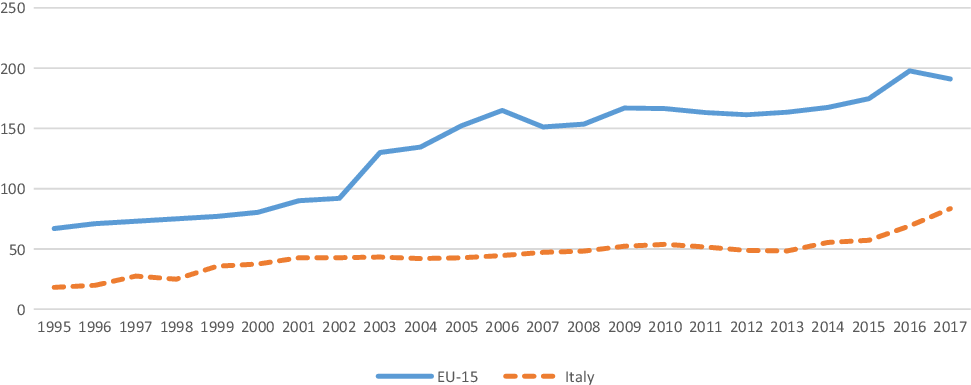
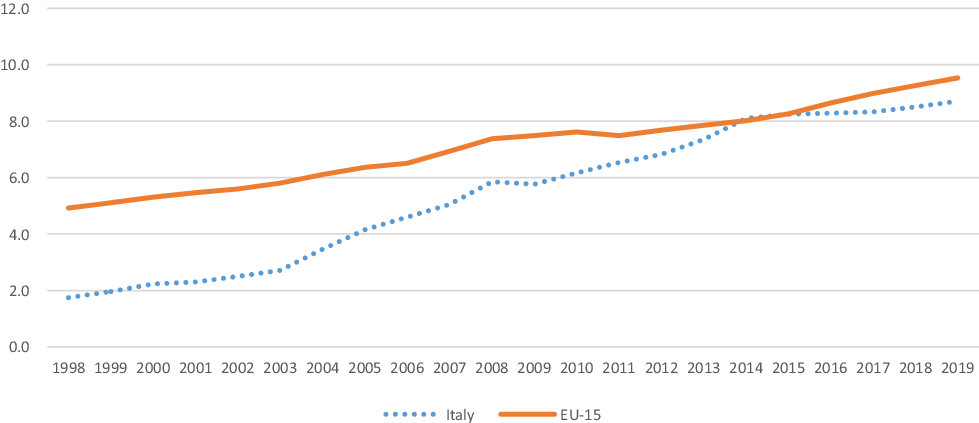
Figures 1 and 2 provide basic information on both phenomena studied in this article. The per-capita public expenditure on social exclusion in Italy has been traditionally much lower than in the Western part of the European Union (EU-15) (Figure 1). In particular, between 1995 and 2016, Italy spent in terms of purchasing power parity at the per-capita level between a quarter and a third less than what it was spent in the EU-15 (data not reported in the figure). Migrants were still relatively few at the end of the 1990s in Italy, but their number started to grow very rapidly and they reached the EU-15 average level in the middle of last decade, representing almost 9 per cent of the total resident population in 2019 (Figure 2).
Per-capita public expenditure on social exclusion in Italy and the EU-15 (euros constant prices 2010) (1995-2017)
Source: Authors’ elaboration on Eurostat online database (indicator: migr_pop2ctz)

Share of foreign born individuals living in Italy and the EU-15 over time (% of total population; 1998-2019)
Source: Authors’ elaboration on Eurostat online database (indicator: migr_pop2ctz)

It is within this social and policy context that in the last years, mostly 2015, the issues of social assistance and migration policies came to the forefront not only in the social policy arena but also in the more general public debate. Two populist movements, the Five Stars Movement (5SM) and the increasingly radical-right League, became advocates of interventions in this policy arena: the former in favour of universal coverage against poverty; the latter in favour of a strict and harsh migration policy, limiting as much as possible new arrivals. Apart from political parties, another actor was a protagonist in this policy arena, debating social assistance and migration policies: the Italian Catholic Church (CC). In the present article, when we use the term CC, we refer to both the catholic hierarchy in Italy (the Vatican and the CEI – the Italian Bishops’ Conference) and its main branches. In particular, the CC’s most important branch in relation to social assistance and interventions in favour of migrants is Caritas Italiana.
The CC plays an important role in Italian society (Cartocci, Reference Cartocci2011). Based on the last available European Value Survey data, 77 per cent of Italians declared in 2017 that they were religious and most of them defined themselves as belonging to Catholicism. Moreover, Italy is one of the countries with the highest share of individuals attending regularly religious services (25 per cent at least once a week) and there were relatively few people (28 per cent) attending services very seldom or not at all. In terms of resources, the CC in Italy is a very complex, vast and deeply-rooted organisation: there are around 25,600 parishes, 227 dioceses, 13,000 priests (Chiesa Cattolica, Reference Chiesa2020); regular churchgoers are estimated as more than 13 million out of a total population of 60 million inhabitants. Moreover, there are thousands of civic society organisations, which state they have Catholic origins (9,000 organisations of volunteers out of around 45,000 declare they have stable contacts and collaborations with Catholic institutions – Ascoli and Pavolini, Reference Ascoli and Pavolini2017), and around 2 million volunteers in associations declare being at the same time catholic and participating regularly in Church services. Caritas Italiana, the CC branch dedicated to social assistance, has more than 3,300 local ‘Centres’ spread around the country offering shelters, food, psychological and economic support (Caritas, 2018).
Over time, not only the CC role but also its position toward social assistance has changed: from criticising openly state intervention to joining other social actors in advocating for the expansion of public coverage. This change has been particularly visible since the onset of the 2007-08 crisis. The CC, as a whole, has played a prominent role also in relation to the debate concerning migration policies. Moreover, in times of increasing aversion towards migrants (in particular, asylum seekers, irregular migrants, refugees, etc.), the CC has become one of the few core actors in Italian society advocating explicitly for recognising their rights to be assisted and allowed in the country, and criticising more openly than many others how governments deal with migration policies, coming often to clash publicly with the populist parties mentioned above, especially the League. In this respect, the core theoretical argument of the present essay is that churches’ positions in social policy should not be considered as fixed over time, but, instead, subject to deep, usually incremental, changes. In order to grasp these transformations and how they take place requires adopting an historical perspective, looking at institutions and interests, but also at ideas.
In order to verify the above argument, the article tracks how the CC positions on both migration policies and social assistance have changed over the last 160 years, identifying three different historical phases. The following two sections present first the methodology used and then an interpretative framework in order to explain how and why the changes have occurred. The latter sections describe the CC actions over time and how we can interpret them.
The methodology
The article is based on three sources. First, it uses previous research, also by the article’s authors, on the topics analysed here especially in order to reconstruct the transformations that took place over time. Second, it takes into consideration statistics (mostly from Istat, 2020 and Eurostat, 2020, respectively the Italian and the EU official statistical institutes) and policy documents produced in the last decade on the topics analysed in the present contribution. Third, in order to reconstruct the most recent developments, it uses a content analysis of the main official Catholic newspaper in Italy: ‘Avvenire’, owned by the CEI. We analysed the newspaper’s articles between January 2017 and Summer 2019. This is the period when the Parliament passed a crucial law on social assistance, introducing for the first time a universal public minimum income scheme at the national level, and migration policies became a central and very heated issue in public debate. The period covers the last year of the Centre-Left government (2017-early 2018) and the following year and half of the first populist Italian government (early 2018-Summer 2019). The populist government included the 5SM and the League. The aim of the analysis was to focus on the official CC’s position on social assistance and migration policies. We found fifty-six articles on the CC positions on these topics: forty-nine of them concerned migration and seven dealt with social assistance.
Italian Catholicism and social policy: taking a long-term view
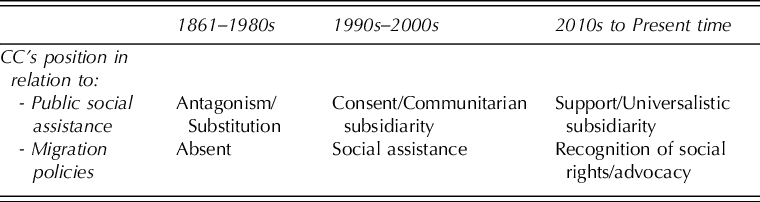
Taking a long-term view over the CC’s role in relation to the Italian social assistance system and migration policies, three different historical phases can be identified (Table 1). The first and longest one covers around 130 years, starting with the creation of an Italian national state in 1861 to the 1980s. The second phase started in the 1990s and it covered around two decades. The third phase goes from 2010 to present.
The Catholic Church, social assistance and migration policies in Italy over time

From the Italian re-unification until the 1970s
CC’s antagonistic approach to public social assistance characterised the first phase. The CC played a quasi-monopoly role in services’ delivery in these fields. Since the creation of the Italian state in 1861 and for a long time, social assistance and social services were mostly delivered by charities connected to the CC (the so-called ‘Opere Pie’), with the state playing a very limited role (David, Reference David and Ascoli1984). The early national legislation brought in by the newly created Italian state made it clear that it did not want to enter into conflict with the Church that ran and controlled the charities (Fargion, Reference Fargion1997). Until the end of the century, the dominant idea was that the CC charity system offered such potentiality that it exonerated the State of financial commitment. Fascism continued this tradition and gave considerable autonomy to Church charities (Ascoli and Arlotti, Reference Ascoli, Arlotti, Manuel and Glatzer2019). The system of social assistance inherited from the Fascist period was the base of the social protection system established after World War II and during the ‘Glorious Thirty’ (Madama, Reference Madama2010). It was only in the 1970s and, particularly toward the end of that decade that a new public commitment toward public social assistance vices was developed (David, Reference David and Ascoli1984). However, the strong opposition of many religious institutions to a stronger public commitment, supported also by the centrality and strength of the main (Catholic) party in Italy, the Christian Democracy (DC), inhibited for many years the approval of a national framework on social assistance (Madama, Reference Madama2010; Ascoli and Arlotti, Reference Ascoli, Arlotti, Manuel and Glatzer2019).
During all this first phase, migration policies were not on the agenda for a very simple reason: from a demographic point of view, migration toward Italy from outside Western European countries remained quantitatively limited until the end of the 1980s.
From opposition to consent in the 1990s and the 2000s
The long-established Church position toward public social assistance began to change at a faster pace starting in the 1990s. From an antagonist approach to public intervention, consent to the role of public social assistance became the new position. The key concept increasingly used in official CC documents was subsidiarity (Colozzi, Reference Colozzi2012). The approach and the specific meaning given to subsidiarity were in this second phase a communitarian one, referring to the idea (typical of other countries where the CC played a role within a religiously pluralistic society, such as the Netherlands or Germany), the state should provide resources and then leave room to local civic society in order to provide answers to social needs. However, within this idea of communitarian solidarity there was not really a focus on citizenship and social rights.
Looking at social assistance, the 1990s and 2000s were years when there were many new initiatives by local authorities, regional ones and the third sector, thanks to the diffusion of new voluntary organisations (Ascoli et al., Reference Ascoli, Ranci, Pavolini, Ascoli and Ranci2002). The number of individuals joining voluntary organisations went from 3.4 million in 1993 to 5.7 million in 2018 (in terms of share of population respectively around 7 per cent and 10.5 per cent). Catholic activism in the field of social assistance and social services renewed especially in the wake of a growing expansion of volunteerism. Within the volunteers’ world, regular worshipper Catholics (defined as those attending at least weekly to religious services) played a very important role: around 46 per cent of all volunteers were in 1993 regular churchgoers; this share went down to 40 per cent in 2018 (Ascoli and Pavolini, Reference Ascoli and Pavolini2017). At the same time, the increase in the number of people volunteering meant that Catholic volunteers were around 1.6 million in 1993 and 2.3 million in 2018.
Indeed in 2000, after many years of debate and strong political conflict, the Italian Parliament passed the national framework law on the integrated system of social services (Law 328/00). This law contained an extended subsidiarisation of social assistance, both between the state, regions, and local authorities and between public and private (non-profit and for-profit) actors. The approval of a good part of Catholic institutions helped to pass the law (Ascoli and Arlotti, Reference Ascoli, Arlotti, Manuel and Glatzer2019).
This new activism by local authorities and non-profit organisations was also the result of the emerging and progressive diffusion of new social risks in the Italian society, including (irregular) migrants, especially since the second part of the 1990s (Bassi, Reference Bassi2014). In fact, Catholic institutions such as Caritas, as well as non-profit organisations with a Catholic inspiration, were at the forefront of intervention in the field of social assistance to migrants already in the 1990s, when migration started to become a structural facet in Italian society (Caritas Migrantes, 1993; see also Figure 2). Especially in the richer part of the country (Centre-Northern Italy), poverty decreased during the 1990s to relatively low levels among native Italians. At the same time, poverty problems were more common among migrants. Therefore, in the 1990s social assistance services (shelters, meals, etc.) were in a large part of Italy a policy area mostly involving intervention in favour of migrants (Itçaina, Reference Itçaina2014). In this phase, assisting foreign migrants was the CC approach, thematising the issue not in terms of rights but mainly of ‘social duty’ toward those in need, which happened to be increasingly foreign migrants.
The 2010s: Italian Catholicism and social policy in times of (right-wing) populism and increasing social needs
The last decade discussed in this article witnessed many changes in Italy. First, a massive rise in social needs, due to the economic crisis. In the European context, Italy was among the countries most severely affected by the impact of the great economic recession since 2007. Consequently, there was a structural increase in poverty and deprivation. The number of individuals in relative poverty went from 6 million to 9 million (26 per cent of the total population) (authors’ elaboration on I.stat online database http://dati.istat.it/). This phenomenon hit the whole country: there was for the first time in decades a high diffusion of poverty even in the wealthiest regions. Second, the absence of an adequate social assistance system reinforced the negative effects of the crisis on the expansion of poverty and social exclusion. Until 2017, there was no general minimum income scheme at the national level. Moreover, severe austerity measures introduced during the crisis implied draconian reductions in financial transfers from the state to local authorities, which bear the responsibility to provide social services (Guillén and Pavolini, Reference Guillén and Pavolini2015; Pavolini et al., Reference Pavolini, León, Guillén and Ascoli2015). Third, after the collapse of the Libyan regime with the death of Muammar Gaddafi in 2011 and the civil war that broke out afterwards, a new flow of irregular migrants started to arrive from Libya to Italian coasts. If around 20 thousand people came by boat in 2007, the number of landings reached 181 thousand in 2016. The sudden rise of landings in only a few years became a central issue in the Italian political debate, especially thanks to right-wing parties, in particular the League, which were able to transform this issue into the pivotal one in Italian political debates (the phenomenon was defined as ‘the invasion of Italy’).
It is within this context that the Italian CC’s positions on social assistance and migration policies have to be framed. Since the beginning of the last decade, Catholic welfare organisations have increasingly pressed on the central government to introduce a universal minimum income scheme in order to cope with the structural expansion of poverty and deprivation in Italy. In 2013, two of the most important Catholic organisations, Caritas and Acli (the Christian Associations of Italian Workers), promoted an intense mobilisation on this topic calling many other civic society organisations (including also the main trade unions) to join and forming the ‘Alleanza contro la povertà’ (Alliance against poverty – AAP; see here: http://www.redditoinclusione.it/il-patto-aperto-contro-la-poverta/presentazione-alleanza/). AAP has been since then a wide political platform in which more than thirty (religious and non-religious) organisations, engaged in the field of poverty and social exclusion, have become involved in order to sensitise public opinion and to develop a proposal aimed to introduce a new universal minimum income scheme (Alleanza contro la povertà, 2015). The national government took (partially) into consideration the AAP proposal, when it drafted and introduced in 2017 a national minimum income scheme. Moreover, the central government and the AAP signed a specific memorandum in May 2017, regarding the main steps for the implementation of this new public programme.
In relation to this policy process, the CC strongly supported the AAP’s proposal for the introduction of a universal measure to combat poverty; as stated, for example, by the then President of the CEI, Bagnasco – ‘it seems necessary to pay the utmost attention to the attempt to introduce a universal programme to combat poverty and to the development of a National Plan against Poverty’ (Avvenire, 2017a). In the same vein, the then secretary of the CEI, Galantino declared: ‘The bishops raise their voices in order to ask for a National Plan against Poverty … if politicians will not adopt measures to help families in need, they will pave the road to Populist Parties’ (Avvenire, 2017b).
The last sentence pronounced by Galantino introduces another important stand made in recent years by the Italian CC: its opposition to populism and its position in favor of migration policies that would allow welcoming more migrants in Italy than the policy of closing borders proposed by populist parties. The Church position on migrants has come at times when many Italians are not in favour of new migrants. For instance in 2016, 58 per cent of Italians agreed in the European Social Survey that the country should allow few/no migrants from different ethnic/race groups. The general position of the Church on the issue of migration can be summarised through two concepts: openness and critique to nationalism/xenophobia. As stated by the current President of the CEI Bassetti: ‘the concept of charity has to be understood in opposition to the arguments of those who play with fears. We must avoid in all possible ways that a sort of “war between poor people” spreads’ (Avvenire, 2017c: 2). The issue of policies accepting and welcoming migrants is highly explicit also in the Vatican’s declarations. In this respect, the current Pope has made unambiguous his support to refugees, asylum seekers and migrants in general. The Pope used four basic verbs to testify the CC position on migration in the context of the celebrations for the 104th World Day of Migrants and Refugees in 2018: ‘to welcome, to protect, to promote, and to integrate’ (Avvenire, 2018a: 2). Not only Pope Francis spoke but also acted accordingly in order to make clearer his message. For example, the first visit of Pope Francis in his papacy in 2013 was to the Sicilian island of Lampedusa, which represents one of the main landings of irregular migrants trying to arrive by boat to Italy. Moreover, the same Pope took back some migrants with him on his plane back to Italy after a visit to the Greek island of Lesbos.
In general, the CC declared on many occasions the intention not to abdicate its guiding role but rather to affirm an alternative strategy to the populist and nationalist-xenophobic one on migration policies. The president of the CEI, Bassetti declared: ‘Unfortunately, there is an increasing refusal against migrants arriving in our country. The economic crisis fuels such refusal and demagoguery amplifies it. The migrant-criminal equation, also proposed by the media, is not only a falsehood but also a prejudice rooted in selfishness. It is necessary to overcome indifference and put a generous welcoming attitude before fears. The Italian Church does not mind receiving criticism for its ideas’ (Avvenire, 2017d: 5). Similarly, the CEI permanent council stated in 2019: ‘Even at the price of losing a certain degree of popularity, the Church feels the need to actively contribute to a culture of integration, as well as overcoming indifference in the face of the tragedy of those who disappear in the Mediterranean or are tortured in the refugee camps of Libya’ (Avvenire, 2019).
Overall, a critical stance has characterised the CC’s position with respect to migration policies of recent governments. The catholic critique to recent ‘law-and-order policies’ has come mainly through the mobilisation of the large world of associations and Catholic organisations committed on the issue of migration (e.g. Caritas, Migrantes Foundation, etc.). The Church criticised strongly the Italy-Libya agreements, signed by the centre-left government in 2018 and aimed at curbing immigration, keeping many migrants in Libya (Avvenire, 2017e). Furthermore, the ‘safety’ decrees of the then Gentiloni government received strong criticisms. According to Caritas, once again the migration issue was ‘framed according to a safety perspective which for us, at this stage, is not a priority’ (Avvenire, 2017f). The critical position of the Church continued and became even stronger with the advent of the populist government in 2018 (formed by the 5SM and the radical right League), when the government’s declarations and its willingness to ‘safeguard Italians’ against migration became explicit. The last Catholic attack came a few months before the populist government collapsed. The critique was for the so-called ‘safety’ bills of 2018-19, which according to Caritas went ‘in the direction of closure, focusing on expulsion and making integration difficult, instead of investing in social integration’ (Avvenire, 2018b).
How to explain continuities and changes in the Italian CC approach to social assistance and migration policies?
The CC has taken in recent years a strong explicit position in favour of universal social assistance policies, departing from its previous positions, and of migration policies more open to accept and to welcome migrants than the ones advocated by many political parties. How can we explain these choices?
When looking at public policy arenas, the understanding of actors’ decisions and policy outputs usually follows one or more of the following macro-explanations: interests, institutions, and ideas (Béland and Cox, Reference Béland and Cox2010). Actors have (material) interests in maintaining a given policy status quo or in trying to subvert such a status quo and they will act accordingly. However, an explanation based only on interests such as the one briefly sketched here falls short in two respects. First, actors are constrained in a given policy arena by the ‘rules of the game’ (the institutional setting regulating a specific policy field), which usually push for path dependent policy change. Second, using interests as the main explanation requires a strong assumption: actors must have clear and stable interests and develop accordingly strategies to pursue them. The historical institutionalist critique to an interests-based explanation tackles the first issue just raised. Institutions (i.e. routine rules, conventions, and practices) tend to bind actors, constraining their behaviours and choices, even when they would prefer different policy outcomes (Pierson, Reference Pierson1996). Most explanations adopt interests or institutions to explain policies. However, coming to the second issue raised above, an increasing number of studies has also taken into consideration the role of ideas, mostly not as an alternative explanation to interests and institutions but as a complementary one to them (Béland, Reference Béland2005, Reference Béland2009). Adopting a perspective considering also the role of ideas means arguing that actors do not necessarily have a fixed and clear set of preferences and interests. Instead, interests are not static or purely objective but related to the perceptions of actors as well as their institutional position. In other terms, preferences are socially and politically constructed and reshaped over time: ‘Ideas are constantly in flux, being reconsidered and redefined as actors communicate and debate with one another. Political action is motivated by ideas, but the goals people articulate and the strategies they develop have feedback effects that further shape their original ideas’ (Béland and Cox, Reference Béland and Cox2010: 2).
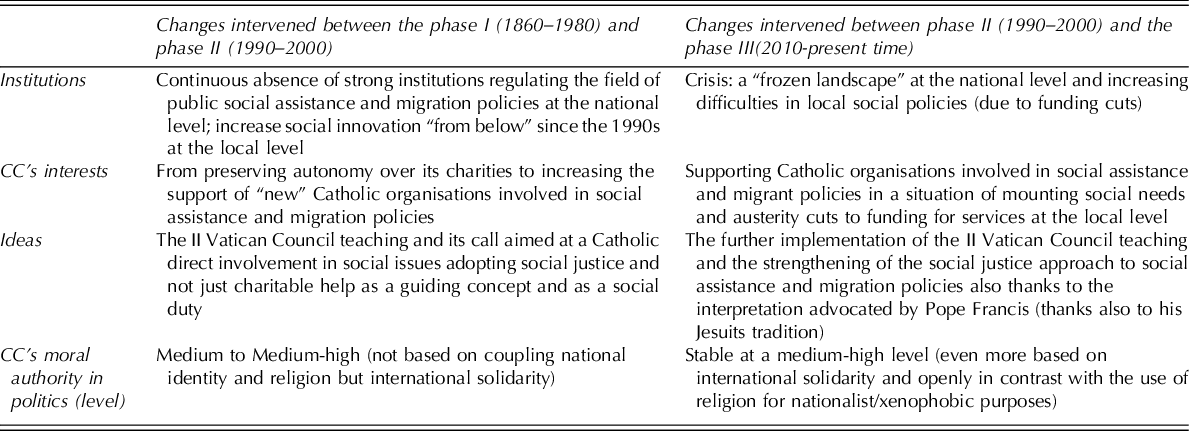
Generally, institutions’ and (Churches’) interests are the typical explanation adopted to interpret actors’ behaviours and policy outcomes in most of the literature studying the role of religious organisations in social policy in the North American and European context (Manuel and Glatzer, Reference Manuel and Glatzer2019). Following this approach, churches align with political parties or put pressures on political and social actors in order to get their interests through. Ideas play a role in this framework only as (fixed over time) theological principles guiding religious actors (organisations and individuals) (Pavolini et al., Reference Pavolini, Béland and Jawad2017). For instance, in order to explain how Church-State relations and social policies differ between countries, this literature focuses on the theological differences between Catholicism and Protestantism, and within Protestantism, and how they interact with political parties’ competition and structure (Manow and Van Kersbergen, Reference Manow and Van Kersbergen2009; Manow, Reference Manow2015). However, Churches’ positions can change over time and the theological interpretation of how ‘good’ believers should behave in relation to social policy issues can be a contested terrain and open to disputes and changes over time. Therefore, following Béland and Cox, we adopt here an approach that simultaneously uses the concepts of institutions and interests, although framing them in a constructivist way and thereby introducing the role of ideas in the explanatory model. In particular, we look at four facets and how they have changed over time, following the distinction into three historical phases adopted in the previous section (see Table 1): the potential interests the CC has in Italy in relation to social assistance and migration policies; the institutions regulating these policy fields; the type of ideas about policies developed by several actors within the CC, and, connected to this dimension, the CC’s ‘moral authority’ in politics, adopting the definition provided by Grzymala-Busse (Reference Grzymala-Busse2015). We argue that a mix of contextual elements and long-term transformations over decades can help to understand the CC positions and how they have changed over time (Table 2).
The Catholic Church, social assistance and migrant policies over time in Italy: institutions, interests, moral authorities and ideas

Institutions
The CC acted in an institutional environment characterised traditionally by low state involvement in social assistance. Until the recent reform introducing a national minimum income programme in 2017, social assistance was relatively underdeveloped in Italy especially compared to other Western European countries (Jessoula and Madama, Reference Jessoula and Madama2018). However, something has changed since the 1990s in Italy thanks to the diffusion of social innovation practices (Ascoli and Pavolini, Reference Ascoli and Pavolini2015): many local and regional authorities started to develop their own local programmes, usually in collaboration with the third sector. In other terms, the shift from phase I to phase II meant: no changes in (absent) national policies, but increasing active and innovative experiences at the regional and local level, also thanks to decentralisation reforms that provided more autonomy since the 1990s to sub-national tiers of government (Kazepov, Reference Kazepov2008). The shift from phase II to phase III brought further change. The national level remained ‘frozen’ (until the 2017 reform). Meanwhile social innovation in many local and regional authorities collapsed: the crisis and the austerity cuts reduced enormously the funding to local authorities and their ability to intervene in these two policy areas, as underlined in the previous section.
Interests
Traditionally one important interest for the CC in social assistance was to preserve the autonomy its charities had enjoyed over centuries. However, the passage from phase I to phase II witnessed a transformation in the nature and characteristics of catholic organisations in social assistance and migration policies. Increasingly Caritas and recently founded non-profit voluntary organisations, created mostly since the 1980s and 1990s, started to substitute century-long charities active in social assistance. These new organisations were often working closely and in collaboration with local and regional authorities in a model much more integrated than the one typical for traditional charities (through contracting-out and joint planning activities) (Ascoli and Pavolini, Reference Ascoli and Pavolini2017). Therefore, supporting the welfare mix and public-private collaboration became more important for the CC than simply advocating for the Charities’ autonomy, because they were somewhat more embedded in contracting-out with public authorities. In this respect, during this II phase there were partially divergent interests within the CC between century-long charities and new non-profit organisations, but the latter were somewhat more active and connected to local communities and public authorities. Moreover, these ‘new’ non-profit organisations were at the forefront of interventions in migration policies, very often supported, if not created, by Caritas.
The shift from phase II to phase III was a continuation of the previous phase, at times when supporting Catholic organisations involved in social policies became even more complicated given the situation of mounting social needs and austerity cuts to local authorities’ funding, which endangered the survival of many of these non-profit organisations. In this respect, it is important to highlight that the AAP proposed to combine income benefits with activation programs, requiring explicitly a role in the programme for third sector organisations, also the religious ones, in the co-definition of goals and provision of (contracted-out) services. In this phase, century-long charities became less and less present and important compared to the grooming of ‘new’ non-profit Catholic organisations.
Ideas
The shift in the CC position on social assistance from phase I to phase II was also the result of the cultural theological debate that led to the II Vatican Council in the 1960s and, even more importantly, of the one that stemmed out of this Council in the following decades. In particular, the CC implemented the II Vatican Council theological message as a call aimed at, on one hand, a Catholic direct involvement in social issues at the local level (Marzano and Pace, Reference Marzano and Pace2013), on the other hand, the promotion not just of social assistance but also of social justice and policy advocacy, as explained in the previous section (Ascoli et al., Reference Ascoli, Ranci, Pavolini, Ascoli and Ranci2002). The II Vatican Council explicitly stated that the CC had the duty to speak out against injustice and to take the voices of the afflicted as her own. The ideas of social justice permeated also CC organisations involved in social assistance, such as Caritas (Pavolini, Reference Pavolini2003). In other terms, the vast new world of catholic non-profit and religious organisations, which took the central stage in the social assistance field since the 1990s, was interested not only in ‘charitable activities’ but also in framing their action in terms of fighting social exclusion and advocating for social justice (Ascoli and Arlotti, Reference Ascoli, Arlotti, Manuel and Glatzer2019). The socio-cultural innovation ‘from above’, thanks to the II Vatican Council teaching, and ‘from below’, thanks to many of these new grassroots catholic organisations (often linked to Caritas), helped slowly but steadily to transform over time how the CC framed social assistance and, as migrants increasingly arrived later on in Italy, migration policies in a more universalistic and progressive direction than in previous decades. In this respect the main ideational change occurred between phases II and I with the II Vatican Council. The later decades were used to develop and to implement the core teaching from the Council. In particular, the step between phases III and II was mainly an incremental one, with an important strengthening factor: the rise to the pontificate of Pope Francis. In this case it is both his personal agency and how he has interpreted solidarity and the CC’s social involvement that are important, as well as the fact that the roots of his theological thinking come from the Jesuits tradition (in Latin America), whose doctrine has been strongly focused on social justice under the leadership of Pedro Arrupe as Superior General in the 1960-70s (La Bella, Reference La Bella2007). Jesuits’ thoughts and also part of the Latin American CC approach to social issues have been the backbone of Pope Francis’s positions on social assistance and migrant policies, framed in terms of social justice. In this respect, his position as Pope is in line with the theological orientation stemming out of the Latin American Bishops Conference’s pastoral work (in particular, the 2007 Aparecida document, led by Cardinal Bergoglio, the later Pope Francis). The Pope’s letter to his ‘brothers and sisters of popular movements and organizations’ on Easter Sunday in April 2020 expresses very well the concept: ‘this may be the time to consider a universal basic wage which would acknowledge and dignify the noble, essential tasks you carry out. It would ensure and concretely achieve the ideal, at once so human and so Christian, of no worker without rights’ (Pope Francis, 2020: 2).
Moral authority in politics
Given the fact that the present article analyses the relationship between social policy, religion and (radical-right) populism, the concept of Church’s ‘moral authority’ in politics, introduced by Grzymala-Busse (Reference Grzymala-Busse2015), becomes very useful when studying religious influence on social policies, because it is strictly connected to the role of power and how social policies are presented by the CC in the public debate. There are several valuable findings in the book for our research goals, even when they do not refer just to Italy but to several North American and European countries. First, Churches gain their greatest political advantage when they can appear to be above petty politics and a Church’s ability to enter corridors of power depends on its historical record of defending the nation:
Conflicts between the “nation” and its secular opponents gave some Churches the opportunity to act as defenders of national identity and cohesion. Where the Church shielded the nation, patriotism became inseparable from religious loyalty. In the course of these fierce struggles national and religious identities thus melded, forging a powerful form of religious nationalism. In turn, the more nation and religion fused as a popular identity, the more Churches gained moral authority in politics: the identification of the Church with national interest, rather than with interests that are purely theological (Grzymala-Busse, Reference Grzymala-Busse2015: 8).
Second, Churches translate religious nationalism and doctrinal convictions into policy depending on their moral authority level: ‘Where Churches have lower or more diffuse moral authority, they could enter partisan coalitions… Those Churches with high moral authority could obtain institutional access – a far more powerful way of influencing politics than either partisan coalitions or relying on diffuse voter demand. Institutional access was largely covert and viewed as non-partisan’ (ibidem: 332).
Where is Italy located according to Grzymala-Busse’s reconstruction? If we adopt the three phases used in the previous section, the first important change in this respect took place in the shift from phase I (1860-1980) to phase II (1990-2000). The CC’s opposition to Italian state unification in the nineteenth century created a disconnection between nationalism and religion, shaping a long-lasting separation between these two concepts. Something very different happened in Ireland or Poland, where the CC fought for national identity and respectively for independence and against communism. Even during a long period of the twentieth century, the CC in Italy was not able to regain this type of ‘moral authority’ in politics. Part of the liberals remained sceptical and suspicious toward the Church and left-wing parties, especially communists (Italy had the strongest communist party in the West), were very critical. Paradoxically the CC’s moral authority in Italian politics increased after 1990 with the collapse of socialism in Central-Eastern Europe (and of the Communist party in Italy), the breakdown of traditional Italian parties due to scandals (including the DC) and the shift to a majoritarian political system. The CC started to be trusted moreFootnote 1 and to act as a neutral and non-partisan actor, opening an intense political dialogue with both left-wing and right-wing parties (Ceccarini, Reference Ceccarini and Haynes2010). In the new majoritarian system introduced in the mid-1990s, the CC influence on catholic voters became even more valuable for parties trying to attract median voters. Furthermore, the CC started to change its public profile. On one hand, it took a strong position in terms of pro-national and pro-state identity, criticising openly the separatist movements from Northern Italy (the party called League, which has become a radical-right and populist one in recent years, was in previous decades a regional/separatist party, called the Northern League), corruption in politics and Mafia’ actions (ibidem). On the other hand, its position cannot be defined as nationalist in the traditional sense: it was only against actors wanting to weaken Italy as a nation state that it rose its voice. At the same time, the CC continued adopting an ecumenical internationalist solidarity approach to migration, declaring that human rights came first (Ascoli and Arlotti, Reference Ascoli, Arlotti, Manuel and Glatzer2019).
The shift from Phase II (1990-2000) to the III phase (the 2010s) did not witness a particular change in respect to moral authority. The critique on nationalism-xenophobia and populism seems to be part of a longer tradition of the CC, which started since the 1990s to actively defend the nation-state and the values of the Republic, as well as international solidarity. In this respect, the confrontation with the League and right-wing populists has become even harsher because, for the first time since the onset of the Italian Republic, there are relevant (in terms of public support) right-wing parties attracting voters and combining nationalism and religion. In other terms, these radical right political parties (the League being the most popular but not the only one) are able to attract many voters and try to ‘compete’ with the CC in terms of declaring they want to protect traditional religious values, and making it a matter of defense of national identity (the ‘Christian-Jewish roots of Europe’). In this respect, these Italian parties follow a strategy adopted already some decades ago in the US by the Republican party (Grzymala-Busse, Reference Grzymala-Busse2015). This strategy is becoming increasingly common also among other radical-right parties in Europe, as the article on France from Peker (Reference Peker2020) shows in this themed section. The result is an increasing cultural-political clash between these new nationalist/xenophobic parties, using religion as a strategic identitarian tool (the League leader M. Salvini has repeatedly kissed the crucifix and the rosary in public as a sign of Catholic devotion), and those Churches, as the Italian one, that have adopted a different model of mixing religion and the idea of the nation.
Conclusions
Churches’ positions in social policy are often described in the literature as fixed over time, especially when looking at the role of the Catholic Church. The article shows that these preferences can change over time and in order to understand if and how these transformations take place requires to approach the issue through a historical perspective and looking not just at interests and institutions, but also ideas and actors reflecting and re-shaping ideas on the role of believers and religious organisations in social policy. The CC continues to play an important role in social protection in Italy toward old needs (social assistance) and new ones concerning foreign migrants, although such role has radically changed over time. The idea of the Italian CC standing against state intervention in social assistance and only being interested in mere assistance to migrants and not also their social rights seems to belong to the past. Nowadays the CC seems keener to build a more universalistic public approach in respect of these needs than simply preserving its sphere of intervention. Changes in interests, institutional legacies, but also ideas and actors fostering them have played an important role in this respect.