INTRODUCTION
Suicide is a common and serious public health issue in the United States and abroad. Accounting for ~37,000 deaths per year, suicide is the tenth leading cause of death in the United States (Murphy et al., Reference Murphy, Xu and Kochanek2012). Among individuals who complete a suicide attempt, ~90% have a diagnosable psychiatric illness, with mood disorders being the most common, particularly major depressive disorder (Mann, Reference Mann2002). There are little data about “failed” or “incomplete” suicide attempts, but most surveillance suggests that the prevalence of non-fatal self-injurious behavior in the United States has increased over the past decade (Brickman & Mintz, Reference Brickman and Mintz2003). Based on three different national surveillance instruments, Claassen et al. (Reference Claassen, Trivedi and Shimizu2006) estimated that for every completed suicide, there are 12–15 suicide attempts requiring care in an emergency department. Whereas firearm injuries are the most common cause of death in completed suicides (Murphy et al., 2010), poisoning is the most common method leading to an emergency department visit in non-fatal suicide attempts (Centers for Disease Control, 2007).
It is unknown how often an incomplete suicide attempt leads to a serious, irreversible medical injury, but patients with such injuries occasionally receive treatment in a palliative care or hospice setting. To our knowledge, there is only one publication in the palliative medicine literature that focuses on this unique population. Eastman and Le (Reference Eastman and Le2012) describe two patients treated by an inpatient palliative care consultation team after sustaining an irreversible brain injury in a suicide attempt. Both patients had a history of depression, and both cases were marked by significant family conflict. The palliative care team was consulted to provide end-of-life care after the patients were extubated, when it was realized that the patients would survive longer than expected (Eastman & Le, Reference Eastman and Le2012).
The goal of the current study was to expand on this small body of knowledge by systematically identifying and characterizing a larger series of patients treated in hospice for life-limiting injuries sustained in a suicide attempt that was not immediately lethal.
METHOD
We identified a case series of all completed suicides in a community-based hospice, during the 7 year study period from 2004 through 2010. The setting was a large, academic hospice, with an average daily census during the study period of 781 patients (range = 505–918). Cases were identified by cross-referencing the hospice registry against the county Medical Examiner Reports for completed suicides, resulting in a list of all suicides in the hospice population during the study period. An initial determination was made as to whether the suicide attempt occurred prior to or during the course of hospice treatment. Data sources included hospice clinical documentation and Medical Examiner Reports. The following data were recorded: (1) basic demographic information; (2) the time course of events from the suicide attempt to death; (3) the method of suicide and medical complications that ensued; (4) information about mental illness (including substance use problems and history of suicide attempt); and (5) family involvement in each case.
RESULTS
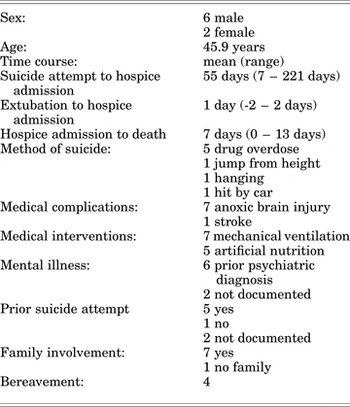
Summary results are presented in Table 1. An incomplete suicide attempt leading to end-of life care was a rare event: 8 cases were identified, out of a total of 20,887 hospice deaths during the 7 year study period. Six of the eight patients were men, and the mean age was ~ 46 years.
Summary results for case series of suicide attempts leading to hospice admission

In nearly all cases, the sequence of events was as follows: suicide attempt, acute stabilization at an acute care hospital, shift in goals of care, cessation of life-prolonging interventions (i.e., extubation), hospice admission, and death. (In one case, the admission to hospice preceded extubation.) The duration of time from the suicide attempt to hospice admission ranged widely, from 7 to 221 days, with a mean of 55 days, suggesting that, in general, these patients were treated in the acute hospital setting for an extended period of time prior to the decision to shift goals of care. In contrast, on average only 1 day elapsed between extubation and admission to hospice, suggesting that patients were moved quickly to hospice if it appeared they would survive for some time after the decision to stop life-prolonging treatments. Finally, once in hospice, patient survival averaged 7 days.
In terms of the method of suicide, five of the eight cases involved an attempted drug overdose; one patient jumped from a height, one involved an attempted hanging, and one patient was struck by a car. All attempts shared a common final pathway of either irreversible anoxic brain injury (n = 7) or stroke (n = 1) as the main medical complication. Prior to hospice admission, seven of the patients were receiving mechanical ventilation, and five were receiving artificial nutrition.
This was a group with significant mental illness: a psychiatric diagnosis was documented in six of the eight cases. Diagnoses included major depressive disorder, bipolar disorder, schizophrenia, and schizoaffective disorder. Of the six with a known prior psychiatric illness, five had made a previous suicide attempt. For two patients, there was no documentation about prior mental illness or suicide attempts; both patients were incarcerated at the time of the attempt, and the reviewers had no access to prior medical or mental health records.
In each case, the decision to allow a natural death marked the shift in care that eventually led to treatment in hospice. Family members were involved in care and decision making in most cases, with the exception of one patient who was incarcerated at the time of the attempt and had no family involvement. Records indicated that most of the subjects had estranged relationships with family at the time of the suicide attempt.
DISCUSSION
The series presented here represents the first systematic review of patients who come into hospice because of injuries sustained in a suicide attempt, and it serves to expand our basic knowledge about this population. Our results point to some unique features of this small subset of hospice patients. First, in terms of basic demographics, this group is substantially younger than “typical” hospice patients. In the setting of this study, for example, the average age of all hospice enrollees during the study period was 81.3 years, considerably older than the 46 years in the subset captured in this review. Second, this is a group that lacks the kinds of medical comorbidities that are typically encountered in the hospice population; were it not for the brain injury sustained in the suicide attempt, these patients would not have had reason to receive hospice care. Third, and perhaps most important, this is a population that carries a significant burden of mental illness, including prior psychiatric treatment, inpatient hospitalizations, and previous suicide attempts, as well as estranged interpersonal relationships and limited psychosocial supports that are often part of the illness experience in chronic psychiatric disease.
LIMITATIONS
There are a number of limitations to this small study. First, our series is limited in scope to a single hospice agency. A broader effort at characterizing this population across a variety of hospice agencies and palliative medicine settings would provide more generalizable information about this group. Second, some of the most important questions about caring for patients and families in this population cannot be answered with a case series and retrospective chart review. For example, how families cope and grieve, how decisions about goals of care are reached, how clinical staff are affected by caring for these patients; these kinds of questions lend themselves to prospective, qualitative methods, which would be a challenge to apply given the apparent rarity of these events. A third, more practical limitation is that the data sources used in this review did not include records from the hospitals where patients were treated prior to receiving hospice care. Review of those records might shed light on decision making regarding the shift in goals of care, and the participation of palliative medicine teams in that process, which would add important detail concerning the broad role for palliative medicine specialists in the care of these patients across different systems of care.
These limitations notwithstanding, the results highlight several potential areas for further work. First, the distinct features of patients in this group, noted previously, likely correspond to unique needs for care and support. For example, there is evidence that bereavement after a suicide can be uniquely challenging: adverse psychological responses and complicated grief reactions are more common after suicide (Tal Young et al., Reference Tal Young, Iglewicz and Glorioso2012), and parental suicide is itself a risk factor for later mental illness and suicide in children, when compared with other causes of parental death (Wilcox et al., Reference Wilcox, Kuramoto and Lichtenstein2010). Future work might focus on developing effective strategies for bereavement support in this population, drawing on some of the experience and expertise that exists already in hospice practices. Similarly, there may be unique needs in terms of spiritual care, given proscriptions against suicide in some faith traditions; further work might shed light on needs and strategies for spiritual support in this population. Third, very little is known about how staff may be affected by cases like these. Future investigation may focus on whether the circumstances of the injury, or the family dynamics, or other features of these cases pose novel challenges to staff, for which interventions might be designed to improve care and decrease staff burnout.
CONCLUSION
In summary, a number of recent efforts have focused on identifying and refining the areas where palliative medicine intersects with the care of the mentally ill (Irwin & Ferris, Reference Irwin and Ferris2008; Berk et al., Reference Berk, Berk and Udina2012). One critically important area is end-of-life care for patients with chronic psychiatric disease who come to receive hospice care after a sub-lethal suicide attempt. Building on the results of this small study, learning how to effectively address the unique needs of this population may enable hospice clinicians and agencies to better care for the individuals and families who come into hospice under these difficult circumstances.
ACKNOWLEDGMENTS
We acknowledge the following, for their support and assistance with this project: the John A Majda, MD Memorial Foundation and Sid Zisook, MD; the San Diego County Medical Examiner's Office; support and clinical staff at San Diego Hospice, in particular Chris Onderdonk, Jessica Empeno, Claudia Hernandez, Chris Symonds, Katrena Pritchard, Beth Saltzman, MD, and Lori Montross, PhD; and staff at the Center for Research at the Institute for Palliative Medicine at San Diego Hospice, including Linda Lloyd, DrPH, Debra Pledger-Fonte, Richard Nelesen, PhD, and Stephanie Whitmore.