Introduction
Behavioral and psychological symptoms are commonly experienced by people living with dementia and are often experienced concurrently (Savva et al., Reference Savva, Zaccai, Matthews, Davidson, McKeith and Brayne2009). These symptoms or changes, for example, agitation, apathy, depression, and hallucinations (Cerejeira et al., Reference Cerejeira, Lagarto and Mukaetova-Ladinska2012) can be troubling for both the person with dementia and their carer/s.
The majority of people with dementia live at home in the community, living either independently or with support from family, friends, and/or paid carers (Lepore et al., Reference Lepore, Ferrell and Wiener2017). Providing care for people living with dementia who experience behavioral and psychological symptoms of dementia can be challenging. Researchers have noted that these symptoms can affect carer well-being more so than other factors (Pinquart and Sorensen, Reference Pinquart and Sörensen2003) and may lead to earlier admission to residential care (Chan et al., Reference Chan, Kasper, Black and Rabins2003). Therefore, it is critical to identify strategies and interventions that might prevent or reduce the impact of such symptoms and to ensure that these strategies or interventions are implemented in practice.
Worldwide, clinical practice guidelines recommend non-pharmacological interventions as the first-line response to behavioral and psychological symptoms of dementia, as research has demonstrated their benefit for both the person with dementia and their carers (Ngo and Holroyd-Leduc, Reference Ngo and Holroyd-Leduc2015). For example, Australian Clinical Practice Guidelines recommend non-pharmacological interventions, such as family caregiver training; tailored, multicomponent interventions that involve engagement in meaningful activities enjoyable for the person with dementia; individualized support and counseling; and a number of specific interventions such as reminiscence therapy, therapeutic use of music, and occupational therapy (Guideline Adaptation Committee, 2016). However, it is widely acknowledged that guideline dissemination infrequently result in changes in clinical practice, and more concerted efforts to implement evidence into practice are required (Grol and Wensing, Reference Grol, Wensing, Grol, Wensing and Eccles2005). Understanding how to effectively translate research into practice within complex health and aged care systems serving people living with people with dementia is essential.
A recent scoping review identified and categorized existing implementation research in dementia care (Lourida et al., Reference Lourida2017). It provided useful information about commonly used implementation strategies or interventions, which are a “method or technique designed to enhance adoption of a clinical intervention” (Curran et al., Reference Curran, Bauer, Mittman, Pyne and Stetler2012, p. 218). These implementation strategies include activities, such as education, reminders, audit, and feedback (Eldh et al., Reference Eldh2017). Unsurprisingly, the review by Lourida et al. (Reference Lourida2017) found that training and education of professionals was the most frequently used strategy to help implement practices supported by research evidence. The review noted that there appears to be little research about how to best implement evidence-based practices for people living with dementia in the community highlighting this as an important target for future implementation efforts (Lourida et al., Reference Lourida2017). Specifically, this review was not able to identify any implementation studies focusing on management of behavioral and psychological symptoms of dementia that were undertaken in community, primary care, or mixed settings. However, such studies do exist (McCurry et al., Reference McCurry2017; Nichols et al., Reference Nichols, Martindale-Adams, Burns, Graney and Zuber2011). As the authors themselves noted, it is possible that the important work of scoping the overall picture of implementation research in dementia care precluded the ability to look at the finer detail of these studies (Lourida et al., Reference Lourida2017).
A systematic review of implementation strategies that are aimed at increasing the use of non-pharmacological interventions (to help manage behavioral and psychological symptoms) is therefore warranted and is the focus of this review. This review is critical because overreliance on antipsychotic prescription for behavioral and psychological symptoms of dementia continues to occur (Szczepura et al., Reference Szczepura2016), and our understanding of how to facilitate access to non-pharmacological interventions (that may improve outcomes for people with dementia and their families) is limited. Further, workforce knowledge and skill in non-pharmacological intervention delivery is not optimal. An examination of approaches to implementing such interventions, particularly within the complex community setting, may help accelerate this access.
This study aimed to identify the nature and effects of implementation strategies to increase the use of evidence-based, non-pharmacological interventions designed to reduce the frequency and/or severity of behavioral and psychological symptoms associated with dementia, for people living in the community.
Methods
This was a systematic review of implementation studies meeting the inclusion criteria below, with a focus on implementation strategies used. The review protocol we used was not published.
Inclusion criteria
Included studies met the following five eligibility criteria:
Study design
Studies could be randomized controlled trials (RCTs), non-RCTs, before-after studies, interrupted time series, or case studies evaluating the use of one or more implementation strategies (e.g. reminders, audit and feedback, education). Implementation strategies were defined as “a method or technique designed to enhance adoption of a clinical intervention” (Curran et al., Reference Curran, Bauer, Mittman, Pyne and Stetler2012, p. 218). Qualitative research studies were excluded. Only full peer-reviewed papers published in English were included as no translation funding was available.
Non-pharmacological clinical interventions
Included studies needed to have implemented a non-pharmacological intervention that had previously been tested in a RCT, with demonstrated improvement/reduction in some aspect of behavior or psychological symptoms experienced by people with dementia. This was regardless of whether the intervention was targeting the person with dementia, the person providing care, or both. Implementation studies in which the original RCTs only reported carer outcomes were excluded because the focus of this review was on outcomes experienced by people with dementia. Implementation studies were included, regardless of whether or not the primary focus of the original trial being implemented was on behavioral and psychological symptoms.
Participants and setting
Implementation studies could focus on practices of any type of health professional or service provider/organization, as long as the clinical intervention of interest was directed at people with dementia and/or their carers living at home in the community, with the intervention implemented in a community setting (e.g. the person’s home, community facilities, or hospital outpatients). For the purpose of this review, health professionals/care staff needed to have provided the intervention of interest as part of their usual/existing duties and remuneration arrangements and not be paid or contracted interventionists. This is because this review was interested in “real-life” implementation within existing systems.
Implementation outcomes
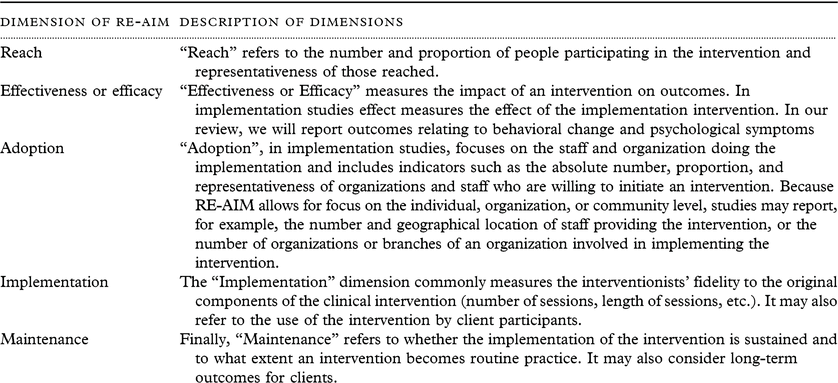
Studies needed to report quantitative outcomes arising from the implementation. Of primary interest was practitioner behavioral change in terms of adherence to guideline or systematic review recommendations or use of interventions shown to be effective in an RCT; and/or “adoption” of the intervention or practice by the health professionals and/or organizations. Adoption, as per the Reach, Effectiveness, Adoption, Implementation Maintenance (RE-AIM) framework (see Table 1), is the number and proportion of staff or organizations who agree to initiate program or policy change and how representative they are (Glasgow and Estabrooks, Reference Glasgow and Estabrooks2018).
Dimensions of the RE-AIM framework (Glasgow et al., Reference Glasgow, Vogt and Boles1999; www.RE-AIM.org, 2019)

Literature search and study selection
Search strategy
We searched five databases (listed below), in January 2019, using a detailed search strategy. We also hand-searched systematic review reference lists and reports relevant to the topic.
-
Cochrane Central Register of Controlled Trials (CENTRAL) in the Cochrane Library.
-
MEDLINE, EBSCOhost (1946 to present).
-
Embase (1947 to present).
-
PsycINFO (1967 to present).
-
CINAHL (Cumulative Index to Nursing and Allied Health Literature), EBSCOhost (1980 to present).
The search strategy for MEDLINE was adapted for other databases. The search strategy for MEDLINE can be seen in Supplementary file 1 published as supplementary material online attached to the electronic version of this paper.
The search terms for implementation studies were based on implementation and knowledge translation (KT) literature (Graham et al., Reference Graham2006), research about searching for KT articles (McKibbon et al., Reference McKibbon2010), and on previous systematic reviews or protocols of implementation research (Cahill et al., Reference Cahill, Carey, Lannin, Turville and O’Connor2017; Mesner et al., Reference Mesner, Foster and French2016). The search terms for dementia were drawn from Cochrane reviews for dementia (Smith et al., Reference Smith, Hameed, Cross, Henderson, Sahota and Fox2015; Van Leeuwen et al., Reference Van Leeuwen2018). We did not restrict the search terms by study design. We ran supplementary searches in PubMed and Google to pick up government or grant reports that may not have been identified by the primary search and searched their reference lists for relevant studies.
One review author did an initial screen of titles of the search results, using predefined eligibility criteria. This was then checked by a second author. The two review authors then independently read the full text of potentially eligible studies to determine eligibility. We also identified the original trials of the interventions being implemented and the protocols or related papers of the implementation studies to confirm eligibility. Any disagreements were settled by discussion between these two authors and other review authors.
Data extraction
Two authors (SB and CR) extracted data from the included studies, independently. Data included the implementation study design; the nature of the implementation strategies (categorized using Expert Recommendations for Implementing Change) (ERIC) interventions (Powell et al., Reference Powell2015; Waltz et al., Reference Waltz2015); how implementation strategies were selected (e.g. use of theory, consultation with stakeholders, mapping to barriers to implementation); use of the RE-AIM framework within a study; and implementation outcomes. When coding implementation strategies using ERIC, we did not include the categories of “fund and contract for the clinical innovation” or “using capitated payments” because studies in which interventionists were paid were excluded from this review. We also identified and used descriptive information from related papers, such as protocols of implementation studies or papers describing the implementation. Information about the clinical interventions being implemented and their outcomes (relevant to behavioral and psychological symptoms of dementia) was also extracted from the original RCTs of the interventions. We used the RE-AIM framework (Glasgow et al., Reference Glasgow, Vogt and Boles1999) to identify and extract data on implementation outcomes reported, regardless of whether authors used this framework or not. This framework has previously been used in systematic reviews of implementation strategies used in dementia care (Boersma et al., Reference Boersma, Van Weert, Lakerveld and Dröes2015) and suggests five dimensions that can be measured: reach, efficacy/effectiveness, adoption, implementation, and maintenance. These dimensions are described in Table 1. Where necessary, authors of papers were contacted to clarify information about outcomes.
Assessment of risk of bias and reporting
Pairs of authors appraised the risk of bias, independently of each other, using the Cochrane Effective Practice and Organisation of Care (EPOC) checklist (Cochrane EPOC, 2017) that assesses RCTs, cluster RCTs, controlled before-after studies, and interrupted time series designs. The EPOC risk of bias criteria were selected, as they were developed for implementation studies and are suitable for use with non-randomized studies. The tool provides a rating of low, high, or unclear risk of bias across nine criteria (Cochrane Effective Practice and Organisation of Care Review Group, 2002). We assessed quality of before-after studies with no control group using the National Institute of Health’s Quality Assessment Tool for Before-After (Pre-Post) Studies With No Control Group criteria (NIH, n.d.). Using the same approach used in a previous review of implementation interventions (Shanbhag et al., Reference Shanbhag2018), we only reported on items relevant to internal validity of the study.
The Standards for Reporting Implementation Studies (STaRI) checklist (Pinnock et al, Reference Pinnock2017) points out that in implementation studies there are two strands of interest: the implementation study itself (including the effects of the implementation strategies) and the clinical effects of the intervention being implemented. Although it is not the purpose of the review to report on the use of each item as per the STaRI checklist, we noted the quality of reporting of key methodological information (e.g. eligibility criteria, implementation strategies, and outcome measures).
Data synthesis
A narrative synthesis was used, given the clinical heterogeneity of the studies in terms of interventions, populations, and outcomes.
RESULTS
Search results and study selection
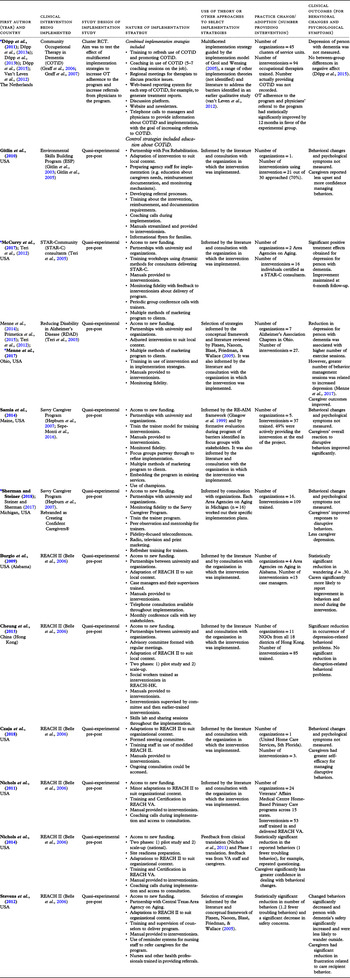
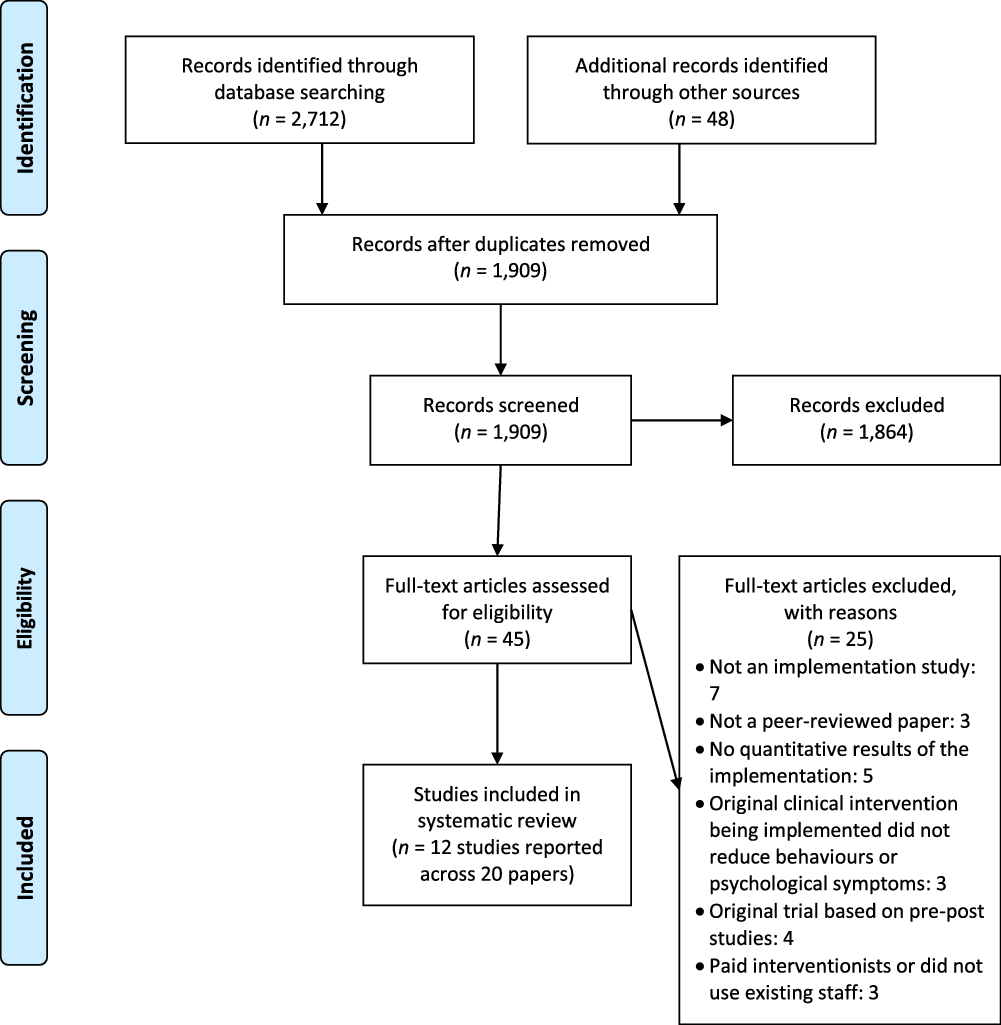
After duplicates were removed, the search strategy resulted in 1,909 papers. After screening the titles of these papers, 45 appeared to be potentially eligible. Two review authors then independently read the full text of these 45 papers and determined that 12 studies (reported across 20 papers) were eligible to be included in this review. Characteristics of studies are presented in Table 2. A number of studies were reported across multiple papers and these are grouped together within the table because they were from the same study. To simplify the wording of this review, we selected only one paper from each study to refer to in the write-up of this review; however, data from all papers in each study were used in the analysis. The selected papers were Döpp et al., Reference Döpp2011, Menne et al., Reference Menne, Bass, Johnson, Kearney, Bollin and Teri2017, McCurry et al., Reference McCurry2017, and Sherman and Steiner (Reference Sherman and Steiner2018). This means that the 12 studies were reported across 20 papers (see Figure 1).
Summary of included implementation studies

RCT = randomized controlled trial, REACH = Resources for Enhancing Alzheimer’s Caregiver Health.
a Some studies were reported across multiple papers. Only the papers with the author in bold are reported in the review for succinctness
PRISMA flow diagram of search results.

The results first present a description of the studies (in terms of setting, design, risk of bias, reporting, the clinical intervention implemented, and implementation strategies that were used) before presenting the implementation outcomes. These outcomes included the reach, effectiveness, adoption, implementation (fidelity), and maintenance of the implemented intervention as per the RE-AIM framework.
Setting
Ten of the 12 included studies were carried out in the U.S. (Burgio et al., Reference Burgio, Collins, Schmid, Wharton, McCallum and DeCoster2009; Czaja et al., Reference Czaja2018; Gitlin et al., Reference Gitlin, Jacobs and Earland2010; McCurry et al., Reference McCurry2017; Menne et al., Reference Menne, Bass, Johnson, Kearney, Bollin and Teri2017; Nichols et al., Reference Nichols, Martindale-Adams, Burns, Graney and Zuber2011; Nichols et al., Reference Nichols, Martindale-Adams, Burns, Zuber and Graney2014; Samia et al., Reference Samia, Aboueissa, Halloran and Hepburn2014; Sherman and Steiner, Reference Sherman and Steiner2018; Stevens et al., Reference Stevens, Smith, Trickett and McGhee2012), 1 in China (Hong Kong) (Cheung et al., Reference Cheung2015), and 1 in the Netherlands (Döpp et al., Reference Döpp2011.
Study design
Eleven studies used a one-group pre-post design. Nine of these studies measured pre and post the clinical intervention (Burgio et al., Reference Burgio, Collins, Schmid, Wharton, McCallum and DeCoster2009; Cheung et al., Reference Cheung2015; Czaja et al., Reference Czaja2018; Gitlin et al., Reference Gitlin, Jacobs and Earland2010; Menne et al., Reference Menne, Bass, Johnson, Kearney, Bollin and Teri2017; Nichols et al., Reference Nichols, Martindale-Adams, Burns, Graney and Zuber2011; Nichols et al., Reference Nichols, Martindale-Adams, Burns, Zuber and Graney2014; Sherman and Steiner, Reference Sherman and Steiner2018; Stevens et al., Reference Stevens, Smith, Trickett and McGhee2012), and two studies measured pre, post, and a further follow-up time point (McCurry et al., Reference McCurry2017; Samia et al., Reference Samia, Aboueissa, Halloran and Hepburn2014) (see Table 2). Only one study used a cluster RCT (Döpp et al., Reference Döpp2011).
Risk of bias and reporting
Risk of bias assessments can be seen in Supplementary Table 1. The cluster RCT (Döpp et al., Reference Döpp2011) had a low risk of bias overall, with the main issue being that it was not possible to blind health professionals. The reporting of this research across several papers focused largely on the effect of the implementation strategies on health providers behavior (e.g. referral rates), with less emphasis on clinical outcomes; overall, the methods and results were clearly reported.
Pre-post studies: the high risk of bias in uncontrolled pre-post studies (especially, those not using an interrupted time series design) is well known (Marsden and Torgerson, Reference Marsden and Torgerson2012). That being said, we could identify relevant information related to the internal validity of the clinical intervention being delivered, as part of the implementation using the items of the NIH tool (NIH, n.d.), but information to determine the rigor of the methods of the implementation study itself was not consistently well reported. Risk of bias judgments can be seen in Supplementary file 2 published as supplementary material online attached to the electronic version of this paper. For example, beyond indicating use of a pre-post design, only three studies clearly described the eligibility/selection criteria of healthcare providers participating in the implementation study (Cheung et al., Reference Cheung2015; Gitlin et al., Reference Gitlin, Jacobs and Earland2010, Menne et al., Reference Menne, Bass, Johnson, Kearney, Bollin and Teri2017) (although other studies did provide detail about the participating organizations), and only one reported loss to follow-up at the provider level (Gitlin et al., Reference Gitlin, Jacobs and Earland2010). Only four studies clearly prespecified the implementation outcomes in their methods (Gitlin et al., Reference Gitlin, Jacobs and Earland2010; Menne et al., Reference Menne, Bass, Johnson, Kearney, Bollin and Teri2017; Samia et al., Reference Samia, Aboueissa, Halloran and Hepburn2014; Stevens et al., Reference Stevens, Smith, Trickett and McGhee2012); however, it was still possible to extract some implementation outcome data using the RE-AIM framework (see Table 1).
With respect to the clinical intervention/s being implemented, most studies had prespecified their eligibility/selection criteria in their methods and used valid and reliable clinical outcome measures. In all studies, participants provided clinical outcome data through self-report. This meant that the participants were the “outcome assessors” and, because they also knew what the intervention was, blinded outcome assessment was not possible. A more detailed explanation of this problem can be found in the new Cochrane Risk of Bias tool RoB 2.0 document (Higgins et al., Reference Higgins, Savović, Page and Sterne2019). Loss to follow-up of participants was high in the majority of studies. Most aspects of the clinical interventions and their testing were well reported.
Clinical interventions implemented
All but two studies, which provided a psychoeducation program (Samia et al., Reference Samia, Aboueissa, Halloran and Hepburn2014; Sherman and Steiner, Reference Sherman and Steiner2018), implemented a multicomponent, structured intervention program. The majority of the clinical interventions focused on improving outcomes for caregivers but also measured care-recipient outcomes. Six different non-pharmacological interventions were implemented. One of the interventions (REACH II) was implemented in six different studies, using different variations of the intervention. These interventions are described in Supplementary file 3 published as supplementary material online attached to the electronic version of this paper.
Nature of Implementation strategies
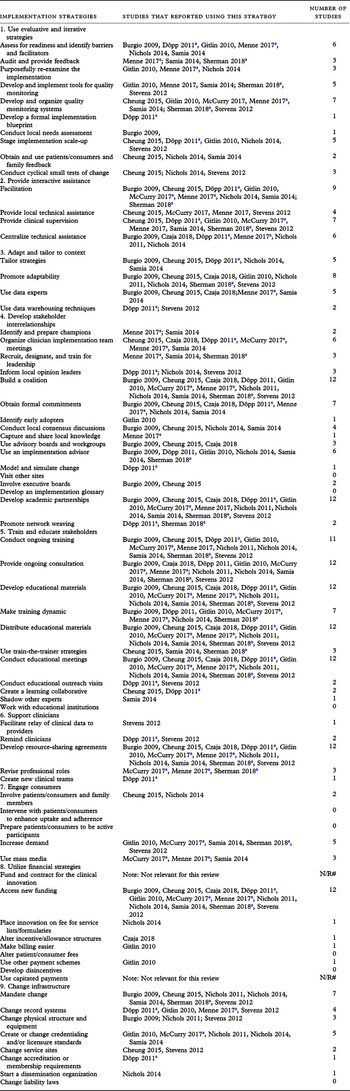
We categorized the nature or type of implementation strategy using the ERIC interventions categories (Powell et al., Reference Powell2015; Waltz et al., Reference Waltz2015). As seen in Table 3, all implementation studies used a large number of implementation strategies from the ERIC strategies, with between 14 and 30 different strategies employed by each study. In Table 3, it can be seen that eight implementation strategies were common to all studies: access to research funding enabling the implementation research (access new funding); building partnerships to facilitate implementation (build a coalition, develop academic partnerships, and develop resource sharing agreements); developed educational materials (e.g. manuals for interventionists), distributed educational materials, conducted educational meetings (e.g. monthly conference calls to stakeholders), and provided ongoing consultation.
Implementation strategies identified across studies (n = 12) using Expert Recommendations for Implementing Change (ERIC) categories (Powell et al., Reference Powell2015; Waltz et al., Reference Waltz2015)

a Some studies were reported across multiple papers. Only one paper is cited above per study, for succinctness. See Table 2 and text of the review for citation details of all papers
# N/R = Not Relevant. For the purposes of this review, studies were not included if health professionals were paid or contracted interventionists. Therefore, strategy number 34 and 36 were not coded
There were eight types of implementation strategies not used at all: visit other sites, develop an implementation glossary, work with educational institutions, prepare patients/consumers to be active participants (i.e. patient-mediated interventions), alter patient/consumer fees, develop disincentives, change liability laws, and intervene with patients/consumers to enhance uptake and adherence. It should be noted, however, that the last strategy was part of the clinical intervention design for a number of studies (e.g. McCurry et al., Reference McCurry2017) but was not reported as an implementation strategy per se. Examples of infrequently used strategies include altering incentive/allowance structures, promoting network weaving, having an implementation blueprint (e.g. a protocol or comprehensive plan), obtaining and using patients/consumers and family feedback, and use of champions. Looking across categories (clusters) of implementation strategies in Table 3, it can be seen that the cluster of “Training and educating stakeholders” had the highest number of studies within any one cluster, and “Engaging consumers” was the cluster that had the lowest number of studies.
Selection of implementation strategies
Only four studies (Döpp et al., Reference Döpp2011, Mennes et al., Reference Menne, Bass, Johnson, Kearney, Bollin and Teri2017; Nichols et al., Reference Nichols, Martindale-Adams, Burns, Zuber and Graney2014; Samia et al., Reference Samia, Aboueissa, Halloran and Hepburn2014) described using theory or conceptual frameworks to inform choice of implementation strategies. For example Döpp et al. (Reference Döpp2011) used Grol and Wensing’s framework (Reference Grol, Wensing, Grol, Wensing and Eccles2005); Reducing Disability in Alzheimer’s Disease (RDAD) (Mennes et al., Reference Menne, Bass, Johnson, Kearney, Bollin and Teri2017) and REACH VA (Nichols et al., Reference Nichols, Martindale-Adams, Burns, Zuber and Graney2014) were informed by the theoretical framework of Fixsen et al. (Reference Fixsen, Naoom, Blase, Friedman and Wallace2005), and Samia et al. (Reference Samia, Aboueissa, Halloran and Hepburn2014) used the RE-AIM framework (Glasgow et al., Reference Glasgow, Vogt and Boles1999).
Selection or development of implementation strategies were also determined in response to an analysis of barriers or enablers identified (Döpp et al., Reference Döpp2011) or were informed by formative data (Nichols et al., Reference Nichols, Martindale-Adams, Burns, Zuber and Graney2014; Samia et al., Reference Samia, Aboueissa, Halloran and Hepburn2014). Studies also selected or refined strategies through consultation and discussion with organization/s in which the intervention was implemented and through recommendations in the literature (see Table 2).
Implementation outcomes – as per the RE-AIM framework
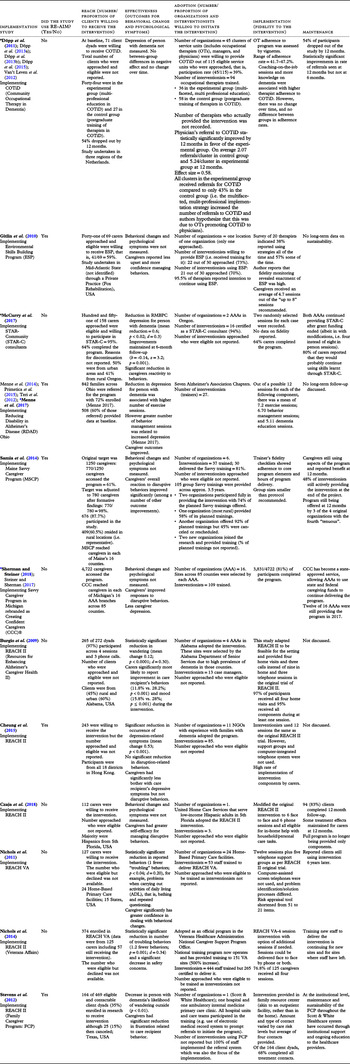
Four studies (Gitlin et al., Reference Gitlin, Jacobs and Earland2010; Menne et al., Reference Menne, Bass, Johnson, Kearney, Bollin and Teri2017; Samia et al., Reference Samia, Aboueissa, Halloran and Hepburn2014; Stevens et al., Reference Stevens, Smith, Trickett and McGhee2012) specifically used the RE-AIM framework to report on implementation outcomes, and one study (Cheung et al., Reference Cheung2015) very briefly considered results in light of the RE-AIM framework. We extracted data from all studies and mapped this information against the RE-AIM framework (regardless of whether or not they had used this framework), as can be seen in Table 4.
Results of implementation outcomes by RE-AIM dimensions

RMBPC = Revised Memory and Behavior Problem Checklist; AAA = Area Agencies on Aging.
a Some studies were reported across multiple papers. Only the paper with the author in bold is reported in the review for succinctness
RE-AIM: reach
With regard to the “Reach” outcome, only five studies (Gitlin et al., Reference Gitlin, Jacobs and Earland2010; McCurry et al., Reference McCurry2017; Menne et al., Reference Menne, Bass, Johnson, Kearney, Bollin and Teri2017; Samia et al., Reference Samia, Aboueissa, Halloran and Hepburn2014; Stevens et al., Reference Stevens, Smith, Trickett and McGhee2012) provided data about the total number of clients who were referred or approached and eligible to participate (necessary to determine proportion of eligible clients willing to participate, as per the “reach” criteria). However, total numbers of clients participating were recorded in all studies, with Sherman and Steiner (Reference Sherman and Steiner2018) having the largest number of participants (n = 4,722).
RE-AIM: Effectiveness
The clinical effect of the interventions implemented was reported in all studies. Importantly, seven studies reported positive outcomes on some aspect of behavioral and psychological symptoms for the person with dementia. Of these studies, four reported reduction in behavior/s (Burgio et al., Reference Burgio, Collins, Schmid, Wharton, McCallum and DeCoster2009; Stevens et al., Reference Stevens, Smith, Trickett and McGhee2012; Nichols et al., Reference Nichols, Martindale-Adams, Burns, Graney and Zuber2011; Nichols et al., Reference Nichols, Martindale-Adams, Burns, Zuber and Graney2014), four reported reduction in participant depression (Burgio et al., Reference Burgio, Collins, Schmid, Wharton, McCallum and DeCoster2009; Cheung et al., Reference Cheung2015; McCurry et al., Reference McCurry2017), and one reported on both (Burgio et al., Reference Burgio, Collins, Schmid, Wharton, McCallum and DeCoster2009). A further study noted reduction in depression was associated with participating in a higher number of exercise sessions, but an increase in depression was associated with attending more behavior management sessions (reported in Menne et al., Reference Menne, Bass, Johnson, Kearney, Bollin and Teri2017). Those that reported reduction in behaviors all implemented some version of the REACH II clinical intervention. Effect sizes were small (d = 0.20 to 0.32), with Nichols et al. (Reference Nichols, Martindale-Adams, Burns, Graney and Zuber2011) suggesting that an effect size of 0.2 is considered clinically significant for psychosocial interventions. Studies reporting reductions in depression for the person with dementia were implementing the STAR-Community (STAR-C) intervention (McCurry et al., Reference McCurry2017), RDAD (Menne et al., Reference Menne, Bass, Johnson, Kearney, Bollin and Teri2017), or a version of REACH II (Burgio et al., Reference Burgio, Collins, Schmid, Wharton, McCallum and DeCoster2009; Cheung et al., Reference Cheung2015), Four studies (Czaja et al., Reference Czaja2018; Gitlin et al., Reference Gitlin, Jacobs and Earland2010; Samia et al., Reference Samia, Aboueissa, Halloran and Hepburn2014; Sherman and Steiner, Reference Sherman and Steiner2018) did not measure behavioral and psychological symptoms, despite the original trials showing benefit in these outcomes. Nine studies reported some improvement in carers’ ability to respond to behavioral and psychological symptoms of dementia (Cheung et al., Reference Cheung2015; Czaja et al., Reference Czaja2018; Gitlin et al., Reference Gitlin, Jacobs and Earland2010; McCurry et al., Reference McCurry2017; Menne et al., Reference Menne, Bass, Johnson, Kearney, Bollin and Teri2017; Nichols et al., Reference Nichols, Martindale-Adams, Burns, Graney and Zuber2011; Samia et al., Reference Samia, Aboueissa, Halloran and Hepburn2014; Sherman and Steiner, Reference Sherman and Steiner2018; Stevens et al., Reference Stevens, Smith, Trickett and McGhee2012); however, as this was not the focus of this review, additional studies measuring this outcome may exist.
RE-AIM: adoption
Adoption is the number and proportion of staff or organizations who agree to initiate program or policy change (Glasgow and Estabrooks, Reference Glasgow and Estabrooks2018) and for this review was a measure of the effect of implementation strategies. In this review, 11 studies reported adoption or change in practice in terms of an organization and its relevant staff delivering a new clinical intervention or program. The remaining study (Döpp et al., Reference Döpp2011) reported proportion of service units willing to provide the intervention and change in existing practice behaviors (increased rates of referral and level of adherence). For each study, the number or proportion of organizations or interventionists willing to adopt the intervention or practice change can be seen in Table 4. Adoption can be considered at the level of the organization and at the level of the individual healthcare provider. At the organization level, adoption varied from adoption of an intervention in two sites of an organization (Stevens et al., Reference Stevens, Smith, Trickett and McGhee2012), to the intervention being adopted as a National Program of an organization across 151 sites (i.e. Veterans Affairs in the USA) (Nichols et al., Reference Nichols, Martindale-Adams, Burns, Zuber and Graney2014). Similarly, adoption by interventionists was intentionally small (three interventionists) in studies testing initial translation of an intervention (e.g. Czaja et al., Reference Czaja2018), compared with nationwide programs (e.g. Nichols et al., Reference Nichols, Martindale-Adams, Burns, Zuber and Graney2014) that had 265 staff certified to deliver (and adopt) REACH II.
RE-AIM: Implementation
All six studies that implemented the REACH II program adapted the intervention prior to implementation. The most common adaptation was the reduction in the number of sessions provided. For example, REACH II originally had nine home-based sessions and three phone calls, but only Cheung et al. (Reference Cheung2015) and Nichols et al. (Reference Nichols, Martindale-Adams, Burns, Graney and Zuber2011) replicated this. Interestingly, the study by Burgio et al. (Reference Burgio, Collins, Schmid, Wharton, McCallum and DeCoster2009), that reduced the REACH II intervention to only four home visits and the usual three calls, still demonstrated beneficial outcomes. The studies that implemented interventions other than REACH II all reported measuring fidelity or adherence, but the approach to doing so varied.
RE-AIM: maintenance
Maintenance can be considered at the level of the organization or the individual clients. Eight studies reported on the maintenance of the implementation (and maintenance of the use of the newly introduced clinical intervention), at the organizational level (Czaja et al., Reference Czaja2018; Döpp et al., Reference Döpp2011; McCurry et al., Reference McCurry2017; Nichols et al., Reference Nichols, Martindale-Adams, Burns, Graney and Zuber2011; Nichols et al., Reference Nichols, Martindale-Adams, Burns, Zuber and Graney2014; Samia et al., Reference Samia, Aboueissa, Halloran and Hepburn2014; Sherman and Steiner, Reference Sherman and Steiner2018; Stevens et al., Reference Stevens, Smith, Trickett and McGhee2012). All but one (Czaja et al., Reference Czaja2018) of these studies reported some success in maintenance of implementation; however, the reporting and measurement of maintenance varied in quality. The majority of these studies reported maintenance of implementation descriptively (e.g. training that was ongoing), rather than by providing data (see Table 4).
Discussion
This systematic review sought to determine the nature and effects of implementation strategies designed to increase the use of evidence-based, non-pharmacological interventions (that can reduce behavioral and psychological symptoms associated with dementia) for those living in the community. Twelve implementation studies were identified, that implemented six different clinical interventions in the community setting. The targeted nature of this review and recency of the search complements a recent scoping review published by Lourida and colleagues (Reference Lourida2017), as it provides specific information about implementation of interventions that reduce behavioral and psychological symptoms of dementia.
Clinical outcomes
One of the key messages from this review is that implementation studies were able to demonstrate clinical improvements, despite substantial changes to original clinical interventions introduced to accommodate the constraints of clinical practice. We are aware of no other systematic reviews (of implementation studies) that provide evidence that positive outcomes for behavioral and psychological symptoms of dementia are still achievable when evidence-based interventions provided in the community are delivered by existing staff, as part of their routine practice. These are important and encouraging findings.
Specifically, 7 of the 11 studies we identified (Burgio et al., Reference Burgio, Collins, Schmid, Wharton, McCallum and DeCoster2009; Cheung et al., Reference Cheung2015, McCurry et al., Reference McCurry2017; Menne et al., Reference Menne, Bass, Johnson, Kearney, Bollin and Teri2017; Nichols et al., Reference Nichols, Martindale-Adams, Burns, Graney and Zuber2011; Nichols et al., Reference Nichols, Martindale-Adams, Burns, Zuber and Graney2014; Stevens et al., Reference Stevens, Smith, Trickett and McGhee2012) demonstrated small, beneficial effects for the person with dementia (in terms of reductions in behavior and/or depression. This was despite the interventions being implemented by clinicians in real-time practice settings, rather than by research interventionists. The majority of studies also reported some improvement in carers’ ability to respond to behavioral and psychological symptoms of dementia. However, this review did not set out to identify studies implementing interventions that had focused on carer outcomes, and this could be a fruitful focus for further reviews.
Choice of outcomes used in the implementation studies varied from those in the original trials. Only eight studies (Burgio et al., Reference Burgio, Collins, Schmid, Wharton, McCallum and DeCoster2009; Cheung et al., Reference Cheung2015; Döpp et al., Reference Döpp2011; McCurry et al., Reference McCurry2017; Menne et al., Reference Menne, Bass, Johnson, Kearney, Bollin and Teri2017; Nichols et al., Reference Nichols, Martindale-Adams, Burns, Graney and Zuber2011; Nichols et al., Reference Nichols, Martindale-Adams, Burns, Zuber and Graney2014; Stevens et al., Reference Stevens, Smith, Trickett and McGhee2012) measured behavioral and psychological symptoms of dementia, as per the original clinical trials. Why the remaining studies did not measure these outcomes is unclear, but this means that we do not have a complete picture of implementation outcomes with respect to behavioral and psychological symptoms.
A number of the implementation studies in this review (Cheung et al., Reference Cheung2015; Czaja et al., Reference Czaja2018; Gitlin et al., Reference Gitlin, Jacobs and Earland2010; McCurry et al., Reference McCurry2017; Nichols et al., Reference Nichols, Martindale-Adams, Burns, Graney and Zuber2011; Samia et al., Reference Samia, Aboueissa, Halloran and Hepburn2014; Sherman and Steiner, Reference Sherman and Steiner2018; Stevens et al., Reference Stevens, Smith, Trickett and McGhee2012) also reported improvements in carers’ abilities to respond to behavioral and psychological symptoms of dementia (as well as other positive outcomes for carers themselves), but this was not the focus of this review. As our search strategies and inclusion criteria were not designed to identify these studies, we cannot be sure others do not exist. It would, therefore, be informative to repeat a review of this kind, focusing on outcomes for carers.
It is important to note, however, that all but one study in this review (Döpp et al., Reference Döpp2011) used pre-post designs with no control group, which have inherent risk of bias. This pragmatic approach to evaluation is common in implementation research, due to the complexity of implementation issues (Glasgow, Reference Glasgow2011), but future research with more rigorous designs may help confirm these findings.
Effect of implementation on practice
This review was primarily concerned with identifying practitioners’ behavioral change and/or adherence to evidence-based recommendations, or health professionals’ “adoption” of the intervention, as per the RE-AIM framework (Glasgow et al., Reference Glasgow, Vogt and Boles1999). Adoption of the intervention by interventionists and by the organization was intentionally small in some studies through to nationwide uptake in others. A number of factors appear to contribute to widespread adoption. It can be seen from the study that reported nation-wide uptake (Nichols et al., Reference Nichols, Martindale-Adams, Burns, Zuber and Graney2014), that 1) it was implementing an intervention with a clear evidence base; 2) the scale of the adoption came after significant preparatory implementation research had already been completed; 3) a nationwide training program had been established to train program providers; and 4) the implementation of the intervention was endorsed at the national level. In contrast, adoption by interventionists was intentionally small in studies that were testing initial translation of interventions. For example, the study by Czaja et al. (Reference Czaja2018) had only three interventionists. Gitlin et al. (Reference Gitlin, Jacobs and Earland2010) argues for the need for carefully planned implementation, starting with small pilot work, prior to rolling the intervention out more extensively.
Measurement of change in practice or adoption also varied. One study (Döpp et al., Reference Döpp2011) reported a change in practice (increased rates of referral), and two studies reported the proportion of health professionals who adopted an intervention (Gitlin et al., Reference Gitlin, Jacobs and Earland2010; Stevens et al., Reference Stevens, Smith, Trickett and McGhee2012). Most of the other studies reported the number (but not proportion) of health professionals who provided the intervention. Calculating the proportion who adopted the intervention requires determining a valid denominator by enumerating all potentially eligible provider staff (or organizations, if measuring adoption at the level of the organization) (Gaglio et al., Reference Gaglio, Shoup and Glasgow2013). For example, Gitlin et al. (Reference Gitlin, Jacobs and Earland2010) demonstrated that, by first identifying the number of health professionals eligible to provide the intervention and comparing this with those who ultimately provided it, it is possible to determine the proportion of health professionals who adopted the practice. However, the ease with which potentially eligible interventionists can be identified is likely to be influenced by the characteristics of the organization in which they work (e.g. size and complexity).
The nature of the implementation strategies
All studies used multiple implementation strategies. The studies in this review were each implementing complex clinical interventions, most of which had not been previously used by the health professional or organization. Thus, it was unsurprising that all studies attended to partnerships with organizations and their stakeholders and used educational strategies for healthcare providers, as it was also reported in the earlier scoping review (Lourida et al., Reference Lourida2017). Some interventions were rarely used or not used at all. For example, few studies reported specifically training and using champions to encourage use of the intervention which is surprising, as it is commonly used as an implementation strategy in other fields (Miech et al., Reference Miech, Rattray, Flanagan, Damschroder, Schmid and Damush2018). Given the complexity of interventions being implemented and that various “levels” of stakeholders were involved (e.g. people with dementia and their carers; health professionals; referring health professionals; and organizations), it seems reasonable that multiple strategies were used. However, only four studies used theory to inform choice of implementation strategies, and just three considered feedback from stakeholders about barriers to implementation or formative data (which, in turn, informed strategy selection). This is in contrast to the widespread recommendations in the implementation literature to use theories and frameworks, and identification of implementation determinants, to guide selection of more targeted implementation strategies, and to facilitate understanding of the mechanisms behind success or failure of implementation (Nilsen, Reference Nilsen2015).
Quality of reporting
A formal analysis of the quality of reporting of implementation studies was not undertaken for this review, but it was clear that reporting of implementation strategies and their effect could be improved. No study used a logic model or pathway – a recommended practice in the StaRI Statement (Pinnock et al., Reference Pinnock2017); only one used a full protocol (Döpp et al., Reference Döpp2011); and only a few studies clearly described the methods for the implementation study itself. While all studies clearly reported results for clinical outcomes, data for outcomes of relevance to the implementation were difficult to identify. It is possible that some of the included studies are yet to publish associated papers providing extra data or that we have not found a study’s implementation plan.
In many instances, it was difficult to identify details of the implementation strategies, which made it difficult to accurately map them against the ERIC categories. Without clear reporting, it is difficult to interpret the results and replicate what was done (Proctor et al., Reference Proctor, Powell and McMillen2013). Reporting of implementation can be improved in a number of ways, with the STaRI guidelines emphasizing the importance of prespecifying and reporting outcomes from both the implementation strategies and the clinical intervention (Pinnock et al., Reference Pinnock2017). STaRI stops short of providing guidelines for reporting implementation strategies. However, it recommends using supplementary guidelines, such as those by Proctor et al. (Reference Proctor, Powell and McMillen2013). Proctor et al. (Reference Proctor, Powell and McMillen2013) recommend that authors of implementation studies make it clear who is providing the implementation strategies; what specific actions making up the strategy; what and who it is targeting; as well as the timing, dose, expected outcome, and theoretical or pragmatic justification for the strategies selected.
Strengths and limitations of this review
To our knowledge, this is the first systematic review of implementation strategies used for implementing non-pharmacological interventions addressing behavioral and psychological symptoms of dementia, within the community setting. A previous scoping review (Lourida et al., Reference Lourida2017) usefully provided an overview of the nature of the implementation literature in dementia but was too broad to allow for a more specific investigation of implementation strategies with a targeted focus, such as in this review.
There are several limitations to this review. Although we used comprehensive searches, the wide range in terminology (applicable to the implementation science and KT field) made the search challenging. Therefore, it is possible that studies were missed; consequently, results should be interpreted with this in mind. The difficulty with terminology in this field is widely acknowledged (Graham et al., Reference Graham2006), with subsequent difficulty in formulating search strategies noted in previous work (Lourida et al., Reference Lourida2017; McKibbon and Fridsma, Reference McKibbon and Fridsma2006). However, use of the full search strategy in this review was supplemented with several other targeted searches and searches of reference lists. Consequently, we are confident that the use of both systematic and targeted search approaches has resulted in a good representation of the eligible literature. We did not search for unpublished studies, but did identify two additional REACH II implementation studies (Altpeter et al., Reference Altpeter, Gwyther, Kennedy, Patterson and Derence2015; Martindale-Adams et al., Reference Martindale-Adams, Tah, Finke, LaCounte, Higgins and Nichols2017) that described the implementation but did not provide sufficient data to meet the inclusion criteria. A further three implementation studies are in progress (Bennett et al., Reference Bennett2019; Clemson et al., Reference Clemson2018; Fortinsky et al., Reference Fortinsky2016).
A protocol was developed for this systematic review; however, it was not published. As well as alterations to the search methods described above, a few changes were made to the eligibility criteria in the protocol once we understood the nature of some of the studies being identified. Specifically, we added “adoption” as an outcome and decided to extract data for outcomes relevant to the RE-AIM framework. We also decided to exclude implementation studies where interventionists were paid or contracted for the purpose of the study, as this does not provide as clear an understanding of how implementation might work in “real life” and is consistent with the purposes of implementation research (Glasgow et al. Reference Glasgow, Vinson, Chambers, Khoury, Kaplan and Hunter2012).
Categorizing implementation strategies using the definitions of the ERIC implementation strategies (Powell et al., Reference Powell2015) was sometimes subject to interpretation, and, therefore, the numbers of studies using these strategies may not be completely accurate. Furthermore, the number of strategies identified in this review may be a reflection of the quality of reporting. Finally, clinical heterogeneity, heterogeneity of implementation strategies, insufficient reporting, and the research design of studies included in this review precluded our ability to draw clear conclusions regarding effects of specific implementation strategies.
Conclusion
Implementation studies of non-pharmacological interventions have demonstrated that it is possible to achieve improvements in behavioral and psychological symptoms common in people with dementia, when an intervention is implemented by clinicians in real-time practice settings, rather than by research interventionists. The reach and scale of adoption of interventions reflected in part the approach of starting with a small implementation program and scale up overtime. To achieve beneficial outcomes, studies also employed many different implementation strategies which commonly consisted of partnerships between organizations, access to new funding, educational strategies, and ongoing support and consultation for interventionists. However, unclear reporting often hampered understanding of what was done and the subsequent implementation effects. It is recommended that future implementation studies provide a protocol and consider guidelines for reporting (e.g. STARI). Given these promising initial findings, greater support for research investigating the implementation of evidence-based, non-pharmacological interventions that can address behavioral and psychological symptoms for people with dementia should be a priority.
Conflict of interest
None.
Description of authors’ roles
S. Bennett was responsible for and involved in all aspects of the study. K. Laver helped to design the study, arbitrated selection of studies, appraised risk of bias, and helped to write the paper. M. McAndrew helped to design the study, arbitrated selection of studies, appraised risk of bias, and helped to write the paper. E. Beattie helped to design the study, arbitrated selection of studies, appraised risk of bias, and helped to write the paper. L. Clemson helped to design the study and to write the paper. C. Runge (research assistant) helped to select the studies, extract the data, categorized the strategies and helped to write the paper. L. Richardson (research assistant) helped to write the paper.
Supplementary material
To view supplementary material for this article, please visit https://doi.org/10.1017/S1041610220001702