Introduction
Management scholars focus on many CEO behaviors that have symbolic meanings, such as the departure and retirement of a CEO, new dress codes, and routines of the succeeding CEO. The above behaviors can all be regarded as symbols. A symbol is a thing that represents something abstract, and it can be a specific static object, a specific action, or a specific event. By using symbols, the CEO can communicate the meaning of organizational change to organization members. This process is labeled sensemaking and sensegiving in management theories. ‘The basic idea of sensemaking is that reality is an ongoing accomplishment that emerges from efforts to create order and make retrospective sense of what occurs’ (Weick, Reference Weick1993, p. 635). Sensemaking ‘emphasizes that people try to make things rationally accountable to themselves and others’ (Weick, Reference Weick1993, p. 635). Sensemaking has to do with ‘the meaning construction and reconstruction by the involved parties as they attempt to develop a meaningful framework for understanding the nature of the intended strategic change’ (Gioia & Chittipeddi, Reference Gioia and Chittipeddi1991, p. 442), while sensegiving is concerned with ‘the process of attempting to influence the sensemaking and meaning construction of others toward a preferred redefinition of organizational reality’ (Gioia & Chittipeddi, Reference Gioia and Chittipeddi1991, p. 442). Later studies further systematically elaborate on the connotations and distinctions between sensemaking and sensegiving (Hopkinson, Reference Hopkinson2001). They point out that the so-called sensemaking allows the relevant stakeholders to understand the nature and importance of organizational change through meaning construction or reconstruction (Berry, Reference Berry2001; Taylor, Reference Taylor1999). Sensegiving, on the other hand, is the process that influences the understanding of others (usually other members of the organization) in terms of the meaning of the changes in an organization, with greater emphasis on its manipulative nature (Rouleau, Reference Rouleau2005). Over the last three decades, some scholars have attempted to map out general patterns of sensemaking and sensegiving with respect to the different dimensions of strategic change (Hill & Levenhagen, Reference Hill and Levenhagen1995; Wagner & Gooding, Reference Wagner and Gooding1997), while some researchers have taken a narrative turn to explore how top managers construct and diffuse stories in the midst of organizational change (Giuliani, Reference Giuliani2016; Prior, Keränen, & Koskela, Reference Prior, Keränen and Koskela2018; Taylor, Reference Taylor1999).
In the process of sensemaking and sensegiving, symbols are one of the most important information carriers, which play an important role in manufacturing consent toward organizational change. However, not all symbols facilitate consent toward changes. Change is a decision about the future, and all change processes can create uncertainty. It is a process that humans use to make decisions about the future when it is not possible to meaningfully identify and use a clear decision model or rule, such as standards (Patriotta & Siegel, Reference Patriotta and Siegel2019). The ex-ante attitudes of some members may be very negative in the face of new decisions. For example, those who have made great efforts to reach the status quo (e.g., longer-tenured members) or those who believe that the rules and standards brought by the change will undermine their status or damage their livelihoods (Bovey & Hede, Reference Bovey and Hede2001; Erwin & Garman, Reference Erwin and Garman2010). In addition, sometimes, while some new themes may be almost completely inoffensive (e.g., security or anti-bureaucratic campaigns) with few opponents, most initiatives will encounter resistance more or less (Courpasson, Dany, & Clegg, Reference Courpasson, Dany and Clegg2012). Therefore, out of this uncertainty avoidance, organizational change is met with opposition and skepticism from shareholders, the board of directors, media, and other external stakeholders to the extent that it cannot be thoroughly promoted (Davenport & Leitch, Reference Davenport and Leitch2005). In this case, CEOs need to consider helping organization members eliminate the uncertainty caused by the changes (Bromiley, Koumakhov, Rousseau, & Starbuck, Reference Bromiley, Koumakhov, Rousseau and Starbuck2019). Moreover, specific symbols during the changes can give organization members a strong sense of the CEO's judgment about the future direction of the organization. For example, symbols can provide information on the insights of the CEO and his or her assumptions about the organizational environment, the process, causes of environmental change, how s/he understands the environmental change, and how the organization itself responds to the understanding (Prescott, Reference Prescott1986; Prescott & Miller, Reference Prescott and Miller2002). This then leads to an interesting question: in the process of sensemaking and sensegiving of organizational change, why do some CEO symbols effectively help members absorb uncertainty by gaining an understanding of the meaning behind the organizational change and accepting and supporting the organizational change, while others cannot? In this paper, we propose a new idea: the absorptive capacity of the CEO symbol of uncertainty can effectively enhance its effectiveness in a process of change. The more CEO symbols help stakeholders absorb uncertainty, the more likely they are to be in line with the change.
A good example is the adjustment of the scaling strategies of fashion firms. The bespoke and ready-to-wear markets are two distinct markets in the fashion industry, where bespoke is always perceived to be better quality, better looking, and better value than ready-to-wear (Ugolini, Reference Ugolini2003). However, with the saturation of the haute couture market and the intensification of competition, fashion firms that focused on the haute couture market have begun to make organizational changes and learn from the digital management model of the ready-to-wear market to improve their competitiveness. For example, the factory symbol is a common organizational design from recent history that generally gives the impression of standardized work to people; therefore, introducing the factory model to speed up the process of value delivery to consumers is the goal of many luxury goods companies todayFootnote 1. However, in expressing this desire for change to organization members, some fashion firm CEOs will simply adopt the ‘factory model’ in their change statements to express their plans for change. Although the ‘factory model’ includes high-tech elements such as digitization, the factory is a powerful symbol of mass assembly line production, which is closely associated with the image of the ‘factory worker’ with low wages and poor working conditions. The symbolic influence of the expression ‘factory’ leads to the negative association of members with organizational change, which has an unexpected negative impact on the overall process of change. Functionally, the term is clear in its goals of digitization and automation. However, this term does not reduce the uncertainty of the employees of the perceived changes. In this case, the concept of the factory symbolizes the lack of ability to absorb uncertainty. Fundamentally, these fashion firms follow a rational calculation process when implementing changes and only pay attention to whether the symbols convey the substantive meaning but ignore whether the symbols can help stakeholders absorb the uncertainty caused by the changes. In contrast, other CEOs have used the term ‘studio’ to express the change. This term also conveys the meaning of digitalization but leans more toward the notion of ‘design’. By using this different symbol, CEOs can digitally integrate efficient ways of thinking and related concepts into the corporate culture.
In this example, both the factory and studio concepts have a modern, high-tech, and efficient abstraction, and our intuitive perception and calculation of this abstraction represented by the factory and studio can be called rational calculation. However, the term factory might be more readily associated with the image of a traditional factory that has a poor working environment, thus resulting in a negative emotional experience of the organization members. By contrast, the term studio is more reminiscent of design and artistry, which trigger a positive emotional experience. In the process of sensemaking and sensegiving during organizational change, the CEO should pay attention not only to the rational meanings constructed and endowed by using symbols but also to the potential impact of symbols on emotions. This paper systematically analyzes the influence of CEO symbols on rational calculation and emotional identification in the sensemaking and sensegiving processes of organizational change for organization members to promote a current understanding of the relationship between CEO symbols and organizational changes. This echoes recent calls for administrative symbols to be interwoven with emotions, politics, and ideology, further fueling academic discussion on sensemaking and sensegiving in organizational change.
Conceptualization and typology of symbols
Patriotta (Reference Patriotta2019, p. 1753) pointed out that ‘the causal structure of experience is complex, and the everyday world we encounter is noisy…the link between experience and reality is tenuous and subject to interpretive flexibility’. As such, the ambiguity of symbols brings about uncertainty in the sensemaking of a CEO when using symbols to convey information on forthcoming organizational changes. Research on social identification has shown that leaders understand that it matters how their work colleagues perceive them (Meister, Thatcher, Park, & Maltarich, Reference Meister, Thatcher, Park and Maltarich2020). Fluidity in the interpretation of the symbolic actions of CEOs thus can adversely affect the work of leaders. Leaders need to consider and manage how others view their work and how to use appropriate symbols to promote their initiated organizational changes.
When a CEO changes the symbols used to communicate with organization members on the issue of change, it is possible to change the function of the symbols. To demonstrate this point, we first discuss the forms of symbols that CEOs might use during the process of sensemaking: symbolic objects, actions, and events.
Symbolic objects
A symbol can be a specific static object. Verbal descriptions, including slogans, stories, and rhetoric, such as metaphors that reflect the latest concepts of business management, new buildings, interior decoration, etc., are common symbolic objects of CEOs (Berg, Reference Berg1986; Siebert, Wilson, & Hamilton, Reference Siebert, Wilson and Hamilton2017). Symbolic objects are constant and ideal for conveying concrete and specific information. These characteristics make them more suitable for conveying information about the dimension of rationality in organizational changes, such as future organizational strategic priorities. However, since they are passive, to convey information to organization members, they need to be noticed by them (Cornelissen & Clarke, Reference Cornelissen and Clarke2010; Lindenberg & Foss, Reference Lindenberg and Foss2011). Therefore, when using symbolic objects to convey the meaning behind organizational changes, the CEO needs to choose sufficiently eye-catching objects as symbols that are visible to all the members of the organization and make significant or even drastic changes to them. For example, Brent Saunders, who led the organizational change of Bausch and Lomb, an eye-care product company, renamed its research and development (R&D) department ‘D&R’ to shift its future strategic priorities and a new commitment to the innovation of commercial products (Hambrick & Lovelace, Reference Hambrick and Lovelace2018). In this case, the change in the acronym is publicly visible to the entire organization. On the one hand, each time the D&R department is mentioned, organization members are reminded that development has priority over research. On the other hand, this change can also have a dramatic effect and not only catch the attention of the organization members but also constantly remind them of this innovativeness. Although scientists who were engaged in basic research at Bausch and Lomb severely ridiculed this change as a symbolic object, the change received a positive response from members of the organization, especially the product development specialists at Bausch and Lomb (Hambrick & Lovelace, Reference Hambrick and Lovelace2018).
Symbolic actions
A symbol can sometimes be an action. Symbolic actions are defined as purposeful and conscious actions that can transform the meaning of organizational change (Ashforth & Gibbs, Reference Ashforth and Gibbs1990). Unlike static symbolic objects, symbolic actions are active and dynamic, which makes them more likely to cause emotional fluctuations in the recipient, so they are considered to be more suitable for conveying information on organizational changes related to attitudes and emotions. For example, Louis Gerstner, who led IBM in the mid-1990s, removed all the chairs from several conference rooms in their headquarters and then arranged key meetings in those rooms to convey his preference and emphasis on reaction speed to the organization members (Gerstner, Reference Gerstner2002). The fact that everyone stood during the meetings meant that all future meetings would not be substantial in the length of time and that there would be no redundant sessions so that the events discussed are truly important and the information conveyed, and the goals assigned that require follow-up actions must also be quick and efficient. In addition, soon after he took office, he asked each branch head to submit a 10-page report on customer needs, product categories, competitive analysis, technology outlook, economic situation, long-term and short-term key issues, and growth prospects for 1993–1994 and asked all of them to describe their general view of IBM, customer relations, sales performance, response to competition, business strategies. In both examples, having all the chairs (instead of just a few) at headquarters (instead of a branch office) removed, and having the branch heads (instead of the executives) turn in written reports (instead of verbal ones) became good symbolic actions, which gave the organization members the feeling that their CEO is greatly motivated to take action.
Symbolic events
In addition to symbolic objects and actions, events are also symbolic and can contain many different symbolic elements. These events mainly exist as a tool not only to convey information about organizational changes but also to convey trustworthiness (Jensen & Roy, Reference Jensen and Roy2008; Markóczy, Li Sun, Peng, Shi, & Ren, Reference Markóczy, Li Sun, Peng, Shi and Ren2013). By leaving a good impression with organization members and enhancing their experience through symbolic events, CEOs can readily infuse organizational changes with more profound meanings and facilitate and promote the acceptance of changes for a long period. For example, a newly appointed CEO could start to actively collaborate with well-known scientists or academic institutions (Hohberger, Almeida, & Parada, Reference Hohberger, Almeida and Parada2015), thus showing the difference between his or her leadership strategy and that of the former CEO. Typically, the outputs of R&D activities often require a long period to realize and are accompanied by a high degree of uncertainty. The R&D model of an organization is often rooted in its culture and has been defined since its inception. Changing its R&D model requires great courage and commitment and is often met with resistance and challenges. Thus, the launch of an external R&D collaboration can be a symbolic event that conveys the new CEO's determination to change the organization's strategy.
Note that these three elements of symbolism have been described separately for expositional convenience. Nevertheless, symbolic typology may at times overlap to different degrees. For example, a symbolic event can have the characteristics of symbolic action and symbolic object. This is important to identify the characteristics of different symbols, which is essential for an in-depth understanding of symbolism and symbol-driven organizational changes.
The elements of executive symbolism
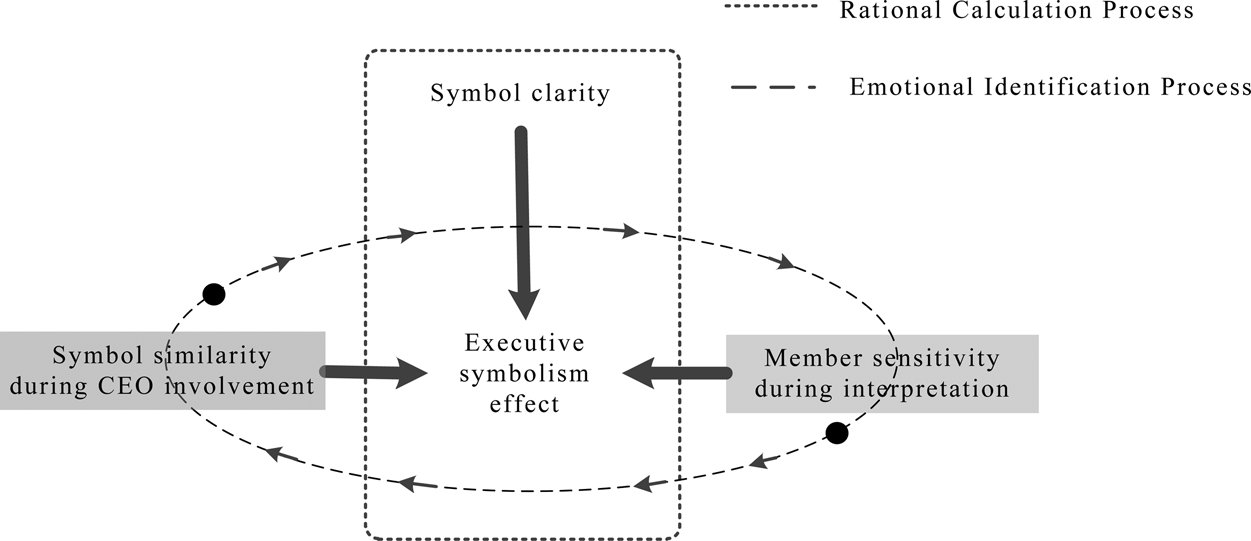
In this study, we examine the different forms of symbols that CEOs use in the organizational context to influence the attitudes of organization members toward organizational changes. In Figure 1, we show the core research elements of the relationship between executive symbolism and the attitudes of the organization members, which determine the critical strategic dimensions of organizational changes driven by executive symbolism. We will discuss these elements each in turn.
Core elements of the effect of executive symbolism during the sensemaking process.

Clarity of symbols
The clarity of symbols refers to whether symbolic objects, behaviors, or events used by a CEO during the process of enacting changes are perceived in a coherent and comprehensible manner by the organization members (Hambrick & Lovelace, Reference Hambrick and Lovelace2018; Schnackenberg, Bundy, Coen, & Westphal, Reference Schnackenberg, Bundy, Coen and Westphal2019). For example, Jack Welch, the CEO of General Electric (GE) from 1981 to 2001, used a series of coherent symbols in the early 1980s to convey the transformative significance of his plan to transform the GE culture. These include his 7 a.m. management meetings, monthly ‘workout’ sessions of three days each time with his staffFootnote 2, and a simplification of the organizational chart. Through several different but coherent symbolic means, Welch gave GE employees a clear picture of his intended organizational changes. To better understand his efforts, we provide a reverse case scenario. When a CEO intends to make organizational changes, s/he often uses symbolic objects, behaviors, or events for attention and awareness. S/he might place posters with certain mottos or images in his or her office or wear a pendant that symbolizes the company's mission. However, these temporary and lone symbols are often ineffective, especially if they do not relate to the actual routines or actions of the CEO and are merely an artifact, such as a photo of a slogan symbolizing the change (Burris, Reference Burris1989; Reed, Reference Reed1997; Woodworth, Reference Woodworth1981). As a result, the intended goals of the symbols will fail due to a lack of clarity. As such, the sensemaking of executive symbolism is one of the critical strategic dimensions that affect its influence. Aside from clarity of symbols, another key strategic dimension of the influence of executive symbolism is the emotional attitude of organization members.
CEO involvement and symbol similarities
CEO involvement means whether the executor of the symbolic behavior, event, or object is the CEO him/herself and the emotional or personal connection of the symbolic element to the CEO. The CEO of a real estate development group, for example, might wear khaki and a sun visor to pitch a new water park business to clients. The CEO gives the impression that s/he is directly involved in the operations of the water park and personally promotes the park. His or her personal use of symbols or participation in symbolic events can have a greater impact on employees and elicit a higher level of organizational and professional commitments (Golden, Reference Golden1992; Litrico & David, Reference Litrico and David2017). The impact of executive symbolism is rooted in the participation of the CEO; it is the CEO who reinforces the influence of symbols, and not the other way around. The CEO is the highest power owner of an organization, with comprehensive and in-depth organizational mobilization ability. In an environment with many stakeholders and diverse personnel, the emotions of the organization members can vary greatly. The similarities between symbolic and stereotypical behaviors can often mean that the former is easily associated with specific stereotypes. For example, the stereotypical image of women is ‘taking care of family, preferring sharing rather than competition’ (Stockley & Campbell, Reference Stockley and Campbell2013). As such, when a female CEO decides to promote flexible work hours, working from home, and work-sharing practices in the company, the organization members are likely to associate these changes in practices or proposals with her gender and stereotypes about women. In extreme cases, organization members may even rely on preconceived notions, such as the idea that the CEO is implementing such practices because she is a woman rather than because the organization needs those practices. In this case, the gender of the CEO becomes the symbolic element of focus and can have a significantly negative impact on the organizational changes initiated by the CEO. The degree of similarity of a symbol with a stereotype is directly related to the ease of association. Conversely, it is less likely that nonstereotypical symbols would lead to the formation of cognitive connections with stereotypes. Different people will interpret the meaning behind the symbols differently, which makes it difficult to form a consistent view and identify the emotions involved at the organizational level.
Interpretation and sensitivity of organization members
In the process of using symbols to drive change, the symbols (objects, actions, and/or events) adopted by the CEO may actually contain both rational and emotional elements. The personal experiences and emotional tenor of the organization members may give them a stronger feeling of perceived gain or loss from the ongoing symbolically infused changes (Rafaeli & Vilnai-Yavetz, Reference Rafaeli and Vilnai-Yavetz2004). We use the sensitivity of the organization members to reflect this situation, that is, their level of sensitivity in response to the executive symbolism that infiltrates their emotional concerns. A higher (lower) sensitivity to a particular symbol points to the ease that the transferred rational value is amplified (reduced). Highly sensitive members are more likely to be affected by the negative implications of the proposed organizational changes, while less sensitive individuals are less likely to be affected. For example, the latter might be indifferent to a new CEO who is described to have a reputation for ruthlessly cutting costs, while the former might be resistant to the same information and anxious about it. The amplification or reduction of emotions around rational gains/losses has been confirmed by existing empirical research to some extent. Research has shown that the appointment of women to technology media and telecommunications (TMT) teams has a significantly diminishing marginal effect, with the market responding more positively to the initial companies that appoint women to TMT teams, while those who follow are more likely to be perceived as ‘gimmicky’ and ‘followers’, so that the reception to the appointment is likely more subdued (Guldiken, Fainshmidt, Mallon, Judge, & Clark, Reference Guldiken, Fainshmidt, Mallon, Judge and Clark2019; Lyngsie & Foss, Reference Lyngsie and Foss2017). The participation of the CEO and subjective interpretation of the organization members of symbolic elements determine the ultimate influence of executive symbolism on the emotional attitudes toward the changes. Together with the clarity of the symbols, they constitute the three critical strategic dimensions of the influence of executive symbolism.
Processes of executive symbolism
Specifically, we propose that there are two basic dominant processes in the symbolic actions of CEOs: rational calculation and emotional identification. In addition to providing benefits or imposing penalties to deter the resistance of organization members, the CEO also needs to use appropriate symbols to create new emotional connections between organizational changes and the social relationships of the members of the organization made possible through resistance. This new connection allows members to emotionally explore and understand the possibility of maintaining the original social relationship in the new environment, thus reducing resistance to the changes.
Clarity of symbols and the process of rational calculation
It is crucial to clearly construct and convey the information about the benefits of change to organization members and allow those who have benefited from the change to actively support the proposed changes. The dominant process of organizational change based on the construction of symbolic meaning is the rational calculation process in which organizational change is based on the logic of the CEO, and the effectiveness of such a process depends on the power of the CEO (Stockley & Campbell, Reference Stockley and Campbell2013). If a CEO does not have power, it is difficult for members to believe that the benefits and promises constructed via executive symbolism will be met in the future. Only when the CEO has real power, will the organization members believe that the meaning and benefits of the symbol can be realized. Therefore, we believe that when CEOs have power and legitimacy advantages, they are more likely to use symbols (static symbolic objects such as written document statements) that convey interesting information in the process of rational calculation to convey the meaning of change and promote organizational change.
Symbol similarity and member sensitivity in the emotional identification process
Organizational change is a long-term activity, and acceptance from the organization members under coercion may not be sustainable. It is inconceivable that CEO-led plans for change could still proceed smoothly when they lose the power of punishing or rewarding the members (such as resigning from the CEO position due to personal reasons such as tenure and physical health) (Ballinger & Marcel, Reference Ballinger and Marcel2010).
It is necessary to convince the organization members to extend their temporary support to the long term, in an organization, to successfully and thoroughly implement the organizational changes. This ongoing support needs to be rooted in the personal views of the members. This study found that the relationship between CEOs and organization members is not a pure signal-releasing/signal-receiving relationship. The executive symbolism produced by the symbol will affect the real thoughts and cognition of the organization members. Changing the focus of the organizational changes from a rational exercise to emotional commitment often translates into resilient loyalty, which is conducive to reducing dependence on external stimulation and punishment to promote changes (Huy, Reference Huy1999). We believe that when CEOs lack lasting power or do not have adequate power, they are more likely to use an approach that focuses on emotional identification and apply symbols that convey emotional information to promote organizational changes. A growing number of studies believe that the failure to regard positive emotions around change as a prerequisite for change readiness is an important limitation of existing research (Oreg, Vakola, & Armenakis, Reference Oreg, Vakola and Armenakis2011; Rafferty, Jimmieson, & Armenakis, Reference Rafferty, Jimmieson and Armenakis2013). Empirical studies such as (Rafferty & Minbashian, Reference Rafferty and Minbashian2019) find that positive emotions are associated with change readiness, and when the organization members are willing to cope with change positively, this enhances the degree to which they are willing to collect knowledge and experience change. This psychological readiness drives support for changes.
On the other hand, leaders also play an important role in promoting change and the relationship between emotions and change (Vuori & Huy, Reference Vuori and Huy2022). Empirical studies show that (Huy, Corley, & Kraatz, Reference Huy, Corley and Kraatz2014; Oreg & Berson, Reference Oreg and Berson2019) both transformational and authentic leadership are associated with a greater likelihood of positive emotions when there is organizational change. Both types of leadership can generate trust among subordinates, thus reducing negative emotions such as anxiety and threatening thoughts (Graebner, Reference Graebner2004; Oreg, Bartunek, Lee, & Do, Reference Oreg, Bartunek, Lee and Do2018; Seo, Taylor, Hill, Zhang, Tesluk, & Lorinkova, Reference Seo, Taylor, Hill, Zhang, Tesluk and Lorinkova2012). Specifically, CEOs can use a variety of symbolic actions to gain emotional support from employees. For example, in 1985, the CEO of Haier, an underperforming home appliance company in China, took the symbolic action of publicly destroying 76 flawed appliances and giving employees the opportunity to do soFootnote 3. The campaign aimed to generate negative feelings about flawed products to strengthen support for major changes in product quality programs. In addition, CEOs can also use different types of prosocial behaviors as symbolic actions to build intimacy with employees and win their trust and ultimately win their support for change. These prosocial behaviors can range from mundane changes in everyday work clothing, such as taking off a tie and wearing casual clothes to work, to public behavior, for example, participating in charity work during off-work hours (such as painting a local orphanage). The symbolic action of all the staff volunteering for a charity with their family members provides the emotional foundations for the upcoming strategic marketing changes of the enterprise.
Figure 1 shows the integration of the above different processes. In this model, the CEO can choose to incorporate symbols into different processes to influence the attitude of the organization members toward organizational change. When the CEO uses the rational calculation process to produce executive symbolism, the clarity of the symbols is the key influential factor. The reason is that only when the organization members see the symbols clearly and interpret them correctly will the sense-making framework of the organizational change be well understood (Cornelissen, Oswick, Thøger Christensen, & Phillips, Reference Cornelissen, Oswick, Thøger Christensen and Phillips2008). When CEOs make an emotional identification, the similarity of symbols and the sensitivity of the organization members become key factors.
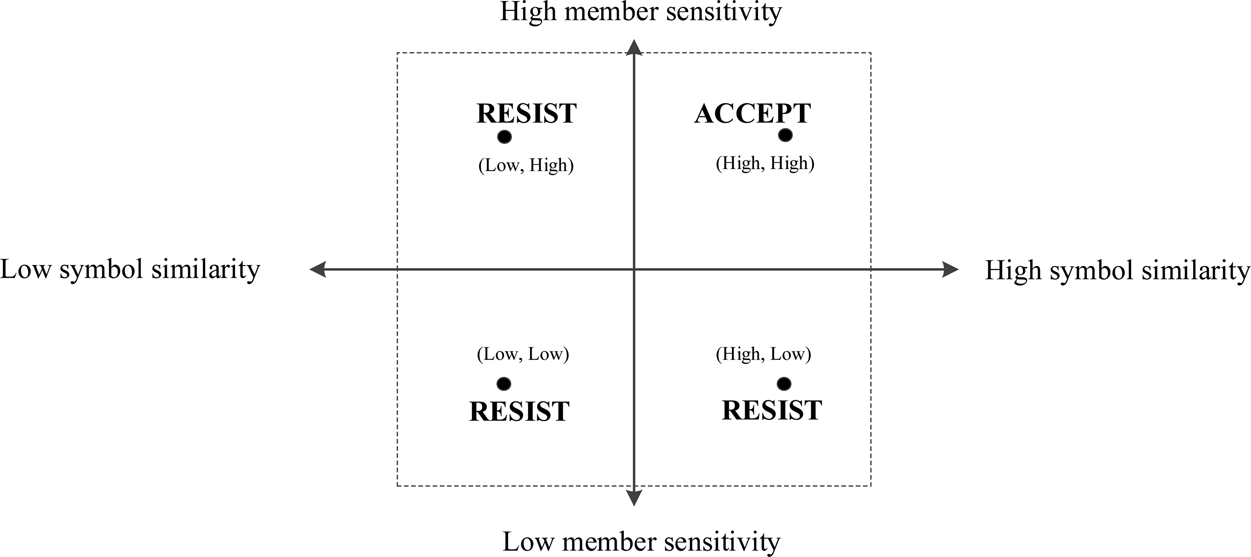
We draw a 2 × 2 matrix based on these two dimensions for four possible scenarios, as discussed below (Figure 2).
Four scenarios of CEOs using symbols to facilitate acceptance of members toward changes.

Quadrant 1 of the matrix: high sensitivity and high similarity
When symbolic behavior is very similar to stereotypical behavior and the members are very sensitive, the CEO symbol will penetrate the emotional core and trigger strong emotional responses from the organization members (Gomez & Jones, Reference Gomez and Jones2000). This emotional awakening can help the CEO to distract the members of the organization from the rational calculation of gains and losses, thus giving new meaning to those who stand to lose during the process of change. This introduction of meaning will help members of an organization emotionally accept the changes. In the financial industry, for example, financial firms are very sensitive to dress codes since the image conveyed to clients is all about competence and trustworthiness, so suits help to reinforce this image. For example, a new CEO at the investment bank Goldman Sachs starts to lead an important work meeting wearing a typical Silicon Valley tech style T-shirt and jeans; the message that this CEO wants to convey is obvious to the members via the apparelFootnote 4. In this case, the high sartorial standards of financial firm employees versus the well-established stereotype of the Silicon Valley uniform of jeans and a T-shirt clash create emotional volatility. This emotional fluctuation resonates with the desire for change, which is buried deep in the hearts of the organization members, giving them hope for change and thus winning their support.
Quadrant 2 of the matrix: high sensitivity and low similarity
When organization members are very sensitive to the symbolic behavior of the CEO but the CEO acts out in a way that bears little similarity to the related social stereotype, the symbolic behavior will not elicit emotions from the organization members. On the one hand, the high sensitivity of the members of the organization means that they can still perceive executive symbolism. On the other hand, low similarity means that the symbolic behavior of the CEO lacks the first typical stereotype as a frame of reference. In this case, members can use the difference between symbols and stereotypes to construct a cognitive field ‘parallel’ to the external environment in the cognitive field to create a parallel cognition without changing their original cognition of the organization. In this case, the CEO still needs to take additional incentive or punishment measures, construct the meaning of the symbolic behavior through a reasonable calculation process, and guide the organization members to make a positive response to the execution symbol. Storytelling is the most common symbolic behavior of CEOs. Every story told in a meeting, no matter how simple, is easily perceived by the organization members as a symbol beyond the story itself. In other words, members are highly sensitive to stories told by the CEO. However, not all stories can be quickly linked to a stereotype and lead to a consistent understanding among all members. As an example, we use a story told by former Yahoo CEO Marissa Mayer, who has been cited in many studies (Hambrick & Lovelace, Reference Hambrick and Lovelace2018). This involves a meeting in response to concerns about a new employee evaluation system that Marissa had just introduced. Before answering questions from employees about the evaluation system, Marissa told a story called ‘Bobbie Had a Nickel’. This is a story about a young boy who gets a nickel and then thinks about what he should buy, say, some candy or an ice cream cone. After the meeting, many expressed confusion about the story on Yahoo's message board. Some speculated that this story was meant to illustrate the difficult trade-offs that Yahoo faced. However, without any prior, accompanying, or follow-up explanation of the topic, the story fails to convey the CEO's ideas around change to the organization members, even though they all know that the CEO is trying to convey some important information about organizational changes through the story. This low similarity results in the uncertainly of the organization members of the emotional color that is intended to be conveyed, such as danger or hope, positive or negative. They only know that it is a meaningful story. In the absence of evoking an emotional resonance or conveying a precise message about rewards and punishments, members will continue to wait and observe any further definite signals instead of showing support toward change.
Quadrant 3 of the matrix: low sensitivity and high similarity
When the organization members are not sensitive to the symbolic behavior of the CEO and the CEO carries out symbolic behavior that has a high degree of similarity with the stereotypical behavior, the behavior will touch the emotional core of the members of the organization. However, since they are not sensitive to the symbolic behavior of the CEO, the members of the organization do not necessarily accept the planned changes merely based on emotional identification (Courpasson & Marti, Reference Courpasson and Marti2019). In contrast, those whose interests are damaged or cannot benefit from the change will continue to reject the change plan, since the members are not easily affected because of resistance. We continue with the example in Quadrant 1. The typical office wear dress code is less relevant for those who work in high-tech companies, which tend to have a very casual dress culture. Programmers often demonstrate competence through their computer and coding skills, which makes it more difficult for the CEO to use dress code changes as a symbolic signal to galvanize the members for change and obtain their support. Moreover, since high-tech companies do not have strict requirements around dress, it is not easy to associate information related to reward and punishments based on a signal around dress, and thus, it is difficult to change their attitude toward the impending changes merely through this symbolic signal.
Quadrant 4 of the matrix: low sensitivity and low similarity
When similarity and sensitivity are both low, it is difficult for organization members to observe that this symbolic behavior is associated with a particular stereotype. At the same time, since opposition would not have repercussions and would not directly lead to sanctions, members are more likely to adopt a rational calculation process. The CEO needs to add additional incentives to encourage the organization members to accept the proposed changes or create more sanctions to reduce their resistance to the change.
In summary, our framework model predicts that if the CEO chooses to introduce symbols through rationally calculated actions, the influence of the executive symbols on the attitudes of the organization members toward the organizational changes will be largely related to the clarity of the symbols themselves. The more clearly the CEO conveys the information about the benefits of the organizational change via the symbol, the more likely s/he can motivate the organization members to accept the planned changes. In addition, the attitudes of members toward organizational change largely depend on the benefits that they can reap from the changes in a rational calculation process. The change only makes sense if there are benefits. In this case, the CEO usually must motivate the organization members to accept changes under a permanent incentive system. Such systems are usually based on the power of the CEO. If the CEO is powerful, then s/he can be rationally calculative in action. However, not all CEOs have lasting power to influence their organization members. Interim CEOs, for example, or the successors of influential CEOs, face more or less a lack of legitimacy to exert much influence. It will be difficult to be rationally calculative to construct meaning through symbols and influence the attitudes of organization members. In this case, our theoretical framework suggests that the CEO should introduce symbols to carry out information transmission during emotional identification. In the process, the influence of symbols on the attitudes of the organization members depends on how the symbols are expressed. The expression of the symbols is largely related to the sensitivity of the organization members and the similarity of the symbols themselves to stereotypes. This kind of emotional identification increases the ability of the organization members to absorb the uncertainties of the changes so that they can accept the proposed planned change even if they cannot benefit from the change.
Discussion
As executive symbolism becomes increasingly common in organizational changes, the key challenge is to better understand its impacts. This paper is the first to address the knowledge gap by integrating the research results of the symbolic behavior of CEOs and executive symbols in recent years and combines foundational knowledge on sensemaking and sensegiving with insights from the organizational change dynamics literature to form a theoretical framework. This framework illustrates the main strategic dimensions and key stages of sensemaking and sensegiving of the organizational change process by the CEO through symbols or symbolic behavior and provides useful information for future research.
Existing theories about symbolism and organizational change do not indicate how CEOs can use symbols during sensemaking and sensegiving processes to facilitate support from organization members for changes (Pache & Santos, Reference Pache and Santos2010; Ramarajan & Reid, Reference Ramarajan and Reid2013). We address this knowledge gap by analyzing the role of CEO symbols in rational calculation and emotional identification, the two key paths taken in the sensemaking and sensegiving processes of organizational changes. First, we describe in detail three different forms of symbols that CEOs can use in their sensemaking and sensegiving processes for organizational change. Different symbols are good at conveying different types of information related to change due to their characteristics. In addition, we clarify the applicable conditions for using rational calculation and emotional identification that influence organizational change during sensemaking and sensegiving processes and propose that emotional identification can be used to obtain the consensus of organization members who have been negatively affected by rationally calculative actions toward change. The sensitivity of the members to the executive symbols and the similarity between symbolic and stereotypical behaviors determine the success of the symbolic behavior of the CEO.
The purpose of the above argument is not to reject the effectiveness of the classical theories of organizational change in analyzing the role of symbolic behaviors of CEOs. Instead, we emphasize that the role of symbolic behavior in organizational change is more complex and diverse than anticipated. This paper makes a comparative analysis of the rational calculation process, which emphasizes the rational benefits, and the emotional identification process, which emphasizes cognitive identification, and furthermore, proposes that the influence of symbolic behavior on organization members and organizational changes needs to consider the differences in executive symbolism. This is also the key point that we make to analyze the complexity of organizational change driven by symbolic behavior.
This paper is a supplement to the original sensemaking and sensegiving theories of organizational change: the finding of consensus among organization members to change facilitated by emotional identification extends the understanding of how organization members make meaning from the changes facilitated by a reward and punishment mechanism in the current sensemaking and sensegiving literature. This shows the vast potential of symbols as a tool to evoke emotional identification, thus bringing greater flexibility and sustainability to sensemaking and sensegiving processes in organizational change. If the CEO symbols can establish deep emotional resonance among the members of an organization, they will continue to accept organizational changes even if the initiator is no longer able to reward or punish them (Carlisle & Baden-Fuller, Reference Carlisle and Baden-Fuller2004).
At the same time, this paper also concludes that previous understanding of the influence of metaphors, slogans, symbolic objects, and other elements for the sensemaking and sensegiving of organizational change is limited. That is, their impact on organizational change goes beyond simply communicating the meaning behind the changes. In contrast, an effective CEO symbol will evoke emotional resonance among organization members and shift their focus from the rationally calculative actions of the CEO to a social-emotional lens with emotional resonance to encourage them to accept the changes. The latter more effectively reduces uncertainty toward changes, facilitates understanding behind the meaning of the organizational changes, and thus results in support for the changes. In contrast, symbolic objects, behavior, or events that are rationally calculative in nature will become ineffective in promoting change once their expected benefits or threats fail to be realized.
Limitations and future research possibilities
Finally, similar to other studies, this paper also has limitations, which means that there are possible future research areas. First, to illustrate our point of view, we have used many specific examples in the article. Most of these examples have explicit references or are based on media reports from well-known companies. However, there are a few examples that are not cited in the literature. The primary reason for this limitation is that the internal details of organizational change, especially the actions of the CEO and related events, are rarely addressed explicitly. Even if mentioned, some of the details that are of interest, such as the specific company names and people, are often missed because of the sensitivity of the information. Based on this limitation, we call for future studies to carry out qualitative and quantitative research with results on the relationship between the symbolic behavior of CEOs and change to test our propositions and increase the understanding of the issues of relevance. Second, the paper lacks quantitative data and empirical models and only includes evidence from archived data, news reports, commentary, and case studies. However, we believe that the perspectives obtained from the analysis in this paper can act as a reference and provide the basis for further quantitative empirical research. Future research can be based on the theoretical framework of this paper and develop variables that can be measured empirically to test the claims of this study.
Specifically, considering that in emotional identification, the sensitivity of the organization members and the similarity between the symbolic and stereotypical behaviors jointly determine the expression of symbols, empirical research that uses research methods such as compositional modeling is recommended. Unlike standard regression modeling, compositional modeling is a more comprehensive approach that focuses on the interdependence of variables (Campbell & Weese, Reference Campbell and Weese2017). When dealing with similarities around the sensitivity level of organization members and the symbolic behavior of a CEO, we cannot increase the degree of one component and leave the rest unchanged. The ratio of these two factors is interdependent, and members of an organization will be more sensitive to more similar behaviors due to their familiarity with them. This means that a hybrid model is very suitable for studying the affective role of symbols in the process of sensemaking. The conclusion of this paper is far from conclusive, but it is only a perspective that might inspire other work as opposed to conclusions of previous studies. Future studies could consider using empirical data to support the points presented in this paper. However, we understand the challenges of obtaining the quantitative data of different types of organizational symbolic behaviors and attitudes of the organization members toward change. A potentially feasible method is to obtain data on proxy variables such as analyst ratings and the employee turnover rate of listed companies for empirical research. In addition, learning from the historical approach used in entrepreneurship studies is also worthwhile (Wadhwani, Kirsch, Welter, Gartner, & Jones, Reference Wadhwani, Kirsch, Welter, Gartner and Jones2020). Like entrepreneurship, organizational change involves uncertainty and cannot be predicted by using the general rules of reasoning from pre-existing facts. This makes it difficult for creative reactions to be observed contemporaneously because they can never actually be understood in advance. In this context, history provides an opportunity for scholars to increase their current understanding of symbolism and diverse empirical research in new ways and link the field with broader multidisciplinary research. Future research can use historical research methods to further deepen the conceptual framework of this paper and explicitly examine the often-unstated historical assumptions behind the conceptual framework.
Acknowledgements
We thank Hailin Lan and Garry Bruton for their helpful comments and suggestions in the development of this paper. We also give special thanks to the editors and the reviewers for the considerable time and effort they invested in this manuscript. Their insight was critical to the developmental process for this paper. This work was supported by the National Natural Science Foundation of China (71902192) and the Hong Kong Scholar Program (XJ2020002).
Mr. Yu Wang has a master in engineering from Sun Yat-sen University and is currently a doctoral student at the School of Business of Sun Yat-sen University. His research interests include corporate strategy and corporate innovation. E-mail: wangy548@mail2.sysu.edu.cn
Dr. David Diwei Lv is a research fellow of the South China University of Technology. He is also the research fellow of the Hong Kong Polytechnic University under the Hong Kong Scholar Program. David's main interest is the antecedents of a firm's decision-making process, R&D management and open innovation. He has published papers in journals like Technovation, Journal of Business Research, Business Research Quarterly, R&D management, and Journal of Engineering and Technology Management. E-mail: lvdiwei@163.com
Prof. Christina WY Wong is a professor in the Institute of Textiles and Clothing as well as the associate dean of graduate school at The Hong Kong Polytechnic University. Christina's main interest is supply chain, green practices, corporate social responsibility, sustainability, environmental management systems, etc. She has published papers in journals like Journal of Operations Management, Journal of Management Information Systems, Industrial Marketing Management and Journal of Business Ethics. She is also an associate editor of Journal of Operations Management, and editor of International Journal of Operations and Production Management as well as Journal of Supply Chain Management. E-mail: christina.wy.wong@polyu.edu.hk