Scholars link increases in the descriptive representation of diverse backgrounds with positive outcomes for representation, writ large. Within this literature, a focus on gender and representation is particularly prominent. Higher levels of women's descriptive political representation boost legitimacy and trust in institutions (Mansbridge Reference Mansbridge1999), greater political engagement and activism (Barnes and Burchard Reference Barnes and Burchard2013; Campbell and Wolbrecht Reference Campbell and Wolbrecht2006; Wolbrecht and Campbell Reference Wolbrecht and Campbell2007), and increased political knowledge (Fridkin and Kenney Reference Fridkin and Kenney2014). Other works have explored more substantive effects for women's descriptive representation within a legislature, such as impacts on legislative output and efficiency (Anzia and Berry Reference Anzia and Berry2011; Volden and Wiseman Reference Volden and Wiseman2014). Yet another body of literature has investigated ways to improve women's access to political office, exploring the impact of electoral institutions (Bernauer, Giger, and Rosset Reference Bernauer, Giger and Rosset2015; Valdini Reference Valdini2012), candidate selection (Aldrich Reference Aldrich2018b; Krook Reference Krook2010b; Luhiste Reference Lühiste2015; Pruysers et al. Reference Pruysers, Cross, Gauja, Rahat, Scarrow, Webb and Poguntke2017), and gender quotas (Dahlerup and Freidenvall Reference Dahlerup and Freidenvall2010; Krook Reference Krook2010a; Matland Reference Matland2006). Research on gender quotas, in particular, has focused on the types that are the most effective in securing elected positions for women (e.g., Schwindt-Bayer Reference Schwindt-Bayer2009), as well as the qualities of women who are selected and then elected, both with and without the use of quotas (Baltrunaite et al. Reference Baltrunaite, Bello, Casarico and Profeta2014; Davidson-Schmich Reference Davidson-Schmich2016; Murray Reference Murray2010; Schwindt-Bayer Reference Schwindt-Bayer2011; Weeks and Baldez Reference Weeks and Baldez2015). The latter literature has tended to focus on the quality of female legislators in terms of political experience and performance in office. In addition, Besley et al. (Reference Besley, Olle Folke and Rickne2017) has even shown that quotas effect the quality of men that are recruited by parties once a gender quota is in effect, raising the competence of male politicians alongside the level of female representation. We contribute to this literature by exploring the aggregate impact of quotas on the diversity of political and professional background experience among male and female legislators elected to the European Parliament (EP).
Although most scholars would agree that increasing the number of women in office is a normatively desirable development, the use of gender quotas to achieve this outcome is not without controversy. Arguments against the use of gender quotas tend to center on the potential decrease in quality brought on by “quota candidates” or a reduction of merit-based competition that quotas might entail. With respect to merit, opponents of quotas argue that a lack of female representation is simply the result of individual choices made by women not to opt for political careers; artificially inflating the number of women on electoral ballots makes competition more about identity than quality (Baltrunaite et al. Reference Baltrunaite, Bello, Casarico and Profeta2014; Holzer and Neumark Reference Holzer and Neumark2000). Another perception of women elected using quotas is that they may not have been able to obtain office on their own and are therefore less qualified to serve. Not only does this perception discredit women in office, it also suggests that quotas may actually decrease the quality of political institutions on the whole (Lovenduski Reference Lovenduski2005; Murray Reference Murray2010). However, research specifically examining the women who enter elected office after the implementation of quotas has shown that these concerns are largely baseless. In fact, most of this literature uses single-country studies to show that “quota women” are not inferior to men or “non-quota women,” both in their qualifications for office and in their ability to work within legislatures (Baltrunaite et al. Reference Baltrunaite, Bello, Casarico and Profeta2014; Murray Reference Murray2010; Weeks and Baldez Reference Weeks and Baldez2015).
We have expanded upon this debate by examining the consequences of gender quotas for the diversity of experience witnessed in a legislature's composition. However, instead of examining the impact of quotas on the competency or qualifications of female legislators, we asked whether the presence of quotas is associated with a different overall composition of legislatures in significant ways. Using the unique electoral structure of the EP, where some members are elected under national and party-level quotas systems and others are not, we have been able to identify which systems are associated with no gaps between men and women's professional and political experience. Our analysis speaks to a larger debate on the extent to which quotas are associated with the removal of common barriers to entry for women who run for office in Europe. In general, systems using a combination of quotas and placement mandates, which are rules requiring the nomination of women to winnable constituencies or list positions (Schwindt-Bayer Reference Schwindt-Bayer2009), have more balanced representation between men and women and also higher levels of qualified politicians from both genders.
The EP provides an interesting test case for this inquiry. Not only is it among the most gender-equal legislatures in the world, it is also comprised of directly elected representatives from 28 liberal democracies and more than 100 national political parties. Although EU law sets a loose, common framework for EP elections, it also provides national parties and electoral systems with a great deal of agency to dictate the terms under which these elections will take place. With respect to the promotion of women in elected office, nine of the 28 EU member states actively incentivize the election of women via gender quotas that are directly required by national electoral law, in addition to dozens of national political parties that do so at an organizational level (Prpic and Chahri Reference Prpic and Chahri2017).
Using individual-level data on the previous professional and political experience of members of the European Parliament (MEPs), we compared the composition of delegations elected to the EP using quotas, both with and without electoral list placement mandates, to the institution as a whole. We have leveraged the uniquely diverse electoral features of the EP to assess the impact of quotas on the composition of the parliament in a way that single-country studies cannot, making a unique empirical contribution to the broader literature on gender quotas.
Although gender quotas and other institutional decisions meant to boost the quantity of female representation have been significantly associated with indicators of professional experience and political expertise, they are not the direct cause of differences in the experience and expertise of MEPs. In fact, in systems in which quotas and placement mandates are in use, differences between men and women tend not to exist, with respect to previous political and professional experience. In addition, systems with quotas contain more experienced MEPs overall, across both males and females, which thereby increases the general quality of the EP. These findings echo the work of scholars from other legislative venues and show that quotas and protocols intended to increase female representation may not only “open the door” or “even the playing field” for elected women but may also more broadly improve the quality of representatives present in the legislature.
ASSESSING THE IMPACT OF QUOTAS ON FEMALE REPRESENTATION
A number of studies have considered the degree to which quotas and other mechanisms for boosting female representation are effective at increasing the number of female representatives, as well as enhancing the quality of representation. We begin by discussing the traditional barriers to entry present in electoral contexts that impact both the quantity and composition (in terms of experience) of the pool of female candidates in democratic societies. We then focus on gender quotas as one institutional tool that can be used to overcome these barriers.
Improving the Recruitment Environment
Women have traditionally faced barriers to election that affect both the supply and demand sides of the political recruitment environment. Among these barriers, electoral systems are one of the most important. At a basic level, the difference between proportional representation (PR) systems and single-member majority districts (SMD) affects women by defining the scope of competition. The nature of this competition also affects both the type of women willing to run and the type of women that parties nominate. SMD and open-list PR systems require women to compete directly against other candidates. In SMDs, this is only their opponent, whereas in open-list PR systems this may be both their fellow party members and opponents from other parties. Thus, they compete on their personal merits, either alone or alongside the merits of their group, whereas closed-list PR systems structure competition around the group. This structure influences the type of candidates that will run for office; not all women feel qualified to compete in an individual manner. Fox and Lawless (Reference Fox and Lawless2004) showed that women doubt their qualifications to run for office more so than men, even when they are objectively as qualified. Kanthak and Woon (Reference Kanthak and Woon2015) used an experimental design to show that women are more averse to the competitive nature of elections, in general, and are only more likely to run if the private costs of doing so can be eliminated. Accordingly, when women do run, we might expect them to be a particular ‘kind’ of woman, in terms of their experience, qualifications, and ambition.
Women who run for office in more individually competitive electoral systems tend to share similar characteristics and qualifications for office. Schwindt-Bayer (Reference Schwindt-Bayer2011), in her study of women in Latin American legislatures, showed that women who win elections for legislative office represent a particular type of candidate. Specifically, these women tend to represent more traditionally defined ‘male’ roles. To compete against men, these women are highly educated and have considerable political and professional experience in areas that traditionally lead to political careers. They are also less likely to be married or have a family and are more likely to be politically ambitious. In other words, they are like the men that they run against and may not be providing the ‘women's’ perspective that descriptive representation is thought to entail.
Being more “like men” has also been shown to be lucrative in elections outside Latin America. For example, Huddy and Terkildsen (Reference Huddy and Terkildsen1993) showed that candidates with ‘masculine’ traits are considered more competent in important policy areas like the military and the economy, which can be helpful in winning elections. But displaying masculine characteristics also has a downside. More recent research has shown that voters also prefer female politicians with more traditional family roles, which can put women candidates in a “double bind” (Teele, Kalla, and Rosenbluth Reference Teele, Kalla and Rosenbluth2018). Having the traits similar to men that signal competence and the ambition to run for office may make a female candidate appear less likeable and overall less competitive.
Each of these factors, combined with the fact that women are rarely encouraged to run for office in the way that men are (Fox and Lawless Reference Fox and Lawless2004), contributes to an undersupply of women across the board. Unsurprisingly, women, regardless of their qualifications, are less likely to run for office than men, and legislatures still have relatively fewer women than men overall. How can women be encouraged to run for office? Institutional rules, like quotas, can help to create a female-friendly environment to encourage ambitious women.
Parties in a variety of national contexts have therefore experimented with the usage of gender quotas at the nomination stage, where various mechanical thresholds require parties to select certain numbers of female candidates. These quotas may be set as either national law or as internal party policies, and they vary widely from overtly tokenistic schemes to ones meant to ensure full gender parity. What they have in common is a requirement for female candidates that can eliminate some of the more individually competitive aspects of candidate selection in non-quota systems, which encourages a more diverse pool of candidates.
Quotas and the Dynamics of Representation
The quota literature largely supports the idea that gender quotas can lower barriers in the recruitment environment of elections for women. A number of studies have examined how electoral laws and policies—particularly gender parity quotas at the recruitment and nomination stage—affect legislator quality within the national political systems of Europe. Allen, Cutts, and Campbell (Reference Allen, Cutts and Campbell2016) examined this question within the United Kingdom, following the introduction of party-level gender quotas in 1997. Women elected under the new quota system were not significantly different than women who were not nominated under quotas, with respect to their backgrounds, vote totals, and further abilities for political advancement. Similarly, Murray (Reference Murray2010) concluded that women's background qualifications and experience, prior to election to the French parliament, were not reduced by the introduction of quotas; there were simply more women listed on the ballot. Such findings suggest that women may not be more (or less) qualified when elected on quotas, but that their ‘numerical’ representation successfully increased.
The question of whether an increased number of female representatives elected via gender quotas affects the overall background qualities of legislators has also been addressed at some length. Taking advantage of a natural experiment in Italy, in which quotas were introduced and then removed, both Baltrunaite et al. (Reference Baltrunaite, Bello, Casarico and Profeta2014) and Weeks and Baldez (Reference Weeks and Baldez2015) found that quotas increased the numbers of women elected to the Italian parliament. For Baltrunaite et al., the increased number of female representatives corresponded with a heightened level of education across all legislators, whereas it reduced the number of male legislators without advanced degrees. Weeks and Baldez’ work echoed this finding, concluding that gender quotas helped to boost the number of women in national office who had prior local political experience and lowered absenteeism across the national legislative body. Somewhat pessimistically, however, these same trends reversed shortly after the Italian quotas were removed.
In addition, O'Brien and Rickne (Reference O'Brien and Rickne2016) showed that the strict gender parity required by local Swedish social democratic party boards not only increased women's representation within the party but also enabled more women to advance into national positions of political leadership more quickly than their colleagues from parties without such regulations. One of the positive externalities of this change in party leadership was the removal of mediocre male party leaders. Besley et al. (Reference Besley, Olle Folke and Rickne2017) suggested that increased competition for male seats after the introduction of a quota made it harder for mediocre leaders to nominate mediocre men in elections and maintain their grip on power in the party. More competent leaders arose, sometimes through the support of women making the most use of the new quotas. These leaders than nominated more competent candidates overall, therefore raising the entire level of quality of candidates across both genders.
Finally, experimental work has demonstrated that the elimination of competition for leadership roles encourages qualified women to seek out these opportunities. Neiderle, Segal, and Vesterlund (Reference Niederle, Segal and Vesterlund2013) have argued that the absence of women in high-profile and competitive jobs might be caused by the competitive environment, in which highly qualified women choose not to enter competitions that they could win. They used experimental evidence to show that introducing affirmative action policies not only encourages more women to participate in competitive tournaments but also maintains the overall quality of all participants. In a similar study, Kanthak and Woon (Reference Kanthak and Woon2015) tested whether women were more sensitive to competitive elections than men, regardless of their objective ability to win or their beliefs about others abilities. Even qualified women were averse to electoral competition, and removing the competitive aspects of elections in favor of volunteer opportunities increased the likelihood that women would step forward as candidates.
In sum, the literature suggests that quota laws and other institutional choices meant to boost gender parity do increase the number of female representatives but do not hurt the quality of representation offered by female legislators. Indeed, quotas may even help raise the quality bar across the bodies in which these rules are found by both introducing competent and quality female candidates and making the nomination of less qualified men more difficult. We therefore expect the presence of quotas in European elections to also impact the type of legislator elected from European Union member states that use them.
Contextual Factors and Women's Recruitment
In addition to institutional rules like quotas, a variety of contextual factors and party characteristics also affect the recruitment environment. At the national level, the inclusion of more women in politics, lower incumbency rates, and overall increased gender equality can encourage more women in office. When women are in elected positions, they serve as role models for other women and girls and encourage political participation (Barnes and Burchard Reference Barnes and Burchard2013; Campbell and Wolbrecht Reference Campbell and Wolbrecht2006; Wolbrecht and Campbell Reference Wolbrecht and Campbell2007). When overall gender equality is high, traditional gender roles and stereotypes about women in office are less pronounced, encouraging more women to seek office (Krook and Norris Reference Krook and Norris2014). Party characteristics such as ideology, the organization of candidates selection, and the number of women activists within the party also play a role (Caul Reference Caul2001). Here, the literature reveals that the most gender-equal legislatures come from countries in which the recruitment environment is the most positive toward women's issues and gender equality concerns. This cultural predisposition should be helpful to women's recruitment at both the party and at the national level. Furthermore, it suggests that an electoral system that combines proportional representation with gender quotas should be most helpful at increasing women's descriptive representation in legislatures. Having considered the general picture, we now examine how these factors are at play in Europe's largest directly elected legislature.
Women's Representation in the European Parliament
In many ways, the EP operates as a microcosm for the comparative study of institutional design in Europe. Although MEPs follow a common set of rules and procedures within the assembly, they are elected via systems that vary widely from country to country and includes parties that represent the full spectrum of political beliefs present across the continent. Reflective of the EU motto, “United in Diversity,” EP elections provide an interesting empirical example of the various systems and peoples found across the European Union, unified within a singular institution.
However, the EP is also an outlier with respect to female representation. The May 2014 EP elections produced an all-time high for women's representation at the EU level, with female MEPs occupying more than a one-third of seats in the multinational legislative assembly. By the midpoint of the term in 2017, this number had grown to 37.9% of all MEPs—making the EP one of the world's most gender-equal legislatures. At the same time, only 22 national legislatures (six of which are EU member states) from around the world could boast a higher degree of female representation (Prpic and Chahri Reference Prpic and Chahri2017). What explains this success in boosting the number of female representatives and what are its consequences for the EP?
Fortin-Rittberger and Rittberger (Reference Fortin-Rittberger and Rittberger2015) examine women's recruitment to the EP during the 2009 elections and find that female MEPs benefit from recruitment strategies that allow for centralized party selection mechanisms at a mix of regional and national levels. In other work, they also find that women are more likely to win election to the EP when they come from countries or parties that employ gender quotas, are nominated to closed lists, and come from districts with greater numbers of MEPs (Fortin-Rittberger and Rittberger Reference Fortin-Rittberger and Rittberger2014; Lühiste Reference Lühiste2015). Although these findings are broadly in keeping with the thrust of the literature that we discussed previously, it is particularly interesting to note that, although all EP elections are inherently proportional, the varying sizes of country delegations suggest that some elections are more proportional than others.
Beyond the mechanical effects of differing electoral systems, other scholars examine intraparty differences for the success of women's election to the EP. Lühiste and Kenny (Reference Lühiste and Kenny2016) concluded that although female MEPs are more likely to come from Leftist parties, which are more likely to use inclusive quotas, women from more conservative and rightist parties are actually more likely to demonstrate relevant political experience and may be more successful in advancing their legislative careers. Aldrich (Reference Aldrich2018b) posited that centralization of party organizations affects the likelihood of selection and nomination for women candidates to the EP. Chiva (Reference Chiva2014) showed that the traditional Left–Right ideological spectrum was less successful than the pro-/anti-EU dimension in accounting for the presence of female MEPs from Central and Eastern European member states. Anti-EU parties may view pro-gender equality as a ‘Western’ norm that is imposed upon parties from the European Union. Finally, Xydias (Reference Xydias2016) examined the role of the second-order elections model on women's representation and discovers that women MEPs are at a comparative advantage for EP elections when they come from national parties that take the EP less seriously and are therefore less competitive with their candidate selection practices.
Although this mixed bag of cultural and institutional variables may make election to the EP more or less difficult for certain types of women, Fortin-Rittberger and Rittberger (Reference Fortin-Rittberger and Rittberger2014) also explained how the EP may be a particularly attractive place for women to work, as compared with national political systems. Because EP elections are less competitive, ambitious women can be advantaged in both ballot selection and election times, as parties and voters pay less attention to who is being elected. Because EP elections are all at least somewhat proportional, women do not suffer the high barriers to entry faced in majoritarian elections. And because the European Union is more gender-mainstreamed and typically more developed in its gender-equality policies, women MEPs may find a neater substantive fit with EU policy making.Footnote 1
In sum, the EP appears to have more female legislators than many national parliaments for the same mix of cultural and institutional reasons that many European legislatures have more female legislators than in other parts of the world. However, given the diverse national systems that coexist within the EP space, every female MEP who benefits from a more gender-equal national political environment and comes from a political party with advantageous selection criteria may also work alongside MEPs from political environments that are less friendly to women's political recruitment. Therefore, we now consider how the sources of variation present in women's selection to the EP may also influence the dynamics of representation on offer there.
THEORIZING THE EFFECT OF GENDER QUOTAS ON REPRESENTATIVE QUALITIES
Thus far, we have considered the effect of quotas on women's legislative representation, with a particular emphasis on the intra-institutional diversity of the EP. In this section, we move on to theorize how the varied usage of gender quotas may also have unintended side effects on the qualities that MEPs demonstrate in their work as legislators. Although the EP was once viewed as an overly complex and technical institution with an extraordinary turnover rate among legislators (e.g., Daniel and Metzger Reference Daniel and Metzger2018), its increased professionalization since the introduction of legislative codecision with the Council in the early 1990s has led to a growing class of politicians whose primary ambition lies in working for the European body (e.g., Daniel Reference Daniel2015). At the same time, national parties have increasingly used European elections strategically to further their national and European goals (Aldrich Reference Aldrich2018a; Pemstein, Meserve, and Bernhard Reference Pemstein, Meserve and Bernhard2015), often favoring incumbent MEPs in the selection of candidates (Meserve, Pemstein, and Bernhard Reference Meserve, Pemstein and Bernhard2018). Nonetheless, incumbent MEPs are not the only politicians recruited for EP elections.
The seniority-driven hierarchies found in many of the EP's internal institutions (Daniel Reference Daniel2013; Ringe Reference Ringe2010; Yoshinaka, McElroy, and Bowler Reference Yoshinaka, McElroy and Bowler2010) suggest that national parties should seek out politicians who are prepared to take on the subject matter dealt with at the EP level, as well as to protect career MEPs. Although we expect that all parties have the rational incentive to select high-quality politicians for office, when it comes to women's recruitment and selection initiatives, we expect that parties using quotas will also feature a higher number of women in electable positions. This will have the related effect of an increased number of quality female politicians, while also making the remaining spots left for male politicians more competitive. In other words, we expect that parties that use quotas will field a quality list of both male and female candidates, but that they may also have fewer spots left over for less qualified men. This will lead such parties’ politicians to be of an overall higher quality.
In the absence of direct previous experience in the EP, the literature consistently views political experience as synonymous with quality candidacy. We expect that when gender quotas require parties to bring in new candidates, these candidates will not only be disproportionately women but will also be more experienced in politics. For this contention and all others, we further expect that quotas will be most effective if they operate alongside placement mandates, which force parties not to squander female candidates in unelectable electoral positions. In other words, our first hypothesis is as follows:
H 1:
Countries and parties using gender quotas (alongside placement mandates) will be associated with MEPs who have higher levels of previous political experience.
However, political experience is not the only important aspect for completing effective work in EP policy making. Specifically, within the literature on the committee-driven nature of EP legislating, the highly technical and oftentimes apolitical nature of EP work is cited as necessitating the recruitment of MEPs who are more likely to be equipped for the demands of specialized committee work (Daniel Reference Daniel2013, but see also Yordanova Reference Yordanova2013). Within the context of gender rules, we expect to see a similar relationship as in H 1, whereby parties that use gender quotas will recruit MEPs that demonstrate higher levels of the sorts of education and professional expertise that are most relevant for EP work. However, what makes an MEP a ‘quality’ one in this case is not political experience alone. More specifically, we anticipate that MEPs from such parties will have more advanced educations and come from employment backgrounds that are more directly compatible with EP work, such as law, international relations, or finance.
H 2:
Countries and parties using gender quotas (alongside placement mandates) will be associated with MEPs who have higher levels of relevant professional expertise for EP work.
To summarize the full argument, we view gender quotas and placement mandates to be useful institutional innovations that can increase women's descriptive representation because they eliminate some traditional barriers to entry for female candidates. Because the candidate pool is increased when more women are encouraged and recruited for office, quotas should raise the bar for the presence of legislators with characteristics more broadly suited to the technical nature of legislative work in the EP. Naturally, a variety of additional variables may also contribute to the success of national parties to send politicians to the EP with heightened political experience and relevant professional expertise. We explore such alternate expectations in the following section.
FIRST CUT: IDENTIFYING GENDERED DIFFERENCES IN MEP QUALITY
To test a theory about gender quotas and legislator experience, we explored the distribution of experience in the EP in 2014 in two ways. Using data from Daniel and Thierse (Reference Daniel and Metzger2018), we first explored the previous political experience of both male and female MEPs, before examining the kinds of expertise gained from their professional backgrounds. In terms of political experience, we identified those MEPs who previously held positions on national party boards, served as members of national parliaments, held local office, or who are returned incumbents from the EP. The measures of relevant professional expertise identify MEPs that have either demonstrated professional experience or educational training, prior to their EP mandate, that is directly related to a particular policy area prescient to the EP's specialized committee system. These categories include MEPs with expertise in agriculture, legal experience, medicine, economics and finance, transportation and telecommunications, education and teaching, international affairs, and journalism.Footnote 2
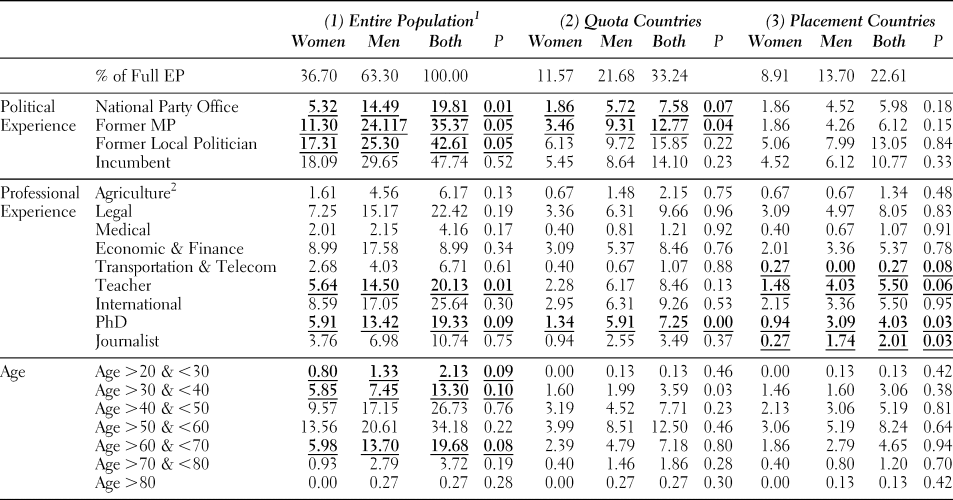
We began by examining simple associative patterns between all MEPs elected in 2014, their levels of political experience and professional expertise, and their gender. Table 1 displays descriptive information on the percentage of MEPs having each type of experience and expertise across gender and the results of a χ2 test for significant differences between genders. The first subset of columns (1) presents the percentage of women, men, and total MEPs with each category of experience for the entire EP. The second subset (2) presents the percentage of MEPs from member states that use any quota, and the third (3) presents the percentage of MEPs in states that use both a quota and a placement mandate. Thus, all percentages were calculated based upon the total number of MEPs. For example, for gendered differences of MEPs who had experience as a former MP, the first subset indicates that 35.37% of all MEPs had this type experience. However, female MEPs with this type of experience made up only 11.30% of the EP, and male MEPs with such experience represented 24.07% of the EP. The data from quota countries (subset 2) tell us that only 12.77% of all MEPs came from quota countries and had experience as a national MP; 3.46% of all MEPs were female former national MPs from quota countries and 9.31% of the EP were male former MPs and came from quota countries, and so on.
Gender and Experience in the European Parliament

1 The subset of columns provides the percentage of women, men, and all MEPs that hold each category of experience, among all MEPs initially seated in 2014 (1), the percentage of all women, men, and MEPs that hold each category of experience and that also come from Quota countries (2), and the percentage of all women, men, and MEPs that hold each category of experience and that also come from placement countries (3), respectively. Each p column provides the p value of a X2 test of association between genders for each category of experience, in each subgroup. Bold and underlined values indicate X2 values with significance ≥90%.
2 For all professional categories, N = 745 and thus the percentage calculations for these experience categories use 745 as the denominator. Categories are not necessarily mutually exclusive.
The columns for the entire population of MEPs, signified through bold and underlined cells, show that differing levels of experience in national party office, past national parliamentary membership and having held a local office are each significantly gendered (in other words, the likelihood of male and female MEPs to display different propensities to appear in each category is significantly different). More specifically, there were significantly more men than women with these types of experience in the EP. On the other hand, gender was not significantly associated with differences in the level of many professional background categories, nor are there many differences in age. This suggests that, on the whole, differences in MEP background that are attributable to gender are mostly limited to political experience.
In contrast to the population as a whole, if we only examine patterns among the subsets of MEPs that have come from countries with quotas or countries with both quotas and placement mandates, then these patterns change. Information on quotas at the national level (i.e., legislated quotas) was taken from Freidenvall and Dahlerup (Reference Freidenvall and Dahlerup2013). The columns show that combining quotas with placement mandates effectively eliminated significant gendered differences for political experience. For example, simple quotas reduced the presence of significant gendered differences in previous local office and national party office, but the addition of placement mandates eliminated significant difference in all forms of political experience. These preliminary results show that although differences in experience across genders do exist for the entire population of MEPs, they do not exist in those countries where both quotas and placement mandates are in place.
EXPLANATIONS FOR WOMEN'S REPRESENTATION: LOGISTIC REGRESSION RESULTS AND DISCUSSION
Although the associative tests indicate that differences exist between male and female MEPs and that these differences are mitigated by the presence of quota and placement rules, several other factors can also lead to the selection and election of experienced legislators. To test the hypothesized relationships across a variety of national and party-level factors, we next modeled a series of logistic regressions that control for various institutional and cultural differences at the national level. These models considered each type of professional and political experience and expertise separately, as their dependent variable. In these models, we used an ordinal measure of quota strength, national gender quota, to measure the variance in gender quota laws at the national level. This variable takes three values, 0 in countries where no quotas exists, 1 in countries where simple quotas exist that require no specific placement of women on electoral lists, and 2 for countries where placement mandates exist.Footnote 3 In keeping with our hypotheses, the expectation was that higher values of the quota index would correspond with a heightened presence of experience and expertise.
In addition to these national characteristics, the models also included additional indicators that may have had bearing on the presence of certain types of experience and expertise and that may have also helped or hurt women's descriptive representation. We used an updated version of Gallagher's (Reference Gallagher1991) measure of the disproportionality (based upon calculations from European Election Survey 2009) of the national electoral system (i.e., disproportionality) and the presence of closed lists in European elections to identify variations across differing national electoral systems. The variable districts was used to account for the number of electoral districts used for European elections in a given country.Footnote 4 Each of these indicators served as a proxy for institutional environments that may have influenced the probability of electing women. To capture the gendered nature of the national political environment, we used three measures that address the general level of gender equality in each EU member state: women with degree, which measures the percentage of women per 100 men with an advanced education in each member state,Footnote 5women in national parliament, which provides the percentage of each national legislature that is female,Footnote 6 and gender equality index. This index is a composite indicator of general levels of equality across work, money, knowledge, time, power and health provided by the European Institute for Gender Equality.Footnote 7
We began by estimating a set of regression models that include country-level data on all MEPs that were initially seated in 2014, excluding replacement MEPs. For each dependent variable, we estimated models using the entire sample of MEPs, just female MEPs, and just male MEPs, to test the effects of quotas across both genders. All logistic models use country-clustered standard errors to account for unobserved heterogeneity at the country level.
Country-Level Quotas and Experience
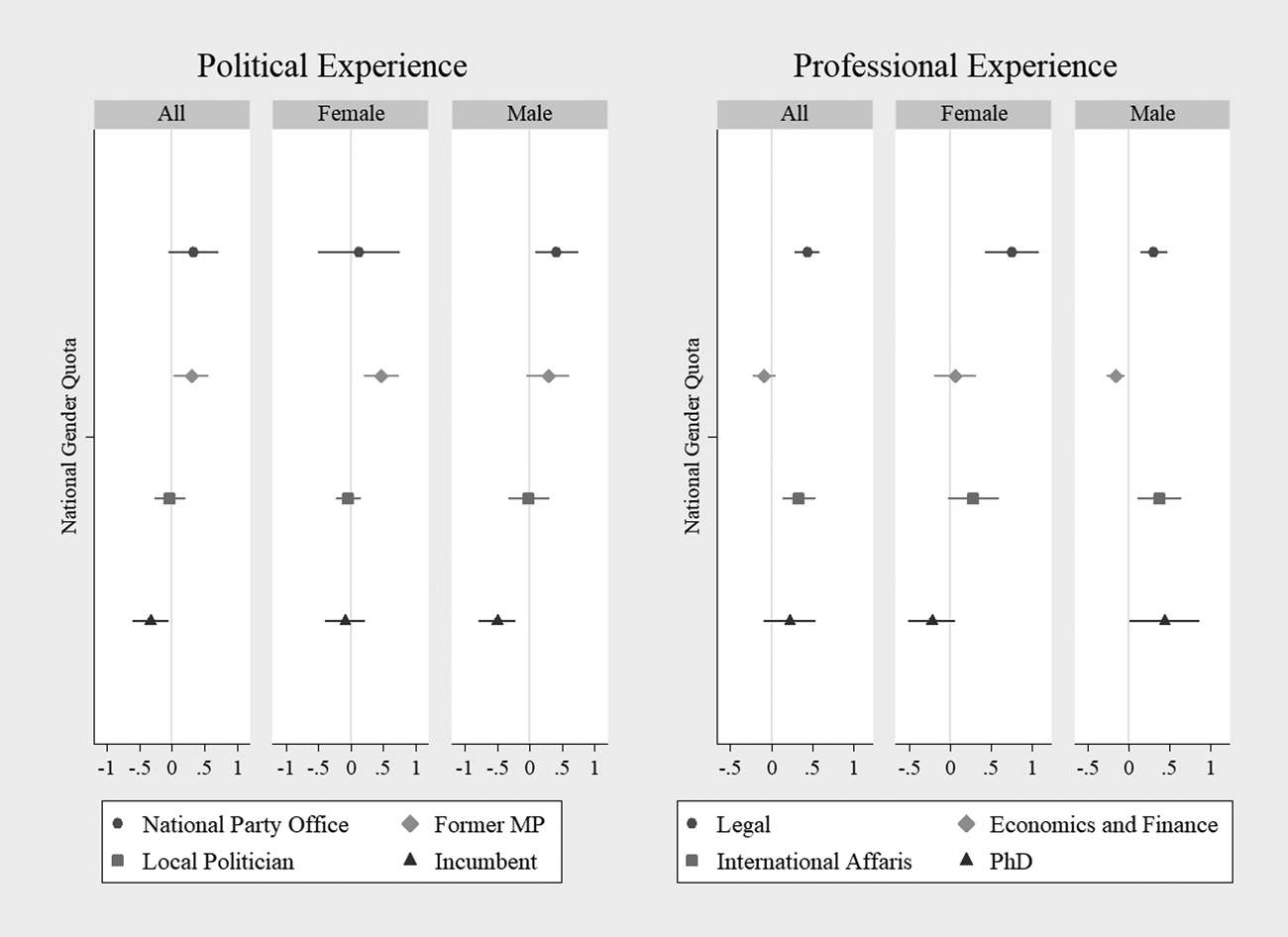
Figure 1 presents the results of the logistic regression analysis for a few key areas of professional and political experience for MEPs across the three data groupings (all MEPs, female MEPs, and male MEPs). The first set of plots report the coefficients and 95% confidence intervals for the effect of national gender quotas and placement mandates on the presence of MEPs with political experience and the second set of plots report the coefficients for relevant professional experience and expertise.Footnote 8
Experience and national gender quotas. The plots display the coefficients and 95% confidence intervals of National Gender Quota for each dependent variable measuring experience.

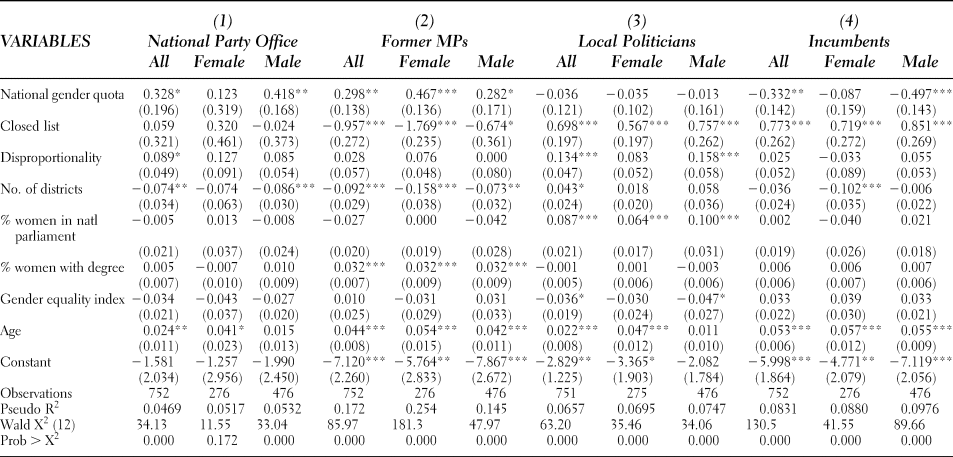
Examining the coefficient plots for previous political experience yielded mixed results for the effect of national gender quotas across women and men. The average effect of national gender quotas on the entire population of MEPs was not significantly associated with the likelihood of an MEP demonstrating most types of previous political experience with only national MPs showing a significant and positive relationship. However, testing the relationship between quotas and political experience across the gendered subgroups highlights more nuanced results that are consistent with H 1. Most notably, the presence of gender quotas does correlate with the likelihood that women will have national experience (former MP) prior to entering the EP, as well as the likelihood that men will have held national party office. This provides evidence in support of H 1, which predicted that countries with national gender quotas will have more politically experienced MEPs. The positive and significant effect of the quotas demonstrate the increased likelihood that both male and female MEPs have had previous national experience that may be useful to them in their work in the EP.
Interestingly, Figure 1 also shows that quota countries are significantly less likely to contain re-elected MEPs from the previous term (marked as incumbents), which does not conform to basic assumptions made by H 1, but the effect appears to be driven by a significant decrease of male incumbents when quotas are used. Although the lack of longitudinal information in the structure of our data set makes it difficult to isolate the mechanism at play specifically, this finding supports our argument that when countries or parties include gender quotas with placement mandates, competition increases for male MEPs, who may be less assured of winning re-election. In particular, the presence of a national gender quota decreases the predicted probability that an MEP is a male incumbent by approximately 11.4%, with placement mandates reducing this by an additional 9.3%. This reduced the male incumbency advantage by nearly half: falling from a 43% predicted likelihood, when no quotas were in place, to only approximately 22.5% when quotas and mandates were used, ceteris paribus.Footnote 9
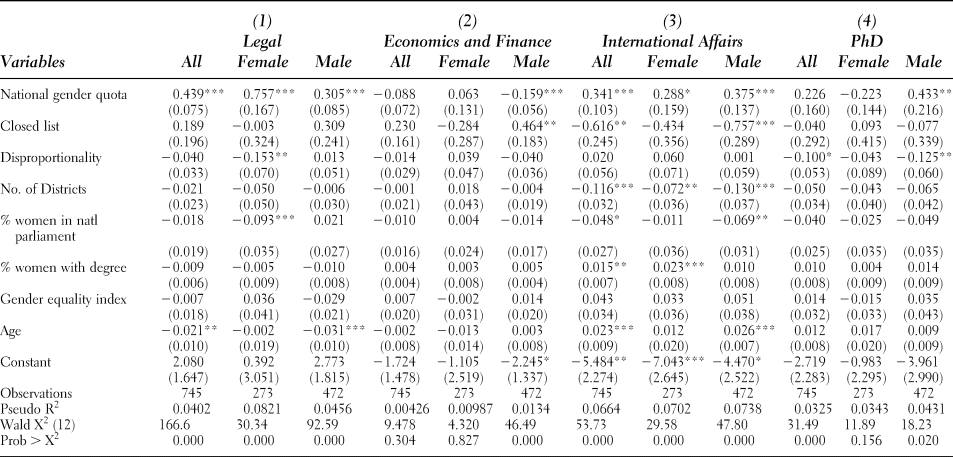
With respect to professional experience, Figure 1 also shows that both men and women from quota countries were significantly more likely to hold qualifications in law and international affairs, and a male member was more likely to have a doctoral degree when he came from a country with a national-level gender quota. Both of these attributes are useful for success in the EP's technical “working parliament” environment. These results provide evidence in support of H2, which argues that national-level quotas increase the number of professionally experienced candidates entering the EP. Of course, the nature of gender equality within each member state might also influence the type of experience MEPs have because professional and educational success might be subject to gendered patterns within society. To account for some of these patterns, we included several controls variables for gender equality both in politics and education and an overall general measure. The relationships of these control variables to our experience categories are presented in Tables A1.1 and A1.2 in the appendix. These results show that these measure are, in most cases, not significant predictors of experience. The most notable relationship was observed between women's education and experience, where the education for women was significantly associated with more women in international affairs, and between women in national parliaments and local politicians, which also had a significant and positive relationship.
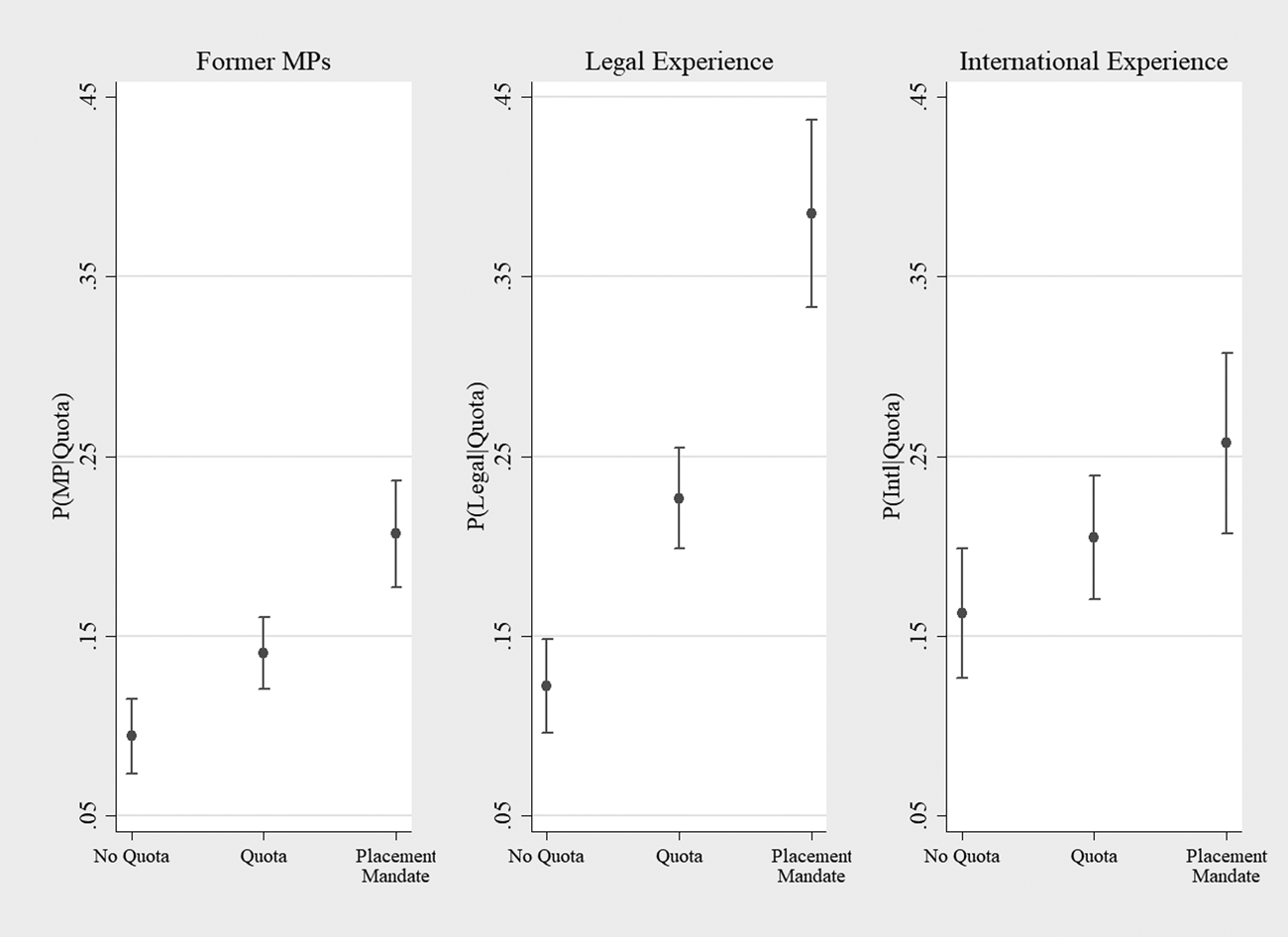
To further evaluate the substantive effects of quotas and placement mandates described in the preceding text, Figure 2 presents the predicted probability that female MEPs had former experience as a national MP (left), expertise in legal professions (center), and expertise in international affairs (right), given the presence of a national quota law in their home country. The results suggest that the power of gender quotas to increase the likelihood of these types of experience mostly accompanied the presence of placement mandates, in conjunction with quotas. In fact, the confidence intervals for the former MPs show that the effect of implementing a placement mandate nearly doubled the effect of a quota. The predicted probability of a woman holding previous experience as an MP increased by half from the baseline, jumping from roughly 9% to nearly 14% when simple quotas were instituted. The inclusion of a placement mandate increased this likelihood again, to more than 20%. The power of placement mandates were also evident when evaluating experience in international affairs. The right panel of the figure shows that the effect of national quotas were essentially indistinguishable from the absence of quotas, with overlapping confidence intervals and average probabilities of approximately 16% and 20%, respectively. However, placement mandates increased the predicted probably of international experience by an additional 10%.Footnote 10
Predicted probabilities of female MEPs and national gender quotas. The plots above display the mean predicted probability and 95% confidence intervals for each dependent variable measuring given the level of quota. All remaining variables in model set to their mean with the exception of closed list which is set at its median.

The center column of Figure 2 shows similar results with respect to legal experience, suggesting that the EP benefitted from more women with legal experience when countries used both a simple quota and a placement mandate. Here, the baseline probability that a female MEP had legal experience was approximately 12%, with a quota increasing this probability to approximately 23%, and placement mandates increased this to approximately 39%. Again, the use of the quota combined with a mandate had a significantly larger effect than the use of simple quotas. In this case, national quotas also had a similar effect on men, increasing the probability that they had legal experience by approximately 5% with quotas and 10.5% with placement mandates from a baseline of approximately 17.5%. These results provide additional evidence in support of H 1 with respect to women in the EP, and also highlights how placement mandates are a powerful tool for increasing the level of women with relevant experience and expertise in the EP. Overall, these models show fairly substantial effects that support H 1 and H 2 and suggest that quotas are generally good for increasing the professional expertise among those entering the Parliament and that placement mandates amplify these effects.
In assessing the impact of quotas on the type of MEP expertise, it is also important to note the influence of other factors that may bias for or against the sorts of expertise examined in the preceding text. Among common electoral system variables, we found significant and independent effects for closed-list systems, disproportionality, and the number districts. Regardless of MEP gender, more disproportional systems tended to have more former MPs and local politicians in the EP, whereas states with more districts tended to have less former MPs. This result is unsurprising, given that electoral systems with several less-proportional districts have many party lists that elect only a single or a few MEPs. Therefore, we expected to see more homogeneity in the types of candidates that enter the EP through these systems. A more important effect was that of closed-list ballots. In the model for political experience, this variable increased the likelihood that men had political experience while decreasing the likelihood that women had political experience. Figure 3 shows the coefficients of this variable across genders.
Political experience and closed ballot effects.

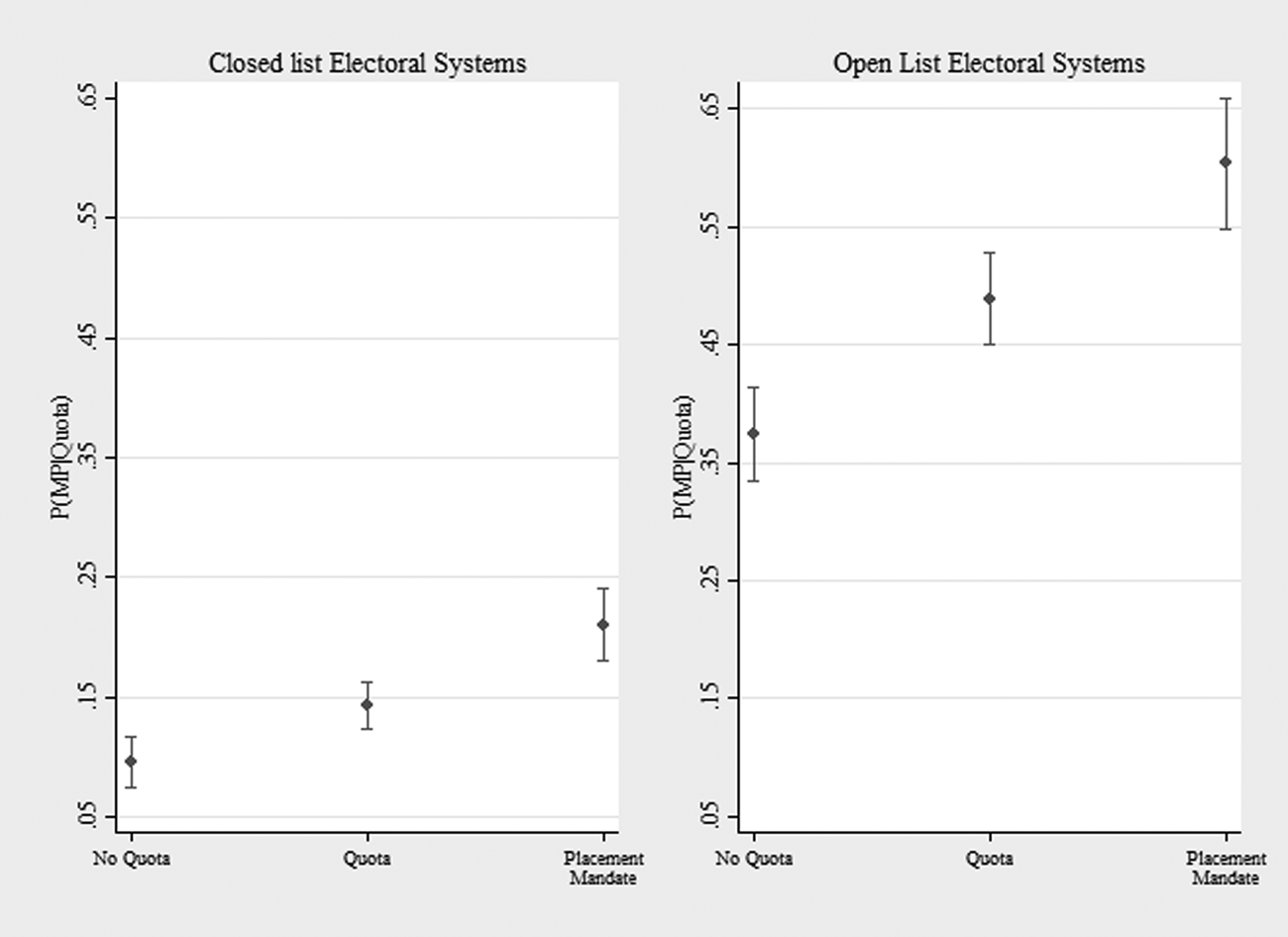
As Figure 3 shows, closed-list ballots increased the likelihood that all MEPs will had experience as incumbents and local politicians and decreased the likelihood that women had been former MPs. This result is especially interesting, given that national gender quotas increased this type of experience in women. This finding suggests that closed ballots may attenuate the positive effects of gender quotas on female MEPs. To explore this further, Figure 4 presents the effect of national gender quotas on the predicted probability that a female MEP served in the national parliament in states with closed-list systems and states that had open ballots. As the figure shows, states with closed-list ballots in place had, on average, a lower probability of women in the EP that have served in national parliaments than did states with open-list systems.
Ballot effects and female MEPs as former MPs.

However, the overall effect of gender quotas on recruiting MEPs with previous expertise remains positive. In states with closed lists, the use of a simple gender quota increased the predicted probability that women had experience as a former MP by approximately 4% and placement mandates increased this probability by approximately another 7% (11.5% overall). In states with open lists, the marginal effect was slightly larger and the baseline probability was higher. Here, gender quotas increased the likelihood a female MEP had held national legislative office by approximately 12%, and placement mandates increased this probability by approximately 23% (or an additional 11%). Overall, women in the EP were less likely to have held national office in closed-list systems without quotas (approximately 5%) and more likely to have held national office in states with open lists and placement mandates (approximately 60%). This finding demonstrates the positive impact that electoral institutions can have in creating equal access to all political positions for women at the national level. The high correlation of the probability of being a former MP and working in the EP for women in these states is likely the result of having fewer barriers to entry in national politics and is representative of political institutions where cross-institutional careers are possible.
We also controlled for several social factors that may have influenced the overall gender equality present in some societies, across the EU member states, as we considered this finding to be plausibly endogenous to our causal story. However, these factors did not have consistent effects across our models. For example, the number of women in national parliaments had a positive and significant effect on the likelihood that male MEPs had previous local political experience, but it did not significantly affect the career trajectories of female MEPs. In addition, a country's general level of gender equality decreased the likelihood that male MEPs had held local elected office (at the 90% significance level), but it did not have any other effect. Each of these results generally suggests that, as gender equality increases, differences associated with gender and political expertise are diminished.Footnote 11
CONCLUSION
In this article, we have taken up the important problem of women's descriptive representation in legislative politics by examining the effect of national- and party-level gender quotas and placement mandates for the election of quality candidates to the EP. As an international legislature that places a premium on its intra-institutional diversity, the EP represents an important venue for testing the varied electoral systems at play in Europe, with respect to women's representation. In keeping with the broader findings of the literature, we assumed that the presence of gender quotas and placement mandates would not only be useful to the promotion of female candidates to the EP, but that it might also come with an added benefit of improving the quality of all MEPs, through the recruitment of candidates that possess both the previous political experience, as well as professional and educational criteria that might improve the effectiveness of their service in the EP.
In keeping with our expectations, we have demonstrated that the association between such institutional choices and representative backgrounds does indeed have a gendered nature. More specifically, we found that national quotas can reduce differences between MEP gender and background qualities and that placement mandates are even more effective at erasing differences between male and female MEPs, in terms of their prior experience. This finding suggests that quotas may remove some barriers to entry that women typically face when deciding to run for office, may help to promote women with prior political experience to further positions, and may increase the number of politically experienced representatives at the European level. Although previous research has also found the important role of placement mandates in the election of women (Jones Reference Jones2004; Schmidt Reference Schmidt2009; Schwindt-Bayer Reference Schwindt-Bayer2009), we have shown that this is also an effective tool for eliminating differences between men and women's prior experience when entering a legislature.
We were also able to identify some areas in which national rules for female recruitment might actually lead to more experienced and quality representatives across both genders. Our results indicate that national-level quota and placement rules are positively associated with higher overall number of MEPs with doctoral degrees, as well as those with valuable professional backgrounds in law, economics and finance, and international affairs and diplomacy. National quotas are also correlated with the presence of more MEPs with a former national MP background. This study provides ample evidence that quotas can impact the overall composition of a legislature and supports our hypotheses that countries and parties that use gender quotas are more likely to have experienced MEPs. It also suggests that the use of quotas covaries with a heightened number of overall MEPs whose experience is especially suited for the unique needs of the EP.
In sum, our findings reveal that the EP is a suitable laboratory to examine the effect of diverse electoral laws focused on women's numerical and descriptive representation. We have also added to the debate on the impact of electoral laws on women's representation by assessing whether or not some laws may also come with the added value (or perhaps detriment) of the quality of representation on offer. Our findings suggest that although gendered differences in political and professional experience do exist in the EP, gender quotas and placement mandates may somewhat abate these differences. Future work can continue to assess the role of party-level rules, as well as to problematize how such institutional innovations may influence the career trajectories of female politicians across the multiple levels of office available within the European Union. Notably, our research could also be extended to ensuring other kinds of diverse descriptive representation. Although gender quotas are perhaps the most pervasive institutional innovation in the European Union, other systems—such as reserved seats for ethnic or religious minorities, as well as recruitment mechanisms to boost numbers of other forms of minority representation—can and do exist in various international contexts. Although it is beyond the scope of this particular project, future work should continue to examine how institutional innovations can enhance the quality of representation via the recruitment, selection, and election of additional diverse dimensions.
SUPPLEMENTARY MATERIAL
To view supplementary material for this article, please visit https://doi.org/10.1017/S1743923X19000291.
APPENDIX
Political experience and national gender quotas

Professional experience and national gender quotas