INTRODUCTION
The Caribbean (Caribbean Sea, the Bahamas Islands and Florida Peninsula) is a tropical marine province bounded in the north by an upwelling system near Cape Canaveral, Florida and in the south by the fresh water outflows of the Rivers Orinoco and Amazon (Briggs, Reference Briggs1974; Avise, Reference Avise2000). Regarding reef-associated fauna this province is the second most diverse marine area in the globe only outnumbered in species by the East Indies Triangle in the tropical West Pacific Ocean (Vermeij, Reference Vermeij, Jablonski, Erwin and Lipps1996; Paulay, Reference Paulay and Birkeland1997). When it comes to heterobranch sea slugs (the traditional opisthobranchs sensu Burn & Thompson, Reference Burn, Thompson, Beesley, Ross and Wells1998), Valdés et al. (Reference Valdés, Hamann, Behrens and DuPont2006) reported the occurrence of 308 species in the region and since then several others have been cited (e.g. Pola et al., Reference Pola, Cervera and Gosliner2008; Caballer & Ortea, Reference Caballer and Ortea2011; Ornelas-Gatdula et al., Reference Ornelas-Gatdula, DuPont and Valdés2011; Ornelas-Gatdula & Valdés, Reference Ornelas-Gatdula and Valdés2012; Ortigosa & Valdés, Reference Ortigosa and Valdés2012). Likely the most comprehensive treatises about the Bahamian molluscs with focus on the northern island of Abaco are those of Redfern (Reference Redfern2001, Reference Redfern2013) where 188 species of heterobranch sea slugs are cited (sensu traditional opisthobranchs; Redfern, Reference Redfern2013).
The Caribbean shows a general faunal homogeneity, but the possibility for biogeographical breaks in the region has been suggested (see Taylor & Hellberg, Reference Taylor and Hellberg2005; Petuch, Reference Petuch2013, for reviews), one of them in the central Bahamas possibly related to past isolation of the deep waters of Exuma Sound and potential for larval retention in the area caused by ocean currents pattern (Colin, Reference Colin1975, Reference Colin1995). Taylor & Hellberg (Reference Taylor and Hellberg2003, Reference Taylor and Hellberg2005) as a result of studies on reef fish provided the first molecular based support for this biogeographical break. Recent molecular systematics research on heterobranch sea slugs conducted by Ornelas-Gatdula et al. (Reference Ornelas-Gatdula, DuPont and Valdés2011), Ornelas-Gatdula & Valdés (Reference Ornelas-Gatdula and Valdés2012) and Carmona (Reference Carmona2013) confirmed the presence of new cryptic species in the Bahamas not known elsewhere in the Caribbean province.
The connectivity between the various regions of the Caribbean is a complex issue beyond the scope of this work (see Ornelas-Gatdula & Valdés, Reference Ornelas-Gatdula and Valdés2012: 319, for a brief overview) but a growing body of evidences is accumulating supporting the idea that the Bahamian archipelago harbours a distinct fauna and may act as a centre of origination of new species (e.g. Ornelas-Gatdula et al., Reference Ornelas-Gatdula, DuPont and Valdés2011; Ornelas-Gatdula & Valdés, Reference Ornelas-Gatdula and Valdés2012; Carmona, Reference Carmona2013; Petuch, Reference Petuch2013). Petuch (Reference Petuch2013) in his recent work on the biogeography and biodiversity of western Atlantic molluscs refers to a Bahamian sub-province and mentions the existence in these islands of several centres of speciation resulting from isolation caused by extensive open areas of ‘sterile’ oolitic sands acting as ecological barriers promoting allopatry and the development of unique sets of species. Petuch (Reference Petuch2013) concluded that the Bahamian sub-province is one of the richest in the Caribbean with a high level of endemism.
The real scale of the Bahamian sub-province as a hot spot of biodiversity and most important as a centre of origination of biodiversity within the biogeographical context of the Caribbean province remains to be thoroughly evaluated across a broader range of taxonomic groups using phylogenetic molecular frameworks, but present evidence flags already the regional importance of the Bahamas for the biodiversity of the whole tropical western Atlantic region.
In this paper I report on the results of a field trip to the Bahamas, where new records including several putative undescribed species and unique colour morphs have been found.
MATERIALS AND METHODS
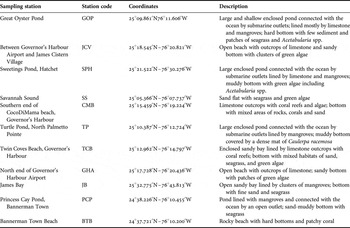
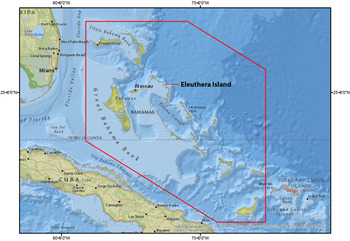
Sampling took place between 8 and19 April 2013 on the island of Eleuthera in the central-west Bahamas (Figure 1). Eleuthera Island is a long and narrow island stretching over 180 km and in some places with little more than 1600 m across. The western side of the island faces the Great Bahama Bank whereas the eastern side meets the Atlantic Ocean. Samples were collected intertidally and subtidally by snorkelling down to five metres deep on exposed and sheltered shore areas both in the Atlantic and Caribbean sides, and from enclosed salt-water ponds connected to the ocean by submarine outlets. Sand flats, seagrass meadows, rocky bottoms, reef shores, and algae mats were inspected for sea slugs (see Table 1). Animals were collected by hand after direct observation and later measured (total length (TL)), photographed, and fixed in 96% ethanol after being frozen overnight in seawater.
Sampling stations with geographical coordinates and biophysical descriptions.

Taxonomic nomenclature follows the valid names accepted in the Wold Register of Marine Species database (WoRMS, 2014). When relevant it is included together with the species’ entries and a discussion about the taxonomic status or any other pertinent aspects.
TAXONOMIC RESULTS
Nineteen species of opisthobranchs were collected. Two new records—Berghia stephanieae and Gastropteron vespertilium, and two colour morphs of the species Chelidonura hirundinina and Bulla occidentalis were found. Ontogenetic variation in Philinopsis cf. pusa was observed and is here documented. Three putatively new species of Haminoea are illustrated (see species’ remarks and figures).
SYSTEMATICS
CEPHALASPIDEA Fischer, 1883
Family AGLAJIDAE Renier, 1807
Chelidonura hirundinina (Quoy & Gaimard, 1833)
MATERIAL EXAMINED
Savannah Sound (SS), 5 specimens (spcs), 11 April 2013, TL = 10–17 mm, University Museum of Bergen, Norway (ZMBN) 91098. SS, 5 spcs, 14 April 2013, TL = 5–20 mm, ZMBN 91109. SS, 15 spcs, 18 April 2013, TL = 8–20 mm, ZMBN 91132.
ECOLOGY
Crawling on sand at daytime, 0.2 m deep.
REMARKS
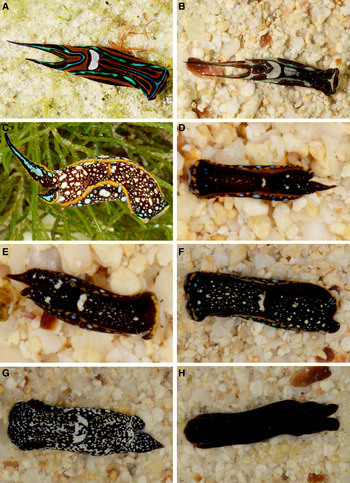
Redfern (Reference Redfern2013: 261, figures 730A–D) has highlighted the variability that this species can show in the Bahamas (Abaco Islands). In Eleuthera two colour morphs were found both crawling on sand (Figure 2A, B); the colour morph depicted in Figure 2A corresponds to the common coloration of this species in the Bahamas and in general across the Caribbean (see Valdés et al., Reference Valdés, Hamann, Behrens and DuPont2006: 38; Redfern, Reference Redfern2013: 261, figure 730A). Only one specimen of the second colour morph was collected; this colour morph is characterized by a replacement of the typical iridescent blue by white coloration on the caudal lobes, edge of parapodial lobes, rear part of the cephalic shield and anterior part of head (Figure 2B). Both Valdés et al. (Reference Valdés, Hamann, Behrens and DuPont2006: 39) and Redfern (Reference Redfern2013: 261, figure 730C) illustrated specimens with a similar pattern from Colombia and Abaco Islands, respectively.
Chelidonura berolina Er. Marcus & Ev. Marcus, 1970
Map of the Bahamas, highlighting the location of Eleuthera Island.

MATERIAL EXAMINED
Southern end of CocodiMama beach, Governor's Harbour (CMB), 14 spcs, 15 April 2013, TL = 10–15 mm, ZMBN 91112. James Bay (JB), 2 spcs, 17 April 2013, TL = 5 mm, ZMBN 91128.
ECOLOGY
Crawling on sand among seagrass at daytime, 0.2–0.5 m deep.
REMARKS
The chromatic variability of this species overlaps with that of the recently described sympatric Chelidonura normani, which makes coloration a trait difficult to use in species discrimination (Ornelas-Gatdula et al., Reference Ornelas-Gatdula, DuPont and Valdés2011). The latter authors referred that the only morphological feature that can reliably separate both species is the shape of the left and right tails when the animal is in motion; in C. berolina the left tail is long and slender; wider proximally but not more than the left tail which is shorter and stout. Whereas in C. normani the left tail tends to be conical and broad proximally occupying at least three-quarters of the posterior end of the body and the right tail is small sometimes inconspicuous. Nevertheless, Ortea et al. (Reference Ortea, Espinosa, Moro, Caballer and Bacallado2012) suggest that the shape of the shell is a key character for the systematics of aglajid snails.
Chelidonura normani Ornelas-Gatdula, Dupont & Valdés, Reference Ornelas-Gatdula, DuPont and Valdés2011
MATERIAL EXAMINED
SS, 1 spc., 14 April 2013, TL = 10 mm, ZMBN 91107. North end of Governor's Harbour Airport (GHA), 3 spcs, 16 April 2013, TL = 8–12 mm, ZMBN 91117. JB, 1 specimen (spc.), 17 April 2013, TL = 10 mm, ZMBN 91120.
ECOLOGY
Crawling on green algae, 0.5–1 m deep.
REMARKS
See Remarks about Chelidonura berolina.
Aglaja felis Er. Marcus & Ev. Marcus, 1970
MATERIAL EXAMINED
SS, 27 spcs, 14 April 2013, TL = 8–13 mm, ZMBN 91108. JB, 9 spcs, 17 April 2013, TL = 5–8 mm, ZMBN 91127. Princess Cay Pond, Bannerman Town (PCP), 1 spc., 19 April 2013, TL = 10 mm, ZMBN 91134.
ECOLOGY
Crawling on sand flats or sand with seagrass at daytime, 0.2–0.5 m deep.
Philinopsis cf. pusa (Ev. Marcus & Er. Marcus, 1966)
MATERIAL EXAMINED
JB, 1 spc., 17 April 2013, TL = 18 mm, ZMBN 91119. JB, 1 spc., 17 April 2013, TL = 8 mm, ZMBN 91121. JB, 1 spc., 17 April 2013, TL = 7 mm, ZMBN 91122. JB, 1 spc., 17 April 2013, TL = 6 mm, ZMBN 91123.
ECOLOGY
Crawling on sand among seagrass at daytime, 0.2–0.5 m deep.
REMARKS
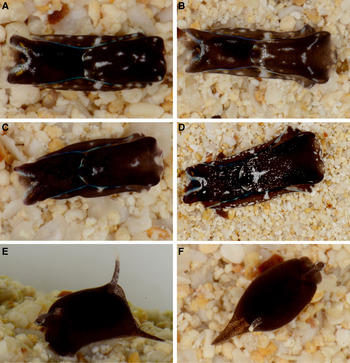
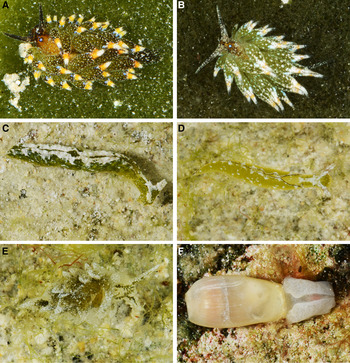
The taxonomic status of several species of Philinopsis in the western Atlantic is controversial and needs revision. Examples of these can be found in Valdés et al. (Reference Valdés, Hamann, Behrens and DuPont2006) where several images depicting extreme chromatic variability in P. pusa are included. Later, Ortea et al. (Reference Ortea, Espinosa, Moro, Caballer and Bacallado2012: 184) criticized several taxonomic identifications in Valdés et al. (Reference Valdés, Hamann, Behrens and DuPont2006) and stressed the state of present confusion of aglajids' systematics in the Atlantic Ocean. The specimens examined here showed chromatic variability; larger specimens have more white blotches and dots on both head and posterior shields when compared to juveniles (Figure 3A–D).
Family BULLIDAE Gray, 1827
Bulla occidentalis A. Adams, 1850
(A) Chelidonura hirundinina (total length (TL) = 17 mm; ZMBN 91098); (B) Chelidonura hirundinina (TL = 20 mm; ZMBN 91132); (C) Chelidonura berolina (TL = 15 mm; ZMBN 91112); (D, E) Chelidonura berolina (TL = 5 mm; ZMBN 91128); (F) Chelidonura normani (TL = 10 mm; ZMBN 91120); (G) Chelidonura normani (TL = 10 mm; ZMBN 91107); (H) Aglaja felis (TL = 13 mm, ZMBN 91108).

MATERIAL EXAMINED
Great Oyster Pond (GOP), 88 spcs, 8 April 2013, TL = 20–30 mm (live animal), ZMBN 91085. TP, 72 spcs, 13 April 2013, TL = 18–25 mm (live animal), ZMBN 91104.
ECOLOGY
Crawling on seagrass and Caulerpa cf. racemosa at daytime, 0.2 m deep.
REMARKS
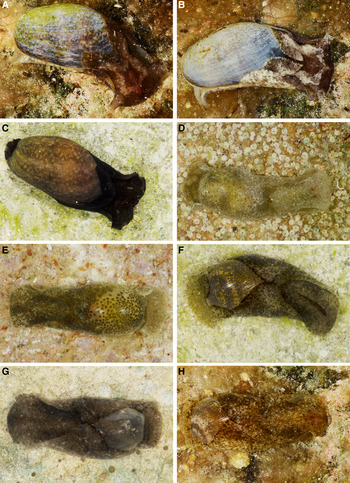
This species was only found inside pond systems. Specimens collected at Turtle Pond (TP) showed the typical colour pattern of B. occidentalis from throughout the Caribbean and other regions of the Bahamas with a mesh of greys, browns and whites covering the body surface (Figure 4A, B; see Redfern, Reference Redfern2013: 258, figure 724B). However, specimens inhabiting the Great Oyster Pond (GOP), which is located about 2 km far apart, have a conserved and characteristic black body (Figure 4C); this coloration was never reported before in this species. Despite the relative short distance between these two ponds, the chromatic differences of the animals are striking, hinting at possible isolation between both populations with reduced or even complete lack of gene flow. Future molecular and morphological studies will clarify the true taxonomic status of these ‘black’ specimens for now identified as B. occidentalis.
Family HAMINOEIDAE Pilsbry, 1895
Haminoea cf. elegans (Gray, 1825)
(A) Philinopsis cf. pusa (total length (TL) = 7 mm, ZMBN 91122); (B) Philinopsis cf. pusa (TL = 8 mm, ZMBN 91121); (C) Philinopsis cf. pusa (TL = 6 mm, ZMBN 91123); (D) Philinopsis cf. pusa (TL = 18 mm, ZMBN 91119); (E, F) Gastropteron vespertilium (TL = 6 mm, ZMBN 91124).

(A) Bulla occidentalis (total length (TL) = 20 mm; ZMBN 91104); (B) Bulla occidentalis (TL = 22 mm; ZMBN 91104); (C) Bulla occidentalis 'black colour morph' (TL = 22 mm; ZMBN 91085); (D) Haminoea cf. elegans (TL = 25 mm, ZMBN 91089); (E) Haminoea cf. elegans (TL = 20 mm, ZMBN 91118); (F) Haminoea sp. 1 (TL = 40 mm, ZMBN 91086); (G) Haminoea sp. 2 (TL = 25 mm, ZMBN 91093); (H) Haminoea sp. 3 (TL = 20 mm, ZMBN 91103).

MATERIAL EXAMINED
GOP, 2 spcs, 9 April 2013, TL = 25 mm (live animal), ZMBN 91089. GOP, 5 spcs, 16 April 2013, TL = 18–25 mm (live animal), ZMBN 91118.
ECOLOGY
On seagrass at daytime, 0.2 m deep.
REMARKS
The diversity of this genus in the Bahamas is high with potentially six species present (see Redfern, Reference Redfern2013: 266–268, figures 740–745) and four different species were likely collected in Eleuthera Island (Figure 4D–H). However, these species are difficult to identify and same may be new to science. A systematic review of the genus Haminoea is presently in progress (work by the author) and based on preliminary molecular phylogenetic analysis several cryptic species have been detected in the tropical western Atlantic including the Bahamas, but the taxonomy and apomorphies of these species are not yet established.
Haminoea sp. 1
MATERIAL EXAMINED
GOP, 18 spcs, 8 April 2013, TL = 30–50 mm (live animal), ZMBN 91086.
ECOLOGY
On seagrass at daytime, 0.2 m deep.
REMARKS
See Remarks about Haminoea cf. elegans.
Haminoea sp. 2
MATERIAL EXAMINED
SPH, 2 spcs, 10 April 2013, TL = 25 mm (live animal), ZMBN 91093.
ECOLOGY
On Caulerpa sp. and brown algae at daytime, 0.5 m deep.
REMARKS
See Remarks about Haminoea cf. elegans.
Haminoea sp. 3
MATERIAL EXAMINED
TP, 5 spcs, 13 April 2013, TL = 15–20 mm (live animal), ZMBN 91103.
ECOLOGY
On filamentous algae at daytime, 0.2–0.5 m deep.
REMARKS
See Remarks about Haminoea cf. elegans.
Family GASTROPTERIDAE Swainson, 1840
Gastropteron vespertilium Gosliner & Armes, Reference Gosliner and Armes1984
MATERIAL EXAMINED
JB, 20 spcs, 17 April 2013, TL = 5–6 mm, ZMBN 91124. JB, 17 spcs, 17 April 2013, TL = 5–6 mm, ZMBN 91125.
ECOLOGY
Extremely abundant. Crawling on sand and seagrass at daytime, 0.2–0.5 m deep.
REMARKS
This is the first record for the Bahamas. Previously only known from Florida (Gosliner & Armes, Reference Gosliner and Armes1984; Valdés et al., Reference Valdés, Hamann, Behrens and DuPont2006).
SACOGLOSSA von Ihering, 1876
Family PLAKOBRANCHIDAE Rang, 1829
Elysia subornata A.E. Verrill, 1901
MATERIAL EXAMINED
Between Governor's Harbour Airport and James Cistern Village (JCV), 1 spc., 9 April 2013, TL = 5 mm, ZMBN 91088.
ECOLOGY
On green algae, 0.5 m deep.
Elysia tuca Ev. Marcus & Er. Marcus, 1967
MATERIAL EXAMINED
Southern end of CocoDiMama beach, Governor's Harbour (CMB), 1 spc., 12 April 2013, TL = 2 mm, ZMBN 91102. Twin Coves Beach, Governor's Harbour (TCB), 8 spcs, 16 April 2013, TL = 8–12 mm, ZMBN 91116.
ECOLOGY
On Halimeda sp., 0.2–4 m deep.
Family LIMAPONTIIDAE Gray, 1847
Costasiella ocellifera (Simroth, 1895)
MATERIAL EXAMINED
CMB, 9 spcs, 15 April 2013, TL = 3–8 mm, ZMBN 91113. JB, 4 spcs, 17 April 2013, TL = 3–4 mm, ZMBN 91129.
ECOLOGY
On Avrainvillea sp., 0.3–1 m deep.
Ercolania cricetus Marcus & Marcus, Reference Marcus and Marcus1970
MATERIAL EXAMINED
JCV, 1 spc., 9 April 2013, TL = 4 mm, ZMBN 91087.
ECOLOGY
On green algae, 0.5 m deep.
REMARKS
There has been some discussion about whether this species is valid or a synonym of the eastern Atlantic/Mediterranean species Ercolania coerulea as suggested by Valdés et al. (Reference Valdés, Hamann, Behrens and DuPont2006). Based on anatomical differences Mollo et al. (Reference Mollo, Muniain and Ortea1994) and Caballer et al. (Reference Caballer, Ortea and Moro2009) considered E. cricetus, a species described from the Caribbean by Marcus & Marcus (Reference Marcus and Marcus1970) as valid, and Redfern (Reference Redfern2013: 290) named specimens from the Bahamas as E. cricetus. Until molecular data yielded from eastern and western Atlantic specimens of these ‘two’ cryptic species become available it seems wiser to use the Caribbean name for this western Atlantic form of Ercolania (Figure 5E).
Family VOLVATELLIDAE Pilsbry, 1895
Ascobulla ulla (Er. Marcus & Ev. Marcus, Reference Marcus and Marcus1970)
MATERIAL EXAMINED
TP, 4 spcs, 13 April 2013, TL = 8–14 mm (shell height), ZMBN 91106. TP, 6 spcs, 15 April 2013, TL = 5–8 mm (shell height), ZMBN 91114.
ECOLOGY
Among the roots of Caulerpa racemosa, 2 m deep.
NUDIBRANCHIA Blainville, 1814
Family AEOLIDIIDAE Gray, 1827
Berghia stephanieae (Valdés, Reference Valdés2005)
MATERIAL EXAMINED
Sweetings Pond, Hatchet (SPH), 1 spc., 10 April 2013, TL = 10 mm, ZMBN 91095. SPH, 2 spcs, 10 April 2013, TL = 8–15 mm, ZMBN 91096.
ECOLOGY
Under a rock, 0.5 m deep.
REMARKS
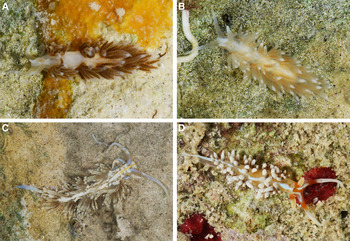
This species was previously known only from Florida (Valdés, Reference Valdés2005; Valdés et al., Reference Valdés, Hamann, Behrens and DuPont2006). Two colour forms of this species were found sympatrically; one with dark brown cerata and the other with pale orange cerata (Figure 6A, B). Both specimens were sequenced for their DNA (COI gene; work by Leila Carmona) and sequences match those previously included in Carmona (Reference Carmona2013) based on specimens collected in Florida.
Family FACELINIDAE Bergh, 1889
Dondice occidentalis Engel, 1925
(A) Costasiella ocellifera (total length (TL) = 8 mm, ZMBN 91113); (B) Costasiella ocellifera (TL = 3 mm, ZMBN 91113); (C) Elysia tuca (TL = 12 mm, ZMBN 91116); (D) Elysia subornata (TL = 5 mm, ZMBN 91088); (E) Ercolania cricetus (TL = 4 mm, ZMBN 91087); (F) Ascobulla ulla (TL = 14 mm, ZMBN 91106).

(A) Berghia stephanieae ‘dark colour morph’ (total length (TL) = 10 mm, ZMBN 91095); (B) Berghia stephanieae ‘pale colour morph’ (total length (TL) = 15 mm, ZMBN 91096); (C) Dondice occidentalis (TL = 25 mm, ZMBN 91094); (D) Phidiana lynceus (TL = 20 mm, ZMBN 91135).

MATERIAL EXAMINED
SPH, 1 spc., 10 April 2013, TL = 25 mm, ZMBN 91094.
ECOLOGY
Crawling on Acetabularia sp., 0.2 m deep.
Phidiana lynceus Bergh, 1867
MATERIAL EXAMINED
Bannerman Town Beach, 2 spcs, 19 April 2013, TL = 15–20 mm, ZMBN 91135.
ECOLOGY
Under rocks, 0.5 m deep.
ACKNOWLEDGEMENTS
I am very grateful to A. DuPont, C. Dahlgren, C. Redfern, G. Giribet, and P. Williams for their help providing several hints about collecting in the Bahamas. I thank L. Carmona for confirming the identification of Berghia stephanieae and to K. Kongshavn for help with the production of the map of the Bahamas. I am indebted to the Department of Marine Resources, Government of The Bahamas for granting a collecting permit (MAF/FIS/12) to sample in Eleuthera Island. The field trip to the Bahamas was part of a research project attributed to the author and funded by the Norwegian Meltzers Foundation–2012.