Introduction
Pea (Pisum sativum L.) and common bean (Phaseolus vulgaris L.) are two economically important grain legumes in Europe (Schneider, Reference Schneider2002; Ney and Carrouée, Reference Ney, Carrouée, Munier-Jolain, Biarnes, Chaillet, Lecoeur and Jeuffroy2005; Guéguen et al., Reference Guéguen, Duc, Boutin, Dronne, Munier-Jolain, Seve and Tivoli2008). The need for more sustainable cropping systems has attracted interest in growing such crops over larger areas in Europe. Seedling establishment is a crucial stage in crop production which influences variations in yield. A major change in the past 20 years in pea production has been to adapt earlier sowing dates for spring pea crops to shift the crop production period (Vocanson and Jeuffroy, Reference Vocanson and Jeuffroy2008). A consequence of earlier sowing is the exposure of seeds and seedlings to stressful cold conditions. A trend in the crop improvement is to breed peas for frost tolerance during winter to enable even earlier sowing, i.e. to breed winter genotypes for sowing in autumn (Etévé, Reference Etévé, Hebblethwaite, Heath and Dawkins1985; Bourion et al., Reference Bourion, Lejeune-Hénaut, Munier-Jolain and Salon2003; Annicchiarico and Iannucci, 2007; Vocanson and Jeuffroy, Reference Vocanson and Jeuffroy2008). Soil temperature and water content are the two main environmental factors that affect germination and early seedling growth before emergence. However, little is known about the effects of these two factors on the early stages of both spring and winter pea cultivars. Information about the possible consequences of the modification of the frost tolerance of vegetative stages on seed germination and heterotrophic growth of early seedlings under cold conditions is not available.
Beans are grown in the same areas as those for peas. Even though beans are sown later in spring, low temperatures can also harm crop emergence (Zaiter et al., Reference Zaiter, Baydoun and Sayyed-Hallak1994). A better knowledge of the range of responses of different genotypes of beans, in terms of temperature requirements for seed germination, could help extend sowing dates to earlier timing (White and Montes-R, Reference White and Montes-R1993).
The aim of this study was to obtain information on germination and early growth of several genotypes of peas and beans in relation to temperature and water potential. For each genotype, we determined the base temperature and base water potential for germination, base temperature for seedling elongation, and thermal times to germination and emergence under different seed production conditions. These particular parameters were determined as they are used in models to predict germination, emergence and early growth under different sowing conditions. In this paper, the results obtained for peas and beans are also discussed in comparison with known characteristics of other legumes.
Materials and methods
Seed production
A frost-tolerant, winter pea genotype, Champagne (Ch), which is derived from a pea forage line, two spring pea genotypes, Baccara (Ba) and Térèse (Te), and two widely cultivated common bean cultivars, Booster (Bo) and Inter (In), were used in this study. As the conditions during seed production can greatly influence germination and early seedling growth, seed lots were produced for each genotype under different production conditions to find true genotypic differences. Peas were produced at the National Federation of Seed Growers (FNAMS), near Angers, France in 2006 and 2007, and at the National Institute for Research in Agronomy (INRA), Mons-en-Chaussée, France in 2006. For Booster, mother plants were grown at FNAMS in 2003 and 2004 (three and two sowing dates, respectively); for Inter, seeds were produced in 2005 at only one sowing date.
Germination and seedling growth experiments
Germination was analysed at 5–33°C for pea and 10–40°C for bean seeds. Germination at 20°C was also tested under four different water potentials ( − 0.2 to − 1.5 MPa) using polyethylene glycol solutions (PEG 8000) following Michel and Radcliffe (Reference Michel and Radcliffe1995). Four replicates of 25 seeds were sown on pleated paper (ref. 3236 GE Healthcare, Vélizy, France) with 80 ml (pea) or 50 ml (bean) deionized water, or on cotton with PEG solutions in plastic boxes (55 × 120 × 180 mm), and were incubated in the dark. Germination (radicle ≥ 1 mm) was observed every (1 to) 12 h, depending on the temperature or water potential. Pea seedling elongation was recorded from 7 to 30°C (depending on seed lots). Bean seedling elongation was measured only in the cv. Booster, at 10–40°C. Three replicates of ten seedlings were grown in the dark to mimic growth before the emergence from soil, in plastic boxes (160 × 100 × 100 mm) filled with 2 kg of white sand (SIFRACO, Paris, France; 150 μm diameter) moistened with 0.19 g (g sand)− 1 nutrient solution (Saglio and Pradet, Reference Saglio and Pradet1980). Seeds were sown at a depth of 2 cm. Non-destructive measurements of shoot length were made every (2 to) 15 d depending on the temperature, in a dark room lit by yellow-green light (Osram lamps, Munich, Germany). Seed depth was measured on each seedling at the end of the experiment and added to each of the previous measurements to obtain total epicotyl (pea) or hypocotyl (bean) lengths.
Data analysis
Germination response to temperature
For each temperature and seed production condition, cumulative germination over time of each replicate was fitted to the Gompertz function (Tipton, Reference Tipton1984):

where G(t) is the cumulative germination at time t from sowing in hours, G max is the maximum cumulative germination, b and c are shape parameters. The germination rate at 50% germination (1/t g50) was then estimated using these fittings and plotted against temperature. This new relationship was fitted to the Yin model (Yin et al., Reference Yin, Kropff, McLaren and Visperas1995) to assess cardinal temperatures:

where T is the temperature, T min and T max are the minimum and maximum temperatures at which germination ceases, i.e. the temperatures at the curve intercept with the x-axis, and α, β and μ are parameters of the equation. Optimum temperature was also calculated from this curve as follows:

The base temperature value used for thermal time calculations was calculated using data for which the germination rate (1/t g50) increased linearly with temperature (Gummerson, Reference Gummerson1986; Dahal and Bradford, Reference Dahal and Bradford1994), by minimizing the sum of square errors between logit values of observed and fitted germination percentages. Fitted values were calculated using the following equation:

where T is the temperature, Tb germ is the germination base temperature, t is the time from sowing (h), and a and b are the parameters of the linear equation.
For each lot, the germination base temperature was calculated for each of the four replicates of 25 seeds. Mean values of each seed lot were then calculated and compared using analysis of variance (see Statistical analysis below). Germination percentages for each replicate were fitted to the Gompertz function with time calculated as thermal time (degree-days, °Cd):
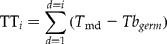
where TTi is thermal time cumulated at day i from sowing day (d = 1) and T md is daily mean temperature. Thermal times to reach 50% of germination were determined (TT50%).
Germination response to water potential
The germination base water potential was estimated for each seed lot and each replicate using data points from the linear portion of the relationship between the germination rate (1/t g50) and the water potential. The base water potential for the median fraction of the population (ψbgerm50) and its standard deviation (σψbgerm50) were calculated as described in Dahal and Bradford (Reference Dahal and Bradford1994) by minimizing the sum of square errors between the logit values of observed germination percentages and fitted values. The latter was derived from the following equation:

where ψbgerm(g), the base water potential of each population fraction (g), is equal to ψ − θh/t g with ψ, the tested water potential, θh hydrotime and t g, the time from sowing of the g fraction. The ψbgerm value was calculated for each replicate of 25 seeds.
Elongation response to temperature
For each temperature and seed lot, the seedling shoot length was fitted (for each replicate) to the Weibull function, usually used for sigmoid curves (Richards, Reference Richards1959):

where L(t) is the shoot length at time t, L max is the maximal shoot length, and b and c are curve shape parameters. From this fitted curve, the elongation rate required to reach 5 cm corresponding to average sowing depth (1/t 5cm) was calculated and plotted against temperature. The elongation base temperatures were then calculated from data for which the elongation rate increased linearly with temperature. Calculations were made for each replicate of ten seedlings. Finally, for each lot, elongation was plotted against thermal time calculated with the estimated base temperatures and fitted to the Weibull function. Thermal time to reach 5 cm (TT5cm) was calculated for each replicate.
Statistical analysis
All curve fittings and statistical analyses were performed using GraphPad Prism 5® (GraphPad Software, San Diego, California, USA). When values were normally distributed before or after transformation (1/y), genotypes and seed production conditions were tested by two-way analysis of variance for pea, whereas only seed production conditions were tested for bean (level of significance P < 0.05). Data that did not conform to a normal distribution after transformation were compared using the non-parametric, Kruskal–Wallis test.
Results
Germination
The final germination percentages of pea and bean were always high (>95%) even at the most extreme temperatures tested, regardless of genotypes or seed production conditions. Only in bean, the final germination percentages decreased at the lowest temperature tested (10°C) in the two seed lots of Booster produced in 2004 (47 and 81%).
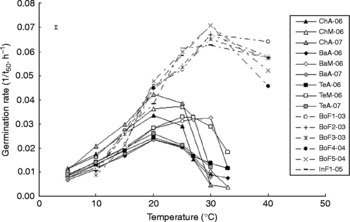
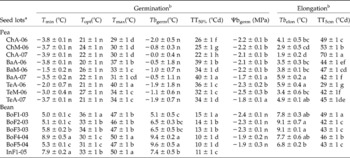
The response curves of germination rates (1/t g50) to temperature (Fig. 1) indicated that pea germinated more rapidly at the lowest temperatures than bean below 20°C. By contrast, at temperatures over 20°C, bean always germinated more rapidly than pea. Below optimum temperatures, the germination rates (1/t g50) of Champagne, a winter pea cultivar, were always higher than those of the two spring genotypes studied. However, the minimum ( − 3.9 to − 1.5°C) and optimum temperatures (20–27°C) calculated using the Yin model, did not differ significantly between genotypes or between seed production conditions (Fig. 1, Table 1). Champagne only had a significantly lower maximum temperature (30°C) than temperatures for the spring genotypes (c. 35°C, Table 1, Fig. 1). Germination rates increased linearly in the 10–20°C range, which was used to calculate the base temperatures (Fig. 1). No significant differences between genotypes and seed production conditions were observed and the mean base temperature was remarkably low ( − 1.1°C; Table 1). The thermal time required to reach 50% germination (TT50%) was always significantly shorter in Champagne (c. 25°Cd) than in Térèse and Baccara (34–38°Cd). We also observed a significant interaction effect of the seed production condition and genotype for this parameter. In bean, the minimum, optimum and maximum temperatures were all higher than those of pea, with significant differences between seed production conditions in both the two years examined (Fig. 1, Table 1). Germination base temperature values (calculated using 15–25°C germination rates) were also higher than those of pea, ranging from 5.1 to 9.6°C. Thermal times required to reach 50% germination (TT50%) were very short (10–15°Cd) compared to pea. Both base temperatures and TT50% differed between production conditions but not between genotypes.
Variations in germination rates (1/t 50) of pea and bean seeds according to temperature. The vertical bar is the average value for standard error. See Table 1 for an explanation of the seed lots listed in the key.

Germination and elongation parameters in pea and bean genotype and seed lots

Mean and standard error of four replicates except for elongation (three replicates) and Ψbgerm (two replicates). n, not significant.
a Pea: Ch for Champagne, Ba for Baccara, Te for Térèse; A for Angers, M for Mons; 06 and 07 for 2006 and 2007; Bean: Bo for Booster, In for Inter; F for field; 03, 04 and 05 for 2003, 2004 and 2005.
b Parameters estimated using the Yin model: T min for minimal temperature, T opt for optimal temperature and T max for maximal temperature; Tb germ and Tb elon germination and elongation base temperatures; TT50% thermal time for 50% of germination and TT5cm thermal time to reach 5 cm of length; Ψbgerm germination base water potential.
The base water potentials (ψbgerm50) were low and in the same range ( − 1.7 to − 2.5 MPa) for pea and bean, indicating their low sensitivity to water stress. They did not differ significantly between genotypes (for pea), but did differ with seed production conditions for both crops.
Heterotrophic seedling growth
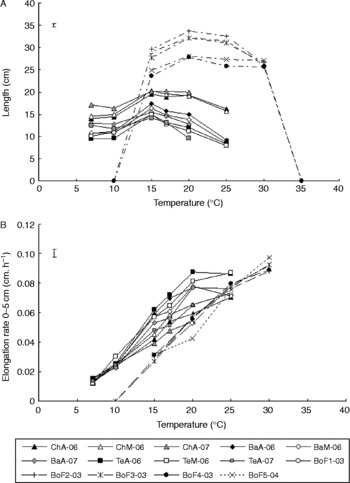
The heterotrophic shoots of peas and beans were remarkably long. Maximum length up to the second of the two first atrophied leaves visible on the pea epicotyl reached 15–20 cm at the optimum temperature (~15°C) (Fig. 2A). Champagne always produced shoots significantly longer than the others. The maximum length of bean hypocotyls was even longer than those of peas (29–35 cm) at an optimum temperature (~20°C). At low and high temperatures, shoots were significantly shortened in both species. Elongation of bean shoots stopped completely at 10 and 35°C. Significant differences were observed between seed production conditions in the two species.
Shoot elongation in peas and beans according to temperature: (A) final lengths and (B) elongation rates to reach 5 cm. The vertical bar is the average value for standard error. See Table 1 for an explanation of the seed lots listed in the key.

At 7–20°C, elongation rates were higher in pea shoots than in bean shoots, whereas at higher temperatures, bean shoot elongation rates continued to increase up to 30°C, while those of pea shoots decreased above 20°C (Fig. 2B). Champagne had a slower elongation rate than that of the other genotypes but still increased above 20°C. Elongation rates were slower for pea seed lots produced in Angers in 2007 (A-07), while bean shoot elongation rates were similar regardless of seed production conditions.
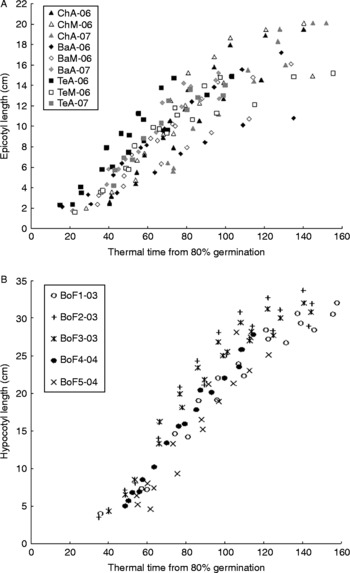
In pea, the elongation base temperature (calculated in the range 10–17°C) differed significantly between genotypes (Table 1, the means were 3.0°C in Champagne, 4.4 and 4.7°C in Baccara and Térèse, respectively), although it seemed to have a strong interaction with seed production conditions. In bean, the elongation base temperatures (calculated in the 15–25°C range) were higher than those of peas, and also depended on the seed lot. The base temperature values were used to calculate thermal times. When all elongation data obtained for peas were pooled, the final lengths of shoots still differed because of the effects of temperature and genotype on these values (Fig. 3A). The thermal time to reach 5 cm was between 42 and 53°Cd (Fig. 3A, Table 1), with the exception of Térèse A-06 and Champagne A-07. When the data for bean hypocotyls were pooled, except for a few differences between seed production conditions, elongation curves overlapped (Fig. 3B). The thermal time to reach 5 cm varied only between 42 and 49°Cd and was very similar to that for pea shoots.
Shoot elongation versus thermal time: (A) in peas, (B) in beans. See Table 1 for an explanation of the seed lots listed in the key.

Discussion
This study provides data on the effects of two major environmental factors, temperature and water potential, which affect the establishment of two main legume crops grown in northern Europe. These data help analyse and control the establishment of pea and bean crops of different genotypes and seed lots. The data can be used in a crop emergence model to simulate emergence under a variety of sowing conditions, as was demonstrated for bean (Moreau-Valancogne et al., Reference Moreau-Valancogne, Coste, Crozat and Dürr2008). The parameters can also be used more generally in crop growth models to predict yields. For both species, seed production conditions had an impact on germination and on seedling growth responses to environmental factors. A better understanding of these impacts will help distribute seed lots suitable to potential environmental stresses in different sowing areas.
The spring and winter pea genotypes differed in many aspects of their germination and early seedling growth. The genotypes that we studied have very different genetic origins, the winter genotype being derived from a forage line (Etévé, Reference Etévé, Hebblethwaite, Heath and Dawkins1985; Bourion et al., Reference Bourion, Lejeune-Hénaut, Munier-Jolain and Salon2003) and the two spring pea genotypes being pure lines of dry pea registered as varieties in France (1988 and 1991, respectively). Our results revealed that the crop origins mattered for germination and early seedling growth. In bean, no differences were observed between the two genotypes, but the range of genetic diversity we studied was narrow (Vilmorin Company, personal communication). In other studies, genetic diversity also affected bean growth during early stages (Hucl, Reference Hucl1993; Nleya et al., Reference Nleya, Ball and Vandenberg2005). Our results suggest that germination and early seedling growth need to be analysed separately in breeding programmes to improve emergence rates. This was also observed in the model plant for legumes used in genomics Medicago truncatula (Brunel et al., Reference Brunel, Teulat-Merah, Wagner, Huguet, Prosperi and Dürr2009; Dias et al., Reference Dias, Brunel, Dürr, Demilly, Wagner and Teulah-Mérah2011).
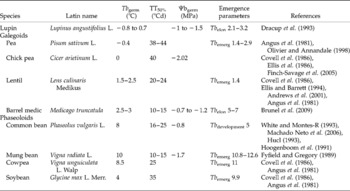
The germination base temperature was very low in pea, as compared to bean. The optimum and maximum temperatures were also lower in pea, especially the optimum temperature, being really low (~20°C) in most cases. These results are in the range obtained in previous studies on other genotypes of pea (Olivier and Annandale, Reference Olivier and Annandale1998) and bean (White and Montes-R, Reference White and Montes-R1993; Machado Neto et al., Reference Machado Neto, Prioli, Gatti and Mendes Cardoso2006). Differences in responses to temperature between peas and beans are in accordance with the geographic origins of the two species. Pea is a temperate, cool-season legume, belonging to the Galegoid group, while bean is a warm-season legume of tropical origin, belonging to the Phaseoloid group (Young et al., Reference Young, Mudge and Ellis2003). Physiological studies indicate that pea seeds are endowed with remarkable tolerance to extremely low temperatures during germination (Stupnikova et al., Reference Stupnikova, Benamar, Tolleter, Grelet, Borovskii, Dorne and Macherel2006). The capacity of pea seeds to germinate on ice has been demonstrated (Macherel et al., Reference Macherel, Benamar, Avelange-Macherel and Tolleter2007). Other legume species in the Galegoid group have the same range of germination base temperature as pea (Table 2). Other species in the Phaseoloid group have much higher Tb germ, similar to those obtained in the common bean in this study. The time to reach 50% germination (TT50%) was very short for bean (10–15°Cd), and longer for spring pea genotypes (30–40°Cd). TT50% calculated using data from the literature showed the same trend for Phaseoloids and Galegoids, respectively. There was a negative correlation between the base temperature values and the thermal times to reach 50% germination. The base water potentials required for germination were low in both species, on average around − 2.0 MPa. In contrast to our results, Hucl (Reference Hucl1993) found that germination was suppressed under − 0.8 MPa in several common bean genotypes (Table 2). References in the literature to the germination base water potential in other legume crops are scarce. In contrast to temperature responses, differences in water stress responses between species did not appear to be correlated with their geographic origin. These differences may be more related to the physical structure or composition of seeds. In peas, seedling elongation occurred at a range of quite low temperatures (5–20°C); however, this stage was more sensitive to low temperatures than germination, when young seedlings had high water content, which was also reported by Stupnikova et al. (Reference Stupnikova, Benamar, Tolleter, Grelet, Borovskii, Dorne and Macherel2006). Higher temperature requirements for seedling elongation than for germination appear to be common in legumes. The minimum temperature required for emergence or hypocotyl elongation was often 2–3°C higher than the temperatures required for germination (Table 2). Thermal time to emergence (TT50% and elongation+TT5 cm) is estimated to be approximately 75–90°Cd for pea or 55–65°Cd for bean. Through a study of the field emergence of different legume species, Angus et al. (Reference Angus, Cunningham, Moncur and Mackenzie1981) also found a longer thermal time and a lower emergence Tb for cold-season legumes (90–110°Cd) than for warm-season species (43–70°Cd).
Germination and emergence parameter values for different legume crops

Tb emerg estimated by authors considering the time between sowing and emergence in several experiments.
Finally, tropical Phaseoloids and temperate Galegoids appear to respond to temperature differently. Comparisons between species help define groups with the same range of model parameter values. The response to water stress does not appear to be related to geographic origin. Studying other species is also useful for multispecies comparison of physiological processes in response to environmental stresses. Medicago truncatula and soybean (Glycine max) are two major model legume species for genetic studies. M. truncatula belongs to the Galegoid group while soybean belongs to the Phaseoloid group (Cook, Reference Cook1999; Zhu et al., Reference Zhu, Choi, Cook and Shoemaker2005). Considerable efforts have been made to sequence the genome and to obtain physical maps of these two species (Yan et al., Reference Yan, Mudge, Kim, Larsen, Shoemaker, Cook and Young2003; Choi et al., Reference Choi, Mun, Kim, Zhu, Baek, Mudge, Roe, Ellis, Doyle, Kiss, Young and Cook2004; Gepts et al., Reference Gepts, Beavis, Brummer, Shoemaker, Talker, Weeden and Young2005). Genetic diversity in the tolerance to low temperatures and water potential during germination and seedling elongation before emergence has been demonstrated in M. truncatula (Brunel et al., Reference Brunel, Teulat-Merah, Wagner, Huguet, Prosperi and Dürr2009; Dias et al., Reference Dias, Brunel, Dürr, Demilly, Wagner and Teulah-Mérah2011). In general, synteny of sequences between genomes is assumed to facilitate the transfer of knowledge from these models to cultivated species. However, this study has shown that other legume species may respond differently to temperature or water stress from the model species. These differences should be taken into account when studying the genetic regulation of the tolerance to environmental stress during early developmental stages. The underlying mechanisms may depend on the geographic origins of species.
Acknowledgements
This study was funded by the Pays de la Loire Regional Council and the French Ministry of Agriculture. We thank V. Moreau, R. Davière, N. Denoyer, S. Renaud, R. Devaux and M.-H. Wagner for help with the experiments. We are grateful to the late Y. Crozat who played an important role in the initiation of this work.