Thursday 7 January (Highclere)
At night after every one else had gone to bed I had a curious conversation with Delane. 1st. he told me on my enquiring it of him that it was true that he was shown in the winter of 1866 a printed draft Reform bill substantially founded upon the resolutions which were at that time kept in MS. in the Cabinet which Lord Derby and Disraeli would not put into print for fear of their becoming known, and which even they at first refused to circulate among the Cabinet. Was there ever such treachery? 2nd. The present Government are deliberating upon endowing the Roman Catholic Church and the Presbyterians with the money available of the Irish Church. They applied to Delane to help them, but he declined to do this. He looks upon it as good in itself but as a breach of public faith.
Thursday 28 January (London – Hatfield)
The Ritual CommissionFootnote 288 again came down to Hatfield in the afternoon. Had a long talk with Salisbury.
Told him of my recent conversation with Delane (7th inst.) as to Reform bill. Attended to the report that he had promised his support to Cairns in the leading of the House of Lords. He said that Cairns had written to him offering to give up the lead to him, but that he had declined this (through inability to act with Disraeli), and told him that he should consider each question on its merits and would so far as he could support him. I suspect that the promise of support was rather strongly expressed and that he looks through Cairns, even from below the gangway, to take great part in leading the Party. I expressed the hope that he had not identified himself with Cairns,
1st. because Cairns is the same now as Disraeli.
2nd. because Cairns on Church questions is absolutely unsound.
I told him that if he would come forward as leader of the House of Lords, even with the view of bringing about a deadlock and compelling a choice between himself and Disraeli, I would do anything I could; but that having no confidence in Cairns, Disraeli or any others of the late Government I would not support them, except in so far as each particular measure which they might put forward was good.
Saturday 24 April (London)
Three persons have spoken on political matters to me today in rather a curiously coincidental manner.
1st. B. Cochrane called for some lunch and afterwards retailed all his own grievances and those of the party with whom he comes in contact. The burden of it was the general distrust that has now succeeded to the former confidence in Disraeli and the wish to get rid of him and to see Salisbury and myself in some recognised position as leaders.
2nd. The Duke of Wellington whom I met at dinner opened the same subject, stating that Cairns was a failure as leader, that I had been badly treated but that there was only one wish that I would return to my place in the House and that moderate people had confidence in me particularly.
3rd. The Duke of Cambridge opened on the same line, deplored Cairns as leaderFootnote 289 and urged strongly my return and Salisbury's to the Front Bench and Salisbury as leader. He said everything was going by the board in the House of Commons and that unless matters could be rearranged the worst results would follow. He looked however to getting rid of Disraeli – but that is the real difficulty.
Saturday 5 June (London)
Very far from well and obliged to send for Gull,Footnote 290 who pronounced that it was only a sort of nervous disturbance from one's work, and that a little care and rest would soon bring me round.
Salisbury called at 11 and though very poorly went with him to the meeting of Conservative Peers in St James's Square. It was very full. Cairns began by a long and an able speech declaring that the only course to be taken with the Irish Church bill was to reject it,Footnote 291 and that there was no middle term. Salisbury followed in a very able speech, asking what next would follow on rejection and that as it was only a question of time and pressure he could not vote for its rejection. On the other side Lord Harrowby and various second rate speakers followed, then Lord Stanhope declared that rejection of bill would destroy all chance of getting better terms and on this Lord Derby made a very vigorous speech in his old manner, denouncing the bill in the strongest language and looking almost pointedly at me said that there was anyhow no individual who did not dislike and protest against every part of the bill and regard it as revolutionary and abominable.
On this after a few words from the Duke of Rutland I said that I could not assent to that uncompromising denunciation of the bill, but that I did object greatly to some parts (disendowment) which were repugnant to me and which were unjust and cruel to the Irish Church; that I was ready to join in amending this, but that I deprecated earnestly the rejection of the measure. I urged that such a rejection would be dangerous to the House as bringing it into collision with the Country; that the final result was inevitable; that the bill would then come to us without the powers of making amendments and would be then most injurious to the Church. I ended by pointing out that the times were critical, that the old constitutional forces were almost in suspense, that the House of Commons was more democratic: that the present crisis might be tided over and the Country recover its balance but that if a collision was provoked indefinite changes and disasters might follow.
Monday 7 June (London)
Very busy in the House on the subject of the Irish Church bill. Several Peers came to me to say that they should vote for the bill or that they should stay away.Footnote 292 CawdorFootnote 293 and DelamereFootnote 294 both said this and others expressed themselves doubtfully.
Tuesday 8 June (London)
Again busy in the House.Footnote 295
Had a communication with Granville.Footnote 296 Told him that I thought it was possible to get rid of the majority though with difficulty but that matters would be smoothed if any indication could be given of a readiness on the part of the Government to consider reasonable amendments.Footnote 297
His reply was much as I expected – that of course the Government could not offer this etc., but he intimated that any amendments that could be devised which were plausible and which did not vitally affect the bill or “re-endow” the Irish Church would not be objected to. He hinted that some margin had been left in the bill with this object and that Gladstone was really sincere in his wish to leave the Church as well as he could, but not re-endowed. I said that the object of any amendment would probably be to improve the pecuniary position of the Church. He parted with, I think, the understanding that the Government would offer no hasty or unfair objection to reasonable amendments.
He expressed himself astonished at the folly of the move, and told me in strict confidence of a certain letter that had been written to Lord D. by —.
Thursday 17 June (London)
Irish Church debate again going on. Salisbury's speech was very good and produced a great effect. Lord Derby's was a melancholy spectacle of the failure of great powers.Footnote 298 Physically, oratorically, mentally, there was a gulf between what he was now and had been a few years ago. He could not resist, as usual, an attempt to fix some sort of attack and misrepresentation on me, but I contented myself with almost a simple denial. His last sentences were almost pathetic, but he closes a career which on the whole I suppose has done as much mischief to his Party and the House as can be reasonably achieved by any one man.Footnote 299
Friday 18 June (London)
The close of the Irish Church debate. We divided at 3 in the morning and I walked home with Lyons.Footnote 300 The cool fresh air and the sun rising over the houses were pleasant after the heat and excitement of the debate. The majority of 33 was larger than we desired, but Bath, who acted as Whip for our tiers parti, was afraid of running it too close.Footnote 301
Cairn's speech was tedious and the Chancellor's though good was not forcible.Footnote 302
Thursday 24 June (London)
My 38th birthday. Time flies very fast and will I suppose fly faster as the hour glass empties. But personally everything has gone well with me.
Salisbury tells me that this morning he, Cairns and the two Archbishops settled the amendments and from what he says I think they are very moderate in character.
Saturday 26 June (London)
Visit from Lowe who said he wished me to understand the exact position of the Irish Church measure and the Government. They wish, he says, to give better terms and to endow the Roman Catholics and Presbyterians but they have sold themselves to the Voluntaries at the Election. They are bound to them and as a matter of self-preservation, for Government and Party, they can consent to nothing which is at variance with the terms of their compact. They would prefer to throw up the bill and to risk all chances of collision with the House of Lords etc. This applies to any amendments which would have the effect of an “amendment of error”, as regards Roman Catholics, or a “re-endowment” as regards the Church. Nothing, he added, could exceed the tension and the pressure on the Government, and nothing but a new Parliament and one pledged to follow a particular minister as this is could have enabled them to go on. He wished, he said, that I should understand that the Government could not substantially alter the bill and that I should think well how far that ought to modify the course of the House of Lords.Footnote 303
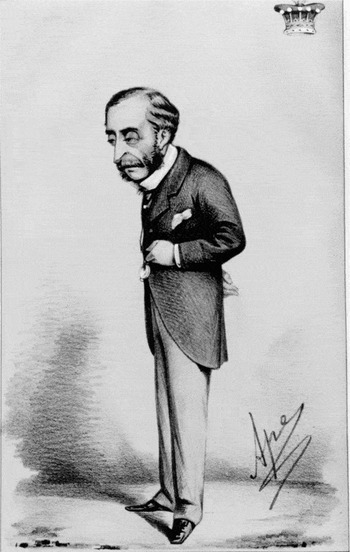
Earl of Carnarvon, Vanity Fair, 11 September 1869, by Carlo Pellegrini (Ape).

In the later part of the day I had a rather curious confirmation of Lowe's conversation. I met Kimberley and walked with him for 1½ hours discussing all subjects and amongst others the Irish Church bill. I alluded to the amendments and to test the matter said that they did not seem to me to be generally and in substance unreasonable except perhaps the one relative to the Ulster Glebes. He assented. So did Chichester FortescueFootnote 304 later in the eveningFootnote 305 whom I saw at the Duc d'Aumales.Footnote 306 But when I said the same thing to Clarendon, he implied very nearly to what Lowe had expressed. From which I drew the conclusion that Lowe and Clarendon being of the inner cabinet knew what course of policy would be but that Kimberley and C. Fortescue regard the matter as any one of the outer world would.
Tuesday 29 June (London)
Irish Church bill in Committee, a long night, only down to Clause 10, and rose about 12.30.Footnote 307
In the middle of the day I received an invitation to a meeting of Conservative Peers at 10 St James's Square. Cairns made a long speech urging our unconditional adoption of six principal amendments and a further proposition to leave the surplus to the disposition of Parliament. I expressed myself doubtfully as to some of the points and declined to pledge myself as to the last and entirely new proposal without further consideration. I think that I was the only person who spoke in a semi-dissentient sense, but there were several in the room who seemed to agree with me.Footnote 308
Thursday 1 July (London)
Irish Church bill again in Committee. I moved an amendment for compulsory commutation and 14 years purchase as in the case of Maynooth.Footnote 309 It was at the time a successful speech though this morning it seems badly reported. The House was quite full and very attentive. We carried it by 155 to 86, and the argument was entirely on my side.
BarringtonFootnote 310 wrote to me as to Lord Derby, whom I saw a few minutes afterwards in the House. He shook hands and assured me that so far as he was concerned there was absolutely no ill feeling, so I hope that it may be so. I would wish to be in peace with him now that he is so broken.
Thursday 15 July (London)
Ritual Commission.
Called on Lord Derby and conferred with him as to the University Tests bill, agreed to move the previous question. The last time I was in that room was the morning of the famous “10 minutes Cabinet” when the Reform bill broke down.Footnote 311 Lord Derby was very much changed – voice, strength, mental power. He spoke of himself “as politically dead”.
[Added subsequently]
It was a very curious interview and the last time that we ever met. At the end of it I expressed the hope that we were friends and Lord Derby quite assented. He tried to induce me to sign a protest as to the Irish Church which would have put me in a ridiculous position after the line I had taken but when I declined he said he was not surprised. We parted as friends and I never saw him again.Footnote 312
Tuesday 20 July (London)
A general meeting of the Conservative Peers at 10 St James's Square. Cairns advised the meeting in the sense we had previously agreed on. One or two peers seemed not quite to like the retention of the Ulster Glebes, but as [no] one said a word, the meeting broke up, but when I came down to the House 2 hours afterwards I found the Ulster Glebes abandoned. It seems that a sort of mutiny had been extemporised at the Carlton against the retention of the amendment and that Cairns had given way – subject to the opinion of the Archbishop of CanterburyFootnote 313 – not very fair to the Archbishop as he thought and reasonably thought. The fact is that Cairns is weak and has very little hold on the party.
The debate on the Preamble was very hot. I never remember the temper of the House so keen on both sides. We divided and beat the Government by 78, a momentous division.Footnote 314 I think we had no alternative but the crisis is a very serious one. Is it like the first shot fired on Fort Sumter?Footnote 315
Thursday 22 July (London)
A marvellous solution to the Irish Church bill entanglement, a compromise come to by Cairns and the Government and announced by Cairns in the House. Neither Salisbury nor I knew anything of it till put before the meeting of the House.Footnote 316 We owe it entirely to the division of Tuesday evening and in a great measure I think to Salisbury's uncompromising speech. On the whole we are well out of a great difficulty though the terms of the compromise may not be all that we might desire.