Tariff policy dominated congressional politics for much of the nineteenth century. Because duties on imports were the primary source of revenue for the federal government, tariff policy was reconsidered frequently as the economic fortunes of the country waxed and waned. The frequent, high-stakes nature of tariff policy not only led to fierce debates in Congress—pitting proponents of free trade against proponents of protective tariffs—but also inspired some of the most enduring institutional features of Congress.
Among the more interesting episodes in this long-running story occurred in the closing hours of the 47th Congress. On March 3, 1883, a lame-duck Congress passed, and President Chester A. Arthur signed into law, the Tariff Act of 1883. The act made numerous changes in the customs duties assessable against foreign goods imported into the United States1—raising duties on some goods while lowering duties on other goods. In the aggregate, the act produced a slight net decrease in customs duties and had little, if any, perceptible effect on the manner in which business in the U.S. was conducted.Footnote 2 Despite strong, preexisting public sentiment in favor of major reforms (reductions) to the tariff rates and an overhaul of the tariff system in general,Footnote 3 the net effect of the reform was minimal.Footnote 4 In short, the act did very little of what most of the actors in the debate wanted and no one wanted to claim ownership of it—leading to it being labeled the “Mongrel Tariff.”
This article explains why Congress failed to adhere to public sentiment for major tariff reform. Our explanation is a familiar one—we show how endogenously created institutions interacted with the policy preferences of key members to produce a policy outcome that few seemed to favor.Footnote 5 Specifically, we focus on the use and creation of institutional rules by political actors to achieve short-term goals aligned with their policy preferences.Footnote 6 In the case of the Mongrel Tariff, the achievement of those short-term goals had a long-lasting and continuing effect. It led to the creation of the one of the most enduring features of the House of Representatives—the special rule.Footnote 7
In what follows, we describe how party leaders manipulated the congressional agenda to limit the vote choices available to individual members of Congress and how these limitations directly affected the policy outcome. We also present information on both party interests and the perceived effects the act was expected to have on congressional constituencies to help us explain the behavior of members of Congress on votes relating to it. We find that a mix of party and constituency interests drove members’ voting decisions on the bill. However, protectionists leaders in both chambers were able to manipulate the order of votes in such a way as to secure an outcome producing less tariff reform than would have been desired by the public and many serving in the Congress.
The Nineteenth Century and the Tariff
Throughout the nineteenth century, tariffs on imported goods were the primary source of revenue for the U.S. government. As a result, Congress frequently altered tariff rates—often in response to the economic fortunes (or misfortunes) of the country during the preceding years. For example, Congress lowered tariff rates in 1846, 1857, and 1872 in response to revenue overflows and increased tariff rates in 1842, 1861, 1864, and 1875 in response to revenue shortfalls.Footnote 8
Because of its important role in and effect on the American economy, tariff policy was frequently a source of political debate and conflict between the parties. Although this debate and conflict raised numerous issues, the underlying concern was often a debate between protectionism and free trade. During the latter half of the nineteenth century, the Republican party, with its power base centered in northern manufacturing interests, favored a protectionist tariff system designed to protect and promote American commercial interests (such as manufacturing) from foreign competition.Footnote 9 In contrast, the Democratic Party, with its power base centered in southern and western agricultural areas, typically favored either a free trade tariff system or a tariff system designed solely as a revenue source with little or no regard for the protection of American commercial interests.Footnote 10 Richard Bensel, in fact, argues that the tariff was the key issue separating Democrats and Republicans during the years 1877–1900.Footnote 11
Protectionism often carried the day during and immediately after the Civil War as Republicans dominated federal offices and Democrats worked to regain a foothold in national politics.Footnote 12 Thus, the legislation adopted during this time tended to favor manufacturing interests and paid little attention to agricultural interests. By the 1870s, however, the Democratic Party had rebounded and strong party alliances to protectionism and free trade were beginning to break down.Footnote 13 Thus, concerns over tariff policy began to reflect a party versus constituency interests debate for many legislators.
The Tariff Act of 1883: Innovations in the Legislative Process
Despite the party and constituency influences that battled over tariff rates during the 1870s, overall tariff policy remained relatively stable. Small reductions were made in 1872 but were repealed in 1875. The period between 1875 and 1882 saw little action on tariff policy mainly because the resurgent Democrats controlled one or both chambers of Congress while the Republicans maintained their grip on White House. The 1880 elections saw Republicans win not only the White House but also majority control of both chambers of Congress. Although tariff revenues soared during the next two years, the Republican-controlled Congress was slow to act on any reduction in tariff rates.Footnote 14
Following the 1882 elections, a sizable majority of the members of the 47th Congress developed a strong desire to alter tariff rates. Two factors combined to effectuate this change. First, many House Republicans, fresh from losing majority status in the 1882 election, wanted to enact a tariff bill during the lame-duck session before the end of the 47th Congress while they still held majority status and could play an important role in shaping the outcome. For their part, many House Democrats were eager to have the issue off the agenda prior to the beginning of the 48th Congress so as to not have such a controversial issue dominating their legislative agenda. Many members of the Senate also wanted to see a bill enacted before partisan control of the two chambers became divided.Footnote 15 Second, the U.S. Tariff Commission, created in March 1882 to study a reform of the tariff system, submitted its report to Congress in December of that year in which it called for a reduction of tariff rates of 25 percent on average.Footnote 16
Despite the widespread agreement to reform the tariff, there was little agreement among the actors as to nature of the reform effort. As in the past, the general debate pitted those favoring high (protectionist) tariff rates against those favoring low (free-trade/tariff for revenue only) tariff rates. While Republicans generally favored high(er) rates and Democrats generally favored low(er) rates, for the most part the identity of individual members favoring these positions was not set in stone. Importantly, however, Republican leaders in both the Senate and the House were the most avowedly protectionist.Footnote 17 In the Senate, the number of Republicans and Democrats was almost evenly divided, but a majority, led in part by western state senators, generally favored a reduction in tariff rates. Commenting on the debate over the Senate bill, Stanwood notes that “it is not to be supposed that the contending forces were like two armies, closely organized, fighting pitched battles. The number of those who were always in favor of high duties was exceedingly small; so, also, was the number of those who never voted for high duties.”Footnote 18 Instead, the identity of those favoring these positions shifted depending on the particular duty schedule (i.e., goods) under discussion. McCown notes that “practically all Republicans and a considerable number of Democrats wanted, each, high protection for some particular articles.”Footnote 19 In the House, Republicans outnumbered Democrats and the majority was strongly protectionist. Some Republicans, who blamed their 1882 electoral losses on the party’s tariff policy, were willing, however, to support a reduction in tariff rates for political reasons. Other House Republicans, along with most (but not all) House Democrats, simply favored tariff rate reductions.
In many instances, constituency interests were the cause of the varying positions taken by both Republicans and Democrats. For members of both parties, the key constituencies were manufacturing interests, agricultural interests, and consumers. Members from areas with strong manufacturing interests generally favored maintaining high tariff rates on commercial goods and manufactured products, while members from areas with strong agricultural interests generally supported a reduction in rates both to decrease the price of consumer goods and hopefully to eliminate the high tariffs that many European countries applied to U.S. agricultural exports. Nonetheless, even members from agricultural areas wanted high tariff rates on their raw product where that product (such as wool, sugar, oranges) competed with foreign goods.Footnote 20
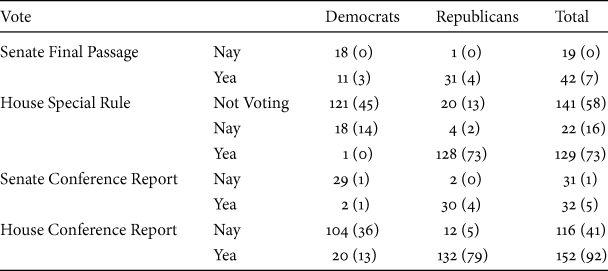
Despite the constitutional requirement that measures relating to revenue originate in the House of Representatives, the first major debates over the bill that eventually became the Tariff Act of 1883 occurred in the Senate. Given the desire to produce tariff legislation prior to the legally mandated conclusion of the 47th Congress, the Senate decided that it would not be possible for it to wait for the House to produce tariff legislation before proceeding. Thus, using the Tariff Commission’s report as a starting point, the Senate transformed a previously passed House bill dealing only with internal taxes, H.R. 5538,Footnote 21 into a tariff bill by striking out all but the enacting clause and replacing the substance of the bill with both its own internal tax legislation (which was essentially the same as that passed by the House) as well as tariff legislation. Amid some misgivings about this action,Footnote 22 the Senate went on considering amendments to the bill for more than six weeks. During this time the Senate held 198 roll-call votes on amendments to the bill, usually to alter the rate on a particular item, before finally passing the bill on February 20, 1883, by a 42–19 vote. Table 1 provides a summary of this vote by party. All told, the Senate took 214 votes on the tariff bill, making up over one-third of the roll-call record for the 47th Senate. As passed, the bill proposed a large reduction in tariff rates, reflecting to a large extent the recommendations of the Tariff Commission.Footnote 23 The bill was not amenable to the Republican leaders in the Senate, but Senators Morill (R-Vt.), Sherman (R-Ohio), and Aldrich (R-R.I.) pushed the bill to pass with the understanding that it would either die in the House or be significantly altered through a conference committee, which was sure to be stacked with protectionists.Footnote 24
Summary of Congressional Votes Relating to the Tariff Act of 1883

Note: Data are taken from Poole and Rosenthal (2012). Numbers in parentheses identify number of lame-duck votes included in votes reported. Number of votes reported does not include paired and announced votes.
The House was simultaneously trying to pass a tariff bill, but a divided Republican caucus was unable to come to an agreement on a bill reported by the Ways and Means Committee and thus could not muster enough votes to get the bill out of the Committee of the Whole and onto the floor.Footnote 25 This set up an interesting situation for the two chambers. Each chamber had passed a bill (H.R. 5538) with the same title, but the House bill dealt only with internal taxes, while the Senate bill dealt with both internal taxes and tariffs. The bills clearly were not in the “identical form” required by the Constitution. Given that the House could not pass its own tariff bill, it was faced with three options: (1) concur with the Senate bill and send it to the president for signature or veto, (2) vote against concurrence and ask for a conference with the Senate, or (3) do nothing and let the bill die at the end of the Congress. The House Republicans caucused on this issue and voted to nonconcur and request a conference. Close to forty members of the House Republican caucus, however, were absent from a joint House and Senate caucus, presumably because they favored the Senate bill and would vote to concur if given the opportunity.Footnote 26
This split among the House Republicans created a great deal of uncertainty for the Republican leaders of both chambers. Both sets of leaders were willing to pass a bill, but only one with significantly higher tariff rates than the Senate bill. Little time before the end of the Congress was left to debate the House tariff bill in the Committee of the Whole, so getting to a conference committee where the provisions of the Senate bill could be amended to reflect higher tariff rates was the only potential solution if a bill was to be passed. The House leadership found itself in a procedural bind, however. The standard order of business dictated that the first vote to be in order would be a vote to concur with the Senate bill as amended. Only if that failed could a motion to nonconcur and go to conference be in order. The only apparent way around the standard order of business would have been through a motion to suspend the rules, which would have required a two-thirds majority. House leaders, however, could not be certain of even getting a simple majority of the House to agree to nonconcur, so the suspension strategy would have surely failed. As the New York Times noted, “The obstacles which oppose the consideration of the Senate Tariff Bill in the House are to some extent caused by the rules.”Footnote 27 They faced a situation in which their least preferred outcome—concurrence—was most likely to occur, while their most preferred outcome—nonconcurrence followed by a conference—was the least likely to occur. As the New York Times continued, “Republicans, after having made a new count of heads, are afraid to move the bill in any way for fear that a sufficient number of Republicans may seize the first opportunity presented to vote in such a way as to force its passage without reference to a conference committee.”Footnote 28
The solution to this problem was to create one of the most enduring institutional features of the House of Representatives—the special rule.Footnote 29 Thomas Reed (R-Me.) had recently become a member of the Committee on Rules, so in an effort to solve the parliamentary dilemma faced by supporters of high tariff rates, he reported the following resolution from the Committee on Rules: “Resolved, That during the remainder of the session it shall be in order at any time to move to suspend the rules, which motion shall be decided by a majority vote, to take from the Speaker’s table House Bill Number 5538, with Senate amendment thereto, entitled ‘A bill to reduce internal-revenue taxation,’ and to declare a disagreement with the Senate amendment to the same, and to ask for a committee of conference thereon, to be composed of five members on the part of the House. If such motion shall fail, the bill shall remain upon the Speaker’s table unaffected by the decision of the House upon such motion” (Congressional Record, 47th Congress, 2nd session, February 24, 1883, p. 3259.)
This resolution was quite remarkable in at least two ways. First, it represented, for the first time ever, the supplementation of the standing rules of the House by a simple majority rather than a two-thirds majority. Second, it altered the nature of reports from the Committee on Rules. Previous reports of the Committee on Rules had been in the form of special orders, which only made the consideration of a bill in order rather than customizing the rule for each bill.Footnote 30 This decision laid the groundwork for the chamber we see today, where all major legislation is considered under a special rule designed specifically for the purpose of ensuring the bill will pass in the form desired by the majority party leadership.
The restrictions the resolution placed on consideration of the bill allowed Reed to reorder the legislative process so that the leadership’s most preferred outcome—conference—was now the most likely to occur, while their least preferred outcome—concurrence—was the least likely to occur. The resolution had the effect of shifting the uncertainty over the final outcome to the recalcitrant House Republicans who favored the Senate bill. They could vote in favor of the resolution, in which case they would have to take their chances on what came out of the conference committee, or they could vote no on the resolution and prevent any tariff reform in the 47th Congress. Because a “no” vote put these reform-minded Republicans in the position of saying no to the Senate’s tariff reduction bill,Footnote 31 they decided to support the adoption of Reed’s resolution, and it passed the House by a vote of 129–22, with 121 Democrats not voting in an attempt to prevent its adoption through the use of the “disappearing quorum.”Footnote 32 Table 1 provides a summary of this vote by party. Upon adoption of the resolution, the motion to nonconcur and go to conference passed the House by a vote of 147–111.Footnote 33
Upon conclusion of the conference, which was controversial in and of itself, each chamber took up consideration of the conference report.Footnote 34 Consideration of the report was acrimonious in both chambers, with Democrats insisting that the conferees had exceeded their authority by increasing tariff rates far above what had been agreed to in the Senate and what had been discussed previously in the House. The rate schedules for both steel and iron reported higher tariff rates than either chamber had considered. Taussig states that “the changes made by the conference committees were, as a rule, in a protectionist direction. The duties on a number of articles were raised by the committee above the rates of the Senate bill, and even above the rates which the House had shown a willingness to accept. The consequence was that the tariff act, as finally passed, contained a much less degree of reduction than the original Senate bill.”Footnote 35 In short, the conference committee succeeded in taking the Senate bill and moving it back toward the original status quo. After considerable debate, including the full reading of the report in the House (which took several hours), the conference report was adopted by a razor-thin 32–31 margin in the Senate, and by a larger 152–116 margin in the House. Table 1 provides a summary of these votes by party. At the end of the day, the bill was a victory for the Republican leadership. Tariff rates were reduced on a few goods and raised on a few others, but in general the modifications were minor and tariff policy remained protectionist in nature.Footnote 36 The procedural tools created to produce this outcome, however, would go on to fundamentally reshape how the House considers legislation.
The Tariff Act of 1883: Institutions, Parties, and Constituencies
The Tariff Act of 1883 is a clear example of how institutions can shape outcomes in legislative bodies such as Congress. Here, however, the story is even more fascinating because the institutional rules did not remain static. Instead, party leaders used their power to alter the rules to achieve their desired policy outcome. The historical account above points to four main institutions that were critical in shaping the final content of the Tariff Act of 1883: the constitutional establishment of a bicameral legislature, the constitutional requirement that each chamber of the legislature must pass the same version of the bill, the constitutional provision that allows each chamber to set its own rules, and the constitutional provision that enables extended lame-duck sessions of Congress.
Previous research has demonstrated that institutions such as these can affect policy outcomes in legislative bodies. For example, Frances Lee and Bruce Oppenheimer argue that the bicameral nature of Congress shapes distributive policy outcomes and tilts outcomes in favor of small-state senators and their constituents because the Senate gives equal representation to both small and large states.Footnote 37 In the case of Tariff Act 1883, equal representation in the Senate enabled the sparsely populated western states to influence the outcome reflected in the bill initially passed by the Senate. As passed, the Senate bill called for reductions in tariff rates on manufactured goods supported by western state senators. Kenneth Shepsle and Barry Weingast assert an influential role for the conference committee as a device to secure bicameral agreement. They argue that the conference committee can act as an “ex post veto” on the ability of a legislative chamber to roll the committee with substantive jurisdiction over a particular bill.Footnote 38 In the case of the Tariff Act of 1883, the Republican Party leaders were able to use the conference committee process to move the bill away from the respective chamber medians and back toward the original status quo.
Although these two institutions played an important role in the final content of the Tariff Act of 1883, perhaps the most important institution was the ability of the two chambers, particularly the House, to set its own rules. The historical account above suggests that without the intervention of party leaders in both the House and Senate the bill that eventually became the Tariff Act of 1883 would likely have led to a considerable reduction in tariff rates. Yet the creative use of the House Committee on Rules, combined with the ability of noncentrist leaders to appoint conferees and a distant status quo, led to a situation in which rank-and-file members found themselves faced with a choice between two nonoptimal outcomes—the status quo and minor tariff reform. This agenda-setting power is theorized to be one of the important powers of the majority party in Congress, yet the party leaders would not have been capable of this without the implicit support of the rank-and-file members.Footnote 39 As John Aldrich succinctly states, “The reason to enter a party is to win more, and here that means reducing uncertainty over future outcomes.”Footnote 40 Thus, in the case of the Tariff Act of 1883, even though the vote on the special rule may have been counter to the constituency interests of some House Republicans, they were apparently willing to sacrifice their constituency interests in favor of party interests in order to reduce uncertainty over the final outcome of the legislation and the party’s electoral future.Footnote 41
Another key element of this story is the fact that the act passed during the short session of the 47th Congress. The short session in this era typically ran from December until early March. Given that it occurred after election day, the session included a number of members who would not be serving in the forthcoming Congress. As Jeffery Jenkins and Tim Nokken demonstrate, this peculiar institutional feature had a number of strategic consequences.Footnote 42 Lame-duck members were theoretically freed from the constraints of both party and constituency and could vote their personal preferences. One consequence of this was that party leaders had much less influence on the voting behavior of exiting members then they did continuing members. At the same time, however, Jenkins and Nokken note that leaders of outgoing majority parties often manipulated the short session agenda in a way to minimize policy losses in the next Congress.Footnote 43 In the case of the Tariff Act of 1883, the Republican leadership in the House used the special rule to manipulate the legislative agenda to their advantage. Although the leadership could have done nothing and let the status quo stand, the fact that the Democrats would control the House in the next Congress (and would thus have greater control over any proposed tariff revision) provided motivation to them to get the (revised by a conference committee) Senate bill enacted.Footnote 44 Highlighting this fact, the New York Times reported that some manufacturers were willing to support passage of a tariff bill: “Although it is not entirely satisfactory to them, [they think] its passage will bring an end to the agitation of the subject and prevent a greater reduction by the next Congress.”Footnote 45
While these institutions enabled party leaders to constrain the choices over outcomes available to legislators, our analysis and summary of the legislative history suggest that the consideration of the Tariff Act of 1883 also presents a situation where many members found themselves torn between party and constituency pressures. The late nineteenth century is often characterized as a “strong party” era in both chambers of Congress with the nomination of many senators largely controlled by the party machines at the state level, and in this era before the direct primary, the nomination of representatives was largely controlled by the local party apparatus. Thus, most senators of this era never had to face their constituents at the polls, and the combination of the “party ballot” and the practice of rotation set up a system in the House whereby constituency interests may well have been dampened and party interests strengthened.Footnote 46
Despite these general characterizations and the historically divergent views between Republicans and Democrats, only recently have scholars begun to assert an effect for party independent of constituency interests on tariff policy. For example, Epstein and O’Halloran use a time series analysis of tariff levels from 1877 to 1934 to argue that parties play a role in aggregating interests into coalitions and have an effect on tariff levels independent of any preference-based effect on these levels.Footnote 47 Brady, Goldstein, and Kessler also argue that party plays a role in explaining congressional votes on tariff policy. Examining Senate votes on tariff policy, they argue that parties play an independent role—especially when they have strong control over legislative institutions and can therefore force members to toe the party line.Footnote 48
Other scholars argue against a party effect hypothesis and assert a strong role for constituency interests. Scholars have demonstrated an “electoral connection” for House members in the late nineteenth century.Footnote 49 In addition, Bensel argues that tariff policy was at the heart of the Republican coalition, enabling Republicans to enlist the support of Union veterans by using revenues generated by the tariff to supply those veterans with pensions.Footnote 50
Empirical Implications, Data, and Measurement
Both the historical summary and the literature review presented above suggest a key role for constituency interests and party interests. For example, constituency interests appear to have helped drive the initial passage of the Senate bill, with western state senators pushing for lower tariff rates. Conversely, party interests appear to have helped drive the vote on the House special rule, with many Republican members—even those whose constituency might prefer to see them push for concurrence with the Senate bill—opting to toe the party line in order to preserve the party’s electoral chances in the 1884 elections.
In what follows, we focus on the effects of both party and constituency on key votes related to the Tariff Act of 1883.Footnote 51 Specifically, we examine the interactive effects of constituency interests and party interests in order to determine how each of these factors played a role in driving voting behavior related to the Tariff Act of 1883. We do so by presenting statistical analysis of three votes from the 47th House and Senate related to the Tariff Act of 1883: (1) the Senate vote on final passage (Model 1), (2) the House vote on the special rule (Model 2), and (3) the House vote on the conference report (Model 3).Footnote 52 Table 1 presents a brief summary of the outcome of each of these votes.
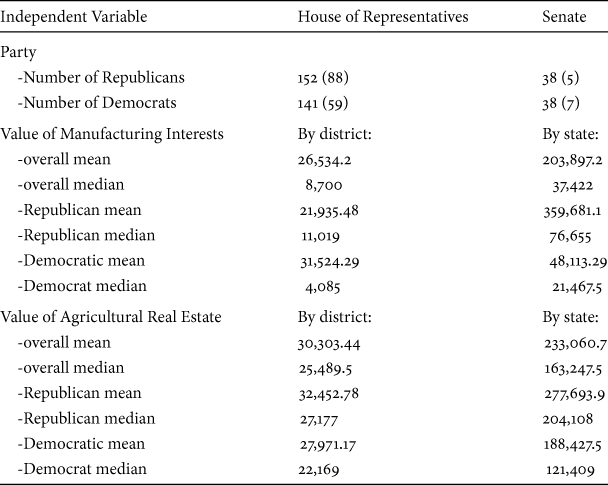
In each of the analyses for Models 1 and 3 presented below, the dependent variable is a variable representing the vote of an individual senator or representative on the specified vote—with a 0 representing a vote against passage and a 1 representing a vote in favor of passage. In the analysis for Model 2 presented below, the dependent variable is a variable representing the likelihood of an individual representative to vote on the motion to adopt the special rule—with a 0 representing a refusal to vote on the motion, and a 1 representing a vote on the motion (a modeling choice we explain more fully below). Our independent variables consist of a measure for party affiliation (0 = Democrat; 1 = Republican), a variable for lame-duck status (0 = not lame duck (reelected); 1 = lame duck), as well as summary data on the dollar value of manufacturing interests for a given legislator’s district/state and summary data on the dollar value of agricultural real estate for a given legislator’s district/state.Footnote 53 We use these last two measures as proxies for the relative influence on the legislator of manufacturing and agricultural interests within his constituency, respectively. The larger the dollar values for each measure, the greater the influence on the legislator for that measure. Because we wish to examine the interactive effects of constituency, party, and lame-duck status, we also include as independent variables the interaction of the party and lame-duck variables with each other and each with both the dollar value of manufacturing interests and the dollar value of agricultural interests for each legislator/senator. Table 2 provides a brief summary of each of these variables.
Descriptive Statistics of Independent Variables

Note: For the House of Representatives, we code as Democrats 10 National Greenbackers, 2 Readjuster Democrats, and 1 Independent Democrat, and we code as Republican 1 Independent. For the Senate, we code as Democrats 1 Readjuster Democrat, and we code as Republican 1 Independent. Numbers in parentheses for both the House of Representatives and the Senate identify the number of lame-duck members included in the numbers reported.
Analysis and Discussion
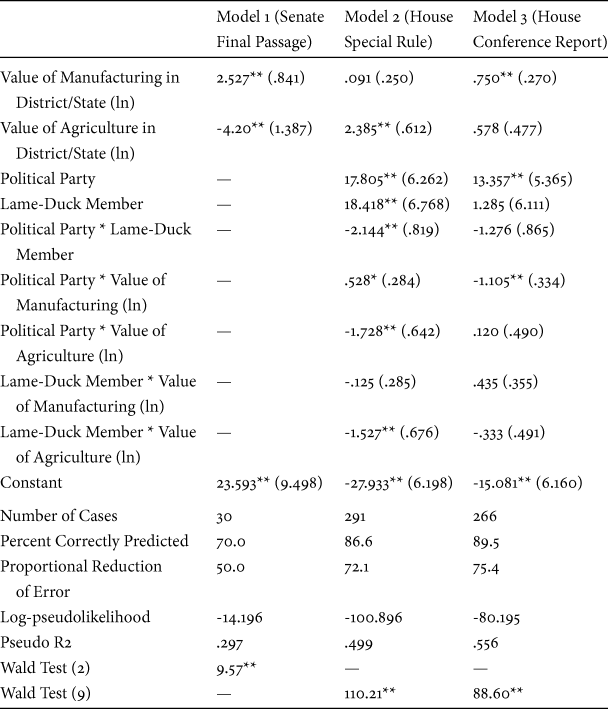
Given the dichotomous nature of our dependent variable in each of our models, we estimate each of these models using logit and simulate predicted probabilities using CLARIFY.Footnote 54 Table 3 presents the results of the estimation of these models.
Congressional Votes on the Tariff Act of 1883

Note: Table presents logit coefficient estimates and robust standard errors (in parentheses). Data are taken from Poole and Rosenthal (2012) and Parsons, Dubin, and Parsons (1990). Model 1 presents results for Democrats only and excludes two influential outlier observations (Delta Beta>2). Model 2 excludes one influential outlier observation (Delta Beta >2). Model 3 excludes two influential outlier observations (Delta Beta >2). For Models 1 and 3, the dependent variable is coded 1 = yea; 0 = nay. For Model 2, the dependent variable is coded 1 = vote (yea or nay); 0 = abstain.
* p ≤ .10 level (two-tailed test) ** p ≤ .05 level (two-tailed test)
A quick review of Table 3 discloses a significant role for both party interests and constituency interests in each of the models. Model 1 presents the results of the effect of the (logged) values of manufacturing and agricultural interests on the Senate final passage vote. Model 1 is limited to Democrats onlyFootnote 55 because of the seemingly strong party interests affecting Republican votes on final passage (see Table 1).Footnote 56 Additionally, Model 1 does not include a control variable for lame-duck status (or the related interaction terms) because lame-duck status perfectly predicts a “yea” vote.Footnote 57 The results of our analysis clearly demonstrate the effects of constituency characteristics on the final passage vote. Both the total value of manufacturing interests and the total value of agricultural real estate have a statistically significant (and opposite) effect on Democratic senators’ votes. As the total value of manufacturing interests increases from its observed 25th percentile value to its observed 75th percentile value, the probability of voting in favor of final passage increases from .05 to .68, an effect that is both substantively and statistically significant. As the total value of agricultural real estate increases from its observed 25th percentile value to its observed 75th percentile value, the probability of voting in favor of final passage decreases more than tenfold from .90 to .09. While these results may seem out of place when considered in light of the historical summary we present above, this is not necessarily the case. What these results likely demonstrate is the view of agriculturally-minded senators who thought that the Senate legislation did not go far enough in reducing tariff rates, which caused them to vote against final passage.Footnote 58 In contrast, these results show that manufacturing-minded senators were enabled to cast a vote ostensibly in favor of “reform” even though they likely knew that the bill would be revised to be more protectionist in nature at conference.
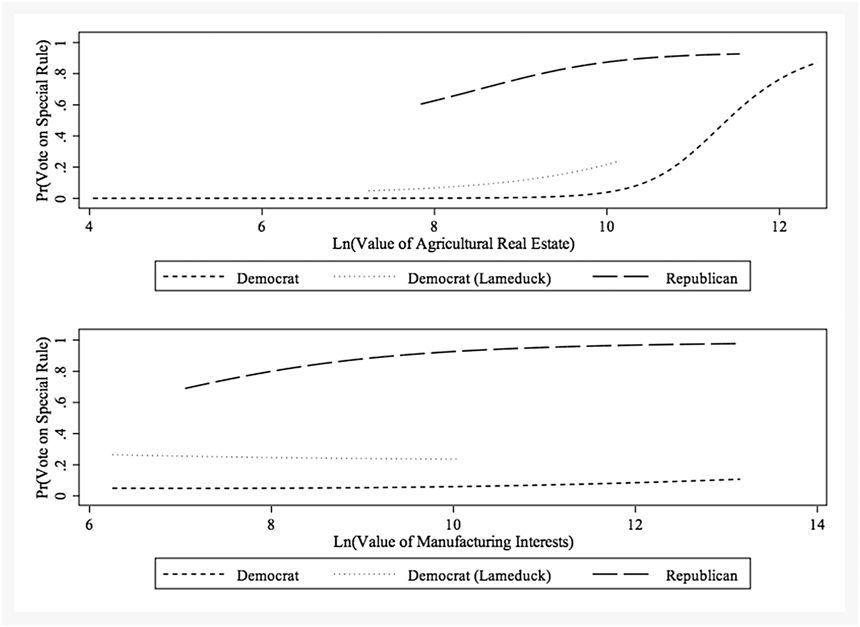
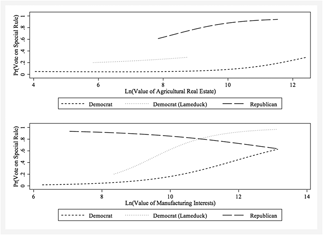
Model 2 presents the results of the effects of the (logged) values of manufacturing and agricultural interests, as well as party, lame-duck status, and the related interaction terms, on the House special rule vote. As we noted above, we model voting on the motion to adopt the special rule (= 1) to abstention from voting on the motion (= 0); a tactic designed to prevent a vote by use of a disappearing quorum.Footnote 59 The results of our analysis clearly demonstrate the effects of both party and constituency on the special-rule vote. This analysis also shows the effect of lame-duck status for a small group of Democrats on the special-rule vote.Footnote 60 With respect to party interests, Republicans were far more likely to vote on the special rule than Democrats. The probability of a Republican representative voting on the special rule is .88 compared to only .05 for Democrats, an effect that is both substantively and statistically significant. With respect to constituency interests, representatives from each party stayed true to their roots. The total value of agricultural real estate has a statistically significant effect on Democratic representatives, while the total value of manufacturing interests has a statistically significant effect on Republican representatives. For Democrats, as the total value of agricultural real estate increases from its observed 25th percentile value to its observed 75th percentile value, the probability of voting increases from .01 to .09. For Republicans, as the total value of manufacturing interests increases from its observed 25th percentile value to its observed 75th percentile value, the probability of voting increases from .87 to .93. Figure 1 presents a graph of these results across the observed values of both manufacturing interests and agricultural real estate. It also presents results for lame-duck Democrats at values that are statistically different from reelected Democrats. From these results, it would appear that although constituency interests played a role in voting on the special rule, party interests trumped constituency interests for both Republican and Democratic representatives. We make this claim because, as Figure 1 makes clear, despite the manipulation of the values of agricultural real estate, the predicted probability of a Democratic representative voting on the special-rule motion is well below .5 except for the most extreme high values of agricultural real estate observed in the data. Meanwhile, Figure 1 also shows that the typical Republican had a .88 probability of voting for the special rule even before taking into account the total value of manufacturing interests in the legislator’s district. Even at the lowest observed value of manufacturing interests, the predicted probability of a Republican representative voting on the special-rule motion is far greater than .5.
Predicted Probability of Vote on Special Rule.

That party interests trumped constituency interests on this vote is not surprising. It is common for party interests to be the key influence on procedural votes. For the Republicans, McCown notes that even House Republicans who would have been willing to concur in the Senate bill were inclined to vote on the special rule because they did not want to be saddled with not voting and causing the defeat of a bill ostensibly for tariff “reform,” or because they did not want to leave tariff reform for Democrats to deal with in next Congress and harm their electoral chances in the 1884 elections.Footnote 61 For the Democrats, McCown notes that the party generally was able to convince its members to abstain from voting. In fact, only the day before the motion on the special rule passed, the same motion was defeated due to the Democrats successfully invoking the disappearing quorum tactic.Footnote 62 On the following day, when a few members broke rank to vote “nay” on the motion, that switch was enough to meet the quorum requirements. What is interesting about this switch, as our results discussed above highlight, is that those Democrats who cast a vote on the motion to adopt the special rule were Democrats with generally high values of agricultural real estate in their districts. Thus, our results show that agriculturally minded Democrats in the Senate worked to block reform legislation by voting against its passage, but that some agriculturally-minded Democrats in the House worked to move this reform legislation forward by casting a vote (albeit a “no” vote) on the motion to adopt the special rule. The likely difference in behavior lies in the makeup of the upcoming 48th Congress. Although Democrats in the Senate would still remain in the minority, Democrats in the House would become the majority and they did not want to be saddled with either the responsibility for tariff legislation once they had a majority or the label of “obstructionists” immediately before taking majority power.
Model 3 presents the results of the effect of the (logged) values of manufacturing and agricultural interests, as well as party and the related interaction terms, on the House conference report vote. The results of our analysis clearly demonstrate the effects of both party and constituency on the House conference report vote. This analysis also shows the effect of lame-duck status for a small group of Democrats on the conference report vote. With respect to party interests, Republicans were far more likely to vote in favor of the conference report than Democrats. The probability of a Republican representative voting in favor of the conference report is .89 compared to only .09 for Democrats, an effect that is both substantively and statistically significant. With respect to constituency interests, the total value of manufacturing interests has a statistically significant effect on Democratic representatives, while neither manufacturing interests nor agricultural real estate has a statistically significant effect on Republican representatives. For Democrats, as the total value of manufacturing interests increases from its observed 25th percentile value to its observed 75th percentile value, the probability of voting in favor of the conference report increases from .04 to .11. Figure 2 presents a graph of these results across the observed values of both manufacturing interests and agricultural real estate. It also presents results for lame-duck Democrats at values that are statistically different from reelected Democrats. From these results, it would appear that although constituency interests played a role in voting on the conference report in the House, party interests trumped constituency interests for both Republican and Democratic representatives. We make this claim because, as Figure 2 makes clear, the predicted probability of a Democratic representative voting in favor of the conference report is well below .5 except for the most extreme high values of manufacturing interests observed in the data. Meanwhile, Figure 2 also shows that the typical Republican had a .89 probability of voting in favor of the conference report, leaving little room for constituency interests to play a significant role.
Predicted Probability of Vote in Favor of Conference Report (House).

That party interests once again trump constituency interests on this vote is not surprising given the changes made to the legislation at the conference. As we noted above, many duties were raised in a protectionist direction—matching the preferences of many House Republicans and enraging many House Democrats. Nonetheless, despite the traditional Democratic Party opposition to high tariff rates, some House Democrats—those with high values of manufacturing interests in their district—were more likely, on average, to ignore their party and vote in favor of the conference committee report, presumably because it provided their districts with desired high tariff rates on manufactured goods.
Conclusion
We have addressed why the Tariff Act of 1883 exemplifies so well the often-observed fact in American politics that policies that lack popular support are nonetheless persistent and stable. Our explanation centered on the importance of institutions and their role in structuring the choices available to members of Congress and of policy preferences and their role in influencing the voting behavior of members of Congress. In short, the Republican leaders in the House were able to structure the agenda to make their preferred short-term outcome the most likely to occur, and the votes of rank-and-file members, influenced by both party and constituency interests, secured that outcome.
Although, in terms of policy, the Tariff Act of 1883 was one of the least consequential tariff reforms ever enacted, it is hard to understate the significance of the procedural path that the invention of the special rule unleashed in the U.S. House. For much of the nineteenth century, the U.S. House was a highly inefficient legislative body. The standing rules gave members little choice over the order in which bills were considered in the chamber and provided few means for a majority to enact desired legislation. Obstruction reigned through the use of dilatory motions and the infamous “disappearing quorum.”Footnote 63 These practices combined to create a situation where both major parties could easily block the policy initiatives of the other party.
The invention of the special rule during the debate over the Tariff Act of 1883 began to change this state of affairs. For the first time, the majority party was able to create legislative procedures for one particular bill. To be sure, the change brought about by the special rule was slow to take hold. The special rule did not reappear until the 51st Congress, when then Speaker Reed—so instrumental in the development of the special rule adopted for the Tariff Act of 1883—used it, as well as other changes to the then-existing House rules, to actively pursue the House majority’s policy goals.Footnote 64
Today, a combination of special rules and Reed’s other rules innovations are the procedural foundation for the modern U.S. House of Representatives. These rules provide the process by which the majority party can dominate the chamber through controlling the floor agenda and shaping the content of legislation that reaches the House floor. All major legislation that passes the House does so with the assistance of a special rule that, in most cases, severely limits the amendments that can be offered as well as their content. Thus, special rules are used to keep members from having to take votes that are politically difficult, as was seen in the debate over abortion amendments to the Patient Protection and Affordable Care Act. In addition, special rules can be used to secure noncentrist policy outcomes as occurred with the Tariff Act of 1883. More recently, a special rule helped the House impeach then President Bill Clinton. Although a majority of House members and more than 70 percent of the public preferred a resolution of censure to impeachment, the rule adopted for consideration of the articles of impeachment prevented a vote on censure.
Further research on this topic may include a more detailed analysis of the factors affecting the decision of certain senators to switch their vote between the final passage and conference report votes and of the factors affecting the voting behavior of House members who initially participated in a “disappearing quorum” tactic to prevent the adoption of the special rule, but who, one day later, cast a vote against the rule that enabled the quorum requirement to be met and the rule to be adopted. In addition, a detailed consideration of the individual and collective interests (and the interaction of these interests) that drove members to support the special rule and the passage of the conference report could shed further light on the development and evolution of institutions in Congress. Each of these analyses, we think, would enable us to further explore the effects of institutions and constituency pressure on the behavior of members of Congress.