Introduction
Toxocara canis and Toxocara cati are common nematode parasites occurring in dogs and cats throughout the world. Their prevalence is strictly connected with host age, being highest in puppies and kittens up to 24 weeks old (O'Lorcain, Reference O'Lorcain1994). The parasite eggs excreted in faeces by the animal embryonate in the environment within 2–3 weeks and, under suitable conditions, can remain infective for several years. Humans become infected by ingesting embryonated eggs from soil or contaminated food. The hatched larvae migrate from the small intestine via the bloodstream to the liver, where most of them are retained. However, some larvae continue their migration through the heart and lungs to the systemic circulation where they are distributed via the bloodstream to various organs. At present, four clinical syndromes of human toxocariasis are recognized, namely visceral larva migrans (VLM), ocular larva migrans (OLM), covert toxocariasis (CT) and neurological toxocariasis (NLM). The clinical manifestations are dependent on the infective dose, localization of larvae, host responses and possible re-infections. Massive infections and re-infections can occur in small children as they may eat sand or soil and frequently have close contact with puppies.
The seroprevalence in adult humans in Europe is 1–5%, as shown by studies from Scotland (Girdwood et al., 1978), Austria (Walder & Aspöck, Reference Walder and Aspock1988), Switzerland (Stürchler et al., Reference Stürchler, Bruppacher and Speiser1986), France (Magnaval & Baixench, Reference Magnaval, Baixench, Lewis and Maizels1993), Germany (Kimming et al., Reference Kimming, Naser and Frank1991) and Spain (Fenoy et al., Reference Fenoy, Cuellar and Guillen1996). However, high rates were revealed in some European rural regions, namely 37% in Switzerland (Jeanneret, Reference Jeanneret1991), 44% in Austria (Deutz et al., Reference Deutz, Fuchs, Auer, Kerbl, Aspőck and Kőfer2005) and 17.4% in the Canary Islands (Fenoy et al., Reference Fenoy, Cuellar and Guillen1996). The highest seroprevalence rate ever reported in adults (92%) was in La Réunion (French Oversea Territories, Indian Ocean) (Magnaval et al., Reference Magnaval, Michault, Calon and Charlet1994). Seroprevalence surveys in young children found 20% to be seropositive in developed countries (Holland et al., Reference Holland, O'Lorcain, Taylor and Kelly1995) and 60% in developing countries (Thompson et al., Reference Thompson, Bundy, Cooper and Schantz1986). The percentage of positive results in children differs in urban and rural regions: 2.1% were found in the Stuttgart area, Germany (Kimming et al., Reference Kimming, Naser and Frank1991) and up to 65.7% among socially and economically disadvantaged children in northern Spain (Cilla et al., Reference Cilla, Perez-Trallero, Gutierrez, Part and Gomariz1996).
Positive serological results only confirm Toxocara infection, hence toxocariasis must be defined on the basis of clinical manifestations and laboratory abnormalities (eosinophilia, elevated IgE level, anaemia) evocative of an active helminthiasis.
During the years 1997–2003, the Department of Children's Infectious Diseases in Warsaw diagnosed about 30 cases of clinical toxocariasis per year in children in Mazowieckie voivodeship, central Poland.
The aim of the present study was to evaluate the correlation between environmental risk factors (soil contamination near children's homes and the presence of a dog or a cat) and anti-Toxocara seropositivity in children, as well as the influence of these factors on dynamics of specific antibody levels after treatment.
Material and methods
During the years 2002–2005 a total of 343 children (aged 2–16 years) from central Poland (Mazowieckie voivodeship) suspected of Toxocara infection were diagnosed at the Department of Children's Infectious Diseases in Warsaw. The reasons for diagnosis in 232 children were laboratory abnormalities (eosinophilia, elevated IgE level, anaemia), anomalies in physical examination (hepatomegaly, lymph node enlargement, the decline in visual acuity, unilateral strabismus) and patients' complaints (abdominal pain, headache). The remaining 111 children were included in the study because of a former diagnosis of Toxocara infection in siblings. Toxocariasis was confirmed in 249 patients, i.e. 197 cases were recognized as VLM and 52 as OLM syndrome. The children (90 girls and 159 boys) were of rural (55.5%), suburban (26.8%) and urban (17.6%) origin. Specific anthelminthic treatment (diethylcarbamazine) was administered to infected children.
Serological testing
Serum samples of 343 children were examined for specific IgG antibodies by enzyme-linked immunosorbent assay (ELISA) based on excretory–secretory (ES) antigens of T. canis larvae. The commercial kit (R-Biopharm, Germany) was used according to the producer's protocol. The working dilution of sera was 1 : 50. The ELISA IgG results were expressed as an index equal to the ratio of the sample absorbence value to the cut-off value. Serological testing was also carried out after 6, 12 and 24 months of treatment in 100, 99 and 69 patients, respectively.
Epidemiological examinations
These included a questionnaire – behaviour of children (geophagia, hygiene practices), place of residence characteristics, ownership of dog or cat – and examination of soil and sand samples.
The place of residence of 164 patients were examined, i.e. 57 households in rural areas, 68 in the suburbs and 39 in urban areas. Soil and sand samples were collected in backyards and gardens around homes (in rural and suburban areas) or in pathways, playgrounds and sandboxes around blocks of flats (in urban areas). In each location ten samples weighing approximately 10 g each were collected. Toxocara spp. eggs were isolated by flotation technique according to the Dada method (Dada, Reference Dada1979). Dried sand or soil was sieved through a mesh and 10 g samples were transferred to a volumetric flask containing 50 ml of 0.1% Tween 80 and vortexed for 30 min. The suspension was poured into a 60 ml centrifuge tube and then centrifuged at 1500 rpm for 10 min. After that the supernatant, free of eggs, was decanted. A saturated flotation solution of ZnSO4 (1.52 specific gravity) was added and the tube was vortexed again and later centrifuged at 1500 rpm for 10 min. The solution was then added to form a meniscus and a coverslip was overlaid. After 15 min the coverslip was transferred to a glass slide, examined at 100 × magnification and Toxocara spp. eggs were counted.
Statistical analysis
Statistical analysis of data was based on the χ2 test. The rate of soil contamination with Toxocara spp. eggs was compared among rural, suburban and urban areas. Also, a decrease in the antibody level after treatment in connection with the presence of risk factors was estimated. Logistic regression was used to estimate the contribution of selected factors, such as age, sex, place of residence, soil contamination with Toxocara spp. eggs, and dog or cat ownership, on the occurrence of Toxocara infection (Statistica, StatSoft Inc., Tulsa, Oklahoma, USA).
Results
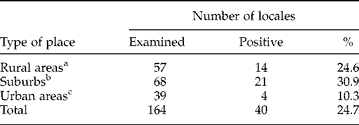
Higher contamination of soil with Toxocara eggs in residential areas was found in suburban and rural regions (30.9% and 24.6%, respectively), than in urban areas (10.3%) (table 1). In rural settlements (backyards and gardens surrounding houses) up to ten eggs of Toxocara spp. were found in the 10 g samples examined, while in urban areas (pathways, playgrounds and sandpits around blocks of flats) no more than three eggs were detected per sample. Only the difference between suburban and urban regions was statistically significant (P = 0.0152). The P value of the difference between rural and urban areas was only slightly above the 0.05 limit (P = 0.0778).
Contamination of soil with Toxocara eggs in different settlements in central Poland.
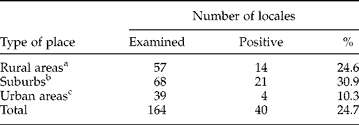
a,b Gardens, backyards.
c Playgrounds, sandboxes.
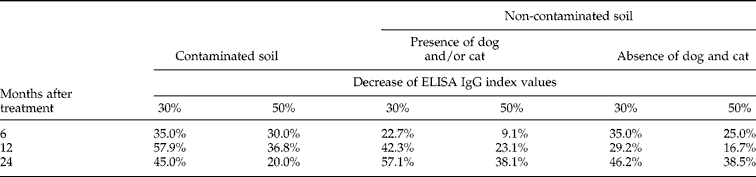
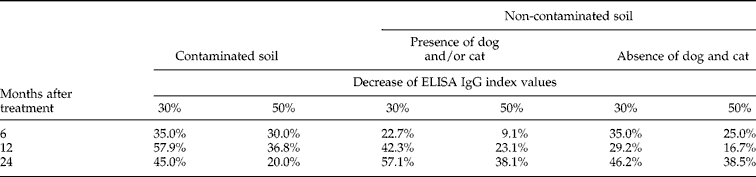
Specific antibodies were detectable after treatment in all patients throughout the study period. After 2 years, a decrease in the antibody level was observed in 47.8% of the children. The results of serological testing after treatment in connection with epidemiological data are shown in table 2. Two years after treatment in about 40% of children living in areas where contamination was not confirmed (irrespective of pet presence), a decrease in the antibody level equal to 50% of the index value was observed. In contaminated places such a decline was found in 20% of the children. However, these differences were not statistically significant.
Percentage of children with a decrease in the antibody level index of at least 30% or 50% connected with epidemiological data.
Among 111 children diagnosed due to confirmed toxocariasis in siblings, 27 were seronegative, while among 84 seropositive 17 had confirmed toxocariasis. The multiple logistic regression model was employed to determine the correlation between seropositivity in these children and factors such as age, sex, place of residence, soil contamination with eggs of Toxocara spp., and dog or cat ownership. The adjustment of this model was statistically insignificant. Testing the adjustment of the model with various combinations of the factors mentioned, we estimated that only a model including dog ownership and soil contamination was statistically significant. In this model, the only statistically significant risk factor for infection was owning a dog (P = 0.0238, odds ratio = 2.9, 95% confidence interval = 1.15–7.26) (table 3).
Logistic regression model for estimating the correlation between the occurrence of anti-Toxocara antibodies in children and environmental risk factors.

Discussion
Looking at seropositivity level as the indicator of the infection, Toxocara infections are frequent among people throughout the world. In different populations the prevalence varies from 3 to 86% (Thompson et al., Reference Thompson, Bundy, Cooper and Schantz1986). In France, the infection rate was 14.4% among rural inhabitants and 4.8% in cities (Magnaval & Baixench, Reference Magnaval, Baixench, Lewis and Maizels1993). Similarly in Turkey infections in rural areas were more prevalent than in towns (16.9 and 1.4%, respectively) (Dogan et al., Reference Dogan, Dinleyici and Bor2006). In the Slovak Republic, among children hospitalized due to symptomatic toxocariasis, 83.3% originated from rural regions, while 16.7% were from urban areas (Dubinsky, Reference Dubinsky1998). In the present study, most patients were inhabitants of rural and suburban areas (76.2%). In these localities children tend to spend time outdoors from the first months of their life, playing in the yards and gardens around their houses. The exposure to Toxocara eggs is high, as has been shown in our results. In Spain, a much higher level of soil contamination with Toxocara spp. eggs was recorded in rural and suburban areas in comparison with urban areas (Conde Garcia et al., Reference Conde Garcia, Muro and Simon1989). Similarly, in the present study the town settlements were found to be safer from the epidemiological point of view. In the urban areas systematic deworming of animals may contribute to the low level of contamination. The study conducted in the Marche region in Italy indicated a much higher percentage of T. canis infected dogs in rural areas as compared to urban areas (Habluetzel et al., Reference Habluetzel, Traldi, Ruggieri, Attili, Scuppa, Marchetti, Menghini and Esposito2003). Similarly, some Polish authors have recorded infection levels that were twice as high in dogs in rural regions than in those kept in towns (Balicka-Ramisz et al., Reference Balicka-Ramisz, Ramisz, Pilarczyk, Cisek and Rolicz2004; Gawor & Borecka, Reference Gawor and Borecka2004).
Our results showed a decrease in the antibody level after treatment in a higher percentage of patients inhabiting areas where Toxocara spp. eggs were not detected. These data suggest a lower rate of re-infection in those children. The lack of statistical significance was probably a result of the small size of the study group. According to the logistic regression analysis employed to determine the correlation between seropositivity in children and selected risk factors, only one factor – dog ownership – was statistically significant. It confirmed the suggestion of the direct threat of infected animals for humans, as Wolfe & Wright (Reference Wolfe and Wright2003) detected invasive T. canis eggs on dog hair. Holland et al. (Reference Holland, O'Lorcain, Taylor and Kelly1995) determined a clear relationship between seropositivity in children and dog ownership and geophagia. The lack of statistical significance of the relationship between seropositivity and soil contamination in our research may be a result of the small size of the study group and the long time interval between diagnosis of infection and examination of samples. Deutz et al. (Reference Deutz, Fuchs, Auer, Kerbl, Aspőck and Kőfer2005) tested for toxocariasis in some professional groups – veterinarians, farmers, butchers, hunters – and a control group of adult inhabitants of Graz (Austria) and found a statistically significant correlation between seropositivity and dog or cat ownership only in the case of farmers and butchers, suggesting the reason for this to be a low standard of healthcare in rural areas and lack of deworming of pets. In our study most patients inhabited rural and suburban areas and usually did not abide by hygiene rules.
The present results have demonstrated the high risk of VLM and OLM for children from rural and suburban areas in central Poland. The sero-epidemiological investigations indicated that re-infection might be the reason for persistence of seropositivity after treatment. These data show the need for educational programmes which should be implemented for prevention of Toxocara infections in children.
Acknowledgements
Financial support for this study was provided by the Ministry of Sciences and Higher Education in Poland (contract no. 3 PO5D 074 23).