Introduction
In September 2009, the member states of the World Health Organization (WHO) from the Asia-Pacific Region adopted a health financing strategy. They agreed to take steps to reduce out-of-pocket payments, increase total health expenditures, cover over 90% of the population with prepayment schemes, and cover 100% of vulnerable populations with social assistance or safety-net programmes (World Health Organization, 2009). Although a number of low- and middle-income country governments have introduced health insurance schemes in recent years, not a great deal is known about their impact. Vietnam, one of the signatories of the WHO Asia-Pacific health financing strategy, has launched on a number of reforms of its health insurance system.
Since the onset of the doi moi economic reforms initiated in 1986, the government of Vietnam has made a number of attempts at reforming its health insurance system. The current system is the result of reforms introduced throughout the 1990s and 2000s. Public health insurance in Vietnam currently includes two main programmes. One is compulsory. The other voluntary.Footnote 1 The compulsory program incorporates four sub-schemes. Social Health Insurance (SHI) in Vietnam, a compulsory employment-based programme introduced in 1993, provides insurance to civil servants and private sector workers in the formal sector. Family members are not covered. Second, a noncontributory scheme provides insurance to ‘people of merit’ including retired government officials, war veterans, members of Parliament, Communist Party officials and war heroes. A third scheme is a compulsory programme that provides health insurance to all children under six years of age. The 1991 Law on Protection, Care, and Education for Children stipulates that children under six years are entitled to primary health care and curative care free of charge at government health facilities. However, it was not until 2005 that free care began to be provided. A fourth scheme, the Health Care Fund for the Poor (HCFP) introduced in 2003, provides insurance to those that are officially classified as poor, ethnic minority households living in remote mountainous areas and households living in communes officially classified as poor. The HCFP is financed from general government revenues at both national (75%) and provincial (25%) levels.
The Voluntary Health Insurance (VHI) scheme, introduced in 1994, targets various groups. Full-time students and school children are an important target group and are often enrolled as a whole at the school or college level (Lieberman and Wagstaff, Reference Lieberman and Wagstaff2009). Family members of those with compulsory health insurance can purchase VHI with the restriction that all household members have to enroll. The latter restriction was removed in December 2007. As of January 2010, all full-time students are required to adhere to the government compulsory SHI scheme. Other groups such as communes are also allowed to enroll in the VHI scheme.Footnote 2
The benefit package is more or less the same across all types of health insurance, whether compulsory or voluntary. It covers most outpatient and inpatient care received at government facilities and drugs on the Ministry of Health list. However, costs of treating injuries from traffic accidents,Footnote 3 of nonprescription drugs bought from drug vendors and pharmacies, and of informal payments to providers are not covered.Footnote 4 There is no deductible but there was a 20% coinsurance rate (with a VND 1,500,000 annual limit) between 2003 and 2005. The coinsurance was waved if the costs of a visit were less than VND 20,000. The health insurance scheme for children under six provides the only exception to this mode of coverage. Benefits include consultations, diagnosis and treatment at government primary care facilities and, if referred by a primary care provider, treatment at provincial and central level facilities. In the event of an emergency, a referral is not needed and diagnosis and treatment can be obtained at any government facilities. Out-of-pocket payments may be required for the use of specialized medical devices and equipment.Footnote 5
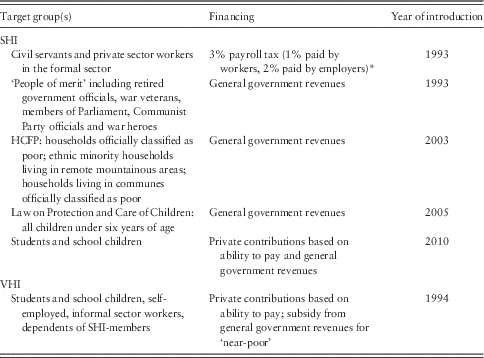
Table 1 provides an overview of health insurance schemes in Vietnam. With one exception private health insurance is negligible in Vietnam. Most for-profit insurance schemes focus on students. Although little information is available, several million students were believed to be enrolled with domestic for-profit insurance companies in 2006. For example, the Bao Viet Insurance Company, a government-owned for-profit general insurance company, reported enrollment of more than 8,000,000 students (Ministry of Health and Health Partnership Group, 2008).
Overview of health insurance schemes

SHI=Social Health Insurance; HCFP=Health Care Fund for the Poor; VHI=Voulntary Health Insurance.
Note: *=Increased to a maximum of 6% from 1 July 2009 (1/3 paid by workers, 2/3 paid by employers).
Source: Ekman et al. (Reference Ekman, Liem, Duc and Axelson2008); Ministry of Health and Health Partnership Group (2008); National Assembly (2008); Lieberman and Wagstaff (Reference Lieberman and Wagstaff2009).
Despite Vietnam’s recent expansion of health insurance, out-of-pocket payments still accounted for about two-thirds of all health spending in 2006. It is important to note that even insured individuals can experience substantial out-of-pocket expenses. In addition to cost-sharing, other out-of-pocket expenses include drugs not covered by the insurance plan, most visits to private providers and informal payments (Lieberman and Wagstaff, Reference Lieberman and Wagstaff2009).
Literature review
Although the RAND Health Insurance Experiment (HIE) was completed more than two decades ago, it remains the only long-term experimental study of the effect of health insurance on the use of health services and on health outcomes. The HIE demonstrated that participants who received free care used more health services than those who paid for a share of their health care. It also showed that those who paid for a share of their health care did not report worse general health than those receiving free care. There were, however, exceptions, especially among the sickest and poorest participants. For example, free care led to improvements in hypertension and dental and vision health (Newhouse and the RAND Insurance Experiment Group, Reference Newhouse1996). The RAND HIE, however, did not randomize indviduals to receive no health insurance. Rather, they were assigned to plans with varying degrees of cost sharing. This design feature combined with the fact that the RAND HIE was conducted in the United States in the 1970s and 1980s limits the generalizability of its findings in the context of low- and middle-income countries.
Research from systematic reviews suggests that health insurance increases utlization in the United States (Hadley, Reference Hadley2003; Buchmueller et al., Reference Buchmueller, Grumbach, Kronick and Kahn2005; Levy and Meltzer, Reference Levy and Meltzer2008). For example, Buchmueller et al. (Reference Buchmueller, Grumbach, Kronick and Kahn2005) found that insured children average one more physician visit per year than uninsured children. This effect was smaller for poor children. They also found that, for children, insurance increases the use of outpatient preventive care (e.g. immunizations, well-child visit) and acute care services but not inpatient services. For adults, health insurance was found to increase outpatient utilization by between one to two visits per year and inpatient utilization by between 0.16 and 0.24 days per year. These estimates represented 30 to 50% increases for children and 60 to 100% for adults. Lagarde and Palmer (Reference Lagarde and Palmer2006) systematically reviewed studies that examine the impact of community-based insurance and SHI on extending access to health services to poor people in low- and middle-income countries and found there was too little evidence to make any conclusive statements. Giedion and Díaz (Reference Giedion and Díaz2010) assessed the evidence on the impact of health insurance in low-and middle-income countries and found that health insurance improved access and use but had no conclusive impact on health status. Spaan et al. (Reference Spaan, Mathijssen, Tromp, McBain, ten Have and Baltussen2012) evaluated the impact of health insurance in low- and lower-middle-income countries in Africa and Asia and found an evidence base that is “incomplete, … , patchy and of variable quality” (pp. 687–688).
A number of studies have examined the impact of health insurance on health service utilization in Vietnam. Axelson et al. (Reference Axelson, Bales, Minh, Ekman and Gerdtham2009), Lieberman and Wagstaff (Reference Lieberman and Wagstaff2009), Nguyen (Reference Nguyen2009) and Wagstaff (Reference Wagstaff2007, Reference Wagstaff2010) examined the early impact of Vietnam’s HCFP on health services utilization. Wagstaff (Reference Wagstaff2010) used single-difference (2006), double-difference (2004–2006) and triple-difference (2002–2004–2006) and regression analysis, and found that HCFP had no effect on utilization (number of outpatient visits and inpatient admissions in 12 months preceding the interview).Footnote 6 Using single-difference (2004) and double-difference (2002–2004) with propensity score matching, Axelson et al. found that HCFP had a modest positive, but not statistically significant, effect on the number of inpatient and outpatient visits. They also found that individuals with HCFP insurance substituted from private to public providers and from primary to secondary and tertiary level care. Wagstaff (Reference Wagstaff2007) used single-difference with propensity score matching and found that HCFP substantially increased health services utilization. The impact on utilization, however, was found to be larger among the better off.Footnote 7 As Axelson et al., Nguyen (Reference Nguyen2009) used single-difference (2004) with propensity score matching. Additionally, Nguyen used an intention to treat approach with instrumental variable and fixed effects estimations. Nguyen also found that HCFP led to increased utilization of government health services, while substituting away from uncovered services in the private sector. Lieberman and Wagstaff (Reference Lieberman and Wagstaff2009) used single-difference (2006) with poisson regressions and found that health insurance and HCFP substantially increased health services utilization.Footnote 8
As noted above, systematic reviews found little evidence that health insurance effects health status in low- and middle-income countries. Two sets of studies are notable, those in Vietnam and China. Wagstaff and Pradhan (Reference Wagstaff and Pradhan2005) studied the effect of VHI on body mass index (BMI) and on the height and weight of young children and found that VHI had a significant positive impact on the BMI of adults and on the height and weight of young children (children aged between 0 and 4 in 1992/93) but not of older children. Wang et al. (Reference Wang, Yip, Zhang and Hsiao2009) evaluated the impact of a community-based health insurance scheme in rural China in 2003. Using data from a social experiment (2002 and 2005) and double-difference with propensity score matching, Wang et al. found that insurance had a positive impact on overall self-reported health and on specific dimensions of quality of life, including pain/discomfort and anxiety/depression but not mobility, self-care or usual activity. Wagstaff and Yu (Reference Wagstaff and Yu2007) evaluated the impact of a World Bank project that combined supply-side interventions with demand-side measures including measures that aimed at expanding health insurance in China. Using two survey waves conducted after the start of the project (2000 and 2004) and difference-in-differences with propensity score matching, Wagstaff and Yu found some evidence that the project led to a reduction in the number of days of sickness and in chronic sickness, but no evidence that the project had any impact on self-assessed health or infant mortality.
The mixed evidence of the impact of health insurance on health outcomes for high-income populations and the limited evidence for populations of low- and middle-income countries calls for additional research on the impact of health insurance. While a number of studies have already explored the impact of HCFP on health services utilization in Vietnam, none explore its impact over a period longer than two years: Axelson et al. (Reference Axelson, Bales, Minh, Ekman and Gerdtham2009), Wagstaff (Reference Wagstaff2007) and Nguyen (Reference Nguyen2009) examine the effect between 2002 and 2004, Wagstaff (Reference Wagstaff2010) examine the effect between 2004 and 2006 while Lieberman and Wagstaff (Reference Lieberman and Wagstaff2009) compares individuals with and without insurance in 2006. Additionally, the impact of the policy to provide free health care to children under six and the impact of gaining student health insurance have not been previously examined. As pointed out by Buchmueller et al., the effects of expanding insurance coverage may vary across the population and may depend on what type of coverage is offered to currently uninsured individuals (Buchmueller et al., Reference Buchmueller, Grumbach, Kronick and Kahn2005). As Vietnam moves toward universal coverage, understanding the probable magnitude of the impact of health insurance on health services utilization for various subpopulations is critical for assessing the costs and benefits of its expansion strategy.
I first examine the impact of the HCFP on health services utilization and health outcomes. Second, I examine the impact of the Law on Protection and Care of Children that mandated free care for children under six. Third, I examine the impact of student and school children health insurance.
Data
The Vietnam Household Living Standards Survey (VHLSS) is a large-scale national survey with a sample in 2006 of more than 9000 households and 39,000 individuals, representative for the whole country, eight regions, urban/rural strata and provinces.Footnote 9 VHLSS has a rich panel component (2002, 2004 and 2006) of more than 6500 individuals. Using a matching algorithm developed by McCaig (Reference McCaig2009), it is possible to link 6575 individuals from 1790 households over the three waves of the survey.
Dependent variables
Following Axelson et al. (Reference Axelson, Bales, Minh, Ekman and Gerdtham2009) and Wagstaff (Reference Wagstaff2007, Reference Wagstaff2010), I use the number of outpatient visits and inpatient admissions in the last 12 months as measures of health services utilization. As measures of health outcomes, I use the number of ‘sickness days’ (number of days in the past 12 months when illness or injuries precluded the respondent from carrying out her/his regular activities, such as work or school); and ‘bed days’ in the past 12 months (number of days in the past 12 months when illness or injuries confined the respondent to stay in bed).Footnote 10 Measures of utilization in VHLSS 2002 differ slightly from the 2004 and 2006 measures. The wording and subsequent coding of the 2002 question do not allow for a record of multiple visits to the same facility for the same episode of care. VHLSS 2004 and 2006 allow such possibility. For example, a handful of respondents in 2004 and 2006 report having visited a specific facility such as a commune health center or a private clinic more than 20 times.
Independent variables
To mitigate selection bias, the following individual and household characteristics are used: age, age squared, sex, marital status, HCFP qualifying criteria (1) whether the individual lived in a household officially classified as poor; (2) whether the household is an ethnic minority household living in especially disadvantaged provinces in the Northern Mountainous region;Footnote 11 and (3) whether the household is living in a ‘decision 135’ communeFootnote 12), geographical regions, household per capita expenditures, student status, ever smoking and household head’s sex, age, age squared and education.
Methods
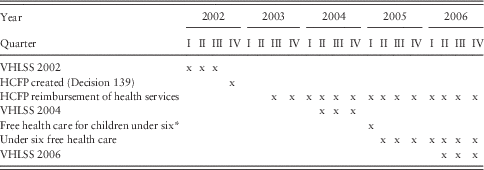
Table 2 presents a timeline of health insurance policy implementations and Vietnam Household Living Standard Surveys.
Timeline of policy implementations and VHLSS
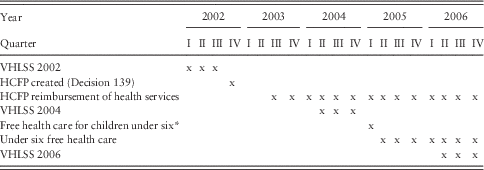
VHLSS=Vietnam Household Living Standard Surveys; HCFP=Health Care Fund for the Poor.
Note: *Law on Protection and Care of Children.
HCFP
HCFP, introduced in 2003, provides insurance to those that are officially classified as poor, ethnic minority households living in remote mountainous areas and households living in communes officially classified as poor. I take advantage of the gradual uptake of HCFP health insurance from 2003 to study individuals who had obtained coverage by 2004 and 2006 (14% and 21% of individuals reported being covered under HCFP in 2004 and 2006, respectively).Footnote 13 First, I compare individuals who had HCFP coverage in 2006 (and had no health insurance in 2004 and were not covered by the predecessor of HCFP in 2002) to individuals who had no health insurance in 2004 and 2006 and were not covered by the predecessor of HCFP in 2002. Second, I compare individuals who had HCFP coverage in 2004 and 2006 (and were not covered by the predecessor of HCFP in 2002) to individuals who had no health insurance in 2004 and 2006 and were not covered by the predecessor of HCFP in 2002.
As a sensitivity check, I also follow Wagstaff (Reference Wagstaff2010) and compare individuals who acquired HCFP coverage between 2004 and 2006 (and who were not covered by the predecessor of HCFP in 2002) to those who had no HCFP coverage in 2004 and 2006 (and who were not covered by the predecessor of HCFP in 2002).Footnote 14 Because HCFP coverage is not randomly assigned it may not possible to control fully for factors such as health status that may influence the uptake of HCFP insurance.Footnote 15
Free health care for children under six (Law on Protection and Care of Children)
Because the panel component of VHLSS contains few children under six, I use single difference with the full 2006 VHLSS sample to examine the impact of the Law on Protection and Care of Children (i.e. I compare children under six with and without coverage in 2006).
I also examine the impact of the Law on Protection and Care of Children using difference-in-differences by pooling the 2004 and 2006 waves of VHLSS and using an intention-to-treat approach: I examine the impact of under six mandated free care regardless of whether or not children under six had acquired coverage by 2006. In 2006, 70% of children under six had already acquired coverage. As a control group, I use children aged 7–10. Consequently, the treatment group includes children under six who were eligible but did not actually report having coverage while the comparison group contains children who were too old to qualify for coverage.Footnote 16 Estimates obtained using the intention to treat approach are unlikely to be biased due to selection as date of birth is difficult to manipulate. Moreover, the inclusion of children who were eligible but did not report having coverage in the treatment group, would if anything, result in underestimations of the impact of mandated free care for under six. It is possible, however, that children with greater unmet need for health services were provided coverage earlier than children with lesser unmet need. Hence, single-difference estimates of the impact of mandated free care for under six children may be overestimated. As a sensitivity check, as control group, I use children aged 7–9 and 7–11.
Students and school children health insurance
Using the VHLSS panel sub-sample of individuals who were 30 years of age or less in 2006, I examine the impact of student health insurance by comparing individuals who had student health insurance coverage in 2006 (and had no health insurance in 2004) to individuals who had no health insurance in 2004 and 2006. As a sensitivity check, I use the VHLSS panel sub-sample of individuals who were 25 or less in 2006. Because full-time students and school children are typically enrolled as a whole at the school or college level, it is unlikely that estimates of the impact of student health insurance are biased due to selection at the individual-level. Selection, however, could occur at the level of the school.
Econometric analysis
To assess the impact of health insurance on health services utilization and health outcomes, I use single difference (SD) and difference-in-differences, or double-difference (DD) approaches to estimate average treatment effects on the treated (ATT). Following Ravallion’s notation (Ravallion, Reference Ravallion2007), let there be two groups indexed by treatment status T=0, 1 where 0 indicates individuals who do not receive treatment (i.e. the control group) and 1 indicates individuals who do receive treatment (i.e. the treatment group). Let Y i be the observable outcome indicator for each individual i and let  $Y_{i} ^{T} $
be the value of Y i under treatment and
 $Y_{i} ^{C} $
the value of Y i under the counterfactual of not receiving the treatment (i.e. the control group). For simplicity, let us assume individuals are observed in two time periods, t=0, 1 where 0 indicates a time period before the treatment group receives treatment and 1 indicates a time period after the treatment group receives treatment. Let X be a vector of observed covariates such as individual and household characteristics. The single difference (D) in mean outcomes between individuals with and without health insurance (i.e. treatment) is
 $$D(X)=E\left( {Y^{T} \left| {X,T=1} \right.} \right){\minus}E\left( {Y^{C} \left| {X,T=0} \right.} \right)$$
The double-difference estimator for period 1 is
 $$DD(X)=E\left( {Y_{1} ^{T} {\minus}Y_{0} ^{T} \left| {X,T_{1} =1} \right.} \right){\minus}E\left( {Y_{1} ^{C} {\minus}Y_{0} ^{C} \left| {X,T_{1} =0} \right.} \right)$$
Conveniently, a regression approach can be used to estimate this double difference design:
 $$Y_{{it}} =\alpha {\plus}\gamma T_{{i1}} {\plus}\delta t{\plus}\beta X_{{it}} {\plus}DD(T_{{i1}} t){\plus}{\varepsilon}_{i} \quad (t=0,1;\;i=1,...\,,n)$$
where α is a constant term; the dummy T i1 captures possible differences between the treatment and control groups prior to the policy change; the dummy t captures aggregate factors that would cause changes in Y even in the absence of a policy change; and T i1t is the interaction term taking on a value of 1 if individual i has health insurance at time t. The coefficient of interest is DD (the coefficient on the interaction term).
The key assumption to ensure validity requires that trends would have been the same in the absence of treatment (i.e. differences between treatment and control group would have remained constant in the absence of treatment). In other words, this DD analysis assumes that the paths of health utilization and outcome for the individuals with and without health insurance would not have been systematically different in the absence of intervention.
The estimated impact (DD – the coefficient on the interaction term) is often estimated using traditional linear-regression methods (e.g. Wagstaff (Reference Wagstaff2010)). Traditional linear-regression methods, however, impose the restriction that the controls enter in a linear-in-parameters form (Ravallion, Reference Ravallion2007). During a 12-month period, a substantial number of individuals do not use any health services. Similarly, a substantial number of individuals do not experience any illness or injuries that preclude them from carrying out their regular activities, such as work or school, or that confine them to stay in bed. Such characteristics of the data render estimates obtained using linear-regressions inconsistent (Cameron and Trivedi, Reference Cameron and Trivedi2005). Several alternative models have been proposedFootnote 17 including two-part models that allow for the possibility that the zero and positive values are generated by different processes (Cameron and Trivedi, Reference Cameron and Trivedi2005).
For completeness and in order to allow comparisons with recent studies, I first present single-difference estimates obtained using ordinary least-squares (OLS) regressions. Second, I present difference-in-differences estimates obtained using: (1) OLS regressions; (2) fixed effects regressions (to control for unobserved heterogeneity); and (3) two-part models (to account for the substantial number of individuals who do not experience the outcome and to allow for the possibility that the zero and positive values are generated by different processes). The first part of the two-part model is estimated using linear probability models (LPM) while the second part is estimated using linear regressions. Sensitivity analyses are conducted using a probit specification for the first part and linear and log-linear regressions for the second part. I also use difference-in-differences with propensity score matching (PSM) using various matching methods to adjust for observables as sensitivity checks. All models are estimated using Stata/MP 11.0 for Macintosh.
Results
Descriptive statistics
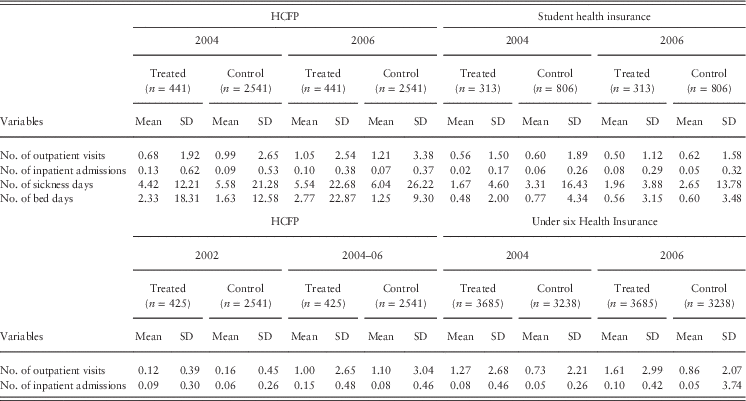
Table 3 presents descriptive statistics of the outcome variables for all treatment and control groups. Overall use of outpatient services increased for both HCFP treatment and control samples between 2004 and 2006 while use of inpatient services decreased during the same period. The number of sickness and bed days increased among all HCFP samples. There was one exception: the number of bed days of the HCFP control group sample. Health services utilization increased among young children treated and control samples with the exception of the number of inpatient admissions among the control group sample that remained more or less the same. Trends among the student health insurance treated and control samples are less evident. Among the treated, use of outpatient services decreased slightly while use of inpatient services and number of sickness and bed days increased between 2004 and 2006. Among the control sample, the converse occurred: use of outpatient services increased slightly while use of inpatient services and number of sickness and bed days decreased.
Descriptive statistics of outcome variables
HCFP=Health Care Fund for the Poor.
Note: No. of outpatient visits: No. of outpatient visits in last 12 months; No. of inpatient admissions: No. of inpatient admissions in last 12 months; No. of sickness days: No. of days in past 12 months when illness/injuries precluded respondent from carrying out regular activities, such as work/school; No. of bed days: No. of days in past 12 months when illness or injuries confined respondents to stay in bed.
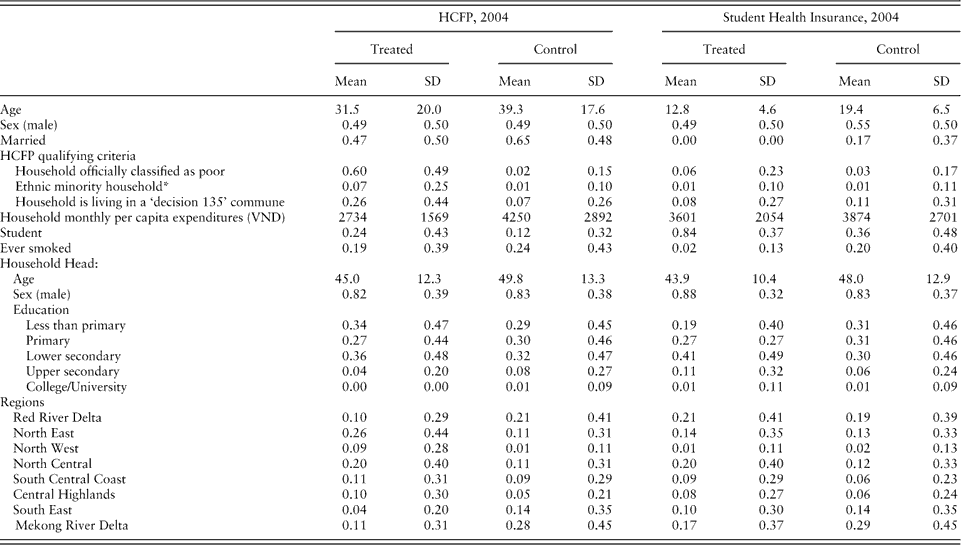
Table 4 provides descriptive statistics of the characteristics of participants and non-participants. Compared with individuals with no health insurance in 2004 and 2006, individuals who obtained HCFP coverage after 2004, are on average younger, are less likely to be married, to have ever smoked and to reside in richer and more urban regions (e.g. Red River Delta and Mekong River Delta), and are more likely to be students, to qualify for HCFP, and to live in a household with lower monthly expenditures and whose head is less educated. The only unexpected systematic difference is the relatively younger age of ‘treated’ individuals, which in turn explains differences in marital, student and smoking status.
Descriptive statistics of control variables (pre-intervention year)
SD=standard deviation; VND=Vietnam Dong.
Note: *=whether the household is an ethnic minority household living in especially disadvantaged provinces in the Northern Mountainous region.
Descriptive statistics of control variables (pre-intervention year)
SD=standard deviation; VND=Vietnam Dong.
On average, individuals who acquired student health insurance after 2004 compared with individuals with no health insurance in 2004 and 2006, are younger, less likely to be male, married, and to live in a household whose head is less educated. There are no obvious unexpected differences between these two groups.
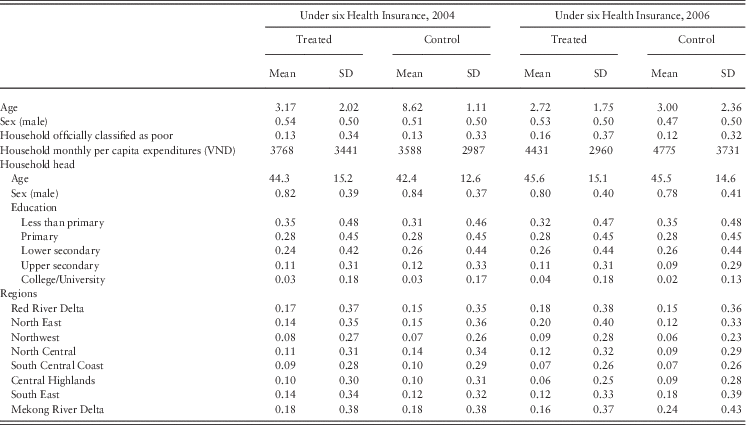
Table 4 also provides descriptive statistics of the characteristics of the treatment and control groups for the under six health insurance scheme for both approaches utilized (i.e. single difference with the full 2006 sample and difference-in-differences that pools the 2004 and 2006 samples and use an intention-to-treat approach). For the intention-to-treat approach, with the exception of age (which is expected given how the control group is constructed), there are no systematic differences between both groups. Children under the age of 6 with health insurance are slightly younger, more likely to be male and live in a poor households, and reside in the North East region and less likely to reside in the South East and Mekong River Delta regions.
Impact of HCFP on health services utilization and health
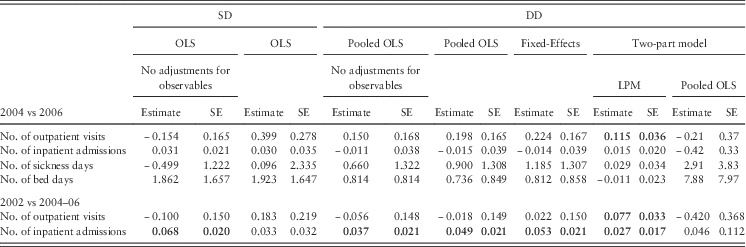
Table 5 presents the estimates of the impact of HCFP on changes in health services utilization and health outcomes between 2004 and 2006 and between 2002 and 2004/2006. The first column under each alternative specification shows the estimated ATTs, the second column shows the standard errors. For example, the last estimate of the first column (0.068) indicates that HCFP was associated with an increase of 0.068 in the annual number of inpatient admissions. From pre-intervention level (i.e. 0.09), an ATT of 0.068 represents an increase of nearly 75%.
Impact of Health Care Fund for the Poor on health services utilization and health
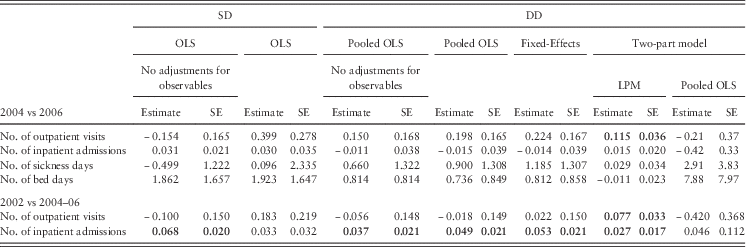
SD=single difference; DD=differences-in-differences; OLS=ordinary least squares; SE=standard errors; LPM=Linear Probability Model.
Note: Unless otherwise noted, estimates of impact are adjusted for observables. Bold indicates significance at 5%. SE are adjusted for clustering at the household level.
On the whole, the results do not suggest HCFP had any statistically significant impact on health services utilization and health outcomes between 2004 and 2006 (top part of Table 5). The lone exception is the finding that individuals who were covered by HCFP in 2006 had a higher probability (0.115) of having had at least one outpatient visit in the past 12 months. When examining individuals who had HCFP coverage in 2004 and 2006, compared with individuals who had no health insurance (bottom part of Table 5), the results suggest HCFP had a statistically significant impact on utilization of inpatient services. The average treatment effects are about 0.05, which represent an increase of more than 50% from pre-HCFP levels (0.09). Of note is the relatively higher estimates of the impact of HCFP on inpatient admissions obtained using DD relative to SD (last row of Table 5): DD estimates are about 50% higher than the SD estimates (0.033 v. 0.049 and 0.053).
Whether individuals gained HCFP coverage by 2004 or 2006 does not appear to alter the estimated effect of HCFP on the utilization of outpatient services. HCFP coverage is not found to impact the utilization of outpatient services with the exception that HCFP coverage appears to increase the probability of having had at least one outpatient visit.
Impact of the Law on Protection and Care of Children on health services utilization
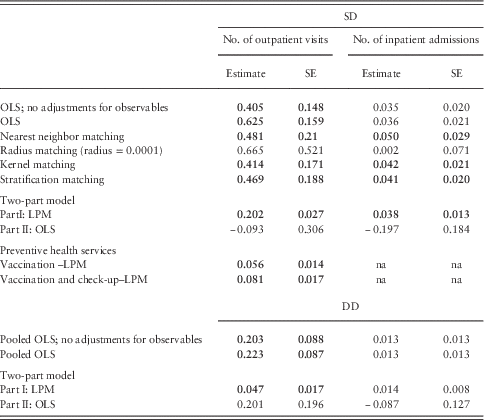
Table 6 presents the estimates of the impact of mandated free care on changes in health services utilization by those under the age of 6. The top portion of Table 6 presents average treatment effects obtained using single difference while the bottom portion presents the intention-to-threat effects obtained using a difference-in-differences approach. The results suggest that providing free care to under six children had a statistically significant and fairly substantial impact on the utilization of outpatient services. Single-difference estimates range from ∼0.4 to 0.6 (which represents an increase of about 30 to 50% from pre-intervention level [1.27]). Single-difference estimates also suggest that the Law on Protection and Care of Children may have impacted utilization of inpatient services, but this finding is not robust across alternative specifications. Looking only at the utilization of preventive health services (i.e. vaccination and check-up and consulting), single-difference estimates suggest that providing free care to under six children had a statistically significant and substantial impact on the utilization of outpatient preventive services. For example, the results indicate under six coverage increased outpatient vaccination visits nearly two-fold. As pointed out by Buchmueller et al., relative to other types of care, estimates of the effect of insurance on preventive care visits are less likely to be confounded by unobserved morbidity. Other sources of bias, such as preferences, however, cannot be ruled out (Buchmueller et al., Reference Buchmueller, Grumbach, Kronick and Kahn2005).
Impact of under six years old health insurance on health services utilization
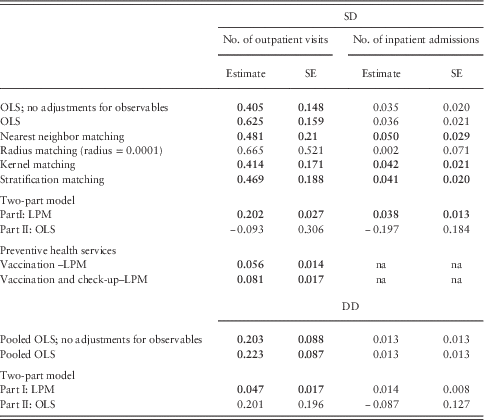
SD=single difference; DD=differences-in-differences; OLS=Ordinary Least Squares; SE=standard errors; LPM=Linear Probability Model; na=not applicable.
Note: Unless otherwise noted, estimates of impact are adjusted for observables. Bold indicates significance at 5%. SE (OLS and LPM) are adjusted for clustering at the household level.
Difference-in-differences estimates also suggest that under six coverage had a statistically significant and fairly substantial impact on the number of outpatient visits but not on the number of inpatient admissions (0.22, which represents an increase of about 17%). As expected, the DD estimates are somewhat smaller than the SD estimates. As discussed earlier, SD estimates may be overestimated due to selection while DD estimates may be underestimated due to the inclusion of children who were eligible but did not report being covered in the treatment group.
Impact of student and school children health insurance on health services utilization and health
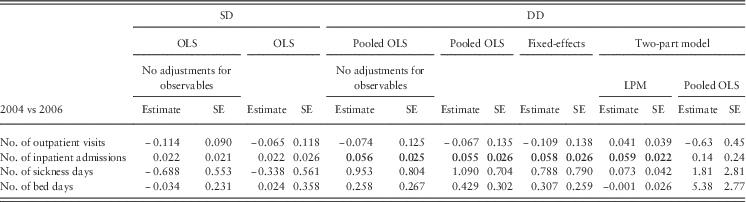
Table 7 presents the estimates of the impact of student health insurance on changes in health services utilization and health outcomes between 2004 and 2006. More specifically, the estimates represent the impact of gaining student health insurance coverage (from no health insurance coverage) between 2004 and 2006 relative to individuals without health insurance coverage in both 2004 and 2006. The results suggest that student health insurance had a statistically significant impact on utilization of inpatient services but not on the utilization of outpatient services or health outcomes. The average treatment effects for inpatient admissions are about 0.06 and represent a more than two-fold increase from 2004 (pre-student health insurance) levels.
Impact of student health insurance on health services utilization and health
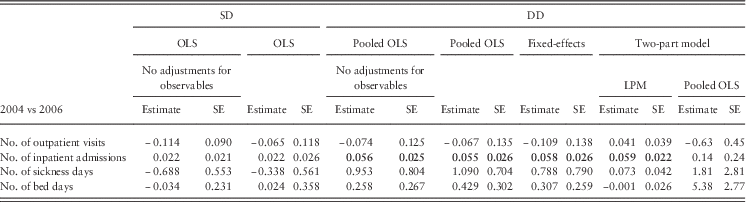
OLS=Ordinary Least Squares; SE=standard errors; LPM=Linear Probability Model.
Note: Unless otherwise noted, impact estimates are adjusted for observables. Bold indicates significance at 5%. SE are adjusted for clustering at the household level.
Robustness: sensitivity analyses
Following Wagstaff’s approach and including individuals who had other forms of health insurance in both HCFP treatment and control groups yields qualitatively similar results. Including FE or using a probit specification for the first part of the two-part models and linear and log-linear regressions for the second part also yields results that are qualitatively similar. Using regression and propensity score matching approaches to examine the impact of under six years old health insurance on health services utilization yields results that are similar in direction but not in effect size (Table 6). The estimates of the impact of health insurance on the number of out-patient visits obtained using propensity score matching methods yields estimates that are somewhat smaller. Conversely, the estimates of the impact of health insurance on the number of inpatient admissions obtained using propensity score matching methods yields estimates that are somewhat larger. Using alternative control groups when examining the impact of under six years old health insurance using an intention treat approach yields results that are essentially identical. Similarly, restricting the VHLSS panel sub-sample to individuals who were 25 years of age (vs 30) or less in 2006 when examining the impact of student health insurance yields results that are qualitatively similar.
Discussion
These results suggest that HCFP did not have an impact on health outcomes if measured by the number of sickness or by the number of bed days. The results, however, provide some support that HCFP led to increased use of inpatient services. The conflicting results between individuals who acquired HCFP coverage after 2004 and those who acquired HCFP coverage in 2003 or 2004 suggest that too little time may have elapsed between the onset of HCFP coverage for those who acquired coverage after 2004 and 2006 for HCFP to impact health services utilization and health outcomes. Moreover, official Vietnam Social Security (VSS) figures indicate that a substantial number of individuals who are covered under HCFP acquired coverage in 2005 and 2006 (Wagstaff, Reference Wagstaff2010).Footnote 18 Changes in health outcomes may be particularly sensitive to the short time frame examined (i.e. changes between 2004 and 2006). The data utilized do not allow one to examine changes in health outcomes from 2002 as VHLSS 2002 did not ask respondents about illness/injuries that precluded them from carrying out regular activities or that confined them to stay in bed. Using data from China, Wagstaff and Yu (Reference Wagstaff and Yu2007) find a statistically significant reduction in the number of days of sickness between 2000 and 2004, which suggests that significant changes in the number of sickness days may be uncovered using relatively short time frames, but perhaps not as short as just two years. Results also suggest that providing health insurance to students who did not previously have any health insurance had a large impact on utilization of inpatient services but not on the utilization of outpatient service or health outcomes.
Estimates of the impact of the Law on Protection and Care of Children mandating free care for children under six suggest that providing medical coverage to young children had a fairly substantial impact on the number of outpatient visits but not on the number of inpatient admissions. As pointed out by Buchmueller et al. (Reference Buchmueller, Grumbach, Kronick and Kahn2005), both theory and empirical evidence such as the RAND HIE suggest a positive effect of insurance on the utilization of outpatient services by children. Because outpatient visits include in addition to treatment of acute illness, preventive care services such as immunizations, increases in outpatient services may lead to decreases in inpatient admissions. This is precisely what was observed in the RAND HIE: coinsurance rates did not effect the probability of admission for children (Newhouse and the RAND Insurance Experiment Group, Reference Newhouse1996). One possible interpretation of the finding that mandated free care for children under six led to increases in outpatient services but not inpatient admissions, is that by improving access to preventive and primary care, mandated free care led to a more efficient use of health care resources (Buchmueller et al., Reference Buchmueller, Grumbach, Kronick and Kahn2005). The finding that providing free care to under six children had a statistically significant and substantial impact on the utilization of outpatient preventive services supports this interpretation. The effect sizes (i.e. increases of between 30 and 50%) are remarkably similar to the effect sizes found by Buchmueller et al. in their systematic review (Buchmueller et al., Reference Buchmueller, Grumbach, Kronick and Kahn2005).
For all three insurance schemes examined, the results of the two-part models suggest that the main pathway by which health insurance impacts health services utilization may be through increases in the probability of a first visit or admission and not through increases in the number of visits/admissions given at least one visit/admission. The positive association between underreporting of self-reported utilization with increased frequency of utilization is well documented (Bhandari and Wagner, Reference Bhandari and Wagner2006). In other words, high users tend to underreport more than low users, as individuals likely forget some visits as the number of visits increase (Bhandari and Wagner, Reference Bhandari and Wagner2006). Such measurement error may explain, at least partially, the finding that health insurance tends to increase the probability of a first visit or admission but not the number of visits/admissions.
This study’s contributions to the health insurance literature are three-fold. First, I examine the impact of three different health insurance schemes that target three distinct groups (the poor, young children and students). Consequently, this study is more relevant than previous studies for forecasting the effects of Vietnam’s health insurance strategy. Second, in addition to examining the impact of health insurance on health services utilization, I also examine the impact of health insurance on health outcomes and thus contribute to the small but growing literature that explores whether expanding health insurance in low- and middle-income countries actually improves health outcomes. Third, I use a number of alternative specifications to ensure that findings are robust.
There are, however, some limitations that merit discussion. First, as discussed earlier, the possibility of selection bias exists (i.e. the selection into health insurance schemes on unobservables). Buchmueller et al. in their systematic review find a high degree of concordance among the results of studies that use an extensive array of variables to control for the nonrandom assignment of insurance status and studies that use instrumental variables or quasi-experimental regression techniques. They concluded that endogeneity bias due to adverse selection may not be a major problem (Buchmueller et al., Reference Buchmueller, Grumbach, Kronick and Kahn2005). Such findings provide some assurance that estimates may not be overly biased because of selection. Second, as noted earlier, measures of utilization in VHLSS 2002 differ slightly from the measures used in 2004 and 2006. This difference likely explains at least partly the substantial increase in reported utilization of outpatient services between 2002 and 2004. The slight difference in measures of utilization between the first wave of VHLSS and the second and third wave, however, would only affect the estimates of impact if it leads to the failure of the parallel trend assumption (i.e. changes in outcomes follow a different trend for the treatment and control group). Third, VHLSS does not differentiate between student insurance provided by the government’s VHI scheme and student health insurance provided by for-profit general insurance companies. This feature limits the generalizability of the findings. Fourth, as discussed earlier, changes in health services utilization and particularly health outcomes may be particularly sensitive to the short time frame examined. Fifth, errors in the measurement of utilization and insurance status may bias the results. Although there is no consistent evidence that the accuracy of self-report utilization varies by socio-demographic characteristics, as discussed earlier, there is a well documented positive association between underreporting of self-reported utilization and increased frequency of utilization (Bhandari and Wagner, Reference Bhandari and Wagner2006). Moreover, studies in the United States and Canada have highlighted the potential for error in self-reported data on source of insurance (Braveman et al. Reference Braveman, Pearl, Egerter, Marchi and Williams1998; Nelson et al. Reference Nelson, Thompson, Davenport and Penaloza2000; Buchmueller et al., Reference Buchmueller, Allen and Wright2003; Grootendorst et al., Reference Grootendorst, Newman and Levine2003). Sixth, the relatively small sample sizes may not allow one to identify effects that are small but nevertheless socially meaningful.
In 2006, more than half of Vietnam’s population had some health insurance coverage. However, health insurance in Vietnam provides limited financial protection. Even under universal coverage, out-of-pocket payments are expected to remain the dominant source of health care financing. They account for more than half of all health spending in Vietnam (Lieberman and Wagstaff, Reference Lieberman and Wagstaff2009). The shallowness of the health insurance coverage may explain, at least in part, the results that health insurance did not increase the use of outpatient services among the poor and among students. Anticipated out-of-pocket payments may deter even those with health insurance to seek health care. As Vietnam moves toward universal health insurance coverage, its decision makers ought to examine the potential contribution to population health of expanding the benefit package for vulnerable groups.
Acknowldgements
The author thanks Jeremiah Hurley, Michel Grignon and Michael Boyle for their comments and guidance, Henrik Axelson, Sarah Bales, Nguyen-Tuan Lam and Jinhu Li for helpful discussions, Brian McCaig for his helpful advice regarding the construction of the 2002–2006 VHLSS panels, Henrik Axelson for sharing his Stata codes and Daniel Canty for his editing assistance.
Funding
Generous financial support from the Social Sciences and Humanities Research Council of Canada and the McMaster University Centre for Health Economics and Policy Analysis is acknowledged.
Competing Interests
None.