Introduction
Laryngeal cancer has an estimated global incidence of 130 000 new cases per year and is responsible for approximately 80 000 deaths annually.Reference Ferlay, Soerjomataram, Ervik, Dikshit, Eser and Mathers1 It is the only cancer that has shown a decrease in five-year survival rate in the USA in the last 30 years.Reference Hoffman, Porter, Karnell, Cooper, Weber and Langer2 Whether this is due to a major drive for organ preservation, at the possible expense of survival, remains unclear. More recently, arguments supporting surgical management have been regaining favour.Reference Stokes, Jones, Bhatia, Oweida, Bowles and Raben3 However, survival is not the only outcome important to patients. This has been echoed in the literature with more articles exploring quality of life (QoL) outcomes of treatment.
Total laryngectomy is considered the primary treatment modality for advanced laryngeal cancer. However, there is increasing awareness of its significant impact on patient QoL.Reference Eadie and Bowker4 It may negatively affect basic essential functions in terms of speech, swallowing, taste and respiration.Reference Maclean, Cotton and Perry5 Additionally, post-operative social integration has been found to be poor, with depression, anxiety and self-isolation commonly reported.Reference Perry, Casey and Cotton6 The surgery is disfiguring and patients are left with a stoma, which is potentially stigmatising and alters communication and intimate relationships. Patients are often unable to continue working, which affects financial status and social networking.Reference Roick, Keszte, Danker, Meister, Vogel and Jenzewski7 Therefore, when assessing treatment success, QoL is regarded to be as important as survival and cancer eradication.Reference Heutte, Plisson, Lange, Prevost and Babin8
The World Health Organization defines QoL as an ‘individual's perception of their position in life in the context of the culture and value systems in which they live and in relation to their goals, expectations, standards and concerns’.Reference Orley and Kuyken9 The concept of QoL is complex and multifaceted, concerning not only physical, psychological and functional health but also financial and social well-being.Reference Murphy, Herrman, Hawthorne, Pinzone and Evert10 Although a substantial body of evidence exists to determine relationships between QoL domains and total laryngectomy, there is a paucity of literature comparing the QoL for total laryngectomy patients of varied socioeconomic standing. Furthermore, no studies explore this comparison on the African continent, where healthcare and socioeconomic inequality is extreme.Reference Mayosi and Benatar11
The current study aimed to assess QoL in total laryngectomy patients, and to ascertain whether socioeconomic status impacts on perceived QoL.
Materials and methods
Study design
A multicentre, cross-sectional study was conducted to compare QoL between state- and private-sector patients following total laryngectomy for stage 3 and stage 4 laryngeal carcinoma. Two hospitals, both situated in Cape Town, South Africa, were utilised: Groote Schuur Hospital, a tertiary academic state institution, and Kingsbury Hospital, a private-sector hospital in an urban setting.
The state-sector hospital serves a lower income, indigent population, whereas the patients treated at the private-sector hospital have access to medical insurance and have a much higher disposable income. Surgical procedures conducted at Kingsbury Hospital were performed by a single surgeon. The same surgeon either performed or oversaw the procedures conducted at Groote Schuur Hospital. Both groups received rehabilitation from the same speech therapist.
Participants
State participants from Groote Schuur Hospital were recruited during follow up at the speech and language pathology clinic, whereas private-sector participants from Kingsbury Hospital were recruited via telephone or e-mail. QoL has been shown to fluctuate in the first two years post-surgery, after which time it remains relatively stable.Reference Hammerlid, Silander, Hörnestam and Sullivan12 Therefore, patients who underwent total laryngectomy for laryngeal cancer without distant metastases were included in the study, provided they had completed their treatment at least two years earlier.
We included English-, Afrikaans- and Xhosa-speaking patients. The questionnaires were in English and Afrikaans, and an interpreter was used for Xhosa-speaking patients who were unable to read English or Afrikaans. All study candidates were able to communicate in at least one of the three languages. The interpreter was a trained and accredited health professional, whose primary language was Xhosa, and who was also proficient in both English and Afrikaans. The same questionnaire was used for interpretation across all languages.
Patients who underwent salvage surgery, partial laryngectomy or a laryngectomy for benign diseases, were excluded. Furthermore, patients were excluded if they suffered from any pre-existing cognitive or medical conditions that may have potentially biased perception of QoL. These included patients with: intellectual disability, disorders affecting mood or anxiety, severe respiratory disease, cardiac disease, hypothyroidism, or shoulder problems prior to surgery.
Procedure
The study was approved by the University of Cape Town Human Research Ethics Committee (approval number: 127/2017). A participant information sheet was presented to all participants, explaining the rationale and voluntary nature of the study. Informed consent was obtained prior to administration of the questionnaires. Participants who were contacted by telephone had the information sheet read to them and had the opportunity to view an e-mailed or hard copy prior to participation.
Questionnaires
Demographics
A two-sheet questionnaire was used to collect demographic information, socioeconomic status and laryngeal cancer management details.
University of Washington Quality of Life Questionnaire
The University of Washington Quality of Life Questionnaire (version four), a head and neck cancer specific questionnaire, has been shown to have high validity and reliability. It has been used in numerous head and neck cancer QoL studies.Reference Laraway and Rogers13 The questionnaire consists of twelve domains: pain, appearance, activity, recreation, swallowing, chewing, speech, shoulder function, taste, saliva, mood and anxiety.Reference Rogers, Gwanne, Lowe, Humphris, Yueh and Weymuller14 As outlined by Rogers et al.,Reference Rogers, Lowe, Yueh and Weymuller15 outcomes are reported using two subscales of physical and social-emotional function. Each subscale is based on the average of six items that are used to derive a QoL score ranging from 0 (worst health-related QoL) to 100 (best health-related QoL). The questionnaire also includes three questions related to global QoL. Scores for this are calculated independently and range from 0 (worst QoL) to 100 (best QoL). Higher scores in each of the components of the University of Washington Quality of Life Questionnaire reflect better QoL.
Voice-Related Quality of Life Questionnaire
The Voice-Related Quality of Life Questionnaire is a simple 10-point questionnaire that evaluates the impact of voice disorders, assessing both physical and social-emotional dimensions.Reference Hogikyan and Sethuraman16 It has been validated and shown to be reliable by highlighting QoL rather than disability, unlike other voice-specific questionnaires such as the Voice Handicap Index.Reference Heutte, Plisson, Lange, Prevost and Babin8, Reference Jacobson, Johnson, Grywalski, Silbergleit, Jacobson and Benninger17 The Voice-Related Quality of Life Questionnaire requires participants to score each item on a scale ranging from 1 (not a problem) to 5 (the problem is ‘as bad as it can be’). The overall score ranges include: 10–15 (excellent), 16–20 (very good), 21–25 (good), 26–30 (fair) and more than 30 (poor).
Brief Illness Perception Questionnaire
The Brief Illness Perception Questionnaire consists of eight questions that explore cognitive and emotional perceptions of participant illness and how it impacts their lives.Reference Broadbent, Petrie, Main and Weinman18 Items were scored on a scale ranging from 0 (not at all impacting) to 10 (extremely impacting). A total score was obtained by reverse scoring questions three, four and seven and adding the sum to the scores of questions one, two, five, six and eight. A higher score represented the perception of a more threatening illness. Additionally, a ninth item in the Brief Illness Perception Questionnaire requires participants to rank-order the three most important factors that they believed caused their illness.
Statistical analysis
Normally distributed variables and composite QoL scores were summarised as the mean and standard deviation (SD), whereas the median and interquartile range were calculated for non-normally distributed variables. Likert-type variables were assessed using the median for central tendency and tabulation for distributions, before adding them together to generate a composite score.
Depending on the distribution of data, either the chi-square or Fisher's exact test was used to compare categorical variables. A two-sample Wilcoxon rank sum test was used to compare non-parametric data between attending groups, and composite QoL scores were compared using the student's t-test. A value of p < 0.05 was considered significant.
Results
A total of 47 participants (20 state- and 27 private-sector) were included in the study, with a median age of 66 years (interquartile range: 61–72). Males made up 80 per cent and 77.8 per cent of state- and private-sector groups, respectively. As shown in Table 1, groups were similar in terms of age, time since surgery, gender and primary home language.
General characteristics

*n = 47; †n = 20; ‡n = 27
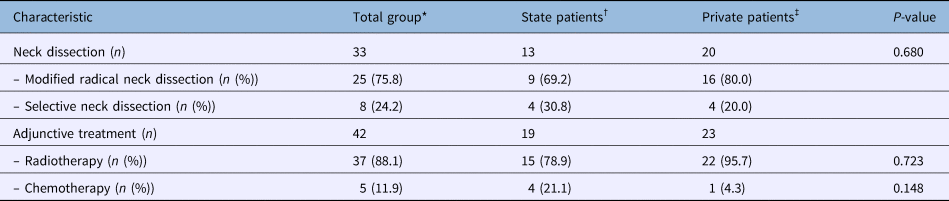
As shown in Table 2, of the patients that received neck dissections, 25 (75.8 per cent) underwent a modified radical neck dissection, whereas 8 (24.2 per cent) underwent a selective neck dissection. The majority of patients (89.4 per cent) received adjuvant treatment, with radiotherapy administered to 78.9 per cent of state patients and 95.7 per cent of private-sector patients. There were no significant differences between the groups with regard to treatment-related factors.
Treatment-related factors

*n = 47; †n = 20; ‡n = 27
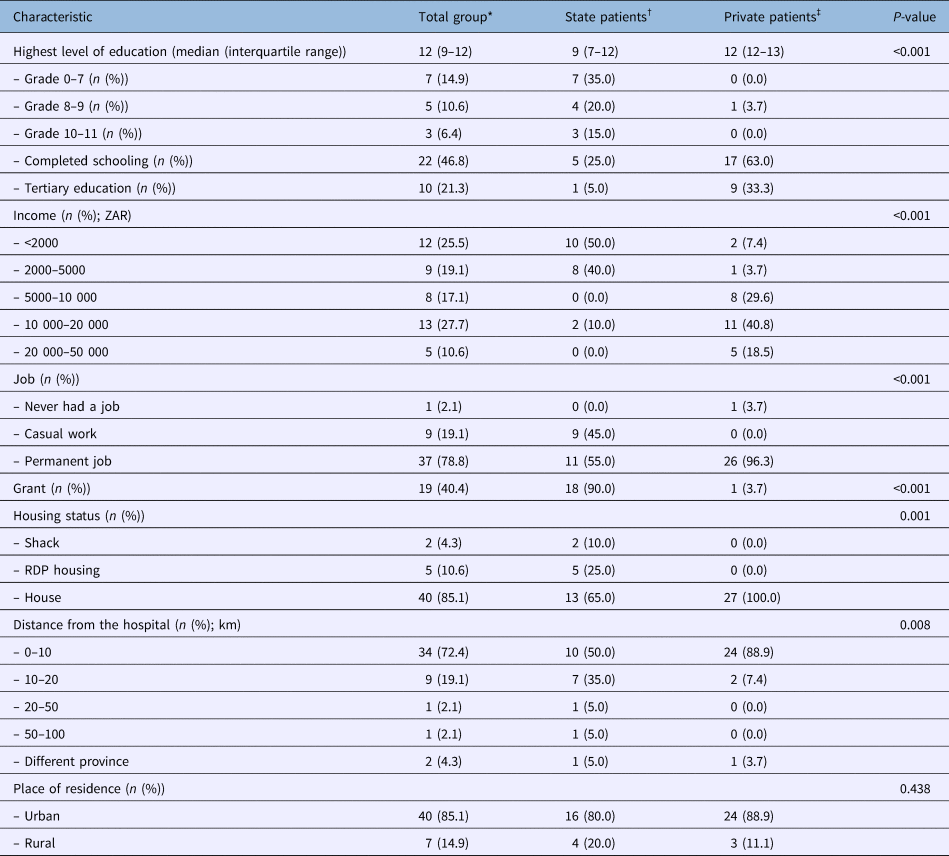
Table 3 shows the differences in socioeconomic factors between the two groups. The private sector participants had: significantly higher levels of education (p < 0.001); significantly higher income (p < 0.001); were more likely to be permanently employed (p < 0.001); and were not receiving a social income grant (p < 0.001). Although both groups resided predominantly in town, the private-sector group of patients were located closer to the hospital (p = 0.008) and had significantly better living conditions (p = 0.001). Thirty-five per cent of state sector patients lived in either informal settlements or government-provided accommodation.
Socioeconomic factors

*n = 47; †n = 20; ‡n = 27. ZAR = South African rand; RDP = Reconstruction and Development Programme
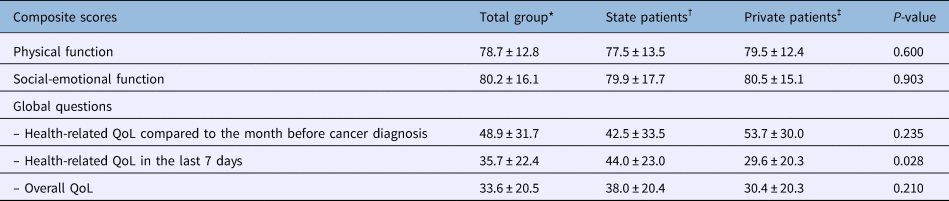
Table 4 shows participant responses to the University of Washington Quality of Life Questionnaire. The mean and SD of the physical and social-emotional composite scores was 78.7 ± 12.8 and 80.2 ± 16.1, respectively. No significant differences were found between state- and private-sector patients. Private-sector patients compared their current QoL more favourably to their QoL a month prior to diagnosis, although this was not significant (p = 0.235). State-sector patients rated their QoL in the last 7 days significantly better than private-sector patients (p = 0.028). There was no significant difference in overall QoL between the two groups.
University of Washington Quality of Life Questionnaire scores

Data represent means ± standard deviations. *n = 47; †n = 20; ‡n = 27. QoL = quality of life
The scores of the Voice-Related Quality of Life Questionnaire and the Brief Illness Perception Questionnaire are illustrated in Table 5. The mean and SD of the Voice-Related Quality of Life Questionnaire score was 22.3 ± 10.0 which indicates a ‘good’ overall voice-related QoL. State-sector patients reported a voice-related QoL of ‘very good’, which was significantly better when compared to private-sector patients who reported a voice-related QoL of ‘good’ (p = 0.043). The mean and SD of the Brief Illness Perception Questionnaire score was 35.6 ± 14.7, with no significant differences found between groups. Both state- and private-sector patients ranked smoking, then alcohol as the greatest perceived cause for their disease.
Voice-related Quality of Life and Brief Illness Perception scores

*n = 47; †n = 20; ‡n = 27. SD = standard deviation
Discussion
The current study aimed to evaluate whether socioeconomic status impacts the QoL of patients following total laryngectomy, as this could potentially influence how patients are counselled about treatment options for laryngeal cancer. Despite the major strides made in social and health-related policies over the last 20 years of constitutional democracy, South Africa is still plagued with considerable inequality in racial and geographical health.Reference Marten, McIntyre, Travassos, Shishkin, Longde and Reddy19 Although there have been improvements in access to primary healthcare, unequal distribution of resources persists, with only 20 per cent of resources going to state healthcare, which services 80 per cent of the population.Reference Coovadia, Jewkes, Barron, Sanders and McIntyre20 These inequalities are highlighted in the significant differences in socioeconomic factors between state- and private-sector patients in this study.
The male preponderance, age at surgery and time since surgery were all consistent with previous research.Reference Eadie, Day, Sawin, Lamvik and Doyle21, Reference Pereira da Silva, Feliciano, Vaz Freitas, Esteves and Almeida e Sousa22 The majority of patients in our study underwent adjuvant radiation therapy. It is well documented that radiotherapy is associated with poorer QoL in head and neck cancer patients.Reference Rathod, Livergant, Klein, Witterick and Ringash23 Furthermore, a study conducted in the West of ScotlandReference Robertson, Yeo, Dunnet, Young and MacKenzie24 showed significantly lower functional outcomes, especially for speech and swallowing, in patients who had undergone radiotherapy with total laryngectomy compared to total laryngectomy alone.
Our study also showed no differences between the two groups in terms of those undergoing selective neck dissection and modified radical neck dissection. It has been previously documented that after surgery, modified radical neck dissection can negatively affect QoL by being associated with up to 100 per cent of shoulder pain and 80 per cent of shoulder droop.Reference Cheng, Hao, Lin and Yeh25 With the two groups in the current study being similar in terms of therapeutic interventions and significantly different in all socioeconomic domains, it could be argued that any differences in QoL scores may be attributed to changes in socioeconomic standing.
Previous literature has suggested that undergoing total laryngectomy results in a reduction in perceived physical health.Reference Hillman, Walsh, Wolf, Fisher and Hong26 Additionally, barriers to fulfilling social relationships are often experienced.Reference Maclean, Cotton and Perry5 However, the results of this study demonstrated University of Washington Quality of Life Questionnaire scores for physical and social-emotional function that showed a positive outlook on QoL after total laryngectomy. This is consistent with previous literature that utilised this questionnaire.Reference Eadie, Day, Sawin, Lamvik and Doyle21, Reference Robertson, Yeo, Dunnet, Young and MacKenzie24 It also reiterates the now established postulate that all domains of QoL deteriorate initially following total laryngectomy and then stabilise over time.Reference Singer, Danker, Guntinas-Lichius, Oeken, Pabst and Schock27 Despite a significant number of state-sector patients in the current study stating that their QoL in the last 7 days was better than private-sector patients, overall global QoL was similar in both groups. Our results therefore indicate that all patients undergo this stabilisation of QoL, regardless of socioeconomic background.
The major finding in our study was the significantly higher Voice-Related Quality of Life Questionnaire scores in state-sector patients when compared to private-sector patients. The postulated reason for this finding was that the significantly higher rate of employment amongst private patients resulted in a more negative outlook on their voice-related QoL because of its impact on their professional life.
This finding was corroborated by a study conducted in India,Reference Agarwal, Gogia, Agarwal, Agarwal and Mathur28 which was the only study correlating QoL after total laryngectomy with socioeconomic status. In this study, high socioeconomic status participants reported significantly lower Voice-Related Quality of Life Questionnaire scores. However, these findings need to be viewed with caution as the study had a large preponderance of low socioeconomic participants, which may have skewed results. Despite this limitation, the authors suggest that in their cohort, social and emotional support was an additional contributing factor to low socioeconomic participants having improved Voice-Related Quality of Life Questionnaire scores.
In a study conducted in Germany,Reference Danker, Wollbrück, Singer, Fuchs, Brähler and Meyer29 40 per cent of over 200 patients who had a total laryngectomy withdrew from social conversations, and over 70 per cent refused to participate in regular social activities because of perceived stigmatisation related to a change in voice. Furthermore, their results demonstrated that over half of their patients refused to go to places where they needed to talk. With their sample including patients with higher levels of education and employment rates, the correlation between higher socioeconomic status and poorer Voice-Related Quality of Life Questionnaire scores appears to be substantiated.
The Brief Illness Perception Questionnaire scores were similar in both state- and private-sector patients in our study. Interestingly, despite the significant difference in education level between state- and private-sector patients, both groups ranked smoking and alcohol use as their number one and two perceived causes of disease, respectively. It is well established that tobacco use is a major risk factor for laryngeal carcinoma, and when used in conjunction with alcohol, has a strong synergistic effect.Reference Sankaranarayanan, Masuyer, Swaminathan, Ferlay and Whelan30, Reference Talamini, Bosetti, La Vecchia, Dal Maso, Levi and Bidoli31 The attributed cause of disease in our study is consistent with previous research evaluating illness perceptions in head and neck cancer patients.Reference Scharloo, Baatenburg de Jong, Langeveld, van Velzen-Verkaik, Doorn-op den Akker and Kaptein32, Reference Scharloo, Baatenburg de Jong, Langeveld, van Velzen-Verkaik, Doorn-op den Akker and Kaptein33
Importantly, it has been shown that cancer patients that attribute their cause of illness to past behaviour and substance use risk increased levels of self-blame, which has been shown to negatively impact QoL.Reference Bennett, Compas, Beckjord and Glinder34, Reference Friedman, Romero, Elledge, Chang, Kalidas and Dulay35 Furthermore, a study by Christensen et al.Reference Christensen, Moran, Ehlers, Raichle, Karnell and Funk36 demonstrated that self-blame in head and neck cancer patients may be associated with potential self-harming behaviour following treatment. However, the results of our study illustrate a favourable overall QoL, despite patients in both state- and private-sector groups ranking prior substance use as the perceived cause of disease.
Although the authors of the current study are reasonably assured of the results reported, several methodological limitations have been identified. A cross-sectional study design and a relatively small sample size may limit the validity of results. It could be argued that the baseline QoL between groups may have influenced the QoL changes seen in this study. Only one institution from both a state- and private-sector setting was analysed, which may have introduced population bias. Finally, validity may have been diminished using an interpreter for Xhosa-speaking patients, which may have resulted in misunderstanding of questions and cross-cultural misinterpretation. However, the questionnaires utilised in this study have all been validated as simple and user-friendly, limiting any impact this may have had on results.
• There is increasing awareness of the significant impact that total laryngectomy has on patient quality of life (QoL)
• A paucity of literature exists comparing QoL after total laryngectomy for patients of varied socioeconomic standing, especially on the African continent
• Overall QoL after total laryngectomy is similar in patients from different socioeconomic backgrounds
• Patients from lower socioeconomic circumstances have better voice-related QoL
• It is important for health professionals to include socioeconomic status when reporting voice outcomes in total laryngectomy patients
Conclusion
Our study indicates that overall QoL following total laryngectomy appears to be similar in patients from different socioeconomic backgrounds. However, owing to the likely negative impact of voice on the professional life of private-sector patients, voice-related QoL appears to be better in patients from lower socioeconomic circumstances. We therefore advocate for inclusion of socioeconomic status when reporting voice outcomes in total laryngectomy patients. Additionally, health professionals should consider socioeconomic status when counselling patients with advanced laryngeal cancer about treatment options. By increasing sample size and focussing on prospective, multicentre study designs, future research may build on the important findings of the current study and further explore longitudinal changes in QoL outcomes in patients undergoing total laryngectomy.
Competing interests
None declared