INTRODUCTION
Archaeological research from across the Maya lowlands has extensively documented the processes associated with the Classic Maya collapse (see Aimers [Reference Aimers2007] for an overview). These investigations show variable timing of sociopolitical collapse between a.d. 750–1000, detailing the differing trajectories of change across the varied regions of the Maya lowlands (Demarest et al. Reference Demarest, Rice and Rice2004; Iannone Reference Iannone2014). Terminal phase artifact features identified at Classic Maya ceremonial centers have increasingly gained attention to better understand the final activities prior to the abandonment of centers. These studies have a long history, as descriptions of large deposits featuring broken ceramics and other materials lying atop terminal floors at Tikal prompted scholars to suggest that those features represented the remains of squatters (re)occupying the area after its abandonment (Harrison Reference Harrison1970; Thompson Reference Thompson1954). It was at that same site that the term “problematic deposit” was coined to encompass not only deposits associated with abandonment contexts but all features (regardless of the period) that eluded classification into the special deposit designations of caches or burials (Coe Reference Coe1982:49).
The terms “problematical deposits,” termination deposits, terminal deposits, or terminal occupation debris, have been used to describe these features that resemble middens but are located on the terminal plaza or courtyard floors within sites. Over the past two decades, similar deposits have been increasingly identified across the Maya lowlands (Ambrosino et al. Reference Ambrosino, Ardren, Stanton, Kathryn Brown and Stanton2003; Ardren Reference Ardren and Gubler1999; Brown and Garber Reference Brown, Garber, Brown and Stanton2003; Chase and Chase Reference Chase, Chase, Demarest, Rice and Rice2004; Clayton et al. Reference Clayton, Driver and Kosakowsky2005; Freidel et al. Reference Freidel, Suhler, Palma and Mock1998; Guderjan Reference Guderjan2004; Helmke Reference Helmke2006; Hoggarth et al. Reference Hoggarth, Zweig, Mzayek, Hoggarth and Awe2014; Houk Reference Houk, Iannone, Houk and Schwake2016; Inomata Reference Inomata, Iannone, Houk and Schwake2016; Mock Reference Mock and Mock1998; Navarro-Farr Reference Navarro-Farr, Iannone, Houk and Schwake2016; Stanton et al. Reference Stanton, Brown and Pagliaro2008; Tsukamoto Reference Tsukamoto2017). Studies have noted that deposits can vary within and between sites (Houk Reference Houk, Iannone, Houk and Schwake2016), as well as across a region (Awe et al. Reference Awe, Aimers, Helmke and Wrobel2009), in their artifact assemblages and contextual composition. Typically these features include large quantities of broken ceramics and other smashed or broken items, with variability in the presence of faunal remains and human bone. These contexts are important, as they offer insights into some of the final activities associated with the use of public space before abandonment.
Houk (Reference Houk, Iannone, Houk and Schwake2016:205) notes methodological challenges and considerations that “problematic deposits” pose, particularly that the features could represent a palimpsest of material, potentially the result of multiple events that spanned days or decades. He also argues that the names or descriptions applied to the features often color the interpretations of archaeologists. We agree with this point, although we think that the term “problematic deposit” has outlived its utility and is far too broad to classify the deposits that archaeologists are increasingly focusing on as one cultural phenomenon associated with the decline or abandonment of sites. To avoid classifying every deposit that defies clear interpretation as a “problematic deposit,” regardless of its context or setting, we have suggested using the term “peri-abandonment deposit” for the features that are directly associated with distinct activities around the time of abandonment (Helmke et al. Reference Helmke, Hoggarth, Awe, Bednar and Johnson2017; Hoggarth et al. Reference Hoggarth, Awe, Bednar, Johnson, McKeown, Lonaker, Green, Moraza-Keeswood, Ray, Walden, Hoggarth and Awe2016). We use this term to refer to the surficial deposits that exhibit clear spatial patterning and variability in artifact composition but, more importantly, have associations with the final activities in ceremonial spaces. As similar deposits have also been identified in Preclassic abandonment contexts (Hansen et al. Reference Hansen, Howell, Guenter, Stanton and Magnoni2008), the use of this term is not restricted only to final activities in ceremonial spaces at the end of the Classic period, but also describe more diachronic views of comparable phenomena across time and space. As “abandonment” is a relatively fluid term, we use it here to describe the period after a site's initial decline, which can include partial or complete abandonment. Therefore, the utility of this term lies in its ability to exclude functional descriptions of deposits before the completion of formal artifact analyses, only defining the deposits stratigraphically and temporally within a shared corpus of activities that occurred sometime around (or after) abandonment in any period.
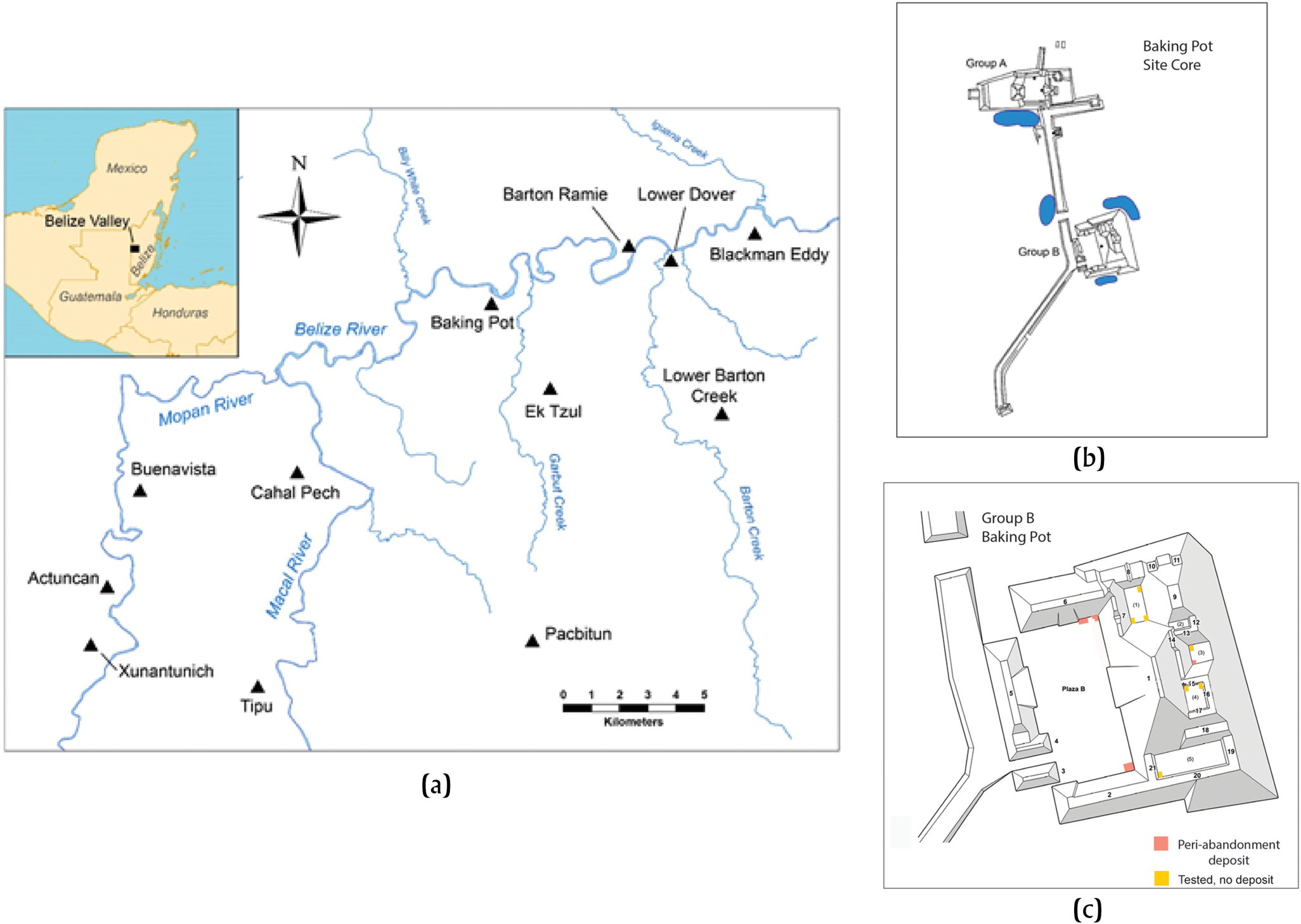
Here, we describe peri-abandonment deposits excavated at the site of Baking Pot, Belize (Figure 1), with a focus on understanding the formation and activities associated with these features. We integrate stratigraphic, archaeological, and hieroglyphic data to note similarities and differences in the artifact assemblages of deposits across the site to better understand the nature of the final activities in the ceremonial center at Baking Pot.
(a) Map of the Upper Belize River Valley, showing the location of Baking Pot. Map by Claire E. Ebert. (b) Map of Group A and B at Baking Pot. Map by Helmke. (c) Locations of peri-abandonment deposits in Group B, as indicated by the red areas. Modified from Helmke (Reference Helmke2008).

PERI-ABANDONMENT DEPOSITS AT BAKING POT, BELIZE
Baking Pot is located on the south bank of the Belize River, approximately 10 kilometers east of Cahal Pech and six kilometers west of Lower Dover in the Belize River Valley of Western Belize (Figure 1a). The site has been the focus of intensive archaeological investigation by the Belize Valley Archaeological Reconnaisance project since 1992 (Awe Reference Awe1993), although earlier excavations by Ricketson (Reference Ricketson1931), Bullard and Bullard (Reference Bullard and Bullard1965), as well as Willey and colleagues (Reference Willey, Bullard, Glass and Gifford1965) have helped to illuminate the site's development and decline. Although earlier excavations identified deposits at the causeway terminus group (Audet Reference Audet2006), the first research project that focused specifically on identifying peri-abandonment deposits at Baking Pot was initiated in 2015 by Hoggarth and colleagues (Reference Hoggarth, Awe, Bednar, Johnson, McKeown, Lonaker, Green, Moraza-Keeswood, Ray, Walden, Hoggarth and Awe2016). Two years previous, a large deposit measuring over one meter in height was identified in the southwestern corner of Courtyard 3, aligning to the same spatial pattern as identified at other sites in Central Belize as described by Awe et al. (Reference Awe, Helmke, Aimers, Ebert, Stemp and Hoggarth2020). Strategic excavations were placed in corners or adjacent to stairways throughout the plazas and courtyards of Group B at Baking Pot to identify additional peri-abandonment deposits (Figure 1). Out of seven targeted excavations, deposits were identified in four of those locations. Interestingly, two of the three deposits were found in loci associated with the entryways into the royal palace complex, with another deposit identified in the most spatially restricted courtyard of the palace complex. Analysis of materials within each deposit was conducted to identify patterning across deposits associated with the final activities in Group B.
Courtyard 3 (Structure B15) Deposit
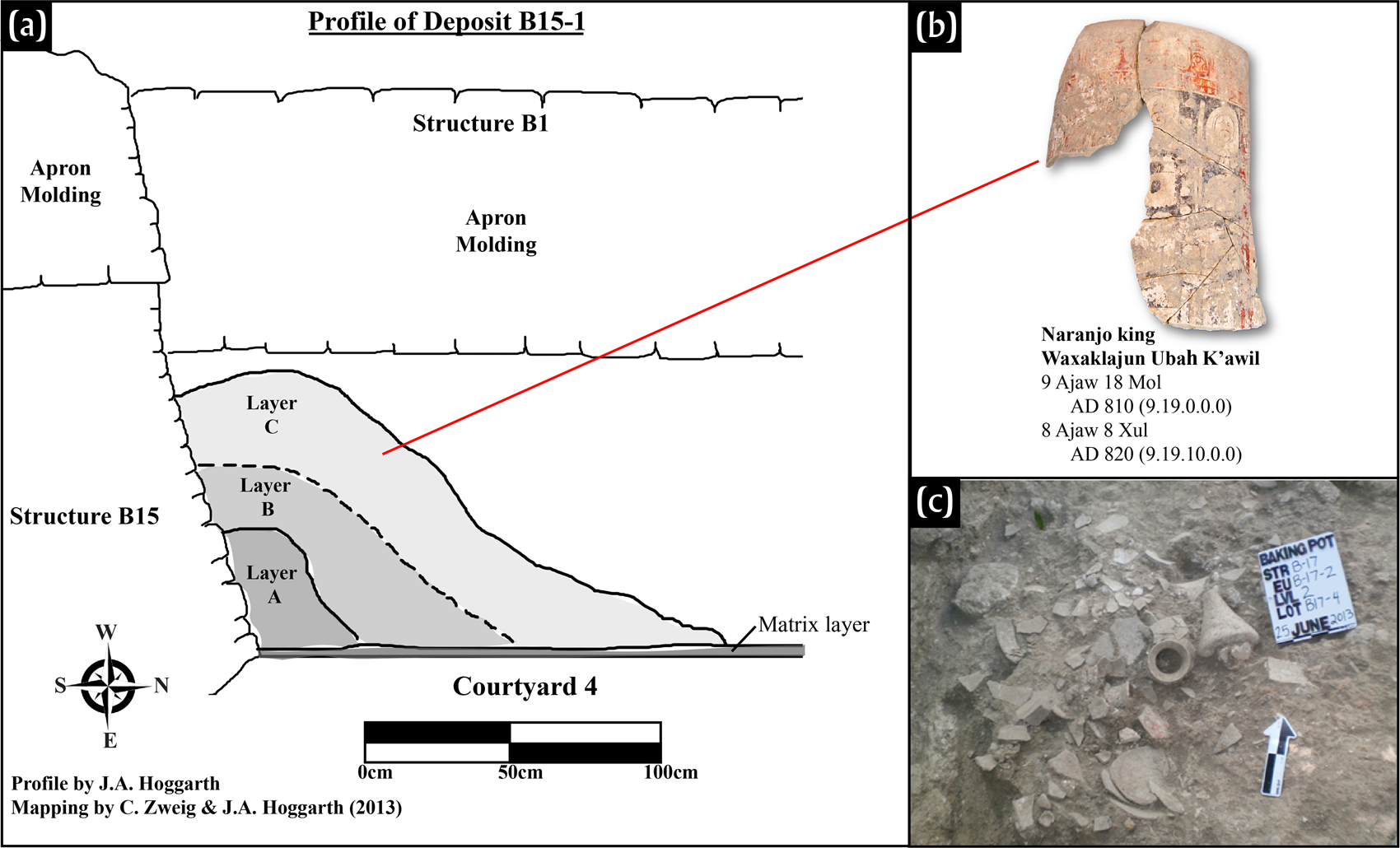
Excavations in the southwest corner of Courtyard 3 at Baking Pot identified a dense deposit of ceramics and other artifacts measuring 127 cm in diameter and over one meter in height (Hoggarth et al. Reference Hoggarth, Zweig, Mzayek, Hoggarth and Awe2014b). The deposit shows evidence of three distinct strata (Figure 2a), which may represent either distinct temporal events or else materials being brought in from different locations. A thin layer of soil matrix measuring 2–5 centimeters in depth was recorded directly on top of the terminal courtyard floor. Above this layer was a concentration of limestone and marl that measured approximately 45 centimeters above the courtyard floor and approximately 50 centimeters m in width, piled primarily in the corner of Structures B14 and B15. This limestone section was indicative of a burning event that was restricted only to the deposit. No evidence of burning was identified outside of the feature, nor was there any other evidence of a destructive event within Courtyard 3 or adjacent structures within the royal palace complex. In comparison with other layers, fewer artifacts were identified within Layer A. Layer B was identified directly above Layer A, measuring approximately 20 centimeters in thickness in the corner but extending horizontally to the northern part of the deposit approximately one meter from the corner of the two structures. This layer consisted primarily of artifacts, rather than limestone and marl, and did not exhibit any evidence of burning as identified in Layer A. Above this strata, we identified the uppermost layer, Layer C, as being approximately 30 centimeters in depth and extending to cover an additional 27 cm to the north of the endpoint of Layer B. As in Layer B, Layer C consisted primarily of ceramics and other broken artifacts (Figure 2a).
Deposit in the southwest corner of Structures B14 and B15 in Courtyard 3 of the royal palace complex at Baking Pot. (a) Profile of deposit. Image by Hoggarth. (b) Polychrome ceramic vase fragment. Image by Helmke. (c) Top-down view of deposit. Photograph by Hoggarth.

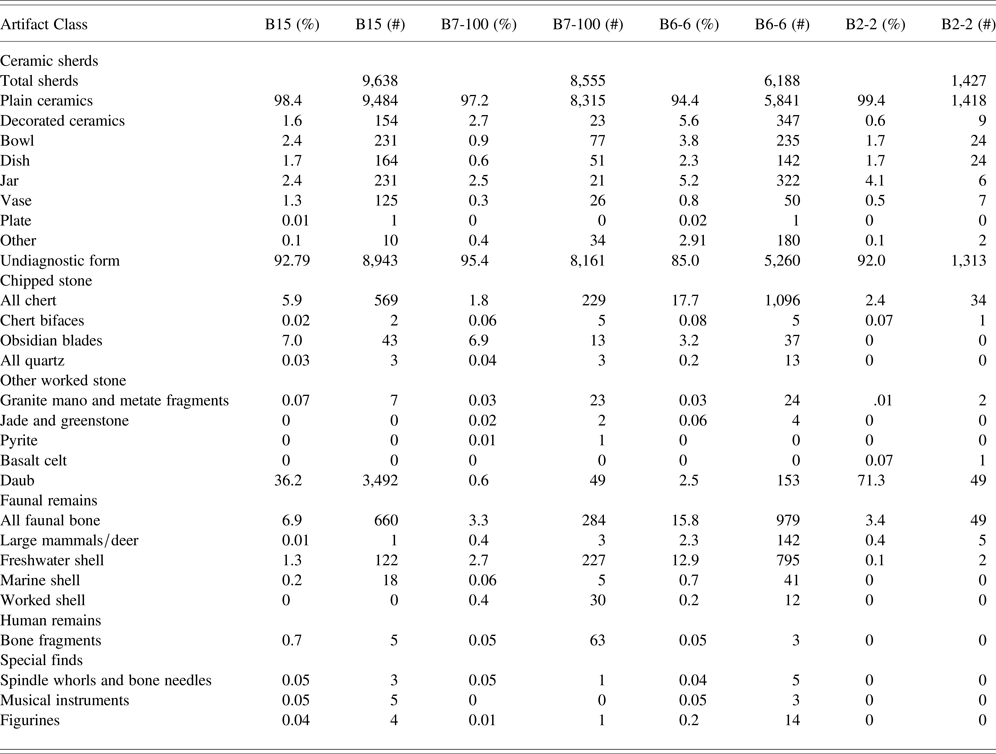
The deposit included a total of 9,638 artifacts and ecofacts, including a large number of broken ceramics, in addition to faunal remains and other materials (Table 1). The artifact assemblage shows that materials in this feature are distinct from other deposits. Fewer amounts of decorated sherds were recorded in this locale than those in deposits B6-6 and B7-100. Furthermore, there were slightly more serving vessels (approximately 3.5 percent) than storage vessels (2.4 percent) identified in the assemblage. The deposit included a large number of ocarinas, as well as a ceramic drum, recovered in the uppermost strata of the feature. Although it is possible that these items were brought in from other locales to be deposited within the feature, the location of this deposit within the most restricted courtyard of the royal palace complex could indicate that activities involving music within the royal court may have been part of the ritual associated with their deposition (see Awe et al. [Reference Awe, Helmke, Aimers, Ebert, Stemp and Hoggarth2020] for a discussion of the importance of music in ethnohistorically known rituals). One barrel-shaped vase was recovered in the uppermost strata. This vessel included two Calendar Round dates corresponding to a.d. 810 and 820 as well as a hieroglyphic text bearing the name of Waxaklajun Ubah K'awil, the last-known ruler of Naranjo. Stela 8 from Xunantunich commemorates the period ending of a.d. 820, and a reference made to the same Naranjo ruler on this monument, suggests that he celebrated that calendrical station at Xunantunich (Helmke et al. Reference Helmke, Awe, Grube, LeCount and Yaeger2010:107–110). Therefore, the discovery of this hieroglyphic text within the uppermost strata of the deposit serves as a terminus post quem of a.d. 820 for that stratum of the deposit. These hieroglyphic data fit well with late facet Spanish Lookout ceramics recovered in the deposit.
Artifact proportions and total artifact counts from four peri-abandonment deposits in Group B at Baking Pot. Note that all contexts of are standardized by taking the proportion of the artifact type to total sherds, to allow for comparability across deposits of different sizes.

Plaza B, Structure B7 Deposits
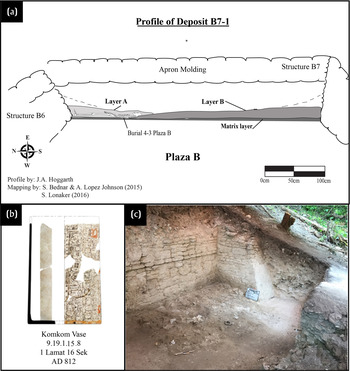
Excavations in the northeast corner of Plaza B in Group B, where Structures B6 and B7 join, uncovered a large artifact-rich deposit that was excavated over two seasons between 2016 and 2017 (Hoggarth et al. Reference Hoggarth, Awe, Bednar, Johnson, McKeown, Lonaker, Green, Moraza-Keeswood, Ray, Walden, Hoggarth and Awe2016; Lonaker et al. Reference Lonaker, Davis, Moraza-Keeswood, Hoggarth, Hoggarth and Awe2017). In total, the deposit covered an area of approximately 5.5 × 2.5 meters (Figure 3a). There were two distinct concentrations within the deposit, as ceramics and other artifacts were concentrated and piled in the interior corner formed by Structures B6 and B7. A second cluster occurred at the base of Structure B7 at the stairside outset, with artifacts piled approximately 35 centimeters above the terminal plaza floor. The extent of the deposit declined at the middle of the deposit, which was suggestive of two distinct depositions that grew to merge, rather than a single deposition across the entire area. We identified dark organic stains against the walls of Structure B7, indicating that the two concentrations in the corners were once thicker and both were compressed by the weight of approximately two meters of structural collapse over the deposit as the buildings continued to collapse. The concentration against the stairside outset of Structure B7 was visibly higher than that in the northeast corner where Structures B6 and B7 intersected. Several large, cut limestone blocks within the deposit also suggest that the structures began to collapse throughout the period when artifacts were left in place. No evidence, however, suggests intentional activity contributed to the collapse of the architecture, nor is there any evidence for burning or other destructive events. Two primary burials, as well as a secondary skull and long bone fragments, were identified within the deposit.
Deposit in the northeast corner of Plaza B, Group B at Baking Pot. (a) Profile of deposit. Image by Hoggarth. (b) Vessel drawing and profile of the Komkom Vase. Image by Helmke. (c) Side view of deposit. Photograph by Hoggarth.

The artifact assemblage of the B7-100 deposit totaled 8,555 artifacts that were primarily dominated by ceramics (Table 1). There were nearly equal proportions of serving vessels (approximately 2.3 percent) in comparison with storage vessel sherds (2.48 percent), suggesting that the activities that contributed to the formation of the deposit were not highly specialized. The deposit also featured the least amount of chert debitage and tools, at 1.8 percent of the assemblage. Included within the B7-100 deposit were the fragments of approximately 70 percent of a reconstructable Chinos Black-on-Cream vase bearing a long hieroglyphic text. This vessel, now known as the Komkom Vase (Figure 3b), featured around 202 glyphs, with a Long Count calendar date of a.d. 812 dedicating the vase for the King of Komkom (Helmke et al. Reference Helmke, Hoggarth, Awe, Bednar and Johnson2017, Reference Helmke, Hoggarth and Awe2018). The text describes a retrospective account of warfare events in February and August of a.d. 799 in which the king of Komkom and allies from Naranjo sacked and burned various settlements within the eastern Maya lowlands. The same events are recorded, albeit in less detail, within the hieroglyphic corpus of Naranjo, corroborating the dates and the events involved.
Plaza B, B6-6 Deposit
Excavations along Structure B6 were focused on the front of the stairs, as well as along their eastern side. An excavation unit was set up to connect to those already established in the northeast corner of Plaza B, where the B7-100 and B7-102 deposits were located (Figure 1c). As excavations proceeded, no substantial artifacts were identified on the front of the stairs. Excavations along the eastern edge of the stairs, however, revealed a deposit, measuring approximately 7 × 1.5 meters, that was concentrated in the corner where the stairside outset intersected with Structure B6 (Davis Reference Davis2018).
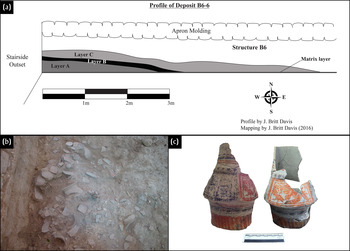
A matrix layer, 2 cm in thickness, appeared as the base of the deposit, directly atop the terminal plaza floor (Figure 4a). Layer A was recorded as a distinct stratigraphic layer above the matrix sediment, measuring 28 cm above the plaza floor and sloping down to 6 cm above the floor at the easternmost extent of that layer. It appears that after this initial deposition episode that Structure B6 experienced a great deal of structural collapse, shown on the profile as Layer B, which measured 36 cm above the floor in the west corner and only 10 cm above floor at its easternmost extent. No evidence was identified to indicate that the structural collapse was intentional, as seen in desecratory termination events in other parts of the Maya lowlands (e.g., Navarro Farr et al. Reference Navarro Farr, Freidel and Arroyave Prera2008). This interval of collapse was followed by the final depositional event (Layer C) in which more ceramics and other artifacts were deposited in the same location over the collapse. Layer C measured 64 cm above the plaza floor in the west corner and 7 cm above floor at the eastern end of the deposit.
Deposit adjacent to Structure B6 in Group B at Baking Pot. (a) Profile of deposit. (b) Top-down view of deposit. (c) Partially complete ceramic vase. Image and photographs by J. Britt Davis.

Similar to other locations, the B6-6 peri-abandonment deposit contained large quantities of ceramics and other artifacts (Figure 4b). Ceramics dominated the artifact assemblage and the B6-6 deposit contained the highest amount of decorated ceramics among all four deposits at 5.64 percent. Several polychrome vessels were identified, including a painted pyriform vessel that was alternately decorated in black and orange paint (Figure 4c). This deposit also featured the highest amount of chert artifacts, at 17.71 percent, as well as the highest amount of faunal remains identified at 15.82 percent. The artifact assemblage in the deposit was quite distinct from the other Baking Pot peri-abandonment deposits. The large amounts of faunal remains, in addition to nearly equal proportions of storage (jars) and serving vessels (bowls and dishes) suggests that the activities associated with the deposition likely involved ritual presentation and/or consumption of food, although these patterns do not align with evidence for feasting (Aimers et al. Reference Aimers, Hoggarth and Awe2020; Burke et al. Reference Burke, Tappan, Wisner, Hoggarth and Awe2020). The B6-6 deposit generally conforms to the same spatial pattern as the others in Group B at Baking Pot, being located at a corner, although this was the only example where the location was a corner adjacent to the central stair rather than an interior corner of a plaza/courtyard.
B2-2 Deposit
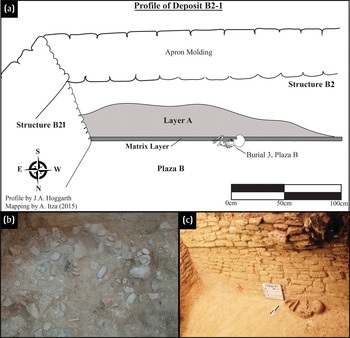
Excavations in the southeastern corner of Group B, at the interface of Structures B2 and B21 in Plaza B at Baking Pot in 2015, identified a peri-abandonment deposit that extended almost two meters in width and was around 30 centimeters in height (Hoggarth et al. Reference Hoggarth, Awe, Bednar, Johnson, McKeown, Lonaker, Green, Moraza-Keeswood, Ray, Walden, Hoggarth and Awe2016:257). At the base of the B2-2 the deposit, we identified a fine matrix layer measuring two to six centimeters in depth (Figure 5a). A primary burial (Burial 3, Plaza B) was identified along the face of Structure B2 within this matrix level. The individual was two to three years of age, of indeterminate sex, and was interred in a flexed position with the head to the west and facing south (Figure 5c). No grave goods were associated with the burial, and the human remains were lying directly on the terminal plaza floor. The interment of this individual could have taken place around the time that the site core fell into disrepair and maintenance and cleaning ceased, with sediment accumulating over the remains. Another possibility is that the burial could have been interred within the matrix sediment, prior or concurrent to the deposition of the artifacts in the deposit above.
Deposit in southeast corner of Plaza B, Group B at Baking Pot. (a) Profile of deposit. (b) Top-down view of deposit. (c) Photograph of Burial 3, Plaza B atop the terminal plaza floor. Photographs and drawing by Hoggarth.

Above the matrix layer, we identified a single layer of artifacts deposited approximately 30 centimeters in height above the terminal plaza floor in the corner (Layer A), sloping down to around five centimeters in depth at its westernmost extent. The artifact assemblage of the B2-2 deposit shows that this is the smallest deposit among the four identified in Group B at Baking Pot, containing only 1,427 artifacts. Of those materials, a large amount consisted of broken ceramics spread throughout the deposit (Figure 5b). Unlike the other deposits, the B2-2 deposit contained the fewest amounts of decorated ceramics (approximately 0.6 percent), and the proportion of jars was also lower than other features (Table 1). The artifact assemblage shows a high amount of daub within the deposit. Unlike the B15 deposit, where there was a distinct burning layer that also contained burned clay and daub, the B2-2 deposit did not have a particular clustering of these remains. Instead, the daub was identified scattered throughout Layer A. The general artifact proportions within the deposit suggest that the events that contributed to the deposition of materials into the deposit were primarily related to activities involving plain, undecorated ceramic vessels. It is unknown whether the daub found throughout the deposits represents intentional activities or else is the result of perishable structures atop Structures B21 and B2 collapsing into the deposit. No large amounts of daub were identified outside of the deposit, suggesting either intentional deposition or else that other materials may have been cleaned during routine maintenance. Given the location of the B2-2 deposit on the southern side of Plaza B and closest to the entrance into the plaza through the ballcourt, the materials that were contained within the B2-2 deposit may have been intentionally plain and unconspicuous, particularly in comparison to materials in the other three deposits associated with the royal palace.
UNDERSTANDING FORMATION PROCESSES
The Baking Pot peri-abandonment deposits are atypical from many deposits described at Cahal Pech and Xunantunich (Awe et al. Reference Awe, Helmke, Aimers, Ebert, Stemp and Hoggarth2020) and other regions of the Maya lowlands. Most deposits described throughout the region are described as surficial and spread horizontally across an area. In the case of the Baking Pot deposits, the deposits were horizontally dispersed in addition to built up, with artifacts concentrated vertically as they were deposited against adjacent corners. The deposits also exhibited much more stratigraphic distinctions than those in the Belize Valley and other archaeological sites in the Maya lowlands. Three of the four deposits showed more than one stratigraphic layer, with structural collapse identified between layers in some instances. This pattern suggests that the deposition of materials occurred over a protracted time frame, rather than being the result of an abrupt warfare event or abandonment scenario. Despite the unique attributes of the Baking Pot deposits, they are not without precedent. At Pook's Hill, Helmke (Reference Helmke2006:182–183) found that deposits were stratified, and some occurred as lenses between discrete layers of collapse debris. Likewise, Houk (Reference Houk, Iannone, Houk and Schwake2016:217) noted similar features with artifacts mixed with collapse debris at Dos Hombres. Neither of those examples, however, is as large and developed as in the Baking Pot example. When we compare archaeological and spatial evidence across deposits, we can identify general patterns that allow for some discussion of the behaviors and activities that formed these important contexts. First, evidence at Baking Pot shows that the deposits shared the same spatial patterns as described by Awe et al. (Reference Awe, Aimers, Helmke and Wrobel2009) in central Belize and others (Mock Reference Mock and Mock1998:115) for sites across the Maya lowlands. There was a strong preference for the interior corners of plazas and courtyards in Group B as locations of activities associated with peri-abandonment deposition.
Evidence within and across the four deposits identified at Baking Pot offer clues to the timing of their deposition. Ceramics from all four deposits included types associated with the early and late facets of the Spanish Lookout ceramic complex (Gifford Reference Gifford1976). From this information alone, we can surmise that the final activities associated with the use of ceremonial space in Group B at Baking Pot occurred in the Late/Terminal Classic periods. Ceramics bearing Long Count or Calendar Round dates were identified in the upper layers of the deposits at B7-100/B7-102 and B15. This is the most direct line of evidence for the timing of activities associated with the final depositions of these features. The dates establish terminus post quo in which we know that the events that contributed to the formation of those specific layers within the deposits could not have occurred prior to the calendar dates, of a.d. 812 and 820 respectively. The timing of deposition within these upper layers are vital for understanding the broader processes of site abandonment at Baking Pot, given that we have no evidence of Postclassic activity in Group B. Therefore, these remains represent the final activities that occurred in these ceremonial spaces. We can infer some information about the contemporeinty of depositions across deposits as well, given two instances where sherds were missing from refitted vessels from one deposit were identified in a completely different feature. Both instances were identified between the deposit at B7-100 and B2-2, which suggests that activity associated with the formation of those deposits occurred simultaneously. In addition, this pattern indicates that scattering of some broken ceramic vessels (or other items) in different contexts was intentional and likely associated with the nature of the ritual activity itself. Although only a few examples of missing sherds being located in other deposits was noted, typically ceramic vessels were not able to be completely refitted. On average, we generally recovered around 50–75 percent of vessels. Given that the deposits were excavated in their entirety, it is possible that the missing sherds from those vessels are scattered among yet undiscovered deposits.
When we compare the archaeological correlates for the types of behaviors associated with the formation of peri-abandonment deposits (Aimers et al. Reference Aimers, Hoggarth and Awe2020) against the evidence in each deposit at Baking Pot, we can begin to narrow down the activities that contributed to their formation. Little solid evidence can be found in alignment with squatter activities (e.g., Harrison Reference Harrison1970; Pendergast Reference Pendergast1979; Stanton et al. Reference Stanton, Brown and Pagliaro2008:28) contributing to the formation of peri-abandonment deposits. There is no evidence of expedient architecture within the royal palace complex or associated plazas or courtyards, nor of domestic trash middens associated with lower status populations. If we examine the artifact assemblage in the deposits in contrast with Late/Terminal Classic commoner household contexts from Settlement Cluster C at Baking Pot (Hoggarth Reference Hoggarth2012) as a baseline, we can begin to better understand how the composition of these deposits varies from typical domestic activity. Obsidian was abundant in significantly higher amounts (49 percent more) in Late/Terminal Classic commoner household contexts than in the peri-abandonment deposits. Manos and metates were nearly 11 times more common in house groups than in these deposits. Faunal remains were nine times more frequent in deposits than in Late Classic commoner households. Together, these patterns suggest that the Baking Pot peri-abandonment deposits were compositionally very different from what we would expect from typical Late/Terminal Classic household contexts that would be associated with squatters.
For activities associated with feasting, we would expect high amounts of faunal remains, especially large species, highest utility elements, rare forms of ceramics and other goods, as well as higher amounts of serving vessels and decorated forms (Dietler and Hayden Reference Dietler and Hayden2010:3; Hayden Reference Hayden, Dietler and Hayden2001:40–41; LeCount et al. Reference LeCount, Yaeger, Leventhal and Ashmore2002:50). All deposits contained faunal remains and on average their abundances were higher than typical Late/Terminal Classic households at Baking Pot. Lower utility elements, which yield less meat, were common within the faunal assemblage across deposits. This pattern does not align with expectations for feasting activities (Burke et al. Reference Burke, Tappan, Wisner, Hoggarth and Awe2020). The abundances of jars and bowls exceeded typical household contexts, indicating that storage and serving activities were predominant in these features. This is not completely unexpected, given the spatial locality of the royal palace complex. Musical instruments were much more common in peri-abandonment deposits than household contexts, with the highest amounts recovered from the Courtyard 4 (B17) and B6-6 deposits. Ritual items, including figurines and censers, were identified in relatively small numbers, which were broadly comparable with amounts recovered in household excavations. Together, the artifact assemblages from the Baking Pot peri-abandonment deposits align in some instances with feasting activities. The focus on jar forms, however, emphasizes storage activities rather than serving activities, which we might commonly associate with feasting contexts. The lack of evidence for butchery on faunal remains also does not align with those expectations. Therefore, we do not view feasting activities as being likely contributors to the formation of peri-abandonment deposits at Baking Pot.
Termination events typically exhibit features that emphasize the ritual “killing” of items or sacred deactivation of structures (Harrison-Buck Reference Harrison-Buck and Harrison-Buck2012, Reference Harrison-Buck, Iannone, Houk and Schwake2016; Iannone et al. Reference Iannone, Houk and Schwake2016a, Reference Iannone, Houk, Schwake, Iannone, Houk and Schwake2016b). The high density of broken items in the Baking Pot deposits does align with these expectations, as we recovered no intact ceramic vessels. Items made of durable materials (e.g., stone points, carved jadeite, or greenstone items) were recovered in broken or fragmented pieces. Ritual items, including figurines and censers, occurred at low levels that were comparable with household contexts. This pattern suggests that, while rituals were important elements of the activities associated with peri-abandonment deposit formation, there might not have been a particular focus on incense burning or ancestor veneration but rather the contents of the assemblage might have conveyed the intended ideological connections. The inclusion of the burials and scattered human remains do align with expectations for reverential termination ceremonies that might have had connotations with ancestor veneration. We did not, however, identify evidence for the in-filling or ritual termination of ceremonial space by blocking areas with rubble or soil matrix (e.g., Schwake and Iannone Reference Schwake, Iannone, Iannone, Houk and Schwake2016) at Baking Pot.
If desecratory activities associated with warfare and destruction contributed to the formation of deposits, we would expect evidence for burning, destruction of public or ceremonial architecture (Brown and Garber Reference Brown, Garber, Brown and Stanton2003:98–102; Freidel Reference Freidel1986; Inomata Reference Inomata, Iannone, Houk and Schwake2016:92–93), weapons located not only in deposits but across the broader ceremonial area of the site, destruction of monuments, looting of burials, and possibly the sacrifice of individuals (Pagliaro et al. Reference Pagliaro, Garber, Stanton, Brown and Stanton2003). No evidence for large-scale burning is evident in Group B at Baking Pot. Initial observations of the articulated human skeletons found within the B6/B7 and B2-2 deposits show no explicit evidence for trauma, although osteological analysis is ongoing. Small numbers of bifacial chert points were recovered in the deposits, many of which broken in half. The abundance of these materials, however, was very low and did not exceed the amounts typically recovered in household contexts. We recovered no other weapons or other evidence of warfare outside of the deposit contexts. Therefore, the artifact assemblages of the Baking Pot deposits do not strongly support warfare or desecratory activities associated with the formation of the deposits.
Evidence for the formation of peri-abandonment deposits due to de facto refuse would include objects left in the context of use, as well as features such as provisional trash in areas that are out of direct foot traffic and use areas (Chase and Chase Reference Chase, Chase, Demarest, Rice and Rice2004, Reference Chase and Chase2020). The deposits at Baking Pot are in locations in the plaza of Group B are not typical locales for provisional trash, even as these ceremonial spaces fell into disuse. Stratigraphic evidence in the deposits and associated ceremonial areas suggest that the process of decline in the monumental core at Baking Pot was a protracted process. Plazas were no longer swept, allowing sediment to accumulate before the formation of peri-abandonment deposits. Adjacent structures began to collapse during their creation, as well as after the deposition of the final artifacts into the features.
Archaeological expectations for post-abandonment ritual or pilgrimages contributing to the formation of peri-abandonment deposits would include the presence of soil lenses below the deposits and sitting atop the terminal floors, an emphasis on ritual materials, “powerfacts,” which can include typical items charged with symbolic meaning, as well as little evidence for domestic activity such as production (Awe et al. Reference Awe, Aimers, Helmke and Wrobel2009). All instances at Baking Pot exhibit evidence of a thin layer of soil on the terminal plaza and courtyard floors below the deposits. In many cases, this soil appears to be thickest (approximately five centimeters) in areas adjacent to architecture and taper off into thinner lenses (approximately two centimeters) moving into the central plaza area. This evidence strongly suggests the end of maintenance and cleaning of the plazas and courtyards of Group B when the first artifacts were smashed to form the peri-abandonment deposits.
Overall, the evidence from artifact assemblages of the four identified peri-abandonment deposits in Group B at Baking Pot show patterning that add to our understanding of the processes associated with the abandonment of Baking Pot at the end of the Classic period. As identified at other Belize Valley sites (Awe et al. Reference Awe, Helmke, Aimers, Ebert, Stemp and Hoggarth2020), the general types of artifacts in each deposit is relatively similar to those across the larger region. Furthermore, the locations where deposits were identified follow similar patterning as in other Belize Valley centers, being located in the corners of plazas or courtyards in the ceremonial center. Unlike many deposits described across the Maya lowlands, however, the Baking Pot deposits are distinct for their large sizes and stratigraphic layering. While many deposits in the Belize Valley are often thin and sheet-like, covering large horizontal spaces, the large and stratified deposits at Baking Pot show evidence that the activities that formed them were deposited over an unspecified, but protracted, amount of time. There was a strong focus on storage jars within the assemblages of all four deposits; however, each deposit showed distinct artifact types that suggest that the activities that formed each had a slightly different focus. The B15 deposit contained numerous musical instruments, while the B7 deposit included prestige items such as jade and numerous polychrome ceramic vessels. The inclusion of ceramics bearing Calendar Round or Long Count calendar dates allows for the timing of the final activities associated with the upper layers of two deposits to be precisely identified in a manner that has never been described for deposits reported in the archaeological literature of the Maya lowlands.
CONCLUSIONS
Detailed investigations of “problematic” deposits are beginning to shed some light on the complex processes associated with the breakdown in political systems and large-scale abandonment across the Maya lowlands around a.d. 750–1000. While many deposits are identified as sheets of materials dispersed across plazas and courtyards, the Baking Pot deposits were both horizontally dispersed as well as vertically developed. Excavations revealed distinct layers within the deposits, which suggest that they may have been deposited over a protracted time frame. Evidence at Baking Pot indicates that the ceremonial spaces were not being cleaned or maintained prior to the formation of deposits. Little evidence could be identified supporting squatter or feasting activity, nor desecratory or martial actions, contributing to their formation. Some elements of ritual termination, however, a reverential activity likely associated with ancestor veneration, and strong ideological or symbolic links were noted. Rare items, such as the Komkom Vase, as well as other associations with elite paraphernalia, were identified in the deposits. Although evidence at Baking Pot exhibits patterning in the artifacts and temporal data, we do not argue that all peri-abandonment deposits in the Maya lowlands are the same, as the deposits at Baking Pot appear to be very different from those that exhibit evidence of warfare or rapid abandonment (Chase and Chase Reference Chase, Chase, Demarest, Rice and Rice2004; Inomata Reference Inomata, Iannone, Houk and Schwake2016). This evidence is to be expected, as we do not characterize “problematic” or peri-abandonment deposits to represent only one homogenous types of activity. This study has also demonstrated that deposits included multiple activities that crosscut the traditional interpretive frameworks that archaeologists have used to study these features (e.g., feasting, termination, reverential, post-abandonment ritual). The deposits at Baking Pot, however, also show the importance of these contexts for reconstructing the processes associated with the abandonment of centers at the end of the Classic period.
RESUMEN
La investigación arqueológica en las tierras bajas mayas ha identificado depósitos especiales que ofrecen información importante sobre el abandono de los centros mayas clásicos. Se argumenta que algunos “depósitos problemáticos” asociados a la arquitectura terminal pueden describirse con mayor precisión como depósitos del peri-abandono, ya que su fechamiento y formación se relacionan con las actividades asociadas al uso final del espacio ceremonial. Aquí, describimos varios depósitos del peri-abandono que fueron identificados en el Grupo B en el sitio de Baking Pot, ubicado en el occidente de Belice. Utilizando información estratigráfica y contextual detalladas, ensamblajes de artefactos y fechas calendáricas inscritas en vasos policromados recuperados de los depósitos, se describe la naturaleza de las actividades asociadas a la formación de depósitos peri-abandono en Baking Pot durante los siglos VIII a IX. Encontramos patrones en las ubicaciones espaciales de depósitos en las esquinas de plazas y patios de Baking Pot, con variabilidad en los ensamblajes de artefactos entre depósitos específicos.
ACKNOWLEDGMENTS
Archaeological excavations at Baking Pot were conducted under the auspices of the Belize Valley Archaeological Reconnaissance (BVAR) Project, directed by Jaime Awe and Julie Hoggarth. Funding for the research came from the BVAR field school, the Tilden Family Foundation, and the National Science Foundation (BCS-1460369, Hoggarth). We thank Dr. John Morris and the Belize Institute of Archaeology for the permitting of BVAR research, as well as their continued support of the project. We also thank Kelsey Sullivan, Sarah Bednar, Amber Lopez-Johnson, Niyo Moraza-Keeswood, Sydney Lonaker, and Christina Zweig for supervising excavations at Baking Pot during the 2013–2016 field seasons. We thank our field excavators, including Antonio Itza (foreman), Manuel Itza, Edgar Penados, and Orvin Martinez for their work in the field, as well as the BVAR field school students.