Introduction
Anthropogenic activities are exerting unprecedented pressure on tropical wildlife, threatening the extinction of a large proportion of its species in the coming years (Hoffmann et al. Reference Hoffmann, Hilton-Taylor, Angulo and Stuart2010, IPBES 2019, Venter et al. Reference Venter, Sanderson, Magrach, Allan, Beher, Jones, Possingham, Laurance, Wood, Fekete, Levy and Watson2016). This situation creates an urgent need for detailed data to understand the nature of human impact and provide the foundations to implement specific initiatives to mitigate its effects at regional and local scales (Bull et al. Reference Bull, Gordon, Law, Suttle and Milner-Gulland2014, Kindsvater et al. Reference Kindsvater, Dulvy, Horswill, Juan-Jordá, Mangel and Matthiopoulos2018). Yet, regardless of the considerable effort that has been made to assess the impacts of anthropogenic activities on tropical wildlife, important knowledge gaps remain due to conceptual and methodological issues.
Current studies emphasise the impacts of drastic habitat transformations such as extensive deforestation and fragmentation on faunal diversity (Alroy Reference Alroy2017, Gibson et al. Reference Gibson, Lee, Koh, Brook, Gardner, Barlow, Peres, Bradshaw, Laurance, Lovejoy and Sodhi2011, Maxwell et al. Reference Maxwell, Fuller, Brooks and Watson2016). In comparison, less attention has been paid to assessing the negative effects that more subtle but chronic anthropogenic disturbances (e.g. subsistence hunting, anthropogenic noise, and selective logging) have on ecological features such as species composition and behaviour, in sites where forest cover is still relatively extensive (Gonçalves et al. Reference Gonçalves, Gonçalves-Souza and Albuquerque2020, Singh Reference Singh1998). Moreover, studies usually focus on a reduced subset of species assuming that responses to perturbations are similar for those species not evaluated (Carmel et al. Reference Carmel, Kent, Bar-Massada, Blank, Liberzon, Nezer, Sapir and Federman2013). Focusing on small subsets of species can lead to important biases in the understanding of the overall responses of vertebrates to human perturbation and, therefore, in the design of effective conservation strategies for maintaining faunal diversity. Thus, having animal surveys that include a large proportion of the local fauna are highly desirable. Unfortunately, some wild vertebrates are recorded in such low frequencies, even when using modern technologies, such as camera traps, that the possibilities of detecting impacts of human perturbation are greatly limited (Kays et al. Reference Kays, Arbogast, Baker-Whatton, Beirne, Boone, Bowler, Burneo, Cove, Ding, Espinosa, Gonçalves, Hansen, Jansen, Kolowski, Knowles, Lima, Millspaugh, McShea, Pacifici, Parsons, Pease, Rovero, Santos, Schuttler, Sheil, Si, Snider and Spironello2020, Kelly Reference Kelly2008).
Small natural features (i.e. sites with ecological importance that is disproportionate to their size, Hunter Reference Hunter2017), such as fruiting trees, mineral licks, and water bodies, attract a great variety of wildlife species and provide the opportunity to simultaneously record information on animal diversity, composition, abundance, and behaviour even for rare species (e.g. Camargo-Sanabria & Mendoza Reference Camargo-Sanabria and Mendoza2016, Matsubayashi et al. Reference Matsubayashi, Lagan, Majalap, Tangah, Sukor and Kitayama2007, Vale et al. Reference Vale, Pimm and Brito2015). An additional advantage is that the study of small natural features can provide evidence about the use that different species make of key resources. Hence, there is great potential for monitoring efforts focused on such natural features to increase our understanding of the impacts that anthropogenic activities have on a broader variety of wildlife species (e.g. Blake et al. Reference Blake, Mosquera and Salvador2013, Eaton et al. Reference Eaton, Keuroghlian, Santos M do, Desbiez and Sada2017).
Tropical forests growing on karst in the Calakmul region (southern Mexico) stand out at the global level due to their importance as biodiversity strongholds, but also due to their increased level of threat (Myers et al. Reference Myers, Mittermeier, Mittermeier, da Fonseca and Kent2000). In these forests, most of the rainfall infiltrates underground provoking a lack of surface rivers and extensive permanent water bodies (García-Gil et al. Reference García-Gil, Palacio-Prieto and Ortiz-Pérez2002). Nonetheless, free-standing water is available in water bodies locally known as aguadas and sartenejas. Aguadas, known as dolines in geological terms (Allaby Reference Allaby2020), are natural shallow depressions that have soils with a high clay content where water from precipitation and seasonal streams is collected and stored (Fig. S1a-b; García-Gil et al. Reference García-Gil, Palacio-Prieto and Ortiz-Pérez2002, Torrescano-Valle & Folan Reference Torrescano-Valle, Folan, Islebe, Calmé, León-Cortés and Schmook2015). These water holes occur at an approximate density of one per 10.5 km2 most of them covering less than a half hectare (Reyna-Hurtado et al. Reference Reyna-Hurtado, Chapman, Calme and Pedersen2012). Depending on their hydroperiod, the aguadas can be intermittent (if they dry up after several months) or semipermanent (if they dry only occasionally during severe droughts) (Colburn Reference Colburn, Jørgensen and Fath2008). On the other hand, sartenejas (kamenitzas in geological terms; Allaby Reference Allaby2020) are small rock pools created in crevices opened in exposed bedrock where rainfall accumulates (Fig. S1c, d; Flores Reference Flores1983). There is approximately one sarteneja per 0.1 km2, and they usually cover less than a square meter (Delgado-Martínez et al. unpubl. data). Sartenejas can collect water even during light rainfall events (Reyna-Hurtado et al. Reference Reyna-Hurtado, Chapman, Calme and Pedersen2012) exhibiting short hydroperiods (a few weeks). Both water sources are heavily exploited by a highly diverse fauna (Delgado-Martínez et al. Reference Delgado-Martínez, Alvarado, Mendoza, Flores-Hernández, Navarrete, Navarrete and Botello2018, Reyna-Hurtado et al. Reference Reyna-Hurtado, Rojas-Flores and Tanner2009, Reference Reyna-Hurtado, O’Farrill, Sima, Andrade, Padilla and Sosa2010). The Calakmul region has recently experienced an increase in the frequency of droughts and disruptions in its rainfall patterns (i.e. rainfall more unevenly distributed, Mardero et al. Reference Mardero, Nickl, Schmook, Schneider, Rogan, Christman and Lawrence2012, Reference Mardero, Schmook, Christman, Metcalfe and De la Barreda-Bautista2020) causing several of the aguadas to more frequently dry up (Reyna-Hurtado et al. Reference Reyna-Hurtado, Sima-Pantí, Andrade, Padilla, Retana-Guaiscon, Sanchez-Pinzón, Martinez, Meyer, Moreira-Ramírez, Carrillo-Reyna, Rivero-Hernández, Macgregor, Calme and Dominguez2019). Because of this, the importance of sartenejas as a water source for wildlife would likely increase. Moreover, due to their small size, it is easier to monitor sartenejas than aguadas (Delgado-Martínez et al. Reference Delgado-Martínez, Alvarado, Mendoza, Flores-Hernández, Navarrete, Navarrete and Botello2018) which makes them ideal for assessing human impact over a wide variety of vertebrate species.
Here, we use sartenejas to assess the combined impacts of small-scale frequent human activities (i.e. beekeeping, hunting, subsistence farming, selective logging, and vehicle transit) on species diversity, composition, and behaviour of medium- and large-sized birds (> 170 g) and terrestrial mammals (> 450 g) in the highly biodiverse forests of Calakmul. By comparing the use of sartenejas within and outside the Calakmul Biosphere Reserve (CBR), we expect to detect differences in species diversity and composition of bird and mammal assemblages reflecting the loss (or reduction in abundance) of species sensitive to anthropogenic disturbance and the spread of alien fauna (e.g. cattle and dogs) (Dornelas et al. Reference Dornelas, Gotelli, McGill, Shimadzu, Moyes, Sievers and Magurran2014, Newbold et al. Reference Newbold, Hudson, Contu, Hill, Beck, Liu, Meyer, Phillips, Scharlemann and Purvis2018, Vetter et al. Reference Vetter, Hansbauer, Végvári and Storch2011). Moreover, we expect that birds and mammals will modify the duration of their visits and their daily activity patterns outside the CBR as an adjustment to avoid humans (Gaynor et al. Reference Gaynor, Hojnowski, Carter and Brashares2018, Suraci et al. Reference Suraci, Clinchy, Zanette and Wilmers2019). Since different studies have found that birds and mammals differ in their response to anthropogenic disturbance (e.g. Benítez-López et al. Reference Benítez-López, Alkemade and Verweij2010, Fontúrbel et al. Reference Fontúrbel, Candia, Malebrán, Salazar, González-Browne and Medel2015, Sauvajot et al. Reference Sauvajot, Buechner, Kamradt and Schonewald1998), we expect the magnitude of the above-mentioned effects to differ between these two groups.
Methods
Study area
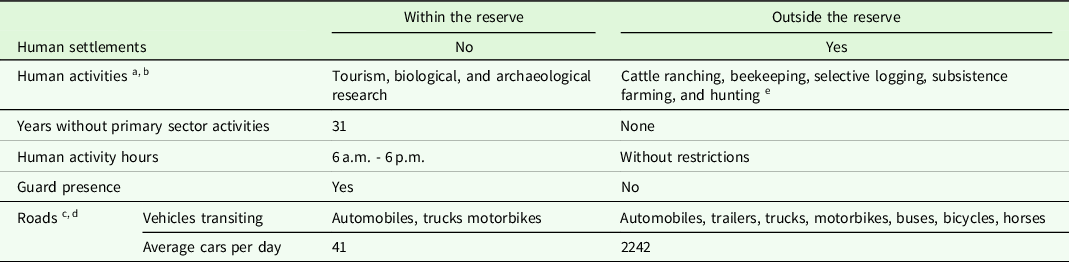
Fieldwork was conducted in the southern portion of the CBR and in the communal lands of the Nuevo Conhuas village, both located in the Calakmul region, in the state of Campeche in southern Mexico (Fig. S2). The Calakmul region covers 2,000,000 ha and is part of the Mesoamerican Biological Corridor and the Selva Maya, constituting the second largest tract of tropical forest in the Americas (Galindo-Leal Reference Galindo-Leal1999). Despite maintaining an extensive forest cover, this region is undergoing an increase in activities such as selective logging, hunting, farming, and cattle ranching (Calmé & Guerra Reference Calmé and Guerra2005, Ramírez-Delgado et al. Reference Ramírez-Delgado, Christman and Schmook2014). The climate in this region is tropical and subhumid, with a dry season lasting from November to April and a rainy season lasting from May to October (Vidal-Zepeda Reference Vidal-Zepeda2005). The mean annual precipitation of the region is 1,059 mm, but annual precipitation has ranged from 340 to 1,527 mm over the last 30 years (CONAGUA 2020). In the last 10 years, the Calakmul region has experienced an increase in drought frequency and changes in its precipitation regime which have caused the occurrence of very dry years but also very intense rainfall events (Mardero et al. Reference Mardero, Nickl, Schmook, Schneider, Rogan, Christman and Lawrence2012, Reference Mardero, Schmook, Christman, Metcalfe and De la Barreda-Bautista2020). The CBR was established in 1989 and has a total extent of 723,185 ha (Gómez-Pompa & Dirzo Reference Gómez-Pompa and Dirzo1995). At both national and global levels, this reserve is one of the last strongholds for several endangered species, such as the bird Meleagris ocellata and the mammals Tapirus bairdii and Tayassu pecari (Kampichler et al. Reference Kampichler, Calmé, Weissenberger and Arriaga-Weiss2010, Naranjo et al. Reference Naranjo, Amador-Alcalá, Falconi-Briones and Reyna-Hurtado2015). Human activities in the CBR study site are restricted to ecotourism and biological and archeological research. The communal lands of the Nuevo Conhuas village cover approximately 56,400 ha and are located in the vicinity of the CBR (Fig. S2). Productive activities in this community include cattle ranching, beekeeping, subsistence farming, and hunting (Calmé & Guerra Reference Calmé and Guerra2005). The Nuevo Conhuas’ communal lands are the closest to our CBR study site (distance between polygon centroids = 35.36 km) and are similar to other communal lands located in the vicinity of the CBR in terms of the activities they develop and the characteristics of the forest cover (Calmé & Guerra Reference Calmé and Guerra2005, Ramírez-Delgado et al. Reference Ramírez-Delgado, Christman and Schmook2014). Different human activities, and with contrasting magnitude, occur in the CBR and Nuevo Conhuas (Table 1).
Factors associated with anthropogenic disturbance in the areas where focal sartenejas were located in the Calakmul region (Campeche, southern Mexico).

a INE (1999).
b Calmé & Guerra (Reference Calmé and Guerra2005).
c SCT (2019).
d CONANP unpubl. data.
e People are usually accompanied by dogs during field activities (Andrés Barrientos pers. comm.).
Selection and monitoring of sartenejas
Our focal sartenejas were located in the southern portion of the CBR (hereafter “within the reserve”) and in the communal lands of Nuevo Conhuas (hereafter “outside the reserve”) (Fig. S2). We recorded the location of 20 sartenejas within the reserve, two of them were previously reported by Reyna-Hurtado et al. (Reference Reyna-Hurtado, Chapman, Calme and Pedersen2012), and 18 were located for this study with the help of local guides and by searching along 26 transects (total length = 116.6 km). From these sartenejas, we selected 10 to be monitored. Moreover, we selected 9 sartenejas outside the reserve based on information provided by local guides. To select the sartenejas to be monitored, we used the following criteria: 1) to have a volume ≥ of 20 L and 2) to be located ≥ 1 km from any other monitored sarteneja. The average (± SD) distance between sartenejas was 7.48 ± 4.36 km and 6.81 ± 3.12 km within and outside the reserve, respectively. We used GPS tracks generated during our travels on the roads and georeferenced points to calculate the distance from sartenejas to the closest road and the site with permanent human presence (hereafter “SWIPHs”, see Appendix S1). Additionally, we used the vegetation cover map provided by the Monitoring Activity Data for the Mexican REDD+ program which is based on Sentinel-2 imagery for the year 2018 (CONABIO 2021) to: (1) calculate the distance from sartenejas to the closest farmland outside the reserve, (2) obtain the vegetation type of the location of sartenejas, and (3) estimate the forest cover within a 1-km buffer around the sartenejas. Except for a sarteneja outside the reserve, which was in a lowland sub-perennial forest, all the sartenejas were in medium height sub-perennial forest. The average (± SD) forest cover within a 1-km buffer around the sartenejas was 99.99 ± 0.02% and 95.45 ± 4.37% within and outside the reserve, respectively. There were no significant differences in canopy cover (W = 22, p = 0.221), mean monthly temperature (t = 0.751, p = 0.457), maximum monthly temperature (t = 1.855, p = 0.071), minimum monthly temperature (t = −1.443, p = 0.157), nor monthly rainfall (t = 0.022, p = 0.983) between sartenejas located within and outside the reserve during the study period (Appendix S1).
We set up one camera trap (models Browning Strike Force Elite BTC5HDE, Bushnell Trophy Cam HD Aggressor 119876C, and Stealth Cam G42NG triggered by motion) aimed at each sarteneja and programmed to take a 20-s long video each time it was activated and to have a 5-s resting time before reactivation. In most of the cases (ca. 90%), the camera trap monitored the whole extent of the sarteneja. The monitoring was conducted over one year (April 2018 to March 2019) to include the dry and wet seasons.
Data analysis
We identified all the mammal and bird species that used the water contained in the sartenejas. We only discarded records of Ateles geoffroyi, an arboreal species whose activities mostly occur in the canopy beyond the detection area of our camera traps. To prevent counting each video of the same species as a different visitation, we grouped records following the procedure described in Camargo-Sanabria & Mendoza (Reference Camargo-Sanabria and Mendoza2016). This approach allows calculating a species-specific minimum time to group consecutive videos of the same species and camera by plotting the number of groups of videos that emerge using increasing intervals of time (from 1 to 1440 minutes). The time interval that is selected to group videos corresponds to the moment the number of groups of videos reaches stability. Therefore, an event corresponds to a single record or grouped records. We calculated the frequency of use of sartenejas for each species using the following equation: (number of events/sampling effort) × 1,000 camera days (O’Brien et al. Reference O’Brien, Kinnaird and Wibisono2003). To estimate the duration of use of sartenejas, we calculated the difference between the end and the beginning of an event.
Diversity and composition of animal assemblages using sartenejas within and outside the reserve
We estimated the sample coverage of birds and mammals in each site by conducting an individual-based sampling coverage analysis (Chao & Jost Reference Chao and Jost2012). Individual sample-based rarefaction and extrapolation curves of Hill numbers (q = 0, 1, and 2) and the corresponding 95% confidence intervals were generated to compare bird and mammal diversity within and outside the reserve (Chao et al. Reference Chao, Gotelli, Hsieh, Sander, Ma, Colwell and Ellison2014). These analyses were conducted using the iNEXT R package (Hsieh et al. Reference Hsieh, Ma and Chao2020) and were restricted to assemblages constituted by native species.
To compare the composition of bird and mammal assemblages using sartenejas within and outside the reserve, we conducted a non-metric multidimensional scaling (NMDS) using the Bray–Curtis index as a measure of distance (calculated based on frequencies of use of sartenejas). We performed an analysis of similarities (ANOSIM) to test for the existence of statistical differences in species composition between assemblages. For this analysis, we included both native and non-native species and used the vegan R package (Oksanen et al. Reference Oksanen, Guillaume-Blanchet, Friendly, Kindt, Legendre, McGlinn, Minchin, O’Hara, Simpson, Solymos, Stevens, Szoecs and Wagner2019).
To assess how distance to roads and SWIPHs related to the composition of bird and mammal assemblages, we conducted a redundancy analysis (RDA) on a Bray–Curtis distance matrix (calculated based on frequencies of use of sartenejas) using predictors standardised to zero mean and unit variance. We did not include the distance to farmlands outside the reserve because it was highly correlated with the distance to roads (R = 0.63, p < 0.05). We tested the significance of the entire model and each of its terms using a PERMANOVA test with 1,000 permutations. For these analyses, we included those species that were recorded in at least half of the sites and used the vegan R package (Oksanen et al. Reference Oksanen, Guillaume-Blanchet, Friendly, Kindt, Legendre, McGlinn, Minchin, O’Hara, Simpson, Solymos, Stevens, Szoecs and Wagner2019).
Patterns of use of sartenejas by birds and mammals within and outside the reserve
To compare the frequency and duration of use of sartenejas by birds and mammals within and outside the reserve, we performed permutation tests of mean differences using the infer R package (Bray et al. Reference Bray, Ismay, Chasnovski, Baumer and Cetinkaya-Rundel2019). First, we calculated the observed difference in the means of the frequencies of use (ⓓ u ) and duration of visitation (ⓓ l ) within and outside the reserve for each recorded vertebrate species. Second, we generated a null distribution of mean differences based on 10,000 permutations. In cases where the observed differences were negative, we calculated the proportion of samples in which the permuted differences were equal to or greater than expected based on the observed difference (p-value); when the observed differences were positive, we calculated the proportion of samples in which the permuted differences were equal to or less than expected based on the observed difference (p-value). Third, we computed the 95% confidence intervals of mean differences using 10,000 bootstrap samples. We restricted this analysis to those species recorded in at least two sartenejas in each site.
We compared daily activity patterns of use of sartenejas in species that had at least 10 events in each site by applying the Ridout & Linkie (Reference Ridout and Linkie2009) method. Following Meredith & Ridout (Reference Meredith and Ridout2018), we estimated the activity overlap between events within and outside the reserve using the estimator of the coefficient of overlapping Δ1 for small samples (less than 75 observations) and Δ4 for larger samples (more than 75 observations). We used the basic0 method for the calculation of 95% confidence intervals. We calculated overlap coefficients and confidence intervals using the overlap R package (Ridout & Linkie Reference Ridout and Linkie2009). Finally, we used a randomisation test that generates a null distribution of overlap indices using 1,000 bootstrap samples, this randomised distribution was used to estimate the probability (p-value) that the observed overlap arose by chance (Rowcliffe Reference Rowcliffe2021).
Results
We accumulated 4,646 camera trap days of sampling, 2,309 within the reserve, and 2,337 outside the reserve. Camera traps generated a total of 35,369 videos with at least one animal visible, it was not possible to identify the species in less than 1% of the cases. We identified a total of 46 species (21 bird and 25 mammal species; Tables S1) using the sartenejas: 16 bird and 20 mammal species within the reserve and 16 bird and 22 mammal species outside the reserve. Overall, the most common species using the sartenejas were the bird Crax rubra and the mammal Dasyprocta punctata.
Diversity and composition of animal assemblages using sartenejas within and outside the reserve
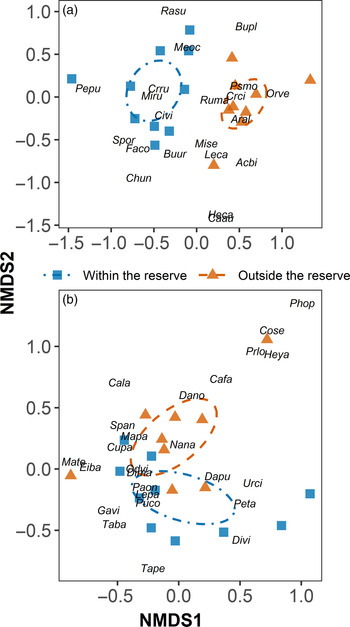
Sample coverage of the bird survey was estimated at 99% both within and outside the reserve (Table S2). The 95% confidence intervals of individual-based sample interpolation and extrapolation curves for bird species richness (q = 0) overlapped, suggesting that there was no significant difference in the species richness of the assemblages using the sartenejas within and outside the reserve (Fig. S3). However, the comparison of Shannon and Simpson diversity curves for bird species (q = 1 and 2, respectively) showed that diversity was significantly higher outside than within the reserve (Fig. S3). The observed bird species richness within and outside the reserve was only slightly lower than estimated: 16 vs. 16.25 ± 0.73 and 16 vs. 17 ± 3.74 (mean ± SE). Bird assemblages using the sartenejas within and outside the reserve were statistically different (ANOSIM; R = 0.69, p < 0.001, Fig. 1a). The bird species Chondrohierax uncinatus, Falco columbarius, Penelope purpurascens, and Spizaetus ornatus were recorded exclusively within the reserve, while Accipiter bicolor, Aramides albiventris, Buteo plagiatus, Cathartes aura, and Herpetotheres cachinnans were recorded only outside the reserve. Differences in bird assemblages using the sartenejas were significantly related to distances to roads and SWIPHs (RDA; F = 2.80, p < 0.01, Fig. S4a). Distance to roads (F = 5.29, p < 0.001) was positively related to the frequency of use by C. rubra both within and outside the reserve, whereas it was negatively related to the frequency of use by Ortalis vetula, Psilorhinus morio, and Rupornis magnirostris outside the reserve. Distance to SWIPHs (F = 2.36, p < 0.05) was negatively related to the frequency of use by Micrastur semitorquatus both within and outside the reserve.
Variation in the species composition of (a) bird and (b) mammal assemblages using sartenejas within and outside the Calakmul Biosphere Reserve, Campeche, southern Mexico. Ellipses represent 95% confidence intervals. Bird species codes: Acbi = A. bicolor, Aral = A. albiventris, Bupl = B. plagiatus, Buur = B. urubitinga, Caau = C. aura, Chun = C. uncinatus, Civi = C. virgata, Crru = C. rubra, Crci = C. cinnamomeus, Faco = F. columbarius, Heca = H. cachinnans, Leca = L. cayanensis, Meoc = M. ocellata, Miru = M. ruficollis, Mise = M. semitorquatus, Orve = O. vetula, Pepu = P. purpurascens, Psmo = P. morio, Rasu = R. sulfuratus, Ruma = R. magnirostris, Spor = S. ornatus. Mammal species codes: Cafa = C. lupus familiaris, Cala = C. latrans, Cose = C. semistriatus, Cupa = C. paca, Dapu = D. punctata, Dano = D. novemcinctus, Dima = D. marsupialis, Divi = D. virginiana, Eiba = E. barbara, Gavi = G. vittata, Heya = H. yagouaroundi, Lepa = L. pardalis, Mapa = M. pandora, Mate = M. temama, Nana = N. narica, Odvi = O. virginianus, Paon = P. onca, Peta = P. tajacu, Phop = P. opossum, Prlo = P. lotor, Puco = P. concolor, Span = S. angustifrons, Taba = T. bairdii, Tape = T. pecari, Urci = U. cinereoargenteus.

In the case of mammals, sample coverage was estimated at 99% within the reserve and 100% outside the reserve (Table S2). As with birds, the 95% confidence intervals of individual-based sample interpolation and extrapolation curves for mammal species richness overlapped indicating that richness was similar within and outside the reserve (Fig. S3). In contrast with birds, Shannon and Simpson diversity curves showed that diversity was higher within than outside the reserve (Fig. S3). The observed mammal richness within the reserve was lower than the estimated (20 vs. 27.98 ± 11.64), but outside the observed richness was the same as the estimated (20 vs. 20 ±0.65). Differences in the composition of mammals using the sartenejas within and outside the reserve were lower than in the case of birds, though still statistically significant (ANOSIM; R = 0.25, p < 0.01, Fig. 1b). The species Galictis vittata, Mazama temama, and T. pecari were recorded only within the reserve, whereas Canis latrans, C. lupus familiaris, Herpailurus yagouaroundi, Philander opossum, and Procyon lotor were recorded only outside the reserve. Differences in mammal assemblages using the sartenejas were significantly related to distances to roads and SWIPHs (RDA; F = 1.68, p < 0.01, Fig. S4b). Distance to roads (F = 2.27, p < 0.01) was positively related to the frequency of use by Leopardus pardalis both within and outside the reserve and to the frequency of use by Panthera onca within the reserve; in contrast, the frequency of use by Nasua narica was negatively related to distance to roads both within and outside the reserve and the frequency of use by Cuniculus paca and D. punctata outside the reserve. Distance to SWIPHs (F = 1.81, p < 0.05) was positively related to the frequency of use by Puma concolor and Urocyon cinereoargenteus outside the reserve.
Patterns of use of sartenejas by birds and mammals within and outside the reserve
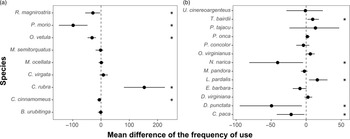
The three bird species most frequently recorded using the sartenejas within the reserve were, in descending order, C. rubra (65.08% of bird records within the reserve), P. morio (6.35%), and R. magnirostris (5.71%). In comparison, outside the reserve, the corresponding species were P. morio (44.95%), R. magnirostris (16.64%), and O. vetula (11.82%) (Fig. S5a). The frequency of use of sartenejas by C. rubra decreased by 86% outside the reserve (ⓓ u = 153.40, p < 0.001) and the duration of its visits by 66% (ⓓ l = 6168, p < 0.001) (Fig. 2a and S6a). In contrast, the frequency of the use of sartenejas by Crypturellus cinnamomeus, O. vetula, P. morio, and R. magnirostris increased outside the reserve by seven (ⓓ u = −5.86, p < 0.05), twelve (ⓓ u = −31.86, p < 0.001), five (ⓓ u = −98.60, p < 0.001), and two times (ⓓ u = −28.80, p < 0.05), respectively (Fig. 2a). The remaining bird species (50% of the total number of evaluated species) showed no difference in their frequency of use of sartenejas or the duration of their visits within versus outside the reserve (Fig. 2a).
Differences in the frequency of use of sartenejas by (a) birds and (b) mammals within and outside the Calakmul Biosphere Reserve, Campeche, southern Mexico. Dots and bars represent the species mean differences in frequencies of visitation and the corresponding 95% bootstrap confidence intervals. Values located to the left of the dotted line represent a higher frequency of use of sartenejas outside the reserve and those located to the right represent higher frequencies within the reserve. Statistical differences (p-value < 0.05) are indicated with an asterisk.

We found significant differences between daily activity patterns within and outside the reserve for the seven evaluated bird species, with overlap coefficients ranging between 0.64 and 0.90 (mean overlap ± SD = 0.77 ± 0.12; Fig. S7). The species C. rubra (Δ = 0.84, 95% CI [0.82, 0.85], p < 0.001), M. semitorquatus (Δ = 0.87, 95% CI [0.82, 0.92], p < 0.001), P. morio (Δ = 0.84, 95% CI [0.82, 0.86], p < 0.001), and R. magnirostris (Δ = 0.90, 95% CI [0.87, 0.93], p < 0.001) showed minor changes in their daily activity patterns (Fig. S7b, S7d and S7f-g). The most pronounced differences among birds occurred in Buteogallus urubitinga (Δ = 0.65, 95% CI [0.60, 0.71], p < 0.001), M. ocellata (Δ = 0.66, 95% CI [0.62, 0.71], p < 0.001), and O. vetula (Δ = 0.64, 95% CI [0.60, 0.67], p < 0.001) (Fig. S7a, S7c, and S7e) which had different peaks of activity in the two sites.
Among mammals, the three most common users of sartenejas within the reserve were Pecari tajacu (21.99%), N. narica (11.81%), and U. cinereoargenteus (11.81%). Outside the reserve, D. punctata (23.94%), N. narica (23.07%), and P. tajacu (12.41%) were the three most common users (Fig. S5b). The frequency of use of sartenejas by L. pardalis, and T. bairdii decreased, respectively, by 82% (ⓓ u = 16.07, p < 0.01) and 92% (ⓓ u = 9.39, p < 0.05) outside the reserve (Fig. 2b). In contrast, C. paca, D. punctata, and N. narica increased their frequency of use of sartenejas, respectively, by ten (ⓓ u = −21.38, p < 0.05), three (ⓓ u = −49.40, p < 0.05), and two times (ⓓ u = −40.80, p < 0.05) outside the reserve (Fig. 2b). The rest of the evaluated mammal species (62%) showed no changes in their frequency of use of sartenejas (Fig. 2b). Only C. paca, D. punctata, and N. narica increased the duration of their visits to sartenejas outside the reserve by 12 (ⓓ l = −1396, p < 0.05), four (ⓓ l = −3856, p < 0.01), and two times (ⓓ l = −2930, p < 0.05), respectively (Fig. S6b).
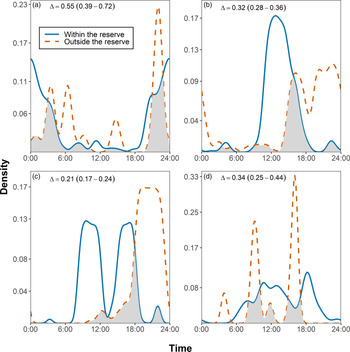
The occurrence of differences in daily activity patterns within and outside the reserve was common among the 10 evaluated mammal species, with overlap coefficients ranging between 0.21 and 0.87 (mean overlap ± SD = 0.54 ± 0.23; Fig. 3 and S8). The daily activity patterns of N. narica (Δ = 0.87, 95% CI [0.85, 0.89], p < 0.001) and P. tajacu (Δ = 0.87, 95% CI [0.85, 0.89], p < 0.001) differed only slightly when compared within and outside the reserve (Fig. S8d-e). Species such as Eira barbara (Δ = 0.43, 95% CI [0.31, 0.56], p < 0.001), L. pardalis (Δ = 0.55, 95% CI [0.39, 0.72], p < 0.001), Odocoileus virginianus (Δ = 0.34, 95% CI [0.25, 0.43], p < 0.001), and U. cinereoargenteus (Δ = 0.77, 95% CI [0.75, 0.79], p < 0.001) were active within the same range of the day within and outside the reserve but the occurrence of their activity peaks differed (Fig. 3a, 3d, S8c and S8f). In comparison, P. concolor (Δ = 0.32, 95% CI [0.28, 0.36], p < 0.001) and M. pandora (Δ = 0.21, 95% CI [0.17, 0.24], p < 0.001) modified their activity from being mostly diurnal within the reserve to being more nocturnal outside the reserve (Fig. 3b-c). Finally, C. paca (Δ = 0.45, 95% CI [0.30, 0.60], p < 0.001) and D. punctata (Δ = 0.59, 95% CI [0.56, 0.62], p < 0.001) had marked peaks in activity time within the reserve, whereas outside their activity had not marked peaks (Fig. S8a-b).
Daily activity patterns of mammals using sartenejas within and outside the Calakmul Biosphere Reserve (Campeche, southern Mexico): (a) L. pardalis, (b) P. concolor, (c) M. pandora, and (d) O. virginianus. The corresponding overlap coefficients (Δ) and 95% confidence intervals are shown in each graph. Gray-shaded areas indicate overlap in activity patterns.

Discussion
Our monitoring focused on sartenejas was successful in terms of allowing us to record a very high proportion of the local fauna in our target groups. For example, the mammal species recorded accounted for 100% (23 out of 23) of the medium- and large-sized terrestrial mammals listed for the Calakmul region (INE 1999). This provided us with a strong foundation to explore the response of species to the effect of small scale but frequent human activities in a region that still maintains an extensive forest cover. We confirmed some of the most evident impacts human activity has already had on the wildlife outside the reserve (e.g. absence of some native species and increased presence of non-native species). But we also detected some incipient effects (e.g. changes in daily activity patterns) that might constitute an early warning of the increased influence of human activity on local wildlife populations. Our methodological approach contrasts with those used in several studies, which concentrate on a single species or small subsets of species and attempt to generalise to the overall target community.
We did not detect an impact at the level of species richness, one of the most commonly used parameters to assess the anthropogenic impact on animal communities (Gibson et al. Reference Gibson, Lee, Koh, Brook, Gardner, Barlow, Peres, Bradshaw, Laurance, Lovejoy and Sodhi2011). However, as we shifted the focus of our attention from species richness to assemblage diversity, composition, and species behaviour, we started to find signs of anthropogenic impact. Therefore, it appears that by heavily focusing on species richness, studies risk underestimating the pervasiveness of chronic anthropogenic disturbances on wildlife, particularly in areas where natural vegetation is still extensive as in the Calakmul region (Dornelas et al. Reference Dornelas, Gotelli, McGill, Shimadzu, Moyes, Sievers and Magurran2014, Fleishman et al. Reference Fleishman, Noss and Noon2006, Newbold et al. Reference Newbold, Hudson, Contu, Hill, Beck, Liu, Meyer, Phillips, Scharlemann and Purvis2018, Ramírez-Delgado et al. Reference Ramírez-Delgado, Christman and Schmook2014).
Despite occurring at a relatively low intensity, human activities outside the reserve appear to be unleashing a series of effects that are directly impacting wildlife by changing the balance of factors that determine their occurrence and activity. The most obvious factor that can have a direct negative impact on some of the species is hunting. Large terrestrial birds and mammals, such as C. rubra and Mazama spp., are among the most hunted species in the Calakmul region (Calmé & Guerra Reference Calmé and Guerra2005, Escamilla et al. Reference Escamilla, Sanvicente, Sosa and Galindo-Leal2000). This would help to explain the absence of these species or their reduced activity in the sartenejas outside the reserve. Abundances of bird and mammal species that are hunted for wild meat consumption or persecuted due to conflicts with livestock (i.e. large carnivores) decline with proximity to roads and settlements (Benítez-López et al. Reference Benítez-López, Alkemade, Schipper, Ingram, Verweij, Eikelboom and Huijbregts2017). This is in agreement with our finding that the distance to roads or SWIPHs was positively associated with the frequency of use of sartenejas (i.e. the greater the distance the higher frequency of use) by the species C. rubra, L. pardalis, P. concolor, and U. cinereoargenteus outside the reserve. Therefore, the lower frequency of use that we detected outside the reserve for some species might be directly related to their local densities in sites with hunting pressure (Briceño-Méndez et al. Reference Briceño-Méndez, Naranjo, Mandujano, Altricher and Reyna-Hurtado2016, Reyna-Hurtado & Tanner Reference Reyna-Hurtado and Tanner2007).
Alternatively to hunting pressure, a series of more complex effects brought about by human presence are those related to the potential generation of a new landscape of fear (i.e. how animals perceive the trade-off between the use they require to do of essential resources and their safety) (Clinchy et al. Reference Clinchy, Zanette, Roberts, Suraci, Buesching, Newman and Macdonald2016, Darimont et al. Reference Darimont, Fox, Bryan and Reimchen2015, Suraci et al. Reference Suraci, Clinchy, Zanette and Wilmers2019). Human activities outside the reserve which are more intense near roads and the village, even when not lethal for fauna, can deter visitation by sensitive species (e.g. Briceño-Méndez et al. Reference Briceño-Méndez, Naranjo, Mandujano, Altricher and Reyna-Hurtado2016, Sánchez-Pinzón et al. Reference Sánchez-Pinzón, Reyna-Hurtado and Meyer2020). This effect can be further increased by the presence of non-native species (i.e. dogs and coyotes), whose presence is directly and indirectly favoured by humans. This can have very important consequences for the long-term viability of wildlife populations, for instance, physiological stress caused by a reduction of water intake might affect animal’s reproductive success (Crosmary et al. Reference Crosmary, Valeix, Fritz, Madzikanda and Côté2012, Tuomainen & Candolin Reference Tuomainen and Candolin2011, Wakefield & Attum Reference Wakefield and Attum2006, Zanette et al. Reference Zanette, White, Allen and Clinchy2011). Additionally, it is known that domestic dogs can harass and prey upon native wildlife, forcing them to avoid usual feeding areas or periods of activity (Hughes & Macdonald Reference Hughes and Macdonald2013, Lenth et al. Reference Lenth, Knight and Brennan2008). Likewise, due to the wide-ranging diet of coyotes, which includes mammals with body sizes ranging from those of mice to deer (Hidalgo-Mihart et al. Reference Hidalgo-Mihart, Cantú-Salazar, López-González, Martínez-Gutíerrez, Fernandez and González-Romero2006, Huegel & Rongstad Reference Huegel and Rongstad1985), they can prey upon most of the native mammal and bird species visiting the sartenejas. Thus, the presence of these non-native species can increase the occurrence of competitive and predator–prey interactions for the local fauna (Hughes & Macdonald Reference Hughes and Macdonald2013).
A particularly interesting change in animal behaviour, which is very likely a manifestation of the new landscape of fear, is the widespread modification we detected in daily activity patterns in birds and mammals. The species P. concolor and M. pandora provide the most compelling cases of changes in daily activity patterns by increasing their nocturnality outside the reserve. An increase in activity during new moon nights was recently reported for T. bairdii in a site with hunting pressure in the Calakmul region (Sánchez-Pinzón et al. Reference Sánchez-Pinzón, Reyna-Hurtado and Meyer2020). Furthermore, recent evidence indicates a widespread increase in nocturnality among medium and large-bodied mammals due to human disturbance (Gaynor et al. Reference Gaynor, Hojnowski, Carter and Brashares2018). This type of response also has been reported in the case of bird daily activity patterns (Fontúrbel et al. Reference Fontúrbel, Orellana, Rodríguez-Gómez, Tabilo and Castaño-Villa2021). Therefore, differences in daily activity patterns outside the reserve might be a response to deal with the direct and indirect effects of human activities. Changes in the hours of activity can generate a broad spectrum of negative consequences. For example, temporal shifts in activity patterns might generate maladaptive responses, such as poor navigational capacity and reduced hunting efficiency, which in turn can promote higher metabolic costs and a reduction of individual fitness (Smith et al. Reference Smith, Thomas, Levi, Wang and Wilmers2018, Suraci et al. Reference Suraci, Clinchy, Zanette and Wilmers2019, Tuomainen & Candolin Reference Tuomainen and Candolin2011).
Not all the species appeared to react negatively to human activities; in fact, some species seemed to be favoured by human activities outside the reserve (i.e. those that were recorded only outside the reserve or increased their frequency of use of sartenejas). Most of these species share some life-history traits, such as being omnivorous and having relatively large litters, which likely help them to thrive in human-dominated landscapes (Carrara et al. Reference Carrara, Arroyo-Rodríguez, Vega-Rivera, Schondube, de Freitas and Fahrig2015, Morante-Filho et al. Reference Morante-Filho, Faria, Mariano-Neto and Rhodes2015, Samia et al. Reference Samia, Nakagawa, Nomura, Rangel and Blumstein2015, Santini et al. Reference Santini, González-Suárez, Russo, Gonzalez-Voyer, von Hardenberg and Ancillotto2019, Sol et al. Reference Sol, González-Lagos, Moreira, Maspons and Lapiedra2014). Interestingly, some of these species showed a negative association with distance to roads (i.e. the shorter the distance the higher the frequency of use) and had increases in the duration of their visits, and only minor changes in daily activity patterns (outside vs. within the reserve). Such responses might be due to the fact these species are not heavily hunted or chased off by local people. It also exists the possibility that these species do not perceive humans as potential predators (Frid & Dill Reference Frid and Dill2002, Sreekar et al. Reference Sreekar, Goodale and Harrison2015) and that, in some instances, they overlap their activity with that of humans as a way to gain protection against some of their natural predators (Berger Reference Berger2007, Steyaert et al. Reference Steyaert, Leclerc, Pelletier, Kindberg, Brunberg, Swenson and Zedrosser2016).
In summary, our study shows that small-scale frequent human activities have a variety of impacts on wildlife despite forest cover is still extensive. Among these impacts stand out those affecting the composition of bird and mammal assemblages and the behaviour of their species.
Conservation implications
Monitoring of sartenejas allowed us to record most of the species in our target groups, including some classified as endangered. Moreover, we obtained the first camera trapping evidence of species such C. latrans and G. vittata occurring in the communal lands of Nuevo Conhuas and the Calakmul Biosphere Reserve, respectively. Therefore, the use of small natural features, providing locally limited resources, such as sartenejas, seems to be a promissory approach to detect impacts of human activities on wildlife at the behavioural, population, and community levels.
Much attention has been paid to the impacts large-scale habitat transformations have on tropical wildlife, but much less is known about the impacts of chronic anthropogenic disturbance on tropical vertebrates in regions where extensive forest remains. Our results highlight the urgent need to generate detailed quantitative data to have a more comprehensive understanding of how the different types and magnitudes of human activity impact wildlife.
At the regional scale, the increasing demand for resources in the Calakmul region, combined with the recent increase in drought frequency and disruptions in rainfall patterns caused by global climate change (Mardero et al. Reference Mardero, Nickl, Schmook, Schneider, Rogan, Christman and Lawrence2012, Reference Mardero, Schmook, Christman, Metcalfe and De la Barreda-Bautista2020), threatens to decrease, in general, the availability of fresh water for wildlife. Due to the size and hydroperiod of sartenejas, these water bodies will, likely, play an increasingly important role as a water source for wildlife inhabiting the region. Therefore, more attention needs to be focused on the monitoring of sartenejas, and their inclusion in conservation initiatives conducted in the Calakmul region is highly desirable. During the recent severe droughts that affected the region park guards installed artificial watering points within the reserve to provide water for wildlife. A useful complementary strategy would be to replenish water in sartenejas during drought peaks.
Supplementary material
To view supplementary material for this article, please visit https://doi.org/10.1017/S0266467421000547
Acknowledgements
This contribution is a requirement for C.M.D.M. to obtain his Master’s in Biological Sciences (in the field of ecology) of the Posgrado en Ciencias Biológicas at Universidad Nacional Autónoma de México (UNAM). We thank the Posgrado en Ciencias Biológicas (UNAM). We are very grateful to the people of Nuevo Conhuas, especially Doña Mema’s family for their hospitality and help during fieldwork as well as to the staff of the regional office of the CONANP. C.M.D.M. was supported by a scholarship from the Mexican National Council of Science and Technology (CONACyT, 629544). E.M. and M.K. were supported by the Sistema Nacional de Investigadores (SNI, National System of Researchers) while conducting this research. We thank G. Gutiérrez-Granados for providing very useful comments on an early draft of this manuscript.
Financial support
This work was supported by the Rufford Foundation (C.M.D.M., grant number 24083-1); the National Geographic Society (C.M.D.M., grant number EC-196R-18); and Idea Wild with an equipment grant to C.M.D.M.
Conflict of interest
None.