Introduction
Impulsivity is a core feature of borderline personality disorder (BPD) and is one of nine diagnostic criteria in the Diagnostic and Statistical Manual of Mental Disorders, 4th edition (DSM-IV; American Psychiatric Association, 1994). It is seen in behaviours such as substance misuse, unsafe sexual activity, disordered eating and impulsive self-harm (Soloff et al. Reference Soloff, Lynch, Kelly, Malone and Mann2000; Trull et al. Reference Trull, Sher, Minks-Brown, Durbin and Burr2000; Dougherty et al. Reference Dougherty, Mathias, Marsh, Papageorgiou, Swann and Moeller2004; Rosval et al. Reference Rosval, Steiger, Bruce, Israel, Richardson and Aubut2006). These impulsive behaviours are the strongest predictor of borderline psychopathology on follow-up after 7 years (Links et al. Reference Links, Heslegrave and van Reekum1999), indicating the importance of understanding this trait.
There is no unitary idea of ‘impulsivity’, which is instead considered to consist of several independent factors. There is little agreement as to what these are (for reviews, see Evenden, Reference Evenden1999a , Reference Evenden b ). Barratt developed a self-report scale that highlighted three second-order factors of impulsivity, specifically: (1) attentional impulsivity which refers to poor cognitive control, concentration and attention; (2) motor impulsivity which represents acting without thinking, and (3) choice or non-planning impulsivity which is being focused on the present with little regard to the future (Patton et al. Reference Patton, Stanford and Barratt1995). Measurement of impulsivity is frequently achieved by using rating scales completed by participants (Lecrubier et al. Reference Lecrubier, Braconnier, Said and Payan1995). These have limitations; some patients may be poor at assessing their own status or may be at variance with external raters (Mattila-Evenden et al. Reference Mattila-Evenden, Svanborg, Gustavsson and Asberg1996), or they may be influenced by the setting. Thus there is a need to use objective, valid and reliable measures to assess impulsivity in conditions such as BPD.
One of the main factors of impulsivity is choice impulsivity (Lecrubier et al. Reference Lecrubier, Braconnier, Said and Payan1995). This can be objectively assessed by delay discounting tasks. In such tasks, the participant is given two choices: they can choose a small immediate reward or a large reward for which they have to wait. Less valuable, immediate rewards are often chosen over more valuable delayed rewards. Greater tendency to discount the value of the reward according to delay in this way reflects greater impulsivity (Reynolds, Reference Reynolds2006). Typically, value is discounted precipitously over relatively short delays but discounting slows as delay length increases (Kirby, Reference Kirby1997), following a hyperbolic discounting function (Mazur, Reference Mazur1987). Reward-based decision making in BPD tends towards short-term gratification and devaluing delayed rewards (Dougherty et al. Reference Dougherty, Bjork, Huckabee, Moeller and Swann1999; Bornovalova et al. Reference Bornovalova, Daughters, Hernandez, Richards and Lejuez2005). One study showed that even when the delay was only 24 h, BPD participants tended to accept the lesser amount of money that was immediately available rather than waiting. While control participants discounted higher values over long delays, the amounts that they would accept immediately rather than wait were much larger than those accepted by the BPD group (Lawrence et al. Reference Lawrence, Allen and Chanen2010). Greater levels of general impulsivity and choice impulsivity on the Barratt Impulsiveness Scale (BIS), but not attentional or motor impulsivity, are associated with steeper delay discounting in BPD participants (Mobini et al. Reference Mobini, Grant, Kass and Yeomans2007; Lawrence et al. Reference Lawrence, Allen and Chanen2010).
Choice impulsivity can also be measured by the use of probabilistic discounting tasks in which participants are asked to choose between a certain reward, and a reward with a specified probability attached to it, for example a 100% chance of getting £10 or 10% chance of getting £100. The value of the probabilistic reward remains constant but the probability of getting it varies whereas the probability of the certain reward by its nature is always 100% but its value varies. The value attributed to a probabilistic reward declines as its probability decreases. Choice impulsivity is related to risk-seeking/risk-aversion and more impulsive individuals show greater risk aversion even at the expense of a greater reward.
Motor impulsivity was another of the central factors of impulsivity proposed by Barratt (Lecrubier et al. Reference Lecrubier, Braconnier, Said and Payan1995) and the stop-signal task (SST) is a paradigm used to measure this (Logan & Cowan, Reference Logan and Cowan1984). The disorder in which motor impulsivity is most classically impaired in is attention-deficit/hyperactivity disorder (ADHD), which is characterized by a persistent pattern of impulsive behaviour, impaired attention and hyperactivity (Faraone et al. Reference Faraone, Biederman, Spencer, Wilens, Seidman, Mick and Doyle2000; Wilens et al. Reference Wilens, Faraone and Biederman2004). ADHD and BPD often occur together (Faraone et al. Reference Faraone, Biederman, Spencer, Wilens, Seidman, Mick and Doyle2000; Biederman, Reference Biederman2004; Wilens et al. Reference Wilens, Faraone and Biederman2004) and a childhood diagnosis of ADHD has been reported as being highly associated with the diagnosis of BPD in adulthood (Fossati et al. Reference Fossati, Novella, Donati, Donini and Maffei2002). It has been proposed that a deficit in behavioural inhibition and therefore increased motor impulsiveness is a core feature of ADHD (Barkley, Reference Barkley1997) and children with ADHD have been found to have longer stop-signal reaction times (SSRTs) compared with healthy controls (Oosterlaan et al. Reference Oosterlaan, Logan and Sergeant1998; Alderson et al. Reference Alderson, Rapport and Kofler2007). If the impulsiveness found in BPD is similarly due to a deficit in behavioural inhibition and increased motor impulsiveness, comparable findings would be expected in individuals with BPD; however, a number of studies have demonstrated that participants with BPD show no impairment in SST performance (Crean et al. Reference Crean, de Wit and Richards2000; Jacob et al. Reference Jacob, Gutz, Bader, Lieb, Tuscher and Stahl2010; LeGris et al. Reference LeGris, Links, van Reekum, Tannock and Toplak2012).
The aim of this study was to examine choice and motor impulsivity using delay and probabilistic discounting tasks and the SST in a group of people with a diagnosis of BPD and a group of healthy controls. The BIS was completed by participants to examine whether the self-rated measure of impulsivity reflects what is found in behavioural measures of impulsivity.
Method
Participants
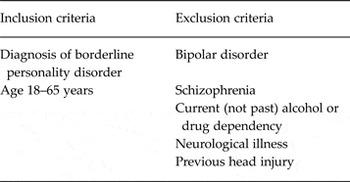
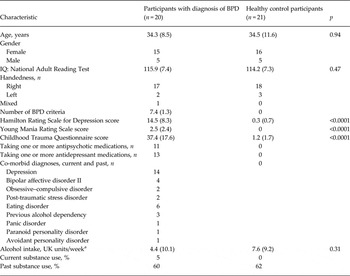
A total of 20 patients meeting DSM-IV criteria for BPD were recruited for the study from out-patient populations. Diagnosis of BPD was established using the Structured Clinical Interview for DSM-IV (SCID-II) administered by a single trained clinician. All participants in the BPD group also had a prior diagnosis of BPD made by local psychiatric services. Participants were screened for co-morbidity using the SCID-I and case-note review. For inclusion/exclusion criteria see Table 1. Scores on the Hamilton Rating Scale for Depression (HAM-D) and Childhood Trauma Questionnaire (CTQ) were recorded (see Table 2).
Study inclusion and exclusion criteria

Population demographics and questionnaire scores for control and BPD groups

Data are given as mean (standard deviation) unless otherwise specified.
BPD, Borderline personality disorder; IQ, intelligence quotient.
a One UK unit = 10 ml alcohol.
In addition, 21 healthy controls were recruited from community volunteers not suffering from BPD, subject to the same exclusion criteria as patients (see Table 1).
Neuropsychological testing
Pre-morbid intellectual function was assessed using the National Adult Reading Test (NART; Nelson, Reference Nelson1982).
BIS
Trait impulsivity was measured using the BIS (Lecrubier et al. Reference Lecrubier, Braconnier, Said and Payan1995). This is widely used in clinical studies and has been recommended for use in studies on BPD (Skodol et al. Reference Skodol, Siever, Livesley, Gunderson, Pfohl and Widiger2002; Bornovalova et al. Reference Bornovalova, Daughters, Hernandez, Richards and Lejuez2005). It includes 30 items grouped into attentional impulsivity (eight items), motor impulsivity (11 items) and choice or non-planning impulsivity (11 items).
Delay discounting task
Choice impulsivity was measured using a computer-based delay-discounting task. Delay discounting describes a phenomenon whereby outcomes decrease in perceived value as a function of delay. This relationship is described by the hyperbolic equation:
 $${\rm Value}\, = \,{\rm A}/({\rm 1} + k{\rm D})$$
where A represents the amount of reward, D is the delay to reward and k is a free parameter (Skodol et al. Reference Skodol, Siever, Livesley, Gunderson, Pfohl and Widiger2002). Larger values of k denote steeper discounting of the value by delay. To measure delay discounting a hypothetical situation was used in which participants were given the option of an immediate or delayed reward but they did not ultimately experience their chosen outcome (i.e. receive a monetary reward). The delay discounting task used in this study was adapted from that described previously (Richards et al. Reference Richards, Zhang, Mitchell and de Wit1999). Participants were asked to choose between receiving one monetary reward immediately or another after a specified delay. The delayed reward maintained a constant value of £100, whereas the monetary value of the immediate reward was varied to establish the indifference point, that is, the immediate value deemed to be as appealing as the delayed reward. A lower indifference point would be consistent with higher impulsivity (for example, someone who considers £10 now to be equivalent to £100 in a week is more impulsive than someone who considers £90 now to be equivalent to £100 in a week). Four delays were assessed (2 days, 1 week, 1 month and 6 months).
Probabilistic discounting task
Choice impulsivity was also measured using a computer-based probabilistic discounting task. The value of a probabilistic reward decreases as its probability decreases. Rachlin et al. (Reference Rachlin, Raineri and Cross1991) used odds against to apply a hyperbolic model to probabilistic discounting:
 $${\rm Value}\, = \,{\rm A}\,/\,({\rm 1} + hO)$$
 $$O\, = \,(1 - p)/\,p$$
where p is the probability of reward and O signifies odds against (Lawrence et al. Reference Lawrence, Allen and Chanen2010).
The value of h indicates how rapidly the value of a reward decreases as the probability of its occurrence decreases. In individuals who are more risk-averse the value of a probabilistic reward declines more sharply as its probability drops than in non-impulsive individuals (Richards et al. Reference Richards, Zhang, Mitchell and de Wit1999).
The probabilistic discounting task used in this study was adapted from that described previously (Richards et al. Reference Richards, Zhang, Mitchell and de Wit1999). Participants were asked to choose between a certain monetary reward, and a monetary reward with a specified probability attached to it. The probabilistic reward was always £100, and the monetary value of the certain reward varied. The four probabilities assessed were 0.9, 0.75, 0.5 and 0.25.
SST
Motor planning was assessed using the SST adapted from Aron & Poldrack (Reference Aron and Poldrack2006). Trials were either ‘go’ or ‘stop’ trials. For go trials, the participant simply had to respond as quickly as possible to a cue, an arrow presented on a computer screen, by pressing a button. For stop trials, a 900 Hz, 500 ms tone would be sounded after a delay following cue presentation, indicating that the participant should withhold their response (for more detail, see online Supplementary material). Task performance is modelled by considering that two processes are operative: a ‘go’ process that leads to responding, and a ‘stop’ process that can cancel an impending action. The duration of the ‘go’ process is directly observable through median reaction time, whereas the duration of the stop process (known as the SSRT) must be estimated by observing the effects of varying the delay between the arrow stimulus and the stop signal (stop-signal delay; SSD). The SSRT is an estimation of the time an individual needs to stop their usual behaviour (i.e. pressing a key every time they see the arrow) in response to the stop signal.
 $${\rm SSRT}\, = \,{\rm MRT}\,-\,{\rm SSD}_{{\rm 5}0} $$
where SSD50 is the SSD at which the probability of inhibition is 50%.
Increased responding (i.e. failure to inhibit) on stop trials, or equivalently a longer SSRT, can be interpreted as increased impulsivity.
Statistical analysis
The demographic characteristics including NART score were compared for the two groups using t tests (Table 1). Repeated-measures analyses of variance (ANOVAs) were used to analyse the delay and probabilistic discounting task data. The k value, the degree to which the reward is devalued by delay, and the h value, how rapidly the value of a reward decreases as the probability of its occurrence decreases, were calculated for each subject. Indifference points were used to estimate delay and probability discount functions for each participant. The equation, value = A/(1 + kD) was fitted to the five delay indifference points using non-linear curve fitting in Matlab by minimizing sum-squared error of fit for each individual, where V = indifference/immediate-equivalent value and D = delay. This determined the best-fitting values for k and the coefficient of determination for delay discounting.
Similarly, the equation, value = A/(1 + hO) was fit to the five probability indifference points to determine the values of h and coefficient of determination for probabilistic discounting. Group differences in k and h values were analysed using a one-way ANOVA of the natural log transformation of k and h values so as to render them normal in distribution. One-way ANOVAs were also used to examine the SST data and BIS data. The relationships between the HAM-D and CTQ scores and performance on the SST, delay and probabilistic discounting tasks were analysed using the Pearson product-moment correlation coefficient. Analysis was performed using SPSS version 19. One outlier in the BPD group was identified and excluded from the analysis.
Results
In all, 20 BPD and 21 control participants completed the NART, delay discounting and probabilistic discounting tasks; 20 BPD and 19 control participants completed the SST. One control participant refused and a second was unable to complete the task due to arthritis of the hands. The groups were matched closely on age, gender and pre-morbid intelligence quotient (IQ) as determined on the NART. They had similar rates of previous alcohol and illegal substance use. There were greater levels of co-morbid psychiatric illness in the BPD group (Table 1).
Delay discounting task
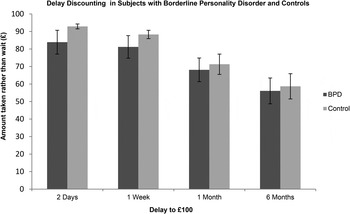
BPD participants exhibited significantly greater delay discounting than the control group across all levels (main effect of group, F 1,38 = 5.7, p = 0.02) (Fig. 1). Participants with BPD were less willing to wait for a larger reward than controls and tended to accept the lesser amount of money that was immediately available rather than waiting. A significant effect of delay was found, with both groups reducing the amount taken rather than wait as the delay increased (F 2,67 = 58.6, p < 0.0001), but for BPD participants, the lowest amounts that they were willing to accept were much smaller than those accepted by the control group at every level. There was no group × delay interaction (F 2,67 = 0.66, p = 5.03, n.s.). BPD patients showed steeper delay discounting (higher k values) compared with controls, with mean log k values (log k where k has units of days−1) of −4.03 (s.d. = 1.88) for the BPD group and −5.4 (s.d. = 1.82) for controls. (F 1,38 = 5.54, p = 0.024). There was no significant relationship between HAM-D score and log k value [Pearson's r = 0.29, p = 0.07, degrees of freedom (df) = 39, n.s.], or between CTQ score and log k value across all participants (Pearson's r = 0.19, p = 0.25, df = 39). Analysis of covariance (ANCOVA) showed that CTQ does not predict log k when controlling for HAM-D (F 23,15 = 1.13, p = 0.41) and that HAM-D does not predict log k when controlling for CTQ (F 17,21 = 1.66, p = 0.13, n.s.). The main group effect on delay discounting remained significant when controlling for use of specific serotonin reuptake inhibitors (SSRIs) (F 1,37 = 12.13, p = 0.001).
Subjects with borderline personality disorder (BPD) were less willing to wait for a larger reward than controls and tended to accept the lesser amount of money that was immediately available rather than waiting. Both groups exhibited delay discounting, reducing the amount taken rather than wait as the delay increased. Values are means, with standard deviations represented by vertical bars.

Probabilistic discounting task
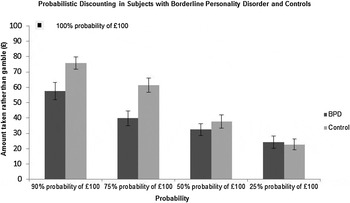
BPD patients showed greater probability discounting than controls, with this effect being predicted by childhood trauma. In the probabilistic discounting tasks, subjects valued an uncertain reward less as its probability decreased (main effect of probability, F 3,103 = 78.54, p < 0.0001). Overall, BPD participants accepted a smaller guaranteed reward than controls, when offered a greater but less likely reward as an alternative (main effect of group, F 1,38 = 5.9, p = 0.02); in addition, there was a group × probability interaction (F 3,103 = 7.25, p < 0.0001), with the group differences being most marked at higher probabilities (Fig. 2). There was a significant difference between the log h values or steepness of discounting of probabilistic rewards in the BPD and control groups (F 1,38 = 5.6, p = 0.023), with BPD participants having higher log h values. Mean log h value was 1.44 (s.d. = 1.4) for the BPD group and 0.58 (s.d. = 0.81) for controls. There was a positive correlation found between HAM-D score and log h value (Pearson's r = 0.46, p = 0.003, df = 39) and CTQ score and log h value across all participants (Pearson's r = 0.35, p = 0.03, df = 39). ANCOVA showed that these findings did not reflect group effects for either HAM-D (F 1,37 = 0.59, p = 0.45, n.s.) or CTQ (F 1,37 = 1.54, p = 0.22, n.s.) and that CTQ does predict log h when controlling for HAM-D (F 1,15 = 13.73, p = 0.002) but that HAM-D does not predict log h when controlling for CTQ (F 1,21 = 0.36, p = 0.55, n.s.). The main group effect on probabilistic discounting remained significant when controlling for the use of SSRIs (F 1,37 = 12.13, p = 0.001).
The certain amount that subjects considered equivalent to a chance of £100 decreased as the probability of obtaining the £100 decreased. Borderline personality disorder (BPD) participants accepted a smaller guaranteed reward than controls, when offered a greater but less likely reward as an alternative. BPD patients showed greater risk aversion in this context (steeper probabilistic discounting; higher values of h; see text). Values are means, with standard deviations represented by vertical bars.

Comparison of probability and delay discounting
Comparison of the log k and log h values demonstrated a positive correlation between delay and probability discounting across all participants (Pearson's r = 0.37, p = 0.018, df = 39).
SST
On the SST the BPD and control groups did not differ significantly in SSRT (F 1,36 = 2.88, p = 0.098, n.s.). The mean SSRT for the BPD group was 337.9 (s.d. = 45.49), with a mean of 314.7 (s.d. = 45.17) for the control group.
Barrett impulsiveness scale
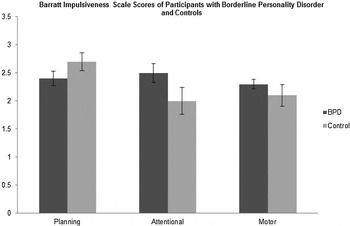
There was no significant difference found on total score for the BIS (F 1,38 = 1.7, p = 0.20, n.s.). The questions on the BIS were divided into categories of impulsivity and scores were compared. There was no significant difference found in the levels of non-planning (F 1,20 = 2.04, p = 0.17, n.s.), attentional (F 1,14 = 2.14, p = 0.17, n.s.) or motor impulsivity (F 1,20 = 1.16, p = 0.29, n.s.) on the BIS in BPD participants compared with controls (Fig. 3). There was no significant relationship found between either HAM-D (Pearson's r = 0.21, p = 0.19, df = 39, n.s.) or CTQ (Pearson's r = 0.07, p = 0.69, df = 39, n.s.) and BIS scores in all participants. ANCOVA showed that CTQ did not predict BIS score when controlling for HAM-D (F 23,15 = 0.49, p = 0.96) and that HAM-D did not predict BIS score when controlling for CTQ (F 17,21 = 0.47, p = 0.94, n.s.).
There was no significant difference between those with borderline personality disorder (BPD) and controls in self-rated scores of planning, attentional or motor impulsiveness as measured by the Barratt Impulsiveness Scale. Values are means, with standard deviations represented by vertical bars.

Conclusions
Participants with BPD showed significantly greater delay and probabilistic discounting than the control group, reflecting greater choice impulsivity. BPD and control groups did not differ significantly in SSRT, a measure of motor inhibitory function. The BPD and control groups did not differ significantly on self-reported impulsivity as measured by the BIS.
Our findings on the delay-discounting task replicated those of Dougherty et al. (Reference Dougherty, Bjork, Huckabee, Moeller and Swann1999) and Lawrence et al. (Reference Lawrence, Allen and Chanen2010) demonstrating that participants with BPD were less willing to wait for a larger reward than controls. The overall steepness with which the value of rewards was discounted based on delay was significantly greater in those with BPD than in controls. When examining the probabilistic discounting task we demonstrated that for both groups the value of a reward decreases as the chance of gaining the reward decreases; however, compared with controls, BPD participants were significantly more likely to accept smaller-value rewards that were guaranteed rather than take the chance of a higher-value reward. These findings are in contrast to those of Crean et al. (Reference Crean, de Wit and Richards2000), who showed no significant difference in probabilistic discounting task performance between a group of psychiatric out-patients who they classed at high risk of impulsivity versus low-risk patients. However this high-risk impulsivity group included participants with a range of diagnoses so it is hard to apply those findings to our study sample. We have also shown that the BPD group discounted rewards more steeply based on probability than the control group.
When we examined discounting by delay and probability simultaneously within the same participants we demonstrated that there is a positive relationship between discounting for these two variables (i.e. participants who exhibited the greatest discounting of delayed rewards also showed the greatest discounting of probabilistic rewards). These findings were consistent with those of Richards et al. (Reference Richards, Zhang, Mitchell and de Wit1999) and with the idea that in greater impulsivity the discounting in value produced by delay and that produced by decreased probability represent the same process (Rachlin et al. Reference Rachlin, Logue, Gibbon and Frankel1986, 1991; Mazur, Reference Mazur1989, Reference Mazur1995). The basis for this is that in real-life situations, rewards that are delayed for long periods often become less certain and payout less probable. Other studies have, however, provided evidence that delay and probabilistic discounting are dissociable processes (Ho et al. Reference Ho, Mobini, Chiang, Bradshaw and Szabadi1999; Bazanis et al. Reference Bazanis, Rogers, Dowson, Taylor, Meux, Staley, Nevinson-Andrews, Taylor, Robbins and Sahakian2002; Green & Myerson, Reference Green and Myerson2004; Mobini et al. Reference Mobini, Grant, Kass and Yeomans2007). An alternative explanation to that of increases in both delay and probabilistic discounting representing deficits in the same process in BPD is that differences in these tasks may represent deficits in two separate processes involved in producing impairment in choice impulsivity in these participants. It has been noted that lesions to the nucleus accumbens core produce exactly the same pattern, steeper delay discounting (and also impaired learning with delayed reinforcement) (Green & Myerson, Reference Green and Myerson2004; Cardinal & Cheung, Reference Cardinal and Cheung2005) and steeper probability discounting and risk-averse choice with uncertain rewards (Cardinal & Howes, Reference Cardinal and Howes2005). It may be that the accumbens core is the central area involved in both these processes and that it promotes rewards that are not certain, and that this area is affected in BPD resulting in these individuals opting for smaller more certain rewards on the delay and probabilistic discounting task whether this is the most beneficial option or not. Previous studies have also indicated that there are deficits in the orbitofrontal cortex (OFC) in individuals with BPD (LeGris & van Reekum, Reference LeGris and van Reekum2006; Chanen et al. Reference Chanen, Velakoulis, Carison, Gaunson, Wood, Yuen, Yucel, Jackson, McGorry and Pantelis2008). This is an area highly involved in choice impulsivity and it is associated with delay discounting in particular. The medial OFC is thought to be involved in determining individual differences in reward value, whereas the lateral OFC is implicated in conflict detection and behavioural inhibition (Bari & Robbins, Reference Bari and Robbins2013). Thus, OFC deficits may contribute to the greater choice impulsivity seen in those with BPD. In contrast to this it is the supplementary motor area (SMA) and anterior cingulate cortex that are thought to be primarily involved in behavioural inhibition and motor impulsivity. In particular the superior and pre-central gyri are thought to be specifically involved in controlling SSRT. The OFC does not seem to play a central role in tasks requiring motor inhibition in humans but it was found that in rats OFC lesions slowed SSRTs (Bari & Robbins, Reference Bari and Robbins2013).
The results on both delay and probabilistic discounting tasks are consistent with the idea of BPD participants having a preference for ‘security of supply’, in that they will tend to choose the more certain and/or immediate reward irrespective of whether this is of lower value. This may be explained by the observation that BPD participants were subject to greater childhood adversity and scored significantly higher on the CTQ and therefore may have experienced a more uncertain early environment. There was a significant positive correlation between HAM-D and CTQ score and log h value, suggesting that those with greater childhood trauma and with depressive symptomatology discounted rewards more steeply based on probability value. Interestingly, CTQ but not HAM-D predicts steepness of discounting based on probability when the effects of the other factors are taken into account. These findings support this idea of the experience of a more uncertain early environment contributing to a preference for certain rewards on these tasks, although it may also reflect greater illness severity in these individuals.
In contrast to the differences in choice paradigms, motor impulsivity was not increased in the BPD participants, as indicated by performance on the SST. This is consistent with the findings of previous studies (Patton et al. Reference Patton, Stanford and Barratt1995; Evenden, Reference Evenden1999 b; Soloff et al. Reference Soloff, Lynch, Kelly, Malone and Mann2000; Lampe et al. Reference Lampe, Konrad, Kroener, Fast, Kunert and Herpertz2007). Motor impulsiveness is most typically thought to be seen in ADHD (Barkley, Reference Barkley1997). ADHD and BPD often occur together (Faraone et al. Reference Faraone, Biederman, Spencer, Wilens, Seidman, Mick and Doyle2000; Biederman, Reference Biederman2004; Wilens et al. Reference Wilens, Faraone and Biederman2004) and while BPD and ADHD are both disorders in which impulsivity is a core feature, our findings suggest that the type of impulsivity found in these disorders is different. Interestingly, these findings are in contrast to other studies using alternative measures of response inhibition in BPD such as the Go/No-Go and Go-Stop Tasks (Kirby, Reference Kirby1997; Reynolds, Reference Reynolds2006).
We found no significant difference in total BIS score or subscales between the participants with BPD and controls. This is in contrast to our findings on the behavioural measures of impulsivity. It highlights the potential difficulties of using self-rating scales to assess impulsivity and is in keeping with the idea that a limitation of these scales is that some patients may be poor at assessing their own status, may be at variance with external raters (LeGris et al. Reference LeGris, Links, van Reekum, Tannock and Toplak2012) or may be influenced by setting. Our findings on the BIS are in contrast to previous studies of impulsivity in BPD showing higher scores on all subscales of the BIS for participants with BPD compared with controls (Evenden, Reference Evenden1999b ; Paris et al. Reference Paris, Zweig-Frank, Kin, Schwartz, Steiger and Nair2004; Domes et al. Reference Domes, Winter, Schnell, Vohs, Fast and Herpertz2006). This may reflect potential differences in populations studied, which are discussed below. Our findings highlight the value in using behavioural measures of impulsivity rather than questionnaires alone. Indeed, it has been shown in other populations that impulsive traits as measured by self-report questionnaires do not often correlate with behavioural measures of impulsivity (Bari & Robbins, Reference Bari and Robbins2013).
There were certain limitations to this study. One such limitation is the possible volunteer bias introduced, as participants agreeing to be involved in the study following recruitment may represent a less functionally impaired subpopulation of those with BPD. Indeed, this sample of BPD participants has above-average IQ and no current substance misuse but they did meet an average of 7.4 of the DSM-IV criteria for BPD. This may go some way to explaining the lack of significant differences found on the BIS between participants in this study with BPD and controls. It has been shown that severity of BPD symptoms correlates with impulsivity as measured by the BIS (Fossati et al. Reference Fossati, Barratt, Carretta, Leonardi, Grazioli and Maffei2004). It is important to acknowledge that sample sizes in this study were small and lack of power may have contributed to there being no significant difference between groups on the BIS. It is, however, possible that the BIS is a less reliable measure of impulsivity than certain behavioural measures particularly in less functionally impaired individuals with BPD and also that the delay discounting and probabilistic discounting tasks are relatively sensitive tests of choice impulsivity. A recent review of impulsivity in cannabis users showed that self-rating measurements of impulsivity often fail to show clear correlations with behavioural methods (Wrege et al. Reference Wrege, Schmidt, Walter, Smieskova, Bendfeldt, Radue, Lang and Borgwardt2014). It would be valuable in future research to include a number of different self-rating scales to further elucidate the comparability between self-rating and objective measures of impulsivity. We also accept that the probabilistic and delay discounting tasks measure specific aspects of impulsivity but do not measure real-world impulsivity. They give an indication of what happens in real-world impulsivity but further work with broader ecological situations will give a greater understanding of the wider ramifications of impulsivity in a real-world setting. A measure of real-world impulsivity has recently been developed (Tomko et al. Reference Tomko, Solhan, Carpenter, Brown, Jahng, Wood and Trull2014). This is a self-report measure of state impulsivity that can be used in naturalistic settings and could be used to address this limitation in future studies.
In conclusion, our main findings were that choice or reward-related impulsivity is significantly greater in those with BPD on behavioural measures but motor impulsivity is not significantly different between participants with BPD and controls. This suggests that the type of impulsivity that is a core feature of BPD is specifically choice impulsivity as opposed to motor impulsivity. Participants with BPD were found to choose the more certain and/or immediate rewards, despite their lower value, suggesting that they have a preference for ‘security of supply’. Interestingly, the tendency to choose more certain rewards was positively correlated with the experience of childhood adversity as measured by CTQ score, suggesting that childhood adversity can have a long-lasting impact on choice preferences such that the traumatized individual avoids uncertain rewards, even to their cost.
Supplementary material
For supplementary material accompanying this paper visit http://dx.doi.org/10.1017/S0033291714003079
Acknowledgements
Funding support was received from the Chief Scientist Office of Scotland (grant number SCD/10) and the Scottish Senior Fellowship of Professor Jeremy Hall.