Introduction
Women experience dramatic biological changes during pregnancy that occur in synchrony with the rapid development of the fetus (Cárdenas, Kujawa, & Humphreys, Reference Cárdenas, Kujawa and Humphreys2020). The prenatal period is a time of enhanced sensitivity to the environment for both mothers and their fetuses (Bock, Wainstock, Braun, & Segal, Reference Bock, Wainstock, Braun and Segal2015). The coronavirus disease 2019 (COVID-19) pandemic has involved widespread increases in exposure to environmental adversity, defined as negative life events related to the environment, as well as psychosocial stress, defined as affective responses to these events (Harkness & Monroe, Reference Harkness and Monroe2016). Pregnant women are a special population for whom stress and adversity related to the pandemic may have specific characteristics. Pandemic-related stress and adversity may lead to or exacerbate common prenatal mental health difficulties, including depressive symptoms, which, in turn, have been found to negatively influence maternal–child health (Glover, Reference Glover2014).
The COVID-19 pandemic involves distinct adverse experiences, such as prolonged social isolation due to social distancing requirements, and specific stress responses, such as ongoing fears of contracting a highly virulent virus that, as of late December 2020, has taken the lives of 1.75 million people. COVID-19 has led to a severe economic recession that disproportionally affects women (Heggeness, Reference Heggeness2020; U.S. Bureau of Labor Statistics, 2020). During this time, pregnant women may experience fear for the health of their future infant, worries about their own wellbeing during what is often the most medically vulnerable period of their life, and disruptions to their obstetric care (Preis, Mahaffey, Heiselman, & Lobel, Reference Preis, Mahaffey, Heiselman and Lobel2020). These fears are not ungrounded. Pregnant women who contract COVID-19 are more likely to experience severe illness, to die from the virus, and to have preterm births (Woodworth et al., Reference Woodworth, Olsen, Neelam, Lewis, Galang, Oduyebo and Whitehill2020; Zambrano et al., Reference Zambrano, Ellington, Strid, Galang, Oduyebo, Tong and Zapata2020). Pregnant women may also choose to socially distance from others more strictly because they are considered high risk (Morris, Traube, Lakshmanan, West, & Saxbe, Reference Morris, Traube, Lakshmanan, West and Saxbe2020). Financial disruptions due to COVID-19 (e.g. employment loss) may be especially threatening when preparing for the expense of raising a new child. Due to the dual impact of prenatal stress and adversity on women and their fetuses (Van den Bergh et al., Reference Van den Bergh, van den Heuvel, Lahti, Braeken, de Rooij, Entringer and Schwab2017), characterizing COVID-19-related stress and adversity in pregnant women is a public health priority.
Stress and adversity in any form can be depressogenic (Hammen, Reference Hammen2005). Emerging findings indicate that depressive symptoms were elevated in the general population compared to historical norms following the first shelter-in-place orders in March 2020 in the U.S. and the U.K. (Ettman et al., Reference Ettman, Abdalla, Cohen, Sampson, Vivier and Galea2020; Fancourt, Steptoe, & Bu, Reference Fancourt, Steptoe and Bu2021; Nelson, Pettitt, Flannery, & Allen, Reference Nelson, Pettitt, Flannery and Allen2020). Among pregnant and postpartum women specifically, 24–50% reported clinically significant depression between April and July 2020 (Cameron et al., Reference Cameron, Joyce, Delaquis, Reynolds, Protudjer and Roos2020; Davenport, Meyer, Meah, Strynadka, & Khurana, Reference Davenport, Meyer, Meah, Strynadka and Khurana2020; Fransson et al., Reference Fransson, Karalexi, Kimmel, Bränn, Kollia, van Zoest and Skalkidou2020; Lebel, MacKinnon, Bagshawe, Tomfohr-Madsen, & Giesbrecht, Reference Lebel, MacKinnon, Bagshawe, Tomfohr-Madsen and Giesbrecht2020; Morris et al., Reference Morris, Traube, Lakshmanan, West and Saxbe2020; Thayer & Gildner, Reference Thayer and Gildner2020). Comparatively, a systematic review of studies including over 35 000 women conducted in developed countries prior to the pandemic found that the average rate of prenatal depression was 17% (Underwood, Waldie, D'Souza, Peterson, & Morton, Reference Underwood, Waldie, D'Souza, Peterson and Morton2016). From a cumulative risk perspective, pregnant women may be especially vulnerable to depressive symptoms during COVID-19 because pregnancy involves mental and physical preparation for dramatic life changes that can be challenging even when welcome (Saxbe, Goldenberg, & Rossin-Slater, Reference Saxbe, Goldenberg and Rossin-Slater2018). Thus, pregnant women, as a group, may be more likely to experience elevated depressive symptoms in response to the pandemic than are non-pregnant women, and among pregnant women, those who experience more severe stress and adversity may be at highest risk.
Based on a bioecological model of human development, both proximal processes that vary at the level of the individual and distal factors that vary across communities influence individuals' experiences of mass adversity (Hoffman & Kruczek, Reference Hoffman and Kruczek2011). Whereas some people may have resources in place that protect them from stress and adversity related to the pandemic, others may lack these resources and/or have characteristics that predispose them to greater stress and adversity (McElroy et al., Reference McElroy, Patalay, Moltrecht, Shevlin, Shum, Creswell and Waite2020). Characteristics of one's community, such as the population's health and socioeconomic standing relative to other places, may also affect levels of stress and adversity by influencing social distancing, disease transmission, and mortality (Adhikari et al., Reference Adhikari, Pantaleo, Feldman, Ogedegbe, Thorpe and Troxel2020; Jay et al., Reference Jay, Bor, Nsoesie, Lipson, Jones, Galea and Raifman2020). As the consequences of the pandemic unfold, identifying risk and protective factors for COVID-19-related stress and adversity in pregnant women will be useful for guiding prenatal care practices based on patient-level variables and for the allocation of public health resources for pregnant women based on the characteristics of communities.
Recent studies provide important information indicating that pregnant women are experiencing high depressive symptoms during the COVID-19 pandemic (e.g. Fransson et al., Reference Fransson, Karalexi, Kimmel, Bränn, Kollia, van Zoest and Skalkidou2020; Lebel et al., Reference Lebel, MacKinnon, Bagshawe, Tomfohr-Madsen and Giesbrecht2020; Morris et al., Reference Morris, Traube, Lakshmanan, West and Saxbe2020). The current study builds on these recent findings by comprehensively assessing pregnant women's experiences of stress and adversity related to COVID-19, and directly comparing their depressive symptoms to women who were pregnant prior to the pandemic. Specifically, the current study analyzes data from a large sample of pregnant women residing predominantly in the San Francisco Bay Area in March−May 2020. In Aim 1, we tested the hypothesis that, compared to women who were pregnant prior to the onset of the COVID-19 pandemic, women who were pregnant during the pandemic have higher self-reported symptoms of depression. In Aim 2, we explored the latent structure of pregnant women's reports of 16 indicators of stress and adversity related to COVID-19. In Aim 3, we identified individual- and community-level risk and protective factors that are associated with dimensions of COVID-19 stress and adversity. Finally, in Aim 4, we examined the associations between dimensions of COVID-19 stress and adversity and women's depressive symptoms. Because analyses for Aims 3–4 depended on the results of the exploratory analyses of Aim 2, we did not have precise hypotheses for Aims 3–4. Nevertheless, we anticipated that factors related to socioeconomic deprivation would be associated with greater risk for stress and adversity due to the pandemic, and that women exposed to greater COVID-19-related stress and adversity would have higher depressive symptoms.
Method
Participants
Participants included independent samples of pregnant women residing predominantly in the San Francisco Bay Area who participated in the Brain and Behavior Infants Experiences project (BABIES; Camacho et al., Reference Camacho, King, Ojha, García, Sisk, Cichocki and Gotlib2020; Humphreys, King, Choi, & Gotlib, Reference Humphreys, King, Choi and Gotlib2018; King, Camacho, Montez, Humphreys, & Gotlib, Reference King, Camacho, Montez, Humphreys and Gotlib2021a; King, Querdasi, Humphreys, & Gotlib, Reference King, Querdasi, Humphreys and Gotlib2021b) prior to the COVID-19 pandemic (hereafter, the ‘pre-pandemic’ cohort), or who participated in the Stanford COVID-19 Perinatal Experiences (COPE) project following the onset of the pandemic in the U.S. and the establishment of state-wide legally enforceable shelter-in-place orders on 19 March 2020 in California (hereafter, the ‘COVID-19’ cohort). These orders, which directed residents to stay at home and required all non-essential businesses to close, remained in place throughout the data collection period. Based on the most recent data available, the population of the San Francisco Bay Area is 7.7 million and the California birthrate is 56.05 per 1000 women over ages 18–44 (Martin, Hamilton, Osterman, & Driscoll, Reference Martin, Hamilton, Osterman and Driscoll2018).
Pre-pandemic cohort
Ninety pregnant women participated in an observational study of the association between perinatal experiences and infant psychobiological development from February 2017 to May 2019. Of these women, two did not complete an assessment of their prenatal depressive symptoms and were not included in the current analyses, yielding a final pre-pandemic sample of 88 women. All women resided in the Bay Area.
COVID-19 cohort
Pregnant women completed an online survey about the psychosocial effects of COVID-19 in April 2020. Of the 1994 women who responded to the survey, 1595 were eligible for the broader study based on being currently pregnant or the mother of an infant age <6 months. Of eligible women, 1058 were currently pregnant; 333 of these pregnant women did not complete the entire survey, yielding a final sample of 725 pregnant women. Of these women, 343 provided their complete current addresses, of whom 333 resided in the Bay Area.
Procedure
Both the BABIES and COPE projects were approved by the Stanford Institutional Review Board. Participants in both cohorts were recruited during their pregnancies through online advertisements.
Pre-pandemic cohort
Participants were screened for inclusion/exclusion criteria through a phone interview. Inclusion criteria were that they were currently pregnant, were ⩾age 18 years, fluent in English, and had no immediate plans to leave the geographic area. Exclusion criteria included bipolar disorder, psychosis, or severe learning disabilities. Participants were recruited to vary in whether they had a history of major depressive disorder (MDD), current MDD, and/or had experienced early adversity. Participants who met inclusion/exclusion criteria and agreed to participate attended an in-person session where they provided informed written consent and completed a series of questionnaires, interviews, and computer tasks. Participants were compensated for their time.
COVID-19 cohort
Participants were screened for inclusion/exclusion criteria using questions at the beginning of the online survey. Inclusion criteria for the broader study were that participants were either currently pregnant or had an infant <6 months old and were ⩾age 18 years. The survey and advertisements were in English and Spanish. Participants who met criteria and agreed to participate provided informed written consent and responded to questions about their experiences of the pandemic and questionnaires measuring symptoms of psychopathology. Participants were entered into a random raffle for one of 25 online gift cards.
Measures
We provide additional descriptive statistics and distributions of study measures in the online Supplementary Material.
Demographic characteristics
Participants in both cohorts self-reported their race and ethnicity, level of education, marital status, country of birth (from which we identified whether they were a U.S. immigrant), type of housing, employment status, annual household income in the previous year, and the number of adults and children in their household. We calculated their income-to-federal poverty line (FPL) ratio based on the number of adults and children in their household. Participants reported whether or not this was their first pregnancy and their due dates. We calculated gestational weeks based on due date.
Prenatal depressive symptoms
Participants in both cohorts completed the Edinburgh Postnatal Depression Scale (EPDS; Cox, Holden, and Sagovsky, Reference Cox, Holden and Sagovsky1987). The EPDS is a self-report questionnaire consisting of 10 items assessing symptoms of depression measured on a 4-point scale, yielding total scores ranging from 0 to 30 where higher scores indicate more severe symptoms. The EPDS has high sensitivity and specificity for detecting depression in pregnant women at a cut-off score of ⩾11 (Levis, Negeri, Sun, Benedetti, & Thombs, Reference Levis, Negeri, Sun, Benedetti and Thombs2020). Whereas we asked women in the pre-pandemic cohort to reflect on their symptoms ‘during your pregnancy,’ we asked women in the COVID-19 cohort to reflect on their symptoms ‘during the last 7 days.’ Internal consistency of the EPDS was good in both cohorts (Cronbach's α: pre-pandemic cohort = 0.89, COVID-19 cohort = 0.85).
COVID-19 stress and adversity
Participants in the COVID-19 cohort responded to a series of questions probing experiences related to the pandemic (see: https://osf.io/uqhcv/), developed by Drs Moriah Thomason and Michelle VanTiegham at New York University and Drs. Alice Graham and Elinor Sullivan at Oregon Health and Science University. We identified items that asked about adversity (i.e. negative life events related to the pandemic; e.g. changes to prenatal care due to COVID-19) or psychosocial stress (i.e. affective responses to the pandemic; level of concern about possible changes to medical care during your baby's birth). We did not include items that assessed adversity or stress unrelated to COVID-19 or items that overlapped with symptoms of depression. Overall, we examined 16 indicators of COVID-19 stress and adversity.
Individual-level risk and protective factors
The COVID-19 cohort also reported on individual characteristics that may influence risk for pandemic-related stress and adversity (see: https://osf.io/uqhcv/). These items included along with several demographic indicators, whether participants had a history of serious medical conditions (e.g. diabetes, lung disease), a history of a mood or anxiety disorder, were at high risk for COVID-19 due to medical conditions, their number of prenatal medical conditions (e.g. gestational diabetes), their number of personal environmental resources (e.g. privacy at home), level of perceived support from their prenatal care team, level of perceived support from social network currently, and level of perceived support prior to COVID-19.
Community-level risk factors
We geocoded the addresses of the 343 participants who provided complete addresses in California. We then matched them based on their census tract codes with population characteristics data from the CalEnviroScreen 3.0. (https://oehha.ca.gov/calenviroscreen/report/calenviroscreen-30). We focused on eight community-level indicators of sensitive health and socioeconomic burden: asthma (rate of emergency room (ER) visits); cardiovascular disease (rate of ER visits for heart attacks); low birth weight (% births of low weight infants in population); low educational attainment (% of population >age 25 years with <high school education); housing burden (% of population that is both low income and paying >50% of income for housing); linguistic isolation (% limited English-speaking households); poverty (% of population with income <twice the federal poverty line); and unemployment (% of population unemployed). The indicators were quantified by the census tract percentile relative to the distribution across all tracts in California.
Statistical analysis
Statistical analyses were conducted in R version 4.0.2 (R Core Team, 2020) and Mplus version 8 (Muthén & Muthén, Reference Muthén and Muthén2017). See the online Supplementary Material for additional details about the analyses.
Matching of participants in the COVID-19 and pre-pandemic cohorts
We used Optimal Nearest Neighbor Matching (Stuart, Reference Stuart2010) implemented in the ‘MatchIt’ package in R (Ho, Imai, King, & Stuart, Reference Ho, Imai, King and Stuart2011) to identify matched samples from each cohort with the smallest average absolute distance across all matched pairs. Distance was quantified by the propensity score estimated from a logistic regression of cohort on age, parity, gestational weeks, number of children, marital status, race/ethnicity, income, education, employment status, and history of treatment for mental health difficulties or substance use.
Aim 1: examine prenatal depressive symptoms in matched samples of women pregnant prior to and during the COVID-19 pandemic
We used a Welch's t test and multiple ordinary least squares (OLS) regression to test the hypothesis that participants who were pregnant during the COVID-19 pandemic had higher prenatal depressive symptoms than did matched participants who were pregnant prior to the pandemic.
Aim 2: explore the latent structure of COVID-19 stress and adversity among pregnant women
Among women pregnant during the pandemic, we used exploratory factor analysis (EFA) estimated with maximum likelihood robust standard errors using a numerical integration algorithm and oblique rotation to identify latent dimensions of COVID-19 stress and adversity (MLR; Muthén and Muthén, Reference Muthén and Muthén2017). We removed items with high cross-loadings (⩾0.30) before identifying a final model. This approach allowed us to determine which indicators of COVID-19 stress and adversity ‘hang together.’ We then extracted estimated scores (i.e. weighted sums) for each factor based on the final EFA solution.
Aim 3: identify individual- and community-level risk and protective factors for COVID-19 stress and adversity in pregnant women
Among women pregnant during the pandemic, we used elastic net (EN) regularized regression (Jerome, Hastie, Simon, & Tibshirani, Reference Jerome, Hastie, Simon and Tibshirani2010), employing a full EN penalty (α = 0.50) and an expected gaussian distribution, to explore the associations between individual- and community-level variables and estimated factor scores for COVID-19 stress and adversity. EN models use a data-driven approach to identify the subset of variables most strongly associated with an outcome among a larger set of potentially correlated variables while penalizing the coefficients of highly correlated variables. We performed leave-one-out cross-validation (James, Hastie, & Tibshirani, Reference James, Hastie and Tibshirani2013) to determine the largest λ (i.e. hyperparameter, regularization value) associated with the smallest mean-squared error, yielding a sparse matrix of non-zero coefficients. To aid interpretation of the results, we computed zero-order effect sizes with 95% confidence intervals for the variables that were selected by the EN models.
Aim 4: examine the associations of dimensions of COVID-19 stress and adversity with prenatal depressive symptoms during the COVID-19 pandemic
Among women pregnant during the pandemic, we used a multiple OLS linear regression to examine the associations between dimensions of COVID-19 stress and adversity and prenatal depressive symptoms.
Results
Sample characteristics
Pre-pandemic cohort
Participants in the pre-pandemic cohort were ages 20–44 years [mean (s.d.) = 32.55(5.04)], 12–37 gestational weeks (mean gestational age (s.d.) = 24.44(5.47)) weeks, and 27% were primiparous. They reported their race and ethnicity as follows: 54% White, 21% Asian or Asian American, 10% Hispanic or Latinx, 3% Black or African American, 3% Native Hawaiian/Pacific Islander, 1% Native American/Alaskan Native, and 6% ‘other.’ Income-to-FPL ratios ranged from 0.06–11.28 [8% had incomes ⩽200% of the FPL; mean (s.d.) income-to-FPL ratio = 5.61(2.52)] and 78% of participants had ⩾a 4-year college degree. With respect to depressive symptoms, scores on the EPDS ranged from 0 to 21 [mean(s.d.) = 7.22(5.35); 25% of participants scored ⩾the cut-off score of 11].
COVID-19 cohort
Participants in the COVID-19 cohort were ages 19–50 years [mean(s.d.) = 33.69 (4.38)], between 4 and 41 gestational weeks [mean(s.d.) = 26.79 (8.81)], and 49% were primiparous. They reported their race and ethnicity as follows: 62% White, 17% Asian or Asian American, 11% Hispanic or Latinx, 7% multi-racial/multi-ethnic, 1% Black or African American, <1% Native American/Alaskan Native, and <1% Native Hawaiian/Pacific Islander. Income-to-FPL ratios ranged from 0.21 to 14.60 [7% had incomes ⩽200% of the FPL; mean (s.d.) = 8.47 (4.13)] and 84% of participants had ⩾ a 4-year college degree. Scores for prenatal depressive symptoms ranged from 0 to 26 in the full COVID-19 cohort [mean (s.d.) = 9.54 (5.21)]; 42% of participants scored ⩾11, indicating possible depression. Three participants reported that they had tested positive for COVID-19.
Aim 1: examine prenatal depressive symptoms in matched samples of women pregnant prior to and during the COVID-19 pandemic
Optimal Nearest Neighbor Matching yielded a subset of 164 women from the pre-pandemic and COVID-19 cohorts (n = 82 from each cohort) who were similar in age, parity, gestational weeks, number of children, marital status, race/ethnicity, income, education, employment status, and history of treatment for mental health difficulties or substance use (see online Supplementary Material for detailed methods and results of matching procedures). Following matching, the groups from each cohort did not differ significantly on any of the variables used in the matching procedure.
As hypothesized, women who were pregnant during the pandemic had significantly higher levels of prenatal depression than did ‘pre-pandemic’ pregnant women [Welch's t(161.01) = 4.16, p < 0.001, Cohen's d (95% CI) = 0.65 (0.33–0.96); Fig. 1]. This association held and was similar in effect size when adjusting for the variables used in the matching procedure [B = 3.17, s.e. = 0.80, t(152) = 3.95, p < 0.001, β (95% CI) = 0.56 (0.28–0.84)]. Participants in the COVID-19 cohort were significantly more likely than were ‘pre-pandemic’ participants to score above the clinical cutoff on the EPDS indicating possible depression (X2(1) = 10.31, p = 0.001). Whereas 25% of participants in the pre-pandemic cohort had possible depression, 51% of participants in the COVID-19 cohort had possible depression, corresponding to a relative risk ratio of 1.81, 95% CI (1.20–2.75)).
Levels of depressive symptoms are significantly higher in pregnant women during the COVID-19 pandemic than in matched pregnant women in a pre-pandemic cohort. N = 164 (82 in each group). This figure shows, for each prenatal cohort, levels of prenatal depressive symptoms for each participant (dots), the medians and interquartile ranges of prenatal depressive symptoms (box plots), and the distribution of prenatal depressive symptoms (flat violin plots).

Aim 2: explore the latent structure of COVID-19 stress and adversity among pregnant women
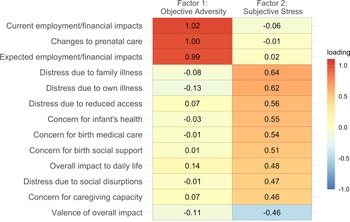
We compared models with one, two, and three factors (models with >3 factors did not converge). In order to maximize both model fit and interpretability (see online Supplementary Material), we selected a 2-factor solution for the 13 indicators of COVID-19 stress and adversity presented with their factor loadings in Fig. 2. The two factors were correlated at r = 0.41. The first factor, objective COVID-19 adversity, was defined by three items assessing extant or expected negative life events due to COVID-19, including the number of current changes in the participant's or the participant's partner's employment and finances (e.g. loss of job, loss of health insurance, reduced ability to afford childcare), the number of expected changes in employment and finances, and the number of current changes to the participant's prenatal care (e.g. changed from planned vaginal birth to induction or C-section, change in prenatal care providers, cancellation or reduction of prenatal care visits).
Factor loadings from exploratory factor analysis of pregnant women's reports of stress and adversity related to COVID-19. All items measured stress and adversity due to the pandemic.

The second factor, subjective COVID-19 stress, was defined by 10 items assessing affective responses to COVID-19. Items that loaded onto this factor included those assessing the severity of participants' concerns about the impact of COVID-19 on the social support and medical care they would receive during labor and delivery, their infant's health, and their capacity to care for their infant following birth. Items assessing the severity of participants' distress due to COVID-19 also loaded on this factor, including distress due to the possibility that they or their family would contract COVID-19, the potential for reduced access to resources (e.g. baby supplies, health care, social interactions) because of COVID-19, and distress due to current disruptions in social interactions because of COVID-19. Finally, participants' ratings of the overall impact of COVID-19 on their daily life and the valence of this impact loaded onto this subjective stress factor.
Aim 3: identify individual- and community-level risk and protective factors for COVID-19 stress and adversity in pregnant women
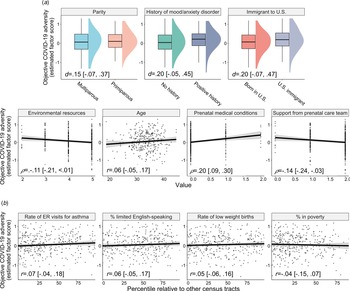
The EN model of objective COVID-19 adversity resulted in 11 variables with non-zero coefficients that explained 11% of the variance in estimated factors score for objective adversity. Based on zero-order effect size (see Fig. 3), women who were immigrants to the U.S. (Cohen's d = 0.20), had histories of a mood/anxiety disorders (d = 0.20), and had more prenatal medical complications (Spearman's ρ = 0.20) were higher in objective adversity. Although the associations were weaker in effect size, women who received greater support from their prenatal care team (ρ = −0.14) and had more environmental resources (ρ = −0.11) were lower in objective adversity.
Zero-order associations between risk and protective factors selected in elastic net regression of estimated factor scores for objective COVID-19 adversity. d = Cohen's standardized mean difference. ρ = Spearman's rank-order correlation. r = Pearson's correlation. Values within brackets are lower and upper bounds of 95% confidence intervals. (a) Individual-level factors associated with objective COVID-19 Adversity. (b) Community-level factors associated with Objective COVID-19 Adversity

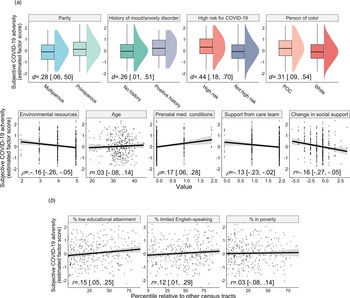
The EN model of estimated factors scores of subjective COVID-19 stress resulted in 12 variables with non-zero coefficients that explained 18% of the variance in subjective stress. Based on zero-order effect size (see Fig. 4), women who were at high risk for COVID-19 due to existing medical conditions (d = 0.44), were persons of color (d = 0.31), were primiparous (d = 0.28), had histories of a mood/anxiety disorder (d = 0.26), resided in census tracts that were higher relative to other tracts in the percent of the population with less than a high school education (Pearson's r = 0.15), and resided in census tracts where a greater percent of the population was limited English-speaking were higher in subjective stress (r = 0.12). In contrast, women with more environmental resources (ρ = −0.16), who received greater support from their prenatal care team (ρ = −0.13), and who experienced less deterioration or greater improvement in social support from prior to during the pandemic (ρ = −0.16) were lower in subjective stress.
Zero-order associations between risk and protective factors selected in elastic net regression of estimated factor scores for subjective COVID-19 stress. d = Cohen's standardized mean difference. ρ = Spearman's rank-order correlation. r = Pearson's correlation. Values within brackets are lower and upper bounds of 95% confidence intervals. (a) Individual-level factors associated with Subjective Covid-19 stress (b) Community-level factors associated with Subjective covid-19 Adversity

See online Supplementary Material for EN coefficient estimates for each model.
Aim 4: examine the associations of dimensions of COVID-19 stress and adversity with prenatal depressive symptoms during the COVID-19 pandemic
In the full sample of participants in the COVID-19 cohort and when covarying for scores of objective COVID-19 adversity, women who were higher in subjective COVID-19 stress had significantly higher prenatal depressive symptoms [β = 0.44, 95% CI (0.35–0.52), p < 0.001, R 2 = 0.17]. In contrast, although the zero-order association between objective COVID-19 adversity and prenatal depressive symptoms was statistically significant (Pearson's r = 0.24, p < 0.001), women's scores on this factor were not significantly associated with their symptoms when covarying for their subjective stress (β = 0.04, 95% CI −0.04 to 0.12, p = 0.356; see the online Supplementary Material for figures depicting these associations).
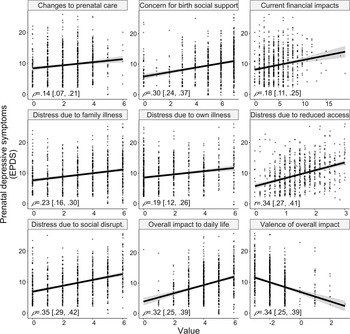
Finally, we sought to identify single indicators of COVID-19 stress and adversity that were most strongly associated with prenatal depressive symptoms. Given that factor scores are difficult to interpret, identifying single indicators may help in translating our findings to clinical settings. The EN model of the associations between single indicators of COVID-19 stress and adversity and depressive symptoms resulted in 9 variables with non-zero coefficients. We present plots for zero-order associations between each of these variables and prenatal depressive symptoms in Fig. 5 (see online Supplementary Material for EN estimates). In order of effect size, women had higher depressive symptoms when they were more distressed about disruptions to their social interactions (Spearman's ρ = .35), were more distressed about reduced access to resources (r = 0.34), rated the pandemic as having a more negative overall impact on their daily life (ρ = 0.34), rated the pandemic as having a greater overall impact on their daily life (ρ = 0.32), were more concerned about the social support they would receive during labor and delivery (ρ = 0.30), were more distressed about the possibility that a family member would contract COVID-19 (ρ = 0.23), were more distressed about the possibility that they would contract COVID-19 (ρ = 0.19), experienced more impacts to their employment and finances (ρ = 0.18), and experienced more changes to their prenatal care (ρ = 0.14).
Zero-order associations between single indicators of COVID-19 stress and adversity selected in elastic net regression of prenatal depressive symptoms. ρ = Spearman's rank-order correlation. r = Pearson's correlation. Values within brackets are lower and upper bounds of 95% confidence intervals.

Discussion
In this study, we examined pregnant women's experiences of the COVID-19 pandemic, including their exposure to stress and adversity and their concurrent depressive symptoms. Among the 725 women that we surveyed, over 40% reported symptoms indicating possible depression. Moreover, compared to a matched sample of women who were pregnant prior to the pandemic, women who were pregnant during the pandemic were almost twice as likely to have possible depression. Pregnant women's experiences related to COVID-19 fell along the two dimensions of objective COVID-19 adversity and subjective COVID-19 stress. Experiences of objective adversity included those that are common to the general population (e.g. changes to finances and employment) and those that specifically affect pregnant women (e.g. changes to prenatal care). Similarly, subjective stress involved women's fears that they or their family would contract the virus, as well as concerns about the support they would receive during labor and delivery. Women who were immigrants to the U.S., who had a history of a mood or anxiety disorder, and who had prenatal medical conditions reported greater objective adversity due to COVID-19. Women who identified as persons of color, had medical conditions that increased risk of contracting COVID-19, and lived in communities with less education and more linguistic isolation also reported more severe subjective stress. Beyond their experiences of objective adversity due to the pandemic, women who experienced more severe subjective stress related to COVID-19 had significantly higher depressive symptoms.
Findings of this study replicate and extend those of other recent studies of depression among pregnant and postpartum women in different regions of North America during the months following the onset of the COVID-19 pandemic (Cameron et al., Reference Cameron, Joyce, Delaquis, Reynolds, Protudjer and Roos2020; Davenport et al., Reference Davenport, Meyer, Meah, Strynadka and Khurana2020; Lebel et al., Reference Lebel, MacKinnon, Bagshawe, Tomfohr-Madsen and Giesbrecht2020; Morris et al., Reference Morris, Traube, Lakshmanan, West and Saxbe2020; Thayer & Gildner, Reference Thayer and Gildner2020). Taken together, these data suggest that the onset of the pandemic led to increased depressive symptoms among pregnant women. Although, based on this cross-sectional analysis, we do not know whether heightened prenatal depressive symptoms in the early months of the pandemic persisted, longitudinal data collected in Sweden indicate nonlinear changes in prenatal depressive symptoms across the pandemic, with pregnant women's symptoms peaking in April 2020 and again in October 2020 (Fransson et al., Reference Fransson, Karalexi, Kimmel, Bränn, Kollia, van Zoest and Skalkidou2020).
The transition to parenthood is a ‘critical window for adult health’ (Saxbe et al., Reference Saxbe, Goldenberg and Rossin-Slater2018). Given striking biological plasticity in the prenatal period, elevations in depressive symptoms in pregnancy, even when temporary, may have lasting effects on maternal–child health. Depression in pregnancy is associated with disruptions of pro- and anti-inflammatory markers (Edvinsson et al., Reference Edvinsson, Bränn, Hellgren, Freyhult, White, Kamali-Moghaddam and Sundström-Poromaa2017; Gustafsson et al., Reference Gustafsson, Sullivan, Nousen, Sullivan, Huang, Rincon and Loftis2018; Osborne et al., Reference Osborne, Biaggi, Chua, Du Preez, Hazelgrove, Nikkheslat and Pariante2018). In turn, maternal inflammatory markers are linked to subsequent infant stress responses, negative affect, and brain structure (Gustafsson et al., Reference Gustafsson, Sullivan, Nousen, Sullivan, Huang, Rincon and Loftis2018; Osborne et al., Reference Osborne, Biaggi, Chua, Du Preez, Hazelgrove, Nikkheslat and Pariante2018; Rasmussen et al., Reference Rasmussen, Graham, Entringer, Gilmore, Styner, Fair and Buss2019). Women who experience prenatal depression are more likely to cease exclusive breastfeeding earlier in the postpartum period (Figueiredo, Canário, & Field, Reference Figueiredo, Canário and Field2014) and to report poorer bonding with their infants (Rossen et al., Reference Rossen, Hutchinson, Wilson, Burns, A Olsson, Allsop and Mattick2016). Because elevations in prenatal depressive symptoms may have enduring consequences for maternal–child health, policymakers and clinicians should consider measures to support women who were pregnant during this pandemic even if their depressive symptoms have since remitted.
Our finding that subjective COVID-19 stress, beyond objective COVID-19 adversity, was strongly associated with prenatal depressive symptoms is consistent with the results of studies conducted outside the context of the pandemic that have distinguished between the impacts of objective exposure and subjective stress on risk for psychopathology. For example, subjective reports, rather than objective measures, explain risk for psychopathology following childhood maltreatment (Danese & Widom, Reference Danese and Widom2020), and perceived socioeconomic standing is more strongly associated with subjective wellbeing than is objectively measured income and education (Tan, Kraus, Carpenter, & Adler, Reference Tan, Kraus, Carpenter and Adler2020). Thus, in addition to policies that help to mitigate disruptions to the environment due to the pandemic, treatments that focus on cognitions about the self and the environment may help to alleviate depressive symptoms in pregnant women. Nonetheless, objective changes to the environment, including widespread societal disruptions due to COVID-19 and the real threats that this virus poses to maternal–child health, create the conditions for susceptible individuals to experience subjective stress (Harkness & Monroe, Reference Harkness and Monroe2016).
The COVID-19 pandemic has had an unequal impact in terms of transmission and mortality; members of our society who are medically sensitive or experience systemic discrimination are most at risk for contracting the virus and dying from it (Karaca-Mandic, Georgiou, & Sen, Reference Karaca-Mandic, Georgiou and Sen2020). Our findings suggest that women who were already experiencing challenges due to socioeconomic inequality and poor health are the most vulnerable to experiencing pandemic-related stress and adversity that is ancillary to becoming infected with the disease. These findings have important implications for the allocation of resources to support recovery from the pandemic. In addition to broad-based screenings to identify depression in pregnant women during the COVID-19 pandemic, medically sensitive women, women of color, and women who are immigrants may be most in need of treatment to assist in coping and recovery from the pandemic.
It is important to consider limitations of the current study. The study sample is representative of women with access to the internet who live in California. Few Black or Indigenous women participated and women tended to be highly educated. Although we matched women who were surveyed following the onset of the pandemic to women who were pregnant prior to the pandemic, these two groups of women might differ on variables that were not assessed. Whereas women in the COVID-19 cohort reported on their symptoms ‘during the last 7 days,’ women in the pre-pandemic cohort reported on their depressive symptoms ‘during pregnancy;’ however, it is not clear how this discrepancy would affect our findings given the lack of an association between depressive symptoms and gestational weeks (see online Supplementary Material). Based on our cross-sectional observational design, we cannot definitively conclude that the onset of the pandemic caused increases in women's depressive symptoms, nor can we speak to how women's experiences have changed as the pandemic has unfolded. However, the U.S. has remained among the highest risk countries for COVID-19 since March 2019; as of late December 2020, California had the highest daily case rate in the nation.
Overall, findings of the current study suggest that pregnant women experienced elevated depressive symptoms following California's ‘shelter-in-place’ measures initiated in response to the COVID-19 pandemic in March 2020. Beyond their experiences of financial hardship, disruptions to employment, and changes to their prenatal care, women's subjective stress responses, including the degree to which they felt distressed about the impact of the pandemic on their and their future infants' lives, were associated with their depressive symptoms. Prior to COVID-19, the U.S. already lagged behind other countries in its treatment of pregnant women, mothers, and infants. Among similarly developed countries, the U.S. has the highest maternal and child mortality rates (Gunja, Fitzgerald, & Zephyrin, Reference Gunja, Fitzgerald and Zephyrin2020; Thakrar, Forrest, Maltenfort, & Forrest, Reference Thakrar, Forrest, Maltenfort and Forrest2018) and is the only developed country without a paid family leave policy (U.S. Department of Labor, 2012). Given the possibility that increases in depressive symptoms during pregnancy affect maternal–child health, it is critical that research of pregnant women's experiences, including their subjective stress responses, continues even as policymakers consider essential support for pregnant and postpartum women during this period and beyond.
Supplementary material
The supplementary material for this article can be found at https://doi.org/10.1017/S003329172100132X
Acknowledgements
We thank Drs. Moriah Thomason, Michelle VanTiegham, Alice Graham and Elinor Sullivan for leading the development of the survey used in this project. We thank Vanessa Lopez for her assistance in survey programming and translation. We thank the participants for their contributions.
Author contributions
L.S. King performed the data analyses and wrote the manuscript. L.S. King and D.E. Feddoes developed the aims for the analyses. D.E. Feddoes collected the data. J.S. Kirshenbaum, Kathryn L. Humphreys, and Ian H. Gotlib provided critical revisions. The project was supervised by Ian H. Gotlib. All authors approved the final version of the manuscript for submission.
Financial support
Funding was provided by the National Institutes of Health (IHG, R21 MH111978; R21 HD090493; R37 MH101495); the National Science Foundation (JSK, Graduate Student Research Fellowship); and the Jacobs Foundation (KLH, Early Career Research Fellowship
2017-1261-05).
Conflict of interest
The authors have no conflicts of interest to report.