Introduction
Police assistance is an increasingly important aspect of foreign policy.Footnote 1 Police officers support their colleagues abroad through the delivery of training, mentoring, equipment, intelligence, and institutional reform. Police assistance holds benefits for donors over direct intervention, that is, executive policing whereby international police officers have arrest powers: assistance creates a smaller political footprint, reduces physical risks to foreign personnel, and promises sustainability by building local ownership. However, little is known about the concrete practices of donor police forces and the underlying causes. This article argues that an organisational approach is vital for explaining why donors often differ in their assistance practices.
The first part of the article underlines the relevance of police assistance. It also outlines the research gap and discusses the use of force by police, distinguishing between civilian and militarised policing. The second part examines three potential explanations of police assistance representing, respectively, a realist domestic rational actor model, a constructivist account of international norms, and mid-level theories on the use of force by democracies. None of these explanations can fully explain divergent police assistance practices.
In a third step, the article develops an organisational culture account of police assistance. Organisations are ‘rational’ only to some extent; their members are also biased with regard to the tasks and methods they regard as appropriate. Views on appropriate policing, and concomitant practices such as organisational routines, differ even among liberal democracies. A focus on organisations is a vital complement of the above-mentioned explanations.
The fourth part describes the organisational cultures of two centralised police forces of Western liberal democracies: the German Federal Police and the Italian Carabinieri. It then shows that the former tried to gear the Afghan police towards civilian and the latter towards militarised policing. The fifth part discusses the shortcomings of realist, constructivist, and mid-level theories for explaining police assistance in Afghanistan. These two empirical parts are based on secondary literature and governmental and police documents. They also draw on interviews with officials in Europe, and on interviews and non-participant observation of police training conducted during five trips to Afghanistan, from 2009–13.
The conclusion argues that students of International Relations (IR) and security studies should pay more attention to security assistance, which requires taking a closer look at policy implementers. Moreover, the effects of security assistance on local populations deserve closer scrutiny.
Research on police assistance
States have been sending police abroad for centuries to reduce crime at home.Footnote 2 However, recent changes to international policing are staggering. For instance, the number of police officers deployed in United Nations (UN) missions has expanded, and so have their tasks. In Kosovo, Timor-Leste, and elsewhere, international police officers have even been given executive law enforcement powers. More often, though, police donors build the capacity of host state police. Many reform efforts focus on fragile states that struggle with providing basic security to their citizens.
Policing reflects specific configurations of state-society relations. It is a core element of political order, and police officers are among the most visible representatives of the government, or ‘street-level bureaucrats’.Footnote 3 By exporting specific police practices abroad, international actors thus potentially transform the order of recipient states and societies, and they impact local citizens. During the Cold War, many ‘train and equip’ programmes contributed to human rights violations.Footnote 4 Post-Cold War police assistance purports to protect human rights. However, donors continue to support police in many countries with dismal human rights records.
Given the practical relevance of police assistance, what do we know about the subject? During the Cold War, policing was a non-issue in IR and security studies, and political science more largely.Footnote 5 The increasing presence of police officers abroad after the Cold War spurred interest in policing, as did the blurring of traditional distinctions between external and internal security, war and peace, war and crime, and police and military roles. Students of IR and security studies have thus joined students of police studies, criminology, and sociology in the debate over international and transnational policing.Footnote 6 Even though this topic still tends to fall between disciplinary cracks, much attention has been paid to police reform in fragile states.
Yet, questions remain. Analyses that do zoom in on concrete assistance practices tend to focus on single donor police forces (in particular Anglo-Saxon ones), limiting generalisability. For instance, only one study examines police training syllabi in fragile states, with focus on a single donor, the United States (US).Footnote 7 Other studies offer conceptual analyses, showing that police-builders may have different foci, such as better human rights protection or better law enforcement.Footnote 8 But this does not tell us how different donors support their counterparts in fragile states, and why they do what they do.
To be sure, the export of divergent security practices, historically, is nothing new. Numerous studies reveal that states have promoted their own models abroad, before, during, and after the Cold War. Postcolonial African military forces represent the models of the militaries of former colonial powers.Footnote 9 The Afghan military has been shaped by foreign powers since the nineteenth century, starting with British and Indian advisers who were followed by Turkish, Soviet, and, after 9/11, US advisors.Footnote 10 Police practices, too, have been diffused abroad. The police of Northern Ireland supported their colleagues in fragile states, and in so doing drew on their own experience during the Troubles.Footnote 11 The US Drug Enforcement Administration exported its own drug control practices around the world.Footnote 12
Analyses of such diffusion processes by historians, political scientists, and area experts enrich our understanding of security assistance. But divergent assistance practices in contemporary multilateral police reform missions beg questions. In such missions, many donors work side by side, and they face the same security situations, are exposed to international norms, and represent liberal democracies. Such interventions thus differ from historical cases of intervention, or from missions dominated by one donor.
Moreover, sociological institutionalists have noted how global cultural principles such as the growing role of individuals, who in contrast to older organisational forms of the state and firms are not mere automatons, have make organisations increasingly alike. Organisations, in the words of John Meyer, Gili Drori, and Hokyu Hwang, ‘incorporate world standards’.Footnote 13 The diffusion of global standards indeed affects police agencies. European and US police agencies have learned from one another for centuries, adopting, for example, new forensic methods.Footnote 14 Human rights concerns after the Cold War have accelerated a convergence in police practices. However, as noted below, differences in police models remain and police assistance practices vary, more than could be expected from a sociological institutionalist perspective.
But what is policing and, more narrowly, police assistance? This article examines one aspect of police work: the use of force. Writings on peace operations offer insights into varying levels of force.Footnote 15 Such levels can be assessed by looking at the number of opponents that police can deal with, and the harm police can inflict on opponents. Police officers that focus on tasks involving interaction with individual citizens and whose means are limited to handcuffs and batons practice civilian policing, for example. Police units that carry out tasks such as crowd and riot control (CRC) and counter-terrorism, and that hold weapons capable of inflicting significant harm move up on the scale of police militarisation. On the right upper extreme end of the militarisation continuum are units capable of fighting militarily-organised and equipped enemies and that hold weapons (such as rocket-propelled grenades [RPGs] or heavy machine guns) capable of killing groups of enemies (see Matrix 1).
Levels of police militarisation

Modern police agencies are not fixed to one point of the continuum. Even agencies with a civilian outlook comprise CRC units and Special Weapons and Tactics (SWAT) teams. Vice versa, even agencies with a militarised outlook may provide services to individual citizens. If there is a need for police to ratchet up and down levels of force in stable democracies, this is even more the case in fragile states where police carry out activities ranging from traffic control to fighting terrorists and insurgents. Still, the continuum above is of heuristic use. Some agencies – such as the Italian Carabinieri discussed below – cover the entire continuum. By contrast, others – such as the German Federal Police – do not carry out tasks and do not hold weapons characteristic for the military end of the continuum.
Donors promote their own, favourite policing practices in a variety of ways: by training street-level policing techniques; producing training curricula; training and mentoring senior police officers; changing police structures; and delivering equipment. This article focuses on how donors train street-level police forces in fragile states and produce training curricula. These are readily observable indicators for the attempted export of policing practices. Moreover, training is a crucial part of police assistance, not least because it allows donors to produce measurable output (such as the number of police officers trained).
Explaining police assistance
How can we explain the implementation of police assistance in fragile states? So far no attempt has been made to answer this question, neither in IR and security studies nor in police studies. From IR theory one can draw three potential explanations: a domestic rational actor model; a constructivist focus on international norms; and theories examining the use of force by democracies. This section shows that these approaches do not offer satisfactory explanations of police assistance.
A domestic rational actor model
From this vantage point, donor states tailor their police assistance to real-world problems, thus maximising their own utility. Such a rational actor model is often associated with realism. Realists thus argue that external threats explain foreign policy choices such as the adoption of offensive or defensive military doctrines.Footnote 16
A main factor that presumably influences police assistance is the security situation. One would expect donors to promote militarised policing in countries experiencing insurgency, and to acquire capabilities that would allow them to pursue tasks and employ methods characteristic of militarised policing.
A rational donor state would, furthermore, want to take into account the preferences of host state governments. Investing into programmess for which there is no local buy-in would increase the risk of squandering money. For example, promoting civilian policing is difficult when a host state government favours militarised policing. Moreover, in case of a clash of interests between a donor and a host state, the latter may exert its sovereign right to decide which police practices to pursue.
Utility considerations can also be expected to impact policing mandates. Donors negotiate mandates for multinational police assistance missions with their partner nations that suit their own interests, such as the pursuit of specific policing styles.
However, a rational domestic actor model has explanatory shortcomings. Most importantly, the correlation between police assistance and security situations is spurious. Donors at times promote civilian policing in armed conflict; in Afghanistan, some governments funded community policing in districts with a strong insurgent presence.Footnote 17 The opposite is the case as well: in relatively stable postwar Kosovo and Bosnia-Herzegovina, some donors promoted militarised policing.Footnote 18 This is not least a consequence of the fact that different policing models can be rational. William Stanley’s analysis of the military in El Salvador reveals the shortcomings of a domestic rational actor model, or what he calls ‘domestic realism’. He demonstrates that the realist assumption, according to which states use violence rationally to respond to opposition, clashes with the fact that ‘much of the internal violence by states in Latin America has been unnecessary, counterproductive, and grossly out of proportion to the actual challenge to the state’s authority’.Footnote 19 To understand such policies, one has to disaggregate the state into its various agencies (and even factions benefitting from specific strategies). Organisational theorists stress the possibility of multiple equilibria, arguing that ‘elements of indeterminacy in action make organizational decisions impossible to predict simply from a knowledge of “objective” constraints’.Footnote 20
Both civilian and militarised policing can be defended as the most promising approach for stabilising fragile states and serving their citizens. For many, police militarisation is equivalent to disproportionate force.Footnote 21 Also, in postwar countries where paramilitary police have violated human rights, internationally-driven police militarisation may send the wrong signals to victims. On the other hand, only robust police forces can prevent or fill public security gaps that bedevil so many fragile states; and such forces are not necessarily less accountable or more prone to violence than police that lack robust capabilities. Indeed, civilianising police may undermine instead of strengthen security in fragile states.Footnote 22 Many citizens of fragile states care little about civilian policing, instead demanding heavy-handed measures against criminals.Footnote 23
A rational actor model, moreover, has problems explaining the acquisition of capabilities. Organisations sometimes acquire or maintain capabilities that do not properly address existing security problems. The US government, during the Cold War, failed to prepare for the damage caused by nuclear firestorms because of organisational biases.Footnote 24
With regard to preferences of host states, police reformers are likely to prioritise the preferences of their domestic audiences. In the field of development aid, donors often neglect the interests of beneficiary states and their populations because they answer to their domestic parliaments and the public, instead of to beneficiaries.Footnote 25 A police agency is unlikely to do things that its own government does not tolerate, even if the recipient state wants these things. Furthermore, donors have the power of the purse, and may ignore local preferences that do not dovetail with their own policing standards. Many fragile states are extremely dependent on international support, especially when facing armed opposition.
Last, international mandates are rather vague, leaving donors options for implementing policy. One study shows that many UN police missions have a ‘community policing’ mandate, but that donors pursue divergent practices under this label, as the UN does not properly define community policing.Footnote 26 This failure is not surprising, giving that leading police scholars disagree over the meaning, as well as the pros and cons, of community policing.Footnote 27
A rational domestic actor model is not irrelevant. No sane donor would advocate tasking unarmed police officer to patrol the streets of insurgent-infiltrated towns; donors take into account the preferences of host state governments; and an international mandate focused on community policing would make it difficult for a donor to exclusively train recipient police in counter-terrorism. Nevertheless, a domestic rational actor model cannot predict and explain what police agencies do abroad, as police views on appropriate force are not simply a function of external circumstances.
A constructivist focus on international norms
Constructivists have paid much attention to international norms, including norms governing the use of force such as the ban on certain weapons and torture. Scholars also discuss transnational norms. For instance, Theo Farrell reveals how transnational military norms transform national militaries, defining such norms as ‘beliefs held by military officers, expressed and codified in military literature, reinforced in military education, and embodied in military practice about how militaries that aspire to be professional should organize themselves and act’.Footnote 28
Research on the diffusion of policing norms and practices is recent. Some authors argue that in response to globalisation, police forces have stepped up transnational cooperation, instigating an emerging culture of transnational policing.Footnote 29 A convergence in policing practices, Reiner states, has been facilitated by a ‘new international body of technocratic police experts who are responsible for the diffusion of fashions in police thinking around the globe’.Footnote 30 Transnational police networks share knowledge about police work, constituting professional communities of practice. Policing norms are diffused through mechanisms including liaison networks, personnel exchanges, foreign training and technical assistance programmes, joint operations, and intelligence sharing arrangements.
Norms and practices of police assistance have also begun to converge. Otwin Marenin sees the emergence of a transnational democratic policing regime that carries ‘notions of so-called good policing, or, more specifically, democratic policing […] across the globe’.Footnote 31 For David Bayley, democratic policing is based on four principles: police should respond to the needs of the local community, be subject to the rule of law, protect human rights, and act transparently.Footnote 32
However, international policing norms are not likely to be major drivers of specific police assistance because they lack robustness. Jeffrey Legro measures the robustness of norms by assessing their specificity (does a norm clearly distinguish between appropriate and inappropriate behaviour?), concordance (how many actors share the norm?), and durability (how long has the norm existed for?).Footnote 33 When norms are specific, supported by many states, and long-standing, they are likely to strongly influence state practices.
Several international organisations have issued documents that contain norms governing the use of force by police.Footnote 34 The UN Code of Conduct for Law Enforcement Officials of 1979 stipulates that ‘law enforcement officials may use force only when strictly necessary and to the extent required for the performance of their duty’. More recently, the UN developed doctrine for Formed Police Units (FPUs) and formulated standards for their training, equipment, and conduct in missions.Footnote 35 The Council of Europe’s European Code of Police Ethics outlines in Article 37 that the ‘police may use force only when strictly necessary and only to the extent required to obtain a legitimate objective’. The guidebook on democratic policing issued by the Organization for Security and Cooperation in Europe (OSCE) demands that the use of force by police ‘must be considered as an exceptional measure, which must not be executed arbitrarily, but must be proportionate to the threat, minimizing damage and injury, and used only to the extent required to achieve a legitimate objective’.
Yet, ‘necessity’, ‘legitimate objective’, or ‘proportionality’ remain undefined, allowing police officers on mission to conduct a variety of activities under labels including community policing, democratic policing, and civilian policing. Even when standards are defined, compliance often lags behind. Many national contingents deployed in UN missions fail to meet UN standards, as indicated by the practice of police officers from liberal democracies to train UN police officers from developing states and autocracies in mission areas.Footnote 36
If international policing norms are unspecific, transnational policing norms are diverse. Two different policing communities exist. A civilian policing community is composed of members of international organisations, civilian police officers, and police scholars. This community is keen to put a wedge between the police and military and to enhance equality within and accountability of the police. A parallel network with strong footing in military and gendarmerie forces stresses the advantages of robust policing. There is no evidence of conflict between these two networks; rather they work alongside each other, each stressing its own competitive advantages.Footnote 37
Several authors point at the fragility of international and transnational policing norms. Alice Hills sees ‘no evidence of a common policecraft, or of a set of norms capable of fulfilling this requirement’, concluding that ‘sub-state policing realities invariably outweigh the idealism and universalising tendencies of liberal commentators and organisations such as the UN’.Footnote 38 The EU, too, lacks definitions of police standards at the operational level.Footnote 39 Bayley bluntly writes that because ‘there is no agreement internationally about police doctrine, advisors teach what they know at home’.Footnote 40 One German officer with significant mission experience says that UN directives on the use of force (the police equivalent to military rules of engagement) are fuzzy, and that ‘everybody believes that their national model is the best’.Footnote 41
To be sure, international intervention has changed a lot since the Cold War, when democracies repeatedly condoned gross human rights violations by their allies. As David Lake shows, the theories upon which US statebuilding practices are based changed over time, with the creation of legitimate states and, in the wake of the fiasco in Iraq, the provision of security and services to the public informing statebuilding practices.Footnote 42 However, the range of normatively permissible action is broad, in statebuilding and, more specifically, police-building.
Theories on the use of force by democracies
A third set of explanations exists: theories that discuss the use of force by democracies. These are mid-level theories, attempting to explain specific aspects of foreign policy. Although diverse, they all zoom in on the domestic structures of democracies, both material and ideational, that influence the use of force (thus opening up the state that many rational choice analyses treat as a black box). Although studies applying these approaches focus on military affairs, they can be applied to police assistance.
The first approach takes regime type as a starting point. Works on the democratic peace posit a variety of mechanisms for explaining why mature democracies do not fight each other. Respect for liberal norms, such as the right to physical integrity, is considered one of the features distinguishing democracies from autocracies.Footnote 43 In addition to an inherent belief in the protection of individual rights, such protection is also seen as stemming from the institutional set-up of democracies. Authors show, for instance, that democratic institutions such as party competition reduce human rights violations.Footnote 44 These insights have implications for policing: police in democracies are likely to be discriminate and proportionate in the use of force. After all, statutory control bodies (such as parliaments, courts, and complaints boards), as well as non-statutory actors (such as NGOs and the media) put pressure on police to respect national and international law and enable accountability. From this one can presume that the police models of liberal democracies are similar, or at the least converging. Moreover, taking into account the normative transfer mechanism of democratic peace according to which democracies export their liberal values abroad, one might expect police forces of Western liberal democracies to export similar policing norms and practices abroad. Indeed, there is evidence that democracy influences policing. For instance, police forces of democracies have increasingly embraced non-coercive forms of protest policing.Footnote 45 Also, most of the post-Cold War police reform missions in fragile states were driven by democratic states and implemented by police forces of democracies.
Three other mid-level theoretical approaches may offer insights into police assistance. Works on constitutional arrangements study how domestic structure influences foreign policy. Foreign Policy Analysis (FPA) studies decision-making by political leaders, in particular the influence of psychological and ideational biases on decisions. Works on strategic culture (as well as on similar concepts such as political culture) show how norms and ideas held in particular by political elites influence that country’s foreign and security policy.
Such mid-level theories do not tell the whole story of police assistance, however. Theories looking at regime type do not capture variations in the domestic police models of democracies. Such variations pertain to police size (the ratio between citizens and police), levels of centralisation, levels of militarisation, and relations between the police and criminal justice agencies;Footnote 46 police structure, function, and legitimacy;Footnote 47 views on the appropriate use of force;Footnote 48 and training practices.Footnote 49 These findings of police scholars suggest that police forces have been much less affected by structural isomorphism than military forces. Initial evidence also suggests divergence in transnational police practices by democracies. As noted above, democracies have exported different military and police practices abroad. Authors examining executive policing in UN missions also point at idiosyncratic practices by international actors, including democracies.Footnote 50
With regard to the three other mid-level theories mentioned above, their focus on politicians is relevant, even in the field of policing; a police force does not exist in a vacuum. James Q. Wilson shows that local political culture influences the practices of police departments.Footnote 51 Theo Farrell argues that, in addition to international and transnational norms, national norms shape substate norms.Footnote 52 However, political preferences can better explain the making rather than the implementation of foreign policy. In their home precincts, police officers have to take decisions on the spot without first consulting with their superiors, and even less so with politicians (in fact, the latter may be illegal). Numerous studies stress the power of policy implementers. Graham Allison and Philip Zelikow, among others, argue that ‘decisions of government leaders trigger organizational routines. Government leaders can trim the edges of this output. … But most of the behaviour is determined by previously establishes procedures.’Footnote 53
If police officers have discretion at home, this is even more the case abroad, where issue salience is low. The autonomy of agents, such as police forces, vis-à-vis their principals, such as governments, diminishes where vital interests or lives are at stake. But police assistance does not directly affect the security of own citizens, usually involves low risks for police trainers, and is therefore unlikely to attract political or public attention. The lack of interest in international police missions is indicated by the fact that parliamentary control powers are weaker than in the case of military missions.
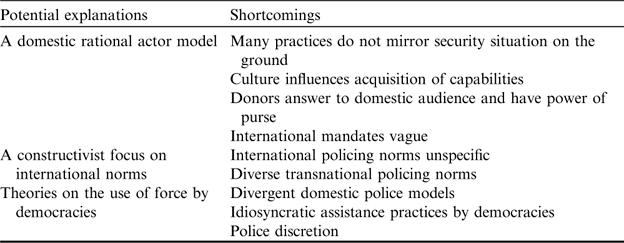
Hence, a variety of potential explanations have shortcomings in explaining how donor police forces support their counterparts in fragile states (see Table 1).
Potential explanations of police assistance
So how can police assistance be explained? The next section underlines the crucial role of donor police forces’ organisational cultures.
Organisational culture
Organisational culture, according to Legro, is a ‘pattern of assumptions, ideas, and beliefs that proscribe how a group should adapt to its external environment and manage its internal affairs’.Footnote 54 Many definitions of culture comprise practices. Police scholar Peter Manning, for instance, defines occupational culture as ‘accepted practices, rules, and principles of conduct that are situationally applied, and generalized rationales and beliefs’.Footnote 55 An organisational culture approach stresses that members of an organisation share views on organisational purposes, perceive the same problems, opt for specific problem-solving methods, and develop specific organisational routines.
Depending on which tasks they carry out and which methods they employ, police forces can be located at different points on the civilian-militarised policing continuum depicted above. Organisational culture shapes the selection of tasks and methods, and thus degrees of militarisation. As demonstrated below, military support tasks that the Italian Carabinieri, as a gendarmerie force, regard as appropriate are nowadays anathema for the German Federal Police; with regard to methods, the latter’s organisational culture biases it against the use of military-grade weapons.
Police organisations are thus not simply rational problem-solvers but biased in their choices. As other organisations, they ‘generate alternatives by relatively stable, sequential search processes. As a result, the menu of choice is severely limited and success is more likely to be defined simply as compliance with relevant rules.’Footnote 56 Organisational rules can trump international rules. Legro thus demonstrates that states’ compliance with norms of warfare varied in the Second World War, depending on the organisational cultures of military forces.Footnote 57 Organisational culture provides a context for specific practices.Footnote 58 In the case of police assistance, police forces’ organisational cultures translate governmental decisions to conduct police assistance into action on the ground.
Organisational cultures are institutionalised in various ways. Laws, police statutes, and doctrines are important indicators, prescribing, for instance, whether police can be placed under military command. Training and education is an expression of preferences for specific tasks and methods. Procurement decisions, such as the purchase of specific weapons, also reflect outlooks on appropriate policing. So do promotional practices; it matters, for example, if managers or warriors are promoted to the highest police ranks. In addition, to reveal the impact of organisational culture on police assistance, one can draw on statements by police officers in which they support specific practices and criticise alternative ones. Moreover, organisational culture is likely to be at work when donors conduct assistance in a way congruent with domestic policing practices even though the situation on the ground invites different approaches.
Organisational cultures are the product of various factors. Crucial are state-society relations more largely – as noted above, domestic norms shape organisational norms. Historical analyses of state formation show that relations between rulers and the ruled varied across European states, and that such variation shaped the characteristics of armed forces.Footnote 59 Idiosyncratic political, social, and economic conditions created organisational path dependencies that shape, to this day, the preferences of police forces for specific tasks and methods. For instance, in countries were rulers encountered armed domestic opposition to statebuilding, centralised and militarised police models emerged.Footnote 60
The organisational cultures of police forces, and more specifically varying levels of police militarisation, are thus institutional expressions of specific relationships between a government and its citizens. British policing (for example, the London Metropolitan Police ‘Peelers’) differs from continental European policing models, which, from the point of view of most Anglo-Saxon observers, served as ‘instruments of state control’.Footnote 61 Domestic police models have changed over the course of time, and changes have primarily played out on the local level and not as a consequence of global pressures.Footnote 62
It is important to note that donors cannot simply export their own police models abroad. One impediment is lack of time: it takes decades to build up a police force, and police assistance missions last several years at most. Another impediment is the small number of police trainers; for example, during the peak of their missions in Afghanistan in 2011, Germany deployed around 200, and Italy 150 police officers. Moreover, donors, to some extent, have to adapt to the context. In Afghanistan, the Germans were never able to implement their own civilian police model, not least due to the fact that Afghan police were involved in a war; neither were the Italians able to create an Afghan gendarmerie, as Afghan stakeholders were too fixated on military combat. Nevertheless, police agencies compromise only so much; they are not willing to sacrifice what Morton Halperin calls their ‘organizational essence’, that is, ‘the view held by the dominant group in the organization of what the missions and capabilities should be’.Footnote 63
Comparing police assistance
This section first analyses the organisational cultures of the German Federal Police and the Italian Carabinieri and, subsequently, how they have supported the Afghan police. These two donor forces have been chosen because both are centralised police agencies of liberal democracies, and because both were given non-executive, training mandates and faced the same security conditions in Afghanistan.
The German Federal Police
The organisational culture of the German Federal Police is centred on civilian policing. This culture developed incrementally. Following the Second World War, the Federal Republic of Germany (FRG) pushed the Western Allies to allow it to create a centralised police force. The government desired such a force in case of a communist insurgency, and to aid the Western Allies in repelling any cross-border attack by the Warsaw Pact. The Federal Border Police (Bundesgrenzschutz, BGS) was established in 1951, as a highly militarised force. Its task to participate in war was institutionalised in the German constitution (the Basic Law), the statutes of the Federal Border Police, and the status of members of the force (who had combatant status and carried military ranks); in training and education (which focused on military combat); the allocation of resources (military weapons dominated, including heavy machine guns and tanks); and promotional practices (many BGS leaders had served as soldiers in the Second World War).Footnote 64
During the second half of the Cold War, the role of the BGS as a light infantry diminished. A 1968 law allowing for the domestic deployment of the German military (the Bundeswehr) in case of armed opposition to the state reduced the need for a police role for this purpose; also, a communist insurrection was no longer likely. In 1972, BGS statutes were harmonised with those of the Länder police (in which most policing powers were and still are vested), leading to the introduction of civilian ranks. The BGS was now preoccupied with public order tasks (to cope with terrorism, a special unit within the BGS [the GSG9] was created in 1973).
The end of the Cold War accelerated and sealed the transformation of the BGS from a militarised to a civilian police force. A 1994 law abolished the combatant status of the BGS, and in 2005 the force was renamed to Federal Police. It comprises around 40,000 members (of which 30,000 are police officers) and operates under the authority of the Federal Ministry of Interior (MoI). Legal opinion generally regards the separation of police and military tasks a constitutional principle, and a lesson from the Third Reich when Hitler created a conglomerate of armed forces with overlapping competencies. The main consequence of this legal interpretation is that German police cannot be placed under military command.
With regard to training, by the time BGS officers were sent to Afghanistan in 2002, they no longer trained for military combat (with the exception of the GSG9). Yet in Afghanistan, officers needed certain skills, which where taught during a few weeks of pre-deployment training. Such skills included awareness of IEDs (improvised explosive devices) and firing the G36 assault rifle used by the Bundeswehr, for the purpose of self-defence. Such course elements caused unease among some officers, indicating the salience of the force’s civilian culture.Footnote 65 This culture is also institutionalised in the allocation of resources: while in 1992 around 80 per cent of BGS officers were part of formed units operating from barracks and only 20 per cent served in regular police stations, in 2013 the ratio for the Federal Police was the reverse.Footnote 66 In conducting tasks such as street-level patrolling, the remit of the BGS overlaps with that of the Länder police. So does the weaponry of the Federal Police. For instance, submachine guns are made to shoot single pistol rounds instead of bursts, in line with the civilian policing norm of preserving life. Last, combat prowess plays a marginal role for promotions within the Federal Police, in comparison to intellectual and management skills. The president of the Federal Police, in 2011, said: ‘The paramilitary tradition has disappeared from our self-understanding and from how other agencies perceive us.’Footnote 67
During the Cold War, the FRG occasionally sent small numbers of police abroad to train police from other countries bilaterally. In 1989, the FRG contributed, for the first time, police officers to a multinational mission, in Namibia. Numerous other missions followed, in which around a third of German police deployed were from the BGS/the Federal Police. In the Balkans, the force promoted its own practices.Footnote 68 The same was true in Afghanistan, where the Federal Police picked tasks and methods that were in line with its civilian culture.
The Federal Police in Afghanistan
In early 2002, Germany became lead nation for coordinating the reform of the Afghan National Police (ANP). The German MoI set up a bilateral, non-executive mission (which in June 2007 was renamed to German Police Project Team [GPPT]). This mission deployed initially small numbers of BGS and Länder police. During the first years after the fall of the Taliban, the focus was on the re-establishment of the Afghan National Police Academy in Kabul, where German police trained and mentored Afghan commissioned (Saran) and non-commissioned (Satanman) officers.
This focus on the higher ranks was not enough – trained street-level patrol police officers (Satoonkai) were needed, too. In 2003, the US Department of State began to train such officers, drawing on the private security company DynCorp. By 2005, insurgents had made a comeback. The Pentagon, regarding both the German and the State Department programmes as too slow and piecemeal, de facto took the lead over police assistance, tasking thousands of US soldiers with training the ANP. The Pentagon also dominated the structural reform of the ANP, through the Combined Security Transition Command – Afghanistan (CSTC-A), which was part of the US-led Operation Enduring Freedom (OEF) and, as of 2010, operated under the umbrella of the NATO Training Mission – Afghanistan (NTM-A). To implement reforms within the Afghan MoI, dozens of active US military officers and contractors mentored the Afghan interior minister and other senior officials; plus, US mentors worked within the provinces and districts. The Pentagon’s influence and its focus on counterinsurgency (COIN) showed in ANP training curricula, which were dominated by combat tasks and methods, taught in courses lasting only a few weeks; training in human rights, community policing, and domestic violence took a back seat.Footnote 69
In response to US pressure to produce more trained police, the GPPT began to train regular Afghan police officers at Police Training Centers (PTC) located near the northern Afghan cities of Mazar-e Sharif (province Balkh), Kunduz (province Kunduz), and Faisabad (province Badakshan). The German MoI also increased funding and the number of personnel, allowing the deployment of up to 200 staff to the GPPT and up to 60 staff to the European Union Police Mission (EUPOL). Around 40 per cent of German police officers serving in Afghanistan were from the Federal Police.Footnote 70
Yet although the US, providing around 90 per cent of funding and personnel to police assistance in Afghanistan, enjoyed hegemony in this organisational field, smaller donors such as Germany had some leverage. Curricula were developed and certified by the Police Development Board (PDB), which brought together the Afghan MoI, NTM-A, EUPOL, and the GPPT. At meetings, Pentagon efforts to turn the ANP into a light infantry were generally endorsed by the Afghan police leadership, which was dominated by persons with military backgrounds keen, for example, on marching drills. But the GPPT tried to salvage civilian policing. For instance, it promoted the inclusion of more civilian policing skills in a new standard curriculum for patrolmen, the Initial Police Training Course (IPTC), which NTM-A and EUPOL approved in March 2011 and subsequently distributed across Afghanistan.Footnote 71
The GPPT was unable to first prevent and later reverse the slide towards militarised policing. Given the preferences of the Afghan government and the Pentagon for police militarisation, German police were often limited to not participating in some activities. The GPPT thus avoided teaching military skills as well as ANP units serving as COIN force multipliers. These were the gendarmerie-like Afghan National Civil Order Police (ANCOP); special counter-terrorism and counter-narcotics units; and the Afghan Border Police (ABD) (GPPT support to the latter was limited to non-controversial measures such as the training of dogs). These forces, a Federal Police officer said, echoing a consensus within the GPPT, ‘blurred the distinction between police and military’.Footnote 72 The US, time and again, put pressure on the German MoI and the GPPT to contribute more directly to the war. It asked the GPPT, for example, to train the ABD in the use of rocket-propelled grenades (RPGs).Footnote 73 But the GPPT did not teach the use of this weapon and of machine guns.
The GPPT, instead, focused on the regular police, that is, the Afghan Uniformed Civilian Police (AUCP) (switching to train-the-trainer programmes over time), as well as the criminal investigation department (CID). The AUCP constituted the largest pillar of the Afghan police and, according to Afghan police doctrine developed under international, including German auspices, was to not to be involved in offensive COIN operations.Footnote 74 The head of the GPPT who was also the deputy head of the Federal Police said: ‘We only train civilian police.’ From time to time the Afghan MoI would send ANCOP police officers but the GPPT would refuse to train them.Footnote 75
Another factor made police training palpable for the Germans: curricula were not straightjackets; trainers had interpretative space. While German police taught the ANP, for instance, how to search for weapons at checkpoints, they did not teach them how to hold a position against insurgents. A main concern of German police was disproportionate force by the ANP. Therefore, they mainstreamed human rights into training activities (teaching the ANP, for instance, not to close handcuffs too tightly and to give food and water to detainees).
The situation in Afghanistan forced the GPPT to adapt. The brief duration of the basic training course left too little time for teaching skills in areas such as law and criminal investigation. Moreover, Afghan police recruits on average had low levels of education. Afghanistan has one of the lowest literacy levels in the world, and most police recruits could not read and write, and therefore not carry out basic tasks such as documenting vehicle plate numbers. German police officers also acknowledged that the ANP had to be able to defend itself against insurgent and criminal attacks (casualty figures were staggering – in summer 2013, around 75 ANP officers were killed per week).Footnote 76 Yet, while US and Italian militarisation practices found tacit support among some German police officers, there was consensus across the ranks that the GPPT should not contribute to militarisation. Moreover, the GPPT believed that civilian policing skills were needed even in Afghanistan. This view is in line with counterinsurgency theorists such as David Kilcullen who argue that the presence of civilian police protecting population centres and delivering the rule of law is a vital element of counterinsurgency policing (although best COIN practices were unknown to German police, revealing their civilian culture).Footnote 77
This culture also affected the choice of police weapons. German police taught the ANP how to use, in addition to pistols, the Kalashnikov, as this was the weapon of choice in Afghanistan. Initially, German police had wanted to replace Kalashnikovs by pistols.Footnote 78 Once the futility of such proposals had sunk in, Federal (as well as Länder) police officers had to familiarise themselves with the AK47. Many officers regarded the weapon as violating a cultural taboo, with one officer saying: ‘We as police do not use military weapons.’Footnote 79
Furthermore, its civilian culture limited the geographical reach of German police. In northern Afghanistan, only few officers ever left the fortified military camps and training centres. Those who did had to observe strict security rules. German police did not participate in embedded partnering, whereby police trainers and mentors live, and if necessary fight, with their local counterparts. Also, with the exception of Mazar-e Sharif, the GPPT did not enter key terrain districts, that is, districts identified by the Pentagon as the focus of COIN. The GPPT therefore did not train the ANP outside the wire in the embattled Kunduz province. Each day, GPPT leaders in the Provincial Reconstruction Team (PRT) fortress outside Kunduz city decided whether the security situation allowed GPPT members to drive the few hundred meters from the PRT to the PTC; sometimes, the police officers had to stay at the PRT.Footnote 80
Differences between the Federal Police and Länder police were marginal: officers would wear different symbols on their uniforms, and the Federal Police was slightly more concerned about formalities such as correct dress. But with regard to views on appropriate police tasks and methods, organisational cultures were the same. While preferences for specific tasks and methods varied within the GPPT, such differences reflected unit rather than organisational membership: for example, members of Länder SWAT teams were keener than Federal Police officers with desk jobs back home to train the ANP in tactical skills.Footnote 81 Federal Police officers with a martial attitude and appearance risked ridicule by their colleagues, as happened to one Federal Police officer (and former soldier), despite his senior rank.Footnote 82
If Federal Police officers in Afghanistan wanted to promote civilian policing despite the growing insecurity and pressure from its allies to contribute to police militarisation, this was even more the case for police leaders back home. The Federal Police officially stated that it supported ‘the establishment of a civilian police in Afghanistan respecting the rule of law’.Footnote 83 Federal Police officers coordinating the Afghanistan mission within the MoI underlined that ‘we are not soldiers’, and that ‘we as civilian police are a role model for the ANP and must pursue a human rights approach’.Footnote 84
The Italian Carabinieri
Italy’s Arma dei Carabinieri force has a gendarmerie culture. The remit of gendarmerie forces varies across countries and continents, but most gendarmeries are police forces with military status. With regard to the use of force, gendarmeries operate on all points along the continuum depicted further above, routinely carrying out tasks and employing methods that place them on the civilian and military ends of the continuum, and in between.
In the Italian case, such versatility has a long history. The Carabinieri was created in 1814 as the police of the Kingdom of Sardinia, modelled after the French Gendarmerie Nationale. It fought during Italy’s unification in the nineteenth century, backed up the regular army during the First World War, and was used by Benito Mussolini to bolster his regime domestically and to secure colonies. In the Second World War, the Carabinieri participated in combat, with many, during the latter phases of the war, also fighting against Italian and German fascism.Footnote 85
During the Cold War, the Carabinieri hardly operated abroad, as Italy’s fascist past and the strength of leftist parties militated against international missions. The force’s domestic tasks included the fight against left-wing terrorists and organised crime groups. After the Cold War, the Carabinieri, comprising around 100,000 members, continued to conduct a variety of tasks. On the military end, Carabinieri support the regular armed forces as military police and – in the case of paratroopers of the 1st Carabinieri Regiment Tuscania – as a specialised combat force. On the policing side, Carabinieri are present across Italy, undertaking tasks ranging from counter-crime and counter-terrorism operations to crowd and riot control, criminal investigation, and street-level policing. In southern Italy, Carabinieri operations against organised crime groups at times resembled low-intensity conflict.
The gendarmerie culture is institutionalised in the Carabinieri’s legal foundation, training, and allocation of resources. They are a police force with military status (in 2001, they became one of Italy’s four military forces), and members have military ranks. Officer cadets receive the same two-year military training, under the auspices of the Ministry of Defence, as regular military officer cadets; the ranks are recruited from the Italian army. Following their military training, Carabinieri are taught policing skills. This socialisation forges a hybrid organisational identity, with Carabinieri regarding themselves as both soldiers and police officers.Footnote 86 Depending on their specialised function, Carabinieri have access to weapons and armoury ranging from automatic rifles and armoured personnel carriers to pistols, batons, and tear gas.
In the 1990s, Italy increased its participation in international missions. Deploying the Carabinieri allowed the government to enhance Italy’s international standing at relatively low financial and political cost (most missions were conducted by three regiments comprising the 2nd Mobile Brigade.) In various postconflict and conflict countries, the Carabinieri protected critical infrastructure; conducted CRC as part of executive military and police missions, as well as close protection and surveillance; trained domestic police forces in all these tasks; and supported the regular Italian armed forces.Footnote 87
Being able to operate along a spectrum ranging from civilian police to light infantry gives the Carabinieri a competitive edge in filling public security gaps in fragile states, for which the regular military is too blunt an instrument and for which civilian police are not sufficiently robust. The Carabinieri draw on their skills not only in missions with an executive mandate but also in police-building, exporting gendarmerie skills to trainees in various fragile states.
The Carabinieri in Afghanistan
The Carabinieri served in various roles in Afghanistan. Some were military, such as military policing and contributions to the US-led OEF mission by Carabinieri paratroopers. The force’s main task, however, was to train the ANP. The Carabinieri began to offer specialised training (in close protection) in late 2001. The main training programme began in 2008. The US, in early 2008, had pressurised Italy to deploy Carabinieri to train and mentor the ANP. For US diplomats, the Carabinieri had the ‘mission-critical skills’ to contribute to the US COIN plan.Footnote 88 Italy agreed to send sixty Carabinieri to train ANCOP in the Western province of Herat, where Italy led a PRT. The Carabinieri initially contributed to CSTC-A’s Focused District Development Programme (FDD), in the framework of a bilateral agreement between the US and Italy. Subsequently, they operated as part of the ISAF mission.
The initial training began in September 2008 in Adraskan in Herat province. By the time that programme ended in October 2012, the Carabinieri had trained more than 11,000 ANP in over ninety courses.Footnote 89 The US held the programme in high esteem, with US General David Petraeus calling the Carabinieri ‘the Michael Jordan of police trainers’.Footnote 90 US diplomats, though, complained that the Italian defence budget was too small and that Italy did not send enough troops to Afghanistan, stating that ‘sending the Carabinieri has by now become a convenient and cheap way to respond to the international community’s call for more resources’. In response to US pressure to increase its role in Afghanistan, the Italian Ministry of Foreign Affairs, in April 2009, offered to send more Carabinieri trainers to Afghanistan.
Thus, the initial training programme in Adraskan was complemented by two more programmes: in the Regional Training Center near Camp Arena, also in Herat province, the Carabinieri (from December 2009 to October 2012) trained around 4,000 ANP in thirty courses. In the Central Training Center in Kabul, the Carabinieri (from December 2009 to June 2013) trained over 7,000 ANP in forty courses. Training at the latter site took place under the command of the Combined Training Advisory Group Police (CTAG-P), which was part of NTM-A.Footnote 91 The Carabinieri training programme in Afghanistan ended in summer 2013.
The Carabinieri focused on training ANCOP. In comparison to the regular ANP, ANCOP was an elite force. Around 5,000 strong, and recruited and deployed nationally, training lasted 16 weeks. During the FDD programme, lasting until 2011, ANCOP was backfilling regular ANP units withdrawn for training. More importantly, ANCOP was tasked to hold districts that the military had cleared of insurgents,Footnote 92 and even to participate in offensive operations. By 2011, around 130 Carabinieri were training ANCOP.Footnote 93
While most training took place within fortified camps, some Carabinieri mentored and partnered with the ANP in Herat province on brigade level, as part of POMLTs (Police Operational Mentoring and Liaison Teams) and, later Police Advisory Teams (PAT) and Mentoring Advisory Team (MAT). Carabinieri mentors, escorted by Carabinieri paratroopers, often left camp. According to one officer: ‘Since we are part of the military, there are no significant restrictions even when risks are involved.’Footnote 94 Attacks did not reduce their appetite for risky tasks.Footnote 95
In supporting ANCOP, the Carabinieri (as well as the French Gendarmerie Nationale) tried to create a force resembling a European gendarmerie. They were convinced that the gendarmerie model was the best fit for the Afghan police. In this view they were supported by the Pentagon, which regarded the Carabinieri as possessing skills that neither regular soldiers nor civilian police such as the Germans had. Already in the Balkans, the US had brought in the Carabinieri, as the latter’s organisational culture and concomitant practices seemed most suitable for filling police-military grey zones.Footnote 96
The Carabinieri divided the training into three parts, which together represented practices that the Carabinieri had carried out at home and abroad and were now reflexively replicating in Afghanistan. In the first part, ANCOP recruits learned about basic tactical movement and the Afghan penal code. In the second part they were taught more advanced skills such as complex movements, body searches, and checkpoint techniques. Last, recruits learned specialised skills, such as how small teams should move in high-threat areas (the Brick concept developed by the British Army). Combat skills figured prominently in all of this. The Carabinieri taught ANCOP skills that included firing weapons while in motion, walking in military formation, securing areas, responding to demonstrations turning lethal, searching for IEDs, and evacuating casualties.Footnote 97 Concomitant with these tasks, the Carabinieri taught not only the use of standard police weapons and equipment such as pistols and handcuffs but also the use of weapons including heavy machine guns and RPGs.
As in the German case, the Italians were unable to simply export their own model. Ironically, while for the Germans the Carabinieri were too militarised, the Carabinieri would have liked to put more emphasis on skills such as crowd management, yet were prevented from doing so because the ANP leadership, most of them former Mujahideen, asked Italy to produce fighters.Footnote 98 For instance, ANCOP leaders were keen to acquire artillery.Footnote 99 But in contrast to the Germans, the organisational culture of the Italians allowed for training focused on combat skills and for the enactment of a martial identity. Criticising how employees of DynCorp (most of them retired police officers) had trained ANCOP, one commissioned Carabinieri officer said: ‘We are soldiers. Civilian police officers are not needed in a war zone.’ He complained, among others, that DynCorp, with its ‘civilian mentality’, had not taught ANCOP how to shoot while wearing body armour.Footnote 100
Consequently, the Carabinieri had no qualms about including combat skills in ANCOP’s main training course, as well as in specialised courses on, among others, ‘individual combat training’, ‘foot patrols’, and ‘The Brick’. Curricula were replete with martial terms including enemy, operators, shooting sectors, camouflage, contact, combat movement, and tactical military terms such as ‘leopard step’, ‘monkey step’, and ‘ghost step’.Footnote 101 According to one officer: ‘We, together with the French, have shaped the mind-set of ANCOP.’Footnote 102 The Carabinieri even tried to shape the development of non-ANCOP curricula. In doing so, their understanding of appropriate police tasks and methods sometimes clashed with the one of the GPPT. For instance, the latter took the lead in developing an NCO trainers’ guide. When the GPPT presented a draft in Kabul in April 2011, Carabinieri officers objected that machine gun training was not included in the curriculum.Footnote 103
Shortcomings of alternative explanations
The discussion above demonstrates that police assistance of the German Federal Police and the Italian Carabinieri in Afghanistan were congruent with these two forces’ organisational cultures. The salience of culture was, furthermore, underlined by police officers presenting specific tasks and methods as appropriate and criticising alternative practices.
Moreover, the potential explanations outlined further above have shortcomings. The factors stressed by a rational actor model, a constructivist account, and mid-level theories narrow the range of options available to German and Italian police officers in Afghanistan, but do not determine concrete practices. Without taking into account organisational culture, explanations of these practices remain incomplete.
A rational domestic actor model is challenged by the civilian policing approach of the German Federal Police. Despite a growing insurgency and the preferences of the US and the Afghan government for police militarisation, the German Federal Police did not, in contrast to the Italians, attempt to turn the ANP into a light infantry. Those compromises that the Germans could not avoid, such as teaching the use of the Kalashnikov, they made reluctantly. German Federal Police officers did not want to appear to be like soldiers. There were no demands for heavier weapons, and many felt ambivalent about a heavier force structure, whether when travelling in the Eagle, a heavy police vehicle delivered in 2011 to protect against IEDs, or when accompanied by armoured vehicles of the German military. One officer said: ‘I cannot perform effective police work when I’m sitting in an armoured vehicle.’Footnote 104
One might consider the Carabinieri’s activities as supporting a realist perspective. To be sure, their combat focus balanced against the violence of insurgents. However, this focus was not so much a rational choice but a reflexive replication of organisational routines – as was the German focus on civilian policing. Also, while the Italians received much praise and the Germans much criticism from the US and the Afghan government, their martial approach was no panacea to the growing violence and crime. It did not address the ANP’s weakness in fields other than combat, such as criminal investigation. The focus on combat was not purely ‘rational’ for other reasons as well. Oversight and accountability of security forces in Afghanistan was weak, and enhancing their ability to use more force risked undermining human rights, which in turn played into the hands of insurgents keen to portray the Afghan state and its international backers as illegitimate. Indeed, the UN reported cases of human rights abuses by ANCOP.Footnote 105
Neither can police assistance practices be predicted by studying international mandates. Two agreements from 15 March 2002, amended in 2006, provided the legal basis for the presence of German police officers in Afghanistan and their activities. These agreements were precise on some points, for example, banning German police from exporting weapons and ammunition. But the agreements were vague on the type of training offered. German police were to offer ‘advice to the Afghan security agencies in how to lead an Afghan police dedicated to principles of the rule of law and respect for human rights, and support the training of Afghan police officers’.Footnote 106 The Carabinieri, too, had interpretative space. NATO stipulated that the NTM-A mission (under which the Carabinieri trained the ANP in Kabul) would reform the ANP ‘at the district level and below to increase operational capabilities and survivability. The ANP needs more robust training and mentoring, as well as equipment.’Footnote 107 But NATO did not define terms such as robustness.
A constructivist account has shortcomings, too. None of the police trainers interviewed referred to international policing norms, only to national police cultures, their historical origins, and domestic best practices. To be sure, the training provided and curricula developed in Afghanistan did not violate the international policing instruments mentioned further above. But the norms enshrined in these instruments are so unspecific that neither Germany nor Italy, even though their practices differed markedly, violated these norms.
Last, mid-level theories on the use of force do not offer satisfactory explanations. These theories privilege policymakers over policy implementers. Yet, the latter had much leverage over police assistance in Afghanistan. In both Germany and Italy, political (and public) interest was focused on the military role in Afghanistan. The German Bundestag discussed the German police programme for the first time in November 2007. Moreover, GPPT officers, in 2008, said that the MoI in Berlin did not have a strategy for German police assistance in Afghanistan, and that there was not enough communication between ministry officials and police officers in Afghanistan.Footnote 108 This gave officers discretion on the ground. To be sure, German politicians and (non-police) ministry officials showed little interest as long as police trainers were safe. One GPPT officer said: ‘If one of us returns in a body bag, the program will be shut down immediately.’Footnote 109 Also, not only German police officers in Afghanistan clung to civilian policing; the MoI in Berlin, German parliamentarians, and Federal Police and Länder police leaders in Germany did so, too. This cultural fit made the delegation of powers to the GPPT easier, as principals did not have to fear that their agents would act contrary to domestic norms.
The delegation of powers was even stronger in the case of Italy. Carabinieri training programmes are a non-issue in Italian public debate, which is not surprising, given that even Italy’s military combat role was hardly publicly debated.Footnote 110 Moreover, the Carabinieri enjoy significant discretion abroad, as well as at home, where a tradition of autonomy over operations and tactics goes back to the nineteenth century.Footnote 111 One Carabinieri officer stressed that from 2008–13, when the Carabinieri were training the ANP, there was no ‘political interference on the operational and tactical levels’.Footnote 112
Conclusion
This article underlines the idiosyncrasy of police assistance and shows that taking into account police agencies’ organisational cultures is indispensable for explaining the implementation of police assistance. Future research should pay more attention to security assistance, whether by police, military, or intelligence agencies. Two issues require answers: why states pursue specific assistance practices, and what the effects are.
IR and security studies have paid little attention to security assistance not least because of a focus on top-level decision-making rather than policy implementation. As the Afghanistan case reveals, policy implementers, and their ideational biases and organisational routines, crucially influence security assistance. The findings here support other works on national and subnational cultures and norms that balance the trend in constructivist IR research to stress the power of international norms.
Yet, more comparative work is needed. This article has analysed two security forces similar in some respects (both are centralised police forces of liberal Western democracies) but different in others (both operated under different mandates, and one cannot be placed under military command whereas the other can). Future studies could examine harder cases for the power of organisational cultures, such as whether two civilian police forces operating under the same mandate behave differently. Researchers could also show how much attention police forces developing training curricula pay to international policing norms promulgated by international organisations; and whether transnational police networks promoting, respectively, militarised and civilian policing, contest each others’ norms within international organisations and/or clash in mission areas.
With regard to the effects of police assistance, authors have studied predominantly the negative effects of Western, especially US, police assistance on human rights during the Cold War.Footnote 113 Less is known about the effects on local populations of contemporary, multilateral police reform missions. In IR and security studies, this lacuna reflects not only a lack of interest in policing but also in the effects of foreign policy on the societies of fragile states. To be sure, the practical and methodological challenges of evaluating policy impact are significant. For instance, to reveal whether international police training improves human rights, one would have to study the behaviour of trained host state units over time, compare units that received training from different external actors, and control for variables other than training that influence performance, such as levels of anti-government violence.
Existing evaluations do not provide such details. All we know about the Afghan police, for example, is that by early 2015 problems of effectiveness and accountability persisted, despite significant reform efforts by external actors for more than a decade. In early 2015, a US oversight institution thus reported that many Afghan police officers did not receive their salaries that international actors paid through the Afghan MoI,Footnote 114 increasing the risk of predatory police behaviour. Moreover, the dominance of the Pentagon has meant another round of police militarisation, with problematic consequences: for 2014, the UN documented 49 civilian casualties caused by ground engagements of the ANP against anti-government forces.Footnote 115
Security assistance is not mundane and technical; it is deeply political, and risky. Amounting to social engineering, that is, intervention into complex systems, security assistance is prone to causing negative unintended consequence, including for local populations. External donors profess to put human rights at the centre of security assistance. Yet, under conditions of host state corruption, pressures to withdraw troops and reduce costs, and high levels of violence, donors carry out train and equip missions rather than pushing democratic reforms. Creating large and strong security forces raises problems of democratic civilian control. Soldiers have often become political rulers.Footnote 116 Police, too, have affected state formation and national politics, in democracies and autocracies, often at the cost of human rights.Footnote 117 In Afghanistan, the risk of security forces spinning out of control and disintegrating, as they did in the early 1990s following the end of Soviet support, increases as external actors withdraw their personnel and funding.