





Impact statement
This investigation revealed that the association between women’s empowerment and mental health symptoms is complex in low- and middle-income countries (LMICs) in Sub-Saharan Africa and South Asia. While higher decision-making autonomy is associated with better mental health, higher social independence may sometimes be associated with higher odds of mental health symptoms. This highlights that not all forms of empowerment have the same associations. These findings have important implications for maternal and public health policies, where women’s empowerment is often encouraged as a key strategy to improve maternal mental health symptoms. Programs should focus on practical and supportive forms of empowerment, especially those that strengthen women’s role in household decision-making, while being aware of possible safe and optimum social and cultural challenges. The findings also support the evidence-based global development priorities. They contribute to the accomplishment of SDG 3: Good Health and Well-being and SDG 5: Gender Equality and are associated with the comprehensive vision of the Millennium Development Goals. By showing that empowerment alone is not enough, this study emphasizes the need to combine empowerment strategies with improvements in socioeconomic conditions. Additionally, the importance of structural determinants, including poverty reduction, maternal employment opportunities and access to digital resources, which were consistently associated with better mental health in LMICs. Overall, the findings can be generalized to similar LMIC settings and support more context-specific and balanced policies to improve both women’s mental and maternal health.
Introduction
Women’s mental health symptoms, particularly depression and anxiety, represent a substantial and growing burden in LMICs; however, it remains widely underdiagnosed and unexplored in these settings (Herrman et al., Reference Herrman, Patel, Kieling, Berk, Buchweitz, Cuijpers, Furukawa, Kessler, Kohrt, Maj, McGorry, Reynolds, Weissman, Chibanda, Dowrick, Howard, Hoven, Knapp, Mayberg, Penninx, Xiao, Trivedi, Uher, Vijayakumar and Wolpert2022). The global prevalence of depression among women is approximately higher than among men, with gender disparities especially observed in LMICs, where women often face intersecting vulnerabilities, including poverty, lower education, early marriage and limited access to decision-making autonomy (Patel et al., Reference Patel, Saxena, Lund, Thornicroft, Baingana, Bolton, Chisholm, Collins, Cooper, Eaton, Herrman, Herzallah, Huang, Jordans, Kleinman, Medina-Mora, Morgan, Niaz, Omigbodun, Prince, Rahman, Saraceno, Sarkar, de Silva, Singh, Stein, Sunkel and UnÜtzer2018). Bangladesh, Lesotho, Mozambique, Nepal and Zambia, spanning South Asia and sub-Saharan Africa (SSA), exhibited substantial burdens of common mental symptoms, yet the structural and social determinants underlying these conditions remain insufficiently explored (Vos et al., Reference Vos, Lim, Abbafati, Abbas, Abbasi, Abbasifard, Abbasi-Kangevari, Abbastabar, Abd-Allah, Abdelalim, Abdollahi, Abdollahpour, Abolhassani, Aboyans, Abrams, Abreu, Abrigo, Abu-Raddad, Abushouk, Acebedo, Ackerman, Adabi, Adamu, Adebayo, Adekanmbi, Adelson, Adetokunboh, Adham, Afshari, Afshin, Agardh, Agarwal, Agesa, Aghaali, Aghamir, Agrawal, Ahmad, Ahmadi, Ahmadi, Ahmadieh, Ahmadpour, Akalu, Akinyemi, Akinyemiju, Akombi, al-Aly, Alam, Alam, Alam, Alam, Alanzi, Albertson, Alcalde-Rabanal, Alema, Ali, Ali, Alicandro, Alijanzadeh, Alinia, Alipour, Aljunid, Alla, Allebeck, Almasi-Hashiani, Alonso, al-Raddadi, Altirkawi, Alvis-Guzman, Alvis-Zakzuk, Amini, Amini-Rarani, Aminorroaya, Amiri, Amit, Amugsi, Amul, Anderlini, Andrei, Andrei, Anjomshoa, Ansari, Ansari, Ansari-Moghaddam, Antonio, Antony, Antriyandarti, Anvari, Anwer, Arabloo, Arab-Zozani, Aravkin, Ariani, Ärnlöv, Aryal, Arzani, Asadi-Aliabadi, Asadi-Pooya, Asghari, Ashbaugh, Atnafu, Atre, Ausloos, Ausloos, Ayala Quintanilla, Ayano, Ayanore, Aynalem, Azari, Azarian, Azene, Babaee, Badawi, Bagherzadeh, Bakhshaei, Bakhtiari, Balakrishnan, Balalla, Balassyano, Banach, Banik, Bannick, Bante, Baraki, Barboza, Barker-Collo, Barthelemy, Barua, Barzegar, Basu, Baune, Bayati, Bazmandegan, Bedi, Beghi, Béjot, Bello, Bender, Bennett, Bennitt, Bensenor, Benziger, Berhe, Bernabe, Bertolacci, Bhageerathy, Bhala, Bhandari, Bhardwaj, Bhattacharyya, Bhutta, Bibi, Biehl, Bikbov, Bin Sayeed, Biondi, Birihane, Bisanzio, Bisignano, Biswas, Bohlouli, Bohluli, Bolla, Boloor, Boon-Dooley, Borges, Borzì, Bourne, Brady, Brauer, Brayne, Breitborde, Brenner, Briant, Briggs, Briko, Britton, Bryazka, Buchbinder, Bumgarner, Busse, Butt, Caetano dos Santos, Cámera, Campos-Nonato, Car, Cárdenas, Carreras, Carrero, Carvalho, Castaldelli-Maia, Castañeda-Orjuela, Castelpietra, Castle, Castro, Catalá-López, Causey, Cederroth, Cercy, Cerin, Chandan, Chang, Charlson, Chattu, Chaturvedi, Chimed-Ochir, Chin, Cho, Christensen, Chu, Chung, Cicuttini, Ciobanu, Cirillo, Collins, Compton, Conti, Cortesi, Costa, Cousin, Cowden, Cowie, Cromwell, Cross, Crowe, Cruz, Cunningham, Dahlawi, Damiani, Dandona, Dandona, Darwesh, Daryani, das, das Gupta, das Neves, Dávila-Cervantes, Davletov, de Leo, Dean, DeCleene, Deen, Degenhardt, Dellavalle, Demeke, Demsie, Denova-Gutiérrez, Dereje, Dervenis, Desai, Desalew, Dessie, Dharmaratne, Dhungana, Dianatinasab, Diaz, Dibaji Forooshani, Dingels, Dirac, Djalalinia, do, Dokova, Dorostkar, Doshi, Doshmangir, Douiri, Doxey, Driscoll, Dunachie, Duncan, Duraes, Eagan, Ebrahimi Kalan, Edvardsson, Ehrlich, el Nahas, el Sayed, el Tantawi, Elbarazi, Elgendy, Elhabashy, el-Jaafary, Elyazar, Emamian, Emmons-Bell, Erskine, Eshrati, Eskandarieh, Esmaeilnejad, Esmaeilzadeh, Esteghamati, Estep, Etemadi, Etisso, Farahmand, Faraj, Fareed, Faridnia, Farinha, Farioli, Faro, Faruque, Farzadfar, Fattahi, Fazlzadeh, Feigin, Feldman, Fereshtehnejad, Fernandes, Ferrari, Ferreira, Filip, Fischer, Fisher, Fitzgerald, Flohr, Flor, Foigt, Folayan, Force, Fornari, Foroutan, Fox, Freitas, Fu, Fukumoto, Furtado, Gad, Gakidou, Galles, Gallus, Gamkrelidze, Garcia-Basteiro, Gardner, Geberemariyam, Gebrehiwot, Gebremedhin, Gebreslassie, Gershberg Hayoon, Gething, Ghadimi, Ghadiri, Ghafourifard, Ghajar, Ghamari, Ghashghaee, Ghiasvand, Ghith, Gholamian, Gilani, Gill, Gitimoghaddam, Giussani, Goli, Gomez, Gopalani, Gorini, Gorman, Gottlich, Goudarzi, Goulart, Goulart, Grada, Grivna, Grosso, Gubari, Gugnani, Guimaraes, Guimarães, Guled, Guo, Guo, Gupta, Haagsma, Haddock, Hafezi-Nejad, Hafiz, Hagins, Haile, Hall, Halvaei, Hamadeh, Hamagharib Abdullah, Hamilton, Han, Han, Hankey, Haro, Harvey, Hasaballah, Hasanzadeh, Hashemian, Hassanipour, Hassankhani, Havmoeller, Hay, Hay, Hayat, Heidari, Heidari, Heidari-Soureshjani, Hendrie, Henrikson, Henry, Herteliu, Heydarpour, Hird, Hoek, Hole, Holla, Hoogar, Hosgood, Hosseinzadeh, Hostiuc, Hostiuc, Househ, Hoy, Hsairi, Hsieh, Hu, Huda, Hugo, Huynh, Hwang, Iannucci, Ibitoye, Ikuta, Ilesanmi, Ilic, Ilic, Inbaraj, Ippolito, Irvani, Islam, Islam, Islam, Islami, Iso, Ivers, Iwu, Iyamu, Jaafari, Jacobsen, Jadidi-Niaragh, Jafari, Jafarinia, Jahagirdar, Jahani, Jahanmehr, Jakovljevic, Jalali, Jalilian, James, Janjani, Janodia, Jayatilleke, Jeemon, Jenabi, Jha, Jha, Ji, Jia, John, John-Akinola, Johnson, Johnson, Jonas, Joo, Joshi, Jozwiak, Jürisson, Kabir, Kabir, Kalani, Kalani, Kalankesh, Kalhor, Kamiab, Kanchan, Karami Matin, Karch, Karim, Karimi, Kassa, Kassebaum, Katikireddi, Kawakami, Kayode, Keddie, Keller, Kereselidze, Khafaie, Khalid, Khan, Khatab, Khater, Khatib, Khayamzadeh, Khodayari, Khundkar, Kianipour, Kieling, Kim, Kim, Kim, Kimokoti, Kisa, Kisa, Kissimova-Skarbek, Kivimäki, Kneib, Knudsen, Kocarnik, Kolola, Kopec, Kosen, Koul, Koyanagi, Kravchenko, Krishan, Krohn, Kuate Defo, Kucuk Bicer, Kumar, Kumar, Kumar, Kumar, Kumaresh, Kurmi, Kusuma, Kyu, la Vecchia, Lacey, Lal, Lalloo, Lam, Lami, Landires, Lang, Lansingh, Larson, Larsson, Lasrado, Lassi, Lau, Lavados, Lazarus, Ledesma, Lee, Lee, LeGrand, Leigh, Leonardi, Lescinsky, Leung, Levi, Lewington, Li, Lim, Lin, Lin, Linehan, Linn, Liu, Liu, Liu, Looker, Lopez, Lopukhov, Lorkowski, Lotufo, Lucas, Lugo, Lunevicius, Lyons, Ma, MacLachlan, Maddison, Maddison, Madotto, Mahasha, Mai, Majeed, Maled, Maleki, Malekzadeh, Malta, Mamun, Manafi, Manafi, Manguerra, Mansouri, Mansournia, Mantilla Herrera, Maravilla, Marks, Martins-Melo, Martopullo, Masoumi, Massano, Massenburg, Mathur, Maulik, McAlinden, McGrath, McKee, Mehndiratta, Mehri, Mehta, Meitei, Memiah, Mendoza, Menezes, Mengesha, Mengesha, Mereke, Meretoja, Meretoja, Mestrovic, Miazgowski, Miazgowski, Michalek, Mihretie, Miller, Mills, Mirica, Mirrakhimov, Mirzaei, Mirzaei, Mirzaei-Alavijeh, Misganaw, Mithra, Moazen, Moghadaszadeh, Mohamadi, Mohammad, Mohammad, Mohammad Gholi Mezerji, Mohammadian-Hafshejani, Mohammadifard, Mohammadpourhodki, Mohammed, Mokdad, Molokhia, Momen, Monasta, Mondello, Mooney, Moosazadeh, Moradi, Moradi, Moradi-Lakeh, Moradzadeh, Moraga, Morales, Morawska, Moreno Velásquez, Morgado-da-Costa, Morrison, Mosser, Mouodi, Mousavi, Mousavi Khaneghah, Mueller, Munro, Muriithi, Musa, Muthupandian, Naderi, Nagarajan, Nagel, Naghshtabrizi, Nair, Nandi, Nangia, Nansseu, Nayak, Nazari, Negoi, Negoi, Netsere, Ngunjiri, Nguyen, Nguyen, Nguyen, Nguyen, Nichols, Nigatu, Nigatu, Nikbakhsh, Nixon, Nnaji, Nomura, Norrving, Noubiap, Nowak, Nunez-Samudio, Oţoiu, Oancea, Odell, Ogbo, Oh, Okunga, Oladnabi, Olagunju, Olusanya, Olusanya, Oluwasanu, Omar Bali, Omer, Ong, Onwujekwe, Orji, Orpana, Ortiz, Ostroff, Otstavnov, Otstavnov, Øverland, Owolabi, P A, Padubidri, Pakhare, Palladino, Pana, Panda-Jonas, Pandey, Park, Parmar, Pasupula, Patel, Paternina-Caicedo, Pathak, Pathak, Patten, Patton, Paudel, Pazoki Toroudi, Peden, Pennini, Pepito, Peprah, Pereira, Pereira, Perico, Pham, Phillips, Pigott, Pilgrim, Pilz, Pirsaheb, Plana-Ripoll, Plass, Pokhrel, Polibin, Polinder, Polkinghorne, Postma, Pourjafar, Pourmalek, Pourmirza Kalhori, Pourshams, Poznańska, Prada, Prakash, Pribadi, Pupillo, Quazi Syed, Rabiee, Rabiee, Radfar, Rafiee, Rafiei, Raggi, Rahimi-Movaghar, Rahman, Rajabpour-Sanati, Rajati, Ramezanzadeh, Ranabhat, Rao, Rao, Rasella, Rastogi, Rathi, Rawaf, Rawaf, Rawal, Razo, Redford, Reiner, Reinig, Reitsma, Remuzzi, Renjith, Renzaho, Resnikoff, Rezaei, Rezai, Rezapour, Rhinehart, Riahi, Ribeiro, Ribeiro, Ribeiro, Rickard, Roberts, Roberts, Robinson, Roever, Rolfe, Ronfani, Roshandel, Roth, Rubagotti, Rumisha, Sabour, Sachdev, Saddik, Sadeghi, Sadeghi, Saeidi, Safi, Safiri, Sagar, Sahebkar, Sahraian, Sajadi, Salahshoor, Salamati, Salehi Zahabi, Salem, Salem, Salimzadeh, Salomon, Salz, Samad, Samy, Sanabria, Santomauro, Santos, Santos, Santric-Milicevic, Saraswathy, Sarmiento-Suárez, Sarrafzadegan, Sartorius, Sarveazad, Sathian, Sathish, Sattin, Sbarra, Schaeffer, Schiavolin, Schmidt, Schutte, Schwebel, Schwendicke, Senbeta, Senthilkumaran, Sepanlou, Shackelford, Shadid, Shahabi, Shaheen, Shaikh, Shalash, Shams-Beyranvand, Shamsizadeh, Shannawaz, Sharafi, Sharara, Sheena, Sheikhtaheri, Shetty, Shibuya, Shiferaw, Shigematsu, Shin, Shiri, Shirkoohi, Shrime, Shuval, Siabani, Sigfusdottir, Sigurvinsdottir, Silva, Simpson, Singh, Singh, Skiadaresi, Skou, Skryabin, Sobngwi, Sokhan, Soltani, Sorensen, Soriano, Sorrie, Soyiri, Sreeramareddy, Stanaway, Stark, Ştefan, Stein, Steiner, Steiner, Stokes, Stovner, Stubbs, Sudaryanto, Sufiyan, Sulo, Sultan, Sykes, Sylte, Szócska, Tabarés-Seisdedos, Tabb, Tadakamadla, Taherkhani, Tajdini, Takahashi, Taveira, Teagle, Teame, Tehrani-Banihashemi, Teklehaimanot, Terrason, Tessema, Thankappan, Thomson, Tohidinik, Tonelli, Topor-Madry, Torre, Touvier, Tovani-Palone, Tran, Travillian, Troeger, Truelsen, Tsai, Tsatsakis, Tudor Car, Tyrovolas, Uddin, Ullah, Undurraga, Unnikrishnan, Vacante, Vakilian, Valdez, Varughese, Vasankari, Vasseghian, Venketasubramanian, Violante, Vlassov, Vollset, Vongpradith, Vukovic, Vukovic, Waheed, Walters, Wang, Wang, Wang, Ward, Watson, Wei, Weintraub, Weiss, Weiss, Westerman, Whisnant, Whiteford, Wiangkham, Wiens, Wijeratne, Wilner, Wilson, Wojtyniak, Wolfe, Wool, Wu, Wulf Hanson, Wunrow, Xu, Xu, Yadgir, Yahyazadeh Jabbari, Yamagishi, Yaminfirooz, Yano, Yaya, Yazdi-Feyzabadi, Yearwood, Yeheyis, Yeshitila, Yip, Yonemoto, Yoon, Yoosefi Lebni, Younis, Younker, Yousefi, Yousefifard, Yousefinezhadi, Yousuf, Yu, Yusefzadeh, Zahirian Moghadam, Zaki, Zaman, Zamani, Zamanian, Zandian, Zangeneh, Zastrozhin, Zewdie, Zhang, Zhang, Zhao, Zhao, Zheng, Zhou, Ziapour, Zimsen, Naghavi and Murray2020; Oram et al., Reference Oram, Fisher, Minnis, Seedat, Walby, Hegarty, Rouf, Angénieux, Callard, Chandra, Fazel, Garcia-Moreno, Henderson, Howarth, Macmillan, Murray, Othman, Robotham and Rondon2022; Miah, Reference Miah2026). While socioeconomic factors have been widely examined, the role of women’s empowerment, a multidimensional construct encompassing decision-making autonomy, social independence and attitudes toward violence, has received comparatively limited attention in mental health research (Heise et al., Reference Heise, Greene, Opper, Stavropoulou, Harper, Nascimento, Zewdie, Darmstadt, Greene, Hawkes, Henry, Heymann, Klugman, Levine, Raj and Rao Gupta2019; Amouzou et al., Reference Amouzou, Barros, Requejo, Faye, Akseer, Bendavid, Blumenberg, Borghi, El Baz, Federspiel, Ferreira, Hazel, Heft-Neal, Hellwig, Liu, Maïga, Munos, Pitt, Shawar, Shiffman, Tam, Walker, Akilimali, Alkema, Behanzin, Binyaruka, Bhutta, Blanchard, Blencowe, Bradley, Brikci, Caicedo-Velasquez, Costello, Dotse-Gborgbortsi, El Arifeen, Ezzati, Freedman, Guillot, Hanson, Heidkamp, Huicho, Izugbara, Jiwani, Kabiru, Kiarie, Kinney, Kirakoya-Samadoulougou, Lawn, Madise, Mady, Masquelier, Melesse, Nilsen, Perin, Ram, Romanello, Saad, Sharma, Sidze, Spiegel, Tappis, Tatem, Temmerman, Victora, Villavicencio, Wado, Waiswa, Wakefield, Walton, You, Chopra, Black and Boerma2025). Understanding how different domains of empowerment are associated with mental health symptoms is essential for designing effective, gender-sensitive mental health interventions in resource-constrained settings (Greene et al., Reference Greene, Yangchen, Lehner, Sullivan, Pato, McIntosh, Walters, Gouveia, Msefula, Fumo, Sheikh, Stockton, Wainberg and Weissman2021).
The three Survey-based Women’s Empowerment (SWPER) domains indicate harmonizing dimensions of women’s empowerment agency (decision-making autonomy), social independence and gender norms (attitudes toward violence), which may be associated with women’s mental health symptoms through distinct psychosocial pathways (Eom et al., Reference Eom, Jang, Hasman, Subramanian and Kim2026). Decision-making autonomy refers to the level of participation of women in decision-making. Attitudes toward violence indicate the extent to which women reject the justification of intimate partner violence (Miah & Kabir, Reference Miah and Kabir2026).
Kabeer’s empowerment framework conceptualizes empowerment as a process where women acquire resources, agency and achievements to make strategic life choices (Kabeer, 1999). Similarly, Heise’s work emphasizes how the role of gender inequalities and power dynamics is associated with mental health symptoms (Heise et al., Reference Heise, Greene, Opper, Stavropoulou, Harper, Nascimento, Zewdie, Darmstadt, Greene, Hawkes, Henry, Heymann, Klugman, Levine, Raj and Rao Gupta2019). These frameworks provide a theoretical foundation for understanding the three SWPER areas as interdependent aspects of women’s empowerment. Decision-making autonomy is mainly associated with women’s decision-making autonomy (Miah & Kabir, Reference Miah and Kabir2026) made at the household level, and social independence is associated with the opportunities women have to access education, information, mobility and other resources that can improve women’s agency. Gender norms and women’s rejection of the justification of violence in intimate partner violence (IPV) relationships are reflected in attitudes toward violence. These dimensions may associate with depression and anxiety in unique socio-emotional ways, such as perceived control, access to resources and social support, gender-role expectations and exposure to unequal gender norms. Therefore, more control over women’s empowerment in one dimension may not necessarily lead to better mental health symptoms when other social and gender-specific factors remain (Shawon et al., Reference Shawon, Hossain, Ahmed, Poly, Hasan and Rahman2024, Reference Shawon, Rahman, Fahima, Jannat and Hossain2025).
In this study, mental health symptoms were operationalized by depression and anxiety symptoms. Mental health symptoms were considered multidimensional, including aspects such as stress, mental health symptoms and others (Aguerrebere et al., Reference Aguerrebere, Frias, Smith Fawzi, Lopez and Raviola2021). However, we decided to include only depression and anxiety since these two have relatively high prevalence rates in developing countries among females, and DHS data included only anxiety and depression data (Pengpid et al., Reference Pengpid, Peltzer and Hasan2025).
Mental health symptom conditions have a large proportion of the disease burden globally, and depression has a mediating role in one of the major causes of disability in women of reproductive age (Miller et al., Reference Miller, Abalos, Chamillard, Ciapponi, Colaci, Comandé, Diaz, Geller, Hanson, Langer, Manuelli, Millar, Morhason-Bello, Castro, Pileggi, Robinson, Skaer, Souza, Vogel and Althabe2016; Quenby et al., Reference Quenby, Gallos, Dhillon-Smith, Podesek, Stephenson, Fisher, Brosens, Brewin, Ramhorst, Lucas, McCoy, Anderson, Daher, Regan, Al-Memar, Bourne, MacIntyre, Rai, Christiansen, Sugiura-Ogasawara, Odendaal, Devall, Bennett, Petrou and Coomarasamy2021). The prevalence of mental health symptoms in women in South Asia and SSA is significant, but mental health symptoms are not adequately resourced, with severe gaps in their provision (Khan et al., Reference Khan, Wojdyla, Say, Gülmezoglu and Van Look2006; Naghavi et al., Reference Naghavi, Vollset, Ikuta, Swetschinski, Gray, Wool, Robles Aguilar, Mestrovic, Smith, Han, Hsu, Chalek, Araki, Chung, Raggi, Gershberg Hayoon, Davis Weaver, Lindstedt, Smith, Altay, Bhattacharjee, Giannakis, Fell, McManigal, Ekapirat, Mendes, Runghien, Srimokla, Abdelkader, Abd-Elsalam, Aboagye, Abolhassani, Abualruz, Abubakar, Abukhadijah, Aburuz, Abu-Zaid, Achalapong, Addo, Adekanmbi, Adeyeoluwa, Adnani, Adzigbli, Afzal, Afzal, Agodi, Ahlstrom, Ahmad, Ahmad, Ahmad, Ahmadi, Ahmed, Ahmed, Ahmed, Ahmed, Ahmed, Ahmed, Akkaif, al Awaidy, al Thaher, Alalalmeh, AlBataineh, Aldhaleei, al-Gheethi, Alhaji, Ali, Ali, Ali, Ali, Allel, al-Marwani, Alrawashdeh, Altaf, al-Tammemi, al-Tawfiq, Alzoubi, al-Zyoud, Amos, Amuasi, Ancuceanu, Andrews, Anil, Anuoluwa, Anvari, Anyasodor, Apostol, Arabloo, Arafat, Aravkin, Areda, Aremu, Artamonov, Ashley, Asika, Athari, Atout, Awoke, Azadnajafabad, Azam, Aziz, Azzam, Babaei, Babin, Badar, Baig, Bajcetic, Baker, Bardhan, Barqawi, Basharat, Basiru, Bastard, Basu, Bayleyegn, Belete, Bello, Beloukas, Berkley, Bhagavathula, Bhaskar, Bhuyan, Bielicki, Briko, Brown, Browne, Buonsenso, Bustanji, Carvalheiro, Castañeda-Orjuela, Cenderadewi, Chadwick, Chakraborty, Chandika, Chandy, Chansamouth, Chattu, Chaudhary, Ching, Chopra, Chowdhury, Chu, Chutiyami, Cruz-Martins, da Silva, Dadras, Dai, Darcho, das, de la Hoz, Dekker, Dhama, Diaz, Dickson, Djorie, Dodangeh, Dohare, Dokova, Doshi, Dowou, Dsouza, Dunachie, Dziedzic, Eckmanns, Ed-Dra, Eftekharimehrabad, Ekundayo, el Sayed, Elhadi, el-Huneidi, Elias, Ellis, Elsheikh, Elsohaby, Eltaha, Eshrati, Eslami, Eyre, Fadaka, Fagbamigbe, Fahim, Fakhri-Demeshghieh, Fasina, Fasina, Fatehizadeh, Feasey, Feizkhah, Fekadu, Fischer, Fitriana, Forrest, Fortuna Rodrigues, Fuller, Gadanya, Gajdács, Gandhi, Garcia-Gallo, Garrett, Gautam, Gebregergis, Gebrehiwot, Gebremeskel, Geffers, Georgalis, Ghazy, Golechha, Golinelli, Gordon, Gulati, Gupta, Gupta, Gupta, Habteyohannes, Haller, Harapan, Harrison, Hasaballah, Hasan, Hasan, Hasani, Haselbeck, Hasnain, Hassan, Hassan, Hassan Zadeh Tabatabaei, Hayat, He, Hegazi, Heidari, Hezam, Holla, Holm, Hopkins, Hossain, Hosseinzadeh, Hostiuc, Hussein, Huy, Ibáñez-Prada, Ikiroma, Ilic, Islam, Ismail, Ismail, Iwu, Iwu-Jaja, Jafarzadeh, Jaiteh, Jalilzadeh Yengejeh, Jamora, Javidnia, Jawaid, Jenney, Jeon, Jokar, Jomehzadeh, Joo, Joseph, Kamal, Kanmodi, Kantar, Kapisi, Karaye, Khader, Khajuria, Khalid, Khamesipour, Khan, Khan, Khan, Khanal, Khidri, Khubchandani, Khusuwan, Kim, Kisa, Korshunov, Krapp, Krumkamp, Kuddus, Kulimbet, Kumar, Kumaran, Kuttikkattu, Kyu, Landires, Lawal, le, Lederer, Lee, Lee, Lepape, Lerango, Ligade, Lim, Lim, Limenh, Liu, Liu, Liu, Loftus, M Amin, Maass, Maharaj, Mahmoud, Maikanti-Charalampous, Makram, Malhotra, Malik, Mandilara, Marks, Martinez-Guerra, Martorell, Masoumi-Asl, Mathioudakis, May, McHugh, Meiring, Meles, Melese, Melese, Minervini, Mohamed, Mohammed, Mohan, Mokdad, Monasta, Moodi Ghalibaf, Moore, Moradi, Mossialos, Mougin, Mukoro, Mulita, Muller-Pebody, Murillo-Zamora, Musa, Musicha, Musila, Muthupandian, Nagarajan, Naghavi, Nainu, Nair, Najmuldeen, Natto, Nauman, Nayak, Nchanji, Ndishimye, Negoi, Negoi, Nejadghaderi, Nguyen, Noman, Nwakanma, O’Brien, Ochoa, Odetokun, Ogundijo, Ojo-Akosile, Okeke, Okonji, Olagunju, Olivas-Martinez, Olorukooba, Olwoch, Onyedibe, Ortiz-Brizuela, Osuolale, Ounchanum, Oyeyemi, P A, Paredes, Parikh, Patel, Patil, Pawar, Peleg, Peprah, Perdigão, Perrone, Petcu, Phommasone, Piracha, Poddighe, Pollard, Poluru, Ponce-de-Leon, Puvvula, Qamar, Qasim, Rafai, Raghav, Rahbarnia, Rahim, Rahimi-Movaghar, Rahman, Rahman, Ramadan, Ramasamy, Ramesh, Ramteke, Rana, Rani, Rashidi, Rathish, Rattanavong, Rawaf, Redwan, Reyes, Roberts, Robotham, Rosenthal, Ross, Roy, Rudd, Sabet, Saddik, Saeb, Saeed, Saeedi Moghaddam, Saengchan, Safaei, Saghazadeh, Saheb Sharif-Askari, Sahebkar, Sahoo, Sahu, Saki, Salam, Saleem, Saleh, Samodra, Samy, Saravanan, Satpathy, Schumacher, Sedighi, Seekaew, Shafie, Shah, Shahid, Shahwan, Shakoor, Shalev, Shamim, Shamshirgaran, Shamsi, Sharifan, Shastry, Shetty, Shittu, Shrestha, Siddig, Sideroglou, Sifuentes-Osornio, Silva, Simões, Simpson, Singh, Singh, Sinto, Soliman, Soraneh, Stoesser, Stoeva, Swain, Szarpak, T Y, Tabatabai, Tabche, Taha, Tan, Tasak, Tat, Thaiprakong, Thangaraju, Tigoi, Tiwari, Tovani-Palone, Tran, Tumurkhuu, Turner, Udoakang, Udoh, Ullah, Ullah, Vaithinathan, Valenti, Vos, Vu, Waheed, Walker, Walson, Wangrangsimakul, Weerakoon, Wertheim, Williams, Wolde, Wozniak, Wu, Wu, Yadav, Yaghoubi, Yahaya, Yarahmadi, Yezli, Yismaw, Yon, Yuan, Yusuf, Zakham, Zamagni, Zhang, Zhang, Zielińska, Zumla, Zyoud, Zyoud, Hay, Stergachis, Sartorius, Cooper, Dolecek and Murray2024). The intersection between gender inequality, poverty and limited health systems resources poses threats associated with higher odds of mental health symptoms (Kieling et al., Reference Kieling, Baker-Henningham, Belfer, Conti, Ertem, Omigbodun, Rohde, Srinath, Ulkuer and Rahman2011; Patel et al., Reference Patel, Chisholm, Parikh, Charlson, Degenhardt, Dua, Ferrari, Hyman, Laxminarayan, Levin, Lund, Medina Mora, Petersen, Scott, Shidhaye, Vijayakumar, Thornicroft and Whiteford2016). Although academic interest in the social determinants of mental health symptoms is growing, systematic evidence on how women’s empowerment across sociodemographic, reproductive, socioeconomic, household, and behavioral domains is associated with mental health outcomes across diverse LMIC contexts remains limited (Kola et al., Reference Kola, Kohrt, Hanlon, Naslund, Sikander, Balaji, Benjet, Cheung, Eaton, Gonsalves, Hailemariam, Luitel, Machado, Misganaw, Omigbodun, Roberts, Salisbury, Shidhaye, Sunkel, Ugo, van Rensburg, Gureje, Pathare, Saxena, Thornicroft and Patel2021; Flor et al., Reference Flor, Spencer, Cagney, Gil, Aalruz, Abd ElHafeez, Abdelwahab, Abdoun, Abebe, Abebe, Abedi, Abeldaño Zuñiga, Abie, Abiodun, Aboagye, Abreu, Abu Farha, Abubakar, Abuhammad, Achore, Adams, Adebiyi, Adedokun, Adegbile, Adegoke, Adeleke, Adeniyi, Adesina, Adewuyi, Adnani, Adzigbli, Afolabi, Afolabi, Afzal, Afzal, Agyemang-Duah, Ahinkorah, Ahmad, Ahmad, Ahmad, Ahmed, Ahmed, Ahmed, Ahmed, Ahmed, Akin-Odanye, Akosile, Akpabio, Alam, al-Amer, Alansari, Alanzi, Aleidi, Alemu, Alhalaiqa, al-Iede, Alinejad Rokny, Almagharbeh, al-Mamun, Almazan, Alnaeem, Alrimawi, Alshahrani, Alyahya, Amin, Amini, Amiri, Amu, Amzat, Anderson, Anuoluwa, Anvari, Anyasodor, Aravkin, Arias de la Torre, Armocida, Arrieta, Arumuganainar, Ashraf, Aslam, Asri, Athari, Atorkey, Atre, Atsbaha, Atta, Atteraya, Azzam, Baghlaf, Baig, Balcha, Balmori-de-la-Miyar, Bandyopadhyay, Barik, Barker-Collo, Bashar, Bashir, Bashiri, Bastan, Beeraka, Belayneh, Belge Bilgin, Bell, Berihun, Bermudez, Bhatnagar, Bhattarai, Biswas, Bjertness, Bolarinwa, Bolourinejad, Boppana, Botero Carvajal, Bouaoud, Brugha, Buonsenso, Burns, Bustanji, Carugno, Carvalho, Carvalho, Castaldelli-Maia, Cerrai, Chandan, Chandradasa, Charalampous, Chattu, Chaudhary, Chaudhuri, Chen, Ching, Chopra, Chukwu, Chukwu, Chung, Cullen, da Silva, Dachew, Dadras, Dai, Dalal, Dandona, D’Anna, Darcho, Dayal, DeGraw, Dellie, Deuba, Dewan, Dias da Silva, Diaz, Dohare, Dowou, Dumbili, Dunne, Eboreime, Edeh, Edinur, Ekholuenetale, el Morsi, Eshun, Fagbamigbe, Fan, Farahani, Faro, Fasanmi, Feizkhah, Ferreira, Franklin, Fry, Gao, Gebregergis, Gebrehiwot, Geda, Gelchu, Getahun, Ghasemi Assl, Gholami, Gholizadeh, Ghotbi, Gilani, Girmay, Golechha, Goleij, Grivna, Guan, Gunawardane, Gupta, Halder, Halil, Hanif, Hanifi, Hareru, Haro, Has, Hasaballah, Hasani, Hay, Herbert, Hesari, Hlongwa, Hossain, Hossain, Hossain, Hossain, Hu, Huang, Huang, Iftikhar, Iqbal, Irham, Iskander, Islam, Islam, Jabbarinejad, Jena, Jha, Joseph, Joshua, Kang, Kanmodi, Karajizadeh, Karami, Kashoo, Khaing, Khajuria, Khalil, Khan, Khan, Khanmohammadi, Khasbage, Kheirallah, Khoshvaght, Khosrowjerdi, Khubchandani, Kim, Kim, Knaul, Knudsen, Koomson-Yalley, Kretchy, Krishan, Kuate Defo, Kuddus, Kuitunen, Kulimbet, Kumar, Kumar, Kumar, Kumar, Kumar, Kumar, Kusi Amponsah, Kusnali, Kuwornu, Kyei-Arthur, L C, Laflamme, Lahariya, Lajunen, Langguth, Laslett, Lassi, Latif, Lawal, Lawan, Lee, Leshargie, Li, Li, Liu, Liu, Llanaj, Loreche, Ma, Ma, Madadizadeh, Madureira-Carvalho, Mahmood, Makram, Mallick, Malta, Manjani, Maravilla, Marzouk, Matei, Mathangasinghe, Mattoo, Maulik, Mbachu, McLaughlin, McPhail, Meles, Mendoza, Menezes, Mengesha, Mestrovic, Mettananda, Mewoabi, Michelerio, Miller, Minervini, Mirghafourvand, Mittal, Mohamed, Mohamed, Mohamed Ahmed, Mohammad-Alizadeh-Charandabi, Mohammadian-Hafshejani, Mohammed, Mokdad, Molavi Vardanjani, Monasta, Moradi, Moreira, Motappa, Mozahheb Yousefi, Mubarik, Mujica, Mullany, Murray, Myung, Nagarajan, Nargus, Nashwan, Nassar, Navaratna, Nayak, Nayak, Nazri-Panjaki, Ndungu, Nearchou, Nega, Negoi, Nguyen, Nguyen, Nguyen, Nguyen, Noor, Noreen, Norouzy, Nri-Ezedi, Nwakama, Nyande, O’Connell, Okonji, Okunlola, Olabisi, Olorunsaiye, Onie, Onwujekwe, Orscelik, Ortiz-Prado, Osborne, Osuagwu, Ouyahia, P A, Padubidri, Palma-Alvarez, Pantazopoulos, Parikh, Parmar, Pashaei, Pasovic, Patel, Patel, Patil, Pawar, Pawar, Peprah, Poluru, Pourtaheri, Pradhan, Prates, Puthussery, Puvvula, Qattea, Qi, Qi, Qiao, Raheem, Rahimi-Movaghar, Rahman, Rahman, Rahman, Raimondo, Rajaa, Rajpoot, Ramadan, Ramazanu, Ranabhat, Rao, Rathish, Rauniyar, Rezaeian, Rhee, Rodriguez, Roever, Ronfani, Rony, Ross, Rouzbahani, Rouzbahani, Roy, Roy, Rudolf, Sabet, Saeed, Saeed, Sagar, Sagoe, Sahoo, Sajadi, Salihu, Sameen, Samy, Santomauro, Santric-Milicevic, Sarkar, Sarode, Sarode, Satpathy, Sawhney, Selvaraj, Sethi, Shahab, Shahid, Shahwan, Shaikh, Shaikh, Shamsi, Shamsutdinova, Shan, Shanawaz, Shannawaz, Sharma, Shetty, Shetty, Shi, Shimul, Shiri, Shittu, Shiue, Shorofi, Siddig, Silva, Singh, Singh, Sousa, Stanikzai, Stein, Stein, Stubbs, Subramaniyan, Suhaib, Sullman, Sun, Swain, T Y, Tabarés-Seisdedos, Tabatabaei, Tabche, Tampa, Tareke, Taridashti, Tasnim, Temsah, Tesfu, Thapar, Thiruvengadam, Tian, Tovani-Palone, Tran, Tran, Tromans, Truppa, Tsai, Tsermpini, Twalibu, Unnikrishnan, Vally, Vasconcelos, Vieira, Villarreal-Zegarra, Vinayak, Vos, Waheed, Walia, Wang, Wang, Wang, Wickramasinghe, Wiredu Agyekum, Xie, Xu, Yahoo (Syed, Yan, Yang, Ye, Yesodharan, Yi, Yismaw, Yon, Yonemoto, Yu, Yunusa, Zadey, Zamagni, Zandam, Zeariya, Zemariam, Zhang, Zhang, Zhumagaliuly, Zinchuk, Zoromba, Zyoud and Gakidou2026). Evidence points to the fact that mental flourishing of women is significantly associated with empowerment, as it is associated with higher access to resources, strengthens self-efficacy and improves coping abilities to social and economic conditions (Lund et al., Reference Lund, Brooke-Sumner, Baingana, Baron, Breuer, Chandra, Haushofer, Herrman, Jordans, Kieling, Medina-Mora, Morgan, Omigbodun, Tol, Patel and Saxena2018). Emotional resilience and perceived agency may be associated with women’s empowerment, which is associated with lower odds of mental health symptoms (Naslund et al., Reference Naslund, Aschbrenner, Araya, Marsch, Unützer, Patel and Bartels2017). However, empowerment was associated with social obligations and expectations, potentially exacerbating poor mental health symptoms (Woelbert et al., Reference Woelbert, Lundell-Smith, White and Kemmer2021).
Studies from LMICs have revealed that financial independence and household decision-making autonomy are significantly associated with lower anxiety and depression symptoms, yet these associations are inconsistent across settings (Lund et al., Reference Lund, Brooke-Sumner, Baingana, Baron, Breuer, Chandra, Haushofer, Herrman, Jordans, Kieling, Medina-Mora, Morgan, Omigbodun, Tol, Patel and Saxena2018; Miah & Kabir, Reference Miah and Kabir2026). The previous studies have revealed that women’s empowerment is associated with mental health symptoms (Ahmed et al., Reference Ahmed, Ali, Amenga-Etego, Ariff, Bahl, Baqui, Begum, Bhandari, Bhatia, Bhutta, Biemba, Deb, Dhingra, Dube, Dutta, Edmond, Esamai, Fawzi, Ghosh, Gisore, Grogan, Hamer, Herlihy, Hurt, Ilyas, Jehan, Kalonji, Kaur, Khanam, Kirkwood, Kumar, Kumar, Kumar, Manu, Marete, Masanja, Mazumder, Mehmood, Mishra, Mitra, Mlay, Mohan, Moin, Muhammad, Muhihi, Newton, Ngaima, Nguwo, Nisar, O’Leary, Otomba, Patil, Quaiyum, Rahman, Sazawal, Semrau, Shannon, Smith, Soofi, Soremekun, Sunday, Taneja, Tshefu, Wasan, Yeboah-Antwi, Yoshida and Zaidi2018; Kennedy et al., Reference Kennedy, Binder, Humphries-Waa, Tidhar, Cini, Comrie-Thomson, Vaughan, Francis, Scott, Wulan, Patton and Azzopardi2020). Indicatively, research in South Asia and SSA has reported that higher decision-making autonomy is associated with lower odds of depression and anxiety (Ferdous Khan & Qian, Reference Ferdous Khan and Qian2021; Babandi et al., Reference Babandi, Habib, Umar, Taura, Gudaji, Salihu, Owolabi, Aghukwa, Baguda and Umar2024; Borges do Nascimento et al., Reference Nascimento, Abdulazeem, Weerasekara, Marquez, Vasanthan, Deeken, Morgan, Tan, Yordi Aguirre, Østeengaard, Kularathne, Azzopardi-Muscat, van Kessel, Martinez, Permanand and Novillo-Ortiz2025; Kennedy et al., Reference Kennedy, Binder, Humphries-Waa, Tidhar, Cini, Comrie-Thomson, Vaughan, Francis, Scott, Wulan, Patton and Azzopardi2020; Shaikh, Reference Shaikh2025). However, the available literature is mostly country-specific, uses heterogeneous measures of empowerment and, in most cases, it explores one or two dimensions as opposed to an overall framework (Miah & Kabir, Reference Miah and Kabir2026). The SWPER index is a validated and cross-country comparable, standardized measure based on the DHS, which consists of three fundamental domains: attitudes towards the violence, social independence and decision-making autonomy (Ewerling et al., Reference Ewerling, Lynch, Victora, van Eerdewijk, Tyszler and Barros2017). Nonetheless, despite these benefits, there is no previous multi-country study that has conducted a systematic study of the interrelationship of these different domains of empowerment with depression and anxiety in South Asia and SSA (Ewerling et al., Reference Ewerling, Raj, Victora, Hellwig, Coll and Barros2020). The gap is critical to fill in to provide context-specific evidence to shape mental health policies and interventions to improve the mental health of women and promote gender equity in LMICs (Onah, Reference Onah2021; Hellwig et al., Reference Hellwig, Wado, Faye, Requejo, Alkema, Kananura, Boerma and Barros2026).
The present study addresses this gap by leveraging nationally representative DHS data from five countries such as Bangladesh, Lesotho, Mozambique, Nepal and Zambia to examine the association between women’s empowerment (measured using the SWPER index) and mental health symptoms (depression and anxiety).
This study aims to: (1) estimate the prevalence of depression and anxiety among women of reproductive age across the five LMIC countries; (2) examine the association between the three SWPER empowerment domains and mental health symptoms, adjusting for sociodemographic, economic, household and behavioral factors; and (3) to assess whether these associations vary across countries, reflecting contextual inequalities in gender norms and social structures.
By employing standardized, cross-nationally comparable empowerment measures and rigorous survey-weighted analytic approaches, this study provides the first comprehensive assessment of how different dimensions of empowerment shape women’s mental health across diverse LMICs. Findings will inform the development of targeted, culturally appropriate mental health symptom interventions that address the structural determinants of women’s mental health symptoms, ultimately contributing to the dual goals of improving mental health symptoms and advancing gender equity in LMICs.
Methods
Reporting guidelines
This research was conducted in compliance with the Strengthening the Reporting of Observational Studies in Epidemiology (STROBE) checklist (Cuschieri, Reference Cuschieri2019).
Study design and data sources
This study used a cross-sectional design and secondary data were collected from the recent DHS conducted in five LMICs, including Bangladesh, Nepal, Zambia, Mozambique and Lesotho. The DHS program is a nationally representative household survey program implemented through a partnership between national statistics offices, Inner City-Forum (ICF), the United States Agency for International Development (USAID) and other partners. The Demographic and Health Survey has been considered the standard in providing high-quality, comparable and standardized information on demographic, health and socioeconomic status in LMICs. The surveys included in the study were Bangladesh DHS 2022, Nepal DHS 2022, Mozambique DHS 2022–2023, Zambia DHS 2024 and Lesotho DHS 2023–2024. The details of the surveys, methodologies and questionnaires can be accessed in the final reports of the surveys.
Sampling procedure
The surveys conducted by DHS use a two-stage stratified cluster sampling. In the first stage, the enumeration areas are selected using probability proportional to size (PPS), where data are based on the most recent census or sample frame. In the second stage, a fixed number of households are sampled from each enumeration area (EA) using equal probability sampling. For data collection in DHS surveys, all women in selected households aged 15–49 years who are either residents or visitors who are present in the household the night before the survey are selected to participate in the survey. Data collection is performed using standardized computer-assisted personal interviewing (CAPI). CAPI helps in increasing accuracy in data collection while minimizing transcription errors. The surveys are representative at the national level. The surveys are weighted to account for unequal probabilities of selection and nonresponse. The response rate for all surveys included in DHS was more than 90%.
Data access, harmonization and preparation
Access to the DHS data sets was made possible through the DHS program, which approved the request for data access. The country-specific data sets were separately cleaned, recoded and harmonized before pooling. For harmonization, there was a need to standardize the definitions, coding and grouping of variables across countries, which included sociodemographic, household and empowerment variables. This analytical method is reliable with previous multi-country DHS studies using pooled datasets, while preserving country-specific survey design features (Kim et al., Reference Kim, Eom, Ko, Subramanian and Kim2024). The final harmonized dataset enabled both pooled and country-specific analyses, while maintaining internal consistency across all variables (Supplementary Table S1).
Study population and sample size
The initial pooled dataset comprised 57,860 women aged 15–49 years across the 5 countries: Bangladesh (n = 19,987), Lesotho (n = 3,297), Mozambique (n = 13,183), Nepal (n = 7,442) and Zambia (n = 13,951). After applying inclusion criteria and excluding observations with missing data on key variables, the final analytical sample included 22,071 women for depression analyses and 20,875 women for anxiety analyses. The smaller sample for anxiety reflects the absence of anxiety-related variables in Lesotho. Country-specific sample sizes in the final analytical dataset were Bangladesh (n = 10,112), Lesotho (n = 1,196), Mozambique (n = 3,951), Nepal (n = 2,526) and Zambia (n = 4,286). A complete-case analysis approach was applied, whereby individuals with missing values in any exposure, outcome or covariate variables were excluded. This reduction in sample size was mainly due to the use of exclusion criteria for the studies, the availability of PHQ-9/GAD-7 data and the full data needed to calculate the SWPER index and not primarily to the amount of missing data. The final analytical sample included eligible ever-married women aged 15–49 years with available PHQ-9, GAD-7 data and whole data for SWPER index creation, consistent with previous DHS-based SWPER studies. This ensured consistency across regression models and comparability between pooled and stratified analyses (Figure 1).
Flow diagram of the study population selection across Bangladesh, Nepal, Zambia, Mozambique and Lesotho using demographic and health survey (DHS) data.

Figure 1. Long description
The flowchart is organized into four main vertical columns at the top, leading to a final sample at the bottom. A vertical label on the far left indicates the population is Women Aged 15 to 49 Years.
Column 1: Country D H S (Year). Lists Bangladesh 2022, Nepal 2022, Zambia 2024, Mozambique 2022-23, Lesotho 2023-24, and G A D-7 and P H Q-9.
Column 2: Total Sample. Lists corresponding values: 30078, 14845, 13951, 13183, 6413, with a total of 78470.
Column 3: Missing G A D-7 and P H Q-9 Items. Lists corresponding exclusions: 10091, 7403, 0, 0, 3116, with a total of 20610.
Column 4: Pooled Sample. Lists the remaining counts: 19987, 7442, 13951, 13183, 3297, with a total of 57860.
Below the Pooled Sample column, an arrow points to a diamond shape labeled Missing S W P E R Component of 14 Items = 35789.
An arrow from this diamond points left to a cylinder representing the Final Analytical Sample, n = 22071 Women Aged 15 to 49 Years.
A final arrow points left to a box stating: Provides Key Insights to Policy Making.
Outcome variables
The main study outcomes were depression and anxiety, both of which were considered dichotomous variables. Depression was evaluated using the Patient Health Questionnaire-9 (PHQ-9), a well-validated depression screening tool that consists of nine items. The total score ranges from 0 to 27. Each item is rated from 0 (“not at all”) to 3 (“nearly every day”). A score of ≥10 is considered to indicate probable depression “Yes,” otherwise “No.” Anxiety was evaluated using the Generalized Anxiety Disorder-7 (GAD-7), a well-validated seven-item instrument for screening for anxiety disorders. The total score for GAD-7 varies from 0 to 21. A cutoff score of ≥10 is considered to define probable anxiety “Yes,” otherwise “No.” The PHQ-9 and GAD-7 are widely used in population-based epidemiological research (Boreham and Schutte, Reference Boreham and Schutte2023).
Measurement of women’s empowerment (SWPER index)
Women’s empowerment was assessed using the SWPER index, a validated composite measure derived from DHS data and specifically designed for cross-country comparability in LMICs. The SWPER index captures three conceptual domains of empowerment: (i) attitudes toward violence, (ii) social independence and (iii) decision-making autonomy. The index was constructed using 14 DHS-derived indicators, including: attitudes toward intimate partner violence (v744a–v744e), participation in household decision-making (v743a, v743b and v743d), educational attainment (v133), media exposure (v157, v158 and v159), age at marriage (v511) and age at first birth (v212). Particularly, variables v744a–v744e were combined to generate a single latent indicator indicating acceptance/nonacceptance of wife-beating under diverse conditions. Likewise, v743a, v743b and v743d were combined to generate a composite evaluation of decision-making autonomy in household matters. Women’s age was used as a confounding factor, as per convention from the previous studies on factors determining mental health symptoms. Evidence from Bangladesh has also examined women’s attitudes toward intimate partner violence (Ferdous Khan & Qian, Reference Ferdous Khan and Qian2021).
However, though the social independence domain within SWPER includes several factors regarding life cycle timing (such as age of marriage and age at first childbirth), current age is not measured within that context. As such, controlling for current age is a valid methodological strategy to account for differences in mental well-being associated with age (Ewerling et al., Reference Ewerling, Lynch, Victora, van Eerdewijk, Tyszler and Barros2017, Reference Ewerling, Raj, Victora, Hellwig, Coll and Barros2020). These variables were coded following the standardized SWPER Global methodology to ensure consistency across countries. Principal component analysis (PCA) was used to analyze the standardized data to extract three orthogonal components representing the three domains of empowerment. Each respondent provided a standardized score for each domain based on PCA factor loadings. The score was then used to measure the level of empowerment. For analytical purposes, the scores were grouped into tertiles (low, medium and high levels of empowerment) based on existing global cutoff points for SWPER scores (Ewerling et al., Reference Ewerling, Lynch, Victora, van Eerdewijk, Tyszler and Barros2017, Reference Ewerling, Raj, Victora, Hellwig, Coll and Barros2020; Khan et al., Reference Khan, Babu, Tasnim, Tarannum, Haque, Sultana and Ullah2024). These cutoff points are based on the pooled distribution of SWPER scores in several LMICs. The respondents who had missing information for any of the components of SWPER were excluded from the analysis to ensure proper index construction (see Supplementary Table S2).
Covariates
In this study, reproductive and marital characteristics included women’s age (15–19, 20–24, 25–29, 30–34, 35–39, 40–44 and 45–49 years), number of living children (none, 1–2 or ≥ 3), current pregnancy status (yes vs. no), pregnancy loss history (yes vs. no), co-residence with husband/partner (yes vs. no), current abstinence status (yes vs. no), number of marital unions (once vs. more than once), menstruation within the last 6 weeks (yes vs. no), pressure to become pregnant (yes vs. no), husband’s fertility preference (more/same vs. fewer children) and contraceptive decision (respondent/joint vs. husband/other). Socioeconomic and household characteristics included place of residence (urban vs. rural), sex of the household head (male vs. female), employment status (yes vs. no), wealth status (poor, middle or rich), household materials (improved vs. unimproved), household size (1–3 vs. ≥4 members), internet use (yes vs. no) and household asset ownership (yes vs. no). Occupational variables included respondents’ and husbands’ occupations (housewife/not working, agriculture, professional/clerical, skilled manual or other). Health-related characteristics included total children ever born (0, 1, 2, 3, 4 or ≥ 5) regarded as relevant covariates. Covariates were selected based on data availability in the DHS and their established relevance in previous studies and theoretical relevance (Miah & Ullah, Reference Miah and Ullah2026; Miah, Reference Miah2026; Miah & Uddin, Reference Miah and Uddin2026; Miah et al., Reference Miah, Lamia, Begum and Akhter2026).
Sample size considerations and analytic restrictions
The sample sizes after applying all inclusion criteria and complete case analysis are 22,071 for depression analysis and 20,875 for anxiety analysis. This discrepancy arises because there were no anxiety data available for Lesotho. The occupation status variable was considered as a covariate, but it was removed from the analysis due to a substantial amount of missing data, which would have resulted in a considerable loss of sample size. Country-specific modeling adjustments were applied where necessary. In Zambia, depression models excluded women’s age and number of living children, while anxiety models excluded number of children due to model specification and data availability constraints.
Statistical analysis
Descriptive statistics were applied to summarize the characteristics of the samples and to estimate the prevalence of depression and anxiety in different countries and subgroups. The relationship between SWPER domains and mental health outcomes was measured by applying weighted logistic regression. Each SWPER domain, which included attitudes toward violence, social independence and decision-making autonomy, was included in the model as a categorical variable. Unadjusted and adjusted odds ratios (aORs) with their 95% confidence intervals (CIs) were estimated. Two-sided p-values <0.05 were considered to determine statistical significance. The complex survey design was accounted for by applying the sampling weights provided by DHS. The sampling design was also stratified and included clustering at the primary sampling unit level. All data management and statistical analyses were performed using Stata version 17 (StataCorp LLC, College Station, TX).
Confounder adjustment
These variables were selected based on conceptual frameworks and existing empirical evidence indicating their potential confounding roles in the association between women’s empowerment and mental health outcomes. Covariate selection was directed by a directed acyclic graph (DAG) implemented a priori to assess possible confounding ways. All models adjusted for a consistent set of potential confounders, including SWPER domains (attitudes toward violence, social independence and decision-making autonomy in tertiles), women’s age, pregnancy status, history of pregnancy loss, household wealth quintile, current working status, place of residence (urban/rural), household size category, sex of household head, household asset ownership, housing materials and internet use. These covariates were selected based on prior literature and their potential confounding relationship with both women’s empowerment and mental health outcomes (Figure 2). While indicators (age at first birth) of social independence are part of the domain, current age is not included in the social independence domain, but was retained as a potential confounder because of its independent influence on mental health symptoms.
Conceptual framework of the association between women’s empowerment (SWPER index) and mental health symptoms.

Figure 2. Long description
A network diagram with two primary nodes at the bottom and eleven mediating nodes above.
At the bottom left is a yellow circular node labeled S W P E R Index. At the bottom right is a blue circular node labeled Mental Health Symptoms. A direct horizontal green arrow points from the S W P E R Index to Mental Health Symptoms.
Above these, eleven blue circular nodes represent covariates, each with green arrows pointing toward both the S W P E R Index and Mental Health Symptoms.
On the left side, four nodes are stacked vertically: Place of Residence, Women’s Age, Wealth Status, and Employment Status.
In the center, three nodes are stacked vertically: History of Pregnancy Loss, Current Pregnancy Status, and Sex of Household Head.
On the right side, four nodes are distributed: Household Size at the top, followed by Internet Use, Household Asset Ownership, and Household Materials.
All green arrows originate from the upper blue nodes and terminate at the two bottom nodes, indicating their role as confounding or mediating variables in the association.
Handling of missing data
A complete-case (listwise deletion) approach was used. Observations with missing values in any exposure, outcome or covariate variables were excluded from the analysis. While this approach ensures internal consistency, it may introduce bias if the missingness mechanism deviates from missing completely at random (MCAR).
Data quality and bias considerations
DHS surveys use robust data collection methods, which include pretesting of standardized questionnaires, interviewer training, supervision and real-time monitoring of data quality using CAPI technology. These help ensure high reliability, validity and cross-country comparability of the results obtained from the surveys. Though the surveys have their own advantages, there are also some potential biases. Recall bias may be there in the information collected on reproductive history, and reporting as well as social desirability biases may be there in the information collected on sensitive issues of mental health and intimate partner violence. The selection bias has been minimized using sampling weights and nationally representative survey designs.
Model assumptions and diagnosis
The model fit was determined by the Hosmer–Lemeshow goodness-of-fit test, and a nonsignificant p-value was used to decide on adequate model calibration. To check for any significant multicollinearity among the independent variables, variance inflation factors (VIFs) were calculated, and a mean VIF value < 10 was regarded as a sign of the absence of significant multicollinearity. Model discrimination was assessed by the area under the receiver operating characteristic curve (AUC), and overall predictive performance was assessed by the classification accuracy. Multicollinearity was assessed using variance inflation factors (VIFs). The mean VIF was 5.55 (<10), suggesting an acceptable level of multicollinearity among the explanatory variables. Both multivariable logistic regression models had acceptable fit with the Hosmer–Lemeshow test for anxiety (χ 2 = 8.38, p = 0.397) and depression (χ 2 = 12.91, p = 0.115). There was no significant multicollinearity among the explanatory variables, as the mean VIF was 5.55. The classification accuracy for the depression model was 95.52%, and the area under the receiver operating characteristic curve was 0.60 with moderate discriminatory power (Supplementary Table S2).
Code availability and reproducibility
All Stata codes used for SWPER index creation, data preparation and statistical analyses are publicly available at https://github.com/muhammadsalek/SWPER-Depression-Anxiety-Multi-country.
Ethical considerations
This research was based on secondary data collected anonymously by the Demographic and Health Surveys (DHS) Program. This research was conducted in compliance with the ethical standards outlined in the Declaration of Helsinki. Ethical clearances were also obtained by the DHS surveys in all the respective countries. Ethical clearances were also obtained from the ICF Institutional Review Board. Informed consent was also provided by all the participants in their respective studies. Authorization to use the data was also given by the DHS Program. Ethical clearances in respective countries were given by the National Institute of Population Research and Training (NIPORT) and the Bangladesh Medical Research Council (BMRC) in Bangladesh, the Nepal Health Research Council (NHRC) in Nepal, the ERES Converge Institutional Review Board in Zambia, the Mozambique National Bioethics Committee for Health in Mozambique and the Lesotho Ministry of Health Ethics Committee in Lesotho. As the data were only based on existing data and were anonymous in nature, no specific permission was required. More information on data privacy and informed consent can also be obtained from the DHS Program. However, details have been provided at https://dhsprogram.com/Methodology/Protecting-the-Privacy-of-DHS-Survey-Respondents.cfm.
Results
Background characteristics
The figure shows that the prevalence of both depression and anxiety remains consistently low (~4–6%) across all levels of women’s empowerment and SWPER domains. Across attitude toward violence, social independence, decision autonomy and the composite index, the proportions of depression and anxiety are nearly identical between low, medium and high empowerment groups, with only minimal differences and no consistent gradient. Overall, there is no clear visual association between women’s empowerment and either depression or anxiety, suggesting that any relationship is weak or not apparent descriptively and requires formal statistical testing for confirmation (see Supplementary Figure S1).
Across empowerment indicators, a consistent pattern was observed where higher levels of empowerment were generally associated with lower prevalence of depression and anxiety, particularly for the decision autonomy domain. Women with high decision-making autonomy had the lowest prevalence of both depression (3.7%, 95% CI: 3.3–4.2) and anxiety (4.2%, 95% CI: 3.8–4.7), compared with those in the low empowerment group (p < 0.001 for depression; p = 0.006 for anxiety). In contrast, differences across categories of attitudes toward violence and social independence were smaller but remained statistically significant (p < 0.001 for both anxiety and depression). Older age was associated with a higher prevalence of anxiety, with the highest prevalence observed among women aged 45–49 years (6.2%); however, the overall association was only marginally significant (p = 0.057). Parity was associated with both anxiety and depression, with women having three or more children showing higher prevalence of depression (5.3%) and anxiety (5.4%) compared with women with no children (p = 0.003 and p = 0.002, respectively). Similarly, a history of pregnancy loss was associated with depression (5.5% vs. 4.5%, p = 0.021) and anxiety (6.7% vs. 4.5%, p < 0.001). Women from richer households had a lower prevalence of depression (4.0%) and anxiety (4.4%) compared with those from poorer households. Employment status also showed significant differences, with working women reporting a lower prevalence of depression (3.9%) than nonworking women (p < 0.001). Finally, women who used the internet were substantially associated with lower prevalence of depression (3.6%) and anxiety (4.1%) compared with nonusers (p < 0.001 and p = 0.007, respectively) (Table 1).
Survey-weighted prevalence (%, 95% CI) of depression (PHQ-9 ≥ 10) and anxiety (GAD-7 ≥ 10) by sociodemographic, household and SWPER empowerment indicators among ever-married women aged 15–49 years (n = 22,071 for depression; n = 20,875 for anxiety)

Table 1. Long description
The table presents survey-weighted prevalence percentages and 95 percent confidence intervals for Depression (P H Q 9 greater than or equal to 10, n = 22,071) and Anxiety (G A D 7 greater than or equal to 10, n = 20,875).
* S W P E R Empowerment Indicators:
- Attitude toward violence: Medium empowerment shows 5.1 percent depression and 5.0 percent anxiety; High empowerment shows 5.3 percent depression and 6.1 percent anxiety (p < 0.001 for both).
- Social independence: High empowerment shows 5.2 percent depression and 5.8 percent anxiety (p < 0.001 for both).
- Decision autonomy: High empowerment shows the lowest prevalence at 3.7 percent for depression and 4.2 percent for anxiety.
* Sociodemographic Characteristics:
- Age group: Prevalence generally increases with age, peaking at 45 to 49 years with 5.9 percent for depression and 6.2 percent for anxiety.
- Occupation: Agriculture and ‘Other’ categories show significantly higher prevalence rates, both exceeding 17 percent for both conditions.
- Wealth status: Rich women have lower prevalence (4.0 percent depression) compared to middle class (5.2 percent).
* Reproductive and Household Characteristics:
- Pregnancy loss: Women who experienced loss have higher prevalence (5.5 percent depression, 6.7 percent anxiety) compared to those who did not (4.5 percent).
- Household assets: Owning major assets correlates with lower prevalence (4.3 percent depression) compared to no major assets (5.3 percent).
- Internet use: Users have lower prevalence (3.6 percent depression) than non-users.
Note: CI: confidence interval; GAD-7: Generalized Anxiety Disorder Scale-7; PHQ-9: Patient Health Questionnaire-9; ref: reference category; SWPER: Survey-based Women’s Empowerment Index. Values represent weighted prevalence % (95% CI). p-values were derived from Pearson’s chi-square tests. Statistical significance was set at p < 0.05.
Overall pooled associations
For depression, higher levels of social independence were significantly associated with higher odds of depression. Compared with women in the low category, those with medium and high social independence had significantly higher odds of depression (aOR = 1.55, 95% CI: 1.25–1.93; and aOR = 1.79, 95% CI: 1.43–2.26, respectively; p < 0.001 for both). In contrast, decision-making autonomy showed a significant association with depression. Women with high decision autonomy had significantly lower odds of depression compared with those in the low category (aOR = 0.66, 95% CI: 0.61–0.82; p < 0.001). Women with high social independence had significantly higher odds of anxiety compared with those with low social independence (aOR = 1.73, 95% CI: 1.40–2.12; p <0.001). Women with high autonomy were associated with lower odds of anxiety compared with those in the low category (aOR = 0.71, 95% CI: 0.63–0.89; p = 0.003). For the attitude toward violence domain, only the high empowerment category was significantly associated with anxiety in the adjusted model (aOR = 1.27, 95% CI: 1.03–1.57; p = 0.025 (Table 2).
Associations of SWPER empowerment components with depression and anxiety symptoms among ever-married women aged 15–49 years: Survey-weighted logistic regression results.

Table 2. Long description
The table is divided into two primary sections: Depression and Anxiety. Each section lists three variables: Attitude toward violence, Social independence, and Decision-making autonomy, with ‘Low’ as the reference category.
For Depression:
* Attitude toward violence: Medium has an unadjusted O R of 1.62 and adjusted O R of 1.05. High has an unadjusted O R of 1.60 and adjusted O R of 1.17.
* Social independence: Medium has an unadjusted O R of 1.66 and adjusted O R of 1.55. High has an unadjusted O R of 1.75 and adjusted O R of 1.79 (p < 0.001).
* Decision-making autonomy: Medium has an unadjusted O R of 0.79 and adjusted O R of 0.84. High has an unadjusted O R of 0.72 and adjusted O R of 0.66 (p < 0.001).
For Anxiety:
* Attitude toward violence: Medium has an unadjusted O R of 1.12 and adjusted O R of 0.94. High has an unadjusted O R of 1.54 and adjusted O R of 1.27 (p = 0.025).
* Social independence: Medium has an unadjusted O R of 1.45 and adjusted O R of 1.36. High has an unadjusted O R of 1.56 and adjusted O R of 1.73 (p < 0.001).
* Decision-making autonomy: Medium has an unadjusted O R of 0.87 and adjusted O R of 0.91. High has an unadjusted O R of 0.72 and adjusted O R of 0.71 (p = 0.003).
All O R values are accompanied by 95 percent C I and p-values. Adjusted ratios control for age, pregnancy status, wealth, and other demographic factors.
Note: Adjusted odds ratios were estimated after controlling for women’s age, current pregnancy status, history of pregnancy loss, wealth status, employment status, place of residence, household size, sex of the household head, household asset ownership, housing materials and internet use.
Country-specific associations
In Bangladesh, higher social independence was significantly associated with higher odds of depression among women in the high empowerment category (aOR = 1.52, 95% CI: 1.12–2.07; p = 0.008). In Mozambique, decision-making autonomy revealed a significant association with both anxiety and depression. Women with high autonomy were associated with substantially lower odds of depression (aOR = 0.34, 95% CI: 0.19–0.61; p < 0.001) and anxiety (aOR = 0.56, 95% CI: 0.34–0.91; p = 0.020), respectively. High social independence was significantly associated with higher odds of both anxiety and depression compared with low social independence (aOR = 1.63, 95% CI: 1.03–2.57; p = 0.037, and aOR = 1.60, 95% CI: 1.02–2.50; p = 0.039, respectively). In Nepal, social independence was significantly associated with both depression and anxiety. Women with high social independence had higher odds of depression (aOR = 1.86, 95% CI: 1.14–3.04; p = 0.013) and anxiety (aOR = 1.80, 95% CI: 1.16–2.78; p = 0.009), respectively. In addition, high decision-making autonomy was associated with higher odds of anxiety (aOR = 2.11, 95% CI: 1.25–3.56; p = 0.006). Attitudes toward violence were associated with lower odds of anxiety in the high category (aOR = 0.60, 95% CI: 0.37–0.98; p = 0.042) (Table 3) compared with those in the low category.
Associations of SWPER empowerment indicators (attitude toward violence, social independence and decision autonomy) with depression and anxiety among ever-married women aged 15–49 years across five LMICs (Bangladesh, Lesotho, Mozambique, Nepal and Zambia): Survey-weighted logistic regression results

Table 3. Long description
A table presenting survey-weighted logistic regression results for Bangladesh, Lesotho, Mozambique, Nepal, and Zambia. For each country, the table lists adjusted odds ratios (a O R), 95 percent confidence intervals (C I), and p-values for Depression and Anxiety across three indicators: Attitude toward violence, Social independence, and Decision-making autonomy, each categorized as Low (Reference), Medium, or High.
* Bangladesh (n = 10,112): High social independence is significantly associated with depression (a O R 1.52, p = 0.008).
* Lesotho (n = 1,196): Anxiety data is unavailable. No significant associations are reported for depression.
* Mozambique (n = 3,951): High decision-making autonomy is significantly associated with lower odds of depression (a O R 0.34, p < 0.001) and anxiety (a O R 0.56, p = 0.020). Medium and high social independence are associated with increased anxiety (p = 0.037 and 0.039 respectively).
* Nepal (n = 2,526): High social independence is significantly associated with depression (a O R 1.86, p = 0.013) and anxiety (a O R 1.80, p = 0.009). Medium decision-making autonomy is associated with anxiety (a O R 2.11, p = 0.006).
* Zambia (n = 4,286): No statistically significant associations (p < 0.05) are observed for any indicator.
Statistical significance is set at p < 0.05. Models are adjusted for age, residence, wealth, employment, and other household factors.
Note: aOR: adjusted odds ratio; CI: confidence interval; Ref: reference category. Estimates were obtained from country-specific survey-weighted multivariable logistic regression models. All models were adjusted for women’s age, place of residence, wealth status, employment status, sex of household head, current pregnancy status, history of pregnancy loss, household size, internet use, household asset ownership and household materials (except where country-specific model specification required exclusion of certain variables (see Methods). Statistical significance was set at p < .05. Dashes (–) indicate that anxiety data were not available for Lesotho.
Discussion
This study examined the association between women’s empowerment, measured using the SWPER index, and mental health symptoms among ever-married women across five LMICs, including Bangladesh, Lesotho, Mozambique, Nepal and Zambia. Since this study used a cross-sectional design, the findings should be interpreted as associations rather than causal relationships, and reverse causality cannot be excluded. Overall, the descriptive findings revealed low and relatively uniform prevalence of depression and anxiety across empowerment levels, with minimal variation in the unadjusted models. However, multivariable analyses revealed more significant associations. Decision-making autonomy was significantly associated with lower odds of both depression and anxiety. In contrast, social independence was associated with higher odds of both anxiety and depression in several settings, while attitudes toward violence showed limited and inconsistent associations. Country-specific analyses further highlighted substantial heterogeneity, indicating that the association between empowerment and mental health symptoms is context-dependent rather than uniform across settings.
The negative association observed between decision-making autonomy and poor mental health symptoms indicates that women with higher participation in household decision-making autonomy are associated with lower odds of anxiety and depression, respectively (Eom et al., Reference Eom, Chi, Jung, Kim, Jeong, Subramanian and Kim2024). One possible explanation is that higher decision-making autonomy enhances women’s agency and self-efficacy, both of which have been linked to better mental health symptoms (Raj et al., Reference Raj, Dey, Rao, Yore, McDougal, Bhan, Silverman, Hay, Thomas, Fotso and Lundgren2024; Singh et al., Reference Singh, Singh and Singh2025). Besides, women with higher decision-making autonomy were associated with superior access to material resources, medical care and social support networks, therefore indirectly promoting more favorable mental health resources (Quisumbing et al., Reference Quisumbing, Cole, Elias, Faas, Galiè, Malapit, Meinzen-Dick, Myers, Seymour and Twyman2023; Bageant et al., Reference Bageant, Lentz, Narayanan, Jensen and Lepariyo2024). In contrast, it is probable that the positive association between social independence and higher odds of depression and anxiety is positive, intricate and context-specific (Ngo Nguéda Radler et al., Reference Ngo Nguéda Radler, Tchoffo Tameko and Kelly2026; Zhang et al., Reference Zhang, Zhuang and Ji2026). The social independence indicator of the SWPER index includes mobility, media exposure and external social interactions (Chuman-Sanchez et al., Reference Chuman-Sanchez, Tapia-Sequeiros, Galeas-Torre and Roman-Lazarte2024). One probable explanation is that, in sociocultural settings considered by restraining gender norms, higher unconventionality may increase women’s exposure to social analysis, diminish supposed social protection and enhance mental health symptoms (Miah & Uddin, Reference Miah and Uddin2026) (Black and Kowalski, Reference Black and Kowalski2021). Alternatively, women who are more socially independent might have higher health literacy and more disposition to identify and communicate mental health symptoms, which might explain the associations observed (Ma et al., Reference Ma, Chen, Kong, Chen, Geldsetzer, Zeng, Wu, Wehrmeister, Lu, Subramanian, Song and Li2023; Sulistiawan and Bai, Reference Sulistiawan and Bai2024). The inconsistent associations between attitude toward violence and mental health symptoms suggest that internalized gender norms, assessed independently, might not be directly associated with the quantifiable variation in mental health symptoms (Kumar et al., Reference Kumar, Raghunathan, Arrieta, Jilani and Pandey2021). One conceivable clarification is that this domain is associated with mental health symptoms through indirect frameworks that were beyond the scope of the present analysis (Coll et al., Reference Coll, Santos, Devries, Knaul, Bustreo, Gatuguta, Houvessou and Barros2021).
The lower association of decision-making autonomy observed in Mozambique may highlight contextual heterogeneity in domestic power relations, gender-role expectations, and socioeconomic settings across the study countries (Coll et al., Reference Coll, Santos, Devries, Knaul, Bustreo, Gatuguta, Houvessou and Barros2021; Vidyasagaran et al., Reference Vidyasagaran, McDaid, Faisal, Nasir, Muliyala, Thekkumkara, Wright, Huque, Benkalkar and Siddiqi2023; Sarwer et al., Reference Sarwer, Jahan and Chowdhury2025).
Similarly, the higher associations that were observed between social independence and mental health symptoms in the countries of Bangladesh, Mozambique and Nepal can be a reflection of the difference in cultural expectations regarding the mobility and autonomy of women (Srinivasan et al., Reference Srinivasan, Reddy, Sarkar and Menon2020; Miah & Ullah, Reference Miah and Ullah2026; Wu et al., Reference Wu, Sun, Zhou, Xu and Du2026). Higher decision-making autonomy associated with existing prescriptions and agency in individuals can change the state of mental health symptoms (Acharya et al., Reference Acharya, Bell, Simkhada, Van Teijlingen and Regmi2010; Aguerrebere et al., Reference Aguerrebere, Frias, Smith Fawzi, Lopez and Raviola2021; Patel et al., Reference Patel, Saxena, Lund, Kohrt, Kieling, Sunkel, Kola, Chang, Charlson, O’Neill and Herrman2023).
The observed differences in country association variables emphasize the context-specific nature of women’s empowerment, in line with previous frameworks that have focused on the importance of restraining gender norms and sociocultural environments on women’s health (Heise et al., Reference Heise, Greene, Opper, Stavropoulou, Harper, Nascimento, Zewdie, Darmstadt, Greene, Hawkes, Henry, Heymann, Klugman, Levine, Raj and Rao Gupta2019; Singh and Babbar, Reference Singh and Babbar2022; Vara-Horna and Rodríguez-Espartal, Reference Vara-Horna and Rodríguez-Espartal2025). The lower association between decision-making autonomy and anxiety in Mozambique was consistent with Kabeer’s conceptualization of agency as a pathway to better well-being, but the positive associations between social independence and depression and anxiety imply that agency may not uniformly benefit mental health symptoms in contexts (Bandara et al., Reference Bandara, Al-Anzi, Zhdanova and Hirani2024; Kabeer, Reference Kabeer1999). The empowerment paradox may be one possible explanation for this, as people’s higher social independence, in a setting where the norms supporting patriarchy remain strong associates with backlash from patriarchy, such as women being subjected to more social commentary, opposition to gender role change or internal family violence, which can worsen mental health symptoms (Kaplan, Reference Kaplan2021; Meyer et al., Reference Meyer, Hardt, Brambilla, Page and Stöckl2024; Hoven et al., Reference Hoven, Eikemo, Backhaus-Hoven, Riebler, Fitzgerald, Martino, Huijts, Heggebø, Vidaurre-Teixidó, Bambra and Balaj2025).
These results revealed that the consequences of empowerment for women’s mental health symptoms are not only associated with the degree of empowerment but also with the social and cultural environment in which empowerment is practiced (Zimmerman, Reference Zimmerman1995). The current results are consistently aligned with available sources of literature on women’s empowerment and mental health symptoms, where higher empowerment, in particular in terms of decision-making autonomy and economic involvement, has been repeatedly associated with lower odds of anxiety and depression (Ameyaw et al., Reference Ameyaw, Tanle, Kissah-Korsah and Amo-Adjei2016). These findings support the protective nature of autonomy that has been revealed in the previous findings (Antabe et al., Reference Antabe, Antabe, Sano and Pienaah2025). Additionally, the social independence associated with lower odds of mental health symptoms indicates that those who normally report empowerment have higher odds of mental health symptoms (Muchemwa et al., Reference Muchemwa, Phiri, Hollington and Sodi2025). These inequalities could be due to differences in the operationalization of the concept of empowerment, cultural differences or differences in accommodating confounding factors (Llop-Gironés et al., Reference Llop-Gironés, Julià, Chicumbe, Dulá, Odallah, Alvarez, Zahinos, Mazive and Benach2019). Multimodal SWPER index and its separate domains might include subtle and even contradictory associations between mental health symptoms, which explains the heterogeneity among studies (Chicumbe and Martins, Reference Chicumbe and Martins2022).
Gender-sensitive methods that indicate empowerment with socially suitable mental health symptom facilities may progress the prevention and management of depression and anxiety, mostly in resource-constrained LMIC settings (Kaplan, Reference Kaplan2021). The existing heterogeneity across countries, which has been observed, is consistent with previous cross-national studies that indicated that the role of empowerment on mental health symptoms is significantly associated with situational conditions (González et al., Reference González, Manun’ebo, Meremikwu, Rabeza, Sacoor, Figueroa-Romero, Arikpo, Macete, Ndombe, Ramananjato, Liach, Pons-Duran, Sanz, Ramírez, Cirera, Maly, Roman, Pagnoni and Menéndez2023). The nexus between empowerment and mental health symptoms can be altered by divergences in gender norms, socioeconomic factors and access to services, as well as differences in the sociopolitical environment (Pandey et al., Reference Pandey, Adhikari, Bista, Lamichhane, Joshi, Saugat Pratap, Sharma and Baral2024; Leseba et al., Reference Leseba, Vermaak, Makatjane and Lebuso2025). Higher social independence may provide additional role demands and mental health symptoms in settings with strong traditional gender norms. Previous research has also associated restrictive gender roles and heavy family responsibilities with mental health symptoms among women (Kaplan, Reference Kaplan2021, Reference Kaplan2023).
Strengths
This study has several strengths. First, it uses large, nationally representative DHS and pooled data from five LMICs, enhancing the generalizability of findings within and across similar LMIC settings. Second, the use of the SWPER index provides a standardized and validated measure of women’s empowerment, enabling cross-country comparability. Third, the application of survey-weighted logistic regression accounts for complex survey design, improving the validity of the estimates. Fourth, the study examines multiple dimensions of empowerment separately, allowing for a more nuanced understanding of how different aspects of empowerment relate to mental health. Finally, the inclusion of country-specific analyses provides insights into contextual heterogeneity, which is often overlooked in pooled analyses.
Limitations
There are also several limitations to this study. First, the cross-sectional study design does not allow for causal inferences, and the observed associations are not causal relationships. Reverse causality is possible, such that women’s mental health status could be associated with their empowerment. Second, depression and anxiety were not assessed clinically, but rather using self-reported measures that may result in reporting bias and misclassification. Third, despite adjusting for a range of covariates, residual confounding from unmeasured factors such as social support, marital quality or community-level associations may remain. Fourth, the SWPER index, while comprehensive, may not capture all culturally relevant dimensions of empowerment, particularly those specific to individual countries. The variables related to alcohol and smoking status were not available for all countries, that is, only available for Nepal and Mozambique. Furthermore, the total number of children variable was removed from the anxiety model for Zambia to exclude the association with other reproductive variables to avoid multicollinearity. Household religion and administrative province or division variables were not included. Besides, another key limitation is that Lesotho does not have Anxiety data. A complete case approach provided consistency in model estimation, but it is important to be aware that there may be some selection bias if the participants with missing data were systematically different from those who were included in the model estimations. Longitudinal studies are necessary to clarify the path of these associations.
Conclusion and policy implications
This study demonstrates that the association between women’s empowerment (SWPER) and mental health outcomes varies across countries and empowerment dimensions in five LMICs. Overall, decision-making autonomy was the most consistent component, particularly in Mozambique, where higher autonomy is associated with lower odds of both depression and anxiety. In contrast, social independence shows mixed and context-specific effects, being positively associated with adverse mental health symptoms in Bangladesh, Mozambique and Nepal, suggesting that higher mobility and social exposure may not be consistently associated with lower odds of anxiety and depression in LMICs with restrictive or transitional gender norms. Attitudes toward violence revealed limited and inconsistent associations, with a notably lower association for anxiety observed in Nepal only. Country-specific findings further indicate that empowerment associations are not consistent. Mozambique showed significantly lower odds of anxiety and depression with decision-making autonomy, Nepal showed both higher and lower odds across domains, Bangladesh revealed higher odds of depression with higher social independence, while Zambia and Lesotho showed no statistically significant associations across SWPER domains. These inequalities revealed the need to adapt the interventions to address women’s empowerment and mental health symptoms within the sociocultural context of each country rather than applying a one-size-fits-all strategy. Policy approaches to mental health promotion for women in LMICs should focus on increasing women’s autonomy in decision-making by strengthening their gender responsiveness, education and financial empowerment. Improving social independence should be done through culturally appropriate mechanisms, to take into account the main gender norms and to avoid unintended mental health symptoms. The inclusion of mental health services, such as through primary health care, addressing structural disparities in vulnerable settings and promoting gender equality, are all vital to improve women’s mental health symptoms and to progress toward SDG 3 (Good Health and Well-being) and SDG 5 (Gender Equality).
AI statement
The study used generative AI tools such as Grammarly, QuillBot, and ChatGPT (GPT-4) solely to improve the language. These tools were not used for any data work, like data generation, analysis, or interpretation.
Abbreviations
- aOR
-
adjusted odds ratio
- BDHS
-
Bangladesh Demography and Health Survey
- CAPI
-
Computer-Assisted Personal Interviewing
- CI
-
confidence interval
- DHS
-
Demographic and Health Survey
- EA
-
enumeration area
- GAD-7
-
Generalized Anxiety Disorder-7
- ICF
-
Inner City-Forum
- LMICs
-
low- and middle-income countries
- MCAR
-
missing completely at random
- MDHS
-
Mozambique Demographic and Health Survey
- NDHS
-
Nepal Demography and Health Survey
- PCA
-
principal component analysis
- PHQ-9
-
Patient Health Questionnaire-9
- PPS
-
probability proportional to size
- SDG
-
Sustainable Development Goal
- STROBE
-
Strengthening the Reporting of Observational Studies in Epidemiology
- SWPER
-
Survey-Based Women’s Empowerment
- USAID
-
United States Agency for International Development
- ZDHS
-
Zambia Demographic and Health Survey
Open peer review
To view the open peer review materials for this article, please visit http://doi.org/10.1017/gmh.2026.10323.
Supplementary material
The supplementary material for this article can be found at http://doi.org/10.1017/gmh.2026.10323.
Author contribution
M.S.M.: Conceptualization, data curation, formal analysis, writing original draft, final manuscript, resources and project administration. M.O.U.: Reviewing the manuscript and providing valuable and constructive feedback.
Competing interest
The authors declare no competing interests.
Data availability statement
This secondary dataset is available on request from the DHS program website at: https://www.dhsprogram.com/data.
Ethics and approvals
This study involves human participants. All procedures performed in this study were in accordance with the ethical standards of the relevant institutional and national research committees. Informed consent was obtained from all participants before data collection. Permission to access and use the data was granted by the DHS Program. As the dataset is publicly available and fully de-identified, no additional ethical approval was required. However, details can be found at https://dhsprogram.com/Methodology/Protecting-the-Privacy-of-DHS-Survey-Respondents.cfm.
Funding statement
This research received no specific grant from any funding.
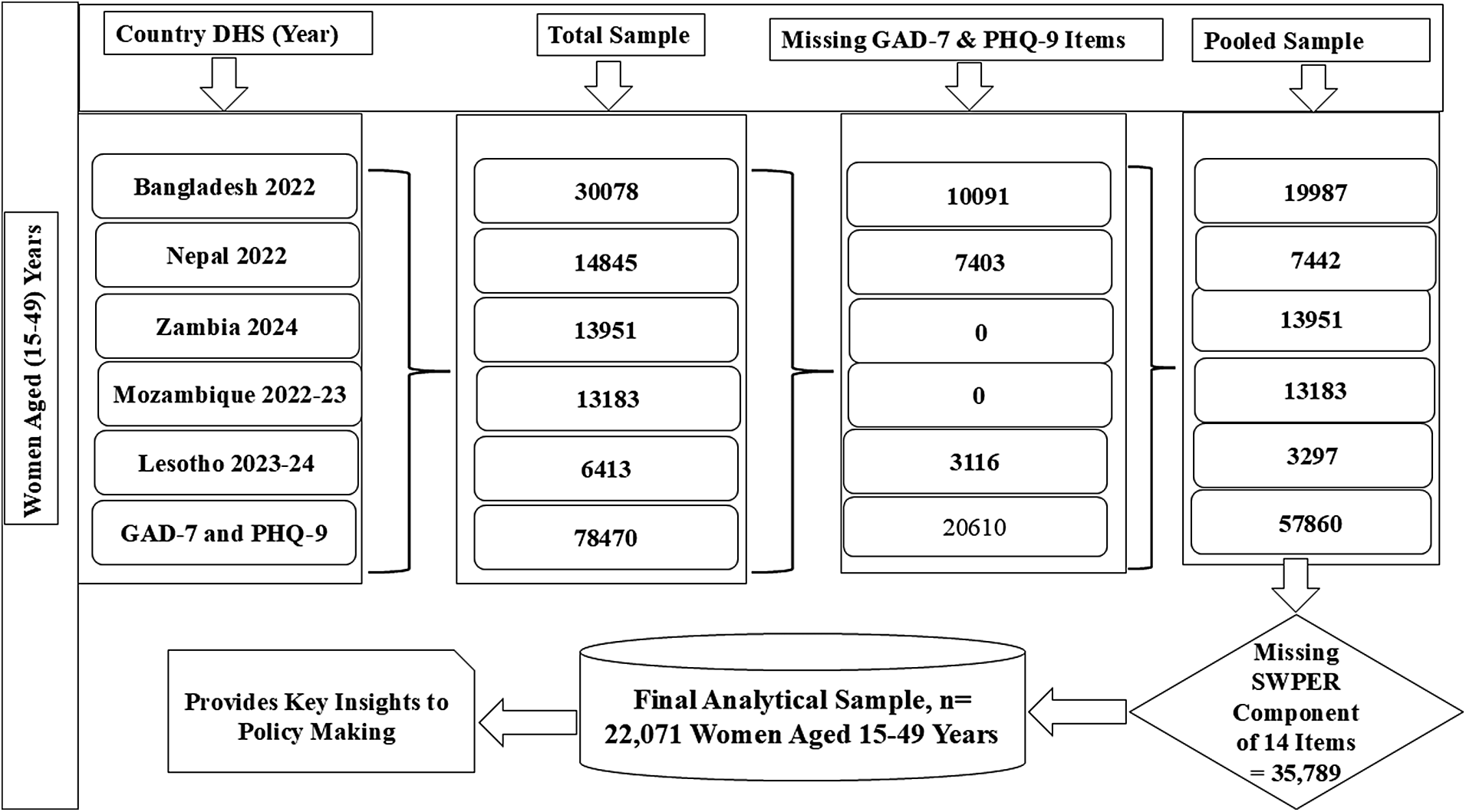


 Open access


Comments
Dear Editor,
I am pleased to submit our manuscript entitled “Association Between Women’s Empowerment and Mental Health in Sub-Saharan Africa and South Asia: Evidence from the Survey-based Women’s emPowERment (SWPER) Index” for consideration for publication in Global Mental Health.
This study examines the relationship between multidimensional women’s empowerment and mental health outcomes among ever-married women aged 15–49 years across five low- and middle-income countries (Bangladesh, Lesotho, Mozambique, Nepal, and Zambia), using nationally representative Demographic and Health Survey data. Employing the Survey-based Women’s emPowERment (SWPER) Index, we analyze three domains of empowerment—attitudes towards violence, social independence, and decision-making autonomy—and their associations with depression and anxiety.
Our findings highlight the complex and context-dependent nature of empowerment as a determinant of mental health. Notably, decision-making autonomy demonstrates a consistent protective association with both depression and anxiety, while social independence shows mixed and, in some settings, adverse associations. These cross-country differences underscore the importance of context-sensitive and gender-responsive mental health policies in LMICs. We believe this work contributes to the growing evidence base on social determinants of mental health and aligns closely with the journal’s focus on global mental health equity and policy-relevant research.
This manuscript is original, has not been published previously, and is not under consideration for publication elsewhere. All authors have approved the manuscript and agree with its submission to Global Mental Health. There are no conflicts of interest to declare.
Thank you for considering our manuscript. We hope it will be of interest to the readership of Global Mental Health. We would be grateful for the opportunity to contribute to your journal.
Sincerely,
Md Salek Miah
Department of Statistics
Shahjalal University of Science and Technology
Sylhet-3114, Bangladesh
Email: saleksta@gmail.com
On behalf of all authors
Corresponding Author:
Mohammad Ohid Ullah, PhD
Professor, Department of Statistics
Shahjalal University of Science and Technology
Sylhet-3114, Bangladesh
Email: ohid-sta@sust.edu