Introduction
Air-breathing aquatic animals must balance their need to acquire food at depth with their need to replenish oxygen stores at the surface (Kramer Reference Kramer1988, Mori Reference Mori1999). To maximize the time available for foraging within the water column, these animals have increased the amount of oxygen that can be stored in their tissues and have reduced the costs of diving (Kooyman Reference Kooyman1989, Williams et al. Reference Williams, Fuiman, Horning and Davis2004). For air-breathing predators that forage in polar fast ice environments, this balance is further complicated by restricted access to air. These predators must return to holes in the ice in order to breathe and, as a result, breathing holes represent a valuable resource in the fast ice environment (Kooyman Reference Kooyman1981). Most Antarctic pinnipeds rely on sea ice for critical portions of their life history and show particular sensitivity to changes in the sea ice physical and biological environment (e.g. Erickson et al. Reference Erickson, Siniff, Cline and Hoffman1971, Gilbert & Erickson Reference Gilbert and Erickson1977, Bester & Hofmeyr Reference Bester and Hofmeyr2007).
Several life-history traits emphasize the importance of sea-ice dynamics and access to breathing holes for Weddell seal (Leptonychotes weddellii (Lesson)) reproductive success. This species has a circumpolar distribution in Antarctica and is well adapted for living and breeding in the fast ice environment (Kooyman Reference Kooyman1968, Reference Kooyman1981, Castellini et al. Reference Castellini, Davis and Kooyman1992). Weddell seals are one of the largest of all seals and are capable of making extremely deep, long dives (Kooyman Reference Kooyman1981). Weddell seals are typically located near major perennial ice cracks or shoreline cracks created by tidal and wind forces. They maintain access to the surface throughout the year by using their specially adapted upper canines and incisors to ream the ice (Kooyman Reference Kooyman1981), and in locations where ice is only a few centimetres thick, seals can create new breathing holes by breaking through the ice (Castellini et al. Reference Castellini, Davis and Kooyman1992). Females haulout on the sea ice during the spring to give birth to their pups, and after 6–8 weeks of nursing, the pups are weaned and copulation occurs under the ice (Kooyman Reference Kooyman1981). During the breeding season, adult males use breathing holes to establish underwater territories that they defend against other males (Castellini et al. Reference Castellini, Davis and Kooyman1992, Harcourt et al. Reference Harcourt, Hindell and Waas1998). Aggressive interactions are often observed in locations where seals are forced to share breathing holes. Cuts and gashes on the chest, axillary and genital regions, and flippers are common (Kooyman Reference Kooyman1968).
Diving habits and foraging behaviour of Weddell seals have been well studied (e.g. Kooyman Reference Kooyman1981, Castellini et al. Reference Castellini, Davis and Kooyman1992, Davis et al. Reference Davis, Fuiman, Williams, Collier, Hagey, Kanatous, Kohin and Horning1999, Harcourt et al. Reference Harcourt, Hindell, Bell and Waas2000). Their hole-breathing behaviour and ability to dive to extreme depths allow them to hunt in both the pelagic and benthic environments of the Antarctic continental shelf (Lake et al. Reference Lake, Burton and van den Hoff2003). The diet of Weddell seals in McMurdo Sound varies little in midsummer and consists primarily of small nototheniid fishes, such as Antarctic silverfish (Pleuragramma antarcticum (Boulenger)) and Trematomus spp. (Castellini et al. Reference Castellini, Davis and Kooyman1992, Burns et al. Reference Burns, Trumble, Castellini and Testa1998, Davis et al. Reference Davis, Fuiman, Williams, Collier, Hagey, Kanatous, Kohin and Horning1999). However, other types of food are available, and the seals are known to feed occasionally on Antarctic toothfish (Dissostichus mawsoni (Norman)), bald notothen (Pagothenia borchgrevinki (Boulenger)), icefishes (Suborder Notothenioidei), mysids, decapod and amphipod crustaceans, octopus and squid (Dearborn Reference Dearborn1965, Testa et al. Reference Testa, Siniff, Ross and Winter1985, Davis et al. Reference Davis, Fuiman, Williams, Collier, Hagey, Kanatous, Kohin and Horning1999, Fuiman et al. Reference Fuiman, Davis and Williams2002).
Researchers have frequently taken advantage of the hole-breathing behaviour of Weddell seals to study their physiology and behaviour in situ (e.g. Kooyman et al. Reference Kooyman, Wahrenbrock, Castellini, Davis and Sinnett1980, Qvist et al. Reference Qvist, Hill, Schneider, Falke, Liggins, Guppy, Elliott, Hochachka and Zapol1986, Burns & Castellini Reference Burns and Castellini1996, Davis et al. Reference Davis, Fuiman, Williams, Collier, Hagey, Kanatous, Kohin and Horning1999, Reference Davis, Fuiman, Williams, Horning and Hagey2003, Williams et al. Reference Williams, Davis, Fuiman, Francis, Le Boeuf, Horning, Calambokidis and Croll2000, Reference Williams, Fuiman, Horning and Davis2004, Fuiman et al. Reference Fuiman, Madden, Williams and Davis2007) by using the ‘isolated-hole protocol’ (Kooyman Reference Kooyman1965). By creating a man-made hole in the sea ice that is too far from other holes for the animal to reach while holding its breath, the seal must return to the same location. However, the isolated-hole protocol restricts seals to a single breathing hole, and when only one animal is used, it prevents interactions with other seals. Behaviour may differ when additional breathing holes and seals are present. Recent advances in technology have allowed researchers to begin studying the behaviour of free-ranging Weddell seals which have access to multiple breathing holes and are free to interact with other seals (Madden et al. Reference Madden, Fuiman, Williams and Davis2008).
Previously, we found general similarity in the types of dives used by free-ranging and isolated-hole seals, with only one type of dive absent in the repertoire of free-ranging seals (Davis et al. Reference Davis, Fuiman, Madden and Williams2013). Here, we examine the finer details of midsummer foraging dives, in particular, by comparing data gathered from free-ranging seals with data collected during a previous study in which seals dove at an isolated hole (Fuiman et al. Reference Fuiman, Madden, Williams and Davis2007). We used 3-D dive profiles and video imagery of prey encounters to compare foraging dive structure, hunting tactics, and allocation of time, locomotor activity and energy during dives. We hypothesized that underwater foraging behaviour would vary between the two studies due to differences in availability of breathing holes.
Methods
To determine whether restricted access to breathing holes affects the structure of midsummer foraging dives, we compared fine-scale underwater behaviour during deep-aerobic foraging dives of free-ranging seals diving offshore with data from a previous analysis of Weddell seals foraging at a man-made isolated hole (Fuiman et al. Reference Fuiman, Madden, Williams and Davis2007). Special efforts were made to minimize differences between the two studies in order to identify the strengths and limitations of data obtained using the isolated-hole protocol. Environmental conditions in the study region were very similar in the two studies: ice thickness was nearly identical (2–3 m thick), currents in eastern McMurdo Sound do not change, and water temperature is consistently -1.5°C without a thermocline. Capture and instrumentation methods were fully described in Davis et al. (Reference Davis, Fuiman, Williams, Collier, Hagey, Kanatous, Kohin and Horning1999). Briefly, seals were captured using a purse string net and transported to an experimentation hut where they were sedated indoors, instrumented and allowed to recover from sedation for a minimum of 6–12 hours. After recovery, seals were released into the water through a trap door in the hut. Although seals in the isolated-hole study were confined to one hole, free-ranging seals had access to additional breathing holes (the nearest was <1 km from the hut).
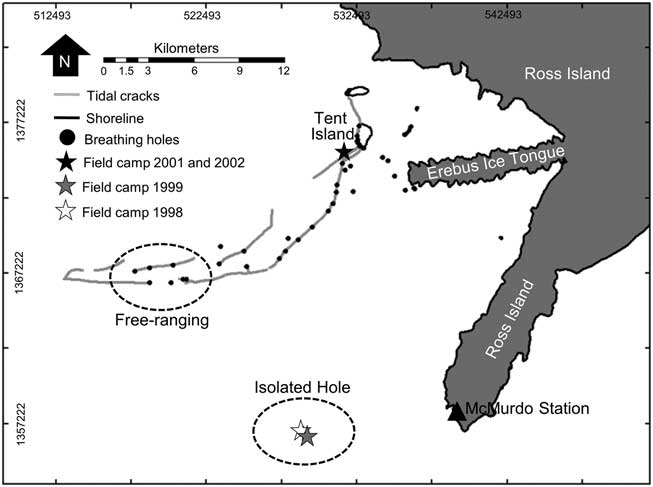
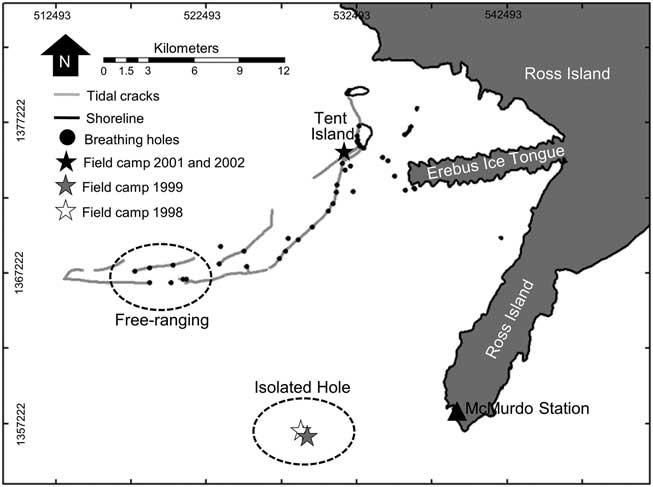
Eight adult seals (seven non-lactating females and one non-territorial male; mean body mass (± SD)=432.6±75.6 kg, mean standard length=239.9±9.0 cm) were captured near Ross Island, McMurdo Sound, Antarctica from October to November of 2001 and 2002 for the free-ranging study (Madden et al. Reference Madden, Fuiman, Williams and Davis2008). Two of the free-ranging female seals (seal 25: body mass=391.0 kg, standard length=231.5 cm; seal 26: body mass=428.4 kg, standard length=246.0 cm) moved away from the coast and dove at offshore breathing holes (Fig. 1). The offshore breathing holes of seals 25 and 26 represented foraging conditions that were similar to the conditions of the seals diving in the previous isolated-hole study (i.e. located away from the coastline in an area where the sea was c. 500 m deep, Fig. 1). Since these were the only two free-ranging seals to travel to and dive at this location, the comparison with isolated-hole seals was restricted to the foraging dives of seals 25 and 26. Isolated-hole seals were also captured near Ross Island during November and December of 1998 and 1999. At the isolated hole, ten adult seals (nine non-territorial males and one non-lactating female; body mass=379±36.3 kg, standard length=239±9.6 cm) dove at two man-made isolated-hole locations that were < 15 km from the free-ranging dive locations (Fig. 1).
Map of study area within McMurdo Sound with UTM coordinates listed on perimeter and diving locations for free-ranging and isolated-hole Weddell seals indicated by dashed lines.
During the free-ranging study, seals were relocated after 3–5 days and the instruments were exchanged for additional deployments (ranging from 1–6 deployments per free-ranging seal). Seals were relocated to within a 0.5-km radius using a satellite transmitter, and final localization was accomplished using VHF radio transmitters, a receiver and directional antenna. Isolated-hole seals were also deployed multiple times and instruments were exchanged while seals were resting on the sea ice surface within the experimental hut. In both cases, instrument exchange involved briefly placing a bag over the head of the seal and changing the batteries and video tape while they rested. The entire procedure took c. 30 minutes and there was no indication that the procedure altered the subsequent behaviour of the seals. All animal handling procedures were in accordance with animal use protocols of the University of Texas at Austin, Texas A&M University and the University of California Santa Cruz, under National Marine Fisheries Service permits to R.W. Davis and T.M. Williams.
Equipment
The self-contained video/data logger (described in detail by Davis et al. Reference Davis, Fuiman, Williams, Collier, Hagey, Kanatous, Kohin and Horning1999) was contained in a torpedo-shaped, aluminium housing and was designed to record data from several instruments: i) a low-light sensitive, monochrome video camera, ii) a depth sensor (pressure transducer), iii) a water speed sensor (paddle wheel), iv) a gimbaled flux-gate compass and v) a single-axis accelerometer placed on the dorsal surface near the base of the tail. Pressure, speed and bearing were sampled at 1 Hz, the accelerometer was sampled at 16 Hz, and the camera recorded at 30 Hz. The pressure transducer was calibrated in the laboratory for water depth. The compass was calibrated at the deployment site using the position of the sun together with GPS location, time and a navigation computer. The speed sensor was calibrated after each deployment using the method of Blackwell et al. (Reference Blackwell, Haverl, Le Boeuf and Costa1999). Accelerometer output varied as the hind flippers moved from one side to the other, stopping momentarily at the end of a stroke before the flippers reversed direction. This allowed identification of individual strokes during swimming as well as periods of no stroking (i.e. gliding). A stroke was defined as one right-to-left (or left-to-right) sweep of the hind flippers. The video camera was surrounded by a circular array of near-infrared light-emitting diodes that enabled the camera to record images underwater in complete darkness up to a distance of c. 1 m. Images were visible at much farther distances when additional ambient light was available. The infrared light source (λmax=850 nm) was assumed to be invisible to the seals and their prey (Lavigne et al. Reference Lavigne, Bernholz and Ronald1977). The frontal area of the video camera and data logger occupied<5.5% of the frontal area of the seal, and the additional hydrodynamic drag created by the video recorder did not result in significant differences in the recovery oxygen consumption for seals diving with and without the equipment (Williams et al. Reference Williams, Fuiman, Horning and Davis2004).
Data analysis
Data and video recordings were downloaded immediately upon recovery of the instruments. Video tapes were duplicated in VHS format and a time and date code was superimposed on the video display. Video tapes were reviewed and used to build a database of observations (e.g. encounters with prey, visible substrate, breathing hole markers). Encounters with several types of prey were observed on the video record for the two free-ranging seals, including Antarctic silverfish, bald notothen and icefish (Channichthyidae, species unknown). Madden et al. (Reference Madden, Fuiman, Williams and Davis2008) used eighteen dive descriptors summarizing duration, depth, speed, stroking frequency, gliding and energetic cost of dives to perform a non-hierarchical cluster analysis and identify groups of free-ranging dive behaviour. Presence of prey on the video record was then used to confirm foraging dives. Seals 25 and 26 performed 33 and 26 deep-aerobic (i.e. average estimated energetic cost was within the available oxygen limits of Weddell seals, which suggests they were not relying on anaerobic metabolism) foraging dives, respectively, at the offshore breathing holes (Madden et al. Reference Madden, Fuiman, Williams and Davis2008). Seals 25 and 26 were always successful in encountering prey when foraging in this region, so we restricted our comparison with the isolated-hole data to successful foraging dives (i.e. those in which prey were encountered) of six seals at the isolated hole.
Three-dimensional dive paths were computed from raw data for depth, compass bearing, speed and time using traditional methods of dead-reckoning (Davis et al. Reference Davis, Fuiman, Williams, Collier, Hagey, Kanatous, Kohin and Horning1999). Of the 33 deep-aerobic foraging dives conducted by seal 25, only 30 could be reconstructed in 3-D due to unknown start and end locations. Similarly, only 16 of the 26 deep-aerobic foraging dives performed by seal 26 could be reconstructed. This reduced the sample size for analysis of 3-D movements to 46 for the free-ranging seals. The isolated-hole dataset of Fuiman et al. (Reference Fuiman, Madden, Williams and Davis2007) included 3-D dive paths of 61 successful foraging dives (ranging from 1–20 per seal).
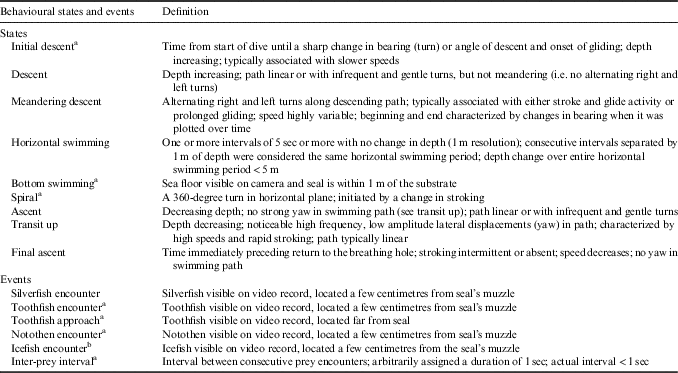
Fine-scale behaviour of seals and structure of individual foraging dives was determined by identifying distinctive behavioural states and events using the method and catalogue of behaviours developed by Fuiman et al. (Reference Fuiman, Madden, Williams and Davis2007). Operational definitions are provided in Table I. Transitions (i.e. changes in behavioural states or events) were identified by carefully examining 3-D dive profiles for changes in swimming path geometry, swimming speed and stroking activity. Events observed from the video record included: i) submergence of the head at the beginning of a dive, ii) emergence of the head at the end of a dive, and iii) encounters with prey. Behavioural states or events were assigned to the entire duration of a dive, except when an instrument failed to record data (which only occurred in a single dive when the speed sensor malfunctioned for 43 seconds). These missing data were assigned to the category ‘unknown’. Since the equipment failure only occurred once, this category was not included in the behavioural catalogue or the analysis of dive structure.
Operational definitions of behavioural states and events exhibited by isolated-hole (Fuiman et al. Reference Fuiman, Madden, Williams and Davis2007) and free-ranging (current study) Weddell seals.

a Behavioural states and events only present in isolated-hole dives.
b Event only present in free-ranging dives.
The structure of foraging dives was depicted by an ethogram which summarized the time-activity budget of seals. Ethograms were constructed using the method of Fuiman et al. (Reference Fuiman, Madden, Williams and Davis2007). Activity was measured by calculating the average amount of time spent in each state during a dive and was further refined by summarizing the proportion of time spent stroking and gliding within a state (gliding was defined as three or more consecutive seconds without stroking). All two-state transitions (dyads) were identified and their frequencies were summed for all foraging dives of the two seals foraging offshore. Only statistically significant two-state transitions (those that occurred at a frequency greater than expected by chance) that were identified with first-order Markov chain analysis (Fagen & Young Reference Fagen and Young1979, Lehner Reference Lehner1996) were included in the ethogram, unless otherwise indicated.
One behavioural state (unknown) and three behavioural events (icefish encounter, notothen encounter, inter-prey interval) did not meet the requirements of the statistical analysis (expected frequency greater than one; Lehner Reference Lehner1996) and were eliminated from the ethogram. The number of dyads observed in the offshore foraging dives (n=2405) exceeded five times the square of the number of states and events and was, therefore, sufficient for rigorous statistical analysis (Fagen & Young Reference Fagen and Young1979, Lehner Reference Lehner1996). Since the seals typically encountered multiple silverfish within a dive, the multi-state transitions leading to the first silverfish encounter in a dive were also examined. This is a useful tool for understanding the tactics seals use to search for food in the absence of information about the location of patches of prey (Fuiman et al. Reference Fuiman, Madden, Williams and Davis2007). The Markov chain method was also applied to the triads and tetrads (i.e. multi-state transitions) that led to the first silverfish encounter in foraging dives.
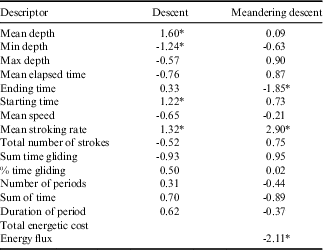
Hierarchical cluster analysis (single linkage, Euclidean distance) was used to explore patterns of similarity in diving behaviour among all seven seals. Each behavioural state was characterized by 16 descriptors (listed in Table II) and a separate cluster analysis was performed for each behavioural state using the mean value for each descriptor for each seal. Energetic cost of each behavioural state was calculated from the equation provided by Williams et al. (Reference Williams, Fuiman, Horning and Davis2004) for non-feeding Weddell seals. This equation estimates oxygen consumption during a dive from the body mass, duration of the behavioural state and the number of strokes of the hind flippers during the state. This equation does not take into account the added cost associated with processing a meal (i.e. heat increment of feeding), but was chosen because it provided a standard method for calculating energy consumption throughout the entire course of a dive. The energy flux descriptor (ml O2 kg-1 min-1) was calculated by dividing the total energetic cost (ml O2 kg-1) of each behavioural state in a dive by the total amount of time (min) spent in that state.
Standardized canonical coefficients for descriptors included in the stepwise discriminant function analysis comparing behavioural states and events of Weddell seals at an isolated hole (Fuiman et al. Reference Fuiman, Madden, Williams and Davis2007) with free-ranging seals offshore. Missing entries indicate variables that were eliminated from the stepwise analysis because they did not meet tolerance levels.

* Indicates coefficients that contributed most to the discrimination of groups.
When a cluster analysis placed free-ranging and isolated-hole seals in separate clusters, stepwise discriminant function analysis was used to identify the descriptors that best distinguished the clusters. Wilks’ λ was used to test for multivariate differences between the two clusters and jackknife classification results were examined as an indication of the strength of the differences. Following the multivariate comparisons, bivariate analyses (two-sample t-tests with a Dunn-Sidak correction for multiple comparisons) were used to compare each descriptor in order to better understand how a given behavioural state differed for free-ranging and isolated-hole foraging dives.
The frequency of two-state behavioural transitions in free-ranging and isolated-hole foraging dives was compared in order to determine how the sequence of behavioural states differed between the two studies. In all, 75 two-state transitions were observed during the free-ranging and isolated-hole studies, and the frequency of each transition was calculated for every dive. Due to high zero counts and lack of normality, mean frequency of each two-state transition was compared between free ranging and isolated-hole seals using non-parametric Mann-Whitney U-tests with a sequential Bonferroni correction for multiple comparisons. A similar procedure was used to compare the sequence of behavioural states leading to the first silverfish encounter in a dive. The frequency of two-, three- and four-state transitions leading to the first silverfish encounter in a dive was calculated for each seal, and the mean frequency of each single-state and multi-state transition was then compared between free-ranging and isolated-hole seals. Mann-Whitney U-tests with a sequential Bonferroni correction were used for these comparisons.
Ascent was the primary behaviour preceding silverfish encounter in both the isolated-hole and free-ranging studies (Fuiman et al. Reference Fuiman, Madden, Williams and Davis2007), therefore this behaviour could serve as a useful tool for estimating foraging success of Weddell seals that feed on small, midwater prey. Time-depth profiles were constructed for a subset of 50 successful foraging dives from the isolated-hole and free-ranging studies and were used to calculate the number of ascent periods during the bottom phase (i.e. defined by Mitani et al. Reference Mitani, Watanabe, Sato, Cameron and Naito2004 as the time from the beginning of the first ascent deeper than 50 m to the time of the end of the last descent deeper than 50 m of the dive). The relationship between the number of silverfish encounters and the number of ascent periods during the bottom phase of a dive was modelled using geometric mean regression (Ricker Reference Ricker1984). This model was validated by comparing the predicted number of silverfish encounters with the observed number of silverfish encounters (determined from the video record) for a separate sample of 11 successful foraging dives using a paired t-test. All statistical analyses were performed with Systat statistical software (version 10.2; Systat Software).
Results
Two free-ranging seals performed 51 successful foraging dives at offshore breathing holes, while the seals diving at an isolated hole performed 61 successful foraging dives from six seals. Twice the number of prey were encountered per dive by free-ranging seals compared to isolated-hole seals (mean±SE=11.9±0.9 and 5.8±0.6, respectively). The primary prey item consumed by both sets of seals was Antarctic silverfish.
Only 46 successful free-ranging foraging dives could be reconstructed in 3-D and compared with 61 successful isolated-hole foraging dives for fine-scale differences in 3-D movements. Three behavioural states (bottom swimming, initial descent, spiral) and two events (toothfish approach and toothfish encounter) observed for isolated-hole seals were not observed in the offshore deep-aerobic foraging dives of free-ranging seals. The remaining six behavioural states (descent, meandering descent, horizontal swimming, ascent, transit up and final ascent) and three events (silverfish encounter, notothen encounter and inter-prey interval) were all observed in at least one of the 46 foraging dives. One additional event (icefish encounter; not described by Fuiman et al. Reference Fuiman, Madden, Williams and Davis2007) also occurred during the current study. Icefish encounter was observed once in each of two foraging dives. Both of these encounters were made in midwater, one by each seal. Depth (mean±SD=238.2±131.1 m) and time since start of dive (10.1±1.2 min) of the encounters varied. Both icefish encounters were preceded by ascent, one was followed by ascent and one by horizontal swimming.
Comparison of behavioural states
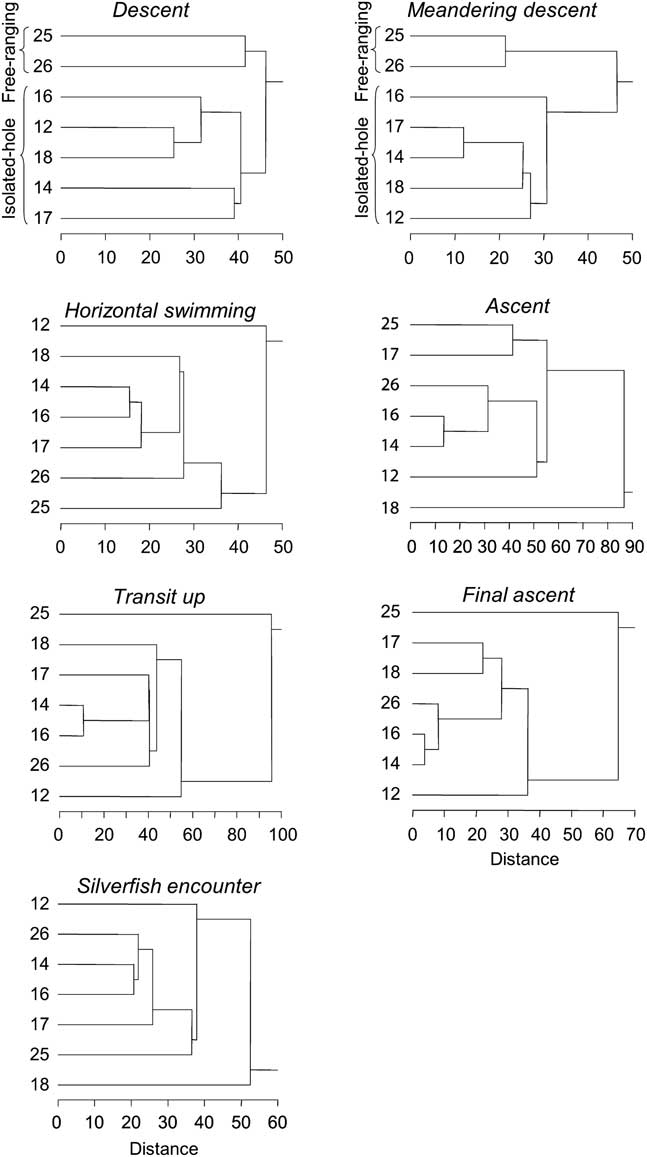
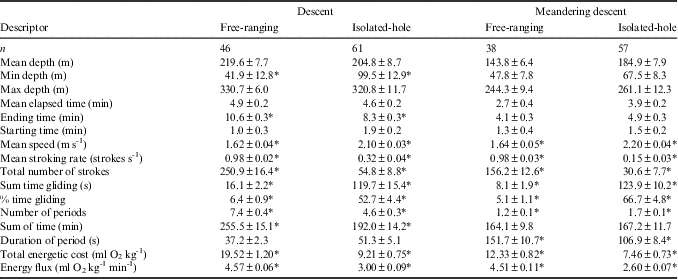
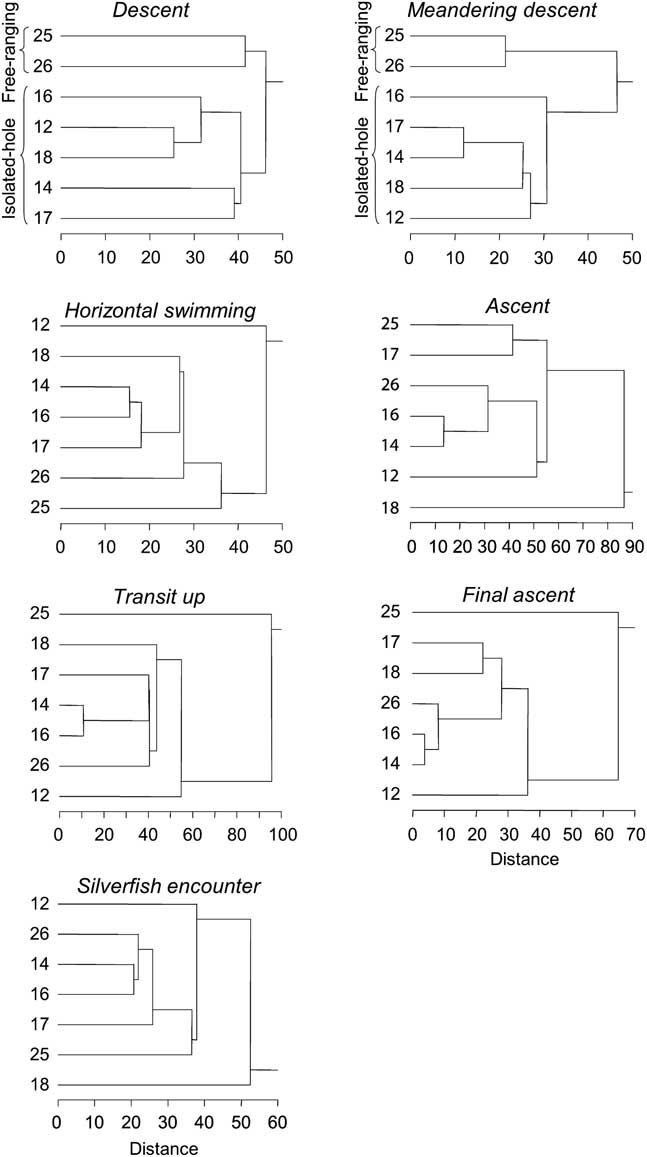
Hierarchical cluster analyses revealed a distinct separation between free-ranging (seals 25 and 26) and isolated-hole seals (seals 12, 14, 16, 17 and 18; seal 15 only performed one successful foraging dive and was not included in this analysis) for only two states or events: descent and meandering descent (Fig. 2). The multivariate differences were significant (Wilks’ λ>0.115, P<0.001). Mean depth and stroking rate of free-ranging seals during descent was greater than isolated-hole seals, and they started descent earlier (in time and depth; Tables II & III). During meandering descent free-ranging seals had a greater stroking rate and energy flux, and transitioned to another state earlier (Tables II & III).
Results of hierarchical cluster analyses for six behavioural states and one event for foraging Weddell seals. Free-ranging seals (25, 26) clustered separately from seals diving at an isolated hole (12, 14, 16, 17, 18) for descent and meandering descent.
Discriminant analysis correctly classified 94% (jackknife results) free-ranging and isolated-hole seals during descent periods. Of 16 descriptors of descent periods, 11 were significantly different (Table III). Free-ranging seals began descent significantly shallower than isolated-hole seals due to the absence of a period of initial descent. Free-ranging seals began descent immediately upon leaving the hole, while isolated-hole seals typically began dives in initial descent. Seals at the two locations finished descent at similar depths, but the ending time for descent periods was significantly later for free-ranging seals, resulting in a longer duration of descent for free-ranging seals. The later ending time and longer duration of descent periods were not due to an increase in the average duration of individual descent periods, but rather, a significantly greater number of descent periods during free-ranging dives. Despite significantly lower swimming speeds during descent for free-ranging seals, mean stroking rate was significantly higher. Differences in stroking activity translated into energetic differences; free-ranging seals expended more energy and at a higher rate during descent than isolated-hole seals.
Descriptors (mean±SE) of descent and meandering descent for free-ranging and isolated-hole foraging dives of Weddell seals. Data for isolated-hole foraging dives are from Fuiman et al. Reference Fuiman, Madden, Williams and Davis2007.

* Indicates significant differences in specific dive descriptors (P<0.05 after Dunn-Sidak correction for multiple comparisons).
Jackknife classification success for meandering descent was also high (94%) and there were significant differences between free-ranging (n=38) and isolated-hole (n=57) dives in nine descriptors (Table III). Free-ranging seals used fewer periods of meandering descent, although there was no difference in the amount of time spent in this state. Instead, the average duration of each meandering descent period was longer for free-ranging seals. A significantly higher stroking rate during meandering descent resulted in five times as many total strokes, less gliding (both total and percentage of time), more total energy expended and a higher rate of energy expenditure for free-ranging seals. Differences in stroking activity also translated into differences in total energy expended during meandering descent. Despite the increased stroking activity of free-ranging seals, they swam significantly slower than the isolated-hole seals.
Behavioural sequence of foraging dives
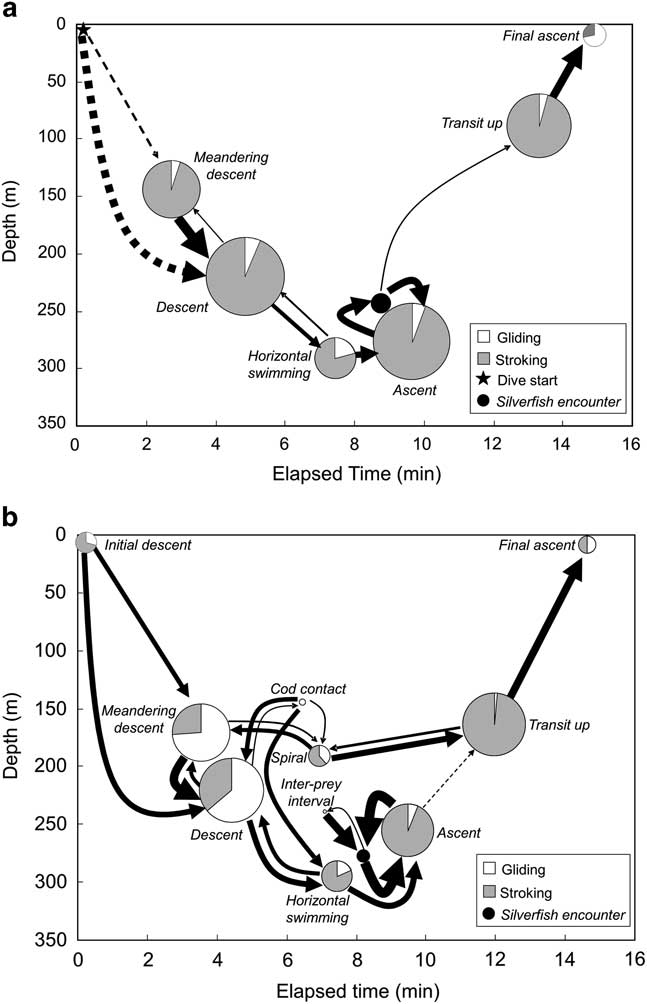
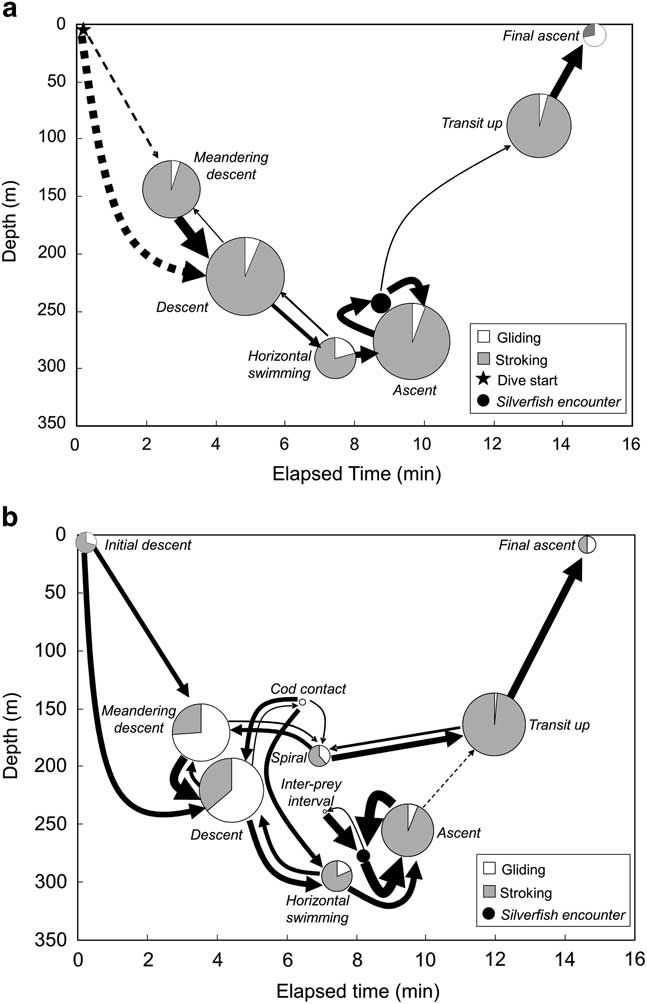
The ethogram for free-ranging foraging dives was much simpler than the ethogram for foraging dives at an isolated-hole, principally because of the dominance of silverfish encounters by free-ranging seals and the lack of contacts with toothfish. Free-ranging seals had ten significant transitions, while isolated-hole seals had 21 transitions (Fig. 3). All but one of the transitions (silverfish encounter → transit up) was observed in both groups of seals, indicating a common foraging sequence was present in both. Free-ranging seals began foraging dives with descent or meandering descent (36 and 10 times, respectively; Fig. 3a) and switched between the two. Seals also transitioned from descent to horizontal swimming (40%). Once in horizontal swimming, the only significant transition was to ascent (61%), which in turn led to silverfish encounter (68%). After encountering a silverfish, the seals transitioned most often to ascent (77%) or transit up (4%). From transit up, the only significant transition was to final ascent (78%), which lasted until the seals returned to the surface and ended the dive (Fig. 3).
Ethograms depicting mean depth and elapsed time at which behavioural states and events (circles) occurred in Weddell seal foraging dives. Circles are scaled in proportion to the amount of time spent in each state and patterns within each circle identify the proportion of time in each state during which the hind flippers were stroking or gliding. Arrows identify transitions between states and events that occurred significantly more frequently than expected by chance. Arrow widths are scaled to the proportion of all transitions from the originating state. a. Ethogram for free-ranging seals (n=46). Broken arrows show how the seals began foraging dives. b. Ethogram for isolated-hole seals (n=53; adapted from Fuiman et al. Reference Fuiman, Madden, Williams and Davis2007). Broken arrow shows the most frequent sequence by which seals returned to the breathing hole.
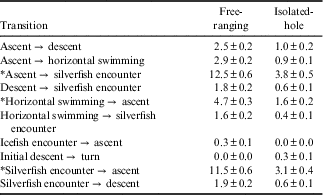
The frequency of ten of the 75 two-state transitions differed between isolated-hole and free-ranging dives (Table IV). Many of the differences were directly related to a larger number of silverfish encounters by free-ranging seals. For example, there were significantly more transitions from ascent, descent and horizontal swimming into silverfish encounter during free-ranging dives. There were also significantly more transitions out of silverfish encounter into ascent, descent and horizontal swimming. The seals also transitioned back and forth between descent, horizontal swimming and ascent at a significantly higher frequency during free-ranging dives than they did at the isolated hole. Finally, two of the significant differences were due to the absence of states (initial descent) and events (icefish encounter) during one of the studies.
Frequency (mean±SE) of two-state behavioural transitions that were significantly different between free ranging (n=46) and isolated-hole (n=61, data taken from Fuiman et al. Reference Fuiman, Madden, Williams and Davis2007) foraging dives of Weddell seals.

* Sequences that occurred more frequently than expected by chance during free-ranging dives, as determined from Markov chain analysis.
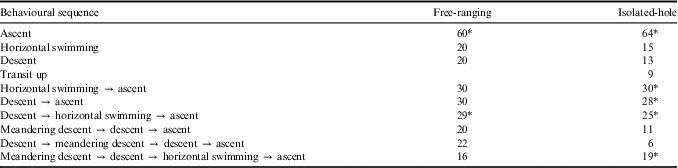
The behavioural states leading to the first silverfish capture within a dive are similar between free-ranging and isolated-hole seals. Free-ranging seals encountered at least one silverfish in all 46 foraging dives. Ascent, horizontal swimming, or descent immediately preceded the first silverfish encounter in a dive, but only ascent occurred at a frequency greater than expected by chance (Table V). Eight different two-state transitions preceded silverfish encounter, but none occurred significantly more than expected (Table V). The two-state transitions horizontal swimming → ascent and descent → ascent both preceded 30% of the first silverfish encounters. There were 13 three-state transitions preceding the first silverfish encounter, but only the sequence of descent → horizontal swimming → ascent was significant and it was present in 29% of the dives (Table V). Of the 15 four-state transitions, none were significant (Table V), but the sequence of descent → meandering descent → descent → ascent preceding silverfish encounter was observed in the highest percentage of dives (22%). Mann-Whitney U-tests (sequential Bonferroni corrected for multiple comparisons) showed no significant differences between free-ranging and isolated-hole seals in the mean frequency of multi-state transitions leading to the first silverfish encounter in a dive.
Behavioural sequences leading to the initial silverfish encounter in a dive and their relative frequency (%) in successful foraging dives for free-ranging and isolated-hole (data taken from Fuiman et al. Reference Fuiman, Madden, Williams and Davis2007) Weddell seals.

* Sequences that occurred more frequently than expected by chance during free-ranging dives, as determined from Markov chain analysis.
Estimating foraging success
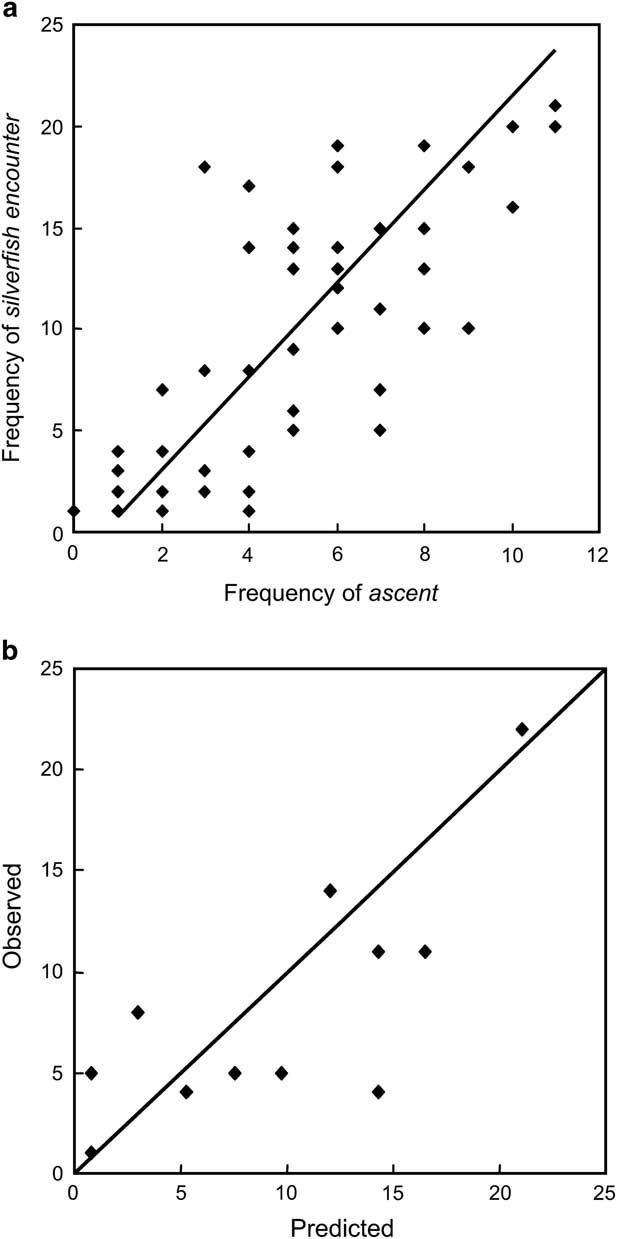
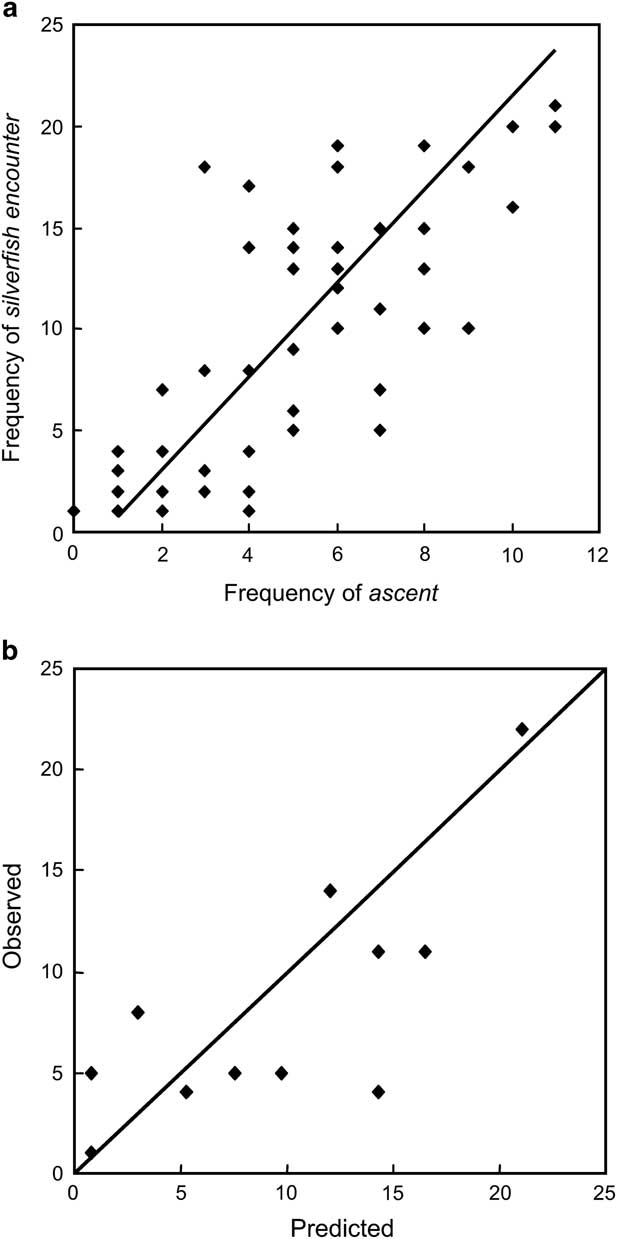
There was a significant positive relationship between the frequency of silverfish encounters and the number of ascent periods during the bottom phase of a dive (r 2=0.56, t 48 =3.48, P=0.001; Fig. 4a). On average, predicted values were slightly greater than observed values (mean difference=1.4 encounters), but there was no significant difference between predicted and observed values (t 10 =-1.01, P=0.337; Fig. 4b), suggesting that the number of ascent periods calculated from the bottom phase of time-depth profiles is useful for estimating foraging success of Weddell seals feeding on silverfish when other means for confirming fish encounters are not available.
a. Number of encounters with silverfish (determined from the video record) in relation to the number of ascent periods during the bottom phase of dive. Regression equation: silverfish encounters=1.4+1.7 (number of ascents) (n=50, r 2 =0.56, t 48 =3.48, P=0.001). b. Relationship between predicted and observed frequency of silverfish encounters from the above equation based on an independent sample of 11 dives from both free-ranging and isolated-hole Weddell seals.
Discussion
We found strong behavioural consistency among Weddell seals midsummer foraging at a single breathing hole and seals with access to multiple breathing holes. The diet of offshore free-ranging (Madden et al. Reference Madden, Fuiman, Williams and Davis2008) and isolated-hole (Fuiman et al. Reference Fuiman, Madden, Williams and Davis2007) seals during midsummer consisted almost entirely of Antarctic silverfish. In both groups, ascent was the most frequent behaviour leading to and following silverfish encounter, suggesting that Weddell seals primarily use ascent to attack silverfish. The overall sequence of behaviours in free-ranging dives was similar to that in dives at an isolated-hole (Fig. 3). There were also strong similarities in the hunting tactics used by free-ranging and isolated-hole seals to locate midwater prey. The common tactics were meandering descent and descent followed by horizontal swimming and then ascent. This sequence was interpreted by Fuiman et al. (Reference Fuiman, Madden, Williams and Davis2007) as the seals detecting prey during the two descent states, pursuing the prey horizontally while the prey flee upward and then ascending into attack.
The consistent behavioural patterns used by free-ranging and isolated-hole seals led to a model that predicts foraging encounters from data available in time-depth profiles (Fig. 4). This simple model could prove useful to researchers who are unable to observe underwater prey encounters directly. However, this relationship only applies to encounters with small, midwater prey and additional studies will be needed to develop similar relationships for other types of prey.
Despite the strong consistency of midsummer hunting behaviour of free-ranging and isolated-hole seals, there were several important differences that suggest how foraging behaviour changes in response to restricted access to breathing holes. For example, when access to breathing holes was restricted (isolated hole), seals glided more than 50% of the time during descent and meandering descent whereas free-ranging seals glided 7% of the time during these periods. Despite the significantly higher stroking rate of free-ranging seals during meandering descent and descent, there swimming speeds were significantly lower, possibly through lower amplitude strokes than isolated-hole seals.
Williams et al. (Reference Williams, Davis, Fuiman, Francis, Le Boeuf, Horning, Calambokidis and Croll2000) demonstrated the substantial energy savings that are achieved by gliding during the descending phase of a dive. The higher stroking rate of free-ranging seals translated into a two-fold increase in the energetic cost of descent compared to that of isolated-hole seals. Thus, energy optimization may not be as critical when multiple breathing holes are available. However, seals diving with access to a single breathing hole appear to behave more conservatively by incorporating substantially more energetically efficient periods of gliding while descending. The estimated total available body-oxygen store for adult Weddell seals is 67 ml O2 kg-1 (Kooyman Reference Kooyman1989). During foraging dives, the amount of energy expended by free-ranging seals was close to their total available oxygen stores (67.60±1.31 ml O2 kg-1), while seals at an isolated-hole remained well below their total available oxygen stores (Fuiman et al. Reference Fuiman, Madden, Williams and Davis2007). Thus, it appears that when access to the surface is limited, foraging seals behave more conservatively than when access to breathing holes is greater.
Differences in stroking rates and energetic cost of descent and meandering descent may be related to additional factors such as differences in prey availability. The video record showed that the density of prey near free-ranging seals was substantially greater than that near seals diving at the isolated holes, with free-ranging seals encountering twice as many prey per dive as the seals at the isolated hole. Fuiman et al. (Reference Fuiman, Madden, Williams and Davis2007) surmised that: i) searching for prey occurred during descent and meandering descent periods, ii) gliding during descent and meandering descent increased perception of prey by reducing self-generated hydrodynamic noise, and iii) the lateral excursions characteristic of meandering descent increased prey encounters by widening the search path. This suggests that in addition to saving energy, seals may also use more gliding and meandering descent to increase their ability to detect prey when prey densities are low or there is greater uncertainty regarding prey abundance, such as at the isolated hole. Therefore, some of the behavioural differences between free-ranging and isolated-hole foraging dives may be more related to prey availability than to the number of breathing holes.
Prey availability differences also may have resulted in slight differences in the hunting sequence of seals. It was most common for free-ranging seals to search for the first silverfish in a dive by alternating between descent and meandering descent before transitioning into ascent and silverfish encounter. In contrast, this sequence contained a period of horizontal swimming between descent and ascent at the isolated hole. Fuiman et al. (Reference Fuiman, Madden, Williams and Davis2007) suggested that if prey are close to the seal at the time they are detected, the seal might not need to use a period of horizontal swimming to pursue prey. Instead, the animal can transition directly from descent into ascent. Therefore, higher prey abundance could explain the absence of a horizontal swimming period during the free-ranging study since seals would have been closer to the silverfish when they were detected.
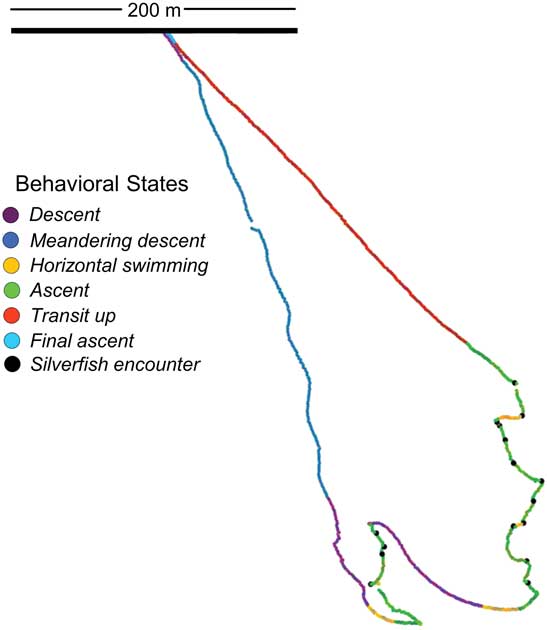
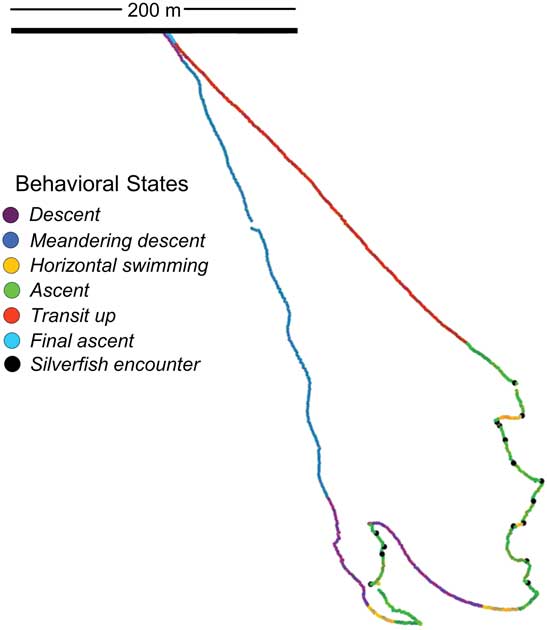
Finally, lower prey densities at the isolated holes could also explain the significantly lower number of transitions from ascent to descent observed during isolated-hole dives. Previous observations from video records at the isolated hole showed that silverfish occur in loose aggregations, typically located 2–4 m from one another (Fuiman et al. Reference Fuiman, Davis and Williams2002). As the seals ascend and forage within a patch of silverfish, the prey gradually become shallower, and when the patch is no longer profitable, it is reasonable to assume that seals must descend in order to relocate a reformed patch or to locate a new patch. Transitions from ascent to descent occurred more often in free-ranging dives, which could happen if free-ranging seals were descending after dispersing or depleting a patch of silverfish (Fig. 5). This idea is also supported by the presence of more periods of descent at significantly later times in free-ranging dives and a lack of significant differences in the number of transitions between meandering descent and descent. The increased number of descent periods were used later in free-ranging dives as the seals began searching for new (or reformed) patches of prey (Fig. 5).
Snapshot of a three-dimensional dive path reconstruction of a Weddell seal foraging at an offshore breathing hole. Colours represent different behavioural events and states. Each point represents the position of a seal at 1-second intervals during the dive. Black bar at top of figure represents both the surface of the ice and the scale of the figure.
This study provides one of the first insights into the similarities and differences that exist in the foraging behaviour of seals diving at an isolated hole and seals diving with access to multiple breathing holes. Our results show that the structure, hunting tactics, and allocation of time, locomotor activity and energy during foraging dives at an isolated hole during midsummer were very similar to dives at offshore locations with multiple breathing holes. Differences between the two locations indicate that seals employ an energetically more conservative foraging strategy when access to breathing holes is limited. Temporal and spatial variations in prey abundance also appear to contribute to many of the differences between the two groups. These results highlight the importance of understanding the complex interactions between breathing hole access, prey abundance and other factors (predators and competitors) that may impact the foraging strategies of Weddell seals seasonally, inter-annually or as a result of long-term environmental or human-induced change.
Acknowledgements
Thanks to D. Calkins, M. Horning, S. Kanatous, J. Purdy, M. Rutishauser and R. Watson for their work in the field and to W. Hagey for his role in the development of the equipment. Thanks also to M. Davis and M. Rutishauser who spent many hours analysing video footage. Thanks to A. Ojanguren, E. Buskey and K. Dunton for their helpful suggestions and critical review of this manuscript. This research was funded by the National Science Foundation (NSF), Office of Polar Programs (OPP 9909422). Additional financial support was provided by the Nancy Lee and Perry R. Bass Endowment at the University of Texas Marine Science Institute. Contribution 1678 of The University of Texas Marine Science Institute.