In recent years, the priming paradigm has been one of the most widely used procedures to test several hypotheses related to the process of acquisition and consolidation of word reading. Computational reading models, like the one recently published by Monaghan and Ellis (Reference Monaghan and Ellis2010), use three levels of representation of the stimuli: orthographic (letters or sequences of letters), phonological (based on sound) and semantic (based on meaning), in order to define the units with which the word recognition system works. In this context, and to test the role that the different levels play in word processing, the phenomenon of semantic and perceptual priming and the classic distinction between conceptual and perceptual implicit tests (Roediger & McDermott, Reference Roediger, McDermott, Spinnler and Boller1993) have gained methodological relevance. In the framework of the relation between implicit memory and reading, the semantic priming paradigm has been used on children in several different languages (e.g., Betjemann & Keenan, Reference Betjemann and Keenan2008; Casalis, Dusautoir, Colé, & Ducrot, Reference Casalis, Dusautoir, Colé and Ducrot2009; Quémart, Casalis, & Colé, Reference Quémart, Casalis and Colé2011). These studies have used lexical decision tasks and response time as the dependent variable. One of the problems of lexical decision tasks is that children show great variability in response times, a result that may obscure the effect of priming (Feldman, Rueckl, DiLiberto, Pastizzo, & Vellutino, Reference Feldman, Rueckl, DiLiberto, Pastizzo and Vellutino2002). Therefore, in order to analyze further the role that orthographic processing plays in word reading in children, it might be more appropriate to use the paradigm of “perceptual priming by repetition” and the word-fragment completion task.
Experimental research has highlighted that the effect of priming by repetition occurs for processes different from those of semantic priming (Ray, Reference Ray2008). In fact, some proposals uphold that the experimental effect of perceptual priming is sustained at the theoretical level in the so-called Perceptual Representation System (PRS), which has been defined by Schacter, Wagner, and Buckner (2000, page 636) as “a set of modules that operates on the perceptual information relating to the form and structure of the words and objects”. In experimental literature, perceptual priming refers to the changes that occur in an individual’s ability to identify an object as a result of having had a previous encounter with it (Roediger & McDermott, Reference Roediger, McDermott, Spinnler and Boller1993). One of the PRS modules, the “forms of words”, seems to specialize in the orthographic processing of these stimuli.
The word-fragment completion task consists of identifying the word that completes a fragment that has been extracted from a word that the participant may or may not have seen before. The overlap between the physical characteristics of the visual form of a word that has been previously activated and the visual form of its fragment will facilitate the answer. Therefore, the number of fragments correctly completed will be greater for previously seen word fragments. The expected result for these tasks corresponds to the so-called “perceptual priming by repetition”. The word-fragment task has been chosen because, unlike other implicit tests such as word stem completion, this test is thought to be a “pure” measurement of the perceptual priming generated by the orthographic processing of the stimuli (Bruss & Mitchell, Reference Bruss and Mitchell2009). Previous studies have obtained priming with the word-fragment completion task in samples of children over 7 years old (Deacon, Campbell, Tamminga, & Kirby, Reference Deacon, Campbell, Tamminga and Kirby2010; Feldman at al., 2002; Naito, Reference Naito1990). Naito (Reference Naito1990) conducted a study in which the priming effect obtained did not differ between young 7-to-12 year olds and adult participants under physical and categorical encoding conditions. Deacon et al. (Reference Deacon, Campbell, Tamminga and Kirby2010) confirmed priming scores obtained by children in Grades 4, 6 and 8 using the word-fragment completion task. Feldman et al. (Reference Feldman, Rueckl, DiLiberto, Pastizzo and Vellutino2002) carried out a word-fragment completion experiment with young readers. Results showed that orthographic priming was sensitive to the level of orthographic overlap between the prime and target, and that the magnitude of priming was greater in the conditions in which primes included transparent fragments that were morphological relatives of the target words (e.g., Prime: TURN; Target: TURNED).
The main purpose of this study is to clarify further the importance of the level of perceptual analysis in visual word identification during the reading process, i.e. to advance in the study of the relation between the PRS and the strengthening of reading abilities. To that end, perceptual priming was evaluated in 9-to-10 year old children who had reached different levels of reading ability, by means of an implicit memory task consisting of completing word fragments in Spanish. The study also tried to observe whether the variables involved in perceptual priming had a different impact according to the level of reading ability the child had reached.
The relationship between perceptual priming and reading has received some attention among samples of people who show some important deficiencies in their reading abilities (see Arguin, Bub, & Bowers, Reference Arguin, Bub and Bowers1998, with a sample of participants with dyslexia). In this regard, it has been highlighted that the study of perceptual priming may be an appropriate procedure to test certain hypotheses about functional alterations related to the orthographic system of “word-forms” lying at the root of dyslexia (e.g., Warrington & Shallice, Reference Warrington and Shallice1980). However, the relationship between perceptual priming and reading has not been explored in a sample of children who do not show these deficiencies, and this is the main objective of the present study.
This study aims to clarify the relationship between level of orthographic word processing performance and reading ability performance, using the word-fragment completion task. The main hypothesis is that children with a poorer reading ability will also show a poorer performance in the conditions of the implicit test, revealing the existence of some kind of deficiency in the orthographic processing of words. In addition to the implicit memory and reading tests, the participants were administered the WISC-IV tests (TEA Ediciones, 2005), which evaluate Working Memory, and five subscales that enable the estimation of the IQ. The objective is to control the possible negative effect on perceptual priming due to a general slowing down in processing, stemming from a low IQ or impaired executive functions, as previous research has observed (e.g., Betjemann & Keenan, Reference Betjemann and Keenan2008). Introducing these measures will make it possible to identify whether there are IQ and Working Memory differences between the children according to their reading level, as well as controlling their effect on the studied variables.
Method
Participants
A total of 41 children in the fourth grade of primary school from several public schools in the Community of Valencia (Spain) volunteered to participate in this research, with prior parental authorization. The ages ranged from 9 years and 1 month to 10 years and 10 months (M age = 9 years and 8 months, SD = 0.40), and 46.2% were girls. They were all native Spanish speakers and had normal or corrected-to-normal vision. The data from two children were eliminated from the subsequent statistical analyses because they were more than 2 SD away from the mean on reading speed and reading errors. Therefore, the final sample was composed of 39 children.
Material
With the objective of ensuring that the words used in the word-fragment completion task were appropriate, 75 words were selected from the Soler, Dasí, and Ruiz (Reference Soler, Dasí and Ruiz2009) database, and they were submitted to 82 primary school children in 1st (with an appropriate reading level), 2nd, 3rd and 4th grades in a pilot phase. The words were morphologically simple nouns of five to seven letters in length (M = 5.96), and containing two to four syllables (M = 2.63). From the 75 initial words, the 30 that showed a lower number of reading errors and that were known by all the children were chosen. According to the Soler et al. (Reference Soler, Dasí and Ruiz2009) database, the mean familiarity was 5.93 (SD = 0.59) on a seven-point Likert-type scale, the difficulty mean (probability of completing a fragment) was 0.66 (SD = 0.20), and the frequency mean was 36.36 (SD = 38.23). From the 30 chosen words, 15 pairs were made. The first word in each pair (List 1) was used as a prime stimulus for half of the participants in the study phase, and the second word (List 2) was used as prime for the other half. No significant differences were obtained when contrasting the means for word familiarity (p > .99), fragment difficulty (p > .85), or frequency (p > .91) of the two lists. Fragments of the 30 chosen words were presented in the test phase. The fragments were selected from the Soler et al. (2009, see for detailed description of the characteristics of the fragments) database, and each fragment had only one correct solution.
Procedure
The following tasks were administered to the children individually by a trained psychologist during school hours:
Word-fragment completion task
The task was carried out in three phases. In the first phase (study phase), each child was shown one of the 15 words from one of the two lists on a computer screen for 8 seconds, plus two words as an example. The instructions specified that they had to read each word aloud, and they were asked how often they used the word in everyday life (“not at all”, “not much” or “a lot”). The second phase consisted of a distracting task. For five minutes the children had to write on a sheet of paper all the Spanish cities they were able to remember. Finally, in the third phase (test phase), the children were shown each of the fragments (e.g., _ _nt_ñ_, fragment that corresponds to the Spanish word “montaña”) corresponding to 30 words for 12 seconds on the computer screen, half of which they had already seen in the study phase. During the exposure time, they had to try to find out the word that completed the fragment and say it aloud so that the experimenter could write it down. In order to become familiar with the task, the participants started with two practice fragments that were not considered in the analyses. In the instructions, participants were not told that half of the fragments corresponded to the words from the first phase of the experiment.
Reading task
The participants’ reading ability was individually evaluated by means of the Analysis Test of Reading and Writing (Toro & Cervera, Reference Toro and Cervera1989). This test is one of the most commonly used in the academic field (Muñiz & Fernández-Hermida, Reference Muñiz and Fernández-Hermida2010). It makes it possible to evaluate both reading speed and reading accuracy. The two measures collected to evaluate the children’s ability were the number of mistakes and the time, in seconds, spent reading the text. The most important dependent variable in this study was speed, since it is the variable that best reflects reading ability. In order to interpret this variable correctly, it is important to bear in mind that higher values represent lower reading speed. Accuracy was used only as an exclusion criterion when the number of mistakes was two standard deviations above the mean. Only the data from two children showed such high error rates that had to be eliminated before carrying out the statistical analyses.
Working Memory and IQ
The children were evaluated individually using the three subtests of the WISC-IV that form the Working Memory (WM) index: “Digits”, “Letters and numbers” and “Arithmetic”. In addition, they were evaluated on “Similarities” and “Incomplete figures”, since these subscales are included in the short forms of this test (e.g., Crawford, Anderson, Rankin, & MacDonald, Reference Crawford, Anderson, Rankin and MacDonald2010). From the scaled scores that correspond to these five subscales, an estimated IQ (eIQ) (Fuentes, Romero, Dasí, & Ruiz, Reference Fuentes, Romero, Dasí and Ruiz2010) was obtained, in order to ensure that all the participating children had an IQ of 85 or more.
Results
The data were treated and analyzed using the SPSS 17.0 statistical package. For reading speed, the mean was 105.6 seconds (SD = 28.1), the reading mistakes mean was 10.3 (SD = 1.1), the WM mean was 100.2 (SD = 14.9), and the eIQ mean was 96.3 (SD = 16.2). The median on the reading speed test was 103, and it was used as a cut-off point to separate the children into two groups: a) 20 children with a high reading speed (mean reading speed for HRS = 85.30 secs.) and, b) 19 children with low reading speed (mean reading speed for LRS = 126.95 secs.).
The WM and eIQ of the two groups, HRS and LRS, were compared. Although the means of the low reading speed group were lower (96.4 vs. 103.8 for the WM and 92.2 vs. 100.2 for the eIQ), none of these differences were significant (p > .12).
The three analyzed dependent variables from the word-fragment completion task were the following: percentage of correctly completed word-fragments that had been studied (studied %), percentage of correctly completed word-fragments that had not been studied (non-studied %), and priming (i.e., the subtraction of the other two dependent variables). The three variables showed a normal distribution according to the Shapiro-Wilks test (p > .10). Table 1 shows the t tests of independent groups carried out to compare the HRS and LRS groups on these variables, as well as the contrasted means. It can be observed that children who are fast readers show a better performance; in other words, they show higher percentages of completed fragments for both the studied and non-studied words. At the same time, the difference between the percentages, i.e. the priming derived from the implicit study phase, is more than twice as large for high-speed readers.
Contrast of the means corresponding to both groups of children (High and Low Reading Speed) in the dependent variables of the Word-Fragment completion task

*p < .05; **p < .01.
In order to guarantee that eIQ did not explain the differences that were found in the percentage of correctly completed fragments and in the priming percentage, ANCOVAs were carried out using the eIQ as covariate. In the three contrasted dependent variables, the significant differences were maintained: studied %, F(1, 36) = 28.01, p < .001,η2 p = .44, non-studied %, F(1, 36) = 8.23, p < .01, η2 p = .19, and priming, F(1, 36) = 6,47, p < .05, η2 p = .15.
The next step in the analysis was to look for the best possible regression model to explain Reading Speed based on the variables: studied %, non-studied %, priming, WM and eIQ. The linearity of the bivariate relations between the factors and the criterion variable was graphically explored. In order to assess possible problems of collinearity, a Pearson’s correlation matrix was used. This matrix showed that the “studied %” significantly correlated with the other two variables, non-studied % and priming (r = 0.514, p < .001 and r = .711, p < .001, respectively). However, the correlation between “non-studied %” and “priming” was not significant (r = –0.237, p > .10), and so both variables were included in the model. None of these variables correlated with the other two dependent variables (WM and eIQ). Instead, the correlation between WM and eIQ was significant (r = 0.845, p < .001). Therefore, we removed the variable that showed a lower correlation with the criterion (RS), i.e. eIQ (r = –0.427, p < .01), given that WM had a slightly higher correlation (r = –0.471, p < .005).
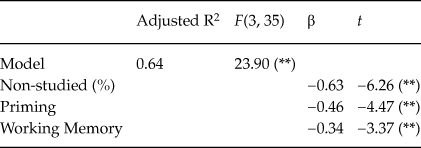
The final model contained the “non-studied %”, “priming”, and WM as factors. The regression coefficients and the evaluation of the model are shown in Table 2.
Multiple regression analysis explaining Reading Speed

*p < .05; **p < .01.
The relevant tests were carried out in order to verify the assumptions of the multiple linear regression. It was confirmed that all assumptions were adequately satisfied: the independent Durbin-Watson contrast was 1.62, the Shapiro-Wilks tests to contrast normality were not significant (p > .10), and the tolerance percentage was very high for the three variables (0.89, 0.93, and 0.94), which indicated the absence of collinearity. A graphical analysis of the residuals (scatter plot of the typified residuals on the typified foreseen marks and the three partial regression diagrams) was carried out in order to verify the homoscedasticity and linearity, respectively, all of which showed correct behavior.
As can be seen in Table 2, the model explains 64% of the differences in the children’s RS; therefore, it is a significant model as a whole. From the values of the Beta coefficients, it follows that the most important variable in the model is the percentage of fragments corresponding to the non-studied words, followed by the priming and, finally, the WM.
Discussion
This study has focused on analyzing the relation between perceptual priming and reading speed in children with a consolidated reading ability in the fourth grade of primary school. The results of the analyses have confirmed the initial hypothesis of the existence of a narrow relationship between perceptual implicit memory and reading speed. First, it should be pointed out that the performance of the slowest readers on the two dependent variables provided by the word-fragment completion task (% of completed fragments of words previously studied; % of fragments of non-studied words) is significantly lower than the performance of the faster readers on the same variables. Specifically, the differences in complete fragments of non-studied words suggest a deficit in accessing lexical representations in children who read worse. This result also confirms the role that the Perceptual Representation System of “forms”, proposed by Schacter et al. (Reference Schacter, Wagner, Buckner, Tulving and Craik2000), plays in the visual processing of words, and it supports some of the hypotheses stating that significant dysfunctions in reading, like dyslexia, may be caused by functional deficiencies in the orthographic system of “word-forms” (Warrington & Shallice, Reference Warrington and Shallice1980).
Second, the detailed analysis of the third dependent variable, obtained with the fragment completion task (i.e. perceptual priming) makes it possible to conclude that deficits in the orthographic processing of words do not respond to an “all or nothing” pattern, given that the group of children who read worse also obtain benefits from having previously processed the words. Indeed, levels of perceptual priming have been observed in both the faster and slower readers, a fact that coincides with the expected positive changes in the ability to identify a word as a consequence of a prior encounter with the same stimulus (Deacon et al., Reference Deacon, Campbell, Tamminga and Kirby2010). What distinguishes one group of readers from the other is the magnitude of the perceptual priming reached. These differences in magnitude are statistically significant and reveal, in numerical values, that the group of faster readers obtains twice as much priming as the other group. It is important to point out that, in the fragment completion task, all the children were capable of reading the words, since they read them aloud during the first part of the test. Nevertheless, apparently the children who read worse are also the ones who benefit less from having previously processed a word.
Third, the present study makes it possible to conclude that the differences in perceptual priming are not explained by a slowing down of general processing or deterioration in the executive functions in the group of children who read worse, as has been suggested in some research focused on semantic priming (Betjemann & Keenan, Reference Betjemann and Keenan2008). In fact, both groups showed no differences in IQ or Working Memory, therefore neutralizing the possible negative effects of these variables.
Finally, at a methodological level, we consider that the use of perceptual and conceptual implicit tests is an appropriate way to assess the hypotheses formulated in current models of word reading and to identify the role of the different levels (orthographic, phonetic and semantic) that take part in word recovery. However, some limitations in the present study make it impossible to draw conclusions about what level of processing is influencing the perceptual priming. The first part of the task was to read words and judge their level of use; therefore, the perceptual priming effect obtained may be due to orthographic processing, as our study found, although it could be based on phonological information. To test this hypothesis, future studies should adapt the task used here, so that in the first phase the child has to perform a purely orthographic manipulation of the stimuli.
Given the characteristics of the word-fragment completion task, and particularly its strong perceptual load, it should be considered as an instrument that offers many possibilities, not only in experimental research, but also in applied evaluation and training of reading ability. As completing fragments of new words stands out among the variables with a strong capacity to predict reading speed, practicing this task might be a way to improve this ability. Thus, word-fragment completion tasks could be used to evaluate reading speed, and then become instruments used to evaluate this ability quickly and easily. Lastly, series of fragments to be completed could be prepared as a reinforcement task aimed at training children with reading deficits to improve their reading speed.