Introduction
Major humanitarian crises, resulting from both natural disasters as well as conflicts, require a rapid, massive convergence of material and human resources at local, regional, and usually international levels to respond appropriately and provide effective aid to affected communities. For example, after the Haiti earthquake in 2010, over 26 international search-and-rescue teams responded within three days and over 400 humanitarian groups responded within the first two weeks.Reference Garbern, Ebbeling and Bartels 1 More recently, after the 2015 earthquake in Nepal, the International Federation of Red Cross and Red Crescent Societies (Geneva, Switzerland) deployed over 7,900 responders to the region. 2 Disaster and humanitarian responders - volunteers, professional search-and-rescue workers, health care providers, and many others - arrive on short notice, often from great distances, to provide their services, although some may not be adequately prepared and some may have insufficient awareness of the risks they may encounter in their efforts to help.
Historically, research mainly has focused on the outcomes of victims who are affected by disasters and conflicts. More recently, however, increased attention also has been brought to understanding the health consequences of those who respond and provide aid. Disaster and humanitarian responders (referred to simply as responders for the remainder of this article) often are placed in unfamiliar and potentially dangerous settings where they are at-risk for environmental exposures, infectious diseases, traumatic injuries, and adverse psychological outcomes from treating severely injured people, seeing dead bodies and body parts, dealing with unsuccessful rescue efforts, and caring for people who have lost loved ones. 3 - Reference Thoresen, Tønnessen and Lindgaard 5 Much of the current research on responders has investigated the psychological consequences of working in disaster settings while relatively little research has been done on physical health consequences. 3
This article reviews the current literature on the health outcomes, both physical and psychological, of responders with the following objectives: (1) to summarize the major health outcomes of responders to various disasters and conflicts; (2) to provide information for deploying agencies to inform the occupational health care needs of their responders; and (3) to highlight particular health risks that need to be addressed and areas in need of further study. The findings of this review were intended to be useful for improving the safety and health of humanitarian responders around the world.
Methods
Search Strategy
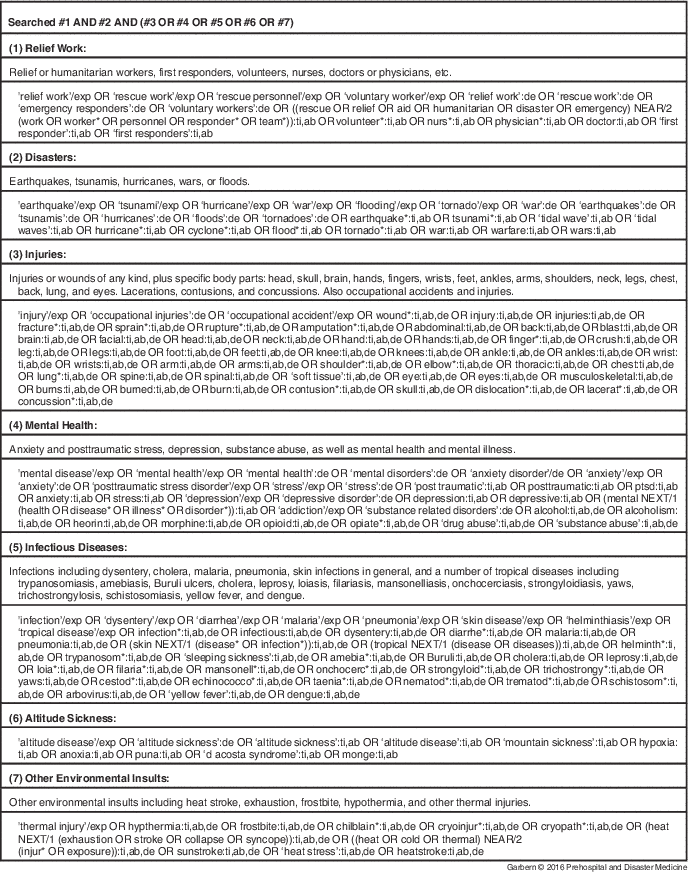
To better understand the health consequences of responding to disasters and conflicts, the EMBASE (Elsevier; Amsterdam, Netherlands) database was searched for all articles published up through March 2014 (no start date was specified) using the terms “Relief Work” and “Disasters” in combination with either of “Injury,” “Mental Health,” “Infectious Disease,” “Altitude Sickness,” or “Other Environment Insults.” The “Disasters” search string also included “war” and “warfare” as search terms. The full EMBASE search strategy is provided in Table 1. The EMBASE database was chosen because it is large and contains more European and international journals.
EMBASE Search Strategy

Screening and Selection Criteria
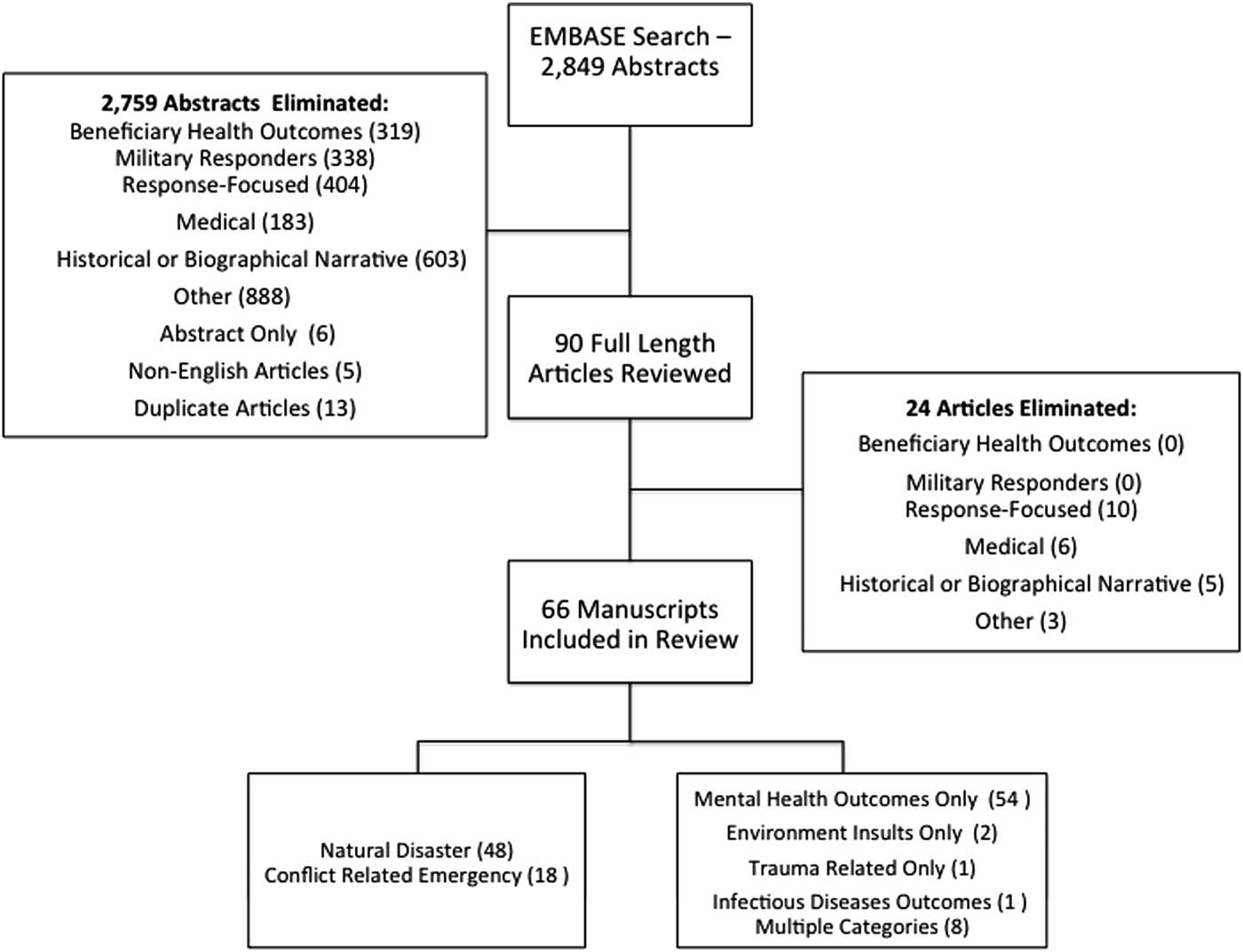
The search generated a total of 2,849 abstracts, each of which was screened by one of two reviewers who had been trained previously in the screening process. Articles that described the following were included: (1) civilian, voluntary or professional, first responders to a natural disaster or to a war-related emergency and (2) at least one health-related outcome. Articles that focused on: (1) beneficiary health outcomes, (2) military responders, (3) disaster or humanitarian responses in general, or (4) historical or biographical narratives of individual first responders, as well as abstracts and non-English articles, were excluded. Ninety abstracts were retained after exclusions, and each was reviewed independently by two investigators to determine relevance to the study question. Inter-rater reliability for relevance screening was measured to be 0.68 and discrepancies were resolved through discussion with a third reviewer. Of the 90 articles, 66 were included in the final review. Full details of the screening results, as well as the types of disasters and emergencies included and the categories of health outcomes, are illustrated in Figure 1.
Results of Literature Search, Screening, and Review.
Results
The majority of the articles included in this review (57 of 66 articles) focused on the mental health outcomes of responders and the risk factors that may lead to development of adverse psychological responses. Most research also had concentrated on natural disasters; 60 articles presented health outcomes for responders to natural disasters, while only six articles examined health outcomes for responders to war and conflict-related crises.
Study Subjects
The occupations of responders described in the selected articles varied greatly and included non-professional volunteers, government officials, physicians, nurses, firefighters, police officers, Emergency Medical Service personnel, administrators, utility workers, and public health workers. Nurses were the most studied group by occupation with 20 articles including nurses in their study. Seventeen articles included physicians, 16 included professional rescue or aid workers without further specifying occupation, 14 included firefighters, 11 included logistics or administrative personnel, eight included police officers, six included paramedics, six included utility or road workers, five included non-professional volunteers, three included city or government officials, and three included public health workers.
Study Settings
Humanitarian settings were highly varied, from natural and man-made disasters to war, and included earthquakes, hurricanes, tsunamis, civil wars, prolonged war stress contexts, and terrorist attacks. Specific humanitarian settings included in this review were: the Loma Prieta Earthquake of 1989; the Midwest US floods of 1993; the Bosnian War of 1992-1995; the Nakhodka Sea accident in 1997; Hurricane George (Gulf of Mexico/Puerto Rico) of 1998; the Chi-Chi Taiwan Earthquake of 1999; the Marmara Turkey Earthquake of 1999; the World Trade Center Attack (New York, USA) of 2001; the Bam Iran Earthquake of 2004; the Indian Ocean Tsunami of 2004; Hurricane Katrina (Louisiana/Mississippi USA) of 2005; Hurricane Rita (Gulf of Mexico) of 2005; Hurricane Wilma (Florida USA) of 2005; Hurricane Dennis (Florida USA) of 2005; the Lebanon-Israel War of 2006; the Gaza War of 2009; the Haiti Earthquake of 2010; the Sichuan (Wenchuan) Earthquake of 2008; the Great East Japan Earthquake of 2011; the Fukushima nuclear disaster (Japan) in 2011; and the Syrian Arab Republic Civil War of 2011-present.
Study Designs
The majority of articles addressing mental health (41 of 57) were cross-sectional in design, while eight used a longitudinal cohort design following participants over a time period from days up to several years after the disaster. Two studies were randomized-controlled trials, five articles were literature reviews themselves or general review articles aiming to increase education and awareness regarding posttraumatic stress disorder (PTSD) among disaster responders, and one article was a case report. Data were collected mainly through questionnaires (n=45 studies), although other modes of data collection also included clinician-administered assessments (n=4 studies), personal interviews (n=5 studies), and focus groups (n=1 study).
Many studies focusing on mental health used standardized instruments to measure specific outcomes. The most commonly used instrument was the Impact of Event Scale (IES; either original IES or revised IES-R edition) used in 22 articles. This self-report scale assesses distress caused by traumatic events, measuring the severity of PTSD symptoms of intrusion, avoidance, and hyperarousal over the past one week on a 4-point Likert scale, and is used widely in trauma literature.Reference van der Velden, van Loon, Benight and Eckhardt 6 A cutoff score of 33 was used in several studies to determine clinically important levels of distress consistent with a likely diagnosis of PTSD. The gold-standard instrument for diagnosis of PTSD symptomatology is considered to be the Clinician Administered PTSD Scale (CAPS); this was utilized in four studies. This scale is administered in person by a trained clinician. The Center for Epidemiologic Studies Depression Scale (CES-D) was the most commonly used instrument to measure depressive symptoms and was used in seven of 57 studies.
All the articles studying environmental, infectious disease, or traumatic injuries were case-based reports except for one census-based study, one cross-sectional study, and one longitudinal cohort study.
Mental Health
The majority of articles on mental health (36 of 57) investigated the development of, or screened for, PTSD after humanitarian work as a primary marker of the range of adverse mental health consequences responders may face. Posttraumatic stress disorder, as defined by the Diagnostic and Statistical Manual of Mental Disorders, is an anxiety disorder that can develop after exposure to a traumatic event and is characterized by re-experiencing, avoidance, or numbing of memories of the event, and hyperarousal that lasts over one month after the event.Reference Sundin and Horowitz 7 In this review, the proportion of likely PTSD diagnosis ranged from non-existent or extremely low in the studies of Dutch Urban Search and Rescue team members responding to the Haiti Earthquake (0% meeting PTSD criteria) and Japanese firefighters responding to the Great East Japan Earthquake (1.7% meeting PTSD criteria), to as high as 34% among student volunteers responding to the Bam Iran earthquake. Many studies, however, opted not to use an actual cutoff point for likely diagnosis of PTSD, but rather reported on overall PTSD symptomatology and “sub-threshold” PTSD as primary outcomes.
Seven articles investigated depressive symptoms or diagnosis of major depression, while nine studies included measurements of anxiety symptoms or general psychiatric distress. In studies investigating depressive symptoms, the proportion of likely clinical depression ranged from 21.4% among disaster medical team workers responding to the Great East Japan Earthquake to as high as 53.7% at-risk for major depression among hospital personnel in the Lebanon-Israel War of 2006.
Three studies investigated risk factors for development of “compassion fatigue.” The first part of compassion fatigue describes symptoms of exhaustion, frustration, anger, and depression typical of “burnout.” The second part of compassion fatigue is negative feelings driven by fear and work-related trauma, and secondary exposure to people who have experienced trauma. 8 One study among Florida public health nurses in the 2004 hurricane season found that 76% were considered low-risk for compassion fatigue during the hurricanes, and 87% were low-risk at three to four months after the hurricane season. 8 Among well-baby clinic nurses in Israel during the Second Lebanon War in 2006, 32.5% had “burn-out” symptoms and 68.7% had lack of compassion satisfaction.Reference Frank and Adkinson 9 Among Belgian first aid personnel responding to the Haiti Earthquake, there was no clear pattern in compassion satisfaction.Reference Berger and Gelkopf 10
Twenty-two articles also included an analysis of various factors including demographics, personality traits, social support, occupation, prior experience, and coping style as factors that might affect a person’s risk for development of adverse psychological outcomes after disaster and humanitarian work. Several studies reported increased risk for development of PTSD or depression among responders who did not have prior training or experience, compared to professional responders.Reference Van der Auwera, Debacker and Hubloue 11 - Reference Armagan, Engindeniz, Devay, Erdur and Ozcakir 14 Other studies found positive correlations between PTSD and neurotic personality types;Reference Review, Thormar and Paul 15 , Reference Liao, Lee and Lee 16 avoidant, distancing, and negative coping styles;Reference Liao, Lee and Lee 16 , Reference Huang, Liu and Li 17 low social support;Reference Armagan, Engindeniz, Devay, Erdur and Ozcakir 14 , Reference Liao, Lee and Lee 16 , Reference Chang, Lee, Connor, Davidson, Jeffries and Lai 18 - Reference Marmar, Weiss, Metzler, Delucchi, Best and Wentworth 20 and peri-traumatic dissociative experiences.Reference Chang, Lee, Connor, Davidson, Jeffries and Lai 18 , Reference Weiss, Marmar, Metzler and Ronfeldt 19 , Reference Kaspersen, Matthiesen, Götestam and Girolamo 21 In a study on Taiwanese rescue workers responding to the 1999 Chi-Chi Taiwan earthquake, investigators found that having a pre-disaster major life event, such as separation from or death of a close relative, major systemic disease, or problems at work in the past six months, closely predicted psychological distress.Reference Huang, Liu and Li 17
Only two studies included pre-disaster assessments that established a baseline from which post-deployment comparisons could be made. A study on Belgian responders to the Haiti earthquake found both drops and rises in compassion satisfaction as measured before, during, and up to three months post-disaster.Reference Berger and Gelkopf 10 A study on Dutch first responders to the Haiti earthquake found overall stable and very low rates of any mental health morbidity among their group.Reference Thoresen, Tønnessen and Lindgaard 5
Qualitative studies focused on the highly personal and individual experiences shared by study participants, explained through descriptions of general themes that emerged, as well as the use of key quotes from participants. Themes such as frustration with leadership, experiencing intrusive thoughts, work-family conflicts, and coping mechanisms were discussed, and authors suggested that further, larger scale research was needed on those topics.Reference Marmar, Weiss, Metzler, Ronfeldt and Foreman 22 - Reference Clukey 25
Environmental
Environmental factors affecting responders included temperature, ground conditions, exposures, safety, and weather. Interestingly, there were somewhat limited data regarding the environmental effects on responders and the dangers of response,Reference Wang, Chan, Shi and Wang 26 making it challenging to implement preventative strategies. Nine articles were identified that addressed the environmental effects of disasters on responders, including topics such as radiation exposures,Reference Fayard 27 fatalities,Reference Wang, Chan, Shi and Wang 26 heat injuries in flooding,Reference Morita, Miura and Yoshida 28 and the direct health effects of various disaster events. 3 , Reference Delinger, Kachur and Sternber 29 - Reference Jablecki, Norton and Keller 33
An article by Fayard et al. evaluated fatalities of responders and the underlying causes in various natural disasters over a 14-year period.Reference Wang, Chan, Shi and Wang 26 Utilizing the Census of Fatal Occupational Injuries from 1992-2006, 307 natural disaster deaths in workers were identified.Reference Wang, Chan, Shi and Wang 26 Wildfires were the most common natural disaster to cause death with a total of 80 fatalities, followed by hurricanes with 72 fatalities. Most of the fatalities in wildfires were due to exposures to fire and gases, particularly while firefighting. Hurricanes led to 72 deaths among emergency responders, predominately from injuries sustained during cleanup and reconstruction leading to intracranial hemorrhages, polytrauma, drowning, and electrocutions. Floods led to 62 responder fatalities from drowning, while tornadoes led to 33 deaths among responders. Other natural disasters, such as landslides, avalanches, ice storms, and blizzards, led to far fewer deaths (total of 56 responder fatalities).Reference Wang, Chan, Shi and Wang 26 In floods, the floodwater created hazardous conditions leading to drowning in 76% (n=47) of the reported fatalities. Interestingly, 86% of these workers were not directly engaged in disaster response activities, but rather were driving or were protective service workers (ie, firefighters or law enforcement).Reference Wang, Chan, Shi and Wang 26 In tornadoes, landslides, and avalanches, the onset of the disaster event led to a large majority of the fatalities recorded. However, ice storms and blizzards created dangerous environmental conditions leading to deaths related to electrocutions and transportation incidents.Reference Wang, Chan, Shi and Wang 26 Ultimately, Fayard found that worker safety was compromised due to disaster-related pursuits in wildfires, hurricanes, and ice storms and due to hazardous conditions in floods, tornadoes, landslides, avalanches, and blizzards.
Responders were also at-risk of various environmental exposures, which could result in morbidity. Morita et al. evaluated internal radiation doses from exposure during Fukushima using a whole body counter over two years in responders and evacuees.Reference Fayard 27 They found that radionuclide intake was over five times as high in evacuees than in responders who arrived in the days following the initial event. This is important for responders to such events because it suggests that responders may be protected from significant radiation exposure if they are not on site when the initial accident occurs.Reference Fayard 27 Additionally, Dellinger et al. examined the effects of heat-related injuries during the Midwest floods in 1993. During the summer of 1993, the Midwest experienced higher temperatures, humidity, and significant amounts of rainfall requiring responders to perform heavy exertional activities like sandbagging and levee-reinforcement.Reference Morita, Miura and Yoshida 28 Heat-related injuries including heat cramps, heat exhaustion, heat syncope, and heat stroke were the most frequent injury-related medical claims, followed by a variety of traumatic musculoskeletal injuries. Rashes, gastrointestinal symptoms, and fatigue could also have been caused by extreme heat and could put responders at an increased risk of injuries and non-injury complications.Reference Morita, Miura and Yoshida 28
Much of the reviewed literature evaluated the effects of hurricanes on responders, particularly Hurricane Katrina. Sullivent et al.,Reference Delinger, Kachur and Sternber 29 Morantz,Reference Bernard, Driscoll, Kitt, West and Tak 31 Swygard et al., 3 and the Centers for Disease Control and Prevention (CDC; Atlanta, Georgia USA)Reference Sullivent, West and Noe 30 , Reference Morantz 32 , Reference Jablecki, Norton and Keller 33 all evaluated the injuries and main medical complaints for a variety of responders in the weeks and months following Hurricane Katrina and Hurricane Rita. Swygard et al. looked at outcomes and exposures in post-deployment volunteers from the state medical assistance team who provided disaster relief work in Mississippi following Hurricane Katrina. 3 The group found that exposures changed over time: in the first weeks of deployment, there were greater exposures to contaminated water, insect bites, and physical trauma; in the first month following deployment, responders most commonly reported skin lesions (ie, insect bites, trauma, and abscesses), respiratory symptoms, and diarrhea; and, over the next reporting periods at three months and six months post-deployment, psychiatric symptoms predominated and other complaints decreased. 3 Sullivent et al. used the active injury and illness surveillance system established after Hurricane Katrina to evaluate responder and resident health impacts during the cleanup period following Katrina (September 8-October 14, 2005).Reference Delinger, Kachur and Sternber 29 Among responders, the leading cause of injury was from puncture wounds, insect bites, crush injuries, and falls, predominately in the cleanup phase and repair work.Reference Delinger, Kachur and Sternber 29 , Reference Sullivent, West and Noe 30 Injuries during rescue attempts and while operating power tools were less common.Reference Delinger, Kachur and Sternber 29
The CDC data collected from Hurricane Katrina evaluated health hazards in responders, including government workers, volunteers, and New Orleans (Louisiana USA) firefighters and police officers. Data showed that relief workers exposed to heat, insect bites, brackish water, and wet clothes reported a higher prevalence of skin complaints such as tinea corporis, folliculitis, bites, prickly heat, and chafing injuries than evacuees,Reference Sullivent, West and Noe 30 - Reference Jablecki, Norton and Keller 33 likely due to the extended period of time spent in the floodwaters and wet environments during cleanup.Reference Delinger, Kachur and Sternber 29 Furthermore, responders reported an increased prevalence of respiratory complaints and unintentional injuriesReference Delinger, Kachur and Sternber 29 , Reference Jablecki, Norton and Keller 33 , Reference Lopez, Bergeron and Ratard 34 compared to residents and evacuees.Reference Delinger, Kachur and Sternber 29 , Reference Jablecki, Norton and Keller 33
Ultimately, environmental exposures could lead to a number of fatal and nonfatal injuries and occurrences in responders. The environmental effects of man-made disasters including nuclear accidentsReference Fayard 27 and terrorist attacks, like September 11, 2001, 3 can lead to radiation exposure and respiratory problems due to airborne pollutants, respectively. 3 , Reference Fayard 27 Additionally, there were five volunteer deaths during the 1997 Nakhodka Sea accident in Japan caused by an oil spill due to lack of awareness and prevention.Reference Tak, Driscoll, Bernard and West 35 Heat, flooding, high winds, contaminated water, insects, poor air quality, and dangerous conditions could lead to additional injuries and long-term health effects. Preventative measures, like environmental awareness, surveillance, vehicle safety, hydration, protective gear, weather appropriate clothing, vector control, sunscreen, hand washing, hygiene, and avoidance of hazardous materials, are key to protecting responders from environmental injuries. 3 , Reference Wang, Chan, Shi and Wang 26 , Reference Bernard, Driscoll, Kitt, West and Tak 31 , Reference Morantz 32
Trauma
Responders work in potentially treacherous environments with many risks for traumatic injuries. Seven articles addressed various types of injuries sustained by responders. 3 , Reference Wang, Chan, Shi and Wang 26 , Reference Delinger, Kachur and Sternber 29 , Reference Sullivent, West and Noe 30 , Reference Jablecki, Norton and Keller 33 , Reference Tak, Driscoll, Bernard and West 35 , Reference Haraoka, Hayasaka, Murata and Ojima 36 These articles included injuries associated with Hurricane Katrina, Hurricane Rita, and the Great East Japan Earthquake. 3 , Reference Delinger, Kachur and Sternber 29 , Reference Sullivent, West and Noe 30 , Reference Tak, Driscoll, Bernard and West 35 One article looked at injuries reported in various natural disasters using data from the Census of Fatal Occupational Injuries from 1992-2006,Reference Wang, Chan, Shi and Wang 26 and another article discussed the outcomes of medical professionals in Syria during the Syrian Arab Republic Civil War.Reference Haraoka, Hayasaka, Murata and Ojima 36 The time frame for when responders sustained injuries varied, although most physical trauma occurred during early deployment and complications from those injuries typically developed in the first month after deployment. 3 Some deaths and injuries were due to violence and unstable political environments as opposed to environmental causes or natural disasters. For instance, medical professionals working during the Syrian Arab Republic Civil War were targeted for violence leading to the death of 130 doctors, 50 nurses, and 87 field medic personnel.Reference Haraoka, Hayasaka, Murata and Ojima 36
An active injury and illness surveillance system was established after Hurricane Katrina during the cleanup period from September 8-October 14, 2005. There were 7,543 nonfatal injuries reported among residents and relief workers during this time period.Reference Delinger, Kachur and Sternber 29 , Reference Jablecki, Norton and Keller 33 In 2005, there were 47 responder fatalities due to Hurricanes Dennis, Katrina, Rita, and Wilma.Reference Wang, Chan, Shi and Wang 26 Among responders, there were 977 injury-related visits recorded, 80% of which were in male patients. The leading mechanism of injury was penetrating (ie, cut/pierced/stabbed), followed by bites, crush injuries, and falls, predominately during cleanup activities.Reference Delinger, Kachur and Sternber 29 , Reference Jablecki, Norton and Keller 33 Another study evaluated health hazards in police officers and firefighters during Hurricane Katrina and showed that the most common injuries in both groups were lacerations, sprains/strains, falls, and bites/stings.Reference Sullivent, West and Noe 30 Similar injury patterns were seen in nonprofessional disaster volunteers who responded to the Great East Japan Earthquake between April 4-10, 2011.Reference Tak, Driscoll, Bernard and West 35 Most volunteers worked to support victims in cleanup, shelter evacuations, clearing mud, and clearing rubble. These activities resulted in traumatic injuries such as abrasions, contusions, puncture wounds, and cuts or lacerations.Reference Tak, Driscoll, Bernard and West 35
Infectious Diseases
Responders to disasters and conflicts may be required to travel to areas of the world with endemic tropical diseases. In this search, six articles were identified that addressed infectious disease exposures during disaster responses in the US and Puerto Rico, but no such articles were identified for other geographic locations.
Five of the infectious diseases articles discussed the exposures reported during Hurricane Katrina. 3 , Reference Sullivent, West and Noe 30 - Reference Jablecki, Norton and Keller 33 Following Hurricane Katrina, the CDC conducted a health hazard evaluation of New Orleans police officers and firefighters involved in the Hurricane Katrina response between October 17-28 and November 30-December 2, 2005.Reference Sullivent, West and Noe 30 The most commonly reported physical symptoms in both groups were upper respiratory tract symptoms, cough, and skin rashes,Reference Sullivent, West and Noe 30 although there were no indications of whether these symptoms were secondary to infectious or environmental causes. When comparing residents and responders following Hurricane Katrina, there was a higher proportion of acute respiratory events among the relief workers.Reference Jablecki, Norton and Keller 33 Infectious rashes in this group were mainly tinea corporis among those working in wet environments and folliculitis in workers in Mississippi.Reference Morantz 32 An email survey of responders to Hurricane Katrina found that the timing of deployment influenced the infectious exposures reported. 3 During early deployment, participants reported insect bites and greater exposures to contaminated water. Within one month following deployment, participants predominately noted insect bites, abscesses, respiratory symptoms, and diarrhea, which largely decreased over time. 3
During the Hurricane Katrina response, vibrio infections and norovirus infections became more prevalent for evacuees who were housed together in hurricane-damaged areas than for responders.Reference Bernard, Driscoll, Kitt, West and Tak 31 Interestingly among rescue workers in the acute phase of response to Hurricane Katrina, CDC and local government data show that there were no reports of diarrheal disease and only few infectious respiratory diseases between August and September 2005.Reference Morantz 32 While highly infectious water-borne diseases like cholera are concerning, they are not endemic and likely will not affect the US or other developed countries during disaster responses. 3 However, even when considering endemic diseases such as cholera in the developing world, the risk of exposure among responders remains unclear.
Hurricane George hit Puerto Rico in the middle of the 1998 dengue epidemic.Reference Sibbald 37 Among responders, 82% reported mosquito bites, but only 62 participants reported illness including cough, headache, diarrhea, fatigue, sore throat, chills, muscle pains, and joint pains. Furthermore, only 12 participants reported an illness that could be classified as dengue-like, and serologic testing as well as virus isolation were negative in all participants.Reference Sibbald 37 It is probable that preventative measures like insect repellant, work location, and sleeping indoors with air conditioning contributed to the lack of disease transmission,Reference Sibbald 37 highlighting the need for aggressive preventative measures when responders are working in disaster-affected areas.
Discussion
Responders are at-risk for experiencing a wide range of physical and psychological health conditions, from minor injuries to chronic mental health problems and fatalities. These health outcomes are highly dependent on the nature of the emergency as well as the preparation and role of the responders. Most of the articles included in this review (57 out of 66) studied mental health outcomes, largely focusing on development of PTSD symptoms and depression. Prior research on this subject has produced highly variable findings regarding rates of PTSD as levels of distress are affected greatly by the particular circumstances of the different crises, including the level of exposure to traumatic stressors, the length of time since the trauma exposure, the professions and training of the responders being studied, pre- and post-deployment preparations, as well as many other variables that coalesce in a complex fashion to determine psychological responses. Prior studies have cited the prevalence of PTSD among responders to be 9%-21%.Reference O’Leary, Rigau-Pérez and Hayes 38 The current review indicates that the prevalence of PTSD among responders may vary even more (0%-34%) and, in certain groups, be even higher than reported previously. Additionally, while any responder may develop PTSD, risk factors such as low social support; recent major life events pre-disaster; peri-traumatic dissociative experience; neurotic personality type; or avoidant, distancing, or negative coping styles may identify individuals with a higher likelihood of developing PTSD. Higher rates of PTSD and depression also were found among non-professional responders compared to professional responders. These findings suggest that more intensive support should be made available for non-professional responders in order to avoid long-term symptomatology. The high degree of variability in development of mental health morbidity also necessitates an individualized approach to support and treatment, since the needs of responders may differ considerably even within the same disaster response team.
Physical health outcomes among responders have been much less studied and the prevalence of various illnesses and injuries largely is unknown due to under-reporting and inadequate surveillance systems. This review found that physical ailments suffered by disaster responders generally fall into one of three categories: environmental, infectious, or traumatic. Environmental illnesses result from exposure to the unique conditions of the disaster setting itself and include heat exhaustion and heat stroke, insect bites and stings, dermatologic conditions from prolonged exposure to dirty water and heat, and in a few cases, radiation exposure. Infectious diseases contracted by responders largely are gastrointestinal, respiratory, and vector-borne, and largely are related to overcrowded and unsanitary conditions. Environmental and infectious conditions largely are preventable with simple measures such as wearing appropriate protective equipment, frequent hand washing, teaching environmental awareness specific to the setting, having adequate water and sanitation, and implementing vector control measures to protect disaster responders. Traumatic injuries such as lacerations, stabs, burns, falls, sprains, fractures, and crush injuries generally occur early in relief efforts, likely secondary to search-and-rescue activities and cleanup. In general, non-violent fatalities were infrequent among responders, and when they occurred, there were most commonly due to firefighting as well as cleanup and reconstruction after hurricanes, although the research in this area is limited.
Despite the fact that only one article in this review discussed intentional violence directed towards responders, such violence is increasingly common. In fact, over the past 15 years, the number of intentional attacks on responders has increased dramatically, reaching an all-time high in 2013 with 251 reported attacks on a total of 460 responders.Reference Zhen, Huang, Jin, Deng, Zhang and Wang 39 In recent years, violence against responders has occurred in 30 countries, but approximately three-quarters of all attacks occurred in Syria, Sudan, South Sudan, Afghanistan, and Pakistan. Increasingly, responders are targeted on the road when they are traveling from one place to another,Reference Zhen, Huang, Jin, Deng, Zhang and Wang 39 and the number of kidnappings among aid workers has more than quadrupled in the past decade. 40 National staff have made up roughly 80% of all violence-related responder fatalities since 2001, which may be because local staff are sometimes placed in more dangerous situations. 41 Attacks on responders are most prevalent in weak, unstable states with active armed conflict, and in general appear to be independent of the political regime or overall homicide rates in the host state. 42 Since much of these data are from non-governmental organizations, it tends to be reported in the grey literature most often, and therefore, was grossly underrepresented in the current search of peer-reviewed literature. The paucity of articles on violence does not imply that it is not an important cause of morbidity and mortality among responders, as arguably it is the most important threat in many conflict and insecure settings.
Limitations
This study is limited by its inherently retrospective nature and its reliance on largely case-based studies. Additionally, the search was limited to EMBASE given the large number of articles identified using that single database, and only full-length articles in English were included. In doing so, it is possible that relevant articles were missed. The disaster and conflict settings also varied greatly with regards to type and scale, and also with respect to the training, occupation, and prior experience of the responders, thus limiting comparisons across settings and the ability to draw general conclusions. A major limitation of assessing mental health among responders is the lack of pre-deployment mental health baseline data. Without documentation of baseline mental health conditions, it is impossible to draw definitive conclusions regarding the role of the response work in development of mental health morbidity. This review of fatalities also was limited as its main source of data was from the Census of Fatal Occupational Injuries, which did not include events since 2007 and only included US-based occupational injuries. Another significant limitation was that the search identified only one study that described violence towards responders. War and conflict-related humanitarian crises likely represent a very different set of health hazards and were not truly captured in the current systematic review of the peer-reviewed literature.
Future Research
To truly monitor responder outcomes and to ensure the safety of responders, more sophisticated surveillance and reporting systems are needed. Very few of the included studies used a formal surveillance or data collection system, and without accurate data, it is challenging to create strategies to better protect responders.
While mental health outcomes are extremely important, more research should be done on physical health outcomes of responders in order to better understand the full scope of risks with the goal of preventing morbidity and mortality. Additionally, baseline mental health assessments should be considered for all responders pre-deployment in order to both screen for risk factors of developing mental health conditions as well as to better assess the true prevalence of disaster-related mental health illnesses. A specific focus should be placed on researching the unique health risks faced by responders to conflict and war-related crises, as this area clearly is understudied, yet potentially more hazardous.
Conclusion
While disasters and conflicts may be unavoidable, an improved understanding of adverse health consequences for responders is necessary in order to inform potential responders of the possible risks, to help implement mitigation strategies, and to plan post-response care.