





Introduction
‘The effectiveness of scarification for increasing germination of dormant [Sorghum] seeds might suggest that an impervious seed coat was a prime factor in causing the observed dormancy. However, even those seeds which showed a high degree of dormancy absorbed water and swell in size, indicating the dormancy was not due to a seed coat impermeable to water’. (Gritton and Atkins, Reference Gritton and Atkins1963)
‘… the presence of physical dormancy [water-impermeable seed covering layers] does not always imply having a harder covering structure than non-dormant seeds and therefore terms such as “hardseeded” or “hard coat” should no longer be used as synonyms for this trait’ (Visscher et al., Reference Visscher, Barreiro, Gomez, Carta, Liu, Wu, Muthuthanthirige, Forest, McCabe and Pritchard2025).
In a paper published in this journal in 2006, C. Baskin, K. Thompson and J. Baskin identified and briefly discussed 22 mistakes commonly made in studies on whole-seed germination biology and ecology. Three of the mistakes (numbers 7, 9 and 18) dealt specifically with physical dormancy (PY), i.e., dormancy due to a water-impermeable seed (or fruit) coat. A germination unit consisting of a seed surrounded by fruit or other tissues, e.g., endocarp (drupe of Prunus) or pericarp (achenes of Rosa), is a diaspore. Hereafter, we refer to both seeds and diaspores as seeds.
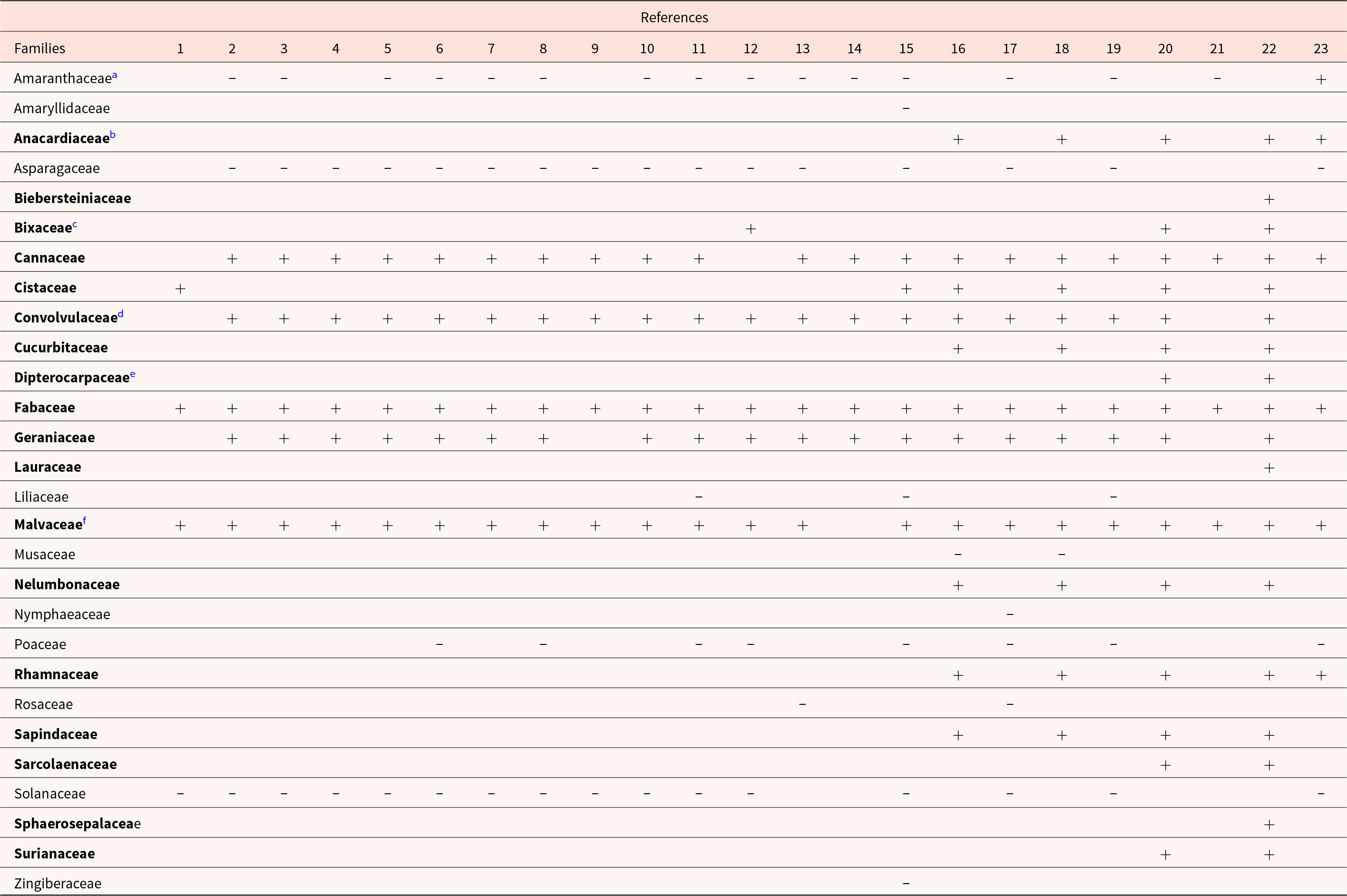
Since 2006, papers have continued to be published in which mistakes are made with regard to correctly identifying PY. Two common mistakes mentioned in the 2006 paper are related to researchers misidentifying seeds with PY. One, researchers may lack knowledge of the 18 plant families of angiosperms (Anacardiaceae, Biebersteinaceae, Bixaceae, Cannaceae, Cistaceae, Convolvulaceae, Cucurbitaceae, Dipterocarpaceae, Fabaceae, Geraniaceae, Lauraceae, Mavaceae, Nelumbonaceae, Rhamnaceae, Sapindaceae, Sarcolaenaceae, Sphaerosepalaceae and Surianaceae; Table 1) in which PY has been verified by anatomical and/or physiological evidence in at least one (but some families all) species; no gymnosperms have been documented to have PY. Two, researchers may not realize that mechanical and acid scarification can break dormancy not only in seeds with PY but also in those with other classes of dormancy such as physiological dormancy (PD), the most common kind (class) of diaspore dormancy.
A brief history of physical dormancy (PY) reported in plant families

Table 1 Long description
References are numbered 1 through 23 across the columns, and each plant family row contains plus or minus marks, with many cells left blank. Fabaceae has a plus mark in every reference column from 1 to 23. Cannaceae has plus marks in references 2 through 11 and 13 through 23, with reference 12 blank. Malvaceae f has plus marks in all references except 14, which is blank. Convolvulaceae d has plus marks in references 2 through 20 and 22, with 21 blank. Solanaceae has minus marks in references 1 through 12 and 15, 17, 19, and 23, with references 13, 14, 16, 18, 20, 21, and 22 blank. Asparagaceae has minus marks in references 2 through 13, 15, 17, 19, and 23, with 14, 16, 18, 20, 21, and 22 blank. Several families show plus marks only in later references, including Rhamnaceae and Sapindaceae with plus marks at 16, 18, 20, and 22, and Anacardiaceae b with plus marks at 16, 18, 20, 22, and 23.
Note: +, authors reported PY in family documented to have PY; −, authors reported PY in family that does not have PY. Families shown in bold are known to have one or more genera with PY.
1, Crocker, Reference Crocker1916; 2, Harrington, Reference Harrington1916; 3, Crocker, Reference Crocker1948; 4, Watson, Reference Watson1948; 5, Crocker and Barton, Reference Crocker and Barton1957; 6, Barton, Reference Barton and Ruhland1965; 7, Crocker and Barton, Reference Crocker and Barton1957; 8, Barton, Reference Barton and Ruhland1965; 9, Ballard, Reference Ballard1973; 10, Rolston, Reference Rolston1978; 11, Werker, Reference Werker1980/81; 12, Bewley and Black, Reference Bewley and Black1982; 13, Ellis et al., Reference Ellis, Hong and Roberts1985a,Reference Ellis, Hong and Roberts1985b; 14, Bewley and Black, Reference Bewley and Black1994; 15, Werker Reference Werker1997; 16, Baskin and Baskin, Reference Baskin and Baskin1998a; 17, Argel and Paton, Reference Argel, Paton, Lock and Gerguson1999; 18, Baskin et al., Reference Baskin, Baskin and Li2000; 10, Probert, Reference Probert and Fenner2000; 20, Baskin et al., Reference Baskin, Thompson and Baskin2006; 21, Bewley et al., Reference Bewley, Bradford, Hilhorst and Nonogaki2013; 22, Baskin and Baskin, Reference Baskin and Baskin2014a; and 23, Santos et al., Reference Santos, Souza, Silva, David, Cangussú, Custodio, Borges and Pereira2024.
a Subfamily Chenopoideae.
b In the first edition of our book on seeds (Baskin and Baskin, 1998a), we mistakenly thought that the only class of dormancy in the Anacardiaceae was PY. However, the only tribe of this family that contains species with PY is Rhoeae (Baskin and Baskin, Reference Baskin and Baskin2022). However, we subsequently learned that only some species of Rhoeae and all species in the other four tribes of Anacardiaceae have seeds with physiological dormancy or are nondormant.
c Including Cochlospermaceae.
d Including Cuscutaceae.
e Including only subfamilies Monotoideae and Pakaraimoideae of the Dipterocarpaceae.
f Including Bombacaceae, Sterculiaceae and Tiliaceae (Stevens, Reference Stevens2001 onwards).
The purpose of this review paper is to survey the literature for reports of PY in species that do not belong to families known to have seeds with PY. In surveying the literature, careful attention was given to the methods used in each paper regarding water uptake and seed coat anatomy. We asked several questions. Is there evidence for additional plant families with PY? In cases of false reports of PY, what errors in the methods led to the conclusion that seeds had PY? Furthermore, if seeds do not have PY, what kind of dormancy do they have? Finally, we constructed a history of the reporting of PY in families of angiosperms.
Methods
For more than three decades, we have collected information from the scientific literature on mistakes in research on whole-seed germination biology. A short summary of the early results of this compilation has been published (Baskin et al., Reference Baskin, Thompson and Baskin2006). In addition to the ongoing long-term general literature survey, we recently conducted a web search for additional reports of false PY, including for each seed plant family accepted by the Angiosperm Phylogeny Group (APG; Stevens, Reference Stevens2001 onward). The search terms for each family were name of family, water-impermeable seed coat, seed imbibition and PY. Nomenclature of all plant species was checked using Plants of the World Online (2024).
In evaluating each paper in which authors concluded that seeds of a species (not belonging to one of the 18 families known to have PY) had PY, we asked: did the authors obtain data from seed imbibition studies showing that seeds were water-impermeable? Furthermore, did the paper contain photographs/drawings showing that the seed coat had a layer of macrosclereids with a light line? If imbibition and anatomical studies were not performed, or if they showed a lack of supporting evidence for PY, we concluded that the paper falsely reported PY. If a paper falsely reported PY, we looked at germination responses to seed scarification and embryo morphology to evaluate the kind of seed dormancy. If seeds had a fully developed embryo, were water-permeable and scarification increased germination percentage, we concluded that they had PD. If seeds had a small (underdeveloped) embryo and scarification promoted germination (or if seeds failed to germinate), we concluded that they had morphophysiological dormancy (MPD). To add to our assessment of the kind of dormancy in seeds with false PY, we consulted studies on other species in the same genus and/or family, paying particular attention to imbibition studies and responses of seeds to scarification and other dormancy-breaking treatments.
We included the Anacardiaceae and Cucurbitaceae in our literature search for examples of false reports of PY in seeds, although PY has been documented in one or more species of both families (Baskin and Baskin, Reference Baskin and Baskin2014a, Reference Baskin and Baskin2014b Reference Baskin and Baskin2022). In Anacardiaceae, the only one of the five tribes known to contain species with PY is Rhoeae, mostly those in the Rhus s. str. complex. Species in the other four tribes are either nondormant (ND) or have PD (Baskin and Baskin, Reference Baskin and Baskin2014a, Reference Baskin and Baskin2022). In Cucurbitaceae, only seeds of the genus Sicyos have been documented to have PY (Baskin and Baskin, Reference Baskin and Baskin2014a). We wanted to know if there were other genera with PY that should be listed for each of these two families.
We did not accept ‘hard seed’ or ‘hardheadedness’ as the sole or overriding criterion of the authors’ indication for PY, i.e., that they thought these terms indicated PY (Visscher et al., Reference Visscher, Barreiro, Gomez, Carta, Liu, Wu, Muthuthanthirige, Forest, McCabe and Pritchard2025). Neither did we use these words as synonyms for PY in the first (Baskin and Baskin, Reference Baskin and Baskin1998a) or second (Baskin and Baskin, Reference Baskin and Baskin2014a) edition of our book on seeds. Thus, we needed a more definite indication (words, terms) that the authors thought (emphasis ours) seeds had PY, e.g., the functional seed trait water-impermeable seed coat (see Poschlod et al., Reference Poschlod, Mašková, Chen, Phartyal, Rosbakh, Silveira, Saatkamp, Dalling, Dalziell, Dickie, Fernández-pascual, Guja, Jiménez-alfaro, Merritt, Ooi and Vandelook2026). It is worth noting that although ‘hard’ is frequently used by authors as a descriptive character of the seeds of their study species, none of these 81 families have been documented to have species with PY seeds. In many studies reporting PY (or criteria for PY), the authors stated that the seeds have both PY and PD [i.e. ‘double dormancy’ according to the reporting authors or ‘combinational dormancy’ sensu the Nikolaeva-Baskin seed dormancy classification system (Baskin and Baskin, Reference Baskin and Baskin2021)]. Thus, when we say that seeds of a taxon have false PY, according to the authors, seeds also may have PD.
Results and discussion
There is a long history of PY being reported in families of angiosperms, and some of the reports have turned out to be reports of false PY (Table 1). For example, Harrington (Reference Harrington1916) reported PY in seeds of Solanaceae, and PY has continued to be reported in this family for more than 100 years (Santos et al., Reference Santos, Souza, Silva, David, Cangussú, Custodio, Borges and Pereira2024). However, the only kind (class) of dormancy in seeds of Solanaceae is PD (Baskin and Baskin, Reference Baskin and Baskin2014a; Baskin and Baskin, Reference Baskin and Baskin2026).
After researching all extant seed plant families listed by APG, we identified 81 families (5 gymnosperm and 76 angiosperm) for which false PY has been reported in the scientific literature (Table 2). However, the papers for these 81 families did not contain supporting evidence for PY, and the families are not known to have PY. In addition, we found reports of false PY for various genera of Anacardiaceae and Cucurbitaceae. The two most common classes of seed dormancy in representatives of the 81 families (Table 2) are PD (78.3%) and MPD (19.1%).
False reports of physical dormancy (PY) in dispersal units (seeds/fruits) of gymnosperms and angiosperms and corrections of kind (class) of dormancy

Table 2 Long description
Entries list plant family and species reported with false physical dormancy, alongside the original reference, whether an imbibition test was done, and a documented class of dormancy with supporting references. The table is divided into Gymnosperms and Angiosperms, with families grouped under each section. Documented classes shown include physiological dormancy, morphological dormancy, morphophysiological dormancy, nondormant, and combinations such as nondormant and or physiological dormancy, and morphological dormancy and morphophysiological dormancy. Gymnosperm examples include Cupressus species and Juniperus species documented as physiological dormancy, Cycas revoluta documented as morphophysiological dormancy, Pinus lambertiana and Pinus species documented as physiological dormancy, and several Podocarpaceae entries documented as morphophysiological dormancy. Angiosperm examples include Andrographis paniculata and Actinidia species documented as physiological dormancy, Yucca elata documented as physiological dormancy, Alstroemeria species documented as morphophysiological dormancy, and multiple Anacardiaceae entries where Pistacia species, Sclerocarya birrea, and Spondias mombin are documented as physiological dormancy. Several rows show imbibition test status as no or yes with a footnote marker, while other rows leave the imbibition test cell blank. Some taxa are listed at genus level with a documented dormancy class, while a related species row may list only the false physical dormancy reference and imbibition test status without a documented class in that row.
ND, nondormant; MD, morphological dormancy; MPD, morphophysiological dormancy; PD, physiological dormancy.
Note: For a given taxon reported to have false PY, corrections are based on class of dormancy (and/or nondormancy) documented for the same or another (other) species in the genus or family. We also indicate whether imbibition tests were conducted on seeds/fruits of species for which false PY is reported.
a Imbibition curves for scarified versus non-scarified diaspores/seeds are not typical of those with PY (see Figure 1 and text).
b The only one of the five tribes of Anacardiaceae that contains some species with PY is Rhoeae. Although Pistacia belongs to tribe Rhoeae, its seeds have PD, not PY. Sclerocarya and Spondias belong to tribe Spondiadeae, and their seeds have PD (Baskin and Baskin Reference Baskin and Baskin2022).
c In Cucurbitaceae, only seeds of the genus Sicyos are water-impermeable (Baskin and Baskin, Reference Baskin and Baskin2014a).
False PY is reported in five species of palms (Arecaceae) in Table 2. For another species of palms, namely Borassus flabellifer, Masilamani et al. (Reference Masilamani, Rathika, Induranti and Venkatesan2025) speculated that the species might have PY, i.e., a water-impermeable stony endocarp that impedes imbibition of water to the seed in pyrenes. However, studies on the morphology and phenology of germination of this species by Dassanayake and Sivakadachchan (Reference Dassanayake and Sivakadachchan1973) and Mudavanhu et al. (Reference Mudavanhu, Jaganathan and Phartyal2026) have clearly shown that the seeds of B. flabellifer have MPD – or more specifically epicotyl MPD.
False PY has been reported in several species of Anacardiaceae: Pistacia species (Ng, Reference Ng1992; Takos and Epthimiou, Reference Takos and Epthimiou2003; Acar et al., Reference Acar, Yasar and Ercisli2017; Eersali, Reference Eersali2024); Sclerocarya birrea (Santos et al., Reference Santos, Souza, Silva, David, Cangussú, Custodio, Borges and Pereira2024); and Spondias mombin (Fadimu et al., Reference Fadimu, Idowu and Ipinlaye2014), all of which have PD (Pair and Khatamian, Reference Pair and Khatamian1982; Shekafandeh and Shaybany, Reference Shekafandeh and Shaybany1986; von Teichman; von Teichman and Robbertse, Reference von Teichman and Robbertse1986; Omenaca et al., Reference Omenaca, Estebanez and Pardos1990; Msanga, Reference Msanga1998; Yang et al., Reference Yang, Chen and Lin2000; Joker and Erdey, Reference Joker and Erdey2003; Piotto and De Noi, Reference Piotto and De Noi2003; Sautu et al., Reference Sautu, Baskin, Baskin, Deago and Condit2007; Moyo et al., Reference Moyo, Kulkarni, Finnie and Van Staden2009; Guo et al., Reference Guo, Liu, Wang and Li2022). Based on seed germination information in various publications, Baskin and Baskin (Reference Baskin and Baskin2022) concluded that seeds of the large (>100 species), mostly African (especially Southern Africa) genus Searsia (formerly Rhus subgenus Thezera [Moffett, Reference Moffett2007; Yang et al., Reference Yang, Meng, Wen, Sun and Nie2016]) were ND or had PD. In contrast, Kheloufi (Reference Kheloufi2024) reported that the seeds of S. pentaphylla (type species of genus Searsia) had PY. Notably, however, Kheloufi did not compare imbibition of water by scarified and nonscarified seeds (imbibition test), i.e., did not demonstrate whether the endocarp was water-impermeable or water-permeable. Thus, the author cannot say with confidence that seeds of S. pentaphylla have PY. Likewise, Bahuguna et al. (Reference Bahuguna, Rawat and Joshi1986) stated that the endocarp of the Asian species (sensu Yang et al., Reference Yang, Meng, Wen, Sun and Nie2016) Searsia parviflora (formerly Rhus parviflora [Moffett, Reference Moffett2007]) was hard and water-impermeable, but they did not conduct an imbibition test. Obviously, more research is needed on Searsia to determine if the species have PY, PD and/or PY + PD or if seeds are ND. Thus, we did not find additional genera of Anacardiaceae with PY.
We concluded that false PY has been reported in Citrullus colocynthis (Saberi et al., Reference Saberi, Shariari, Tarnian and Noori2011), Cucumis melo (Chaodumrikul et al., Reference Chaodumrikul, Kaewsorn, Chulaka and Chanraset2016), Luffa aegyptiaca (Hatwal et al., Reference Hatwal, Badoni, Chamoli, Dangwal, Negi and Kumar2022) and Momordica cochinchinensis (Pandey et al., Reference Pandey, Devi, Kak, Khan and Gupta2013), all of which have PD (Koller et al., Reference Koller, Poljakoff-mayber, Berg and Diskin1963; Sen and Bhandari, Reference Sen and Bhandari1974; Edelstein and Kigel, Reference Edelstein and Kigel1990; Weston et al., Reference Weston, Geneve and Staub1992; Patro and Reddy, Reference Patro and Reddy2009; Khan et al., Reference Khan, Zaki and Moin2017; Kahrom et al., Reference Kahrom, Garzam and Mesdaghi2022; Haq et al., Reference Haq, Hyas, Suhartanto and Purwanto2023). Thus, Sicyos is still the only known genus in the Cucurbitaceae with PY.
It seems that at least some of the confusion regarding assignment of PY to non-PY seeds is due to the authors not using strict impermeability (watertight) to define PY. Most studies (80.2%) for the 81 families did not include an imbibition test (Table 2), and those that did test imbibition of scarified versus nonscarified seeds did not interpret the results correctly. For example, Figure 1 (bottom) shows that both scarified (curve d) and nonscarified (curve e) non-PY seeds usually imbibe water, whereas most or all nonscarified PY seeds do not (Figure 1 top, curve c). Furthermore, scarified PY seeds usually imbibe a lot more water (Figure 1 top, curve a) than scarified non-PY seeds (Figure 1, bottom, curve d). The water imbibed by nonscarified PY seeds (Figure 1, curve b) is due to the fact that impermeability may not develop in 100% of the seeds (Jayasuriya et al., Reference Jayasuriya, Wijetunga, Baskin and Baskin2013; Jayasuriya and Phartyal, Reference Jayasuriya and Phartyal2024). In other words, some seeds in a seed lot of a PY species are permeable at maturity, i.e., they are ND. Thus, the major reason why PY has been wrongly assigned to seed in various plant families (and genera of Anacardiaceae and Cucurbitaceae) is that imbibition studies either were not conducted or were not interpreted correctly. We note that imbibition curves for scarified versus nonscarified seeds of the non-PY species Calycanthus floridus (Adams et al., Reference Adams, Adejumo, Jahn and Montgomery2017) and Lepechinea floribunda (Ashworth et al., Reference Ashworth, Camina and Funes2017) are similar to those of PY species. Neither of these two species otherwise has been reported to have PY, and they do not belong to the list of plant families documented to have PY. One possible explanation for the differences in the curves is that nonscarified non-PY seeds imbibe water slower than scarified non-PY seeds. We suggest that the duration of imbibition tests may have been too short for nonscarified seeds of C. floridus (12 h) and L. floribunda (24 h) to imbibe fully. In an imbibition test of Cornus Florida (a non-PY species), the percentage of water uptake for scarified and nonscarified seeds after 24 h was 17 and 7%, respectively, but after 168 h (7 days), it was 17 and 16%, respectively (Liu et al., Reference Liu, Liu, Ji, Chen and Xu2015b). In other words, the time for imbibition tests for seeds of C. floridus and L. floribunda may have been too short for nonscarified seeds to complete imbibition.
Representative results (curves) of imbibition tests for scarified and nonscarified water-impermeable (PY, top) and water-permeable (false PY, bottom) seeds. (a) Scarified seeds with PY (Baskin and Baskin, Reference Baskin and Baskin1998b). (b) Nonscarified seeds with a low percentage of naturally permeable seeds (Jayasuriya et al., Reference Jayasuriya, Wijetunga, Baskin and Baskin2013). (c) Nonscarified seeds with no (0%) naturally permeable seeds (Baskin and Baskin, Reference Baskin and Baskin1998b). (d) Scarified water-permeable seeds (Liu et al., Reference Liu, Qian, Zhou, Zhang, Ma and Li2015a, Reference Liu, Liu, Ji, Chen and Xu2015b). (e) Nonscarified water-permeable seeds (Liu et al., Reference Liu, Qian, Zhou, Zhang, Ma and Li2015a, Reference Liu, Liu, Ji, Chen and Xu2015b).

Conclusions
PY has been incorrectly assigned to seeds of species in 81 plant families. Also, PY has been falsely assigned to some species of the Anacardiaceae and Cucurbitaceae; thus, some species in these two families have PY and others PD or ND seeds. Reports of false PY result because imbibition studies were not conducted on intact seeds, and scarification, which releases mechanical resistance of the seed coat on the embryo, promoted germination. Reporting PY in seeds that are water-permeable has negative implications for whole-seed studies devoted to understanding the ecology, biogeography and evolution of the kinds of seed dormancy. Since most of the families in which false PY was reported in our study have PD or MPD, it is obvious that a dormancy profile for a world climate or vegetation region, plant community or habitat type will be incorrect if the results of false PY data are used. That is, for example, the proportion of species with PD and MPD will be lower than they actually are and that of PY and/or PY + PD higher. And one can only imagine the misinformation generated by replacing MPD with PY on a phylogenetic diagram of seed plants.
Competing interests
The authors have no conflicts to declare.


 Open access

