


As Americans altered history in 2008 by sending the first black man to the White House, another less celebrated record was charted: 1 in every forty-one adults, including fully 13% of black men, could not cast a vote in his election because they were disenfranchised due to a past criminal record (Sentencing Project 2010). Indeed, the scale of citizen contact with the American criminal justice system is now unmatched in modern history. For the first time, one in 100 Americans is incarcerated, topping all other countries in the world (Pew Center on the States 2008). If current trends persist, 11% of American men—and 1 in 3 black men—will at some point in their lives serve time in prison (Bonczar Reference Bonczar, Thomas2003).
Over the past half century, the American criminal justice system has undergone tremendous expansion. In 1965, there were 780,000 adults under correctional authority of any type (President's Commission on Law Enforcement and Administration of Justice 1967); that population steadily expanded to seven million by 2008, whereas the number of living people who have ever been imprisoned grew by 3.8 million between 1974 and 2001 (Bonczar Reference Bonczar, Thomas2003). On any given day, about 1 in every 31 adults is currently in custody, on parole, or on probation.
In addition to the runaway expansion of prisoners, citizens have become much more likely to experience other state interventions that are disciplinary in nature. Although systematic national data on police contact are rarer than imprisonment data, several recent studies suggest that involuntary interactions with law enforcement are increasingly commonplace in some communities (Goffman Reference Goffman2009; Gelman, Fagan, and Kiss Reference Gelman, Fagan and Kiss2007). For instance, in Chicago, 20% of all sampled residents and 70% of young black men recalled being stopped in the past year (Skogan Reference Skogan2006).
Carceral contact is not randomly distributed, but is both spatially and racially concentrated. On any given day, 11% of black men aged 25 to 29 years are incarcerated (PEW Center on the States 2007), and one third of black men aged 20 to 29 years are under some type of correctional supervision (Tonry and Melewski Reference Tonry and Melewski2008). Contact is even higher among the most disadvantaged; experts estimate that nearly one fourth of young black men aged 16 to 24 years who did not finish high school were confined in juvenile detention, jail, or prison compared to only 6% of whites (Dillon 2009). Similarly, incarceration and police surveillance are largely concentrated in certain cities, particular communities within those cities, and even specific neighborhoods. Researchers have identified the presence of “million-dollar blocks,” where so many residents are behind bars that the government is spending more than $1 million a year to incarcerate them (“Million-Dollar Blocks” 2004). For example, almost three fourths of the prisoner population in New York State originated from just seven community board districts (of more than 50 board districts in the city) (Fagan, West, and Holland Reference Fagan, West and Holland2003). In Texas, seven neighborhoods in Houston receive more returning prisoners than several entire counties in the state of Texas (Watson et al. Reference Watson, Solomon, La Vigne and Travis2004). In short, these areas are deep reservoirs of criminal justice involvement, where law enforcement and discipline are now part of the architecture of community life.
This study examines the implications of these developments for citizens’ relationships with government. Specifically, we assess how and in what ways encounters with the criminal justice system influence citizens’ political attitudes and behaviors, using two data sources that allow us to estimate this relationship.Footnote 1 The argument we make here is that the criminal justice system is a primary site of civic education. Through both interpretive and resource mechanisms, custodial interactions negatively affect the likelihood of participating in politics and carrying out the responsibilities of citizenship.
The analyses that follow demonstrate a powerful effect of criminal justice contact on a range of political behavior and attitudes. In fact, our findings challenge a centerpiece of political participation orthodoxy—that individual resources such as time, knowledge, and money are the strongest predictors of participation. Instead, we find that the effect of exposure to criminal justice dwarfs some of even the most important predictors in the resource models of participation. The robustness of the relationship, even after accounting for other factors, suggests that punitive encounters with the state foster mistrust of political institutions and a weakened attachment to the political process. In short, our findings point to a distinctive political orientation that is held by a sizable and growing “custodial population.” Our central conclusion is that the carceral state has emerged as an important force in shaping American mass politics.
The first part of this article presents the theoretical argument for why and how punitive encounters with government shape citizens’ experience of government, advancing several possible mechanisms. The second part describes our data and methods. In addition to multivariate models that describe a strong and consistent effect of contact with criminal justice, our analysis uses subsets of the data and genetic matching to identify a causal effect of custodial contact. In the third part, the results of these analyses are presented. Finally, the article develops a broader understanding of what the carceral state means for American democracy. Ultimately, scholars of American political development, public policy, race and ethnicity, and political behavior must consider the meaning of the expanding coercive role of the state for the development of politically engaged citizens, a cherished pillar of American democracy.
EFFECTS OF THE CARCERAL STATE
Scholars have begun to understand public policies not only as outcomes whose adoption should be explained, but also as causally important in shaping mass publics. Recent scholarship points to the ways in which policy designs can communicate deservingness and legitimacy of recipients (Schneider and Ingram Reference Schneider and Ingram1993; Soss Reference Soss, Schneider and Ingram2005), divide categories of citizens and separate the types of government provisions for which they are eligible (Mettler Reference Mettler1998), and shape individual expectations and civic obligations in relation to government (Campbell Reference Campbell2003; Mettler Reference Mettler2002; Mettler and Soss Reference Mettler and Soss2004). In these ways, the characteristics of policies themselves can enhance or diminish participation.
With a few exceptions (Mettler Reference Mettler2007; Mettler and Stonecash Reference Mettler and Stonecash2008; Soss Reference Soss1999), most of the research in this policy centered perspective has so far focused on policies that confer benefits to individuals and groups—hallmark examples include Social Security and the GI Bill. These studies are important for helping us understand that public policies and state institutions can cultivate good citizens. Yet, because the focus of these studies has primarily been confined to large social welfare programs, on program beneficiaries and clients, and almost exclusively on voluntary interactions between the state and citizens, they have prematurely concluded that the civic lessons imparted by government are generally positive, fostering participation, efficacy, and trust.
Criminal justice policies represent a distinct and overlooked sphere of government provision, one that does not provide benefits in a traditional sense, but, as we argue here, nonetheless is an important source of political identity, action, and thought. For many citizens, their most frequent, visible, and direct contact with government may be through a prison, court, or police station, rather than a welfare office, state capital, or city hall. One early study of a small sample of incarcerated offenders found that most “had dealt with the political system exclusively through the criminal justice process” and had little experience with other political venues, actors, or institutions (Fairchild Reference Fairchild1977, 296). In a more recent study, black high school dropouts were more likely to be exposed to penal institutions than other societal institutions, including the military, higher education, unions, or the labor market (Western Reference Western2006). Moreover, correctional facilities, parole and probation offices, and halfway houses are increasingly important sites of social provision, given that wards of the state are regularly housed, educated, employed, and receive health care through penal institutions (Wacquant Reference Wacquant, Frampton, Lopez and Simon2008). Jennifer Lawless and Richard Fox (Reference Lawless and Fox2001), in their study of poor, inner-city residents of the South Bronx area of New York, report one of their respondents noting that “‘in cities like this . . . most people have their only real contact with government in hostile confrontations with the police'” (376).
In these localities, a very different “face” of the state has emerged. We refer to the totality of this spatially concentrated, more punitive, surveillance- and punishment-oriented system of governance the “carceral state,” and the people who encounter it, “custodial citizens.” Unlike contact with government through clientele relations and through the receipt of benefits that may increase citizens’ capacity to engage, custodial relations are characterized by involuntary, intrusive, absolute power over citizens. This type of citizen-state contact may have both resource and interpretive effects (Pierson Reference Pierson1993), and we briefly discuss each in turn.
By structuring the availability of resources such as time and money, public policies can significantly affect a wide range of individual behavior. For example, Andrea Campbell (Reference Campbell2003) argues that Social Security benefits allow older Americans to retire earlier and provide them with a sizable proportion of their income following retirement. In this way, Social Security supplies at least some of the resources necessary for political activity. Policies also provide nonmonetary resources, such as time, organizational skills, or public speaking, which can also be useful for political participation (Brady, Verba, and Schlozman Reference Brady, Verba and Schlozman1995).
Like welfare and social security, criminal justice policies structure individual choices by altering the availability of time and money. However, unlike redistributive policies that provide resources and promote participation, punitive encounters are likely to depress political action by limiting and diminishing resources. For many, a criminal record results in considerable financial penalties and limited job prospects, diminishing the material resources available for participation in politics.Footnote 2
Perhaps as important, however, are the ways that public policies can shape political attitudes and beliefs through their “interpretive effects.” Several scholars have suggested that political models of participation should take account not only of the resources that citizens possess, but also the ways in which encounters with “street-level” bureaucrats can inform citizens’ understanding of the goals and nature of government (Lawless and Fox Reference Lawless and Fox2001; Lipsky Reference Lipsky1980; Soss Reference Soss1999, Reference Soss, Schneider and Ingram2005). In short, citizens learn about their government through their interactions with it. Moreover, contact with one part of government can form a “bridge” to perceptions of other aspects of the state. In his interviews of welfare recipients, Joe Soss (Reference Soss, Schneider and Ingram2005, 309) found that clients saw government as “one big system,” often not distinguishing their views about welfare caseworkers from attitudes toward other government officials and bodies: “experiences at the welfare agency come to be understood as an instructive and representative example of their broader relationship with government as a whole.” Similarly, Lawless and Fox (Reference Lawless and Fox2001, 375) found that “bad experiences with the welfare system transcended into other facets of government.” As one woman recounted, “I know all there is to know about government from welfare workers” (375). Our expectation is that the more intense experiences citizens have with criminal justice agents will have similar, if not even more profound, cognitive effects.
As clients of the criminal justice system, dealings with governing bodies present a political picture that is the inverse of democratic, responsive government. Studies show that police–citizen encounters routinely feature derogatory remarks and bodily contact, and citizens forced to do humiliating things (Brunson and Weitzer Reference Brunson and Weitzer2009). Research by Wesley Skogan (Reference Skogan2006, 104) finds that police-initiated encounters had a large impact on perceptions, fostering less confidence and satisfaction in the police; “police-initiated contacts . . . may not be entered into voluntarily and are more likely to be of a suspicious, inquisitorial and potentially adversarial nature.” These encounters had an asymmetric impact, or “negativity bias”; negative encounters, where police were deemed unfair, insulting, discriminatory, or impolite, overwhelmingly outweighed the impact (14 times larger) of positive encounters. In another study, even those interactions with police that subjects deemed fair still led to negative views of the police (Schafer, Huebner, and Bynum Reference Schafer, Huebner and Bynum2003).
Given that citizens evaluations of the procedural fairness of an interaction with authorities is one basis on which they judge government and the political system generally (Lind and Tyler Reference Lind and Tyler1988),Footnote 3 these experiences are not likely to result in positive perceptions of government or promote participation in the political process. Instead, poor evaluations of treatment by the police, parole officers, and prison guards may translate into a broader cynicism about government authorities as a whole. Studies of urban communities suggest that many “define the power of the state as a nemesis to be avoided rather than an ally to be cultivated” (Rose and Clear Reference Rose and Clear1998, 465). In this situation, political participation rates may significantly decline as citizens who have adversarial interactions with law enforcement become less likely to seek out government of any kind.
The second important component of the civic education received by custodial citizens is the lessons learned about their own civic identity; in addition to shaping perceptions of government, punitive interactions influence an individual's perception of his or her own political standing, membership, and efficacy. Custodial contact occurs via “one way transactions” (Soss Reference Soss1999, 366) where citizens are passive subjects acted on by authorities, not responded to by representatives; where decisions are made about them, not in response to their claims; where their input in decision making is minimal; and where they are “objectified and dependent rather than equal participant” (Fairchild Reference Fairchild1977, 296). In addition, many policies related to criminal justice stigmatize by their very design, conferring a dishonorable status. Although remaining formal citizens, the standing of “the criminal class” in society is diminished through political and economic practices that strip suspects and convicts of rights, privileges, and numerous social supports, including restrictions on public assistance through welfare reform, the termination of parental rights under the Adoption and Safe Families Act, the seizure of assets of drug suspects through forfeiture laws, automatic deportation of convicts, and the loss of property and marriage rights through individual state laws.Footnote 4 These economic and social handicaps are joined by exclusions from the political rights and responsibilities of citizenship. Five million citizens are banned from casting a ballot because of their convict status, some permanently disenfranchised (Manza and Uggen Reference Manza and Uggen2006). In many states, probationers and misdemeanants are barred from voting despite never having spent a day in jail. In most states, felons are barred from serving on a jury and from holding public office.
These policies and practices send consistent messages to custodial populations that they are not worthy of equal citizenship; they serve to create an enduring demarcation between the law-abiding citizen and those branded as deviants. Not surprisingly, these signals are internalized by custodial populations who inherit what one scholar has termed a “stigma consciousness” (Soss Reference Soss, Schneider and Ingram2005). The felon label often overrides other relevant social categories and classifications, becoming a master status that confers “negative credentials” (Pager Reference Pager2007). In their interviews with inmates and ex-felons, a team of sociologists found that many believed that having a criminal record was an all-encompassing aspect of their identity and viewed their conviction status as so totalizing that it outweighed even a college degree or wealth. One respondent remarked that the felon label had “branded” him with an “F” for life (Uggen, Manza, and Behrens Reference Uggen, Manza, Behrens, Maruna and Immarigeon2004). From this stigmatized, delegitimized position, custodial populations may infer that they are not equal members of the polity and do not deserve to be equal participants in the political process. They may thus become less likely to believe that they can make demands of government.
We hypothesize that criminal justice contact weakens attachment to the political process and heightens negative perceptions of government. Specifically, we hypothesize that custodial populations will (1) exhibit lower levels of political participation and civic engagement; (2) be less trusting of government and less committed to civic norms; (3) that these effects will increase in magnitude with greater degrees of contact with the criminal justice system; and (4) that these demobilization effects can be explained as the direct consequences of punitive encounters, rather than preexisting differences in respondent characteristics such as education, poverty, or predilections for crime and violence.
DATA AND METHODS
Despite the pervasiveness of citizen contact with crime control and penal institutions, we know little about how interactions with criminal justice change perceptions of government and participatory habits. The voices of custodial populations have been mostly invisible in studies of policy and politics, largely due to the fact that they are underrepresented or unidentifiable in the majority of social surveys. Large surveys such as the Current Population Survey and Panel Study of Income Dynamics do not measure contact with the criminal justice system, nor do mainstream political science and social surveys such as the American National Election Studies and Social Capital Community Benchmark Survey. Conversely, surveys of inmates and ex-offenders by the Bureau of Justice Statistics do not query custodial populations about their political beliefs and engagement. Therefore, we rely on two unusual sources that each fulfills three necessary and sufficient conditions: (1) an adequate number of people targeted by law enforcement, (2) detailed measures of involvement with criminal justice, and (3) items related to subsequent political behavior and attitudes. These data allow us to undertake an analysis that would otherwise be impossible.
The first, the National Longitudinal Study of Adolescent Health (hereafter, Add Health) is a study that follows youth over their life course and provides a nationally representative sample of school-age people in the United States (Harris Reference Harris2008). Begun in 1994 with a sample of 20,745 adolescents in grades 7 to 12,Footnote 5 the analyses presented here use data collected in the third wave of the study, where a sample of 15,170 of the original adolescents were reinterviewed 6 years after the baseline survey from August 2001 to April 2002; by that third interview, respondents were young adults between the ages of 18 and 26 years. Add Health has several unique advantages for this analysis, including being large enough to have a significant sample of people with criminal justice histories, more than 150 detailed measures of criminal justice involvement, as well as a section on political attitudes and behaviors in the third wave.
We also employ a second source of data, the Fragile Families and Child Wellbeing Study (hereafter, Fragile Families), a panel study that measures the economic and social condition of life for disadvantaged parents and their children. Specifically, the study interviewed mothers and fathers in 4,898 family units in the hospital at their child's birth between 1998 and 2000, and subsequently interviewed them 1, 3, and 5 years later.Footnote 6 Although mothers and fathers were asked mainly about their relationships, parenting behaviors, physical and mental health, economic situation, and participation in government social programs, the third-year interview collected information about their political attitudes, beliefs about government, and political activity. In addition, the Fragile Families study included several detailed measures of arrest, conviction, and sentence history in a special module designed by Bruce Western. We focus on the relationship between custodial history and political behaviors for the 3,299 fathers in the 3-year follow-up interview conducted between 2001 and 2003, who are much more likely to have had contact with the criminal justice system than mothers in the sample.
To capture the degree and severity of exposure to the criminal justice system, we constructed a measure based on several similar items in both surveys. The main variable of interest, Criminal Justice Contact, combines these items to measure progressive contact, from the least to the most serious criminal justice involvement: no encounters with the criminal justice system, stopped by police for questioning, charged or arrested for breaking the law, convicted (not including minor traffic offenses), ever served time in a correctional facility,Footnote 7 and incarcerated for 1 year or more.Footnote 8 The categories are mutually exclusive and represent the respondents’ highest level of contact. In the following multivariate analyses, this variable is treated as a dummy for each level of contact.Footnote 9
In Add Health, although the vast majority of respondents had not had encounters with the police, courts, or corrections, about 20% of the sample had some contact with adult criminal justice agencies by their young adulthood. Of the Wave III sample, 20% reported being stopped by the police for questioning, 9% had been arrested as adults, 4% had been convicted in adult court, about 1% had been confined in an adult correctional facility, and 0.3% had served 1 year or more behind bars. Compared to the Add Health study, a much greater proportion of respondents in the Fragile Families study had exposure to criminal justice, and many more had actually served hard time. According to their self-reported custodial history, 61% of the fathers interviewed in the 3-year follow-up had been stopped or questioned by police, 36% had been charged and arrested, 25% had been convicted of a crime in court, 22% had served time in a correctional facility, and 10% had been imprisoned for 1 year or more.
To measure the effect of criminal justice contact on political behavior and attitudes, we examine the available political variables: items in each survey that asked whether the respondent was registered to vote (Registered), had voted in the last presidential election (Voted),Footnote 10 indices of involvement in civic organizations (Civic Participation), and additional measures unique to each survey. Add Health includes two additional constructed measures—a binary measure of whether the respondent reported doing any of several political activities (contributing to a candidate or party, contacting an official, running for public or private office, participating in a rally) (Political Participation) and trust in three levels of government (local, state, and federal) scaled to one variable (Trust in Government).Footnote 11 Fragile Families contains an additional constructed measure of how important it is to vote, do community service, serve on a jury, and serve in the military (Civic Obligations).
Causal Effects from Observational Data
Respondents may misrepresent participationFootnote 12 and criminal behaviors,Footnote 13 and differential panel attrition may inhibit our ability to generalize to the full sample,Footnote 14 although there are several reasons that this is not likely to threaten validity. More problematic is that contact with the criminal justice system is not randomly distributed. Rather, custodial populations are systematically different from noncustodial citizens, in that they are much more likely to be poor, less educated, more unstable in their family relationships and employment, and more likely to be a member of a racial/ethnic minority group. These factors make them less likely to engage in politics in the first place and are important in predicting their political attitudes. In our data, selection bias may therefore limit the conclusions that we can draw from statistically significant associations between political indicators and measures of custodial contact. A major hurdle of this analysis is thus to adequately dispel the possibility that any positive relationship between custodial status and political activity is due to respondents selecting into both criminal activity and lower levels of political engagement.
We use several empirical strategies in order to mitigate against the possibility that preexisting differences across individuals, and not exposure to criminal justice, account for different levels of participation. First, we include standard controls for age, education, sex (Add Health only, given that the analysis is restricted to fathers in Fragile Families), household income, employment, marital status, race and ethnicity, citizenship, region, poverty status (Fragile Families only), and parental background (having at least one college-educated parent). Each independent variable is correlated with both custodial contact and political attitudes. We also control for other types of contact with government that might shape participation and attitudes, including military service and receiving welfare.
In addition, we control for measures of criminality that are likely to predict criminal justice contact. Our logic is that, if a predilection for criminality is driving our results rather than interactions with law enforcement and criminal justice, then including measures of individual propensity for offending will provide a rigorous test. In Add Health, we account for personality traits that predict criminal activity by including a scale of self-control items; research has established impulsivity to be one of the key determinants of violent offending (Farrington Reference Farrington1998; Gottfredson and Hirschi Reference Gottfredson and Hirschi1990). We also include measures of self-reported violent and nonviolent criminal activity over the past 12 months. In Fragile Families, we use a similar index of self-control items, as well as history of domestic violence (as reported by the mother) and drug use. We control for these confounders in all multivariate models reported here.
Our second strategy is to conduct additional analyses on the Add Health data that are designed to test the sensitivity of our causal claim. We do this first by limiting our sample to only those individuals who self-report criminal behavior in the form of illegal drug use. We then leverage the fact that some of these individuals have experienced criminal justice contact, whereas others have not. In the Wave III sample, approximately 54% of respondents reported having recently taken illegal drugs, including 16% who reported using “hard” drugs (excluding marijuana, steroids, and prescription medication without a doctor's order). However, many of those who reported illegal drug use had never been caught or punished for any type of crime; for instance, 71% of drug users and 58% of serious drug users, respectively, reported having no contact with police or criminal justice authorities. Thus, we can divide the sample into a fourfold typology: non–drug users who have had no custodial contact, non–drug users who have had contact, drug users who have not had contact, and drug users who have had contact.
Comparing the political engagement across these four groups helps us gain some leverage on the extent to which preexisting criminality is driving our results. Even among illegal drug users, though, we know that criminal justice contact is nonrandom. We therefore employ a nonparametric estimation method, genetic matching, to adjust for baseline covariates that differ across the two groups. Genetic matching is a generalization of propensity score matching and Mahalanobis distance, which uses a genetic algorithm (Mebane and Sekhon Reference Mebane and Sekhon1998) to maximize covariate balance between treated and control groups (Diamond and Sekhon Reference Diamond and Sekhon2008; Sekhon Reference Sekhon2010; Sekhon Reference Sekhon, Box-Steffensmeier, Brady and Collier2008). Cases are selected using the results of t tests and bootstrapped Kolmogorov-Smirnov (KS) tests, a distribution-free test of the equality of two cumulative distributions.Footnote 15 Genetic matching has better properties than alternative methods of matching, irrespective of whether the “equal percent bias reduction” property holds (Diamond and Sekhon Reference Diamond and Sekhon2008; Sekhon Reference Sekhon2006).
Genetic matching can be used with or without a propensity score, but is significantly improved with the incorporation of a propensity score (Sekhon n.d.). The propensity score is the conditional probability of receiving treatment (here, criminal justice contact) given observed covariates (see Rosenbaum and Rubin Reference Rosenbaum and Rubin1983). In each matching analysis, we employ a logistic regression to estimate the propensity score. We then match on both the linear predictor, which has the benefit over the predicted probabilities of not compressing the propensity score near zero and one (Sekhon n.d.), and a set of covariates that has been orthogonalized to the propensity score. We match on all covariates from the multiple regressions with the exception of employment and income, which are likely to be negatively affected by carceral contact. To include an indicator of SES without controlling for these posttreatment covariates [see Rosenbaum (Reference Rosenbaum1984) for a discussion of bias that results from adjustment for a concomitant variable affected by treatment], we proxy for these variables by matching on parents’ income and employment as measured in Wave I, as well as parents’ education.Footnote 16 We employ one-to-one matching with replacement and ties are handled deterministically. We achieve excellent balance on the propensity score and on individual predictors. Thus, we are confident that in our matched sample these observed covariates are not a significant source of bias (though, of course, we cannot control for potentially unobserved differences between treatment and control). We then use the matched sample to estimate the effect of criminal justice contact on each of our dependent variables [the average treatment effect on the treated (ATT)].
We first match respondents who reported illegal drug activity but had no history of carceral contact with respondents who also reported illegal activity but did report a criminal conviction (groups 3 and 4 in our typology). We then leverage the longitudinal design of the Add Health study to provide one further test of whether the associations we find between carceral contact and political attitudes and behaviors are indeed the result of custodial contact, as we posit that they are. Although Wave III is the only panel of Add Health that includes political measures, Wave IV of the study repeats questions from Wave III that measure criminal justice history. Between the two waves, about 1,079 respondents are added to the ranks of those who have experienced a criminal conviction. Being able to identify these “future offenders” in the Wave III data allows us to compare the political attitudes and behaviors of individuals who have been exposed to a criminal justice intervention by Wave III with a matched set of individuals in Wave III who have not yet been exposed to criminal justice but who will experience this contact by Wave IV. The logic here is that if criminal propensity is driving the results, and not criminal justice contact per se, then those respondents who will be involved with the criminal justice system in the future should exhibit higher levels of participation than those who have already experienced it.
Finally, we conduct a placebo test in which we match respondents who will have criminal justice contact by Wave IV but have not yet by Wave III with respondents who do not report criminal justice contact in either Wave III or Wave IV. We then estimate effects on political attitudes and behaviors at Wave III. If our previous analysis is truly identifying a causal effect of contact with criminal justice, rather than reflecting underlying differences in the likelihood of experiencing contact, we expect that this analysis will fail to reject the null hypothesis of no difference across the two groups.
RESULTS
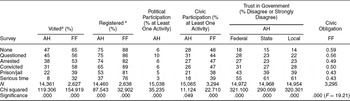
Table 1 depicts the bivariate relationship between custodial involvement and political attitudes and behavior. In both surveys, respondents who experienced criminal justice contact were significantly less likely to report having voted in the last presidential election.Footnote 17 Table 1 also highlights that there is declining participation at every level of contact with criminal justice authorities; even a minor encounter with the police that did not result in arrest is associated with a reduced likelihood of turning out in an election. The gap in participation is largest for more significant encounters with criminal justice, such as incarceration; for example, in the Add Health study, only 8% of respondents reported having voted if they had served a lengthy sentence behind bars. In the Add Health study, it is likely that depressed participation is the result of both decreased turnout and formal exclusion from exercising the franchise. By comparison, felon disenfranchisement is not the only reason for diminished voting among Fragile Families respondents because our measure of voting in that study specifically excludes those who were not eligible to vote. Thus, the differences in turnout that are evident in these data represent the gap in voting between custodial and noncustodial legally eligible voters. Similar to voting and registering, the importance of criminal justice involvement is also evident in other political activities such as contacting a government official or contributing to a political party or candidate, as measured by the index, although the relationship is weaker. A reduction in these activities appears only for those who have been incarcerated.
Bivariate Relationships between Criminal Justice Contact and Various Measures of Participation and Political Attitudes

AH, Add Health; FF, Fragile Families.
aVoted and registered percentages exclude noncitizens.
Civic engagement is similarly defined by encounters with the criminal justice system. Table 1 shows that those who experience punitive interventions—from police questioning to incarceration—are much less likely to seek out civic society and participate in cultural, social, or political groups. In addition, commitment to civic traditions shrinks as exposure to crime control authorities grows. People who experienced an encounter with criminal justice institutions were much less likely to believe that it was important to vote, serve on a jury, volunteer time to community service, or serve in the military, and this effect grew starker with more severe encounters. Consistent with these findings, people who undergo criminal supervision of any kind also express less confidence in government. For example, only 18% of respondents who had not encountered criminal justice in any form said they disagreed or strongly disagreed that they trusted the federal government; this percent rises to 28% and 27% for those who were questioned or arrested, 31% for those who were convicted, 43% for those who had been incarcerated, and 55% for those who had experienced imprisonment of substantial duration.
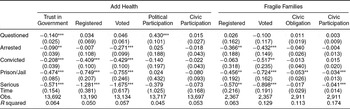
So far, our results suggest that contact with criminal justice is associated with diluted political engagement; those who have dealt with the supervisory, punitive side of the state are less likely to be politically active or engaged in civic society and have less trust in government. These results are striking, but one might reasonably ask whether they show a causal effect or only an association. To address these concerns, our analysis must take into account a host of potentially confounding factors. Table 2 presents the results of a set of multivariate analyses estimating the effects of a criminal justice intervention on later political expression. If the effect of punitive encounters is working through other distinctive aspects of the carceral population or self-selection, then the significant relationships should disappear when controls are introduced.
Multivariate Results

Notes: Dependent variables Registered, Voted, and Political Participation are based on Logit and exclude noncitizens; all other models are ordinary least squares (OLS). For space considerations, models in Add Health include controls not displayed here for race, age, gender, region, education, income, parental education, unemployment, marital status, citizenship, property crime, violent crime, self-control, military, and welfare receipt. For Fragile Families, models control for race, age, education, income, parental education, unemployment, poverty level, marital status, citizenship, domestic violence, drug use, self-control, cognitive ability, military, and welfare receipt. Full results tables are available from the authors. Standard errors in parentheses.
***p < .01, **p < .05, *p < .10.
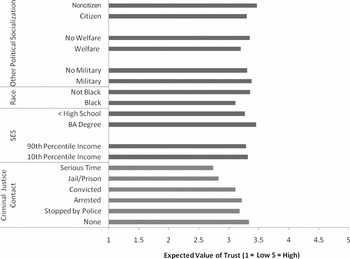
In both the Add Health and the Fragile Families data, the substantial impact of custodial status on political outcomes remains even after accounting for differences in SES and demographic factors. The left side of Table 2 shows the results from the Add Health data. Involvement with criminal justice significantly depressed a person's trust in government, independent of propensity for criminal behavior and other factors. More important, damage to trust grew with increasing severity of the interaction (with the exception that being stopped by the police had a relatively larger effect than being arrested, holding all else constant). Specifically, being stopped and questioned by the police is associated with a 3% decrease in trust in the government, being arrested is associated with a 2% decline, a court conviction is associated with a 4% decline in trust, being incarcerated is associated with a decline of 9%, and having been incarcerated for 1 year or more was associated with a decline of 11% net of other factors. The magnitudes of these custodial contact effects are large; to provide a point of reference, we show in Figure 1 that the predicted decrease in trust between having no contact and having been incarcerated is an order of magnitude larger than standard individual-level predictors such as education, income, and race, and criminal justice contacts are associated with larger gaps in attitudes than other types of socializing experiences, such as receiving welfare or serving in the military. In short, having had encounters with criminal justice is a large predictor of an individual's trust in government.
Expected Value of Trust in Government by Criminal Justice Contact, Holding Other Factors Constant at Their Means [From National Longitudinal Study of Adolescent Health (Add Health), 2001−2002]

Similarly, contact with criminal justice is also related to a decline in voting and registering to vote in Add Health (Table 2). The measures of registering to vote and voting in Add Health, unlike Fragile Families, include people who are potentially ineligible to vote based on a felon conviction; thus, the effects of criminal justice contact on turnout and registration in these data are tapping into both formal and informal barriers to voting. Using Clarify to interpret the coefficients of the logistic regressions, we find that the likelihood of registering to vote declines by 8% for those who were convicted in adult court (but did not serve hard time), 16% for those incarcerated less than 1 year, and 29% for those who had been imprisoned for at least 1 year, holding other factors constant at their means (King, Tomz, and Wittenberg Reference King, Tomz and Wittenberg2000; Tomz, Wittenberg, and King Reference Tomz, Wittenberg and King2003). Criminal justice involvement also lessened the likelihood of voting, and the magnitude of the effect was larger for more severe punitive encounters: holding other factors constant at their means, being arrested reduced the likelihood of voting by 7%; being convicted reduced the odds of turning out by 10%; being sentenced to jail or prison reduced it further by 17%, and serving more than 1 year reduced the likelihood of voting by nearly one third. Again, the effects are substantial; to compare, being unemployed is associated with a decline of less than 3% in the predicted probability of voting; receiving welfare decreased the likelihood of voting by 7%; and the probability of voting increased by 6% moving from the 10th to 90th income percentile (similar in size to being arrested). The only factor that outdoes custodial contact in the size of its influence is having a college degree (associated with a 42% increase in voting).
There are two exceptions to the pattern of results so far. The relationship between contact with criminal justice and other means of participating was largely insignificant after accounting for other influences, and one significant association is not in the hypothesized direction (being questioned by the police was positively related to participation). Civic participation also did not exhibit a strong relationship to criminal justice contact. These (non)results may be due to weak measures. Specifically, very few people actually reported having done any of the political participation items in the past year; only 2.6% contacted an official, 1.8% contributed money to a party or candidate, and 3.3% reported participating in a political rally; negligible percentages of study respondents actually ran for a public or nonpublic office. This likely reflects the young age of the sample. This was not the case for participation in civic groups, which 28% of the sample reported having done in the past year. However, there are important reasons for the absence of a relationship here; perhaps respondents who had had a disciplinary encounter were just as likely to do voluntary work with a group because they were court ordered to do so as a provision of their parole or probation. Unfortunately, we cannot further test this speculation because no measure of whether the community service was voluntary or court ordered is available.
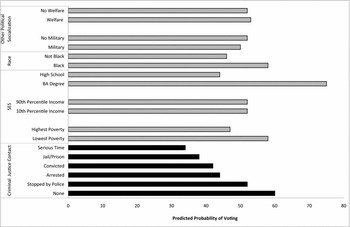
Contact with the criminal justice system continued to be an important influence on political engagement in the Fragile Families study, largely replicating the pattern seen in Add Health. As Table 2 indicates, criminal justice involvement was associated with a significant decline in the likelihood of being registered to vote or voting in the last presidential election, independent of other influences, including poverty, education, and criminality. Being arrested, incarcerated, and confined for 1 year or more was associated with a decrease of 5%, 6%, and 8%, respectively, in the probability of registering to vote. Figure 2 depicts the probability of voting using Clarify to interpret the logistic coefficients. The probability of voting declined 8% for those who had been stopped and questioned by the police; by 16% for those with a history of being arrested; by 18% for those with a conviction; by 22% for those serving time in jail or prison; and, if this sentence was more than 1 year in duration, the probability of voting declined by an overwhelming 26%, holding other factors at their means. These effects are quite large, given that the probability of voting only decreases by 11%, moving from the lowest to highest level of poverty. The effect of being incarcerated or imprisoned is larger in size than having a college-educated parent, being in the military, receiving welfare, and being black. Like Add Health, only the effect of a college diploma is larger in size (increases voting probability by 31%). Similar to voting and registration, participation in civic groups was also affected, however, only for those who were incarcerated or imprisoned (the results for those who were stopped, arrested, and convicted are not significant after controls are included). Commitment to civic obligations—serving on a jury, serving one's country in war, serving one's community, and going to vote—is also significantly related to encounters with the punitive side of the state, although again this effect did not reach significance for lower levels of criminal justice involvement after controls were included.
Predicted Probability of Voting by Criminal Justice Contact, Holding Other Factors Constant at Their Means (From Fragile Families and Child Wellbeing Study, 2001–2003.)

To summarize the results, there is a large, negative effect of criminal justice contact for several aspects of political life—turning out to vote, involvement in civic groups, and trusting the government—and these effects persisted net of SES and criminality. Consistent with our hypotheses, more severe encounters were associated with a larger decline in political participation and trust. Nor were these results unique to either survey. Results obtain and are largely consistent across two very different samples—one being largely unmarried parents from seriously disadvantaged circumstances in urban settings, and the other being a young adult population that is more highly educated and nationally representative. In addition, it is not just that custodial populations come from disadvantaged backgrounds or are prevented from voting due to felon exclusions; the results point to the large, independent effect of punitive encounters that does not depend on preexisting characteristics and is not only the result of formal disenfranchisement. In fact, it is likely that we have somewhat underestimated the effect of incarceration and punitive encounters, given that many of the factors we controlled for have also been documented as consequences of incarceration (marital instability, less income, poverty). In addition, these effects persist despite our accounting for factors that predict the risk of criminal justice involvement. In each multivariate model, we include controls for criminal thinking, as well as self-reported incidents of nonviolent and violent crime. The effects of custodial status are robust and large even after accounting for these potential confounders. This suggests that criminality does not drive lower participation per se, but that contact with agencies of criminal justice does.
As a first robustness check of our results, we compare political attitudes and behaviors across four subgroups of the Add Health sample: respondents with no history of illegal drug use or criminal justice contact (N = 6,266), respondents with no history of illegal drug use but with custodial contact (N = 628), respondents with illegal drug use and no custodial contact (N = 5,631), and respondents with both illegal drug use and custodial contact (N = 2,282). Differences in voter turnout and registration, trust in government, political participation, and civic participation across the four groups are all highly significant (F test p < .001 for all tests). Those with both illegal drug use and custodial contact have the lowest levels of civic and participation and the least political trust of the four groups. For example, 47% of non−drug users with no contact report having voted in the last election, and 44% of both non−drug users with contact and drug users with no contact report voting. By comparison, 37% of drug users who had some type of criminal justice contact turned out to vote.
We then examine the effects of criminal justice contact among only the subset of 7,913 Add Health respondents who self-report illegal drug use. Limiting the sample to only those respondents who took part in illegal drug activity helps confirm that the effects of criminal justice contact are not solely the result of preexisting criminal tendencies. In multiple regression models that estimate effects of progressive contact among only this subset, we find consistent effects; among illegal drug users, contact with the criminal justice system decreases trust and lowers voter registration and turnout. As in the full sample, there is no significant effect on our other measures of political and civic participation once we control for the full set of confounders, and we interpret these nonsignificant results similarly to our previous discussion. Also, as in the full sample analyses, the size of the effects increases as contact becomes more intense. For example, ceteris paribus, being questioned or arrested lowers trust by about 2%, being convicted by about 3%, serving time in prison or jail by about 9%, and serving serious time lowers trust by roughly 11%. The same results are obtained in similar models when the sample is further restricted to include only serious illegal drug users, excluding those who report using only marijuana, steroids, or prescription drugs.Footnote 18
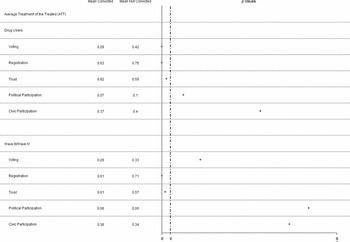
We then use weights from genetic matching to create a matched set of convicted and never convicted drug users, ensuring that the two groups are well balanced on the full set of covariates that we describe in the preceding parametric models, as well as on a propensity score that predicts having been convicted of a crime. After matching, there are no significant differences on baseline covariates in the matched sample between illegal drug users who have been convicted of a crime and those who have not.Footnote 19 However, there are differences between the two groups in the outcomes of interest, as shown in Figure 3. Among self-reported drug users, having a criminal conviction lowers trust in government by about 3% and reduces voter registration and turnout by roughly 13% each. We find similar effects of other types of contact, and the effects are larger as contact becomes more severe.Footnote 20
Treatment Effects of Criminal Conviction

Our second cut at establishing causality follows a somewhat similar logic. Here we compare the political attitudes and behaviors of respondents in Wave III who have experienced a criminal justice intervention against a demographically comparable group of Wave III respondents who have not yet experienced that type of contact, but who will have joined this segment of the custodial population by Wave IV. That is, we compare our treatment group (those who report a criminal contact by the third wave survey) with our control group (those who do not report that type of criminal contact by the third wave but do report one in the fourth wave) on political outcomes at Wave III. In bivariate analyses, those who have been convicted of a crime by Wave III, compared to those who have not yet but will have by Wave IV, are less likely to vote (47% compared to 34%, chi squared = 87.72, p < .001), register (74% to 67%, chi squared = 27.98, p < .001), or participate politically in another way (7% compared to 5%, chi squared = 5.24, p = .01). They also have lower levels of political trust (F stat = 103.21, p < .001) and civic participation (F stat = 41.95, p < .001). In a multiple regression similar to those described previously, having a conviction at Wave III relative to those who do not have a conviction until Wave IV predicts a decrease of 4% in trust and 10% in the likelihood of registering to vote. As before, we also conduct a nonparametric analysis using genetic matching. Results are shown in Figure 3. In our matched sample, we again find a significant and negative effect of a criminal conviction on trust (3%) and registration (10%).Footnote 21
As a final placebo test, we compare respondents who do not have a conviction in Wave III but will in Wave IV with those who do not report this type of carceral contact in either wave. As expected, we find that future convicts in Wave III, ceteris paribus, have political attitudes and behaviors that are statistically indistinguishable from respondents who report no contact with criminal justice in either wave. Put simply, future criminal justice contact is not predictive of political attitudes and behavior. This further confirms our assertion that these differences reflect a treatment effect of contact with criminal justice that is independent of existing differences related to the probability of criminal offending.
Taken together, we find these results to be quite persuasive of a causal effect of criminal justice contact. Our regression analyses provide straightforward and easily interpretable estimates of the effects of carceral contact and allow for a comparison between the size of the criminal justice effect and other salient variables. Our matching analyses allow us to estimate treatment effects without the parametric modeling assumptions required for regression. In addition, by limiting the sample to self-reported illegal drug users or only those with a criminal conviction, as well as balancing the treatment and control groups on measures of violent and nonviolent criminal behavior, criminal cognitions, and a propensity score predicting conviction, we ensure that it is unlikely to be selection alone that is driving our results. Instead, these analyses strongly suggest that the causal arrow goes in the hypothesized direction—experience with incarceration and other punitive interventions depress political engagement. The fact that we find consistent support for our hypotheses across these different estimation procedures is compelling.
DISCUSSION
Our findings have implications for four scholarly debates. First, scholarship on political participation and civic engagement should consider not only individual resources, interest, and mobilization as ingredients for political involvement, but also the way the state shapes individual civic capacities, efficacy, and perceptions of government. Our findings suggest that contact with the institutions of criminal justice is important in structuring patterns of participation long assumed in the dominant literature to stem primarily from aspects of the individual. These findings are especially important vis-à-vis the vibrant recent attention to participatory inequality. If we take seriously the results presented here, they suggest that those with contact at every level of criminal supervision withdraw from political life—they are less likely to participate in civic groups, they are less likely to express their political voice in elections, and they are less trusting of government. Thus, the carceral state carries deep implications for who is included and how they are included in the polity. It is therefore troubling that the study of inequality in politics, itself the subject of a recent Task Force in the American Political Science Association, has barely registered the carceral earthquake.
Second, and related, this study suggests that state interventions of the punitive, not just redistributive, side of the state matter in ways that have not yet been fully explored. Scholars in the tradition of public policy and institutionalism have long recognized the limitations of the participation literature, noting that they have “given little heed to the role of government in citizens’ lives” (Mettler Reference Mettler2007, 643; see also Mettler and Soss Reference Mettler and Soss2004). To fill that gap, studies of the GI Bill, Social Security, welfare, and other social policies have flourished, making important inroads into our understanding of how policy shapes democratic citizenship. However, the role of government in citizens’ lives is often conceptualized in this literature as relatively circumscribed, defined mainly as social policy interventions meant to ensure against poverty and unemployment and provide a safety net for the elderly, veterans, and children. With few exceptions, these recent studies find that policies boost the civic and political participation of citizens by giving them critical resources, civic teaching, and the motivation to enter the political fray when policies important for their well-being are threatened. By expanding our view of the ways government plays a direct role in citizens’ lives, our study points to the ways government activity can also serve to demobilize and dissuade citizens from engaging in political life.
Third, this research builds on several studies by sociologists and economists that have linked incarceration to economic hardship, poor health outcomes, and family destabilization. For example, researchers estimate that prison confinement results in a 6% decrease in employment and between a 15% and 26% decrease in wages (Geller, Garfinkel, and Western Reference Geller, Garfinkel and Western2006), the substantial black−white disparity in marriage would be cut in half without incarceration (Western, Lopoo, and McLanahan Reference Western, Lopoo, McLanahan, Pattillo, Weiman and Western2004), the black–white gap in infant mortality would be decreased by 23% if incarceration had stayed at its 1973 level (Wildeman Reference Wildeman2009), and incarceration explains approximately 70% of racial health disparities such as AIDS (Massoglia Reference Massoglia2008). We add to the growing literature on the “collateral consequences” of incarceration by showing that the effects of punitive encounters are not limited to economic marginality or the disruption of marital bonds, but have a political dimension as well.
Finally, we extend the small but growing studies of felony disenfranchisement (Drucker and Barreras Reference Drucker and Barreras2005; Haselswerdt Reference Haselswerdt2009; Manza and Uggen Reference Manza and Uggen2006; Marable, Steinberg, and Middlemass Reference Marable, Steinberg and Middlemass2007; McLeod, White, and Gavin Reference McLeod, White and Gavin2003; Miles Reference Miles2004). For example, Chris Uggen and Jeff Manza (Reference Uggen and Manza2002) estimate that, in the absence of felon disenfranchisement laws, 35% of ex-felons would have voted in the 2004 presidential election, and that these laws have had a significant impact on several close U.S. Senate elections and at least one presidential election. These studies are important. However, we argue that criminal justice involvement has a large effect on a broader array of civic attitudes and forms of participation, and that these varied political effects extend not only to those who are legally disenfranchised, but also to the large and growing numbers of citizens who experience direct contact with state agents of crime control.
Thus, from distinct scholarly perspectives and each in their own way, studies of political participation, policy feedback, and sociology have inadvertently treated criminal justice as a politically neutral institution in the lives of citizens. Political participation scholars and scholars in the policy feedback/institutionalist tradition have neglected the punitive activity of the democratic state, whereas scholars of criminal justice have long understood the importance of coercive citizen—state interactions but have focused primarily on their social and economic consequences. In contrast, this study establishes criminal justice as a set of institutions with political significance, a force that citizens are increasingly likely to encounter in their daily lives.
Still, this article is only a first step toward understanding how carceral contact shapes conceptions of government, citizenship, and the state. We see at least four distinct directions for future research on what the punitive expansion means for American politics. Most obviously, this article examines only a limited set of dependent variables—participation, civic engagement, civic norms, and trust. We remain in the dark about whether and in what ways punitive encounters shape a broader array of political attitudes and identities. However, the potential to pursue this type of analysis will be limited until surveys of American politics begin incorporating items that query respondents about their contact with the criminal justice system (as the General Social Survey has begun to do). Second, scholars might also investigate how criminal justice contacts shape racial “narratives,” given that criminal justice is a disproportionately routine experience among black citizens. One preliminary investigation finds that blacks who have been stopped, arrested, convicted, or incarcerated are much more pessimistic about racial equality in America, more likely to perceive widespread discrimination against themselves and their group, and more likely to believe that the prospects for their group were severely limited (Lerman and Weaver Reference Lerman and Weaver2010). Third, given that experience with criminal justice is so heavily concentrated geographically, political scientists could also explore if punitive contact has a community level dimension. For example, scholars have suggested that the concentration of incarceration alters the civic health of communities, fraying the bonds of its residents and diminishing social capital and networks (Rose and Clear Reference Rose and Clear1998). Finally, future studies should unravel the specific mechanisms through which punishment and surveillance activities influence the political lifeworlds of Americans. In particular, it will be critical to examine whether and how different types of contact operate in different ways to shape citizens’ political behavior and understandings.
Political scientists have been slow to evaluate the supervisory provision of government compared to its redistributive role, even though the social arena is but one of the ways the state acts on its citizens, and growth in the former has increasingly outpaced and overshadowed the latter [for important exceptions, see Gottschalk Reference Gottschalk2006 and Miller Reference Miller2008]. We began by hypothesizing that the more frequent and increasingly intense contact with the state that the criminal justice system engenders leads citizens to adopt a particular set of “transcripts” and political worldview, a uniquely negative experience of democracy, and a criminal justice–centered framework for understanding government and one's role in the civic community. Our results suggest in no uncertain terms that the exponential growth in the carceral state will have important, and increasingly detrimental, consequences for the American political landscape. And in a society founded on democratic inclusion and political equality ideals, these developments are deeply troubling. It is time scholars of American politics took notice.




Comments
No Comments have been published for this article.