INTRODUCTION
Lough Hyne Marine Reserve in County Cork, south-west Ireland is at the interface between two biogeographical provinces. Thus, the lough has a tremendous biodiversity of cold-temperate Atlantic marine species as well as warm-temperate Lusitanian species. The presence of a few noteworthy Mediterranean and Lusitanian species of fish, invertebrates and seaweeds has been long known. Salient examples include trigger fish, several unusual species of nudibranchs and numerous species and varieties of ‘southern' seaweeds (Myers et al., Reference Myers, Little, Costello and Partridge1991).
In this study, we report records of a large, orange nemertean worm: Paradrepanophorus crassus (Quatrefages, Reference Quatrefages1846). Although not a new record for Lough Hyne, the unusual and largely overlooked nemertean has become much more frequent in recent years. The nemertean occurs under rocks from ‘just below the low-tide mark' (Sheppard, Reference Sheppard1935: 234) to 5 m (Gibson, Reference Gibson1982; Hayward & Ryland, Reference Hayward and Ryland1990, Reference Hayward and Ryland1995). The species also occurs in ‘a delicate membranous, glistening, parchment-like tube, which is secreted by the worm, fixed to the under side of large stones' (Sheppard, Reference Sheppard1935: 234). The species attains lengths of 160 mm long and 8–12 mm wide (Sheppard, Reference Sheppard1935; Gibson, Reference Gibson1982, Reference Gibson1994; Hayward & Ryland, Reference Hayward and Ryland1990, Reference Hayward and Ryland1995). Renouf (Reference Renouf1931) called the specimens ‘bright orange-coloured' whereas Sheppard (Reference Sheppard1935: 235) contended that the ‘worm can hardly be bright orange-coloured. Actually the mid-dorsal region is a brown colour, which shades into a dull orange towards the lateral margins. The ventral surface of the worm is pinkish white in colour.' The body is flattened and tapered at both ends; there are white cephalic furrows with brown secondary slits on the head (Stiasny-Wijnhoff, Reference Stiasny-Wijnhoff1926; Gibson, Reference Gibson1982, Reference Gibson1995; Hayward & Ryland, Reference Hayward and Ryland1990, Reference Hayward and Ryland1995). Our observations strongly support Renouf's record of species coloration.
We also report a photographic record of another large (but striped) nemertean, Punnettia splendida (Keferstein, 1862). This species is distributed along the French and British coasts of the English Channel (Gibson, Reference Gibson1995). There is a single, published record for Ireland, on the west coast (Gibson, Reference Gibson1995, Reference Gibson2009; Guiry & Guiry, Reference Guiry and Guiry2011). Whether the record actually refers to Galway (as shown in Gibson, Reference Gibson2009) is unclear as the list is for the country. No vouchered specimens have been located and CEDaR records (Centre for Environmental Data and Recording) at the Ulster Museum (courtesy of Dr Julia Nunn) have no records of either nemertean species under their current names or various synonyms.
MATERIALS AND METHODS
Lough Hyne Marine Reserve (51°30′N 9°17′W) is a semi-enclosed, fully marine sea lough in County Cork, south-west Ireland. The lough is ~1 km long and ~0.5 km wide (Figure 1) and is connected to the Atlantic Ocean by a shallow, narrow (25 m wide at high tide, 12 m at low tide) channel called the Rapids. Our records of the large orange nemertean came from long-term monitoring of the intertidal and sub-tidal benthic communities at fixed sites around the lough—a continuation of earlier studies by Ebling et al. (Reference Ebling, Sleigh, Sloane and Kitching1960) and Little et al. (Reference Little, Morritt and Stirling1992). Some preliminary observations were made in 1990 and 1991 (Little et al., Reference Little, Morritt and Stirling1992), but routine surveys were carried out annually from 1994 to 2011 in the last week of August and/or first two weeks of September. Using fixed monitoring sites, we examined 10 m sections of shore at low tide and recorded abundance of ecologically significant species. The 10 stations (names and locations shown in Figure 1) were a subset of the 20 described by Ebling et al. (Reference Ebling, Sleigh, Sloane and Kitching1960). We turned over all the shallow subtidal rocks at each site and recorded the number of nemerteans. To ensure non-destructive sampling of the historical sites, we did not collect or disturb the nemerteans from these locations.
(A) Map of south-western Ireland, indicating location of Lough Hyne; (B) map of Lough Hyne, indicating Renouf sectors and sites at which Paradrepanophorus crassus was recorded during this study and previous ones. Monitoring sites include orange circular symbols (nemertean records) and black ones (no records). Supplementary sites are indicated by red diamonds (when nemerteans present). Locations on the north shore of Castle Island are approximated as Sheppard (Reference Sheppard1935) did not report specific Renouf sectors.

In 2011, we selected eight additional 10 m sites (3 on the south shore and 5 on the west shore) to supplement the monitoring sites. The sites were selected based on availability of low-shore rocks (25 to 50 cm diameter). These sites were used to evaluate whether the annual rock-turning influenced the abundance of nemerteans and to find specimens to be collected. In June 2012, we selected an additional 12 sites (each 10 m long): five on the south shore and seven on west shore. A total of 379 rocks were turned in search of nemerteans over the 120 m of shoreline investigated in June 2012.
RESULTS
SYSTEMATICS
Class ENOPLA
Order HOPLONEMERTEA
Suborder POLYSTILIFERA
Family PARADREPANOPHORIDAE
Paradrepanophorus crassus (Quatrefages, Reference Quatrefages1846)
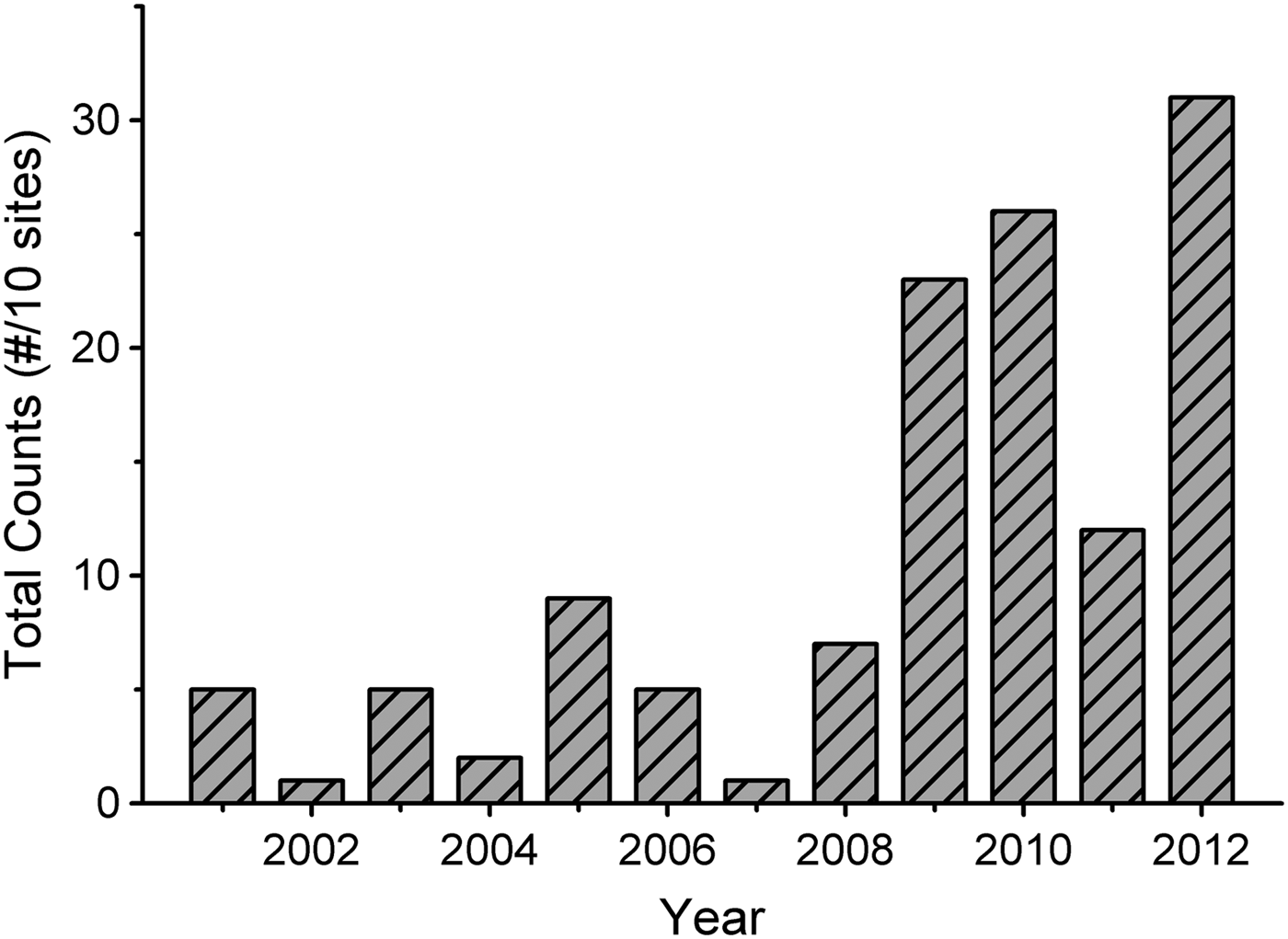
During annual sampling of monitoring sites from 1994 to the present, the large, orange nemertean Paradrepanophorus crassus was first observed in 2001. In the last 12 years, we have recorded the species at 9 of the 10 monitoring sites (Figure 3). The nemertean was most consistent at Codium Bay (south-east corner of lough) near the top of the tidal rapids that connect to the open ocean. The nemertean species was also commonly found on the western shore (Westwood South and Westwood North) and south-east Labhra (Figure 1). The nemertean was never recorded from North Island, which had virtually no shallow sublittoral rocks (the site is an outcrop, not part of the shoreline). Furthermore, in recent years, the habitat underneath the low-shore rocks at East Goleen and East Castle has been anoxic with no P. crassus.
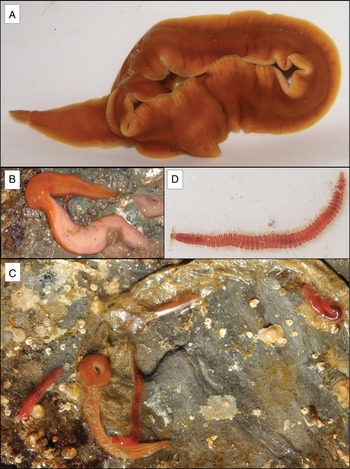
Specimens had a bright orange dorsum and paler ventral surfaces (Figure 2A, B); they were almost always found inside parchment tubes or had tubes near them. On some occasions parchment tubes were found without worms, and it was impossible to know whether these were old tubes or recently inhabited tubes. In 2009, 2010 and 2012, we recorded >20 specimens overall (Figure 3) and several of the specimens were substantially larger than we have seen before. In 2011, one of largest specimens collected from the new sites weighed 6 g (wet weight) (Figure 2A). Overall peak density (2012) was 0.31 P. crassus per metre of low shoreline searched. Values of 0.16/m were found in 2011 at the study sites and 0.14/m at the 18 areas searched. In June 2012, nemertean abundance was lower (0.04/m of shoreline) but this could have been a seasonal effect (mid-June vs late-August/early-September sampling). Finally, one tube collected in June 2012 contained eggs.
Specimens of Paradrepanophorus crassus photographed in August 2010 and September 2011: (A) dorsum of large (6 g wet weight), adult specimen; (B) view of the orange dorsum and pale ventral surface. Shiny parchment tubes visible in A and C; (C) specimen of Punnettia splendida and red polychaetes associated with many nemertean specimens; (D) close-up of polychaete.

Total number of Paradrepanophorus crassus at the 10 monitoring sites in Lough Hyne Marine Reserve recorded during the annual community-level survey.

Based on numerous colour images of P. crassus and its membranous tubes, we have recorded frequent occurrences of a bright red polychaete in or near the tubes (e.g. Figure 2C, D). In 2011, polychaetes recorded in and around the nemertean tubes included at least three species of worms, including scale worms (family Polynoidae), fire worms (family Amphinomidae) and red-coloured worms (family Dorvilleidae). The association of the worms was not obligate: sometimes the nemerteans co-occurred with the polychaetes and other times not (at the scale of individual rocks).
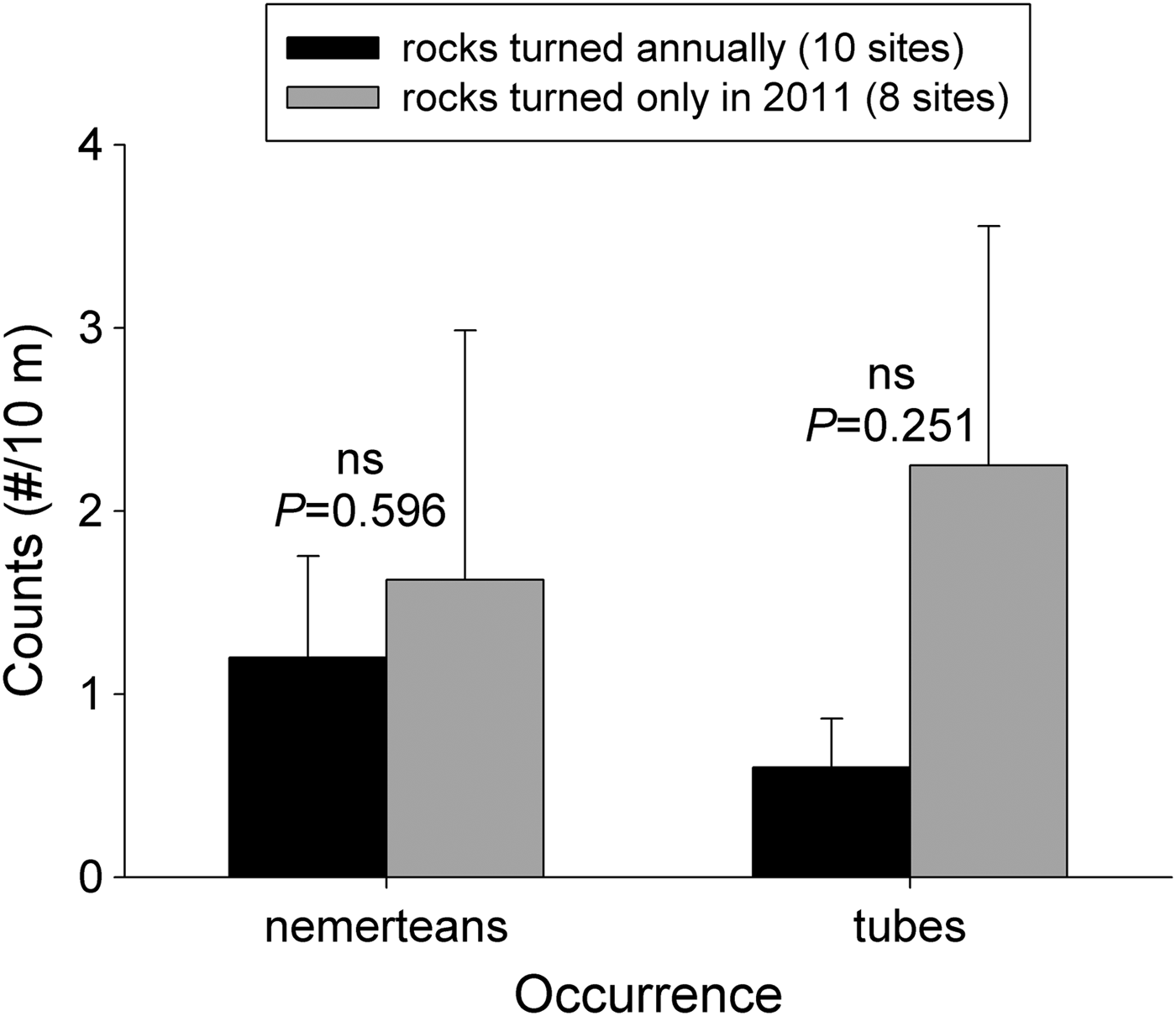
In 2011, the abundance of P. crassus did not differ significantly (Mann–Whitney U-test, P = 0.596) between sites where rocks had been turned annually (2004–2011) and turned just in 2011 (Figure 4) indicating annual rock turning does not influence the abundance of nemerteans. Furthermore, the frequency of membranous tubes, while variable, also did not differ significantly (P = 0.251).
Nemertean abundance in 10 m sections of the shore under low-shore rocks. Number of replicate sites is indicated. Error bars denote 1 standard error. P values are based on Mann–Whitney U-tests.

Class ENOPLA
Order HOPLONEMERTEA
Suborder POLYSTILIFERA
Family DREPANOPHORIDAE
Punnettia splendida (Keferstein, 1862)
Our photograph of the striped nemertean (Figure 2C) appears to be Punnettia splendida (Keferstein, 1862), a species known from the English Channel and western Ireland (Gibson, Reference Gibson1994). Although we did not collect the specimen (as it resided in one of our long-term monitoring sites), five dorsal longitudinal stripes are clearly visible and there are no transverse bands. The ventral surface was not observed but the lateral margins were pale. The distribution of the ocelli cannot be fully resolved from the photograph but the non-interrupted dorsal lines and the general appearance strongly support the specimen as P. splendida. In September 2012, another specimen of P. splendida was collected as part of a more detailed study of nemerteans in the lough (Laurel Hiebert, personal communication).
Whether Punnettia splendida enters the tubes of Paradrepanophorus crassus or whether it produces similar tubes in the same environment is not clear. Irrespective of this issue, the two nemertean species clearly coexisted under the same rock along with polynoid and dorvilleidaean polychaetes.
DISCUSSION
Nemertean records
Paradrepanophorus crassus was first found in Lough Hyne by Renouf (Reference Renouf1931) on the south shore (recorded under the name Cerebratulus marginatus Renier) in Renouf sectors S12–S17 (Figure 1). Based on his investigation of internal and external anatomy, Sheppard (Reference Sheppard1935) noted that the species did not belong to the genus Cerebratulus despite the flattened body; he showed that specimens were consistent with Stiasny-Wijnhoff's (1926) description of P. crassus. It was subsequently recorded ‘not uncommonly on the south shore' by Sheppard (Reference Sheppard1935) who also found it on the northern shores of Castle Island (Figure 1). Kitching & Thain (Reference Kitching and Thain1983) also recorded the species in S2; it was identified for them by Ray Gibson, the leading specialist in European nemerteans.
Paradrepanophorus crassus was originally described from Mediterranean shores (Italy and environs) by Quatrefages (Reference Quatrefages1846). Although Stiasny-Wijnhoff (Reference Stiasny-Wijnhoff1926) considered nemertean specimens from non-Mediterranean locations to be other species, subsequent authors did not necessarily agree. Härlin & Härlin (Reference Härlin and Härlin2001) reported that P. crassus is one of only a few broadly distributed nemerteans with the dispersal from the Mediterranean to the north-east Atlantic to be ‘unequivocal'. Joubin (Reference Joubin1894) reputedly collected P. crassus from the Atlantic coasts of France (Stiasny-Wijnhoff, Reference Stiasny-Wijnhoff1926). Anadón (Reference Anadón1980) and Vernet & Anadón (Reference Vernet and Anadón1991) recorded the species from Atlantic Spain. Intriguingly, there are also reports of the species in the western Atlantic: Puerto Rico, USA, and the West Indies (e.g. Coe, Reference Coe1951). Norenburg (Reference Norenburg, Felder and Camp2009: 558) reported the species' geographical range to be ‘global, warm water' and Gibson (Reference Gibson and Gibson2010) included all the regions mentioned above.
As these records are based on morphological features, molecular comparisons of the eastern and western Atlantic specimens are needed to confirm they are indeed conspecific. In fact, Norenburg (Reference Norenburg, Felder and Camp2009: 555) suggested that ‘the potential for cryptic species or unrecognized morphological differentiation is high among nemerteans.' Our colleague, Laurel Hiebert (OIMB), confirmed that our Lough Hyne specimens matched those in GenBank for P. crassus.
Kay (Reference Kay2011: 126) reported a large orange nemertean in Lough Hyne; he suggested that the species was possibly the flaming ribbon worm Nipponnemertes pulcher (Johnston, 1837). Based on Gibson (Reference Gibson1994), our specimens were not N. pulcher. Key distinguishing features between the taxa include the placement of ocelli and the number of stylets. Paradrepanophorus crassus has ocelli arranged in ‘four distinct longitudinal rows on the head' (Gibson, Reference Gibson1994: 50) whereas N. pulcher does not. Furthermore, P. crassus is polystiliferous whereas N. pulcher is monostiliferous.
Ecological notes
Tube formation is sometimes, though not always, a taxonomically linked character. For example, many or most species of the genus Tubulanus often secrete ‘cellophane- or parchment-like tubes' (Ritger & Norenburg, Reference Ritger and Norenburg2006; references therein). Yet, Tubulanus is in a different nemertean order than Paradrepanophorus. Tube formation can, in other cases, vary within populations that are known to be conspecific (S. Maslakova, personal communication). Records of P. crassus (other than in Lough Hyne) typically do not mention the tube. According to Sheppard (Reference Sheppard1935), Stiasny-Wijnhoff reported that the nemerteans continuously secreted mucus, making mucous tubes, and she presumed that this indicated that tube-production was a response to unfavourable conditions. Perhaps the under-rock community in Lough Hyne is more oxygen-stressed than on Mediterranean shores. Our unpublished oxygen measurements indicate that the under-rock habitat in the lough is often hypoxic in late summer.
Why the nemertean populations are expanding in Lough Hyne in the past few years is unclear. On one hand, P. crassus has a Lusitanian to Mediterranean distribution (for the north-east Atlantic records) so increases in abundance could indicate a warming climate. Several other ‘southern' species are expanding populations in Lough Hyne including seaweeds and snails. On the other hand, the nemerteans occupy the same habitat as the purple urchin Paracentrotus lividus (Lamarck, 1816); the dramatic decline of urchin populations in Lough Hyne (Trowbridge et al., Reference Trowbridge, Little, Pilling, Stirling and Miles2011) may have made additional habitat available for the nemertean. Irrespective of the mechanism, the tube-dwelling nemertean is currently expanding its under-rock populations within the lough.
Also intriguing are the consistent observations by Renouf (Reference Renouf1931), Sheppard (Reference Sheppard1935) and the present study that there is a red polychaete associated with the nemertean. The first two studies suggested that the polychaete Dorvillea rubrovittata (Grube, 1855) [previously called Staurocephalus rubrovittatus] was commensal (though no evidence was provided beyond a regular association). In 2011, we collected the polychaete to confirm its identity. It belongs to the family Dorvilleidae (based on the Natural History Museum's online polychaete key accessible at: http://www.nhm.ac.uk/research-curation/research/projects/taxinfo/index2.html). We presume it is D. rubrovittata, based on its colour (bright red) and its frequent coexistence with the nemertean in Lough Hyne (Figure 2C, D). However, in 2011, we noted that the association is not as consistent as Renouf and Sheppard presumed. We found multiple cases where: (1) no D. rubrovittata specimens were present; (2) two species of scale worms were associated with and/or in the nemertean tubes; and (3) D. rubrovittata was present under rocks in the absence of nemerteans or their tubes.
Furthermore, in other areas of the British Isles and the Mediterranean Sea, D. rubrovittata is apparently not associated with the nemertean (i.e. not mentioned in Gibson, Reference Gibson1982; Hayward & Ryland, Reference Hayward and Ryland1990, Reference Hayward and Ryland1995). To our knowledge, though one group of nemerteans is specifically associated with crustaceans (e.g. as egg predators), nemerteans do not form associations with polychaetes. Dorvillea rubrovittata has also recently been reported from Japan (Imajima, Reference Imajima1992). The polychaete species' known range is the Adriatic and Mediterranean Seas, tropical West Africa, and Japan (Imajima, Reference Imajima1992) as well as Lough Hyne (Ireland); thus, the nemertean and purported commensal co-occur in only some geographical areas. The relationship of these two species merits further examination.
ACKNOWLEDGEMENTS
We are grateful to Declan O'Donnell and Patrick Graham of the National Parks and Wildlife Service for permission to carry out research in the Lough Hyne Marine Reserve. We are particularly grateful for help received from the late warden of the lough, John Bohane, and we were much helped by information and assistance from Rob McAllen. This material is based upon work partially supported by the National Science Foundation under Grant No. 0211186. Any opinions, findings, and conclusions or recommendations expressed in this material are those of the authors and do not necessarily reflect the views of the National Science Foundation. Over the period of the surveys, we are indebted to the following colleagues (listed alphabetically) for help with rock-turning: K. Bennett, M. Consalvey, T. Crowe, T. Horton, A. Laferriere, D. Morritt, M. Paulling, S. Phillips, S. Schroeder, L. Teagle, J. Thain, V. Thain, G. Williams and M. Wolf. We thank Svetlana Maslakova for valuable comments on nemerteans.