Alphabet knowledge in young children has been consistently and empirically shown to be an important emergent literacy skill and continues to be of interest to literacy and educational researchers (Hammill, Reference Hammill2004; Piasta & Wagner, Reference Piasta and Wagner2010a; Whitehurst & Lonigan, Reference Whitehurst and Lonigan1998). Knowledge of letter names in kindergarteners is one of the strongest predictors of future reading ability (Adams, Reference Adams1990; Catts, Fey, Tomblin, & Zhang, Reference Catts, Fey, Tomblin and Zhang2002; Foulin, Reference Foulin2005; Hammill, Reference Hammill2004; Scarborough, Reference Scarborough, Shapiro, Accardo and Capute1998; Schatschneider, Fletcher, Francis, Carlson, & Foorman, Reference Schatschneider, Fletcher, Francis, Carlson and Foorman2004; Stevenson & Newman, Reference Stevenson and Newman1986), and poorly developed alphabet recognition skills is a reliable risk factor in identifying later reading difficulty (Catts, Fey, Zhang, & Tomblin, Reference Catts, Fey, Zhang and Tomblin2001; McCardle, Scarborough, & Catts, Reference McCardle, Scarborough and Catts2001; O'Connor & Jenkins, Reference O'Connor and Jenkins1999; Snow, Burns, & Griffin, Reference Snow, Burns and Griffin1998).
Although much of the research has focused on characteristics related to the naming of uppercase (UC) letters (e.g., Ellefson, Treiman, & Kessler, Reference Ellefson, Treiman and Kessler2009; Justice, Pence, Bowles, & Wiggins, Reference Justice, Pence, Bowles and Wiggins2006; McBride-Chang, Reference McBride-Chang1999; Piasta & Wagner, Reference Piasta and Wagner2010a; Treiman, Kessler, & Pollo, Reference Treiman, Kessler and Pollo2006; Treiman, Levin, & Kessler, Reference Treiman, Levin and Kessler2007), much less research has focused on lowercase (LC) alphabet recognition (e.g., Evans, Bell, Shaw, Moretti, & Page, Reference Evans, Bell, Shaw, Moretti and Page2006; Treiman & Kessler, Reference Treiman, Kessler and Kail2003, Reference Treiman and Kessler2004; Turnbull, Bowles, Skibbe, Justice, & Wiggins, Reference Turnbull, Bowles, Skibbe, Justice and Wiggins2010). While learning UC letters is important, the ability to recognize LC letters is critical for reading (Adams, Reference Adams1990) because a majority of text comprises LC letters (Worden & Boettcher, Reference Worden and Boettcher1990). Using Jones and Mewhort's (Reference Jones and Mewhort2004) data set on the frequency of UC and LC characters, we estimate that LC letters appear approximately 17 times more often than UC letters.
Our study examined the LC alphabet naming knowledge of 5,020 kindergarteners from economically disadvantaged homes who attended publicly funded preschool programs in Virginia. We simultaneously test five hypotheses associated with kindergarteners successfully naming LC letters. The five hypotheses are (a) the own-name advantage hypothesis, (b) the letter-order hypothesis, (c) the UC–LC similarity hypothesis, (d) the letter-frequency hypothesis, and (e) the letter-confusability hypothesis. We extend and refine prior research (Justice et al., Reference Justice, Pence, Bowles and Wiggins2006; Treiman & Kessler, Reference Treiman, Kessler and Kail2003, Reference Treiman and Kessler2004; Turnbull et al., Reference Turnbull, Bowles, Skibbe, Justice and Wiggins2010) that tested theories related to alphabet knowledge, and we focus on LC letter naming with kindergarteners using a much larger sample than previously tested.
BACKGROUND
On its own, how many letters a child can name in kindergarten appears to be as successful in predicting future reading ability as giving an entire reading readiness assessment (Scarborough, Reference Scarborough, Shapiro, Accardo and Capute1998). While the body of knowledge on letter name knowledge has grown over the years, little is known about how alphabet knowledge is best taught (Piasta, Purpura, & Wagner, Reference Piasta, Purpura and Wagner2010) or what factors may influence its acquisition (Evans et al., Reference Evans, Bell, Shaw, Moretti and Page2006; Treiman, Reference Treiman2000). Learning that the alphabet is a symbolic system representing speech sounds (Snow et al., Reference Snow, Burns and Griffin1998; Whitehurst & Lonigan, Reference Whitehurst and Lonigan1998) is an important stage in a child's literacy development (Foulin, Reference Foulin2005). An important step in letter name mastery is knowing both the UC and the LC forms by name (Treiman & Kessler, Reference Treiman, Kessler and Kail2003), and the lack of knowledge of both forms can impede reading growth which requires the symbolic knowledge of letters (Bialystok, Reference Bialystok1991).
In the United States, parents and teachers typically do not teach children to recognize and differentiate the visual shapes of alphabetic letters until after they have already been exposed to letter names through the commonly known alphabet song (Smith, Reference Smith2000). Adams (Reference Adams1990) maintains that early familiarity with letter names provides a useful mnemonic peg on which to hang the percept of the letter as it further develops through instruction and asserts that familiarity with the visual shapes of letters is a prerequisite for learning to read. Research also suggests a reciprocal interaction between letter names and letter sounds (McBride-Chang, Reference McBride-Chang1999; Treiman & Kessler, Reference Treiman, Kessler and Kail2003), and the correlation between the two has been reported to be as high as 0.88 (Evans et al., Reference Evans, Bell, Shaw, Moretti and Page2006). A recent study on 653 English-speaking kindergarteners has shown the probability of knowing a letter sound increased from 4% when children did not know a letter name to 63% when they did (Kim, Petscher, Foorman, & Zhou, Reference Kim, Petscher, Foorman and Zhou2010). Earlier research has also found that children knew more letter sounds when the letter name was also known (Ehri Reference Ehri, Gentile, Kamil and Blanchard1983; Treiman, Tincoff, Rodriguez, Mouzaki, & Francis, Reference Treiman, Tincoff, Rodriguez, Mouzaki and Francis1998), and some evidence suggests that knowledge of letter names may even be causal because letter names predict letter sounds, but not vice versa (Kim et al., Reference Kim, Petscher, Foorman and Zhou2010; Share, Reference Share2004). Although the directionality of this relationship has yet to be determined, at least in the United States, learning the names of letters is an important part of learning to differentiate their shapes and learning the sounds associated with each one. Thus, knowledge of letter names facilitates the acquisition of the alphabetic principle or the understanding that letters and letter patterns represent sounds of spoken language.
Although alphabet knowledge plays a foundational role in literacy development (Treiman et al., Reference Treiman, Kessler and Pollo2006), only a few studies actually simultaneously test various hypotheses on the factors related to letter naming ability (e.g., Justice et al., Reference Justice, Pence, Bowles and Wiggins2006; Turnbull et al., Reference Turnbull, Bowles, Skibbe, Justice and Wiggins2010). The more the education community understands what factors contribute to learning both UC and LC letter names, the better instructional practices can be informed.
No clear consensus currently exists as to how to approach teaching LC letter names as seen in various preschool curricula (Justice et al., Reference Justice, Pence, Bowles and Wiggins2006). Some studies and reading curricula may propose a specific sequence for teaching LC letters (Groff, Reference Groff1972; Lehr, Reference Lehr2000), and others propose that LC letters be taught before UC letters (Wrighton, n.d.). While some curricula may focus on teaching the letters in alphabetical order, others may focus on frequently occurring letters or letters in the child's name or may have no focus on specified order (Justice et al., Reference Justice, Pence, Bowles and Wiggins2006).
All letters are not of equal difficulty (Arciuli & Simpson, Reference Arciuli and Simpson2011), and letter-specific attributes may influence the probability of a letter being correctly named (Evans et al., Reference Evans, Bell, Shaw, Moretti and Page2006). From an efficiency point of view, some more easily recognized letters pairs may require less time to learn (e.g., Oo, Xx) while others may require more attention (e.g., Bb, Dd). In addition, the set of letters that are easy or difficult tend to be the same for children as they grow older (Worden & Boettcher, Reference Worden and Boettcher1990). Teaching and learning letter names may be made more efficient by allocating time based on the differential difficulty of the letters (Piasta & Wagner, Reference Piasta and Wagner2010b).
HYPOTHESES GUIDING THE CURRENT STUDY
We test five hypotheses associated with child- and letter-related factors associated with learning individual LC characters: (a) the own-name advantage hypothesis, which states that children will be more familiar with the characters that appear in their own name; (b) the letter-order hypothesis, which states that letters appearing earlier in the alphabet string will be better known than those that occur later; (c) the UC–LC similarity hypothesis, which states that LC letters that are highly visually similar to their UC counterparts will be more readily recognized; (d) the letter-frequency hypothesis, which states that more frequently appearing LC letters in print will be easier to recognize; and (e) the letter-confusability hypothesis, which posits that LC letters that are not visually distinct and subject to reversals (e.g., b and d) and transpositions (e.g., d and p) will have a lower probability of being recognized correctly. The letter-confusability hypothesis also extends to letters that do not have a distinct phonological structure and states that letter names that sound similar (e.g., m and n) may be also more easily confused. The literature regarding each hypothesis follows.
Own-name advantage hypothesis
Previous research has established how a child's name can play an important role in literacy skill acquisition (Bloodgood, Reference Bloodgood1999; Levin & Ehri, Reference Levin and Ehri2009; Treiman, Cohen, Mulqueeny, Kessler, & Schechtman, Reference Treiman, Levin and Kessler2007; Treiman, Kessler, & Bourassa, Reference Treiman, Kessler and Bourassa2001). Empirical studies have repeatedly demonstrated that preschoolers and kindergarteners are better able to recognize UC letters that appear as the first letter in their own name (Justice et al., Reference Justice, Pence, Bowles and Wiggins2006; Treiman & Broderick, Reference Treiman and Broderick1998; Treiman et al., Reference Treiman, Kessler and Pollo2006). The own-name advantage has been supported for UC letters with students from other countries, such as Australia (Treiman & Broderick, Reference Treiman and Broderick1998) or Brazil (Treiman et al., Reference Treiman, Kessler and Pollo2006), and in other languages, such as Hebrew (e.g., Levin & Aram, Reference Levin, Aram, Ravid and Shyldkrot2004) and Portugese (Treiman et al., Reference Treiman, Kessler and Pollo2006). A probable reason for the advantage is that children are more familiar with letters that they form an association with and see regularly on name labels, cubbyholes, art projects, and photos (Haney, Reference Haney2002). In addition, a child's own name is often the first string of letters that a child learns to write (Clay, Reference Clay1975), and children are exposed to their names consistently in both print and oral forms (Haney, Reference Haney2002). Other studies on US preschoolers have also found an increased probability, although to a lesser extent, of successful letter naming that extends to whether the letter is found in a child's name, not just in the initial position (Justice et al., Reference Justice, Pence, Bowles and Wiggins2006; Treiman & Kessler, Reference Treiman and Kessler2004; Treiman et al., Reference Treiman, Kessler and Pollo2006). Turnbull et al. (Reference Turnbull, Bowles, Skibbe, Justice and Wiggins2010) extended earlier research by investigating the own-name advantage hypothesis as it applied to LC letter naming with a sample of 451 preschoolers (mean age = 51 months) who were tested near the end of the school year. Turnbull and colleagues, however, did not find support for the own-name advantage hypothesis as it related to LC letter knowledge, except in instances when the child was already familiar with the UC counterpart (e.g., Dan is more likely to correctly name the letter d only if he can recognize the capital D).
A part of the own-name advantage hypothesis is a child's familiarity with the letters that appear in his or her last name. In one of the earliest studies on name writing, Hildreth (Reference Hildreth1936) studied 170 children who were 36 to 77 months old and stated that last name writing ability lagged behind the ability to write the first name, but as “soon as the first name had been successfully achieved, apparently the last name followed promptly with little difficulty” (p. 293). Studies focusing on a child's knowledge of the letters in their surname have been much more limited (Treiman, Levin, & Kessler, Reference Treiman, Levin and Kessler2010), and early findings have shown no statistically significant last name advantage (Levin & Aram, Reference Levin, Aram, Ravid and Shyldkrot2004; Treiman & Broderick, Reference Treiman and Broderick1998). Using an UC letter recognition task with a sample of preschoolers to first graders from the United States and Australia, Treiman and Broderick found no advantage for letter names found anywhere in the children's last name. Likewise, Levin and Aram's study on 101 preschoolers and kindergarteners found no surname-letter advantage in Hebrew. Although the most well-established influence on a child's learning individual letters is the own-name advantage hypothesis (Justice et al., Reference Justice, Pence, Bowles and Wiggins2006), not much evidence supports the own-name advantage when the last name is considered.
Letter-order hypothesis
The letter-order hypothesis posits that letters that appear earlier in the alphabet are more likely to be known compared to letters occurring later in the alphabet (e.g., a vs. b, d vs. e, m vs. n). This may be a result of children's familiarity with the alphabet song, teaching the letters in alphabetic order as done in some literacy programs, or greater attention placed at the start of the alphabet string during alphabet instruction (McBride-Chang, Reference McBride-Chang1999). Treiman and Kessler (Reference Treiman, Kessler and Kail2003) tested this hypothesis, running regression analyses on three preschool data sets (n = 207, mean age = 51 months) using UC and LC letters, and found that letter position in the alphabet did not contribute any additional variance when the letter was coded as belonging to the first (i.e., a to m) or second (i.e., n to z) half of the alphabet. Evans et al.'s (Reference Evans, Bell, Shaw, Moretti and Page2006) study on 149 Canadian kindergarteners (mean age = 71 months) also showed no statistically significant correlation between letter order and LC alphabet knowledge. However, Justice et al. (Reference Justice, Pence, Bowles and Wiggins2006) found empirical support for the letter-order hypothesis using UC letters with a sample of 339 preschoolers (mean age = 54 months) analyzed using multilevel logistic regression; the letter A was 1.5 times more likely to be known than Z.
UC–LC similarity hypothesis
UC letters are more recognizable than their LC counterparts among young children (Adams, Reference Adams1990; Evans et al., Reference Evans, Bell, Shaw, Moretti and Page2006; Treiman, Cohen, et al., Reference Treiman, Cohen, Mulqueeny, Kessler and Schechtman2007; Treiman & Kessler, Reference Treiman and Kessler2004; Turnbull et al., Reference Turnbull, Bowles, Skibbe, Justice and Wiggins2010). UC letters are often learned earlier probably because UC letters are often taught earlier at home and are more visually distinct compared to LC letters (Worden & Boettcher, Reference Worden and Boettcher1990). The UC–LC similarity hypothesis states that if a LC letter shape is similar to its UC letter shape, children will have an increased probability of correctly naming the letter. Treiman and Kessler (Reference Treiman and Kessler2004) reanalyzed two samples of kindergarteners who were tested in the second half of the school year (n = 298, mean age = 73 months) and showed that nine LC letters that were visually similar to their UC analogs (i.e., Cc, Kk, Oo, Pp, Ss, Vv, Ww, Xx, Zz) were more likely to be correctly identified compared to UC–LC letter pairs that were visually dissimilar. In another study of UC–LC letter naming among US and Australian preschoolers (n = 150, mean age = 49 months), Treiman and Kessler (Reference Treiman, Kessler and Kail2003) found that a major factor that influenced performance on the LC naming task was whether the letter had the same shape as its UC counterpart. Evans et al. (Reference Evans, Bell, Shaw, Moretti and Page2006) also found that letters with a strong UC–LC similarity had a higher percentage of Canadian kindergarteners correctly naming them (with the exception of Uu). In addition, Turnbull et al. (Reference Turnbull, Bowles, Skibbe, Justice and Wiggins2010) demonstrated that UC–LC letters that were more visually similar, using a continuous measure based on the similarity matrix of Boles and Clifford (Reference Boles and Clifford1989), were more likely to be identified correctly by preschoolers.
Letter-frequency hypothesis
More frequently occurring letters in print are hypothesized to have a higher probability of being named correctly. Treiman et al. (Reference Treiman, Kessler and Pollo2006) conjectured that letters appearing frequently in print are more likely to be discussed by parents and teachers and are more likely to be of interest to children. Children encounter writing in great abundance in school, at home, or on the street (Treiman & Kessler, Reference Treiman and Kessler2011), and one might expect that children will perform better on letters that they have seen several times compared to letters that occur less frequently (Treiman & Kessler, Reference Treiman, Kessler and Kail2003).
However, an early study of 332 primary grade students indicated that the rank order correlation of the LC letter naming ease and frequency of letter use was low (r = .08) and nonsignificant (Cohn, Reference Cohn1974). Decades later, Treiman and Kessler's (Reference Treiman, Kessler and Kail2003) reported that letter frequency was not a significant predictor of UC–LC letter name knowledge among US and Australian preschoolers. Their study used multiple regression analyses and controlled for visual, case, and phonological similarity while using a letter frequency measure derived from Zeno, Ivenz, Millard, and Duvvuri's (Reference Zeno, Ivenz, Millard and Duvvuri1995) word frequency counts. Using Mayzner and Tresselt's (Reference Mayzner and Tresselt1965) letter frequency counts, Evans et al.'s (Reference Evans, Bell, Shaw, Moretti and Page2006) research on Canadian kindergarteners also found that the correlation between letter frequency and the percentage of children knowing the UC or LC name was not statistically significant.
Other studies have found more positive results for letter frequency and letter naming tasks. Using letter frequency counts based on Zeno et al. (Reference Zeno, Ivenz, Millard and Duvvuri1995), Treiman et al. (Reference Treiman, Kessler and Pollo2006) showed that the proportion of US preschoolers (n = 318, mean age = 56 months) who could identify UC letters was higher when letters were more frequently occurring. The positive association of letter frequency and letter name recognition has also been found in Hebrew (Treiman, Levin, et al., Reference Treiman, Cohen, Mulqueeny, Kessler and Schechtman2007) and Portugese (Treiman et al., Reference Treiman, Kessler and Pollo2006). More recently, using a much larger corpus of 14 million English words (Jones & Mewhort, Reference Jones and Mewhort2004), Turnbull et al. (Reference Turnbull, Bowles, Skibbe, Justice and Wiggins2010) reported that for each rank order frequency higher, a child was 1.05 times more likely to know the LC letter. Turnbull et al. stated that the letter e (the most frequent LC letter) was 3.8 times more likely to be known than q (the least frequent), while controlling for UC familiarity, UC–LC similarity, and if the letter was the initial character in a child's first name.
Letter-confusability hypothesis
Letters that may look or sound like other letters (or numbers) may have a greater probability of being confused or mistaken for another letter (Ehri & Roberts, Reference Ehri, Roberts, Dickinson and Neuman2006; Levin, Saiegh-Haddad, Hende, & Ziv, Reference Levin, Saiegh-Haddad, Hende and Ziv2008; Treiman et al., Reference Treiman, Kessler and Pollo2006). In general, UC letters are more visually distinct compared to LC letters (Cohn & Stricker, Reference Cohn and Stricker1979; Ehri & Roberts, Reference Ehri, Roberts, Dickinson and Neuman2006), and children who have difficulty visually differentiating graphic forms may have a difficult time correctly naming LC letters (Guralnick, Reference Guralnick1972). In the 1960s and 1970s, various studies focused on visual confusions encountered with LC letters (Blair & Ryckman, Reference Blair and Ryckman1969; Cohn, Reference Cohn1974; Cohn & Stricker, Reference Cohn and Stricker1976; Popp, Reference Popp1964), especially with static reversals typically associated with letters such as b, d, p, and q, or m and w (Cohn & Stricker, Reference Cohn and Stricker1979). In a seminal study of children aged 4 to 8 years, Gibson, Gibson, Pick, and Osser (Reference Gibson, Gibson, Pick and Osser1962) described various types of shape discrimination errors that may apply to letters that involve perspective, rotation and reversal, line to curve, and break and close transformations.Footnote 1 Since then, studies have proposed various visual confusion/similarity matrices or feature sets (e.g., Boles & Clifford, Reference Boles and Clifford1989; Briggs & Hocevar, Reference Briggs and Hocevar1975; Fiset et al., Reference Fiset, Blais, Éthier-Majcher, Arguin, Bub and Gosselin2008; Thorson, Reference Thorson1976) with no generally accepted consensus.
In assessing children's LC alphabet recognition, Evans et al. (Reference Evans, Bell, Shaw, Moretti and Page2006) noted that b, d, g, and q, or letters that were similarly shaped, were often named incorrectly whereas i, o, s, x, and z, which were more visually distinct, were better known. In an early study of the visual discrimination of LC letters among 65 children aged 61 to 73 months, Popp (Reference Popp1964) found that the letters u, q, d, h, p, v, and b had the highest error rates of all the letters. Several decades later, in a study of US and Brazilian preschoolers, Treiman et al. (Reference Treiman, Kessler and Pollo2006) noted that UC letters that were visually similar to one another were more easily confused. Similarly, Treiman and Kessler's (Reference Treiman, Kessler and Kail2003) preschool study concluded that, on average, more errors were made on LC letters that were shaped similarly to other letters, though the study did not report the same outcome for UC letters.
Visual confusability extends to other languages as well. Levin et al. (Reference Levin, Saiegh-Haddad, Hende and Ziv2008) studied 60 Israeli–Palestinian kindergarteners from economically disadvantaged homes and noted that the visual similarity of Arabic letters increased letter confusability.Footnote 2
In addition to the confusion brought about by visual similarity, studies also refer to another source of confusion: phonological similarity (Treiman & Kessler, Reference Treiman, Kessler and Kail2003; Treiman et al., Reference Treiman, Kessler and Pollo2006). Even today, confusion that may be caused by nondistinct sounding English letter names is evident when air traffic controllers and pilots are heard using a phonetic alphabet (e.g., saying Bravo–Victory instead of B–V) or radio speak in order to avoid confusion brought about by similar sounding letter names (Tajima, Reference Tajima2004). Treiman and Kessler (Reference Treiman, Kessler and Kail2003) found that letter names that shared phonemes with other letters (e.g., b–p, a–h) were more likely to be confused. The finding was replicated in a later study, and UC letters that were both visually and phonologically confusing had a greater likelihood of being incorrectly identified (Treiman et al., Reference Treiman, Kessler and Pollo2006).
THE PRESENT STUDY
The current study was designed to simultaneously test five hypotheses related to child- and letter-specific attributes that have been associated with letter naming accuracy. Our study adds to the growing body of knowledge of how children come about learning LC letter names in several important ways.
First, while the hypotheses tested are not new in terms of UC letters, the associations with LC letters have not been tested using a large sample (e.g., n > 1,000) of kindergarteners. To our knowledge, our sample size (n = 5,020 students) is larger than any other previously published study using item-level student responses for an English LC alphabet recognition task resulting in a data set of 130,520 individual responses (i.e., 5,020 × 26 letters).
Second, we focus specifically on kindergarteners who, apart from age and physical attributes, are different from preschoolers in what they can and cannot do as a result of schooling (Crone & Whitehurst, Reference Crone and Whitehurst1999; Treiman, Cohen, et al., Reference Treiman, Cohen, Mulqueeny, Kessler and Schechtman2007). A large number of published letter name studies have focused on UC letter name knowledge and preschool-aged children.
Third, we both extend and improve on prior hypotheses using more refined measures. For example, the letter-confusability and the last name aspect of the own-name advantage hypotheses have not been tested in relation to LC letter knowledge using more robust statistical methods.Footnote 3 In terms of measures, we investigate the letter-frequency hypothesis using a true interval measure that is based on a corpus of approximately 183 million words (Jones & Mewhort, Reference Jones and Mewhort2004).
Fourth, only a handful of letter name studies have used multilevel logistic regression methodologically, those that have only used two-level analysis, and most do not control for student-level factors (e.g., Justice et al., Reference Justice, Pence, Bowles and Wiggins2006; Piasta & Wagner, Reference Piasta and Wagner2010b; Turnbull et al., Reference Turnbull, Bowles, Skibbe, Justice and Wiggins2010). The current study uses three-level logistic regression modeling and includes student-level covariates that are associated with emergent literacy outcomes. Prior letter naming studies using multilevel logistic regression have focused on preschoolers (Turnbull et al., Reference Turnbull, Bowles, Skibbe, Justice and Wiggins2010), on UC letters (Justice et al., Reference Justice, Pence, Bowles and Wiggins2006), or had a very limited sample size (Piasta & Wagner, Reference Piasta and Wagner2010b). Using a regression framework also allows us to test hypotheses simultaneously, which is important since Turnbull et al. have shown that LC alphabet knowledge in young children is determined by multiple factors operating at the same time.
METHODS
Participants
A total of 5,020 first-time kindergarteners (49% male, 51% female) from 404 public schools across the Commonwealth of Virginia participated in the study. Students had previously attended publicly funded preschool programs (i.e., Title I preschool, Head Start, state prekindergarten, and programs that received blended public funding) and were all economically disadvantaged as indicated by their free or reduced-price lunch status, our proxy for socioeconomic status. Students were classified as 43% Black, 37% White, 14% Hispanic, 1% Asian, and 4% other race/ethnicity. Students with any kind of identified disability were excluded from the sample, and the mean age was 66.50 months (SD = 3.60).
In Virginia, all public school kindergarteners in the fall are screened in order to identify children requiring additional literacy support as part of a statewide initiative to reduce the incidents of reading difficulties (Invernizzi, Justice, Landrum, & Booker, Reference Invernizzi, Justice, Landrum and Booker2004). Over 99% of school districts in the commonwealth use the state-approved screener, the Phonological Awareness Literacy Screening—Kindergarten (PALS-K; Invernizzi, Swank, Juel, & Meier, Reference Invernizzi, Swank, Juel and Meier2003) as part of this statewide initiative. Our sample is a subset of the total population of students from economically disadvantaged homes who attended public preschool with no identified disabilities. Only students whose teachers used the PALS-K electronic Online Assessment Wizard (OAW), which facilitates the capture of item-level student responses, were included in our sample.
To test for selection bias or the uneven probability of being included in our analytic sample, we ran a multilevel logistic regression model to predict if a student would be included (in = 1; n = 5,020) or excluded (in = 0; n = 9,173) from the sample. For our predictor variables, we used the student's gender, race/ethnicity, the type of preschool program attended, and scores on a LC alphabet recognition task, a letter sounds task, and an invented spelling task. Results indicated that none of our predictor variables was statistically significant (all ps > .20), suggesting that selection bias was not present. In other words, students in our analytic sample and the students who were not assessed using the OAW did not show statistically significant differences based on gender, race/ethnicity, preschool attendance, and emergent literacy scores.
Procedures
Teachers administered the PALS-K to their students in the fall of their kindergarten year in 2010. One of the tasks in PALS-K is the LC alphabet recognition task. In the LC alphabet recognition task, students were assessed individually and the teacher presented to the child an 8.5 × 11 in. sheet with 26 randomly sorted LC letters printed in the Zaner–Bloser font. The teacher then said to the student, “See these letters? Put your finger on each letter and name it. If you don't know the name of a letter, skip it and go on to the next letter.” Self-corrections were counted as correct answers. Throughout the assessment, teachers were to provide no positive or negative feedback to indicate correct or incorrect responses. Teachers in our sample maintained an electronic running record of the letters named using the PALS-K OAW, and the OAW automatically computed the total score as well.
Measures
Alphabet recognition
Our dependent variable was scored as a 1 for correct and 0 for incorrect per letter. The mean number of LC letters correctly named per students was 20.07 (SD = 6.90).
For our independent variables, we used a set of child-related variables and a set of letter-specific attributes.
INITIAL LETTER IN FIRST NAME
If the letter was the first letter of the child's first name, it is scored as 1, otherwise as a 0.
LETTER IN FIRST NAME
If the letter was found in the child's first name other than in the initial position, it is scored as 1, otherwise as a 0.
INITIAL LETTER IN LAST NAME
If the letter was the first letter of the child's last name, it is scored as 1, otherwise as a 0.
LETTER IN LAST NAME
If the letter was found in the child's last name other than in the initial position, scored as 1, otherwise as a 0.
LETTER ORDER
This represents the raw numerical order of the letter, that is, a = 1, b = 2, . . ., y = 25, z = 26.
LC LETTER FREQUENCY
Using Jones and Mewhort's (Reference Jones and Mewhort2004) data set containing frequency counts of approximately 183 million words that were “representative of texts that human regularly experience” (p. 389), we computed relative frequencies of LC letters. All raw LC letter frequencies are divided by the frequency of the least frequently occurring LC letter (q) in order to create interval level measures of word frequency. As a result, the most frequently appearing LC letter (e) had a frequency score of 131 because it appeared 131 times more often than q, which had a frequency score of 1. For example, the letter l has a score of 43, which indicates that it is 43 times more common than q and approximately a third less frequent than e. Frequency scores per letter (M = 40.0, SD = 35.0) are presented in Appendix A.
UC SIMILARITY
Nine LC letters, as used by Treiman and Kessler (Reference Treiman and Kessler2004), which were very similar in shape to their UC analogs (i.e., Cc, Kk, Oo, Pp, Ss, Vv, Ww, Xx, Zz) were coded with a 1 and all other letters as 0. We also consulted the similarity matrix of Boles and Clifford (Reference Boles and Clifford1989) that compared UC–LC letter similarity, and the nine letters had a UC–LC similarity score of at least 4 on a 5-point similarity scale.Footnote 4
VISUAL CONFUSABILITY
We took into consideration the literature on visual discrimination/confusability (Briggs & Hocevar, Reference Briggs and Hocevar1975; Cohn & Stricker, Reference Cohn and Stricker1976; Evans et al., Reference Evans, Bell, Shaw, Moretti and Page2006; Fiset et al., Reference Fiset, Blais, Éthier-Majcher, Arguin, Bub and Gosselin2008; Popp, Reference Popp1964; Thorson, Reference Thorson1976) and the characteristics of the letters presented, which used the Zaner–Bloser font. Letters were coded as not often confused (o, r, x), sometimes confused (a, c, e, f, s, t, y, z), often confused (i, j, k, l, m, w), and very often confused (b, d, g, h, n, p, q, u, v). We dummy coded the variables with very often confused letters as the reference group.
PHONOLOGICAL CONFUSABILITY
We followed a similar method used by Treiman et al. (Reference Treiman, Kessler and Pollo2006) where we identified the phonemes in letter names that are shared with other letter names. If the letter name shares a phoneme with another letter in the exact same position (i.e., first, second, or third phoneme), then the letter was classified as phonologically confusable. For example, P /pi/ is phonologically confusing because it shares a phoneme in the second position with the letter names such as B /bi/, T /ti/, and V /vi/. Only six letter names are phonologically distinct (e, o, i, r, u, y).Footnote 5 We coded phonologically confusing letters as 1 and phonologically distinct letters as 0.
Analysis
Alphabet naming studies often involve the investigation of either child or letter properties but not both simultaneously (Piasta & Wagner, Reference Piasta and Wagner2010b). However, the use of multilevel modeling (Raudenbush & Bryk, Reference Raudenbush and Bryk2002) allows us to do both, treating the student responses to the 26 letter names as scores (Level 1) nested within students (Level 2) who are in turn nested within schools (Level 3). The use of multilevel logistic regression modeling to investigate alphabet knowledge correctly partitions the variance attributable to school-, child-, and letter-specific differences.
Multilevel analyses were done in SAS 9.2 using PROC GLIMMIX (i.e., generalized linear models–mixed) specified with a logit link function and a binary outcome variable. While a handful of studies (e.g., Justice et al., Reference Justice, Pence, Bowles and Wiggins2006; Piasta & Wagner, Reference Piasta and Wagner2010b; Treiman et al., Reference Treiman, Levin and Kessler2010; Turnbull et al., Reference Turnbull, Bowles, Skibbe, Justice and Wiggins2010) have used two-level modeling to investigate the alphabet knowledge of students, to our knowledge, ours is the only study to properly account for the school-level variance using a three-level design. School-level variance has been ignored in most letter name studies, and failure to account for the nested structure of the data is not a mere technical issue (Guo & Zhao, Reference Guo and Zhao2000) and has been shown to lead to higher Type I errors where a statistically significant association is claimed but is not actually present (Raudenbush & Bryk, Reference Raudenbush and Bryk2002).
We conducted preliminary analysis of our data set to determine if multilevel modeling would be necessary to account for the school-level nesting (i.e., if the intraclass correlation or p > .05). We ran an unconditional multilevel model (i.e., students nested within schools, average number of students per school = 12.4) using students’ total scores on the alphabet recognition task as the outcome variable. Results showed that the variance attributable at the school level was statistically significant, and the intraclass correlation was 0.13. In other words, 13% of the variance in the alphabet recognition task was found between schools, and failure to account for the nested design could result in a higher likelihood of inaccurately rejecting our null hypotheses. As a result, running our main analytic model accounting for school-level variance is warranted.
The Level 1 structural model, where ηijk was the log of the odds of correctly identifying letter i in child j in school k (1 = correct, 0 = incorrect), was
 \begin{eqnarray}
&&{\rm ln}\left(\frac{p_{ijk}}{1 - p_{ijk}} \right) = \eta _{ijk} = \pi _{0jk} + \pi _{1jk} ({\it FirstLetFN})_{ijk} + \pi _{2jk} ({\it InFName})_{ijk}\\
&&\quad +\, \pi _{3jk} ({\it FirstLetLN})_{ijk} + \pi _{4jk} ({\it InLName})_{ijk} + \pi _{5jk} ({\it LetNo})_{ijk} \\
&&\quad +\, \pi _{6jk} ({\it UCSim})_{ijk} + \pi _{7jk} ({\it Freq})_{ijk} + \pi _{{\rm 8}jk} ({\it NotCon})_{ijk} + \pi _{9jk} ({\it SomCon})_{ijk} \\
&& \quad +\, \pi _{10jk} ({\it OftCon})_{ijk} + \pi _{11jk} ({\it PhonCon})_{ijk}
\end{eqnarray}
At Level 2, π0jk was a function of a two student-level controls (i.e., age and gender) and a random coefficient, π0jk = β00k + β01k(Female)jk + β02k(AgeC)jk+r 0jk. All other Level 1 coefficients, πpjk, p > 0, were fixed: π1jk = β1jk ⋅⋅⋅ π11jk = β11jk. At Level 3, β00k = y 000+u 00k and all other Level 2 coefficients were fixed.
We included student-level covariates that have often been shown to have an association with emergent literacy skills, although they have not been tested often using letter-naming tasks specifically (Treiman et al., Reference Treiman, Kessler and Pollo2006). We included gender (female = 1, male = 0) and age in months at the time of testing (AgeC), which was grand mean centered. More recent studies have shown that girls tended to know more letter names than boys (Treiman et al., Reference Treiman, Kessler and Pollo2006, Reference Treiman, Cohen, Mulqueeny, Kessler and Schechtman2007) and older children consistently outperformed younger students on various emergent literacy tasks (Crone & Whitehurst, Reference Crone and Whitehurst1999; Cunningham & Carroll, Reference Cunningham and Carroll2011; Morrison, Griffith, & Alberts, Reference Morrison, Griffith and Alberts1997). Chiu and McBride-Chang (Reference Chiu and McBride-Chang2006) emphasized that models investigating reading-related outcome variables should include student-level variables such as gender.
As in a standard logistic regression model, the results are shown in the log odds metric along with corresponding standard errors as well as a more easily understood odds ratio (OR) and a 95% confidence interval for the OR. A change in the OR of 1.45 means a 45% increase in the odds of correctly identifying a letter for a 1-unit increase in the independent variable, while controlling for the other variables in the model. A change of <1 results in a decrease in the odds; an OR of 0.75 means a 25% (i.e., 1–0.75) decrease in the odds. An OR of ~1 signifies no change in the odds. In addition to presenting odds ratios as effect sizes, we converted coefficients of binary variables into approximations of Cohen d as proposed by Chinn (Reference Chinn2000) for ease of interpreting effect sizes (i.e., d =  $\frac{{\sqrt 3}}{{\rm \pi}} \times \ln [OR]$). For continuous variables, such as letter order and letter frequency, we compute standardized logistic regression coefficients using b*s = b × SDx, which can also be converted to approximations of d. We use Cohen's (Reference Cohen1992) guidelines (i.e., ≈0.20, small; ≈0.50, moderate; ≈0.80, large) for interpreting effect size measures.
Testing all of the hypotheses together using a single model is important in advancing our understanding of the factors associated with a child's letter-name knowledge. Although the included variables in the model test a specific hypothesis, the variables also act as controls for the other hypotheses tested. For example, a child named Sarah may be able to correctly identify the letter s because the letter is found at the beginning of her name, because the LC–UC similarity of the letter is high, and/or because s is a frequently occurring letter. However, using a multiple regression framework, including statistical controls, and analyzing a large-scale data set allow us to properly attribute an association, over and above the other included variables in the model. As a result, the findings of statistical significance in our study are robust in that other variables, all of which have been found to have some form of association with alphabet knowledge, are properly controlled for.
RESULTS
The best known letters in our sample of kindergarteners, based on the proportion of letters correctly identified, were x (95%), o (94%), s (89%), and z (87%). The four least-known letters were q (53%), d (55%), b (61%), and u (64%). The percentages of children correctly identifying each LC letter are shown in Appendix A.
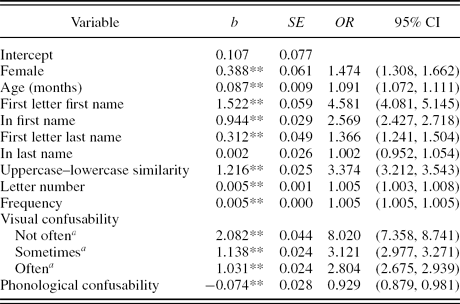
The results of the multilevel logistic regression model are presented in Table 1. All of the independent variables and covariatesFootnote 6 were statistically significant (all ps < .01) with the exception of one variable (InLName). For the letter-name hypothesis, the odds ratios indicated that children who had a letter as the initial character in their first name had a higher likelihood of correctly identifying the LC letter compared to children who did not have the initial character in their first name (OR = 4.58, d = 0.84). The advantage was also found if the letter was the first letter of the child's last name though to a much smaller extent (OR = 1.37, d = 0.17). In addition, we also found that as long as the letter was in the child's first name, children also had a greater likelihood of identifying the letter correctly (OR = 2.56, d = 0.52). As a result, if a child had both the letter as the initial letter and the letter also found in the child's name (e.g., Ana, Susan), the likelihood of correct identification was even higher (i.e., 2.56 × 4.58 = 11.72 OR, d = 1.36). However, children were not able to better identify letters correctly if the letter appeared in their last name other than in the initial position (p = .94).
Three-level logistic regression model results showing the log odds of identifying a letter correctly
Note: N = 5,020 students in 404 schools.
aVery often confused is the reference category.
**p < .001.
The second hypothesis tested was the letter-order hypothesis and our results indicated that, while controlling for all other variables, letters that appeared later in the alphabet string were more likely to be recognized than characters that appeared earlier in the alphabet string (OR = 1.005). Sample participants knew 75% of the letters from a to m on average whereas 79% correctly identified n to z. The range of the letter-order variable was limited from 1 to 26 (SD = 7.6). Although the results of the letter-order hypothesis were statistically significant (p < .001), the effect size, based on a 1 SD increase in letter order, was very small (d = 0.04). Put in practical terms and using the maximal difference represented by the letters a and z, the letter z would have odds of being correctly identified that were 1.13 times higher (i.e., =exp [25×0.005]) than the letter a.
Our results also supported the UC–LC similarity hypothesis. LC letters that were visually similar to their UC counterparts had higher odds of being identified (OR = 3.37, d = 0.67) compared to LC letters that were not visually similar to their UC analogs.
In terms of the letter-frequency hypothesis, children were also more likely to recognize letters that were more commonly seen in print (OR = 1.005). In other words, the letter e, which appears 130.8 times more frequently than the letter q, had odds of being correctly identified that were 1.83 times higher, while controlling for all other variables. While both letter order and letter frequency had the same rounded regression coefficients, the much larger range and variability in the letter-frequency variable (SD order = 7.6 vs. SD frequency = 35.0) accounts for the larger, though still small, effect size for letter frequency (d = 0.09).
For our final hypothesis, the letter-confusability hypothesis, we found support for both visual and phonological confusability. Letters that were less visually confusing had a much higher likelihood of being correctly identified (ORs = 2.80−8.04). The least visually confusing LC letters (e.g., o, x) had odds of being correctly identified that were 8.04 times higher compared to the most often confused letters (e.g., b, d). The 95% confidence intervals also indicate that our defined visual confusability categories are distinct from each other because the confidence intervals do not overlap. In other words, children had a higher likelihood of correctly identifying the letters that were sometimes confused compared to the letters that were often confused. Effect size measures for visual confusability were moderate to large and meaningful (ds = 0.57–1.15). Phonologically confusable letters also had a lower likelihood of being correctly identified (OR = 0.93, p < .01) though the effect size was very small (d = 0.04).
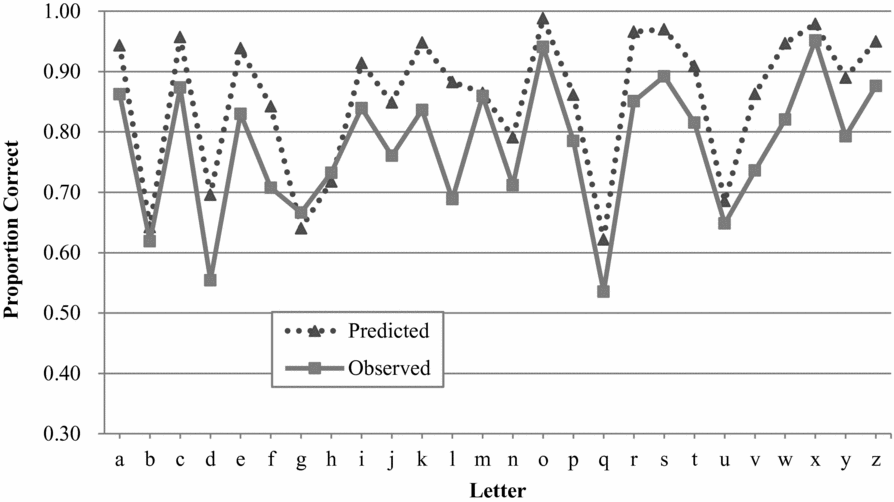
As a final check, we examined the precision of our predictions per letter based on our model (see Figure 1). The largest discrepancies were for the letters l and d, while the most accurate predictions were for letters b, h, and m. Overall, the predicted scores closely followed the pattern of the observed scores.
Comparison of predicted and observed probabilities of correctly naming a lowercase letter.
DISCUSSION
LC letters appear more frequently in print than UC letters, yet the bulk of previous letter naming research has focused on UC letters. We tested five hypotheses in order to find empirical support for the theories that might account for the variance in LC letter name knowledge of first-time kindergarteners from economically disadvantaged homes. The five hypotheses are (a) the own-name advantage hypothesis, (b) the letter-order hypothesis, (c) the UC–LC similarity hypothesis, (d) the letter-frequency hypothesis, and (e) the letter-confusability hypothesis. Our results show that LC letter name knowledge is determined by multiple factors, factors that are intrinsic to the child (i.e., knowing the letters in a child's name), based on the letter itself (i.e., similarity to other letters, UC similarity, and letter order), or dictated by the environment (i.e., letter frequency). The use of multilevel logistic regression modeling is important since our model tests all the hypotheses simultaneously while controlling for all the other variables included in the model. Overall findings indicate that all five hypotheses contribute to a child's LC letter naming facility, although odds ratios and effect sizes indicate that the own-name advantage, UC–LC similarity, and the letter-confusability hypotheses have the greatest association with accurate LC letter identification. Letter order, phonological confusability, and letter frequency, which also yielded statistically significant results, had effect sizes that were much smaller in comparison (all ds < 0.10). These results are important because of their implications for teaching the letters of the alphabet to young children, and we discuss each of these findings in turn.
Own-name advantage hypothesis
Our finding that reinforces the own-name advantage hypothesis is not surprising because the hypothesis has been supported by several other studies (e.g., Bloodgood, Reference Bloodgood1999; Justice et al., Reference Justice, Pence, Bowles and Wiggins2006; Levin & Aram, Reference Levin, Aram, Ravid and Shyldkrot2004; Treiman & Broderick, Reference Treiman and Broderick1998; Treiman et al., Reference Treiman, Kessler and Pollo2006). We do, however, extend the own-name advantage hypothesis as it applies to LC letters, and we find that letters in a child's first name as well as letters that appear as the initial letter in a child's last name are associated with an increased probability of correctly naming the LC letter.
Although the lack of statistical significance for the main effect for the own-name advantage hypothesis in the Turnbull et al. (Reference Turnbull, Bowles, Skibbe, Justice and Wiggins2010) LC-letter preschool study may at first seem to differ from our finding, their study reported a statistically significant interaction term. Because the interaction term (i.e., UC Familiarity × Own-Name Advantage) was statistically significant, we cannot meaningfully interpret and should not compare findings based on the nonsignificant main effect alone (Agresti & Finlay, Reference Agresti and Finlay2009). Because, on average, the preschoolers in the Turnbull et al. study already had a high level of UC familiarity (M = 19.0 UC letters correctly identified), interpreting the main effect together with the interaction seems appropriate. As a result, the Turnbull et al. study does find support for the own-name advantage hypothesis when the preschooler is familiar with the UC counterpart.
We also show that the own-name advantage applies as well to the other letters in the child's first name, not just the initial letter, similar to previous research (Levin & Aram, Reference Levin, Aram, Ravid and Shyldkrot2004; Treiman & Kessler, Reference Treiman, Kessler and Kail2003; Treiman et al., Reference Treiman, Kessler and Pollo2006). However, since our sample specifically included kindergarteners who attended publicly funded prekindergarten programs, the knowledge of the LC letters in a child's name may also be a result of preschool instruction, which may emphasize learning the letters in a child's name. Indeed, a number of the publicly funded preschools in the commonwealth reported using curricula (e.g., HighScope, Core Knowledge) that may focus on the letters in children's names.
We extend the own-name advantage hypothesis by showing that kindergarteners have an increased likelihood of correctly naming a LC letter if it is the initial letter of their last name, controlling for all the other variables included in our model. This is contrary to the finding of a limited number of older studies that did not show a statistically significant association between letter name knowledge and having the letter appear in a child's last name (Levin & Aram, Reference Levin, Aram, Ravid and Shyldkrot2004; Treiman & Broderick, Reference Treiman and Broderick1998). A possible reason is that our data, which uses 2010 student scores, reflects at least a 13-year time difference when compared with the two samples used in Treiman and Broderick's study. Over such a span of time, it is possible that academic expectations from preschoolers and kindergarteners have increased, which may result from the curriculum of the higher grade getting pushed down to the lower grade (Bracey, Reference Bracey1989). In other words, kindergarteners today may know more (or be expected to know more) than the kindergarteners 10 years ago. If a child already knows the letters in his or her name at the end of preschool, learning how to write the letters in the last name may be a reasonable next step, and the effect sizes of the own-name advantage hypothesis show a logical, decreasing progression of a child's familiarity with the LC letters in his or her first and last names (i.e., initial, first name d = 0.84; in first name d = 0.52; initial, last name d = 0.17).
Given that the probability of children knowing the letters in their own name is large, including the name-related variables in the model is important since they act as controls for the remaining independent variables tested. That is, all the remaining hypotheses investigated have controlled for the letters being in the child's name, and the reported associations are over and above the variance explained by the own-name advantage hypothesis.
Letter-order hypothesis
Although the letter-order hypothesis was statistically significant, the expected direction and associated effect size (OR = 1.005) was in the opposite direction as what might have been expected based on Justice et al.'s (Reference Justice, Pence, Bowles and Wiggins2006) study of preschoolers using UC letters (OR = 1.02). In our study, the later LC letters were better known that the earlier letters. Disparate findings may result from differences in the study samples and letter case used because our study focused on kindergarteners assessed on LC letters at the start of the school year. Another explanation may be that if letters are taught in alphabetical order in preschool, it may be possible that the letters introduced at the end of the sequence are fresher in the minds of children at the beginning of kindergarten, exhibiting a kind of recency effect. However, the overall effect size for the letter-order hypothesis, based on Cohen's (Reference Cohen1992) guidelines, was extremely small.
UC–LC similarity hypothesis
In terms of the UC–LC similarity hypothesis, the more visually similar the LC letter is to its UC counterpart, the greater the probability that a child will correctly identify the character. Our findings are consistent with several other recent studies on LC letters (Evans et al., Reference Evans, Bell, Shaw, Moretti and Page2006; Treiman & Kessler, Reference Treiman, Kessler and Kail2003; Turnbull et al., Reference Turnbull, Bowles, Skibbe, Justice and Wiggins2010). Essentially, if the LC letter is nearly identical to the UC letter, in general, children learn UC letters first (Treiman, Cohen, et al., Reference Treiman, Cohen, Mulqueeny, Kessler and Schechtman2007; Worden & Boettcher, Reference Worden and Boettcher1990), naming the LC counterparts should be easier since there is hardly any variation in the shape of the letter, with the exception of the vertical scale. Treiman and Kessler (Reference Treiman, Kessler and Kail2003) mentioned that “a major determinant of performance on LC letters is whether they have the same shapes as their UC counterparts” (p. 19), and our findings corroborate their conclusion. The UC–LC effect size in our model is the third largest overall.
Letter-frequency hypothesis
Letter frequency is also shown to have an association with successful LC letter naming in line with other studies (e.g., Treiman, Cohen, Reference Treiman, Cohen, Mulqueeny, Kessler and Schechtman2007; Treiman et al., Reference Treiman, Cohen, Mulqueeny, Kessler and Schechtman2007; Turnbull et al., Reference Turnbull, Bowles, Skibbe, Justice and Wiggins2010). The more frequently a letter appears in print, in general, the higher the likelihood of a child correctly naming the letter. Our findings are contrary to earlier studies (Cohn, Reference Cohn1974, Evans et al., Reference Evans, Bell, Shaw, Moretti and Page2006; Treiman & Kessler, Reference Treiman, Kessler and Kail2003) that showed the letter frequency was not associated with letter name knowledge. Differences between our study and earlier research that did not find a statistically significant association with letter frequency might be attributed to our much larger word corpus combined with our much larger sample size as well. Earlier studies, which used smaller samples, may not have been able to detect the small effect size associated with letter frequency.
Our results are similar to Turnbull et al.'s (Reference Turnbull, Bowles, Skibbe, Justice and Wiggins2010) preschool study that rank ordered the LC letters in terms of frequency (i.e., 1 = most frequent and 26 = least frequent) and used a word corpus from Jones and Mewhort (Reference Jones and Mewhort2004) as well. However, we used a different frequency variable that was an interval level measure (i.e., 1 = least frequent and 130 = most frequent) based on an expanded version of the data set (183 million words vs. 14 million words). In our kindergarten sample, a 1 SD change in frequency is associated with an OR of 1.17 (d = 0.09). Although the association again is statistically significant, the corresponding effect size is relatively small as well.
Letter-confusability hypothesis
Finally, our findings support the hypothesis that if a letter is visually confusable, students may have a more difficult time identifying the LC letter correctly. Our findings control for other important predictors (i.e., all other ps < .01) and are in line with prior research, which suggests that the visual confusability of the letter is also a major determinant of successful LC letter recognition (Levin et al., Reference Levin, Saiegh-Haddad, Hende and Ziv2008; Treiman & Kessler, Reference Treiman, Kessler and Kail2003; Treiman et al., Reference Treiman, Kessler and Pollo2006). A probable explanation is that LC letters are subject to more confusion (Popp, Reference Popp1964) compared to UC letters that are more visually distinct (Cohn & Stricker, Reference Cohn and Stricker1979; Ehri & Roberts, Reference Ehri, Roberts, Dickinson and Neuman2006). For example, the UC letters B, D, P, and Q are much more visually distinct from each other compared to LC letters such as b, d, p, and q.
The not often confused letters had odds of being correctly named that were eight times higher than the very often confused letters (d = 1.15), which is the largest effect size in the current study. Even the sometimes and often confused letters were much more likely to be named correctly than the very often confused letters (d ≈ 0.60), which is a moderate to large effect size based on Cohen's (Reference Cohen1992) guidelines. The effect sizes of these two visual confusability categories are comparable to the effect sizes if the letter was found in the child's first name or if the UC–LC letters were similar to each other. Overall, these results extend the findings of previous research and suggest a hierarchy of LC letter difficulty based on visual confusability and indicate that not all letters shapes are equal.
In terms of phonological confusability, our results were statistically significant but had a very small effect size (d = 0.04) in comparison to other findings. Our coding system for phonological confusability was quite simple in comparison to our coding scheme for visual confusability, and it may be that a more nuanced coding system for capturing more granular aspects of letter name phonology would have yielded stronger results for the phonological confusability of letter names. Previous research has shown that developmental aspects of language production influence the accurate naming of letter names, such that letters names that contain phonemes acquired earlier in speech production are also learned earlier (Justice et al., Reference Justice, Pence, Bowles and Wiggins2006). Our results for phonological confusability may have been stronger had developmental aspects of language production been taken into account. Previous research has also suggested that certain phonemes are more salient to young children than others (Sander, Reference Sander1972), which may be influenced by the physiological and sensory aspects of manner, place, and voicing of articulation.
Limitations and ideas for further research
As with all studies, there are several limitations to our analyses that need to be considered when interpreting the results, which may also present areas for future research. First, a limitation is that we assessed a child's LC alphabet knowledge using a single naming task, and the randomized order of the letters presented to the students did not vary from student to student. We do not know how results may have changed if letter order were completely randomized per student or if an alternative form of assessment were used (e.g., having a student point to the letters). Second, another limitation is that unobserved teacher bias (e.g., Rosenthal & Jacobson, Reference Rosenthal and Jacobson1968) may introduce some form of measurement error since PALS-K is a teacher-administered screener. However, since our measures were collected at the beginning of kindergarten, student outcomes are not a reflection of a teacher's instructional ability, and so teachers have less incentive to bias results of non-high-stakes assessments (Klein, Hamilton, McCaffrey, & Stecher, Reference Klein, Hamilton, McCaffrey and Stecher2000) such as PALS-K. In many instances, teacher reports are relied on heavily in early educational settings (e.g., Fantuzzo, Manz, & McDermott, Reference Fantuzzo, Manz and McDermott1998; Ladd & Profilet, Reference Ladd and Profilet1996). Third, while our sample consisted of first-time kindergarteners from economically disadvantaged homes who attended publicly funded preschool in one state, we do not know how our findings generalize to other populations (e.g., students in other states, children who attended private schools). Fourth, since our participants had already gone through a year of preschool instruction, we were not able to gauge the quality of the instruction that they received. Based on the curricula used by the publicly funded preschool programs in the commonwealth, no specific sequence for learning LC letters was prescribed, in contrast to some curricula which have a proposed letter teaching order (Lehr, Reference Lehr2000). Fifth, we did not consider the ease of learning to produce/write the LC letters as a factor that may be associated with LC letter naming ability. Previous research has shown that learning to write letters is an important aspect of alphabetic knowledge (Puranik, Lonigan, & Kim, Reference Puranik, Lonigan and Kim2011), so the omission of variables related to letter writing may have influenced our results, though this may be explored in future studies. Sixth, this study was correlational in nature and drawing causal inferences from the results of this study is not possible, even with the use of a large-scale data set. Nevertheless, the current study provides important information about the associations of letter- and child-related characteristics and LC letter names among kindergarteners.
Conclusion and implications
Overall, the results of our study show that several factors may influence learning LC letter names, and these factors vary based on the child, the letter attributes, and the environment. While educational and literacy researchers know considerably more about factors associated with UC letter knowledge, the present study adds to the growing body of knowledge that focuses on LC letter knowledge. The factors we investigated all contribute simultaneously to a child's LC letter naming ability, and our results indicate that all of these variables are important to include when studying the acquisition of letter name knowledge. However, some factors may contribute relatively more (i.e., letters in the child's name, UC–LC shape similarity, and visual confusability) to the correct identification of LC letter names compared to others (i.e., letter frequency, letter order, and phonological confusability).
Teaching practices that treat each letter as if they were all equally difficult follow a teacher-centered, as opposed to a child-centered, approach. A large number of kindergarten teachers may use a “letter of the week” method of teaching (Pressley, Rankin, & Yokoi, Reference Pressley, Rankin and Yokoi1996), though that approach may not be very efficient (Treiman, Reference Treiman2000) given our findings that some letters are more difficult than others. From a teacher's point of view, using a letter of the week is straightforward and systematic, though it does not require much planning or differentiation. Teachers end up spending the same amount of time per letter when some letter shapes and names may be more challenging than others, requiring more time, attention, and planning.
Our results suggest that LC letters are not created equally. Letters differ in visual and phonological confusability and they differ in frequency of occurrence in print. Letters also differ in their similarity to their UC or LC partner, and letters that are similar in both UC and LC forms appear easier to learn. In addition, letters that are more easily confused will need more attention. For example, teaching a LC o or x may require much less time than teaching the differences between a LC b and d. To straighten out the confusability of visually confusing LC letters, it may be more efficient to compare at least two LC letters at a time to note similarities and differences in their distinctive features and contrast them with others. In comparing letters, it may be advantageous to first contrast LC letters that are visually and phonologically distinct. Categorizing LC fonts into “same” and “different” and discussing children's reasoning behind their categorizations may help draw attention to critical differences (Bear, Invernizzi, Templeton, & Johnston, Reference Bear, Invernizzi, Templeton and Johnston2012). LC letters whose UC matches are similar or identical would be among the easiest to learn in addition to the letters in children's own names. Teaching one letter a week may not allow children to sort out the nuanced differences in shape and sound.
One essential part of the educational environment in most kindergarten classrooms is the sources of print materials from which children can begin to see the purpose and utility of LC letters. These sources might include students’ names, environmental labels, alphabet strips, nursery rhymes and songs posted on chart paper, the morning message, play centers, and children's books, among others. Our results, though not causal, suggest that continuing to capitalize on children's names is well advised.Footnote 7 Comparing and contrasting the letters across many children's names may help them sort out areas of confusability, and linking letters that occur in children's names to other sources of environmental print in the classroom and in books may also be advantageous.
In conclusion, our study corroborates and extends previous research on the factors associated with LC letter name knowledge, using a large sample of first-time kindergarteners. Kindergarteners in the sample had a higher likelihood of correctly identifying LC letters that appeared in their own name, were visually similar to their UC counterparts, and appeared more frequently in print. In addition, letters that were more visually and phonologically confusable had a lower likelihood of being correctly identified. Our findings suggest that a broader consideration be given to the teaching of LC letters as opposed to focusing on precise letter order or on teaching one letter at time, and multifaceted teaching approaches that consider child, letter, and environmental attributes may be more effective when teaching LC letter names.
APPENDIX A
Computed frequency scores of lowercase letters in printed English and alphabet letters known by kindergarteners in the sample
ACKNOWLEDGMENTS
This paper was prepared using data provided under a contract with the Virginia Department of Education. The content does not necessarily reflect the views or policies of the Virginia Department of Education, the Virginia Board of Education, or the Commonwealth of Virginia. Consequently, the Virginia Department of Education, the Virginia Board of Education, and the Commonwealth of Virginia are not responsible for the paper's content or any loss suffered that is due to the use of such content. Moreover, the mention of any trade names, commercial products, or organizations in this paper is not an endorsement of any of these entities by the Virginia Department of Education, the Virginia Board of Education, or the Commonwealth of Virginia. We thank Anne Carter for her research assistance.