Introduction
Masseter vestibular-evoked myogenic potentials are vestibular-dependent inhibitory reflexes. Masseter vestibular-evoked myogenic potential was first recorded in healthy humans using transmastoid electric stimulation from tonically activated masseter muscles,Reference Deriu, Tolu and Rothwell1 followed by acoustic stimulation.Reference Deriu, Tolu and Rothwell2 Although masseter vestibular-evoked myogenic potential recording was initiated a decade back, there has recently been renewed interest in using this, especially in patients with brainstem dysfunction.Reference Magnano, Pes, Pilurzi, Cabboi, Ginatempo and Giaconi3–Reference Thirusangu and Sinha12 Studies on masseter vestibular-evoked myogenic potentials have shown significant masseter vestibular-evoked myogenic potential abnormalities in patients with an idiopathic random eye movement disorder,Reference de Natale, Ginatempo, Laccu, Figorilli, Manca and Mercante7 multiple sclerosisReference Magnano, Pes, Pilurzi, Cabboi, Ginatempo and Giaconi3,Reference Magnano, Pes, Cabboi, Pilurzi, Ginatempo and Achene4,Reference Vignesh, Bhoopathy, Singh and Rajalakshmi13 and Parkinson's disease.Reference de Natale, Ginatempo, Paulus, Manca, Mercante and Pes5
Masseter vestibular-evoked myogenic potential has been reported to be better than cervical and ocular vestibular-evoked myogenic potentials in diagnosing vestibular lesions in individuals with various pathologies. In a group of patients with Parkinson's disease, de Natale et al.Reference de Natale, Ginatempo, Paulus, Pes, Manca and Tolu6 reported abnormal masseter vestibular-evoked myogenic potentials in 66.7 per cent of the patients, whereas the frequency of abnormal cervical and ocular vestibular-evoked myogenic potentials was 41.7 per cent and 45.8 per cent, respectively. In another study, de Natale et al.Reference de Natale, Ginatempo, Paulus, Manca, Mercante and Pes5 reported abnormal masseter vestibular-evoked myogenic potential in 7.4 per cent of the normal participants, 42.8 per cent of patients diagnosed with early Parkinson's disease and 63.2 per cent of patients with late Parkinson's disease. In the same study, the rate of ocular vestibular-evoked myogenic potential abnormality was 3.7 per cent for healthy participants, 50 per cent for early Parkinson's disease patients and 47.4 per cent for patients with late Parkinson's disease. A recent study on multiple sclerosis also showed higher masseter vestibular-evoked myogenic potential abnormality than for cervical and ocular vestibular-evoked myogenic potential.Reference Vignesh, Bhoopathy, Singh and Rajalakshmi13 The frequency of abnormal masseter vestibular-evoked myogenic potential has been reported to be 62.1 per cent in patients with multiple sclerosis.Reference Magnano, Pes, Pilurzi, Cabboi, Ginatempo and Giaconi3 In patients with idiopathic random eye movement sleep disorders, the frequency of alteration of masseter vestibular-evoked myogenic potential is greater compared with cervical and ocular vestibular-evoked myogenic potentials.Reference de Natale, Ginatempo, Laccu, Figorilli, Manca and Mercante7 Puligheddu et al.Reference Puligheddu, Figorilli, Serra, Laccu, Congiu and Tamburrino9 also reported prolonged p11 latency and reduced amplitude of masseter vestibular-evoked myogenic potential in patients with isolated random eye movement sleep disorder.
The vestibulomasseteric reflex has a di- or tri-synaptic brainstem pathway.Reference Deriu, Tolu and Rothwell1 Masseter vestibular-evoked myogenic potential assesses the vestibulomasseteric reflex, which is believed to stabilise the human jaw during sudden movement and in the desired set position against gravity.Reference Deriu, Ortu, Capobianco, Giaconi, Melis and Aiello14 In humans, static tilt also exerts a bilateral asymmetrical effect on masseter muscles, and the evidence shows that this effect is macular in origin.Reference Deriu, Podda, Milia, Chessa, Sau and Pastorino15 The natural function of the vestibulomasseteric reflexes is to respond to sudden head tilt upward or downward.Reference Deriu, Tolu and Rothwell2 For example, if the head is suddenly dropped, the masseter muscle is inhibited. If the head is suddenly pitched upward, there will be an excitation of the masseter muscles.Reference Deriu, Tolu and Rothwell2 Although masseter muscles are primarily involved in mastication, the vestibular influence helps fine-tune the motor output of masseter muscle during sudden head movement. The schematic diagram of the pathway of the masseter vestibular-evoked myogenic potential is given in Fig. 1.
Schematic diagram of the masseter vestibular-evoked myogenic potential pathway. TN = trigeminal nerve; TMN = trigeminal motor nucleus; VTMP = vestibulotrigeminal monosynaptic pathway; VN = vestibular nucleus; VNe = vestibular nerve

Masseter vestibular-evoked myogenic potential elicited with high-intensity sound consists of two short-latency potentials, p11-n15 complex with a higher threshold and p16-n21 complex with a lower threshold.Reference Deriu, Tolu and Rothwell2 Around 128–138 dB SPL, p11-n15 and p16-n21 overlap as a single p11-n21 waveform.Reference de Natale, Ginatempo, Mercante, Manca, Magnano and Ortu8 Recent studies have indicated that the p11-n15 wave originates from the vestibular system, whereas p16-n21 originates from the cochlear system.Reference Deriu, Ortu, Capobianco, Giaconi, Melis and Aiello14 Masseter vestibular-evoked myogenic potential has been primarily recorded in humans using either clickReference Deriu, Tolu and Rothwell2–Reference Magnano, Pes, Cabboi, Pilurzi, Ginatempo and Achene4,Reference de Natale, Ginatempo, Paulus, Pes, Manca and Tolu6–Reference Loi, Manca, Ginatempo and Deriu10,Reference Deriu, Ortu, Capobianco, Giaconi, Melis and Aiello14 or 500 Hz tone burst stimulus.Reference Vignesh, Singh and Rajalakshmi11,Reference Thirusangu and Sinha12 However, none of the previous studies have compared the latency and amplitude of masseter vestibular-evoked myogenic potential elicited with both the click and tone burst stimulus. When we compare the data across the different studies that used either click or tone burst stimuli, more robust masseter vestibular-evoked myogenic potential responses have been reported for tone burst stimulus than for click stimulus.Reference de Natale, Ginatempo, Mercante, Manca, Magnano and Ortu8,Reference Vignesh, Singh and Rajalakshmi11 However, variation in the protocol and method of masseter vestibular-evoked myogenic potential recording between the two studies makes the comparison debatable.
Studies comparing the latency and amplitude of cervical vestibular-evoked myogenic potential and ocular vestibular-evoked myogenic potential have reported an equal response rate with click, modulate tones and 500 Hz tone burst stimulus.Reference Kumar, Sinha, Bharti and Barman16–Reference Ozgur, Erdivanlı, Coskun, Terzi, Yigit and Demirci18 However, the latency of click evoked cervical and ocular vestibular-evoked myogenic potentials has been reported to be earlier than for 500 Hz tone burst evoked cervical and ocular vestibular-evoked myogenic potentials.Reference Viciana and Lopez-Escamez17–Reference Wu, Shiao, Yang and Lee19 The 500 Hz tone burst and modulated tone burst stimulus produce longer latency and larger amplitude ocular vestibular-evoked myogenic potentials than the click stimuli. The response parameters do not change significantly between the tone burst and mixed modulated tone burst.Reference Deepak, Bhat and Kumar20 Therefore, tone burst stimulus remains better than clicks for evoking cervical and ocular vestibular-evoked myogenic potential. However, there is a dearth of study comparing the various stimuli for recording masseter vestibular-evoked myogenic potential.
There are a few research gaps in the recording of masseter vestibular-evoked myogenic potentials: (1) although the masseter vestibular-evoked myogenic potential has been recorded in many studies, there is no uniformity in the protocol across the studies; (2) the optimisation of the protocol recording for masseter vestibular-evoked myogenic potential has not been established; and (3) the latency and amplitude of masseter vestibular-evoked myogenic potential for different stimuli have not been studied.
Because masseter vestibular-evoked myogenic potential is a recent tool, the characteristics of it need to be studied because it could have various clinical applications in cochleovestibular and brainstem disorders. The vestibulomasseteric reflex pathway is a bilateral pathway, and therefore masseter vestibular-evoked myogenic potentials can be recorded ipsilaterally, contralaterally and bilaterally. Normative studies on click evoked masseter vestibular-evoked myogenic potentials have demonstrated significantly larger amplitude for bilateral stimulation than unilateral stimulation. However, no significant difference in the amplitude of masseter vestibular-evoked myogenic potentials has been reported between ipsilateral and contralateral recordings for click and tone burst stimuli.Reference de Natale, Ginatempo, Mercante, Manca, Magnano and Ortu8,Reference Loi, Manca, Ginatempo and Deriu10,Reference Vignesh, Singh and Rajalakshmi11 The characteristics of masseter vestibular-evoked myogenic potentials for ipsilateral, contralateral and bilateral recordings for the different stimuli need to be explored. The current study aimed at characterising the latency and amplitude of ipsilateral, contralateral and bilateral masseter vestibular-evoked myogenic potentials recorded with click and tone burst stimulus in healthy individuals.
Materials and methods
Twenty normal, healthy individuals aged 19–28 years (11 males and 9 females) with no complaints relating to signs and symptoms of vestibular issues participated in the study. The participants had normal hearing sensitivity and no middle-ear pathology. During the experiment, none of the volunteers had any other medical issues. All participants were informed about the study's purpose, and written consent was acquired. The study was conducted in accordance with the guidelines provided by institutional ethical committee.
Procedure
The modified Hughson and Westlake procedureReference Carhart and Jerger21 was used to obtain a pure tone audiogram for all the octave frequencies between 250 Hz and 8000 Hz for air conduction and between 250 Hz and 4000 Hz for bone conduction thresholds. Tympanometry was performed for all the participants, and acoustic reflex thresholds were obtained for 500 Hz, 1000 Hz, 2000 Hz and 4000 Hz for ipsilateral and contralateral stimulations.
Masseter vestibular-evoked myogenic potential recording
The masseter vestibular-evoked myogenic potential was recorded in two different sessions for all the participants. In the first session, the 500 Hz tone burst (2-1-2 cycle) was used to record masseter vestibular-evoked myogenic potential for ipsilateral, contralateral and bilateral stimulation. In the second session, masseter vestibular-evoked myogenic potential was recorded for a 0.1 millisecond click stimulus for ipsilateral, contralateral and bilateral stimulations. Masseter vestibular-evoked myogenic potential was recorded for zygomatic electrode montage only. Masseter vestibular-evoked myogenic potential does not show any difference in latency or amplitude parameters between zygomatic and mandibular electrode montages.Reference Thirusangu and Sinha12
For recording masseter vestibular-evoked myogenic potential in the present study, the reference electrode was placed on the midpoint of the zygomatic arch, the active electrode was placed on the lower third of the masseter muscle and the ground electrode was placed on the lower forehead. Masseter vestibular-evoked myogenic potential was recorded at 125 dB SPL intensity at a repetition rate of 5.1/second. The recorded responses were amplified 5000 times, averaged for 300 sweeps and filtered between 0.1 and 3000 Hz. The analysis time window was kept at 70 milliseconds with a pre-stimulus of 30 milliseconds. The participants were instructed to clench both sides equally to maintain muscle contraction at the desired level. The muscle contraction level was set at 30 to 50 per cent of maximum contraction.
Data and statistical analysis
The latency of p11 and n21 peaks and rectified amplitude of the p11-n21 complex were measured for both the click and 500 Hz tone burst evoked masseter vestibular-evoked myogenic potential for all the participants. The Shapiro–Wilk test was performed to check the normal distribution of obtained data. Descriptive statistics were used to obtain the mean and standard deviation of the latency of p11 and n21 peaks and p11-n21 amplitude complex of masseter vestibular-evoked myogenic potentials. Wilcoxon signed rank test was used to see the ear difference for the p11 latency, n21 latency and p11-n21 amplitude for click and 500 Hz tone burst evoked masseter vestibular-evoked myogenic potentials. Furthermore, the Wilcoxon signed rank test was also used to compare the latency and amplitude measures of ipsilateral, contralateral and bilateral recordings for both click and 500 Hz tone burst evoked masseter vestibular-evoked myogenic potentials.
Results
Masseter vestibular-evoked myogenic potential could be recorded for all patients. Masseter vestibular-evoked myogenic potential was present for all the patients for ipsilateral, contralateral and bilateral recordings for both click and tone burst stimuli. The Shapiro–Wilk test showed a non-normal distribution of the data (p < 0.05) and therefore non-parametric statistical testing was performed.
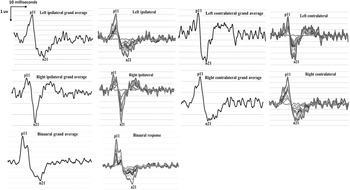
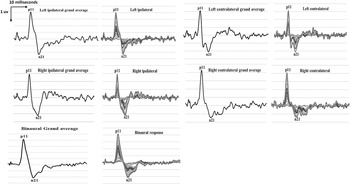
Figures 2 and 3 represent the grand average and individual waveforms of click and 500 Hz tone burst evoked masseter vestibular-evoked myogenic potentials, respectively.
Grand average and individual waveforms of click evoked masseter vestibular-evoked myogenic potential.

Grand average and individual waveforms of 500 Hz tone burst evoked masseter vestibular-evoked myogenic potential.

Parameters of click evoked potentials
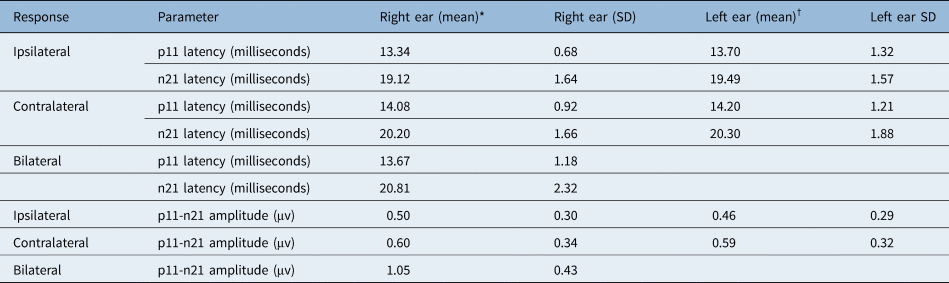
Table 1 shows the mean and standard deviation of p11-n21 latency and amplitude of click evoked masseter vestibular-evoked myogenic potentials from 20 healthy participants. There was statistically no significant difference for p11 latency between the right and the left ear for ipsilateral response (z = 1.63, p = 0.10), for n21 latency between two ears for ipsilateral response (z = 1.63, p = 0.10), for p11 latency between two ears for contralateral response (z = 0.11, p = 0.91) and for n21 latency between two ears for contralateral response (z = 0.97, p = 0.33).
Latency and amplitude of click evoked masseter vestibular-evoked myogenic potential from 20 healthy participants

*n = 20; †n = 20. SD = standard deviation
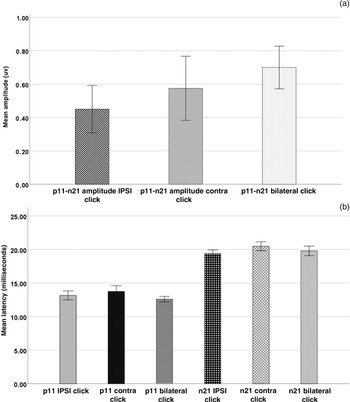
Statistically significant difference was also not observed for p11-n21 rectified amplitude between right and left ears for ipsilateral response (z = 1.92, p = 0.05) and for p11-n21 amplitude between right and left ears for contralateral response (z = 0.76, p = 0.44). Overall, no significant difference was observed for p11 and n21 latency and amplitude between the right and left ear for click evoked masseter vestibular-evoked myogenic potentials. Therefore, data of the right and left ears were combined, and descriptive statistical testing was carried out to determine the mean and standard deviation for the combined data. The mean and the standard deviation for the latency and amplitude measures of the combined data are given in Fig. 4.
Mean and standard deviation of p11-n21 (a) amplitude and (b) p11 and n21 latency and of combined data for click evoked masseter vestibular-evoked myogenic potential. IPSI = ipsilateral; contra = contralateral

Statistically significant difference was observed for p11 latency between ipsilateral and contralateral response (z = 3.48, p = 0.00), n21 latency between ipsilateral and contralateral response (z = 3.28, p = 0.001), and p11-n21 rectified amplitude between ipsilateral and contralateral response (z = 0.46, p = 0.64) for combined data of click evoked masseter vestibular-evoked myogenic potentials. The results suggest prolonged contralateral latency of p11 and n21 peaks and higher amplitude for p11-n21 complex for contralateral responses.
There was statistically significant difference for p11 latency between bilateral and ipsilateral stimulation (z = 1.97, p = 0.48), p11 latency between bilateral and contralateral stimulation (z = 2.93, p = 0.003), n21 latency between bilateral and contralateral stimulation (z = 2.14, p = 0.03), and no significant difference for n21 latency between bilateral and ipsilateral stimulation (z = 1.32, p = 0.18). A statistically significant difference was also observed for p11-n21 amplitude between ipsilateral and bilateral stimulation (z = 3.30, p = 0.001). However, no significant difference for p11-n21 amplitude between contralateral and bilateral stimulation (z = 1.70, p = 0.88) was observed.
Parameters of tone burst potentials
Descriptive statistics were carried out to determine the mean and standard deviation of the latency and amplitude of 500 Hz tone burst evoked masseter vestibular-evoked myogenic potential. Table 2 shows the mean and standard deviation of latency and amplitude of 500 Hz tone burst evoked masseter vestibular-evoked myogenic potential from 20 healthy participants.
Latency and amplitude of 500 Hz tone burst masseter vestibular-evoked myogenic potential from 20 healthy participants

*n = 20; †n = 20. SD = standard deviation
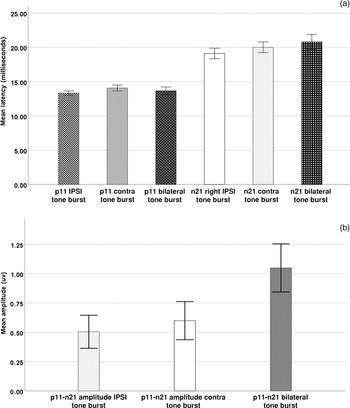
There was no statistically significant difference for p11 latency between right and left ears for ipsilateral response (z = 1.75, p = 0.08), n21 latency (z = 0.50, p = 0.61), p11 latency between two ears for contralateral response (z = 0.28, p = 0.77) and for n21 latency between two ears for contralateral response (z = 0.72, p = 0.46). No significant difference was seen for p11-n21 rectified amplitude between right and left ears for ipsilateral response (z = 0.71, p = 0.47) and for p11-n21 amplitude between right and left ears for contralateral response (z = 0.37, p = 0.70). Because no ear difference was observed for both latency and amplitude of 500 Hz tone burst masseter vestibular-evoked myogenic potentials, right and left ear data were combined. Descriptive statistics were used to determine the combined data's mean and standard deviation. The mean and the standard deviation for the latency and amplitude measures of the combined data are given in Fig. 5.
Mean and standard deviation of (a) p11 and n21 latency and (b) p11-n21 amplitude of combined data for 500 Hz tone burst evoked masseter vestibular-evoked myogenic potential. IPSI = ipsilateral; contra = contralateral

There was a statistically significant difference for p11 latency between ipsilateral and contralateral response (z = 5.26, p = 0.00), n21 latency between ipsilateral and contralateral response (z = 4.41, p = 0.00), and for rectified amplitude between p11-n21 ipsilateral and contralateral response (z = 2.32, p = 0.02) for the combined data of 500 Hz tone burst evoked masseter vestibular-evoked myogenic potentials. The results suggest that contralateral latency for p11-n21 peaks were prolonged compared with ipsilateral response, and the amplitude of the contralateral responses was higher than for ipsilateral responses.
For bilateral tone burst recorded masseter vestibular-evoked myogenic potentials, a statistically significant difference was observed for p11 latency between bilateral and contralateral stimulation (z = 2.15, p = 0.03), n21 latency between bilateral and ipsilateral stimulation (z = 2.95, p = 0.03), for p11-n21 amplitude between ipsilateral and bilateral stimulation (z = 3.83, p = 0.000) and for p11-n21 amplitude between contralateral and bilateral stimulation (z = 3.69, p = 0.000).
However, no significant difference was observed for p11 latency between bilateral and ipsilateral stimulation (z = 1.68, p = 0.92) and n21 latency between bilateral and contralateral stimulation (z = 1.67, p = 0.93).
Comparison between click and tone burst potential parameters
There was no statistically significant difference for p11 latency between click and 500 Hz tone burst for ipsilateral response (z = 1.15, p = 0.24), for n21 latency between click and 500 Hz tone burst for ipsilateral response (z = 0.87, p = 0.38), for p11 latency between click and 500 Hz tone burst for contralateral response (z = 0.76, p = 0.44), and for n21 latency between click and 500 Hz tone burst for the contralateral response (z = 0.79, p = 0.93).
A significant difference was observed for p11 latency between click and 500 Hz tone burst for bilateral response (z = 3.50, p = 0.00). In addition, a significant difference was observed for n21 latency between click and 500 Hz tone burst for bilateral response (z = 1.99, p = 0.04). Overall, the latency of bilateral responses for tone burst evoked masseter vestibular-evoked myogenic potential was greater compared with click evoked masseter vestibular-evoked myogenic potentials.
Wilcoxon signed-rank tests showed a significant difference for the p11-n21 rectified amplitude between click and 500 Hz tone burst for ipsilateral response (z = 2.75, p = 0.006) and p11-n21 rectified amplitude for contralateral response (z = 3.59, p = 0.00). Similarly, a significant difference was observed for p11-n21 rectified amplitude between click and 500 Hz tone burst for bilateral response (z = 3.30, p = 0.03). The results suggest a larger rectified amplitude of p11-n21 peak with tone burst stimulus compared with click stimulus.
Discussion
Parameters of click and tone burst evoked potentials
For both the click evoked masseter vestibular-evoked myogenic potentials and 500 Hz tone burst evoked masseter vestibular-evoked myogenic potentials, no ear effect was observed for p11 and n21 latencies for both ipsilateral and contralateral stimulation. Previous studies on click evoked masseter vestibular-evoked myogenic potentials have also reported no ear effect on p11 and n21 latencies for ipsilateral and contralateral stimulation.Reference de Natale, Ginatempo, Mercante, Manca, Magnano and Ortu8,Reference Loi, Manca, Ginatempo and Deriu10,Reference Vignesh, Singh and Rajalakshmi11 We found prolonged p11-n21 latencies for contralateral stimulation for both the click and tone burst stimulus in the present study. In addition, the amplitude of the p11-n21 contralateral peaks was higher than the ipsilateral p11-n21 peaks for both the click and the 500 Hz tone burst stimuli.
The larger amplitude of p11-n21 peaks for the contralateral stimulation could be because of differences between the ipsilateral and contralateral vestibulomasseteric reflex pathways. In an animal study, it was confirmed that the activity of the trigeminal motoneurons are affected by stimulating or lesioning the vestibular receptors.Reference Tolu, Pugliatti, Lacana, Chessa, Caria and Simula22 During the caloric stimulation, the spontaneous firing of the masseter motor units increases tonically.Reference Tolu, Caria, Chessa, Melis, Simula and Podda23 This response also gets modulated by otolith stimulation. During the electrical stimulation, the masseter motoneurons have excitatory effects.Reference Tolu, Caria, Chessa, Melis, Simula and Podda23 Furthermore, the ipsilateral responses occur earlier than the contralateral responses.Reference Deriu, Podda, Chessa and Tolu24 The latency and duration of the vestibular-evoked trigeminal responses suggest polysynaptic pathways between the vestibular system and the motor trigeminal nuclei, with the contralateral pathway being stronger than the ipsilateral pathway.Reference Deriu, Giaconi, Rothwell and Tolu25 As the contralateral pathways are stronger than the ipsilateral pathways, the amplitude of the masseter vestibular-evoked myogenic potential peaks could be higher for the contralateral stimulation.
The present study also showed latency prolongation of masseter vestibular-evoked myogenic potential peaks for contralateral stimulations. However, previous studies have shown no differences between the latency and amplitude of masseter vestibular-evoked myogenic potentials recorded for ipsilateral and contralateral stimulations using click and tone burst stimuli.Reference Deriu, Tolu and Rothwell1,Reference de Natale, Ginatempo, Mercante, Manca, Magnano and Ortu8,Reference Loi, Manca, Ginatempo and Deriu10,Reference Vignesh, Singh and Rajalakshmi11,Reference Deriu, Podda, Milia, Chessa, Sau and Pastorino15 The recent studies on masseter vestibular-evoked myogenic potentials recording using electrical stimulation on humansReference Deriu, Tolu and Rothwell1 do not match the data obtained from animals.Reference Tolu, Pugliatti, Lacana, Chessa, Caria and Simula22–Reference Deriu, Podda, Chessa and Tolu24,Reference Tolu and Pugliatti26 This could be because of the anatomical differences in vestibulomasseteric reflex pathways between humans and animals. The vestibulomasseteric pathways in humans represent the monosynaptic pathways’ activity, whereas the asymmetric excitatory responses could be because of the activity of the multisynaptic pathways.Reference Deriu, Giaconi, Rothwell and Tolu25 Further data in clinical populations would be required to understand the contribution of the ipsilateral and contralateral pathways to the vestibulomasseteric reflex system. However, the presence or absence of the ipsilateral and contralateral masseter vestibular-evoked myogenic potential responses can help differentiate peripheral and central pathology. For example, lesions confined to the inner ear and affecting the otolith organs would result in abnormality of both the ipsilateral and contralateral responses. However, if the ipsilateral masseter vestibular-evoked myogenic potential responses are present but the contralateral responses are absent, it would indicate a pathology at the neural level.
Comparison of p11 and n21 parameters
The results of the present study also suggest no significant difference in latency of masseter vestibular-evoked myogenic potential peaks between click and tone burst for ipsilateral and contralateral stimulations. To the best of our knowledge, this is the first study that has compared the latency and amplitude of masseter vestibular-evoked myogenic potentials between click and tone burst stimuli. Earlier studies have utilised either a click or a 500 Hz tone burst stimuli to compare the latency and amplitude of masseter vestibular-evoked myogenic potentials.Reference Deriu, Tolu and Rothwell1,Reference Deriu, Tolu and Rothwell2,Reference de Natale, Ginatempo, Mercante, Manca, Magnano and Ortu8,Reference Vignesh, Singh and Rajalakshmi11,Reference Thirusangu and Sinha12,Reference Deriu, Ortu, Capobianco, Giaconi, Melis and Aiello14 Vignesh et al.Reference Vignesh, Singh and Rajalakshmi11 recorded masseter vestibular-evoked myogenic potentials using a 500 Hz tone burst stimuli and compared the latency of masseter vestibular-evoked myogenic potentials with one of the previous studies.Reference de Natale, Ginatempo, Mercante, Manca, Magnano and Ortu8 Vignesh et al.Reference Vignesh, Singh and Rajalakshmi11 reported prolonged latency of masseter vestibular-evoked myogenic potential peaks recorded with 500 Hz tone burst stimulus compared with the click stimulus. This may not be an ideal way to compare the latency of masseter vestibular-evoked myogenic potential between the two stimuli. The difference in latency between the two studies could be because of several factors, such as patient variables and the different equipment used in various clinical setups.
However, previous studies have reported prolonged p13 and n23 peaks for 500 Hz tone burst evoked cervical vestibular-evoked myogenic potential compared with click evoked cervical vestibular-evoked myogenic potential.Reference Kumar, Sinha, Bharti and Barman16,Reference Viciana and Lopez-Escamez17,Reference Wu, Shiao, Yang and Lee19 In the literature, only one study reported a larger amplitude of cervical vestibular-evoked myogenic potential recorded with click stimulus than that recorded with 500 Hz tone burst stimulus.Reference Cheng, Huang and Young27 The present study shows no significant difference in latency between the two stimuli for the ipsilateral and contralateral stimulations. We hypothesise that because of excitation of both the monosynaptic and multisynaptic pathways during the ipsilateral and contralateral stimulations, latency difference may not exist for the masseter vestibular-evoked myogenic potential peaks for the two stimuli.
However, when we used bilateral stimulations, we could find a significant difference in latency between the two stimuli. The 500 Hz tone burst latency evoked masseter vestibular-evoked myogenic potential to bilateral stimulations was greater than the click stimulus. Some reports suggest double or triple firing of the vestibular nerve fibres to 500 Hz tone burst stimulus. The 500 Hz short tone burst stimulus responses might be because of the second or third action potential spike.Reference Cheng, Huang and Young27
In the present study, we found a larger amplitude for the 500 Hz tone burst stimulus for ipsilateral, contralateral and bilateral stimulations. Vignesh et al.Reference Vignesh, Singh and Rajalakshmi11 also reported a higher amplitude of 500 Hz tone burst evoked masseter vestibular-evoked myogenic potential compared with that in the study by de Natale et al.Reference de Natale, Ginatempo, Mercante, Manca, Magnano and Ortu8 Although Vignesh et al.Reference Vignesh, Singh and Rajalakshmi11 used a lower intensity level to evoke 500 Hz tone burst masseter vestibular-evoked myogenic potential, the amplitude was higher than the click evoked masseter vestibular-evoked myogenic potential. The acoustic energy delivered to the inner ear, the transmission of the sound through the middle ear and the resonance of otolith organs determine the amplitude of the vestibular-evoked myogenic potential.Reference Viciana and Lopez-Escamez17 Furthermore, when matched for equal sound pressure levels, the 500 Hz tone burst has higher acoustic energy than the click stimulus. In response to both the click and the 500 Hz tone burst stimuli, an action potential will be generated in vestibular neurons. The acoustic energy of click stimulus below 1 kHz is lesser than for the high frequencies.Reference Todd, Rosengren, Govender and Colebatch28 The difference in acoustic energy at various frequencies for click stimulus happens because the sound pressure level reflects the overall contribution for both the low and the high frequencies. However, the 500 Hz tone burst stimulus overall energy is centred within the otolithic organs’ resonance frequency.Reference Todd, Rosengren, Govender and Colebatch28
In the present study, we also found that bilateral responses were larger than ipsilateral responses for both the click and the 500 Hz tone burst stimuli. Previous studiesReference Deriu, Tolu and Rothwell2,Reference de Natale, Ginatempo, Mercante, Manca, Magnano and Ortu8,Reference Loi, Manca, Ginatempo and Deriu10 have also reported a larger response of masseter vestibular-evoked myogenic potential to bilateral stimulations than ipsilateral ones. The difference in amplitude between the ipsilateral and bilateral stimulations suggests different motor units for activating these pathways.Reference Loi, Manca, Ginatempo and Deriu10 The clinician and researchers must evaluate both ipsilateral and bilateral pathways in individuals with various vestibular disorders. The masseter vestibular-evoked myogenic potential amplitude difference between ipsilateral and bilateral stimulations can clear up questionable test results.Reference Loi, Manca, Ginatempo and Deriu10 The bilateral stimulation will also increase masseter vestibular-evoked myogenic potential detection rates because of higher amplitudes.Reference de Natale, Ginatempo, Mercante, Manca, Magnano and Ortu8 Bilateral responses may also help differentiate between the lesions of the peripheral and central vestibular disorders.
• Masseter vestibular-evoked myogenic potential is a new tool to assess the vestibulomasseteric reflex pathway in humans
• Although masseter vestibular-evoked myogenic potential has been recorded in many studies, there is no uniformity in the protocol across the studies
• Masseter vestibular-evoked myogenic potential can be recorded in ipsilateral, contralateral and binaural modes
• The amplitude of masseter vestibular-evoked myogenic potential evoked with binaural stimulus is higher than for ipsilateral recordings
• The amplitude of the masseter vestibular-evoked myogenic potential recorded with a 500 Hz tone burst is higher than the click evoked masseter vestibular-evoked myogenic potential
• Masseter vestibular-evoked myogenic potential can provide information about trigeminal motor neurons and the brainstem
Prospective clinical applications
Masseter vestibular-evoked myogenic potentials can be used as an additional tool to assess the otolith function in individuals with various peripheral and central vestibular pathologies. The results of the various studies suggest that masseter vestibular-evoked myogenic potential is a better tool than cervical vestibular-evoked myogenic potential and ocular vestibular-evoked myogenic potential in identifying brainstem lesions in multiple pathologies.Reference Magnano, Pes, Pilurzi, Cabboi, Ginatempo and Giaconi3,Reference de Natale, Ginatempo, Paulus, Manca, Mercante and Pes5,Reference de Natale, Ginatempo, Paulus, Pes, Manca and Tolu6,Reference Puligheddu, Figorilli, Serra, Laccu, Congiu and Tamburrino9,Reference Vignesh, Bhoopathy, Singh and Rajalakshmi13 Multiple sclerosis is one of the neurodegenerative diseases that affect the brainstem severely. Brainstem dysfunction in patients with multiple sclerosis can result in severe disability. The brainstem lesions in patients with multiple sclerosis are often undetected by conventional tests.Reference Magnano, Pes, Cabboi, Pilurzi, Ginatempo and Achene4 Magnano et al.Reference Magnano, Pes, Cabboi, Pilurzi, Ginatempo and Achene4 reported that masseter vestibular-evoked myogenic potential could detect brainstem lesions in patients with multiple sclerosis with no clinical symptoms and normal magnetic resonance imaging results. Magnano et al.Reference Magnano, Pes, Pilurzi, Cabboi, Ginatempo and Giaconi3 also reported that the lesions of the medulla result in an abnormality of the vestibulomasseteric reflexes. However, limited studies have reported the effectiveness of masseter vestibular-evoked myogenic potentials in detecting brainstem dysfunction in various pathologies except for multiple sclerosis, Parkinson's disease and idiopathic sleep disorders. The vestibular system stabilises the masseter muscle during sudden head tilt upward or downward.Reference Deriu, Tolu and Rothwell2 It would be interesting to see the effect of various vestibular pathologies on vestibular influences on motor output to the masseter muscles. Future studies should focus on the usefulness of masseter vestibular-evoked myogenic potential in various peripheral and central vestibular disorders.
Conclusion
In the present study, we found a significant difference for p11-n21 rectified amplitude between click and 500 Hz tone burst masseter vestibular-evoked myogenic potential. The amplitude of 500 Hz tone burst evoked masseter vestibular-evoked myogenic potential is larger compared with the click stimulus. However, there is no difference in the latency of various peaks between click and tone burst evoked masseter vestibular-evoked myogenic potential. Based on the previous research on cervical vestibular-evoked myogenic potential and ocular vestibular-evoked myogenic potential, it is recommended to use the 500 Hz tone burst stimulus for evaluating various vestibulocochlear disorders. Previous research has suggested an altered amplitude of cervical and ocular vestibular-evoked myogenic potential in various vestibulocochlear disorders; however, the latency remains normal.
Cervical and ocular vestibular-evoked myogenic potential are used in various audiology, otorhinolaryngology, neurology and neuro-otology clinics across the globe for diagnosing various vestibular pathologies. Masseter vestibular-evoked myogenic potential is a recent tool that assesses the trigeminal brainstem pathway through the vestibulomasseteric reflex pathway. Studies in masseter vestibular-evoked myogenic potential have started to appear, and wide clinical applications of masseter vestibular-evoked myogenic potential have not been understood yet. Masseter vestibular-evoked myogenic potential can be used as an additional vestibular test in clinical practice because masseter vestibular-evoked myogenic potential is easy to administer and does not cause any discomfort to the patient.
Acknowledgements
This study is a part of PhD. The authors would like to thank the Director at the All India Institute of Speech and Hearing, Mysore, India, for granting the permission to carry out the study. The authors also thank all the participants of the study for their voluntary participation.
Competing interests
None declared.