Antimicrobial resistance (AMR) is a serious threat to the development of global public health. 1,Reference Xu, Gu and Huang2 The burden of infectious diseases is increasing, particularly in low-income and middle-income countries (LMIC). 3–Reference Jonas, Irwin, Berthe, Le Gall and Marquez5 Some projections estimate that by 2050, up to 10 million people worldwide will die from AMR infections. Reference Jonas, Irwin, Berthe, Le Gall and Marquez5 Carbapenem-resistant Enterobacterales (CRE) create the greatest concern from a public health perspective due to their resistance to last-resort antibiotics. Reference Gupta, Limbago, Patel and Kallen6,7 The global spread of CRE is increasing rapidly. Reference Xu, Gu and Huang2,Reference Brolund, Lagerqvist and Byfors8 Delayed appropriate antibiotic therapy (DAAT) for patients with Enterobacterales infections is associated with worsening outcomes and longer durations of hospitalization, independent of its impact on mortality. Reference Bonine, Berger and Altincatal9–Reference Zilberberg, Nathanson, Sulham, Fan and Shorr11 Studies from the United States and Europe have reported consistent results with regard to an increased mortality associated with CRE infections among hospitalized patients. Reference Martin, Fahrbach, Zhao and Lodise12 However, Lodise et al Reference Lodise, Berger and Altincatal13 found that DAAT is a more important driver of outcomes than CRE in US hospitals. Few studies have specifically addressed this issue, Reference Martin, Fahrbach, Zhao and Lodise12 and some studies that attempted an evaluation of this topic have not delineated the impact of DAAT and CRE on the attributable hospital cost and morbidity or on resources, such as length of stay (LOS), Reference Bonine, Berger and Altincatal9,Reference Falcone, Bassetti and Tiseo14,Reference Zilberberg, Nathanson, Sulham, Fan and Shorr15 particularly in tertiary-care hospitals in Thailand.
Given the differences in the epidemiology of CRE in different geographical areas, countries, and levels of healthcare settings, Reference Molton, Tambyah, Ang, Ling and Fisher16,Reference Chotiprasitsakul, Srichatrapimuk, Kirdlarp, Pyden and Santanirand17 we sought to address the lack of evidence on this issue by conducting a retrospective cohort study to examine the clinical outcomes and economic impacts of CRE infection along with the effects of DAAT. We identified risk factors associated with in-hospital mortality in patients with Enterobacterales infections in a tertiary-care hospital in Thailand.
Methods
Study design and data source
A retrospective cohort study was conducted using the medical claims database of an 1,100-bed, tertiary-care medical center in Thailand using data that were accumulated during a 5-year period: January 1, 2015 through December 31, 2019.
Patients
All hospitalized patients with evidence of Enterobacterales infections of interest were included. These patients were identified using data from a hospital medical claims database. Criteria for inclusion were as follows: (1) patients with documented microbiological culture who tested positive for Enterobacterales of interest including Escherichia coli, Klebsiella pneumoniae, Klebsiella oxytoca, Proteus mirabilis, and Proteus spp and (2) those diagnosed with bloodstream infection (BSI), pneumonia, intra-abdominal infection (IAI), or urinary tract infection (UTI). All diagnoses in the database were coded according to the International Classification of Diseases, Tenth Revision, Clinical Modification (ICD-10-CM) codes, as shown in Supplementary Table S1 (online). For patients with multiple isolates, only the first episode detected in any clinical specimen (eg, blood, sputum, urine) was included in the analysis. Only the first infection was considered if a patient had multiple infections identified during the study period. Reference de Maio Carrilho, de Oliveira and Gaudereto18 To differentiate infection from colonization, our inclusion criteria specified that patients were treated with an antibiotic beginning within the first 2 days from the time of culture collection and continued for ≥3 consecutive days. We excluded patients who had died within 24 hours, were discharged alive on the index date, or had invalid or missing data for outcomes of interest.
We designated the index date as the earliest date on which a microbiological culture that was positive for Enterobacterales was drawn from a site consistent with the infection type. Patients were classified as having CRE or carbapenem-susceptible Enterobacterales (CSE) based on corresponding susceptibility data. Species identification and in vitro susceptibility testing methods were determined in accordance with the standard methodology specified in the Clinical and Laboratory Standards Institute (CLSI) guidelines. 19 The interpretation of carbapenem susceptibility was based on the CLSI definitions 19 and was reported as resistant (R), susceptible (S), or intermediate (I). Enterobacterales were considered resistant to carbapenems if they were resistant or showed an intermediate response to any carbapenems: imipenem (minimum inhibitory concentration [MIC] >2 mg/L), meropenem (MIC >2 mg/L), or ertapenem (MIC >1 mg/L). The control group included patients with CSE infections that were susceptible to all carbapenems: imipenem (MIC ≤1 mg/L), meropenem (MIC ≤1 mg/L), or ertapenem (MIC ≤1 mg/L). 7,Reference Magiorakos, Srinivasan and Carey20
Data collection
Microbiological data, including specimen type, specimen collection date, pathogen, and results of antibiotic susceptibility testing, were obtained from the microbiological database. The patient demographics, diagnosis, and medication data were retrieved from the medical claims database. The patient demographics and clinical characteristics were ascertained from the information collected at the time of hospital admission. We collected data on the following factors: demographics, health insurance, ward, comorbidities, Charlson comorbidity index (CCI), Reference Charlson, Pompei, Ales and MacKenzie21 type of infection (community-acquired infection [CAI] or hospital-acquired infection [HAI]), source of infection (UTI, IAI, BSI, or pneumonia), and pre-index culture in-hospital measures (eg, length of stay [LOS] before index, evidence of use of antibiotics, corticosteroids, parenteral nutrition, or vasoactive medications before the index date). Patients were classified as having pneumonia, UTI, IAI, and/or BSI based on the primary sites of infection. If patients met the criteria for both UTI and BSI or pneumonia and BSI, the patients were classified as UTI or pneumonia, respectively. However, if the patients had both UTI and pneumonia, we analyzed it as pneumonia. Reference Zilberberg, Nathanson, Sulham, Fan and Shorr15 CAI was defined as an infection that was detected within 2 days of hospitalization, Reference Siegman-Igra, Fourer and Orni-Wasserlauf22 whereas HAI was defined as an infection that occurred after the second day (>48 hours) of hospitalization. Reference Garner, Jarvis, Emori, Horan and Hughes23
We defined antibiotic appropriateness based on the Infectious Diseases Society of America (IDSA) clinical practice guideline for both the class and duration of antibiotic therapy. Reference Tamma, Aitken, Bonomo, Mathers, van Duin and Clancy24 Details of treatment algorithm for Enterobacterales infections are provided in Supplementary Table S2 (online). Patients were considered to have received appropriate antibiotic therapy if antibiotic treatment was based on the treatment algorithm and the patient could receive antibiotics on the index date or within the subsequent 2 days. The earliest date on which all index pathogens were covered was deemed the date of initiation of appropriate therapy. The receipt of appropriate therapy on subsequent days was considered delayed.
Outcome measures
Outcomes of interest included mortality, LOS, and in-hospital cost. A mortality was defined as an in-hospital death that occurred within 30 days after the diagnosis of an Enterobacterales infection. The postinfection LOS was defined as the time from the index date until discharge from the hospital, or until death. The in-hospital cost included general cost (room, meal, and nursing), diagnostic, laboratory, and radiological cost, medication cost, antibiotic cost, material cost, and rehabilitation cost. Accordingly, all costs associated with the medications used and all services (eg, room and board, meal, material, and nursing) noted between the index date and the discharge date were included in the analyses. Costs accrued prior to the index date were excluded from consideration. The study was conducted over 5 years; therefore, we adjusted costs to 2019 currency using the Thailand consumer price index. 25 Costs were collected in Thai Baht (THB) and were converted into US dollars ($) according to Bank of Thailand exchange rate ($1 = 30.12 THB) on December 30, 2019. 26
The study was approved by the Human Investigation Committee of Buddhachinaraj Hospital, Phitsanulok, Thailand (IRB no. 072/63).
Statistical analyses
Data were summarized using descriptive statistics. Continuous variables are described as means with standard deviations or medians with interquartile range, as appropriate, whereas categorical variables are described as frequencies and percentages. We compared the characteristics of patients infected with CRE to those infected with CSE using the χ Reference Xu, Gu and Huang2 or Fisher exact test for categorical variables and the Student t test or Wilcoxon rank-sum test for continuous variables, as appropriate. Kaplan–Meier curves were used to display 30-day mortality estimates. Reference Schober and Vetter27 We used multivariate Cox proportional hazard models to investigate the association between a CRE infection and the risk of 30-day mortality. Reference Schober and Vetter27 Covariate adjustment for confounding factors in Cox proportional hazard models included age, sex, type of infection, and comorbidities. Time-dependent covariates such as vasoactive medications, corticosteroids, and parenteral nutrition were used in Cox proportional hazard models to control the time-varying coefficient that changes over time during the follow-up period. Reference Zhang, Reinikainen, Adeleke, Pieterse and Groothuis-Oudshoorn28 A stratification and subgroup analysis was performed to assess the effect in the different sites of infections (pneumonia, BSI, UTI, and IAI). The LOS and in-hospital cost were examined using generalized linear models that were fitted to γ distributions with log-link functions. Reference Mihaylova, Briggs, O’Hagan and Thompson29 Multivariable analyses were conducted to estimate the predicted LOS and costs based on average marginal effects from a generalized linear model. The covariates adjusted in the generalized linear models were age, sex, site of infection, type of infection, corticosteroids used, parenteral nutrition, vasoactive medication, and comorbidities. Stratified analyses by DAAT were performed to compare the clinical outcomes and economic impacts of the combined effects of CRE and DAAT. Univariable and multivariable Cox proportional hazards models were performed to estimates the hazard ratios (HRs) and 95% confidence intervals (CIs) of factors associated with 30-day mortality in patients with Enterobacterales infection. All P values were 2-tailed, and P < .05 was considered statistically significant.
Results
Study Population
In total, 6,137 patients were hospitalized with Enterobacterales infections during the study period; 4,509 patients met the inclusion criteria and were included in the analysis (Fig. 1). Overall, 46.91% of the study population had UTI, 34.66% had pneumonia; 16.94% had BSI; 1.49% had IAI. The mean age of the Enterobacterales-infected patients was 65.21 years (SD 18.68), and 43.29% were male. Moreover, 627 patients (13.91%) had a CRE infection, and this rate ranged from 0.33% among patients with IAI to 7.78% among patients with pneumonia.
Study flow.

CRE versus CSE infections
CRE-infected patients were more likely than CSE patients to be male (57.42% vs 41.01%; P < .001). CRE-infected patients were more likely to have pneumonia (55.98% vs 31.22%; P < .001), HAI (68.90% vs 31.04%; P < .001), septic shock (26.32% vs 13.96%; P < .001), chronic pulmonary disease (7.50% vs 4.22%; P = .001), and/or AIDS (2.39% vs 1.29%; P = .044). Most CRE cases were reported from the medical ward (n = 328; 52.31%) and ICU (n = 166; 26.48%). CRE-infected patients were more likely to have been exposed to carbapenems (31.42% vs 7.78%; P < .001), piperacillin/tazobactam (22.33% vs 5.26%; P < .001), and/or third-generation cephalosporins (59.81% vs 32.25%; P < .001). The CRE-infected patients had higher mean CCI scores (1.60 vs 1.42; P = .020). Moreover, CRE-infected patients had a longer median hospital stay before infection than the CSE patients (8.0 vs 1.0 days; P < .001) (Table 1).
Demographics and Clinical Characteristics of the Participants

Note. AIDS, acquired immune deficiency syndrome; BSI, bloodstream infection; CCI, Charlson comorbidity index; CRE, carbapenem-resistant Enterobacterales; CSE, carbapenem-susceptible Enterobacterales; CSMBS, Civil Servant Medical Benefit Scheme; IAI, intra-abdominal infection; ICU, intensive care unit; IQR, interquartile range; SD, standard deviation; SSS, Social Security Scheme; UCS, Universal Coverage Scheme; UTI, urinary tract infection
Costs and length of hospital stay
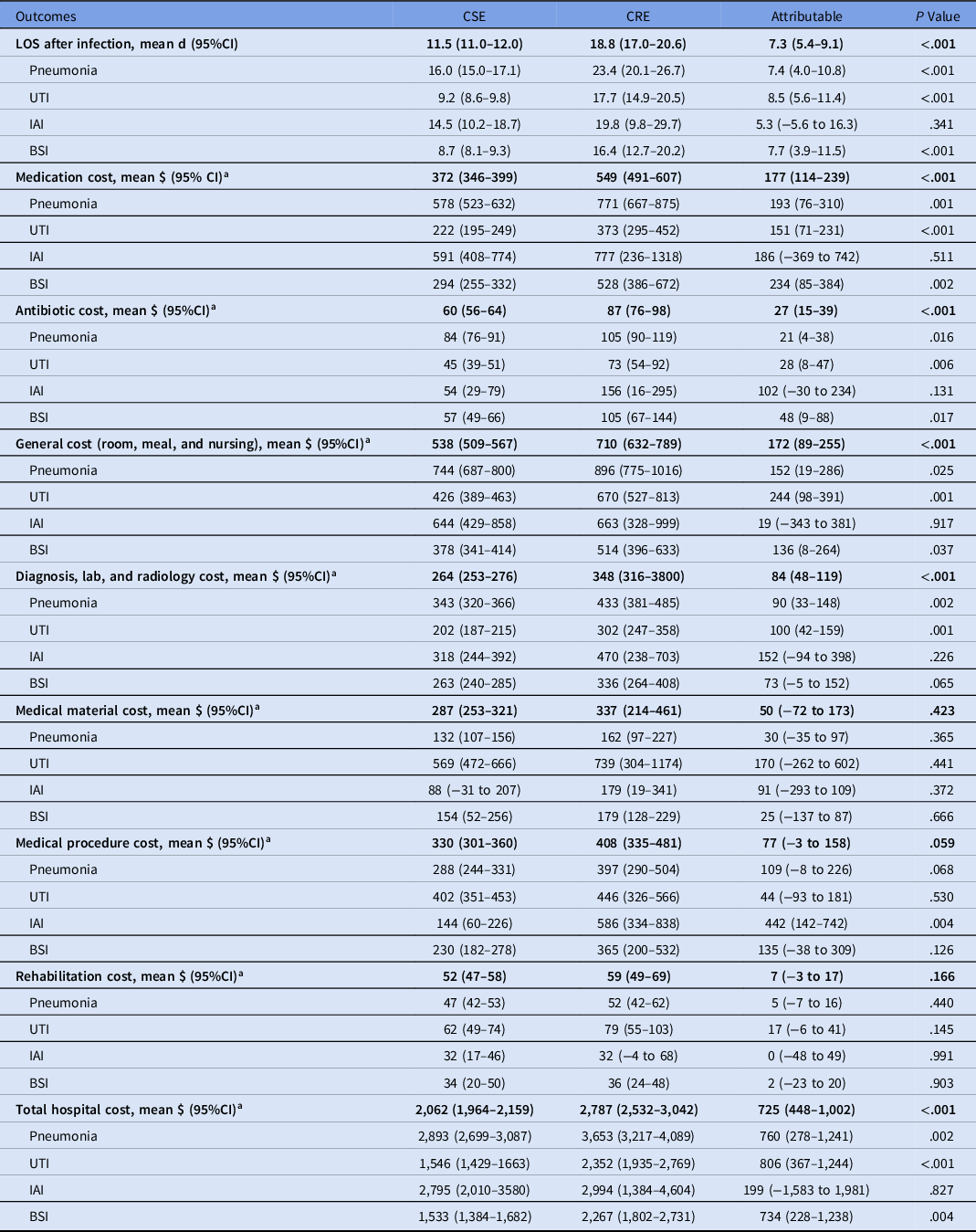
CRE infections were associated with an additional medication cost ($177; 95% CI, 114–239; P < .001), antibiotics cost ($27; 95% CI, 15–39; P < .001), general costs ($172; 95% CI, 89–255; P < .001), and total hospital costs ($725; 95% CI, 448–1002; P < .001) after adjusting for age, sex, site of infection, type of infection, corticosteroids used, parenteral nutrition, vasoactive medication, and comorbidities. Patients with CRE infections had significantly longer LOS than those with CSE (18.8 days vs 11.5 days, attributable 7.3 days; 95% CI, 5.4–9.1; P < .001). Similar effects on costs and LOS were significantly associated with an additional cost and increased LOS in pneumonia and UTI, but no significant difference was observed in patients with IAI (Table 2).
Comparison of the Adjusted Costs and Length of Hospital Stay Between Patients With Carbapenem-Resistant Enterobacterales (CRE) and Those With Carbapenem-Susceptible Enterobacterales (CSE)

Note. BSI, bloodstream infection; CI, confidence interval; CRE, carbapenem-resistant Enterobacterales; CSE, carbapenem-susceptible Enterobacterales; IAI, intra-abdominal infection; LOS, length of stay; UTI, urinary tract infection. $1 = 30.12 THB.
a Predicted value (length of hospital stay and cost) based on average marginal effects from a generalized linear model with a log link function and γ distribution that adjusted for age, sex, site of infection, type of infection, corticosteroids used, parenteral nutrition, vasoactive medication, and comorbidities.
30-day mortality
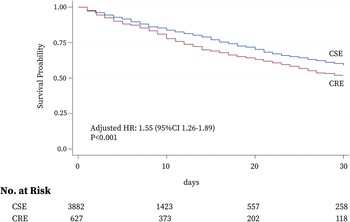
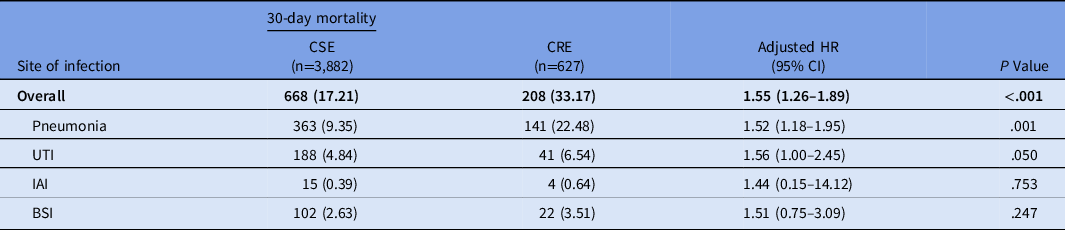
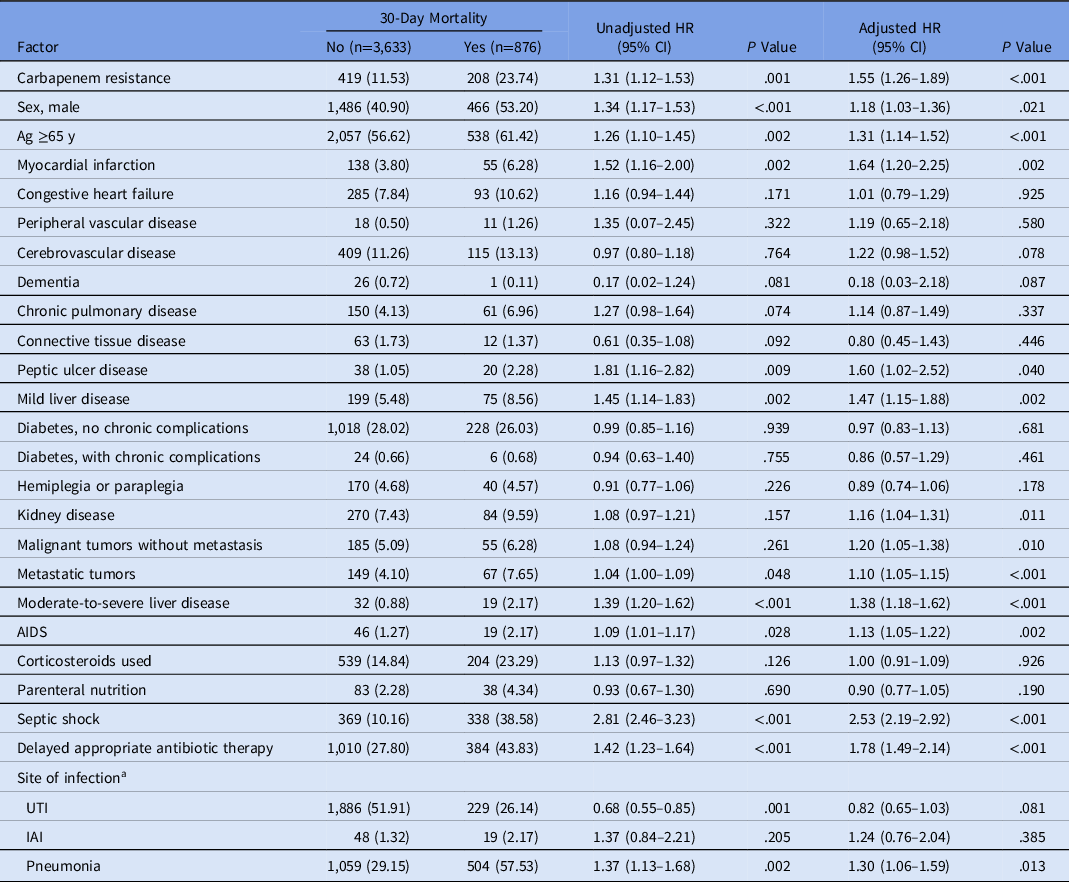
Patients with CRE infections showed a 1.55-fold increase in 30-day mortality (adjusted HR, 1.55; 95% CI, 1.26–1.89; P < .001) (Fig. 2 and Table 3) compared with CSE-infected patients. Factors associated with the 30-day mortality were identified (Table 4) and age ≥65 years (P < .001), myocardial infarction (P = .002), mild liver disease (P = .002), moderate-to-severe liver disease (P < .001), kidney disease (P = .011), malignant tumors without metastasis (P = .010), metastatic tumors (P < .001), AIDS (P = .002), septic shock (P < .001), and receiving DAAT (P < .001) were strong independently associated with an increased 30-day mortality. A similar impact on 30-day mortality was observed in patients with pneumonia and UTI, but no significant difference was observed in patients with BSI and IAI (Table 3).
Kaplan–Meier of 30-day mortality in a comparison of patients with carbapenem-resistant Enterobacterales (CRE) and carbapenem-susceptible Enterobacterales (CSE).

Multivariate-Adjusted Analyses of Infection-Related 30-Day Mortality: Carbapenem-Resistant Enterobacterales (CRE) Versus Carbapenem-Susceptible Enterobacterales (CSE)

Note. BSI, bloodstream infection; CI, confidence interval; CRE, carbapenem-resistant Enterobacterales; CSE, carbapenem-resistant Enterobacterales; HR, hazard ratio; IAI, intra-abdominal infection; UTI, urinary tract infection
aCovariate adjustment for confounding factors in Cox’s proportional hazard models included age, sex, site of infection, type of infection, corticosteroids used, parenteral nutrition, vasoactive medication, and comorbidities.
Carbapenem Resistance and Other Risk Factors Associated With 30-day moRtality in Patients with Enterobacterales Infection

Note. AIDS, acquired immune deficiency syndrome; BSI, bloodstream infection; CI, confidence interval; CRE, carbapenem-resistant Enterobacterales; CSE, carbapenem-resistant Enterobacterales; HR, hazard ratio; IAI, intra-abdominal infection; UTI, urinary tract infection
a BSI as reference (HR, 1.00)
Effects of delayed appropriate antibiotics therapy
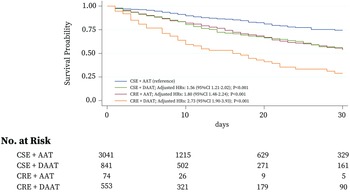
Among the 627 CRE-infected patients, 553 (88.20%) received DAAT, whereas 841 (21.66%) of the 3,882 CSE-infected patients received DAAT. The distribution of antibiotic use is shown in Table S3. Carbapenems (39.06%), third-generation cephalosporins (21.70%), and β-lactamase-β-lactamase inhibitors (19.89%) were the antibiotics that were most likely to be prescribed inappropriately among CRE infections. Compared with CSE infections who received appropriate therapy, those in whom therapy was delayed were more likely to be male (42.33% vs 40.64%), and these patients differed by mean age, ward, site of infection, LOS before infection, type of infection, and comorbidities, such as myocardial infarction, chronic pulmonary disease, and AIDS (all P < .05) (Table S4). When CRE and DAAT were combined in the analyses, a gradient effect was observed across strata. Compared with the reference population (ie, patients with CSE infection who received appropriate therapy), the worst outcomes occurred in the subgroup with DAAT. Among patients with Enterobacterales infections, the highest risk occurred in patients with CRE who received inappropriate antibiotic therapy; they had a 2.73-fold increased risk of 30-day mortality (aHR, 2.73; 95% CI, 1.90–3.93; P < .001) (Fig. 3). Furthermore, patients with CRE receiving DAAT were associated with the highest attributed antibiotic cost ($73; 95% CI, 18–127; P < .001) and LOS (7.0 days; 95% CI, 5.1–8.9; P < .001) compared with patients with CSE who received appropriate antibiotic therapy (Table 5).
Kaplan–Meier of 30-day mortality in a comparison of patients with carbapenem-resistant Enterobacterales (CRE) and carbapenem-susceptible Enterobacterales (CSE) according to the receipt of appropriate or delayed appropriate antibiotic therapy

Stratified Analyses of Infection-Related Outcomes According to the Receipt of Delayed Appropriate Therapy

Note. AAT, appropriate antibiotic therapy; CI, confidence interval; CRE, carbapenem-resistant Enterobacteriaceae; CSE, carbapenem-susceptible Enterobacteriaceae; HRs, hazard ratios; LOS, length of stay. $1 = 30.12 THB.
a Each outcome was adjusted for variables that were included in the inverse probability weighting: age, sex, site of infection, type of infection, corticosteroids used, parenteral nutrition, vasoactive medication, and comorbidities.
† P < .001.
Discussion
These results demonstrate the effects of carbapenem resistance and DAAT on the clinical and economic outcomes of patients with Enterobacterales infection in a tertiary-care hospital in Thailand. CRE significantly increased the 30-day mortality (1.55-fold), total cost (additional ∼$725), medication cost (additional ∼$177), and length of hospitalization (∼7 days) compared to patients with CSE infection. Our results revealed the high incidence of DAAT among hospitalized patients with CRE (88.2%). The 30-day mortality rate increased 2.73-fold and was highest among patients with CRE who received DAAT. Furthermore, we noted that patients with CRE who received DAAT had an attributable median hospital stay of 7 days and an attributable hospital cost of $840. Our findings have important implications for clinical practice; they suggest that the worse outcomes that are typically associated with Enterobacterales infection, regardless of the carbapenem-susceptibility status, can potentially be mitigated by timely appropriate antimicrobial therapy.
Furthermore, CRE infections are difficult to treat, and the risk of treatment failure is high. Reference Zilberberg, Nathanson, Sulham, Fan and Shorr11,Reference Nour, Eldegla, Nasef, Shouman, Abdel-Hady and Shabaan30 Our study clearly demonstrates that the in-hospital medical costs for CRE infections were higher than those for CSE infections, suggesting that carbapenem resistance, indeed, incurs excessive medical costs for patients infected with Enterobacterales. This finding is consistent with those of several studies, wherein carbapenem resistance was associated with higher mortality, hospital costs, and LOS for Enterobacterales infections. Reference Martin, Fahrbach, Zhao and Lodise12–Reference Zilberberg, Nathanson, Sulham, Fan and Shorr15,Reference Huang, Qiao and Zhang31 However, the hospital costs in our study are lower than those reported in a US study, which estimated that the in-hospital costs per patient with CRE infections amounted to $25,506. Reference Lodise, Berger and Altincatal13
The proportion of patients who received DAAT in our study are higher than in the previous study, which estimated that DAAT in CRE ranged from 46.2% to 55.4%. Reference Lodise, Berger and Altincatal13–Reference Zilberberg, Nathanson, Sulham, Fan and Shorr15 Recently, Lodise et al Reference Lodise, Berger and Altincatal13 evaluated the attributable costs and mortality among patients in the United States with serious infections due to Enterobacterales and demonstrated that CRE and DAAT both were associated with worse clinical outcomes and higher costs and charges. Furthermore, studies have shown that CRE and DAAT are associated with higher mortality rates, LOS, medication costs, and total hospital costs in patients with CRE infection in the United States. Reference Falcone, Bassetti and Tiseo14,Reference Zilberberg, Nathanson, Sulham, Fan and Shorr15 Zilberberg et al Reference Zilberberg, Nathanson, Sulham, Fan and Shorr11 found that both CRE and DAAT were associated with an increased risk of readmission within 30 days. Huang et al Reference Huang, Newton and Kunapuli32 demonstrated that carbapenem resistance leads to excessively high costs for Klebsiella pneumoniae infections that are not accounted for by the cost of antimicrobial therapy alone. However, no study has specifically evaluated the attributable cost, hospital utilization, and mortality related to the medication cost of DAAT in patients with CRE. Thus, this study provides unique attributable cost, LOS, and mortality rates for infections caused by CRE, and receiving DAAT.
Our study revealed that higher age (≥65 years), myocardial infarction, mild liver disease, moderate-to-severe liver disease, kidney disease, malignant tumors without metastasis, AIDS, septic shock, and receiving DAAT were independent factors associated with increased 30-day mortality. Regarding patients with septic shock, CRE-related mortality can be substantially higher, as reported previously. Reference Tumbarello, Trecarichi and De Rosa33 A high comorbidity index at presentation, Reference Falagas, Tansarli, Karageorgopoulos and Vardakas34–Reference Kassem, Raed and Michael36 or immunosuppression, Reference Bar-Yoseph, Cohen and Korytny37 has been described as a mortality predictor, as we identified in our patients. Identifying the mortality risk on hospitalization or at the time of infection might minimize the clinical and economic burden associated with CRE infection in this population. This finding highlights the crucial role of the microbiology laboratory and the importance of rapid reporting of microbiological results in the management of patients with a high risk of mortality.
DAAT is associated with high mortality rates in patients with sepsis or septic shock Reference Weiss, Fitzgerald and Balamuth38,Reference Ferrer, Martin-Loeches and Phillips39 ; furthermore, the probability of death increases with the number of hours of delay of antibiotic administration. Reference Weiss, Fitzgerald and Balamuth38 Moreover, time from blood culture collection to the administration of appropriate antibiotic therapy influences the LOS. Reference Zhang, Micek and Kollef40 As noted in our findings, prolonged LOS and additional hospitalization costs for CRE infections constitute a serious problem for public health. The global economic value of a CRE infection for hospitals has been estimated at $22,484–$66,031, which is higher than the annual cost of many chronic and acute diseases. Reference Bartsch, McKinnell and Mueller41 This is a current global issue, and its solution is associated with the prevention and control of these infections, and the optimal rational prescription of antibiotics is crucial.
The strength of this study was the large sample size, which provided significant results regarding clinical and economic outcomes of and the factors associated with poorer outcomes for CRE infections. Nonetheless, this study has some limitations. First, this is an observational study, and additional factors may have been associated with the exposures and outcomes of interest due to unmeasured confounding factors. Although we included several measures for the patients’ comorbidities and disease severity, the Acute Physiology and Chronic Health Examination (APACHE-II) or the Pitt bacteremia score was not evaluated in this study. However, this study reflects the real-world population, which presents a suitable design for studying clinical outcomes and economic impacts. These results provide evidence for informed decision making, and this information can be applied in healthcare settings or countries with a similar health system. Second, CRE may emerge from several mechanisms, including production of β-lactamases, overexpression of efflux pump, alterations in outer membrane proteins, or modifications in penicillin-binding protein. We did not conduct molecular-level analyses to characterize the Ambler classes of β-lactamases mechanism of resistance through which the unmeasured confounders could potentially affect outcomes. Additionally, previous use of inappropriate antibiotics or a history of CRE infection was not considered. Third, we only assessed the in-hospital medical costs, but the true economic impact of CRE includes the postdischarge medical costs and the costs for society, such as the loss of workforce productivity, which were not included in the analysis. However, CRE infection was associated with a significantly higher costs and mortality, which provides supporting evidence that could be used for the health technology assessment in the economic assessment of medications or interventions to control or treat CRE infection.
In conclusion, both CRE and DAAT were associated with worse clinical outcomes and higher in-hospital costs among patient with Enterobacterales infection in hospitalized patients in a tertiary-care hospital in Thailand. This study highlights the detrimental effects of antibiotic resistance and the need for antimicrobial stewardship programs to treat infections caused by these pathogens.
Supplementary material
To view supplementary material for this article, please visit https://doi.org/10.1017/ice.2021.446
Acknowledgments
The authors thank Miss Duangkamon Poolpun, Department of Pharmacy, Buddhachinaraj Hospital for her coordination at the study site. The funding source had no role in the study design; collection, analysis, and interpretation of data; in the writing of the report; and in the decision to submit the article for publication.
Financial support
This work was supported by a grant from the Unit of Excellence on Clinical Outcomes Research and IntegratioN (UNICORN), School of Pharmaceutical Sciences, University of Phayao, Phayao, Thailand.
Conflicts of interest
K.K. reports personal fees from Pfizer (Thailand) outside the submitted work. P.S. is an employee of Pfizer (Thailand), Boehringer Ingelheim (Thai). All other authors report no conflicts of interest related to this article.