My dance company, Cyrff Ystwyth, is based in the west of Wales at Aberystwyth University in the Department of Theatre, Film and Television Studies. We meet once a week throughout the academic year and create one production a year. Cyrff Ystwyth works through the medium of dance, although currently only one member has dance training. The age range of the performers is between twenty-two and sixty-nine and they are people with and without learning disabilities. They all live in the area of Ceredigion in the west of Wales. For a recent Arts and Humanities Research Council UK (AHRC) project, Challenging Place,Footnote 2 we were presented with three central research questions:
What can practical intervention tell us about how abstract concepts such as place, community, dislocation and belonging, as theorised by contemporary academics, map onto the ‘real life’ experiences of vulnerable social groups? Can one or more models of performance practices help to remedy feelings of ‘dislocation’ among community participants? How might such models be evaluated, disseminated and made fully accessible to community theatre organisations?Footnote 3
Of these three questions, the first most directly related to the company's longer-term enquiry and so we focused our work there.
Central to our enquiries is Adrian Jones, a performer and choreographer. He and I have a working relationship that might best be described as a partnership where we co-create and co-produce each other's work as artist and researcher. Since 1987 we have been close collaborators, living in the same area, and part of the extended network and cultural way of life in Welsh-speaking Wales. While he works through an autobiographical approach, he positions himself simultaneously within a range of community experiences and reveals the complex relations among the people, the land, animals and our traditions. His expertise of life in a minority cultural context and language is embodied knowledge and articulated through his choreography, as are his experiences as someone with a learning disability. In this manner we have been able to grasp disappearing realities of this way of life in rural Wales.
Our enquiry into place, community and belonging was conducted using devising processes for the creation of a dance theatre performance. Cyrff Ystwyth has been following a model of work that places the creative authorship in the hands of one member of the company. I work as the director and producer as well as the researcher. The material the performers and I are given comes from individual members of the company who express a desire to create a piece around a particular theme. This theme generally becomes the title of the finished work. This is a deeply collaborative process between the author and the director (me). Out of the eight projects we have completed, Adrian Jones has been responsible for four; 2012's Capel: The Lights Are On is his most recent.
As both a theatre practitioner and an academic researcher I perform a dual role in the company. I am the director and also the research investigator into our work. I understand these endeavours as an embodiment of critical theory. As theatre studies scholar John Freeman argues, if ‘we believe that the expressivity of art is its own (or only) articulation and that sense and knowledge can be best communicated through practice then demonstration becomes more than illustration: it becomes the thesis itself’. Writing as research offers the practice-based researcher the opportunity to develop that practice further. The theme of embodied knowledge and language as different yet interconnected orders of knowledge and expression was central to my thinking about this research project. The analysis of the results of this project, however, as well as of the question we set out to investigate, offers a challenge to rethink the intial assumptions supporting our enquiry. Arts scholar Henk Borgdoff asserts, ‘The requirement that a research study should set out with well-defined questions, topics or problems is often at odds with the actual course of events in artistic research’.Footnote 4 Cyrff Ystwyth's practice is a challenge to dance theatre and intended as a contribution to that broad and varied field of performance.
My research analyses that challenge and describes its potential in context, and here I consider the performance of place within the larger frame of our long-term project. I describe two key experiences of marginality in rural Wales and of learning disability in order to begin to reconsider who might qualify as an expert in this specific field of knowledge. Meaning-making and agency through gesture are set in the context of radically different dancing bodies, the politics of stillness and its impossibility. Finally I return to the enquiry within this larger frame and think about my colleague Adrian Jones's gestural choreography as an inscription of his agency and comment on our place and cultural context. Reading dance theorist Andre Lepecki's Exhausting Dance: The Politics of Movement prompted me to think about our work through the lens of Lepecki's challenge to dance, and in return consider and challenge his proposition on stillness. I take up Lepecki's propostion that, in dance, stillness is a method of understanding the work. As a means of extending this provocation that he presents to contemporary dance I will use his theory to examine the work of a dancer with learning disabilities. The research question I am addressing here suggests that concepts such as place, community, dislocation and belonging are abstractions. The academic grapples with these concepts through theory. Capel, as an example of practice presented in performance, responds to the academic's abstractions through embodied, concrete gesture. Additionally, this work reveals real-life experiences that resonate through history to the present moment. Cyrff Ystwyth makes dance performance, and our practical intervention regarding the AHRC research question took the form of live dance theatre. This was dance, however, that does not and cannot conform to the requirement that a dancer be a body of virtuosic appearance and ability. Rather, I argue it extends the concept of what the term can encompass. Lepecki's argument states that stillness might be the dancer's response to political crisis and I hope to show how this work resonates with this perception of the non-mobile and the unsmooth and unpolished dancing bodies of the company.
Ceredigion is a largely rural area with an economy that depends on the struggling agricultural sector. The terrain is hilly and the land is either stony or heavy, usually waterlogged clay. Of necessity, then, the type of farming is livestock- rather than crop-based. Within this geography there are traditions and lifeways that are the practices of Welsh-speaking people.Footnote 5 The iconic symbol of the chapel is perhaps best known as a signifier of this culture, although numbers are dwindling now, people having transferred faith allegiances to town-based Christian meetings. The rural chapel buildings, however, remain scattered throughout the countryside. They vary from tiny, hidden, secret treasures deep in the rural landscape to large and imposing buildings on hillsides. They are the heritage of a way of life that during the nineteenth century became a defining feature of the Welsh people and the Welsh language.Footnote 6 It is no surprise, then, that Adrian Jones decided to focus his creative response on the themes of chapel life as part of his response to his place and location.
We had begun to discuss the themes and questions for some months previously. Adrian Jones had already signalled his wish to lead the project that would address the research; I have written elsewhere about how he communicates his initial ideas.Footnote 7 He announced its title and theme many times over, usually when we did our weekly thirteen-mile drive between his home in Bronant and Aberystwyth. Each time we passed a chapel he would look and comment either ‘no … no … no lights’, or ‘Capel … The lights are on … yes look!’ The piece was performed in June 2012 at the disused chapel in the heart of Bronant. It was performed in and around the graveyard as well as inside the dilapidated chapel, during some of the worst summer weather we had known in many years – torrential rain that caused floods and high winds. Twelve performers began the process and ten actually completed the project, in driving winds and rain on the high ground of Ceredigion.
The piece took the form of a set of moments that moved from the small on-site vestry to the small graveyard at the side of the chapel. As the performance progressed the action moved to the raised area outside the chapel doors. This section proceeded to shift audience and performers to the inside for a longer section where the audience were seated in the pews. The performers occupied the aisles, the great seat and the pulpit, the areas preserved for performances by the ministers of religion. On leaving the chapel the performers positioned themselves in the larger graveyard at the front of the building that faces the main road through the village. They moved on and around the very old graves and then out to the tiny car park before ending the piece, once again outside the chapel doors. The audience were free to move around, although the weather did not encourage this. The soundtrack, chosen by Adrian Jones, consisted of mid-twentieth-century classical piano by Welsh composer Dilys Elwyn-Edwards, traditional hymns, Elvis Presley songs and a Cuban world-music track chosen by me.
In his article ‘The Body in Difference’, Lepecki discusses cultural difference. Jones works in and with a dual cultural perspective, representative of two marginal contexts.Footnote 8 First, Jones is a person with a severe learning disability; second, he is working within his overarching home context of the rural west of Wales. Both of these specific cultural contexts are under-represented in dance and mainstream, transcultural majority contexts. Both of these cultures, of learning disability and of rural Welsh-speaking Wales, are often disparaged and misunderstood; however, they both operate as markers of difference and inferiority. The west of Wales, and in particular Ceredigion, is culturally distinct and on the margins of populations with better communication networks, centres of power, influence and decision making. This is the experience of geographic and cultural marginalization. A parallel of this marginalization is learning disability itself. People with learning disabilities face marginalization in the form of discrimination and often abuse; the possibility of their knowledge having value goes unrecognized.Footnote 9 Cyrff Ystwyth might be understood as performing acts of resistance in a literal sense to this form of marginalization. In the case of Capel: The Lights Are On the acts of resistance to interpellative forces of geographic, cultural and intellectual marginalization are addressed and challenged. The challenge comes in the form of a critique of the qualifying criteria for the designation expert, practised and enacted through the working relationship between the academic and the colleague with learning disabilities. This project's findings suggest to me that the visible expertise brought to bear on the research questions comes from the designated beneficiary, Adrian Jones, as opposed to myself, the facilitator/researcher. Adrian Jones is an expert in a highly specialized field of knowledge – his home place, his cynefin, translated literally into English as ‘habitat’.Footnote 10 Through the conditions of his being in the world, he brings to light the cultural practices and reopens a forgotten site for others to experience.
Jones's choreography draws on his observations and knowledge of a minority culture's way of life. He routes his precise expression via his disability. This choreography facilitated a theatrical opening of a place and an event.Footnote 11 It was not an invitation to experience a place and a cultural practice through disability, or in spite of disability, but its material embodied expression was because of disability and his ability as a choreographer.
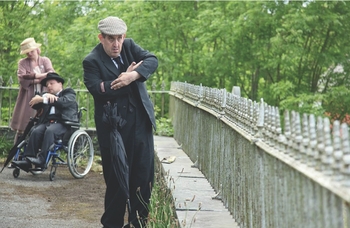
Adrian Jones performing ‘Babi Gwydion’ in the foreground with Jo Strong and Edward Wadsworth in the background outside the doors to the chapel. Photo: Marian Delyth.

In Lepecki's quotation of anthropologist Richard G. Fox, I find a metaphor for Jones as dance choreographer within the world of contemporary dance performance. Lepecki asks, ‘What happens when those bodies, so diverse and unstable in their presence, so hard to recognize in their physicality and expression, start to inhabit other cultures?’Footnote 12 In response to his question he quotes Fox: ‘The foreigner arrives. Perceived as different, the foreigner's odd-sounding words, acoustically hovering, outside logos, disrupt the self-contained economy of the familiar’.Footnote 13 The foreigner is the metaphor for Adrian Jones's work as his odd use of physical and verbal language disrupts a stable notion of the dancing body and extends the limits of dance, the familiar patterns and appearances of contemporary dancers and choreographic repertoires.
Lepecki's manoeuvre of turning to verbal language to describe and explain the illegibility of the physical language of different dancing bodies suggests the resistive potential of dance made by performers with alternative communicative strategies that, although radically different, succeed in speaking directly to their audiences. Dance ethnologist Deidre Sklar considers the embodiment of knowledge, as still tied to logos, yet perceived as the word of communication, when she asserts that ‘[t]he way people move is more than biology, more than art, and more than entertainment. All movement must be considered as an embodiment of cultural knowledge, a kinaesthetic equivalent, that is not quite equivalent to using the local language’.Footnote 14 If the body appears parallel to odd-sounding words because of disability's visual markers, as acoustically, visually and kinetically hovering, outside normative logos, my capacity to find adequate words to describe the cultural knowledge they express is drastically challenged. Jones confronts those of us bound up in language through his performance. These bodies disrupt what we know as dance, and what we know of theatrical appearance. Jones, although bilingual, has little use for words. Because of his physical appearance and postural and gestural behaviours he hovers outside the logos of dance language, taunting it, provoking that system with humour, with passion and with disdain. Cyrff Ystwyth bodies might be mine, ours; at any rate they are marked concretely with the particular signs of lives lived through exacting circumstances of age, pathology, occupation and environment. They are not bodies selected and trained through exacting techniques to produce mobility and speed – the dancing bodies of contemporary taste.
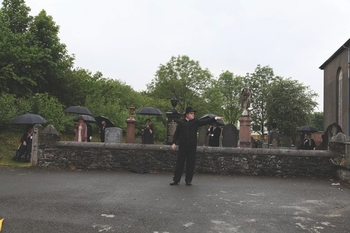
Andrew Evans performing ‘Point and Look’ with, from left to right, Edward Wadsworth, Jo Strong, Virginia Lowe, Adrian Jones, Lowri Lewis, Sam Evans and Heather Giles in the background. Photo: Nick Strong.

Connection between performers and audiences are immediate and direct; sometimes performers break the rules of traditional theatre and address the audience directly, telling people where to look, when to respond or when not to. Cyrff Ystwyth, demanding the gaze of the audience, turns that gaze back on the audience. In performance this appearance of physical variety and confidence is a call to recognition, an assertion, even a demand. The performance of place here becomes an authoritative embodiment. Lepecki states that ‘[t]he presence of the performing body in another culture implicates a very complex negotiation of identities, where “the fact of difference” guarantees the reproduction and perpetuation of a certain organization of the gaze’.Footnote 15 In this context, other cultures are mainstream dance and normative culture. Disability is compromised as a definition of individual problem that constructs social identity norms around health and ability. Here dance performance recognizes and re-presents the variety and ‘normality’ of disabled bodies. Bodies with disabilities are not the exception to the rule of normality, they are the rule. Capel re-presents the place, community and culture back to itself. In this context, I recruit Lepecki's critique of the certain kind of objective gaze that constructs disability in opposition to health and normality, and exoticizes the other, to suggest that the very apparent differences alert us, the audience, to our own variety.
Carrie Noland, who specializes in French literature – poetry – and takes a strong interest in dance as a form of meaning-making, argues that gesture and embodiment produce agency, and that culture is embodied and produced through physicality. Jones's choreography is especially gestural. He uses his hands, arms and face as his movement tools. Noland discusses the potential for gesture and the moving body to undermine gender reifications. I would like to extend this argument to consider how ‘these processes undermine the culturally regulated body-discourse relation’,Footnote 16 and, using Jones's choreography, consider how gestural routines ‘arguably provide a broader field of experience rich with possibilities for experimentation, refinement, and – in a cultural frame – subversion’.Footnote 17 My question then becomes: how does Jones's gestural choreography subvert the cultural frame of dance as the territory of young urban non-disabled artists? How does his work challenge the cultural regulation of disability and of disability dance, and in particular dance by people with learning disabilities?
It is within Jones's gestural choreography that the AHRC question of concept mapped onto real life was addressed. It is also here that, as Lepecki describes, ‘dance emerges from its own dusty, historical sedimentation, to challenge our sensorial and cognitive apparatus’,Footnote 18 not by means of stillness, as he argues, but by means of agency embodied through gesture. I am particularly intrigued by Noland's argument for gesture as citational and as potentially resistant to interpellation. She critiques Judith Butler's analysis of the cultural construction of bodies and genders and argues that Butler ‘seems to want to be able to refer in one breath to “bodily gestures” and “discursive acts” without having to account for the difference between a “corporeal sign”, a sign that is a moving body, and a verbal sign that is pronounced by that body’.Footnote 19 The problem lies in the difference between bodies and their contingent abilities, forms and circumstances and words that attempt to describe those bodies.
Jones has poor facility with words. He says very little. His inarticulate enunciations reify his learning disability. For example, the most recent work made by the company with a different individual author (June 2013) used live interviews and script. The languages we used were foregrounded. Jones, asked to speak to another performer through a microphone, took up the challenge and hurled its potential for insult out of the room by using vocal noise. He seized the instrument, faced his colleague and instead of words, blew a fierce rhythm of breath into the microphone. Amplified, his resistant (non-)speech act, consisting of the refusal of language, magnified his physical presence, his protest, his resistance and his agency. Voice is physical, voice as gesture saw Jones move his voice. Body and voice are not separate entities. In the search for meaning in what is communicated via movement, Noland considers how movement impacts language through physiognomic routes: ‘What is also brought into being as a result of moving in a certain way, as a result of reiterating gestural performance, is another type of “etc.,” it is: ‘a kinesthetic, proprioceptive, and somatic experience that exerts a force on language all its own’.Footnote 20
Noland argues for movement as agency and Lepecki argues for stillness. His stillness is both antidote to a modern agitation and a passage that allows for history to emerge from under the rush of modernity that glides over what has happened, and of the effects of power on peoples and lifeways. Adrian Jones is anything but still and, in fact, to be still is almost impossible for him. He is in constant motion yet his choreography of gestures is an attempt at arresting a moment to ensure visibility. He proceeds with his choreographies of gesture and pushes them, through repetition, to extremes. I understand that he requires these moments to be seen and they need time to register. I feel he means to hold the moment, give it time, and allow space around it.
Soft yet urgently fluttering fingers, restricted flexibility in breath and vocal cords, produce here a permanent echo of private thoughts and memories. In the air outside the chapel doors the well-known and somewhat clichéd hymn ‘Calon Lân’ is half-sung and the keyboard accompaniment, played in the air overhead, just beyond reach. The fulfilment of the movement is arrested through use of marked bound flow in the breath, voice and outstretched arm.Footnote 21 Cyrff Ystwyth performers are not still. They do not perform introspection but Jones exemplifies Lepecki's thinking, as his work ‘proposes another dance, one under which time expands immensely, awakening discarded memories to flood, allowing sedimented yet necessary gestures, thoughts, feelings, sights, to emerge once again on the social surface’.Footnote 22 Jones's choreography for Capel is made from a series of stillnesses that were found through twitches, adjustments, stutters and staggering. He changes position and just when you think you might have learnt the shape, he wriggles and fidgets. He usually mutters a constant stream of half-formed words just below audibility, revealing a verbal agitation, an agitation of language on the move. When making a section which was held still for long seconds, he repeatedly thrust his arms out and lost the horizontal open shape he was making. Finally I shouted, ‘Hold it! Hold it! Hold it!’ and the verbal command from an external source became the technique to achieve his image.
Dance movement is generally thought of as precise, deliberate, controlled and knowable; that is, it is part of the system of sign and value in theatrical performance that denotes recognizable skill and an aesthetic approach to the body and actions of that body. The codes of theatrical, contemporary dance contain information that reveals human potential to articulate movement and mastery of space and time through virtuosic technique. The dancers in Cyrff Ystwyth, however, are not trained in the techniques that produce such articulations. Dance scholar Jo Butterworth comments that the community dance practitioner who might usually work with untrained dancers deals with very different concepts of dance from the professional. ‘Often the traditional concepts of form, content and technical skill usually evident in professional dance performance need to be adapted or reconsidered’.Footnote 23 The untrained dancing bodies and dancers with disabilities in Cyrff Ystwyth suggest alternative mastery of movement and write with their bodies, choreographic signs and codes that hold information about alternative value systems within specific cultural contexts. Rather than adaptation of form, content and skill as Butterworth outlines, here I consider how residing on the margins of tradition, and within a rural tradition in Wales, the notion of dance is entirely reconsidered. Contemporary dance in this cultural context is not a popular nor even recognized art form and at best is understood as a peculiar from of theatre more relevant to young city dwellers than the rural populace. Cyrff Ystwyth, emerging from that populace, posits alternative representations of form, content and skill rather than adapted versions of other dance. These alternative articulations of technical aspects of dance theatre embody responses to the research question that considers the interplay between theory and ‘real life’.
Jones choreographed his communication, his manuscript concerning location and community. I am not referring here to a simplistic notion of dance as a non-verbal language that enables people with learning disabilities to express themselves. This idea about dance being an alternative to verbal language is swiftly dispensed with by anthropologist Sally Ann Ness. In response to her critique of ‘gesture as inscription’, where she maintains that inscription is a form of permanent marking that is taken into the substance written upon, and enquires into what forms of dance have this capacity to become part of a body,Footnote 24 I offer that whilst Jones has no knowledge of any dance training that Ness would consider to be inscribed – that is, taken into the body – he does have a lexicon of gestures and movements. These are the outward techniques of inward inscriptions of a rural environment, an environment inscribed within him. Such inscriptions make his lexicon available to imagination and result in varying iterations. In Cyrff Ystwyth we know these gestures and name them: ‘chopping’, ‘leading the bull’, ‘milk’, ‘polishing’, ‘babi gwydion’, amongst others. They are not literal or mimetic but might be understood, as Ness describes the trained dancer's body, as ‘something very much like a living monument to a given technical “discourse”, if it is not exactly that. It appears as a durable host, an organism whose “final form” preserves in its very bones the understanding of a certain tradition of intelligent, methodical practice’.Footnote 25
Lepecki repeatedly questions the values of contemporary dance. In Exhausting Dance the ceaseless motion of the dancer is both physically exhausting and brings about the end times of this art form. Such agitation and display ‘erases from the picture of movement all the ecological catastrophes, personal tragedies, and communal disruptions brought about by the colonial plundering of resources, bodies, and subjectivities that are needed to keep modernity's “most real” reality in place: its kinetic being’.Footnote 26 Lepecki's thesis is a demand that dance must alter in order to respond to the lesson of history and to find a means of representation that releases dancers and audiences from a modern trajectory that removes the painful, unbearable weight of history and concentrates solely on the production of movement, line and pattern. Cyrff Ystwyth, working here on the margins of power and commerce, with experiences of learning disability and cultural changes that are resulting in Welsh cultural demise, attempts to insert our representations of this life. Lepecki focuses on work that challenges moving spectacles of smooth modernity, such as that of Xavier Le Roy and Jérôme Bel. The choreographic device he considers is that of stillness. This, on the one hand, offers the dancer potential as the task then becomes one of drawing attention to one's stillness, which is reminiscent of Steve Paxton's ‘small dance’ – standing still and observing the micro-movements of the apparently motionless body. On the other hand, we might observe that disability often makes impossible the feat of quieting the multitude of reflexes, and discharges of internal activity externally. Stillness is a controlled neurological act as much as dancing is. Disability often externalizes internal processes of spasm, fluctuation of tensions and decision at play with indecision. In the medical world arrest of an action might be understood as pathology, privileging the still body, with the unfinished or barely begun movement signalling failure. I work with dancers who cannot produce a still body. Such dancers might be able to begin to reinstate into the picture of the dance some of those communal disruptions and catastrophes, and assert kinetic being. Capel drew on cultural practice and memory and asked audiences to return to the building that housed this practice. Jones's Capel is an example of a reinstatement of a cultural signifier now haunting the edges of an endangered culture. Welsh Non-conformism that formed a culturally specific identity and was deeply rooted in the language and communal gatherings in rural chapels is a way of life that is almost extinct.
Mainstream Western theatrical dance is a product of training, which produces the well-proportioned bodies of pupils who craft their muscles to appear pleasing. Such training produces a Western contemporary dancing body that is capable of the endlessly moving ‘line’ of the dancer, trajectory through space and the articulation of limbs with spine that defines mobility, the endlessly travelling line of the dance inseparable from the dancer. Lepecki asserts that this inseparability between dance and dancer causes ‘the optical fantasy of the subject’.Footnote 27 Subjectivity here is dependent upon the idea of ideology as mirror, which creates the fantasy of the unique subject that sees him-/herself reflected back in the mirror/ideology of normality. It is, he argues, ‘central in locating and creating the body of the dancer in the history of Western dance’.Footnote 28 This fantasy might well be a useful critique of the privileged few in the conservatories, local dance schools and clubs that form the means of production of dancers and dance. Lepecki's call to a more urgent dance performance that undermines this narcissistic element of dance and questions the sovereign nature of the individual outside history is important. I would argue, however, that realized and not fantasized subjectivity remains critical to the lives of people with learning disabilities. Thomas DeFrantz, a scholar in African and African American studies, also finds this challenge to movement in dance problematic for its ‘displacement of progressive minoritarian performance practices’.Footnote 29 DeFrantz wishes that Lepecki had extended his framework, and, resonant with the argument presented here for artists who choreograph and perform from within a minority geopolitical culture and a minority disability culture, asks, ‘How do these artists or these particular performances choreograph race, or ability, or location or class, gender, velocity, status, age, desire, or family memory?’Footnote 30
Yet whilst finding the challenge to perform stillness exclusionary, I take seriously Lepecki's assertion that choreography could be a ‘practice for political potentiality’.Footnote 31 This might be a practice that opens new questions about disability and the political work of dance and theatre. The findings of the research questions at the heart of Cyrff Ystwyth's project are loaded with political potential for reframing understanding of place and space. Cultural geographer Dereck McCormack states that ‘the quality of moving bodies contributes to the qualities of the spaces in which these bodies move. Put another way, spaces are – at least in part – as moving bodies do’.Footnote 32 If this is the case then the political potential of choreography in Jones's work is the potential to make visible marginal positions that are deemed problematic, such as the rural, people with learning disability and minority cultural identities. He brought his colleagues to Bronant, a place and a signifier of a lifeway that in fact was profoundly difficult for nonconforming bodies. A colleague who uses a wheelchair was abruptly confronted with access problems and impossible spatial negotiations as he attempted to move around old and fallen gravestones on soaked and uneven soil. Additionally, Bronant feels a long way from Aberystwyth, psychologically and geographically, albeit it is only thirteen miles away. The rural marginality provoked increased anxieties for a while. I suggest that Jones's choreographic lexicon, which had become so familiar in the studio, enabled others to overcome these anxieties, as McCormack describes through ‘a kind of corporeal micro-politics’,Footnote 33 delivered through his choreography and their commitment to performing it in its place.
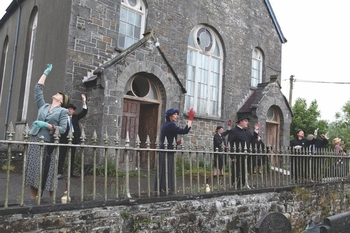
Left to right: Anna ap Robert, Sam Evans, Helen Williams, Lowri Lewis, Andrew Evans, Heather Giles, Virginia Lowe, Adrian Jones, Jo Strong and Edward Wadsworth performing ‘Calon Lân’. Photo: Nick Strong.

Cyrff Ystwyth takes ceaseless movement and, through the production of movements formed through stuttering and twitchy attempts at stillness, performs individual subjectivities without compromise. Presences, bodies, describe the open gaps between us instead of the closure of the dancer and studied choreographic presence. Individuals co-creating might be one way in which performance scholar Hans Thies Lehmann's promise of community in theatre has a real chance of emerging – just for while.Footnote 34 Lepecki's critique of ‘the dancer who moves in the scopic field as she inhabits a body’ has another radical impact.Footnote 35 Absorbing the image of people defined as other, I suggest, presents new ethical visions for our relations. Troubling late capitalist use of the commercial body, the body to be created, moulded and maintained, these bodies return our gaze to us without the artifice of marketing hyperbole. We see ourselves as a community of possibilities; we feel our own bodies’ dancing potential. Performance and disability scholar and artist Petra Kuppers, on the other hand, offers another perspective on the political potential of the moving body's conscious appropriation of stillness. Her analyses of the still body's power range over several contexts and, like Lepecki, she understands this bodily state as resistant to reifying interpellations that contribute to ‘othering’ humans. Her proposal is that stillness may further the experience of the relationship between performer and audience through perception of time and motion passing between them:
In this kind of alternative performance, with its specific demands on the audience's perception of the performers, the unclearly, imperceptibly moving and breathing bodies withholding their inner experience would be alive – that is, not fixed into difference. Something would be moving, and the fact that it would not be clear what is moving and how would draw attention to the not-quite-stillness of the performers, and the spectators’ desire to see and to witness. The inner movements of both performers and spectators would be foregrounded. The “closed system” of the spectators’ worldview might just open up to the implications of difference, the glimpse of duration in the encounter with the “other”.Footnote 36
This observation of a ‘not-quite-stillness’ is further developed in a later article on two visual artists whose works confront atrocity and the ‘othering’ of humans becomes literal annihilation in slavery, racism and misogyny. She complicates the issue of stillness and again affirms that perhaps the perception of stillness defies the fact of movement within a body, offering, ‘Rhythm, flow, and continuation drive an identity politics that needs to tell its stories, and yet refuses the caught-ness of dominant signification’.Footnote 37
DeFrantz suggests that Lepecki's purpose in his argument for stillness and a resistant politics might be ‘to reopen a space for the consideration of modernity's ends to consider how a body onstage in stillness could enable unexpected subjectivities in an open field of the future where bodies do something besides engage in the melancholic’.Footnote 38 The very impossibility of disciplined, composed stillness for most members of Cyrff Ystwyth opens up what dancing bodies might do and inscribes a particularly un-melancholic affect upon the arena of their appearance.
Or does this lack of disciplined stillness trouble further than this? Is it the possibility of my own excision from subjectivity, my own otherness, my own strangeness and hovering? This is something not in my experience, previously disclosed through dance. Rather, the dancer and the dance so exquisitely wrought from youth and training demanded a voyeur's disposition towards the dancing body as monadic subject outside community as it appeared to sell its muscular, yet thin, singular appeal. Jones's choreography prompts my awareness of my subjectivity's contingency within the social order. In Capel the nature of place, community, dislocation and belonging became a concrete experience that moved through us and moved us. Jones's choreography of gesture is his tool for resistance.
Noland offers, ‘Writing is a very specific kind of gesturing, one that rarely invites scrutiny as an instance of motility’.Footnote 39 For Noland the inscriptive act of writing language becomes the dance itself. Recalling Ness's argument that gesturing is not necessarily inscription, I suggest that while inscription with words is not available to Jones, his gestural choreography is his inscription of agency, embodied acts of legibility (that is, choreo-graphy). The AHRC enquiry focuses on how performative practices might alleviate issues of dislocation in contemporary society. In Capel, danced by untrained performers and those with disability, audiences might understand Jones's choreography as shifting our sense of place and belonging, as we absorb into ourselves the ‘other’ and perceive our relationships anew. McCormack's discussion on dance, bodies and geography leads him to the conclusion that the point ‘is not that everything can happen in this space, but that it affords the opportunity for modes of corporeal inventiveness in which new ways of relating might be engendered, or brought into being, each time a dance is enacted’.Footnote 40 In fact the ‘otherness’ of this work might unsettle the very sense of belonging in the world that disabilities studies scholars and activists refer to as normate,Footnote 41 forcing me to encounter the anxieties bestowed on me as ‘natural’ as, in fact, entirely constructed. My response here is to acknowledge my own potential dislocation as a non-disabled director of choreography given to me via my colleague's disability. The process we entered into was inaugurated by Jones's intervention. This intervention became a remark, written in embodied gesture, a comment on a state of affairs that told us something about what was happening, or not happening, in our environment, our place. Whilst I had brought the research project to the group, he made the intervention of offering a title, theme and focus that enabled us to begin a practical investigation by insisting on the significance of lights being on in chapels. I hope to show that the outcomes to the AHRC research question found in his work reveal that as Jones applied choreographic response to concepts, he provided examples of what Noland asserts in her work on gesture and agency. He produced agency through embodied gesture, both of himself and of his home world, his culture. By considering Cyrff Ystwyth as making a contribution to dance via Lepecki's critique of this contemporary form it might also be necessary to take issue with his notion of still acts as resistant and productive, as this excludes the dancer who cannot be still. Cyrff Ystwyth and Jones are dance artists, who help us expand upon the narrow concept of what dance is through twitches and stuttering stillness that reveal basic corporeal existence, raw, intense, frail and intent on being seen.
Returning to the research question and the theme of the inability to find stillness, what is contained within these gestures that Adrian Jones choreographed – physical utterances that constitute the performative response to abstract notions of home and location? Theatre scholar John Freeman states that ‘[a]sking questions through practice, any more than asking questions of practice, does not mean that one should demand or even expect clear answers’.Footnote 42 My response to the first research question stated at the beginning of this article is to interpret this choreography as the ‘real life’ referred to in the research question. Capel was made with choreography of retrieved gesture and interpreted physical citation whose source is the social practice of being a rural Welsh-speaking Non-conformist. Home, location and belonging were examined through embodied knowledge, abstracted and inserted in each specific body. The performance enabled this to be revealed to the audience and to the academics, and as Noland states,
If there is an enduring character to the material body, then it remains a source for new movements and experiences; it promises to disclose an aspect of human kinetic potential that has not previously been integrated into normative gestural routines. The motor body possesses a variety of agency that can help renovate the paradigms of construction and resistance, interpellation and identity, with which we normally conduct theoretical work.Footnote 43
Jones, interpellated as a vulnerable person with a learning disability, has returned the question of how abstract concepts might map onto real life, with kinetic and embodied proposals that leave the contemporary academic with new material to investigate and might help us come to different understandings about how our enquiries relate to ‘real life’. Arts research scholar Henk Borgdoff asserts,
Especially pertinent to artistic research is the realization that we do not yet know what we don't know. Art invites us to linger at the frontier of what there is, and it gives us an outlook on what might be. Artistic research is the deliberate articulation of these contingent perspectives.Footnote 44
Although I may have suspected that particular themes and concerns would emerge in this example of artistic research, I did not know how my colleague Adrian Jones would contribute or how rich his responses would be. The premise of the question about abstract concepts and real-life situations was asked from within an order of knowledge that splits the academic from everyday life and the person with a learning disability from a position of being able to offer expert comment. The person with learning disabilities may also be excluded from everyday life because of social constructions that determine his/her lack of ability. In contrast to such a construction, this practice-as-research project revealed how bodies and abilities of extreme difference are able to produce deep engagements with both concepts and practices of place.