Implications
The belly is generally classified as a fatty primal cut but is also definitely thinner and softer than years ago. The determination of factors influencing belly content is needed to determine its technological value for defined market. Based on the study outcomes, it is possible to estimate tissue composition of pork bellies analysing sex, half-carcass mass and lean meat content. The presented solutions permit a quick and easy evaluation of raw material and its allocation to the adequate market.
Introduction
The tissues composition of pork primal cuts determines their further use. The quality parameters of finishing pig carcasses slaughtered all over the world have been constantly changing, especially in recent years. The main assumptions of improving pork production are to increase the lean meat content of the carcass and to reduce fat (Kouba and Bonneau, Reference Kouba and Bonneau2009). These goals are determined by the demands of the processing plants and consumers. Estimation of the overall lean meat content of the carcass is still the most common form of grading pig carcasses and adjustment of purchase price based on this parameter confirms its strong relationship to the economic value of the carcass (Marcoux et al., Reference Marcoux, Pomar, Faucitano and Brodeur2007). The improvement of the pig population based on reducing backfat thickness has resulted in a decrease in the total fat content, mainly over the leg and back, including intermuscular and intramuscular fat (Vališ et al., Reference Vališ, Pulkrábek, Pavlík, Vítek and Wolf2005). In addition, a negative correlation between the content of meat and fat in the carcass has definitely accelerated the process of the reduction of whole carcass, as well as the primal cuts fatness (Hermesch, Reference Hermesch2008). A consequence of these changes is the increasing share of muscle tissue in primal cuts (Kosovac et al., Reference Kosovac, Vidović, Živković, Radović and Smiljaković2009). The belly perfectly reflects the nature of these transformations.
The belly is generally classified as a fatty primal cut and, in contrast to other primal cuts of the carcass, has a higher fat content in relation to the amount of muscles (Stupka et al., Reference Stupka, Šprysl and Čitek2004). However, over the last 40 years, the decline in fat level of bellies has exceeded 29% (Person et al., Reference Person, McKenna, Griffin, McKeith, Scanga, Belk, Smith and Savell2005). Simultaneously, there has recently been an observable increase in the mass of ham of 19% and loin of 21%, but the mass of belly has remained almost constant (Stetzer and McKeith, Reference Stetzer and McKeith2003). Currently, pork bellies are definitely thinner and softer than years ago. However, the international pork trade forces producers to adapt their products for specific markets.
Export and import of pork is based primarily on market demand and consumer preferences. Asian meat markets show a high demand for pork primal cuts (Uttaro and Zawadski, Reference Uttaro and Zawadski2010); however, it is not easy to enter this market and maintain continuity of supply. The economic value of a carcass depends on the requirements for cuts, which often are also sold in unprocessed form (Knecht et al., Reference Knecht, Jankowska and Zaleśny2012). Pork belly is one of the particularly desirable cuts in Eastern markets (Nam et al., Reference Nam, Jo and Lee2010; Oh and See, Reference Oh and See2012). Hence, the importance of a detailed analysis of the composition and the share of the cut in pig carcasses is needed. Bellies derived from the carcasses of pigs from the commercial population are diverse in terms of tissue composition. It has been suggested that the belly composition is affected mainly by the sex, slaughter mass and lean meat content of the carcasses rather than crossing variant (Vališ et al., Reference Vališ, Pulkrábek, Pavlík, Vítek and Wolf2005). Thus, an issue or prime importance is the determination of the influence of those factors on the belly content in the carcass for the current commercial finisher population, and the potential to estimate their technological value in order to sort raw material at the earliest stage of production.
In the light of the above considerations, the aim of this study was to determine the factors affecting the estimation of the tissues composition and lean meat content of pork bellies.
Material and methods
Design of the study
Finisher pigs chosen for experiments came from the Polish commercial population of pigs. The slaughter of animals was carried out in a meat plant in the province of Pomerania, after a few hours of rest from the time of delivery. The carcasses were bled, separated along the centre line and deprived of tongue, bristle, hooves, genital organs, perirenal fat, kidneys, diaphragm, eyes, middle ear, brain and spinal cord. For further studies only that raw material with a postmortem hot carcass weight between 60 and 120 kg was classified. The total research population consisted of 140 pig carcasses. Lean meat content in carcasses were predicted at the end of the slaughter line, using Capteur Gras/Maigre (CGM; Sydel, Lorient, France) device (EC, 2011).
The carcasses were divided into groups differentiated in terms of sex (gilts, barrows), half-carcass mass (<40, 40 to 43.9, 44 to 46.9, ⩾47 kg) and carcass classes based on their lean meat content: S (⩾60%), E (55% to 60%), U (50% to 55%), R (<50%), and marked directly on the slaughter line. After a 24 h cooling period, the right half-carcasses were chosen. Bellies derived from all carcasses were subjected to a detailed dissection. The belly was separated from the jowl by a cut between fourth and fifth rib following the line of the ribs. The ventral part of belly was separated from the belly by a cut starting 4 cm caudally of the last rib first in straight line to ventral and then following cranially along a line just dorsal from the row of teats (Walstra and Merkus, Reference Walstra and Merkus1996). Dissections were performed according to EU reference methodology by specially trained personnel. As part of the detailed belly dissection, the following aspects were defined: belly, fat with skin (subcutaneous and intermuscular), bone and muscle masses. An approved electronic scale was used for the weighing of belly and tissue components derived from the dissection, with an accuracy to the nearest 1 g. The percentage of belly in each half-carcass and the percentage of dissected tissues in the belly were calculated. The level of lean meat content was calculated following the EC Regulation formula using dissection data (EC, 2006).
Statistical analysis
Numeric materials were analysed statistically using the STATISTICA (2013) program. The values set out in the tables determine the arithmetic mean (
 $\bar{x}$
), RMSE and P-values. The application of the GLM was preferred because the collected data were checked for normality with the Kolmogorov–Smirnov test and with the Brown–Forsythe test for homogeneity of variance. The statistical model consisted of main effects (sex, half-carcass mass, lean meat content class) and interactions between them. To determine the statistical differences, the following level P⩽0.05 of significance were considered. To indicate the significance of differences between means Tukey’s post-hoc test was applied. The regression equations estimating the percentage value and quantity of meat in the belly were designated using stepwise regression. Models of equations were based on correlations with the dependent variable and the following variables. Only significant correlations (P⩽0.05) were used to obtain the smallest possible estimation error: lean meat content and the half-carcass mass. Estimation accuracy was determined via the prediction error and the adjustment of variables. During calculations, all outliers identified in the data set as larger than 0.5 Cook’s distance were removed and eliminated by a needle plot of Cook’s analysis.
Results
Mass of belly and dissected components
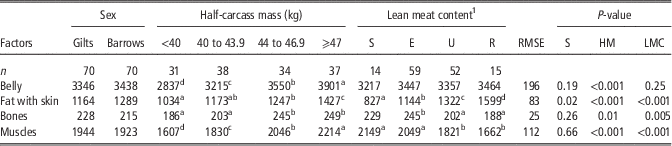
The mass of the belly and its tissue compositions depending on the analysed factors are presented in Table 1. The differences between gilts and barrows were not significant, except for fat with skin mass. Definitely, a higher proportion of this parameter was found in barrows (P=0.02). Half-carcass mass affected all the analysed parameters (P⩽0.05). Proportional increases in the mass of belly, fat with skin, bone and muscle were recorded with increasing half-carcass mass. The only exception was the mass of the fat with the skin in the 40 to 43.9 kg group, for which the value did not differ statistically between the two groups <40 and 44 to 46.9 kg. A decrease in lean meat content affected the growth of the fat and skin mass in a linear way (P<0.001). The highest bone mass was observed for carcasses in class E and its differences between R and U classes amounted to 56.87 and 42.64 g, respectively (P⩽0.05). No differences were observed between S and E classes in terms of belly muscle mass. However, it should be noted that the muscle mass decreased together with a decreasing lean meat content. S and E classes exhibited significantly higher lean meat content than the R (P⩽0.01) and U (P⩽0.05) classes.
Mass (g) of the pork belly and dissected components (fat with skin, bones and muscles) according to sex, half-carcass mass and carcass lean meat content

S=sex; HM=half-carcass mass; LMC=lean meat content.
a,b,c,dValues within a row with different superscripts significantly differed at P⩽0.05.
1 Lean meat content for class S (⩾60%), E (55% to 60%), U (50% to 55%) and R (<50%).
Share of belly and dissected components
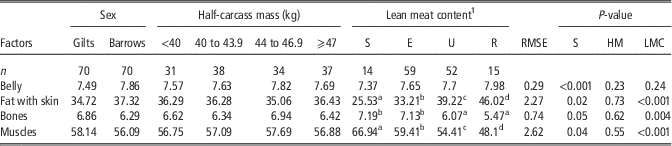
The percentage of belly in half-carcass and dissected components of belly, depending on the factors studied, are presented in Table 2. Sex had a significant effect on the characteristics of the percentage of the analysed parameters in the carcass. A higher share of belly in the half-carcass (+0.37 percentage point) was found for barrows (P<0.001), and bellies issued from barrows were characterized by a higher proportion of fat with skin compared with gilts (P=0.02). Gilts achieved a +2.05 percentage point higher level of muscle in the belly (P=0.04), and a higher proportion of bone (P=0.05). Half-carcass mass did not affect the percentage of belly in half-carcass or the composition of the tissues to a statistically significant level. The highest differences between the analysed parameters were found according to the lean meat content classes. This highlighted a linear decrease in the belly muscle and an increase in fat with skin, along with a decrease in carcass lean meat content class (S to R). The share of bones in the belly was at a similar level in classes S and E and higher than in class R (P⩽0.01) and U (P⩽0.05), without differences between R and U classes.
Percentage of the pork belly in half-carcass and dissected components (fat with skin, bones and muscles) in belly according to sex, half-carcass mass and carcass lean meat content

S=sex; HM=half-carcass mass; LMC=lean meat content.
a,b,c,dValues within a row with different superscripts significantly differed at P⩽0.05.
1 Lean meat content for class S (⩾60%), E (55% to 60%), U (50% to 55%) and R (<50%).
Statistical analyses also revealed interaction between the half-carcass mass and sex on the muscle mass of belly (Figure 1). Heavier (⩾47 kg) half-carcasses from gilts exhibited higher muscle mass of belly than those from barrows (P⩽0.01), whereas differences between sexes on belly muscle mass were not significant for all groups of lighter half-carcasses (<40, 40 to 43.9 or 44 to 46.9 kg). The number of subgroup observations for calculating the interaction was similar and ranged from 15 to 20 observations.
Muscle mass of pork belly according to half-carcass mass and sex.

The regression equation estimating the percentage of lean meat content in the belly
Lean meat content in belly (%)=1.21083 lean meat content of carcass predicted by CGM (%)−0.00003 half-carcass mass (g)−7.81917
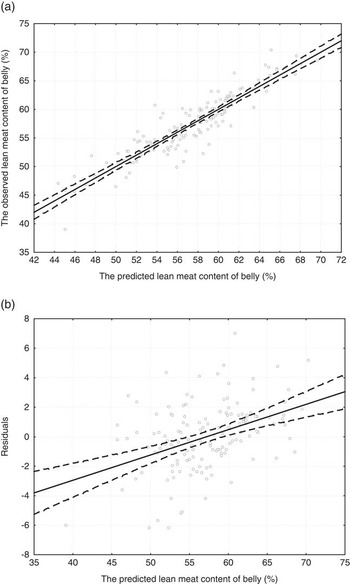
This equation has been developed on the basis of 139 observations, because in order to increase the precision of the estimation one observation was classified as an outlier. The lean meat content of a carcass from CGM adopted as the regression coefficient in the equation was significant (P⩽0.01), whereas the half-carcass mass was a factor added to lift the accuracy of the equation. The results for equation were as follows: F value=330.74, estimation SE=2.32, R 2=0.828. The SE of lean meat content in carcass predicted by CGM coefficient was 0.047, the SE of half-carcass mass coefficient was 0.00004 and the SE of intercept was 3.04. Figure 2a shows the regression curve, which illustrates a high correlation between the observed percentage share of the lean meat content in the belly from dissection and the predicted lean meat content of the belly based on the developed regression equations. The uniform distribution of the residuals shown in Figure 2b demonstrates the good fit of the equation for the study population.
Scatter plots of regression line with confidence intervals (a) and residuals (b) representing differences between percentage lean meat content in pork belly based on dissection and prediction.

The regression equation estimating the lean meat content (g) in the belly
Lean meat content in belly (g)=32.38 lean meat content in carcass predicted by CGM (%)+0.05 half-carcass mass (g)−1865.38
The developed equations were based on data from 140 dissected carcasses. The results for the equation were as follows: F value=177.74, estimated SE=173.5, R 2=0.72. The proposed regression coefficients were statistically significant (P⩽0.01), the SE of lean meat content in carcass predicted by CGM coefficient was 3.51, the SE of half-carcass mass coefficient was 0.003 and the SE of intercept was 226.9. The results in Figure 3a present the fit of the equation estimating the share of meat in the belly to the real value. Similar to the situation in Figure 2a for the first equation, a uniform dispersion of residuals was obtained (Figure 3b).
Scatter plots of regression line with confidence intervals (a) and residuals (b) representing differences between lean meat content (g) in pork belly based on dissection and prediction.

Discussion
The quality of carcass and primal cuts is an important issue in pig production from both the scientific and practical points of view and is based on different parameters and criteria (Kosovac et al., Reference Kosovac, Vidović, Živković, Radović and Smiljaković2009; Tomović et al., Reference Tomović, Žlender, Jokanović, Tomović, Šojić, Škaljac, Tasić, Ikonić, Šošo and Hromiš2014). Our results confirm the influence of the examined factors on the percentage composition of the belly tissues.
The influence of sex was observed on the percentage of belly in the carcass and tissues from dissection, whereas there was no effect on quantitative composition, except for fat and skin mass. This represents a partial negation of the results obtained by the study of Bahelka et al. (Reference Bahelka, Oravcová, Hanusová and Demo2011), who also proved the existence of quantitative differences between bellies from gilts and barrows. However, on the other hand our results almost fully confirms the study conducted by Vališ et al. (Reference Vališ, Pulkrábek, Pavlík, Vítek and Wolf2005), although the presented values of the variables were different. These discrepancies could be due to different methods employed for the selection of animals to form the study population. Such an interpretation is confirmed by the lower average mass of belly and dissected tissues obtained in our experiment compared with the results of the above authors. The nature of changes in the quality of belly depending on sex was also emphasized in work by Correa et al. (Reference Correa, Gariepy, Marcoux and Faucitano2008), who showed a softer fat for gilts. The quality of fat, however, was not investigated in our research.
Half-carcass mass did not affect the content of belly, or tissue proportion, which was similar to observations by Vališ et al. (Reference Vališ, Pulkrábek, Pavlík, Vítek and Wolf2005). The same authors additionally reported a decrease in lean meat content in carcasses with increased slaughter mass over 109 kg. Almost identical findings can be derived on the basis of an analysis of the half-carcass mass. The growth of muscle tissue during fattening is associated with the deposition of protein and fat in the body (Schinckel, Reference Schinckel2001). Pigs are characterized by breed and interindividual variability in relation to this feature (Szulc et al., Reference Szulc, Skrzypczak, Buczyński, Stanisławski, Jankowska-Mąkosa and Knecht2012). Crossing the border of the steady growth of muscle and fat tissues causes the rapid growth of the second. This is directly linked to an appropriate level of nutrition (Skiba et al., Reference Skiba, Raj, Poławska, Pastuszewska, Elminowska-Wenda, Bogucka and Knecht2012). With an increasing slaughter mass of finishers the mass of primal cuts also increases, with the exception of belly (Borzuta et al., Reference Borzuta, Lisiak, Borys, Strzelecki, Magda, Grześkowiak and Lisiak2010), which on the example of half-carcass mass, also confirms our findings.
The tissue composition of belly is associated with the evaluation of pig carcasses on the basis of the overall lean meat content. A higher lean meat content for the whole carcass is the result of the changing structure of the commercial pig population in Poland. Over the last few years an increase in slaughter mass and average lean meat content of the carcass has been achieved (Lisiak et al., Reference Lisiak, Borzuta, Janiszewski, Magda, Grześkowiak, Strzelecki, Powałowski and Lisiak2012). In agreement with the observations of other authors, we reported that the higher meat classes and lower average backfat thickness are associated with a decrease in the percentage of belly in the carcass (Stupka et al., Reference Stupka, Šprysl and Čitek2004; Pulkrábek et al., Reference Pulkrábek, Pavlík, Vališ and Vítek2006; Duziński et al., Reference Duziński, Knecht, Lisiak and Środoń2015), but with an increasing muscle mass and percentage of meat in belly (Lonergan et al., Reference Lonergan, Huff-Lonergan, Rowe, Kuhlers and Jungst2001). A belly muscle content >50% is considered a preferred feature in terms of production and consumption (Pulkrábek et al., Reference Pulkrábek, Pavlík, Smital, Fiedler and Houška1998). We easily obtained this value in the research population, except for the carcasses in the class R.
The tissue composition of belly, and especially its muscle content, depends on the interactive effects of sex and half-carcass mass. It turns out that the sex of pigs is an important determinant of the muscle content in bellies from heavy half-carcasses, but would not impact this trait in light half-carcasses. This is in accordance with the fact that barrows are characterized by a higher accumulation of fat in the belly than gilts during the longer lasting finishing period (Freeden, Reference Freeden1980; Correa et al., Reference Correa, Gariepy, Marcoux and Faucitano2008).
The regression equations developed in this study allow an estimation of the percentage value and quantity of meat in belly. The lean meat content in belly has a significant economic impact on processing and consumer acceptance of pork (Bahelka et al., Reference Bahelka, Oravcová, Hanusová and Demo2011); thus, it is advisable to determine this parameter precisely. The use in the equations of the lean meat content of the carcass is justified owing to its relationship, and this confirmed its relationship with the content of the meat in belly (Vališ et al., Reference Vališ, Pulkrábek, Pavlík, Vítek and Wolf2005). Genetic selection and progress in pig nutrition have led to a more efficient conversion of feed into the growth of muscle tissue (Schinckel, Reference Schinckel2001). The heritability of lean meat content in belly has been estimated in the range 0.21 to 0.34 (Tholen et al., Reference Tholen, Brandt, Henne, Stork and Schellander2001; Hermesch, Reference Hermesch2008).
The introduction of half-carcass mass to the equations helped to increase the precision of the estimation, and therefore was also justified statistically. In addition, in our earlier study one of the parameter for estimating the mass of belly was also carcass weight (Lisiak et al., Reference Lisiak, Duziński, Janiszewski, Borzuta and Knecht2015). However, Freeden (Reference Freeden1980) suggested that neither mass of carcass nor belly were good indicators of the quality of this cut. The apparent discrepancy between results of Freeden (Reference Freeden1980) and present ones could be due to the previously mentioned changing structure of slaughtered finishing pigs over the years. The present raw material is characterized by a higher relationship to half-carcass mass and primal cuts.
A quick estimation of bellies allows an instant determination of the technological value and the separation of raw material. The development of equations is of particular importance in the context of the changing tissue composition of belly. The assessment of composition is difficult because of the large diversity between the interleaving of intermuscular fat and meat (Stupka et al., Reference Stupka, Šprysl and Čitek2004). Thinner bellies are characterized by a lighter front surface, which distorts the measurement surface contributing to large measurement errors (Hermesch, Reference Hermesch2008). However, the studies conducted on modern devices estimate not only the whole carcass lean meat content, but also primal cuts and achieve the precision of accuracy similar to manual dissection (Picouet et al., Reference Picouet, Teran, Gispert and Font-i-Furnols2010; Daumas et al., Reference Daumas, Donko and Monziols2013). Among all primal cuts, magnetic resonance imaging techniques allows a very good prediction of muscle and subcutaneous fat tissue quantities, even though prediction of intermuscular fat quantity is slightly less accurate (Monziols et al., Reference Monziols, Collewet, Bonneau, Mariette, Davenel and Kouba2006). However, for economical and practical reasons, it is important to develop equations based on measurements that can easily be done in practice to predict belly composition, as presented in this study.
Conclusions
Summing up the results of our research, it should be noted that sex mainly affected the amount of fat with skin obtained from the belly of pig carcasses. In addition, sex had an impact on the percentage level of all the analysed parameters. The study evidenced a proportional increase in belly mass and all of its tissues, with an increase in half-carcass mass, indicating that increasing carcass weight does not modify the proportion of tissue components in belly. Lean meat content class affected the belly tissue composition for the mass of muscles, fat with skin and bones and similar differences were noted for the percentage analysis of these components. The demonstration of the interaction between the half-carcass mass and sex emphasizes the merits of taking this factor into account, particularly with heavier carcasses. The equations developed based on the half-carcass mass and lean meat content allow for the fast and highly accurate determination of the lean meat content in belly, without the use of advanced equipment. This suggested solution may be used directly in the production line. Knowledge of the factors influencing the tissues composition of pork bellies and the expected results, if they occur, permits a quick and easy evaluation of raw material and its allocation to the adequate market.
Acknowledgements
This work was financed from statutory activity. The authors wish to thank K. Bernhardt for revising the English version of the manuscript.