Introduction
Bees provide an invaluable ecosystem service as the primary pollinators of wild and agricultural plants (Free Reference Free1993; Klein et al. Reference Klein, Vaissière, Cane, Steffan-Dewenter, Cunningham and Kremen2007). Bumble bees (Bombus Latreille) (Hymenoptera: Apidae) are increasingly being recognised for their global importance as non-Apis Linnaeus (Hymenoptera: Apidae) pollinators (Kevan Reference Kevan1999; Williams and Osborne Reference Williams and Osborne2009). As generalists, bumble bees visit a wide variety of flowers, and a significant number of plants are dependent on them for pollination (Free Reference Free1993; Goulson et al. Reference Goulson, Hanley, Darvill, Ellis and Knight2005). They have several unique morphological, physiological, and behavioural attributes that make them particularly important pollinators in many climates compared with other bees. For example, their thick setae allow them to forage in cold weather for longer periods during the day, and to carry more pollen. Additionally, the capacity of bumble bees to “buzz” pollinate or sonicate flowers results in more effective release of pollen from many plants that have poricidal anthers (Plowright and Laverty Reference Plowright and Laverty1987; Banda and Paxton Reference Banda and Paxton1991; Velthuis and van Doorn Reference Velthuis and van Doorn2006).
The common eastern bumble bee, Bombus impatiens Cresson, occurs throughout most of eastern North America and is common on the Atlantic coast. It is the only Bombus species that is commercially managed for pollination in North America. It is used widely in greenhouse fruit and vegetable production, highbush blueberry (Vaccinium corymbosum Linnaeus) pollination, and is gaining popularity for wild blueberry (Vaccinium angustifolium Aiton) pollination in Atlantic Canada and the state of Maine (United States of America). To ensure proper seed and fruit set, wild blueberry is critically dependent on bees for cross-pollination (Stubbs and Drummond Reference Stubbs and Drummond2001). On a per flower visit basis, bumble bees have demonstrated cross-pollination efficiency of blueberries up to threefold that of honey bees, Apis mellifera Linnaeus (Stubbs and Drummond Reference Stubbs and Drummond2001; Javorek et al. Reference Javorek, Mackenzie and Vander Kloet2002; Desjardins and De Oliveira Reference Desjardins and De Oliveira2006). A challenge for blueberry growers, however, is that some insect pests, such as blueberry spanworm (Itame argillacearia (Packard)) (Lepidoptera: Geometridae) and blueberry flea beetle (Altica sylvia Malloch) (Coleoptera: Chrysomelidae), tend to coincide with bloom. Since these pests are managed predominately with insecticides, both wild and managed bumble bees are at risk of insecticide exposure while foraging, possibly resulting in mortality, impaired foraging ability, decreased life span, and changes in reproduction and development (Johansen et al. Reference Johansen, Mayer, Eves and Kious1983; Johansen and Mayer Reference Johansen and Mayer1990; Tasei et al. Reference Tasei, Lerin and Ripault2000; Tasei Reference Tasei2002; Morandin et al. Reference Morandin, Winston, Franklin and Abbott2005; Gradish et al. Reference Gradish, Scott-Dupree, Shipp, Harris and Ferguson2010, Reference Gradish, Scott-Dupree and Cutler2012).
More sustainable insect pest management in wild blueberry requires use of insecticides with low toxicity and low hazard to bumble bees. Reduced-risk alternatives to old, broad-spectrum chemical pesticides have been developed and generally these insecticides have an improved environmental profile and less impact on nontarget insects. However, depending on the exposure route, even some of these newer options can be harmful to bees (Mayes et al. Reference Mayes, Thompson, Husband and Miles2003; Bailey et al. Reference Bailey, Scott-Dupree, Harris, Tolman and Harris2005; Aliouane et al. Reference Aliouane, el Hassani, Gary, Armengaud, Lambin and Gauthier2009; Gradish et al. Reference Gradish, Scott-Dupree, Shipp, Harris and Ferguson2010), and effects may vary among taxa (Johansen Reference Johansen1977; Devillers et al. Reference Devillers, Decourtye, Budzinski, Pham-Delègue, Cluzeau and Maurin2003; Scott-Dupree et al. Reference Scott-Dupree, Conroy and Harris2009). Our objective was to assess the toxicity of some insecticides to B. impatiens within the context of wild blueberry production. As susceptibility in bees can vary by exposure route and insecticide type, a number of products and exposure methods were tested.
Materials and methods
Test insects
Class “A” B. impatiens colonies were purchased from Biobest Biological Systems (Leamington, Ontario, Canada). A bottle of sugar solution (Biogluc®, Biobest Biological Systems, Leamington, Ontario, Canada) was included with each colony and provided the bees with nectar substitute ad libitum. Honey bee-collected mixed floral pollen pellets were obtained from colonies at the University of Guelph Honey Bee Research Facility, ground to a fine powder, and frozen until use. Each colony received about 1 mL of pollen daily.
Insecticides
Formulated insecticides included in various tests were flubendiamide (Belt™ SC, Bayer CropScience Canada, Calgary, Alberta, Canada), phosmet (Imidan® 50 WP, Gowan Company, Yuma, Arizona, United States of America), deltamethrin (Decis® 5 EC, Bayer CropScience, Calgary, Alberta, Canada), spinosad (Success® 480 SC, Dow AgroSciences Canada, Calgary, Alberta, Canada), and spinetoram (Delegate™ WG, Dow AgroSciences Canada, Calgary, Alberta, Canada).
Direct contact toxicity bioassays
Stock solutions were prepared by dissolving insecticides in deionised water; serial dilutions were then prepared to obtain desired test concentrations. Insecticides were applied to adult workers using an in-house designed, scaled-down version (1/9th size spray tube) of the Potter spray tower (Potter Reference Potter1952), consisting of a mounted air-brush sprayer that applies an even film of pesticide to a fixed area.
In total, 17 commercial colonies were used for the entire study. Colonies were maintained until newly emerged workers became too small for use in experiments (about <1.5 cm body length) and new colonies were purchased as required. Groups of 10 sister workers were randomly selected from the commercial colonies and aspirated into 1-L Mason jars. Each jar was randomly assigned to a treatment. Bees were anaesthetised in jars with CO2 for 10–12 seconds and two groups of four to six bees each were then placed dorsal side up in a 5-cm diameter glass Petri dish containing a Whatman number 5 filter paper. Each dish was placed in the spray tower and 1 mL of solution corresponding to each treatment was applied. Following treatment, bees from both dishes were transferred to a waxed paper Dixie® cup (9-cm diameter × 6-cm high) and covered with a piece of craft netting (about 16 × 16 cm) secured with a rubber band. Each post-treatment cup received two cotton-plugged, 1-mL plastic flower picks, filled with a 50% honey/water solution as a food source. For each insecticide, four to five concentrations causing ∼5%–95% mortality were tested. Control bees were treated with water only. For each concentration and control four to five replicates containing nine to twelve bees were assessed. Post-treatment containers were held in the dark at 25 ± 1°C and 30%–40% RH. Mortality was assessed after 48 hours.
Oral toxicity bioassays
Formulated insecticides tested included flubendiamide, deltamethrin, and spinetoram. Spinosad was not included as an oral LD50 has already been determined for Bombus terrestris (Linnaeus) (0.39 μg active ingredient [a.i.] per bee after 48 hours (Aldershof Reference Aldershof1999), reported by Mayes et al. Reference Mayes, Thompson, Husband and Miles2003). Stock solutions were prepared by dissolving insecticides in a 50% honey/deionised water solution and serial dilutions were prepared to obtain desired concentrations. Control bees were provided 50% honey/water solution only.
Groups of five sister workers were removed from commercial colonies, placed in 1-L glass Mason jars, anaesthetised for ∼8 seconds, and transferred individually into 11-mL plastic snap-lid vials. Each vial contained two holes (1cm diameter): one covered with mesh for ventilation and the other corked. Bees were starved in the dark for 3 hours before use in bioassays.
To administer treatments, each vial was placed on its side, the cork was removed, and a 25 μL drop of the appropriate solution was placed on the inside wall by inserting a micropipette tip through the hole. The cork was replaced and bees were allowed to feed for 15 minutes. Bees that did not fully consume the solution were excluded from the experiment. Treated bees were transferred individually to waxed paper Dixie® cups (9-cm diameter × 6-cm high) and were covered with a piece of craft netting secured with a rubber band. Each dish received a one 1-mL plastic flower pick plugged with cotton, filled with 50% honey/water solution as a food source. Treated bees were maintained in the dark at 25 ± 1°C and 30% RH, and mortality was assessed at 48 hours. For each bioassay, four to five concentrations of insecticide causing ∼5%–95% mortality were tested, each with 9–12 bumble bees. Each bioassay was replicated 5–6 times.
Sublethal toxicity microcolony bioassays
Workers were removed from commercial colonies and placed individually into 11-mL snap-lid plastic vials. Groups of five sister bees in vials were randomly assigned to a treatment, administered as in oral toxicity bioassays. Formulated flubendiamide, deltamethrin, and spinetoram were tested. Spinosad was not included as data have already been generated on its lethal and sublethal toxicity to bees (Mayes et al. Reference Mayes, Thompson, Husband and Miles2003). Deltamethrin was tested at 17 and 1.7 mg a.i./L and spinetoram was tested at 8 and 0.8 mg a.i./L, corresponding to LC10 and 1/10 LC10 values, respectively, obtained from oral toxicity bioassays described above. As an oral LC value could not be determined for flubendiamide, it was tested at 2000 mg a.i./L, ∼four-fold its recommended label rate. Control bees were given a 50% honey/water solution.
Following treatment, groups of five sister bees that had been fed the same treatment were each marked with different colour paint on their dorsal thorax and abdomen (Elmer's Painters, Medium Opaque Paint Markers, Columbus, Ohio, United States of America) to distinguish them, weighed, and placed in microcolony cages. Once isolated from the queen, one worker became dominant and began ovipositing; the other four assisted in brood rearing. As workers were unfertilised, all offspring produced were male.
Microcolony cages consisted of a 473-mL clear plastic container (11 × 8 cm, Plastipak Packaging Inc., Etobicoke, Ontario, Canada) with the bottom cut out and replaced with a piece of craft netting (35 × 35 cm) secured with a rubber band. The plastic containers were placed into 946-mL waxed paper cups (11-cm diameter × 15-cm high, Solo®, Toronto, Ontario, Canada). A glass scintillation vial containing a cotton dental wick soaking in ∼7 mL of 50% honey/water solution was placed in the bottom of each waxed paper cup. The wick sat just beneath the mesh and provided bees with honey solution ad libitum. A 2 cm2 piece of small animal nesting material (Riga Pet Supplies, Toronto, Ontario, Canada) was placed in each microcolony.
A paste was created by mixing ground pollen and honey (both from the Honey Bee Research Facility, University of Guelph) with water in a 5:1:1 ratio. Balls were formed from the paste and were coated with melted beeswax to maintain their integrity and stimulate oviposition. Each microcolony was initially provided a single 2-g pollen ball on which they initiated brood rearing. This ball remained in each colony for the duration of the experiment. Two days later each colony received a supplemental 1-g pollen ball. This ball was replaced with a fresh 1-g ball twice weekly for the entire experiment, and was weighed before and after removal from the microcolony. Pollen balls were placed in small plastic dishes to prevent bees from attaching brood cells to the cage floor. Paper cups and feeders were replaced three times per week. Bees, their brood, and pollen were transferred to a new plastic container when faecal contamination occurred, about every 10 days. Microcolonies were maintained at 25 ± 1°C, 30% RH, and 16:8 light:dark cycle for 40 days.
Bees were observed daily for the entire experiment. Number of days to first oviposition and emergence of males were recorded. Upon emergence, males were removed from microcolonies and terminated. Dead workers were removed and date of death was recorded. Bees that failed to move when probed were considered dead. Ejected larvae were counted and removed. To determine the amount of nectar solution consumed, feeders were weighed before and after being placed in the microcolony. The experiment was repeated three times, with a total of 18 microcolonies per treatment.
Data analysis
For each insecticide used in direct contact and oral toxicity bioassays, regression line slopes, LC50 values, χ 2 values, and 95% fiducial limits were calculated using the probit procedure in SAS 9.1 (SAS Institute 2005). Hazard quotients were calculated for each insecticide by dividing the manufacturer recommended application rate stated on the formulated product label (g of product per ha converted to g of a.i. per ha) by its LC50 (Stephenson and Solomon Reference Stephenson and Solomon2007). Using this method, a hazard quotient of <1 suggests the compound is nonhazardous to B. impatiens for the given exposure route.
In sublethal experiments, data were subjected to an analysis of variance (ANOVA) using the mixed procedure in SAS 9.1 (SAS Institute 2005). Variance was partitioned into the fixed effect treatment and the random effect block. The assumptions of ANOVA were verified by plotting the residuals against the predicted values, block, and treatment. The mean of residuals was equal to zero and a Shapiro–Wilk test confirmed that residuals were approximately normally distributed. Differences among means were determined with Fisher's least significant difference test. All tests were performed at a significance level of α = 0.05.
Results
Direct contact toxicity bioassays
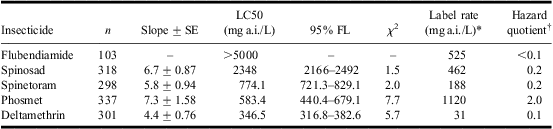
Bombus impatiens was susceptible by topical exposure to all tested insecticides except flubendiamide (Table 1). Flubendiamide did not cause mortality up to 5000 mg a.i./L, approximately four times the recommended application rate of 525 mg a.i./L, and poses no direct contact hazard to B. impatiens. Based on LC50 values, deltamethrin was most toxic, with bees being 6.8-, 2.2-, and 1.7-fold more susceptible to it than spinosad, spinetoram, and phosmet, respectively (Table 1). Spinetoram was three times more toxic to bees by direct contact than spinosad, but due to a lower recommended application rate had an equivalent hazard quotient. The hazard quotient of deltamethrin was also low. Because of its high application rate, only direct contact exposure to phosmet would likely pose a hazard to B. impatiens in the field (Table 1).
Direct contact toxicity and hazard of formulated insecticides to adult worker Bombus impatiens 48 hours following spray application.
*Based on application volumes of 200 L/ha (except phosmet at 1000 L/ha). Where a range of recommended applications rates was given on the formulated insecticide label, a mean rate was used: flubendiamide 105 g a.i./ha; spinosad 92.4 g a.i./ha; spinetoram 37.5 g a.i./ha; phosmet 1120 g a.i./ha; deltamethrin 6.25 g a.i./ha.
†Hazard quotient = insecticide label rate divided by its LC50. An insecticide having a hazard quotient of <1 is considered nonhazardous.
SE, standard error; FL, fiducial limits.
Oral toxicity bioassays
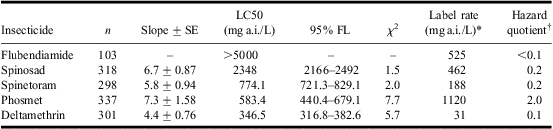
Spinetoram and deltamethrin were both more toxic to B. impatiens following ingestion (Table 2) than by direct contact. With oral exposure, bees were approximately twice as susceptible to spinetoram as compared with deltamethrin and, at label rate, spinetoram would be ∼10-fold more hazardous (Table 2). Ingestion of flubendiamide had no observable impact up to approximately double the label rate and therefore is expected to present no hazard to B. impatiens (Table 2).
Oral toxicity and hazard of formulated insecticides to adult worker Bombus impatiens 48 hours following ingestion.

*Based on application volumes of 200 L/ha (except phosmet at 1000 L/ha). Where a range of recommended application rates was given on the formulated insecticide label, a mean rate was used: flubendiamide 105 g a.i./ha; spinetoram 37.5 g a.i./ha; deltamethrin 6.25 g a.i./ha.
†Hazard quotient = insecticide label rate divided by its LC50. An insecticide having a hazard quotient of <1 is considered nonhazardous.
SE, standard error; FL, fiducial limits.
Sublethal toxicity microcolony bioassays
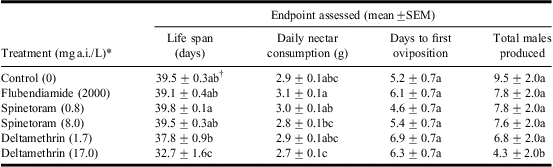
Microcolony workers survived on average 33–40 days (Table 3). Workers treated with deltamethrin at 17 mg a.i./L had significantly reduced survival compared with all other treatments (control: F = 18.5; df = 1,178; P < 0.0001; flubendiamide: F = 15.9; df = 1,178; P < 0.0001; spinetoram 0.8 mg a.i./L: F = 20.7; df = 1,178; P < 0.0001; spinetoram 8 mg a.i./L: F = 18.4; df = 1,178; P < 0.0001; deltamethrin 1.7 mg a.i./L: F = 8.3; df = 1,178; P = 0.0044; Table 3). Also, workers treated with deltamethrin at 1.7 mg a.i./L survived a shorter time than workers treated with spinetoram at 0.8 mg/L (F = 5.4; df = 1,178; P = 0.0211; Table 3).
Sublethal impacts of insecticides on Bombus impatiens.
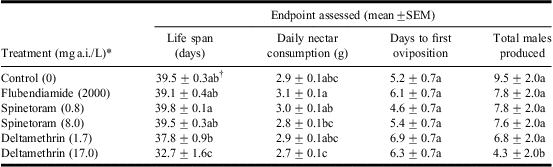
*Each worker consumed 25 μL of honey/water solution mixed with insecticide prior to being placed in a microcolony.
†Values within columns with the same letter are not significantly different (α = 0.05).
Treatment had a significant effect on honey solution consumption (F = 6.0; df = 5,1851; P < 0.0001; Table 3), with microcolonies exposed to deltamethrin at 17 mg a.i./L consuming less per day than those treated with flubendiamide (P < 0.0001) and spinetoram at 0.8 mg a.i./L (P = 0.0006; Table 3). Microcolonies treated with spinetoram at 8 mg a.i./L consumed significantly less honey solution than colonies treated with flubendiamide (P = 0.0123; Table 3).
Treatment had no effect on time to first oviposition, which occurred between 4 and 6 days after the bees were placed in microcolonies (F = 1.88; df = 5,99; P = 0.1052; Table 3). Microcolonies produced between four to ten males during the experiment and this was significantly affected by treatment (F = 2.6; df = 5,100; P = 0.0311; Table 3). Bees exposed to deltamethrin at 17 mg a.i./L produced fewer males than those in control (P = 0.0008), flubendiamide (P = 0.0218), and spinetoram at 0.8 (P = 0.0215) and 8 mg a.i./L (P = 0.0287) microcolonies (Table 3).
Discussion
Numerous bumble bee species are experiencing population declines around the world, and this trend may in part be attributable to pesticide use (Thompson Reference Thompson2001; Goulson et al. Reference Goulson, Hanley, Darvill, Ellis and Knight2005; Williams and Osborne Reference Williams and Osborne2009; Brittain et al. Reference Brittain, Vighi, Bommarco, Settele and Potts2010; Winfree Reference Winfree2010). It is therefore important to identify insecticides that are nonhazardous to bees. Several reduced-risk alternatives to broad-spectrum pesticides have been developed, and generally these insecticides have an improved environmental profile and less impact on nontarget insects. However, depending on exposure route and dose, these options can be harmful to bees (Mayes et al. Reference Mayes, Thompson, Husband and Miles2003; Bailey et al. Reference Bailey, Scott-Dupree, Harris, Tolman and Harris2005; Aliouane et al. Reference Aliouane, el Hassani, Gary, Armengaud, Lambin and Gauthier2009; Gradish et al. Reference Gradish, Scott-Dupree, Shipp, Harris and Ferguson2010).
Wild and managed bumble bees play an important role in wild blueberry pollination but, relative to honey bees, less is known about their susceptibility to insecticides. Possibly because of their setose bodies and lower surface area to volume ratios, bumble bees are generally less susceptible to insecticides than other bees (Thompson and Hunt Reference Thompson and Hunt1999). In our study, only phosmet was hazardous at the manufacturer recommended rate via direct contact. Direct contact exposure to flubendiamide did not cause mortality up to four times its recommended rate. Similarly, Hall (Reference Hall2007) reported flubendiamide was nontoxic to honey bees and bumble bees following direct contact, and we have found topical applications of flubendiamide are nontoxic to adult alfalfa leafcutting bees (Megachile rotundata (Fabricius)) (Hymenoptera: Megachilidae) at concentrations well above recommended application rates (Gradish et al. Reference Gradish, Scott-Dupree and Cutler2012).
We found spinosad to be less toxic to B. impatiens by direct contact in comparison with results reported by others. Mayes et al. (Reference Mayes, Thompson, Husband and Miles2003) reported a formulated spinosad direct contact LD50 of 0.39 μg a.i./bee for B. terrestris, and Scott-Dupree et al. (Reference Scott-Dupree, Conroy and Harris2009) reported with technical-grade spinosad a LC50 of 89 mg a.i./L for B. impatiens. The reduced susceptibility in our study may be method dependant. For example, whereas Scott-Dupree et al. (Reference Scott-Dupree, Conroy and Harris2009) used technical-grade spinosad (about 90.4% pure) with an acetone and olive oil carrier, we used formulated product with a water carrier. In addition, it is possible that our spray pressure was lower than that of Scott-Dupree et al. (Reference Scott-Dupree, Conroy and Harris2009), resulting less penetration of product through bee setae and cuticle, thus giving a relatively lower dose of spinosad. Our results indicate that spinosad and spinetoram, though toxic, should be nonhazardous to B. impatiens by direct contact at recommended field rates. Deltamethrin was most toxic to workers by direct contact, but its field rate is very low, therefore, also giving a low hazard rating.
Bombus impatiens was threefold more susceptible to spinetoram than spinosad in our direct contact experiments. Spinetoram generally is also more efficacious than spinosad against pest insects (Dripps et al. Reference Dripps, Olson, Sparks and Crouse2008). However, Besard et al. (Reference Besard, Mommaerts, Abdu-Alla and Smagghe2011) reported the opposite effect; wet and dry residues of spinetoram were 52 and 8 times less toxic, respectively, to B. terrestris workers compared with spinosad. Different bioassay methods were used, and although we would not have expected such a difference between our results and those of Besard et al. (Reference Besard, Mommaerts, Abdu-Alla and Smagghe2011), different bee species may respond differently to spinosyn exposure. In other direct contact tests using the same methodology described in the current study, we found spinetoram and spinosad to have essentially identical toxicities to adult M. rotundata (Gradish et al. Reference Gradish, Scott-Dupree and Cutler2012). Bombus species can differ in their susceptibility to insecticides and this may partially explain why our results differed from Besard et al. (Reference Besard, Mommaerts, Abdu-Alla and Smagghe2011). Wu et al. (Reference Wu, Li, Peng and Hu2010) found Bombus hypocrita Pérez was twice as susceptible to acetamiprid via direct contact as Bombus patagiatus Nylander and Bombus ignitus Smith, but there was no inter-species difference in acetamiprid toxicity when ingested. Bombus impatiens and B. terrestris may have inherently different susceptibility to insecticides, depending on exposure route. As both B. impatiens and B. terrestris are becoming increasingly popular managed pollinators, potential differences in their susceptibility to insecticides should be explored further.
As in direct contact bioassays, flubendiamide had no impact on B. impatiens mortality when ingested, even at concentrations quadruple that expected to be encountered by bees in the field. This result corroborates our findings with M. rotundata, where no mortality was found in adults sprayed with flubendiamide, or in M. rotundata larvae fed flubendiamide-spiked pollen and nectar provisions (Gradish et al. Reference Gradish, Scott-Dupree and Cutler2012). However, deltamethrin and spinetoram were 10-fold and 33-fold, respectively, more toxic to B. impatiens workers by ingestion than direct contact. When in bloom, V. angustifolium is major forage for B. impatiens and deltamethrin and spinetoram could be hazardous if residues are present in consumed nectar and pollen sources. The majority of flowers on V. angustifolium tend to hang down, and along with having poricidal anthers, this affords its nectaries and pollen some protection against insecticide sprays. Thus, actual concentrations of insecticide in blueberry nectar or pollen may be quite low in a realistic field setting. However, wild blueberry fields are often weedy with alternative angiosperm forage options being present (Sampson et al. Reference Sampson, McCully and Sampson1990), and contamination of these sources could present a risk to B. impatiens. Further, concentrations of spinetoram applied in the field will be about 10-fold higher than those that caused lethal effects in our ingestion experiment, suggesting that oral uptake of a very small doses following field sprays could have adverse impacts. Realistic field experiments should be able to accurately estimate the true risk that applications of deltamethrin and spinetoram pose to bumble bee survival in blueberry production.
Besides mortality, insecticide exposure may elicit a number of sublethal effects in bumble bees, including impaired foraging ability, altered behaviour, decreased life span, and changes in reproduction and development (Johansen et al. Reference Johansen, Mayer, Eves and Kious1983; Johansen and Mayer Reference Johansen and Mayer1990; Tasei et al. Reference Tasei, Lerin and Ripault2000; Tasei Reference Tasei2002; Morandin et al. Reference Morandin, Winston, Franklin and Abbott2005; Desneaux et al. Reference Desneaux, Decourtye and Delpuech2007; Gradish et al. Reference Gradish, Scott-Dupree, Shipp, Harris and Ferguson2010). In our study, feeding on sublethal concentrations of flubendiamide and spinetoram had no observable impacts on worker vitality or reproduction, as compared with control microcolonies. Given that flubendiamide is effective against blueberry spanworm (Ramanaidu et al. Reference Ramanaidu, Hardman, Percival and Cutler2011) and likely other Lepidoptera defoliators that infest wild blueberry during bloom, the low toxicity of this compound to B. impatiens makes it a welcomed, bee-friendly insecticide for blueberry growers. Spinetoram also is effective against blueberry Lepidoptera pests (Ramanaidu et al. Reference Ramanaidu, Hardman, Percival and Cutler2011), as well as important Coleoptera like blueberry flea beetle (based on the observations of G.C. Cutler), and is already being used by many blueberry growers in the Atlantic provinces. It is encouraging that we observed no effects on survival, feeding, or reproduction following treatment with sublethal concentrations of spinetoram. On the other hand, deltamethrin-concentrated (LC10) syrup significantly reduced worker life span and nectar consumption. Tasei et al. (Reference Tasei, Sabik, Pirastru, Langiu, Blanche and Fournier1994) also found that ingestion of sublethal doses of deltamethrin (0.1–0.2 mg/kg) reduced food intake, but did not affect brood production, developmental time, or longevity. Deltamethrin effects on bumble bees in the field remain to be studied, but strong effects due to sublethal exposure seem unlikely.
Overall, we found that susceptibility of B. impatiens to insecticides differed among compounds and exposure routes. In all of our laboratory tests, flubendiamide caused no observable negative impacts at high exposure concentrations, making it a safe option in the presence of B. impatiens. Direct contact exposure to phosmet may pose a hazard, as might ingestion of deltamethrin and spinetoram. Follow-up of experiments conducted here with semi-field or field investigations should be considered to further evaluate the risk deltamethrin, phosmet, and spinetoram pose to B. impatiens. If use of these products is necessary, steps nevertheless can be taken to mitigate managed bumble bee exposure. For example, bumble bee colonies can be closed in the evening once foraging workers have returned to the nest. Insecticides can then be applied, and colonies reopened after sprays have dried. Avoiding exposure to wild bumble bees will be more challenging. Given their dwindling numbers in many regions and importance in pollination of native plants and agricultural crops, minimising pesticide hazards to bumble bees is important. Continued identification and use of insecticides with low impacts will help conserve bumble bees, while minimising risks during crop pollination.
Acknowledgements
Funding for this project was provided by the Nova Scotia Department of Agriculture Technology Development 2000 Program, the Wild Blueberry Producers Association of Nova Scotia, the Prince Edward Island Wild Blueberry Growers’ Association, and the National Science and Engineering Research Council of Canada – Canadian Pollination Initiative (NSERC-CANPOLIN). The authors thank Bayer CropScience and Dow AgroSciences for donating insecticides. This is publication number 16 of NSERC-CANPOLIN.