

Introduction
From traditional UN peacekeeping to stabilisation of weak states and the war on terror, the whole-of-government (WOG) approach has emerged as a blueprint for countries contributing to multilateral interventions.Footnote 1 Generally, WOG refers to improving civil-military coordination within national contingents that deploy as part of multinational peace and stability operations.Footnote 2 Governments are persistently urged to learn the coherence lesson, although evidence suggests that outcomes vary across states.Footnote 3 The reasons why are poorly understood, largely because the causal mechanisms of coherence remain under-theorised.
This study tests three potential theoretical explanations – coalition politics, bureaucratic politics, and strategic culture – and develops a mid-range theory of WOG variation. The unique contribution of the research is in beginning to unpack the causes, antecedent conditions, and intervening factors that result in varying WOG outcomes. I focus on Sweden and Germany, two countries whose approaches to coherence differ, even though a tradition of coalition governance in both supposedly obstructs WOG implementation.Footnote 4 I conduct a structured, focused comparison of Swedish and German WOGs between 2001 and 2014, in the context of the International Security Assistance Force (ISAF). My findings have theoretical and practical implications for the efficiency and effectiveness of integrated peace and stability operations, as well as for other policy areas where WOG is needed.
The debate
The variance in national WOG approaches came under the limelight in debates on the efficiency and effectiveness of multinational interventions. The Western-led, liberal peacebuilding from the 1990s showed that coordination failures between political, security, and development instruments contribute at least in part to unsustainable peacebuilding outcomes.Footnote 5 Since individual countries usually take the lead on specific tasks within the multilateral effort, past experiences illustrated how poor coordination within a single ministry could jeopardise broader mission objectives.Footnote 6 Initially, this realisation produced a wave of policy calls to increase inter-agency coordination. Accordingly, countries adopted a veritable patchwork of WOG approaches, ranging from basic inter-agency information sharing to advanced joint planning, execution, monitoring, and evaluation of a common strategy.
Eventually, disillusionment with attempts to transplant liberal peace and democracy in conflict-torn areas shifted the integrated mission concept towards stabilising weak and failed states.Footnote 7 WOG remains firmly embedded into this more modest rhetoric, but the debate on what integration should look like has evolved. WOG is understood as a spectrum of cooperation options, where civilian-led modalities are heralded as examples to follow.Footnote 8 By contrast, military-driven approaches where soldiers engage in large-scale civilian reconstruction activities, are criticised for violating the neutrality and impartiality principles of humanitarian assistance, and subordinating development agendas to political and security objectives.Footnote 9 Furthermore, in contrast to the initial enthusiasm for more coherence, scholars warn that attempts to increase integration beyond a certain point may be unrealistic.Footnote 10 Others argue that effectiveness does not always require more coordination, but rather customising levels of coherence to match specific mission objectives, and keeping approaches flexible so as to respond to the fluid nature of contemporary crises.Footnote 11 My findings add to these debates by illuminating what the limits of coherence may be. The findings suggest that in coalition-led governments, WOG frameworks are not readily amenable to flexible tailoring.
Evolving counterinsurgency (COIN) doctrine continues to feature WOG as a key element of NATO's comprehensive approach.Footnote 12 WOG variance attracted attention with the war on terror and attempts to execute ‘clear, hold, build’ tactics in Afghanistan.Footnote 13 Organised on a lead nation principle, PRTs were shaped by countries that marshalled different civil-military toolboxes for the ‘build’ stage.Footnote 14 Some, like the Nordic countries, used light footprint models, with strict separation between civilian and military activities. Others, like the United States, granted troops funding and discretion to engage in large-scale civilian reconstruction projects in support of military objectives. Beyond the compatibility challenges these differences caused for countries sharing the operational space, concerns arose that WOG variance may undermine the efficiency and effectiveness of the broader COIN effort.Footnote 15 In response, studies began exploring PRT ‘best practices’, including civilian PRT leadership and recruiting people with the ‘right personalities’ to engage in collaborative working.Footnote 16 My findings, however, suggest that the focus on best practices obscures the understanding of what civil-military capacity can realistically be developed across a variety of national contexts.
Previous research calls for in-depth analysis of the causes and conditions of coherence.Footnote 17 At present, the literature largely fails to distinguish between antecedent conditions, root causes, permissive and obstructive factors for WOG variance. This is problematic, because it appears that most countries experience similar challenges – lack of leadership, scarce political will for joint working, culture, organisational politics, and individual personalities – yet final WOG outcomes vary across states.Footnote 18 Vigorous theory building on the causal pathways of WOG remains scarce. All this exacerbates a tendency to offer generic policy recommendations for improving coherence, and to rely on cookie-cutter templates where the capacity of actors assigned to specific tasks is not correctly matched with actual needs and broader strategic goals.Footnote 19
When it comes to lagging behind in WOG implementation, nations traditionally headed by coalition or single party minority governments are allegedly among the worst offenders. Nonetheless, anecdotal evidence suggests that WOG frameworks vary even among coalitions.Footnote 20 The limited theorising on causes of WOG fluctuation in these countries is surprising, given that coalition is the predominant form of government in the world, and a signifiant number of countries contributing to multilateral interventions have a long tradition of coalition rule.Footnote 21
Furthermore, the literature tends to focus excessively on WOG developments at Headquarters level, through desk reviews of national policies and institutional arrangements.Footnote 22 To be clear, official statements and institutions deserve attention: that is where national WOG interpretations are articulated, as part of a broader strategic foreign policy narrative.Footnote 23 However, scholars argue that strategic narratives have an element of ‘forgery’, and are used by elites to achieve specific objectives.Footnote 24 Similarly, field practitioners point out that policies and strategic frameworks foster a sense of ‘false coherence’ that does not accurately describe operational realities.Footnote 25 This study considers how the strategic framing of WOG affected inter-agency cooperation practices, at home as well as in the field.Footnote 26 Overall, the results suggest that coalitions face limitations in progressing WOG when an aspect of the proposed overall policy (in this case, the nature of the military engagement) is highly disputed in national parliaments.
In the following section, I develop testable expectations based on coalition politics, bureaucratic politics, and strategic culture.Footnote 27 Next, I outline the methods and scope of the research, including the scale I develop to measure levels of coherence. I then explore the case studies. The article concludes with a summary and suggestions for further research.
Explaining variance in whole-of-government
Coalition politics
Coalition politics has long been recognised as a driver of foreign policy outcomes. The collective decision-making inherent in coalition governance involves intense bargaining among parties with competing preferences. Compromises are required to accommodate those who disagree with various aspects of the proposed policy. Parties trade their support of certain issues in exchange for concessions in other areas. This constant pulling and hauling does not necessarily produce less extreme policy outcomes – the end result depends on party preferences.Footnote 28
In the context of multinational interventions, scholars have explored the effects of coalition politics on variance in the behaviour of national troops deployed under a multinational chain of command.Footnote 29 Auerswald and Saideman find that the constant bargaining in domestic parliaments resulted in restrictions on the military's operational capacity and discretion to engage in certain types of activities. Once agreed in national parliaments, these restrictions were difficult to overturn at field level.Footnote 30
Others study how political parties’ ideological positions affect the kinds of restrictions imposed on national contingents. Otto Trønnes finds that Norwegian centre-left parties disapproved of the PRT engaging in humanitarian reconstruction in Afghanistan.Footnote 31 Similarly, Daan Fonck, Tim Haesebrouck, and Yf Reykers find that left-wing Belgian parties favoured operational restrictions and humanitarian safeguards during the 2011 intervention in Libya, while right-wing parties supported a wider intervention mandate.Footnote 32
Accordingly, coalition politics allows for formulating the following expectation for WOG variance: (1) Swedish and German WOG frameworks are expected to emerge after heavy bargaining at national parliaments. Concessions will be made to accommodate left-wing parties, who are expected to be sceptical about pursuing integration. These concessions will take the form of restrictions on civil-military cooperation, particularly when it comes to civilians supporting COIN operations.
Bureaucratic politics
Bureaucratic politics sees policy change as a product of the perpetual competition between government agencies with diverging values and objectives. Ministries fervently protect their autonomy, and constantly seek to preserve or expand their budget and organisational influence. Without formal strategic direction or adequate oversight by a single agency with authority to enforce joint working, departments are unlikely to buy into it. Ministries can still choose to cooperate, but only when they see it as an opportunity to advance their respective agendas.Footnote 33 Previous studies find that bureaucratic resistance obstructs the adoption of a WOG model, particularly in countries with highly decentralised bureaucracies like Sweden and Germany.Footnote 34 Hence, the second prediction of this study is: (2) In the absence of adequate ministerial oversight and enforcement mechanisms, WOG developments in Sweden and Germany are expected to stall. The WOG models will advance only when all ministries simultaneously perceive that it serves their narrow organisational interests.
Strategic culture
The strategic culture literature, which traditionally focuses on political elites, posits that foreign policy outcomes emerge out of a shared set of deeply ingrained societal beliefs about the appropriate ways to behave.Footnote 35 These ‘informal constraints’ vary across states and condition the behaviour of the main decision-makers in the country, which arguably helps explain why states respond differently to similar situations.Footnote 36
The key components of strategic culture are foundational elements and security policy standpoints. Foundational elements are universally shared core values that are highly resilient over time. Security policy standpoints, or policymakers’ interpretations of how foundational elements should be translated into practice, are more malleable and often contested among political elites. Strategic culture evolves incrementally, usually in response to external shocks. Policymakers ‘fine-tune’ their security policy standpoints to fit the new reality, while foundational elements remain largely unchanged.Footnote 37
Scholars argue that Swedish strategic culture has evolved, from non-alignment during the Cold War to European integration and active participation in peacekeeping operations, then back to a renewed focus on national defence.Footnote 38 While not necessarily averse to military intervention, Swedish strategic culture remains rooted in neutrality, impartiality and altruism.Footnote 39 The originally strict interpretation of neutrality has relaxed over time.Footnote 40 Nonetheless, advanced WOG models, particularly those involving civil-military cooperation in stabilisation and counterinsurgency operations, are difficult to reconcile with the core values of Swedish strategic culture.Footnote 41
In the aftermath of the Second World War, German strategic culture has been described as reactive, suspicious of all things military, and averse to deploying the German Armed Forces (Bundeswehr) beyond national borders.Footnote 42 In the main, anti-militarism remains a key foundational element of German strategic culture.Footnote 43 Nonetheless, the political elite is split into two competing security policy standpoints. The ‘never again alone’ camp supports a more active foreign policy for Germany, including through the military.
Conversely, ‘never again Auschwitz’ is the original post-1945 pacifist position, fine-tuned after the Srebrenica massacre, which allows for the use of force in extreme circumstances. Hence, authorising military deployments abroad is only possible under strict conditions that satisfy both sides. One such condition is placing a heavy emphasis on civilian reconstruction support in military activity.Footnote 44 Carolin Hilpert argues that in Germany, there remains a widely shared preference to think of the Bundeswehr as ‘development workers in uniform’.Footnote 45
Strategic culture theory helps formulate a third expectation: (3) Swedish and German WOG models will be shaped by the foundational elements of the respective strategic cultures. WOG variance is expected to occur in response to pressure from the operational environment, which will trigger ‘fine-tuning’ of security policy standpoints in each country. Given the German preference to perceive soldiers as uniformed humanitarians, the German WOG model is expected to feature a larger role for the military in civilian reconstruction support than in Sweden.
Scope and methods
Measuring levels of whole-of-government
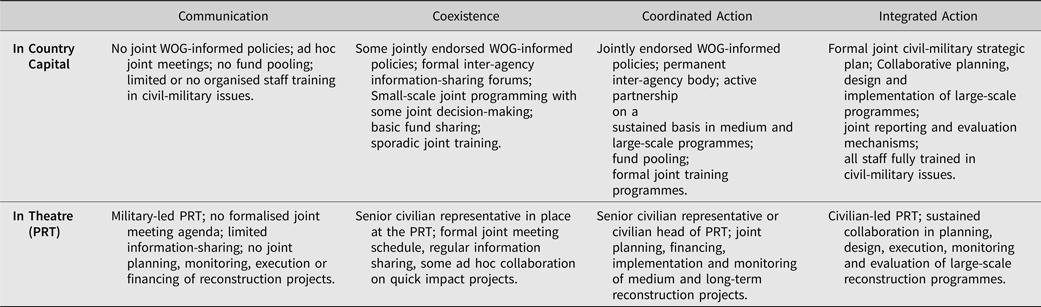
The first task in analysing WOG variance is to determine at which points coherence levels fluctuated. Given the lack of consensus in the literature on measuring coherence, I construct a two-tier scale to capture WOG variance in institutional frameworks and practices, on the home front and in the mission area. For the sake of precision, the scale understands institutions in the formal sense.Footnote 46 In WOG terms, this means government policies, inter-agency bodies (including fund pooling mechanisms and pre-deployment training schemes), as well as the cooperation practices that flow from these structures (frequency and purpose of joint meetings, extent of collaborative decision-making, joint planning, execution and evaluation of activities, and joint training).Footnote 47
Whole-of-government measurement scale. 

The research is bound between 2001 and 2014, covering the entire period of ISAF involvement for both countries. For the purposes of parsimony, I focus only on the three ministries that usually contribute the bulk of the financial and human resources to peace operations: the Ministry of Defence/Armed Forces, the Ministry of Foreign Affairs, and the Ministry (or implementing agency) of international development cooperation. At the lowest level, ‘communication’, agencies are exchanging basic information. The more a WOG approach moves towards ‘integrated action’, the more evidence there is of an overarching joint political-strategic framework, based on joint planning and execution.Footnote 48 Towards the higher end of the spectrum, WOG usually involves access to large-scale funding schemes for stabilisation operations, as well as civilian agencies supporting the military in COIN scenarios.Footnote 49
Methods
This study was designed to respond to calls for more in-depth, comparative, interview-based research on inter-agency cooperation in multinational missions.Footnote 50 The potential causes of WOG variance are not well documented in large-n datasets, and thus the topic does not lend itself well to statistical analysis. The main research question is why WOG varied, and case studies are preferable to large-n methods when it comes to answering ‘why’ questions.Footnote 51 Furthermore, the case study method fits well with the research objective: exploring complex causal mechanisms, and the conditions necessary for these mechanisms to operate, over time and across a variety of contexts.Footnote 52 Process tracing was particularly helpful in narrowing down the potential causes, unpacking causal pathways, and identifying antecedent conditions for WOG variance.Footnote 53 Using multiple cases increases the explanatory power of the findings, and contributes to theory development in a field that often focuses on single case studies with limited generalisability.Footnote 54 The main unit of analysis is the overarching WOG model, which is a cumulative reflection of how separate ministries (embedded sub-units) translate joint working into practice. To allow for sub-unit comparisons within and across the two cases, the study adopts a multiple, embedded case study design.Footnote 55
Case selection
To control for intervening effects, I started by selecting among countries traditionally led by coalitions or single party minority governments, which had also acted as PRT lead nations in Afghanistan. Next, given the varying levels of violence in the operational environment, I focused on countries that deployed to the same geographic area. Regional Command North (RCN) is a good test for WOG, because the North was the most peaceful region in Afghanistan and thus the easiest environment in which to carry out civil-military activities.
At this juncture, Sweden and Germany emerged as a puzzle. Both countries have traditionally emphasised multilateralism, pacifism, and non-politisation of development aid.Footnote 56 Both have a long-standing tradition of coalition rule, as well as constitutional laws that require troop deployments to be sanctioned annually by parliament. Both deployed to areas of comparable security levels: Sweden to Mazar-e-Sharif (2006–14); Germany to Kunduz (2003–13); Fayzabad (2004–13); and eventually Takhar (2008–14). The cases appeared similar, yet evidence suggested their WOG approaches varied.
Data sources
The findings are based on written and oral sources. I first examined policy statements, parliamentary decisions, and other government-issued documents on engagement in failed states and/or contribution to multinational peace operations, including ISAF. I also consulted policy and academic papers, some of which were partially based on a small number of interviews. These documents gave a general overview of the strategic and operational setup of Swedish and German WOG, but lacked sufficient detail on the factors that propelled the emergence of inter-agency structures, how participants experienced these structures, and in what ways joint institutions (or the lack thereof) affected cross-agency interactions.
Triangulating with data from personal interviews became particularly important at this stage. I asked respondents how national policies, inter-agency bodies, and joint training opportunities came about, what kinds of cross-government interactions they generated (or failed to generate), how and why the daily work process changed as a result. My questions also gauged to what extent joint working was enforced at field level.
In 2014–15, I conducted 47 in-depth, semi-structured interviews, 17 in Sweden and 30 in Germany, with current or former ministerial employees who had first-hand knowledge of whole-of-government practices. Of the Swedish respondents, 47 per cent were civilians from the Ministry for Foreign Affairs (MFA), the Swedish International Development Cooperation Agency (SIDA), the Swedish Defence Research Agency, or the Swedish Afghanistan Committee. The rest were employees of the Ministry of Defence or the Armed Forces. Eighty-two per cent of the Swedish respondents had deployed to Afghanistan at least once. Similarly, 90 per cent of the German participants had completed at least one tour in Afghanistan. Fourty-seven per cent were civilians from the Federal Foreign Office, the Federal Ministry for Economic Cooperation and Development (BMZ), the KfW Development Bank, or the German Institute for International and Security Affairs, while 53 per cent were soldiers.
I selected respondents through snowball sampling.Footnote 57 The snowballs initiated in at least five places: personal contacts, the communications departments of the Swedish and German Embassies, government officials, think tanks who had published relevant material, and the participants in German-led multinational civil-military training exercises I attended in 2014–15. The study received clearance by the Carleton University Research Ethics Review Board. I conducted the interviews in English, then transcribed, coded, and analysed the data in Microsoft Excel. The next two sections address the case study findings.
Sweden
2001–06: Agreeing not to agree
Sweden first deployed to Afghanistan during the tenure of a centre-left, Social Democratic Party (SDP) minority government, which had traditionally insisted on strict neutrality in Swedish foreign policy.Footnote 58 In parliament, the annual ISAF mandate extension negotiations were plagued by discord over the military engagement, particularly the collaboration between Swedish and US troops. The centre-right, Moderate Party (MP) opposition supported NATO membership, as well as a broader role of the Swedish Armed Forces in Afghanistan.Footnote 59 Conversely, the Greens and the Left Party perceived American COIN as incompatible with the Swedish approach to foreign policy.Footnote 60 To some SDP members, addressing terrorism by military means, especially through large-scale injections of aid in support of military objectives, was a ‘very un-Swedish way of thinking’.Footnote 61 Against this backdrop, it became clear that pushing for concrete policies to enhance coherence might jeopardise the approval of the ISAF mandate extension bill.Footnote 62 As a compromise, Swedish parties tacitly agreed to avoid debates on developing integrated civil-military capacity, or earmarking civilian funds for stabilisation operations.Footnote 63
This political ‘non-debate’ placed ministries under no formal obligation to implement a WOG approach.Footnote 64 Continuing with business as usual was disappointing to the Armed Forces.Footnote 65 For soldiers, WOG was a convenient solution to a long-identified need to incorporate civilian aspects into military operations, as well as a way to define the purpose of the Swedish military in Afghanistan.Footnote 66 By contrast, SIDA perceived WOG as a ‘hearts and minds’ tactic that would enable the military to co-opt development work, and to focus excessively on short-term, quick impact initiatives like ‘cutting ribbons and opening schools’.Footnote 67
The parliamentary non-debate on WOG produced a strategic narrative that offered little guidance on how civilians and the military were expected to interact.Footnote 68 The first two ISAF mandates briefly mentioned quick impact projects, but did not elaborate on broader joint ventures.Footnote 69 The Ministry of Defence pushed for establishing a joint inter-agency body with authority to coordinate the Afghanistan engagement, but the parliamentary negotiations never progressed.Footnote 70 Instead, Sweden opted for a State Secretary information exchange forum, where the MFA, the Ministry of Defence, the Ministry of Justice, SIDA, the Folke Bernadotte Academy (FBA), and the Swedish National Police Board (SNPB) met bi-monthly to discuss political and security assessments and provide broad strategic direction to the respective ministries. The forum lacked decision-making authority, and did not engage in joint strategic planning or assessment.Footnote 71 Interview data suggests its overall impact on political decision-making was negligible.Footnote 72
Similarly, Sweden never established a fund pooling mechanism for Afghanistan. PRT military commanders had $30,000 per rotation for small-scale reconstruction initiatives. The MFA managed a larger crisis management budget, but it could not be used for stabilisation operations.Footnote 73 SIDA handled the bulk of international development cooperation money for Afghanistan, which was locked into long-term initiatives and impossible to redirect to a fund pooling structure.Footnote 74 Joint pre-deployment training was largely voluntary. Ministries ran independent programmes, where joint training elements lacked a practical component, and omitted civilian planning under a WOG approach.Footnote 75
2006–09: Seeking synergies?
In 2006, the centre-right, Moderate Party-led Alliance coalition gained parliamentary majority, moving WOG up the policy agenda.Footnote 76 The MP had long favoured bolstering both civilian and military means to address deteriorating security on the ground.Footnote 77 The Alliance cultivated a WOG-supportive, yet cautious rhetoric of seeking civil-military ‘synergies’.Footnote 78 ISAF mandates gave some attention to the presence of civilian advisers at the PRT, but without mention to cross-agency strategic planning.Footnote 79 More notably, the Strategy for Development Cooperation with Afghanistan, July 2009 to December 2013, hinted at increasing the reconstruction fund administered by the Kabul Embassy, to use in joint stabilisation initiatives.Footnote 80 However, this vaguely formulated intent was never implemented in practice.
In Afghanistan, Sweden took over as lead nation in 2006, placing a military colonel at the head of the Mazar-e-Sharif PRT. A political advisor (POLAD) from the FBA, a development advisor (DEVAD) from SIDA, and a police advisor from the SNPB were to counsel the commander on civilian matters.Footnote 81 POLADs worked directly under the PRT head, but DEVADs retained complete operational autonomy.Footnote 82 A joint command group met weekly, bi-weekly, or every other day, to exchange basic information and deconflict scheduled visits with local authorities.Footnote 83 Civilians mostly participated as passive listeners.Footnote 84 As the synergies rhetoric gained visibility in Stockholm, the PRT team attempted a joint planning procedure. The civilians advised on the impact of military operations on development activities, but did not support counterinsurgency initiatives or provide intelligence to the military. To civilian participants, this exercise was of limited practical utility.Footnote 85
2010–14: Back to basics
The synergies narrative survived until the next elections, when the Alliance was reelected but lost parliamentary majority. Around the same time, the ruling coalition faced difficult negotiations with the opposition on agreeing a deadline for permanent troop withdrawal from Afghanistan. In the Northern Afghan provinces, violence had reached an all-time high.Footnote 86 The Alliance still favoured keeping the military in Afghanistan for longer than the centre-left, but concerns about Sweden supporting US-led COIN operations once again polarised the debate.Footnote 87 To achieve a longer troop withdrawal timeline than the centre-left would have preferred, the Alliance agreed to drop the synergies rhetoric.Footnote 88
From 2010 onwards, the term ‘synergies’ was phased out of policy documents.Footnote 89 The 2010 Afghanistan Strategy and the 2011 ISAF extension mandate emphasised a clear separation of civilian and military tasks.Footnote 90 In 2012, Cabinet revised the Strategy for Development Cooperation, definitively dropping the synergies narrative.Footnote 91 In response to the deteriorating security on the ground, development cooperation funding increased incrementally over the next five years, but without making provisions for using civilian funds to support stabilisation operations.Footnote 92 Field level requests for a stabilisation budget were denied at MFA headquarters, on the grounds that placing the military as the ‘face’ of the Swedish commitment to Afghanistan was politically sensitive.Footnote 93
In 2010, following negotiations spearheaded by the Armed Forces, the Swedish PRT switched to double-headed leadership. Despite a general reluctance within civilian ministries, a Senior Civilian Representative (SCR) deployed to Mazar-e-Sharif. At field level, this apparent ‘civilisation’ of the PRT generated more joint meetings, but outcomes remained limited to information-sharing.Footnote 94 The SCR officially represented the entire Swedish engagement, but had no authority over military operations.Footnote 95 DEVADs continued reporting directly to SIDA. Neither of the two commanders could initiate joint ventures that were not explicitly negotiated in parliament.Footnote 96 In 2012, PRT leadership formally transferred to the SCR, but without changing the pre-existing structure of strictly separate chains of command.
Interview data revealed diverging perspectives on the SCR. Soldiers welcomed having a senior diplomat in post, because it relieved them of the responsibility to liaise with local civil society.Footnote 97 The civilians were notably less enthusiastic, suggesting the SCR was a ‘figure head’ whose deployment failed to improve the capacity of the civilian team to make a tangible impact on the military operation.Footnote 98 SCRs tended to resolve most issues directly with the military commander, with little involvement of lower level staff.Footnote 99 POLADs thus felt isolated from their military colleagues, and increasingly unable to contribute to joint planning.Footnote 100
Moreover, the SCR deployed without clear instructions on the scope of his authority over civilian funding, which initially created expectations within the military and the MFA that at least part of SIDA's budget would be diverted to stabilisation operations.Footnote 101 Interview data reveals that over time, soldiers repeatedly requested to access SIDA money. However, DEVADs lacked discretion to approve such spending without a parliamentary provision, followed by an explicit directive from headquarters.Footnote 102 In sum, the creation of the SCR post, and the grassroots readjustment of expectations it triggered, effectively phased out the synergies ambition at field level.Footnote 103
For DEVADs, a larger problem was lacking guidance from Headquarters on what ‘synergies’ meant for SIDA, particularly as to the appropriate level of engagement with the Armed Forces.Footnote 104 DEVADs envisioned a larger role for themselves in counselling the military on the needs of local populations, and the importance of situating military activities within the framework of long-term development initiatives. However, the SIDA leadership in Stockholm saw no part for civilians in contributing to military operations.Footnote 105 In the absence of a specific parliamentary provision to adopt a WOG approach, SIDA headquarters enforced strict unilateral restrictions on joint working, ensuring that deployed staff minimised cooperation with the military. In one notable example, DEVADs and soldiers jointly created a population survey for the most conflict-prone areas where the Swedish military was active. The survey was to gauge local perceptions on whether security had improved since the arrival of ISAF forces, and for what reasons. Upon sending it to SIDA Headquarters for approval, DEVADs received specific instructions to drop all security-related questions. The survey was never administered in its original format.Footnote 106 Soldiers and civilians continued to resolve small issues over coffee or talking in the hallway, but oversight from national Headquarters did not allow for informal cooperation to make a tangible impact on WOG fluctuation.Footnote 107
Summarising Swedish whole-of-government
Table 2 summarises the evolution of the Swedish WOG model (see below).
The Swedish whole-of-government model (2001–14).

The study's first expectation is largely supported by the evidence, with one caveat. Coalition bargaining caused WOG fluctuation, although the bargaining was not on WOG directly, but rather on military aspects of the Swedish contribution to ISAF. In parliament, the nature and extent of the military engagement proved to be the thorniest issue, and it took precedence in the consensus building process. By contrast, the coherence question was deliberately avoided, and eventually traded off to secure consensus on the military engagement. This non-debate on coherence reduced the margin of action in developing and enforcing a model of joint working, in Stockholm and especially in Mazar-e-Sharif.
Enthusiasm for WOG was generally higher among right-leaning parties. Swedish WOG reached its peak during the tenure of a majority ruling, centre-right Alliance coalition. Nonetheless, when the same coalition subsequently lost majority, the synergies ambition was abandoned as a concession to the opposition in negotiating the permanent troop withdrawal. The results show little indication of ‘fine-tuning’ in the Alliance's understanding of addressing the threat in Afghanistan. Rather, the evidence points to prioritising consensus building on agreeing a deadline for permanent troop withdrawal, and sacrificing WOG in the process. In short, a right-leaning, WOG-supportive government may have catalysed WOG progress, but it was not sufficient for sustaining momentum.
There is little evidence in support of the second expectation – that a bureaucratic consensus catalysed the shift towards more advanced WOG in 2006–09. Similarly, the demise of Swedish synergies in 2010 was due to coalition bargaining, not bureaucratic pressure. Rather than a root cause, bureaucratic politics was an intervening obstructive condition that was exacerbated by the lack of political debate on WOG. In this context, civilian ministries, particularly SIDA, effectively resisted joint working by limiting the discretion of their staff to interact with the military at field level. Coupled with strict oversight from national headquarters, these restrictions were difficult to overrule, despite the personal preferences and initiatives of the PRT team.
As for the third expectation, I find that Swedish strategic culture was a pre-existing condition that obstructed WOG developments. The political elite was split into two competing camps: the WOG-ambivalent and the WOG-supporters. Elections, rather than fine-tuning, determined which group drove the WOG agenda. There is little indication that pressure from the operational environment in 2006–09 caused a readjustment in the ruling coalition's security policy standpoints. The more likely explanation is that, having finally secured parliamentary majority, the Alliance could pursue a long-standing ambition for synergies.
Swedish strategic culture worked as an antecedent that partially coloured policymakers’ perceptions on WOG. Some WOG modalities came too close for comfort to American COIN, which in turn conditioned the negotiations on extending the ISAF mandate. Despite their disagreements, the two rival policy camps shared a distaste for the war on terror, which clashed with the foundational element of neutrality in Swedish strategic culture. Clearly separating the Swedish engagement from US counterinsurgency was a condition necessary to reconcile the two positions around approving the mandate extension bills. The result was a tendency to shirk the coherence debate, which reduced the scope for WOG progress.
Germany
2001–05: Development workers in uniform?
Much like in Sweden, the German parliament (Bundestag) was perpetually divided over the nature of the military engagement.Footnote 108 Approving the 2001 ISAF mandate caused a rift between the main coalition partners, the Social Democratic Party (SPD) and the Greens. The Greens opposed addressing terrorism by military means, as did some of the more left-leaning SPD members. As a compromise, the military presence was framed as a reconstruction support mission, which effectively removed the urgency to hold an open debate on integrating civilian and military instruments. If the Bundeswehr was not to conduct COIN operations, then provisions for civil-military cooperation in such scenarios became a moot point.Footnote 109
The ministries published a patchwork of policy statements, each treating only those aspects of WOG that served the organisational interests of the department spearheading the text.Footnote 110 Ministry of Defence publications reflected an eagerness to adopt WOG as a working model, while the BMZ avoided WOG language.Footnote 111 BMZ minister Heidemarie Wieczorek-Zeul, a known critic of using civilian aid for military purposes, stated once in the press that ‘[In Afghanistan], there does not have to be a man with a gun standing next to every development worker.’Footnote 112 Interview data suggests that during her tenure, DEVADs were instructed to limit interactions with the military where possible.Footnote 113
The question of establishing joint inter-agency bodies with executive functions for Afghanistan was never addressed in detail in the Bundestag. A State Secretary forum met monthly to exchange information and clarify operational boundaries.Footnote 114 Ministries organised separate pre-deployment training programmes, where outgoing staff usually spend no more than half a day in short inter-ministerial briefings.Footnote 115 Interview data reveals reluctance on behalf of civilian ministries to release staff to attend joint pre-deployment training initiatives.Footnote 116
Despite a weak political ambition around WOG, side issue bargaining in 2005 started a fund pooling mechanism for Afghanistan. As the Bundestag prepared to vote on Germany's participation in a NATO missile defence integration programme, the Greens, a main coalition partner, opposed the draft bill. The Greens then traded off their support in exchange for re-routing €10 million from the defence budget towards crisis management and into the Provincial Development Fund (PDF).Footnote 117 The instrumental role of the Green Party in negotiating the PDF suggests a willingness to endorse joint ventures that fell short of full-scale inter-agency cooperation in ‘clear, hold, build’ scenarios.
At field level, the non-combat strategic narrative in Berlin implied that German PRTs could not be placed under military command.Footnote 118 However, the civilian-led PRT alternative also failed to gain traction in parliament.Footnote 119 As a compromise, Germany adopted a double-headed PRT model with independent ministerial chains of command.Footnote 120 Deploying a Senior Civilian Representative (SCR) initially created within the military and Foreign Office an expectation to control the bulk of development cooperation funding for Afghanistan.Footnote 121 Soldiers came intense pressure to engage in development work without adequate funding for that purpose, which caused frustration and confusion within the military around their responsibilities under a WOG approach.Footnote 122
In the early days, PRT staff held daily joint briefs, co-chaired by the two commanders but dominated by military topics, and following a clear military reporting structure.Footnote 123 Occasionally, the civilians contributed to operational planning, although interview data suggests this was not the norm.Footnote 124 Following instructions from BMZ headquarters, DEVADs lived outside of the military compound and only visited the PRTs in cases of emergency, which meant they were naturally left out of the information-sharing process.Footnote 125
2006–09: Cementing the ‘non-debate’
The 2005 elections produced a realignment within the Bundestag that further obstructed the collective bargaining over the ISAF mandate, which in turn cemented the non-debate on coherence. The centre-left SPD was re-elected in a grand coalition with their traditional rivals, the centre-right Christian Democratic Union (CDU) and Christian Social Union (CSU). Unlike the SPD, the CDU and the CSU endorsed a broader role for the military, as well as political and development instruments in Afghanistan, and were supported by the liberal Free Democratic Party (FDP).Footnote 126 Simultaneously, an increasingly volatile Northern Afghanistan had forced the Bundeswehr into conducting COIN operations, which parts of the political and military elite decidedly opposed.Footnote 127 To ensure extending the annual ISAF contribution, parties avoided a broad conversation on the hard aspects of COIN, including on incorporating civilian funds into the military strategy. Isolated appeals for a comprehensive civil-military ISAF mandate never led to specific negotiations.Footnote 128
Meanwhile, the elections had driven the Ministry of Defence and the Foreign Office into the hands of parties on opposite sides of the ideological spectrum, which exacerbated a long-standing rivalry between the two.Footnote 129 Ministry of Defence documents openly addressed cross-departmental cooperation in conflict zones.Footnote 130 The BMZ refused to endorse these statements, arguing that experiences from the United States clearly demonstrated the negative effects of using civilian aid as a peace dividend.Footnote 131 Interviewees suggested that within the BMZ, WOG was perceived less as a spectrum of cooperation options and more as a tactic allowing the military co co-opt development activities.Footnote 132
The inter-agency State Secretary forum met less regularly during the tenure of the grand coalition.Footnote 133 Attempts at creating joint institutional structures were unsuccessful. In 2008, the CDU advocated for establishing a National Security Council, a joint body to centralise inter-agency strategy formulation and decision-making in security policy. The proposal was struck down in the Bundestag, on the grounds of representing an unacceptable ‘Americanisation’ of German security policy.Footnote 134
In contrast to the stalled developments in Berlin, coherence in Afghanistan advanced tangibly as the PDF started functioning. Financed jointly by the Foreign Office, BMZ and the Bundeswehr, the PDF funded small- to medium-sized reconstruction in remote areas that had remained at the margin of larger development initiatives. Local communities applied for funds via their district governor. The Bundeswehr also submitted applications based on needs identified during village patrols. A joint committee composed of equal numbers of Germans and Afghans voted on applications.Footnote 135 Afghan members held individual voting rights, while the Germans consolidated their position behind a single vote, that of the BMZ. Interview data suggests that renouncing their individual voting rights was not problematic for the Bundeswehr and the Foreign Office.Footnote 136 Despite some significant operational difficulties, interviewees believed that the PDF was a prime example of successfully translating the German WOG concept into practice.Footnote 137
2010–14: The development offensive
In 2009, a centre-right FDP/CDU/CSU coalition gained parliamentary majority, which presented a major opportunity for WOG advancement.Footnote 138 Conditions in the Bundestag were ripe for opening up the coherence debate. The coalition partners agreed that Germany's presence in Afghanistan constituted an involvement in an armed conflict, which shifted the strategic narrative away from non-combat language.Footnote 139 Dirk Niebel, a former paratrooper and newly appointed minister of the BMZ, critiqued the previous government for not exploring the full potential of the WOG concept, and asked deployed staff to use their PRT offices, and to seek out cooperation venues with the military. Interviewees believed that Niebel's military background explained his predilection towards a WOG approach.Footnote 140 From 2010 onwards, DEVADs spent more time at the PRT and actively contributed to joint meetings. Staff continued to resolve minor issues informally, often at social functions outside of working hours, but any significant joint ventures required approval from headquarters.Footnote 141
The incumbent government's view on the ever-worsening security situation in Afghanistan was that civilian aid would act as a stabiliser.Footnote 142 Consequently, the Bundestag approved the Stabilization Fund (SF), a €180-million funding increase for the Foreign Office. While not precisely a fund pooling initiative (fund management rested entirely with the Foreign Office), the SF enabled civil-military cooperation in ‘clear, hold, build’ scenarios. In stark contrast to the smaller-scale, needs-based PDF, the SF had a clearly political objective: to show tangible benefits of the German presence in Afghanistan by financing large-scale reconstruction projects that did not require long-term planning. By 2011, Foreign Office staff had started moving alongside the Bundeswehr into recently cleared areas to discuss possible reconstruction projects with local elders.Footnote 143
Dubbed the ‘development offensive’, this sudden shift from reconstruction support to stabilisation surprised many in political and bureaucratic circles. It brought the portfolio of the Foreign Office almost to the size of the BMZ, exacerbating turf wars between the two civilian ministries. The BMZ questioned the expertise of Foreign Office staff in implementing reconstruction projects, and critiqued SF ventures for lacking sustainability and blurring the boundaries with long-term development initiatives.Footnote 144 Eventually, a strict division of labour was introduced at field level, with each ministry working in different sectors and on different administrative division levels.Footnote 145
Summarising German whole-of-government
Table 3 illustrates the fluctuations in the German WOG framework:
As regards the study's first expectation, the results show similarities with the Swedish case. German WOG fluctuated as a result of coalition bargaining on a highly contested military engagement, which became the focal point of consensus building. Elections were an intervening factor, because power realignments in parliament altered the degree of consensus around the military engagement, which in turn affected the WOG debate. The grand coalition of 2006–09 was particularly challenging for WOG advancement. When the coalitions partners sat on opposite sides of the ideological spectrum, agreeing on the military engagement became harder, which made avoiding the WOG debate more likely.
The German whole-of-government model (2001–14).

Centre-right parties articulated a higher ambition for WOG than the centre-left. German WOG reached its most advanced stage in 2010–14, during the tenure of a majority-ruling, right-leaning government. By contrast, WOG progress mostly stalled during the 2001–05 centre-left coalition rule, largely due to the Greens’ insistence to frame the German engagement in non-combat terms. Interestingly, in 2005 the Greens used side issue bargaining to extract concessions in favour of WOG. The findings suggest that side issue bargaining drove WOG fluctuation, and as a main coalition partner, the Greens marshalled sufficient bargaining power to influence movements towards either side of the WOG scale.
As to the study's second expectation, I find that bureaucratic politics was an intervening condition that hampered or enabled coherence, but did not directly cause WOG fluctuation. Much depended on the ambition of the incumbent government to pursue WOG and to introduce the integration issue into the political debate. Prior to 2009, the more policymakers shirked the WOG question, the more ministries resisted WOG implementation. This curbed, but did not entirely prevent WOG progress. Similarly, from 2010 onwards, WOG marked a rapid and notable progress despite a lack of bureaucratic consensus (increased support within the Foreign Office and military, resistance in the BMZ). The evidence suggests that, to a lesser extent, the preferences and background of the BMZ minister also mattered: a centre-right minister with a military background was an enabler to WOG implementation.
As for the study's third expectation, the evidence suggests that deeply ingrained anti-militaristic core values within and across parties manifested in a persisting controversy around American COIN and supporting the war on terror. Dressing the ISAF mandate in reconstruction support terms was necessary to reconcile the ‘never again Auschwitz’ (also WOG-ambivalent) and the ‘never again alone’ (WOG-loving) security policy standpoints. However, the corollary result for WOG was a non-debate on coherence. Beyond that, realignments in the political constellation, largely due to federal elections, determined which school of thought dominated the WOG agenda. The exponential progress of the WOG model after 2010 fits poorly with the logic of fine-tuning, which predicates slow, incremental policy changes. Rising insecurity in Afghanistan served the new government as justification for the ‘development offensive’. But there is little evidence of fine-tuning here: the centre-right coalition had always favoured a broader civil-military approach for Afghanistan. In sum, the findings indicate similarities with the Swedish case: German strategic culture was not a direct cause, but an underlying obstructive factor for WOG variance.
Conclusion
Despite a broad consensus that a WOG approach contributes at least in part to the efficiency and effectiveness of multinational interventions, the causal pathways to WOG variance remain poorly understood. By testing three potential theoretical explanations – coalition politics, bureaucratic politics, and strategic culture – this research begins to untangle the antecedent conditions, key drivers, permissive factors, and roadblocks that result in WOG variance across states contributing to multinational peace and stability operations. Focusing on Sweden and Germany's participation in ISAF, I have argued that coalition bargaining drove WOG variation. Strategic culture was an antecedent condition: COIN and the war on terror clashed with foundational elements of the Swedish and German strategic cultures. This jeopardised consensus building on the ISAF mandates, and paved the way for a non-debate on WOG in parliament. Bureaucratic politics was an intervening condition that obstructed or enabled coherence, depending on the intentions of the incumbent coalition government to progress WOG.
It turns out that some of the most popular recommendations for improving coherence – opening the political debate, developing joint institutional frameworks and WOG enforcement mechanisms – have limited applicability in Sweden and Germany, where the coalition governments were severely divided over ‘fighting a war’ abroad. The more contested the military engagement, the weaker the ambition to openly debate (and hence, progress) WOG. These findings have implications for integrated peace operations, as well as for recent scholarship on counterinsurgency, which argues that civilian aid provided by COIN forces can serve as an effective stabiliser in some cases.Footnote 146 My results suggest that, when national troops deploy to highly volatile zones, coalition-led nations have limited capacity to tailor WOG approaches to rapidly changing objectives. Moreover, developing civil-military capacity to support counterinsurgency operations is not readily accessible to coalition-led countries where offensive operations in general, and US-style COIN in particular, clash with strategic culture values. Broadly, my findings suggest that culture can work as either a permissive or an obstructive antecedent condition for WOG variance. Future studies can extend these theoretical propositions to other national contexts, where the nature of the military engagement fits better with the strategic culture.
To be clear, coalitions are not perpetually limited in progressing coherence. Elections worked as an intervening factor: realignments in the political constellation determined which of the two rival security policy standpoints dominated in parliament, and thus had more potential to drive the WOG agenda. In both Sweden and Germany, majority-ruling, right-leaning coalitions were the most conducive to moving towards the right side of the WOG scale.
Without negating the value of cooperative personalities in inter-agency working, my results show that personalities mattered less for WOG variance than the political constellation. In contrast to suggestions in other studies, I find that lacking clear strategic direction did not enable deployed staff to interpret the meaning of WOG for themselves.Footnote 147 On the contrary, BMZ and SIDA Headquarters strictly oversaw their PRT personnel, and actively curtailed initiatives to operationalise the WOG concept in ways that were considered unacceptable in country capitals.Footnote 148 Once established, these bureaucratic restrictions tended to stick, and only relaxed once a new government, and a new development cooperation minister, came along. In short, amending the WOG model is possible, but it might mean waiting until the next elections. Meanwhile, for the sake of contributing to broader operational efficiency and effectiveness, national limitations on developing civil-military capacity should inform the planning stages of multinational peace and stability operations, especially at the time of assigning countries to specific tasks. My results support calls for fostering a next generation of multinational interventions where nations are allowed to pursue different levels of coherence, depending on individual capabilities.Footnote 149
It turns out that negotiations on side issues drove WOG variance, although the outcomes differed within and across the two cases. In Germany, negotiations on the first ISAF mandate stunted WOG in 2001. By contrast, side issue bargaining in 2005 catalysed integration. Both of these developments resulted from concessions made to a main coalition partner (the Green Party). As for Sweden, side issue bargaining in 2010 ended the WOG ambition, when a WOG-loving but minority-ruling government conceded to the opposition. All this suggests that side issue negotiations presented windows of opportunity to alter the WOG frameworks, but the end result depended on the ability of political actors to successfully exploit these windows. These dynamics are broadly consistent with institutionalist arguments that change occurs only when an agent with sufficient bargaining power is interested in altering the existing formal structures.Footnote 150 Other studies can explore further the conditions that influence the bargaining capacity and the interest of political actors to progress or abandon integration.
I find that an increasingly volatile operational environment does not necessarily cause a regression in the WOG model. Both Sweden and Germany experienced rising insecurity at field level. Germany went into a ‘development offensive’, while the Swedish model regressed to basics. The evidence suggests that the key condition for WOG variation is not a fluctuating level of external pressure, but rather the understanding of the incumbent coalition about how best to respond to the pressure. My results are consistent with Juliet Kaarbo's argument that, despite a multitude of other domestic and international issues that influence policymaking, final policy outcomes are always filtered through Cabinet as the ultimate collective decisionmaking authority.Footnote 151 Future studies can test these relationships on presidential or single-party majority governments, where decision-making is not collective, but centralised around single individuals.
Scholars argue that future multinational operations will continue to pursue coherence as a means to improving operational effectiveness.Footnote 152 However, ambitions for full-scale military interventions like the war on terror are waning.Footnote 153 My findings suggest that coalitions may have a broader scope for adopting advanced, flexible WOG approaches if a highly contested military engagement is removed from the collective decision-making equation. Past experiences have shown that in contexts outside of Afghanistan and Iraq, coherence becomes a much less controversial issue.Footnote 154 Even if we never see another Afghanistan, this research makes the case for exploring the causes of WOG variance in other conflict and postconflict settings, and across a wider variety of integrated operation types, with or without a military component.
Beyond peacekeeping, scholars and practitioners argue that WOG approaches are needed in a variety of policy areas, such as migration and climate change.Footnote 155 Research on WOG implementation in global health reveals dynamics similar to those outlined in this study.Footnote 156 My research thus holds broader lessons for WOG implementation beyond multinational intervention in failed states. The findings suggest that, when the overarching policy contains aspects that are highly politically controversial, the question of WOG tends to fall off the collective decision-making agenda. This means coalition-led nations are generally constrained in amending the WOG framework, but not all is lost: the final outcomes depend on the underlying political constellation in parliament, and on exploiting windows of opportunity during side issue bargaining.
Acknowledgements
The author is very grateful to Dr Stephen Saideman and Dr Rachel Schmidt for their suggestions and continuous encouragement throughout the research and writing process. Special thanks to the three anonymous reviewers for their insightful comments on earlier drafts. The author would also like to recognise the generous support of Marcus Ohm at the Civil-Military Cooperation Centre of Excellence in Nienburg in facilitating a considerable part of the data collection.
Maya Dafinova has a PhD in International Affairs from the Norman Paterson School of International Affairs, Carleton University. Her research interests include international security, military intervention, international development, and civil-military cooperation.