Introduction
The idea that art can be important and beneficial for people's health has deep roots in the past. A connection between poetry and the process of healing and the restoration of health was already made in Ancient Greece (Clift and Camic, Reference Clift and Camic2015). However, the growing interest in the therapeutic value of arts is quite recent. The findings of the literature review of Perruzza and Kinsella (Reference Perruzza and Kinsella2010) suggest that the use of creative arts occupations in therapeutic practice may have an important qualitative value related to health and wellbeing. In the last few years there has been increasing interest in cultural and art programmes specifically for people with dementia, aiming to improve their social engagement and quality of life (Mittelman and Epstein, Reference Mittelman, Epstein, Rosenberg, Parsa, Humble and McGee2009; Gould, Reference Gould2013). Different types of art programmes exist, such as visual art programmes (e.g. paintings, drawings, ceramics, photography), performing arts (e.g. music, dance, theatre) or literary arts (e.g. prose, drama, poetry). Art programmes offer people with dementia the opportunity to communicate and express themselves (Swinnen, Reference Swinnen2016), and often involve active participation and interaction (Cohen et al., Reference Cohen, Perlstein, Chapline, Kelly, Firth and Simmens2006), thus promoting their social engagement. They can also be a good way to spend leisure time in a meaningful way. Visual art programmes, like museum visits for people with dementia and care-givers, have been found to be beneficial. For example, MacPherson et al. (Reference MacPherson, Bird, Anderson, Davis and Blair2009) found that participants with dementia taking part in discussions of artworks at the National Gallery of Australia became animated, were able to discuss and interact about the artworks, and gained confidence. However, these effects were not found to be lasting. Another study (Johnson et al., Reference Johnson, Culverwell, Hulbert, Robertson and Camic2017) demonstrated that museum activities positively impacted subjective wellbeing and were more effective than a control intervention consisting of offering refreshments and conversation. Flatt et al. (Reference Flatt, Liptak, Oakley, Gogan, Varner and Lingler2015) studied an art museum engagement activity and concluded that museums offer a special setting that is engaging and may improve social wellbeing. Camic et al. (Reference Camic, Baker and Tischler2016) sought to understand better how gallery programmes play a role in the lives of people with dementia. They found that four components were important: (a) the art gallery is seen as a valued place, (b) it provides intellectual stimulation, (c) it promotes social interaction and inclusion, and (d) it can change the perception of dementia among care-givers and gallery facilitators.
Some art programmes are meant for both the person with dementia and his or her (informal) care-giver. Informal care-givers often experience stress and burden due to their continuous care task (Ringer et al., Reference Ringer, Hazzan, Agarwal, Mutsaers and Papaioannou2017). As art programmes enable emotional connection (Bober et al., Reference Bober, McLellan, McBee and Westreich2002) and stimulate communication (Young et al., Reference Young, Camic and Tischler2016), they are expected to also have a positive impact on the care-giver. Indeed, the few studies that report on the impact of combined art programmes on care-givers suggest that art programmes may be beneficial not only for the persons with dementia but also for their care-givers. For instance, Mittelman and Epstein (Reference Mittelman, Epstein, Rosenberg, Parsa, Humble and McGee2009) evaluated the ‘Meet Me at MoMA’ programme that provides interactive museum tours for people with dementia and their care-givers. They found that the participants’ mood, measured by the Smiley Face Assessment Scale (SFAS), in both groups had improved after participating in the museum tour. Moreover, care-givers indicated that, after participation in the programme, the number of people they felt close to increased. In another study into three art museum-based programmes for people with dementia and their care-givers, Lamar and Luke (Reference Lamar and Luke2016) demonstrated an alleviation of care-giver stress associated with participation in the museum programmes. A positive change in mood for both the people with dementia and the care-givers was found in the pilot study of the ‘Awakened Art Stories’ programme, a creative expression intervention (Loizeau et al., Reference Loizeau, Kündig and Oppikofer2015).
When implementing visual art programmes for people with dementia, besides investigating their effects, it is also important to understand how they are experienced by their participants. A few visual art programmes were evaluated on self-reported participant satisfaction. Mittelman and Epstein (Reference Mittelman, Epstein, Rosenberg, Parsa, Humble and McGee2009) reported that the overall satisfaction with the guided museum tours was very high. Of the 29 participants, 75.9 per cent rated the programme with the highest possible rating. Listening to the educators was mentioned most often as an aspect they liked best about their museum visit. Also noted were discussing and looking at the artwork, socialising with others and the private atmosphere. Similarly, participants joining the ‘Awakened Art Stories’ programme were highly satisfied with the content and organisation of the programme (Loizeau et al., Reference Loizeau, Kündig and Oppikofer2015). Sharing the experience with relatives and others as well as experiencing positive feedback in a museum were mentioned as elements that positively influenced the participants’ mood. Flatt et al. (Reference Flatt, Liptak, Oakley, Gogan, Varner and Lingler2015) found that both the participants with dementia and the care-givers rated the art museum engagement activity highly with a 4.5 out of 5. They most enjoyed the art making, followed by the group interactions and the guided art discussion. Previous experience of art appeared to be associated with greater overall programme satisfaction.
However, the research into visual art programmes and dementia to date has mainly been done with small study samples (Windle et al., Reference Windle, Newman, Burholt, Woods, O'Brien, Baber, Hounsome, Parkinson and Tischler2016), and with a focus on the effectiveness of and satisfaction with art programmes and, to a lesser extent, on the experiences of the programmes by participants.
In this paper, we report results of a larger exploratory study on experiences and appreciation of interactive guided museum tours, and the relations between these outcomes and specific background characteristics. How people with mild to moderate dementia responded differently to different types of art was published elsewhere (Hendriks et al., Reference Hendriks, Meiland, Slotwinska, Kroeze, Weinstein, Gerritsen and Dröes2019). The current study was conducted in the Netherlands in the context of a study into the national implementation of the so-called ‘Unforgettable’ programme in 12 Dutch museums in different parts of the country. This programme was modelled after the ‘Meet Me at MoMA’ programme of the Museum of Modern Art in New York, where the effects among people with dementia and care-givers were studied in a smaller pilot study (Mittelman and Epstein, Reference Mittelman, Epstein, Rosenberg, Parsa, Humble and McGee2009).
Aim of the study
The study was intended to contribute to optimisation of the programme for the target group.
More specifically, the study focused on the following questions:
(1) What are the background characteristics of people with dementia and care-givers participating in the ‘Unforgettable’ programme?
(2) How do participants of the ‘Unforgettable’ programme, people with dementia and care-givers experience and appreciate it?
(3) Are the experience and appreciation of the ‘Unforgettable’ programme reflected in mood changes after the guided museum tours (compared to before the tours)?
(4) Are the experience, appreciation and (possible) change in mood related to specific background characteristics of the participants?
Methods
Design
A single-group design was used. To investigate the background characteristics of the participants and their experience and appreciation of the programme, a questionnaire was used after the intervention. To investigate the (change in) mood of the participants, a measurement before and after the intervention took place. The local Medical Ethics Review Committee reviewed the study protocol and information letters, and stated that the study was not subject to the Medical Research Involving Human Subjects Act.
Setting and participants
The data were collected in 12 museums in different parts of the Netherlands. Two developed and started the ‘Unforgettable’ programme in 2013, the other ten implemented the programme sequentially during the three-year period either through a three-month training programme (for the first two museums) or a two-month training programme (for the last eight museums).
Over the period June 2014 to December 2016 study data were collected from people with dementia and (informal and formal) care-givers participating in the programme. The inclusion criteria for the persons with dementia were: participating in the whole museum tour and being diagnosed with dementia. Participants included couples consisting of people living at home and their informal care-givers, as well as community-dwelling people with dementia who visited day care centres or Meeting Centres for people with dementia and their care-givers, and individuals from residential care settings accompanied by formal care-givers. For the accompanying informal and formal care-givers, the inclusion criterion was participation in the whole museum tour programme. There were no specific exclusion criteria.
The ‘Unforgettable’ guided museum tour programme and its implementation
The ‘Unforgettable’ programme, which is offered monthly on a set day and time, comprises a 90-minute museum tour for people with dementia and their care-givers. Depending on the size and logistics of the museum, the preferred maximum group size varies from 10 to 14 participants (five to seven dyads). The programme is led by a specially trained guide and one or two trained ‘hosts’ (volunteers). The museum tour guides and the hosts were trained by a project co-ordinator who worked in each museum for two to three months to implement the programme. The training included information about dementia, information about the guiding method based on the Enquiry Based Learning method (see www.ceebl.manchester.ac.uk/ebl) and one pilot tour per trainee. After the training period, the programme was started in each museum.
Each guided tour is organised around a theme, e.g. ‘portrait’, ‘home’ or ‘love’, and comprises a selection of four to six different artworks. The guide asks open questions about the artworks and gives small creative assignments, such as making a collage or a portrait of the person with whom they take the tour. At the end of the tour all participants receive a souvenir (generally a postcard with one of the museum's artworks on display) to take home. The price of the tour ranged between €7.50 and 8.50 per person.
Measurements
The take-home questionnaires were handed out to the participants (one for the person with dementia and another one for the care-giver) directly after the end of the museum tour. It measured background characteristics of the people with dementia (e.g. age, gender, diagnosis, previous experience with museums/art) and care-givers (e.g. age, gender, relationship with person with dementia, experiences with care-giving). Furthermore, experiences with care-giving were measured using the Positive Experience Scale (PES; De Boer et al., Reference De Boer, Oudijk, van Groenou and Timmermans2012). The PES consists of six statements such as ‘By caring I learned to be happy with the little things in life’. The respondent is asked, taking into account the past month, to indicate on a three-point Likert scale to what level they agree with the statements (I agree, I do not agree/I do not disagree, I disagree). This instrument has been shown to have good psychometric properties (De Boer et al., Reference De Boer, Oudijk, van Groenou and Timmermans2012).
To assess the experience and appreciation of the museum tour, the questionnaires contained both open and closed questions about, for example, the overall satisfaction with the programme, consideration to undertake other activities because of the positive experience with the museum tour, and self-reported effect on conversation, mood, appetite and sleep of the person with dementia. These questions were based on the questions of the survey used in the Mittelman and Epstein (Reference Mittelman, Epstein, Rosenberg, Parsa, Humble and McGee2009) study. They found that people with mild dementia could, for the most part, complete the questionnaires by themselves. Those who were in a slightly more advanced stage of dementia needed to have one-on-one support to answer the questions. For the study into the ‘Unforgettable’ programme some extra questions were added, e.g. ‘Did your contact with the person with dementia change during the programme?’ (for the care-givers) and ‘What do you think about the price of Unforgettable?’.
Visual analogue scales have been shown to be a valid tool for evaluation of mood among people with dementia (Temple et al., Reference Temple, Stern, Latham, Ruffolo, Arruda and Tremont2004). The SFAS used in the study into the Meet ‘Me at MoMA’ programme (Mittelman and Epstein, Reference Mittelman, Epstein, Rosenberg, Parsa, Humble and McGee2009) and in other studies on art programmes (Livingston et al., Reference Livingston, Fiterman Persin and Del Signore2016) was translated into Dutch. The SFAS was applied to measure the mood of the people with dementia and their care-givers before and immediately after the art tour. This visual analogue scale consists of a one-item five-point self-report Likert scale with five face icons ranging from very unhappy to very happy (SFAS; Mittelman and Epstein, Reference Mittelman, Epstein, Rosenberg, Parsa, Humble and McGee2009).
Procedure
A few days before the ‘Unforgettable’ tour was to take place, the contact person at the museum sent the participants an e-mail with information about the study. People who were willing to participate in the study were asked to arrive 15 minutes before the start of the tour. The researcher then briefly repeated the aim and procedure of the study, and asked the persons with dementia and their care-givers whether they would like to participate. If they were willing, the researcher invited them to sign a consent form. If the people with dementia indicated they wanted to participate but were not able to sign the form themselves, the care-giver signed the form on their behalf. Immediately before the start and immediately after the end of the guided tour, the participants were asked to indicate their current mood using the SFAS. The majority of people with dementia were able to fill in the SFAS independently. Those who had difficulty filling in the SFAS independently were supported by their care-giver. After the tour the participants received the two take-home questionnaires, one to be filled out by the person with dementia and one to be filled out by the care-giver. To encourage reliable answers and to prevent non-responders, the participants were asked to fill out these questionnaires at home within three days and then send them to the researcher in the provided return envelope.
Data analysis
The background characteristics and the experience of and appreciation with the programme of the people with dementia are described separately for people with dementia attending in groups from care facilities and people with dementia attending in dyads. For the care-givers this information is described separately for the informal and for the formal care-givers.
The open-ended questions in the take-home questionnaires were analysed by a researcher (IH) using inductive thematic analysis to extract themes from the answers. The open-ended questions were entered into an Excel datasheet, and identification of themes was undertaken. In the final stage the themes were grouped. The groups were carefully inspected to ensure that the clustered themes were representative of the original data and initial assigned themes. For pragmatic reasons only themes that were mentioned by at least three participants are reported. Descriptive analyses on the quantitative data were conducted using SPSS (version 22). Data were checked for normality with the Shapiro–Wilk test.
Differences between the pre- and post-intervention scores on the SFAS (mood) scale were tested using the Wilcoxon signed rank test with a significance level of alpha ⩽ 0.05.
For all the questions about outcomes (appreciation, experience and change in mood) that showed at least some variation in answers by respondents, we investigated if these answers were associated with background characteristics (e.g. education, experience of art, severity of dementia of the people with dementia, and age, type of care-giver, positive experience with caring of the care-giver). These associations between background characteristics and outcomes were calculated using the Spearman rank correlation coefficient. Group differences were calculated using the Mann–Whitney U-test, Kruskal–Wallis test, Chi Square Rank test and Fisher's Exact test (FET), depending on the type of variable.
Results
Background characteristics participants
Of the 117 people with dementia and 128 care-givers (of whom 85 were informal care-givers), 65 (55.6%) people with dementia and 76 (59.4%) care-givers returned the take-home questionnaires. In 11 cases, only the care-giver filled out the take-home questionnaire. They indicated the persons with dementia were incapable of filling out the questionnaire themselves. Nine persons with dementia did not fill in the questionnaire because they joined the tour without a personal care-giver. Twenty care-givers did not fill in the questionnaire because they joined the tour as second or third care-giver. The delay in returning questionnaires ranged from 0 to 11 days for persons with dementia (median 0 days) and from 0 to 23 days for care-givers (median 0 day). Not all questions on background characteristics were answered, which was partly due to the formal care-givers’ and volunteers’ lack of knowledge about the background of the person with dementia.
The groups of participants varied in size (median = 12, range = 5–19) and composition. Most participants with dementia living at home participated with informal care-givers, some participated with formal or voluntary care-givers. Some people with dementia participated in a group from a care institution or day care facility and were accompanied by formal, voluntary and/or informal care-givers.
Prior experience
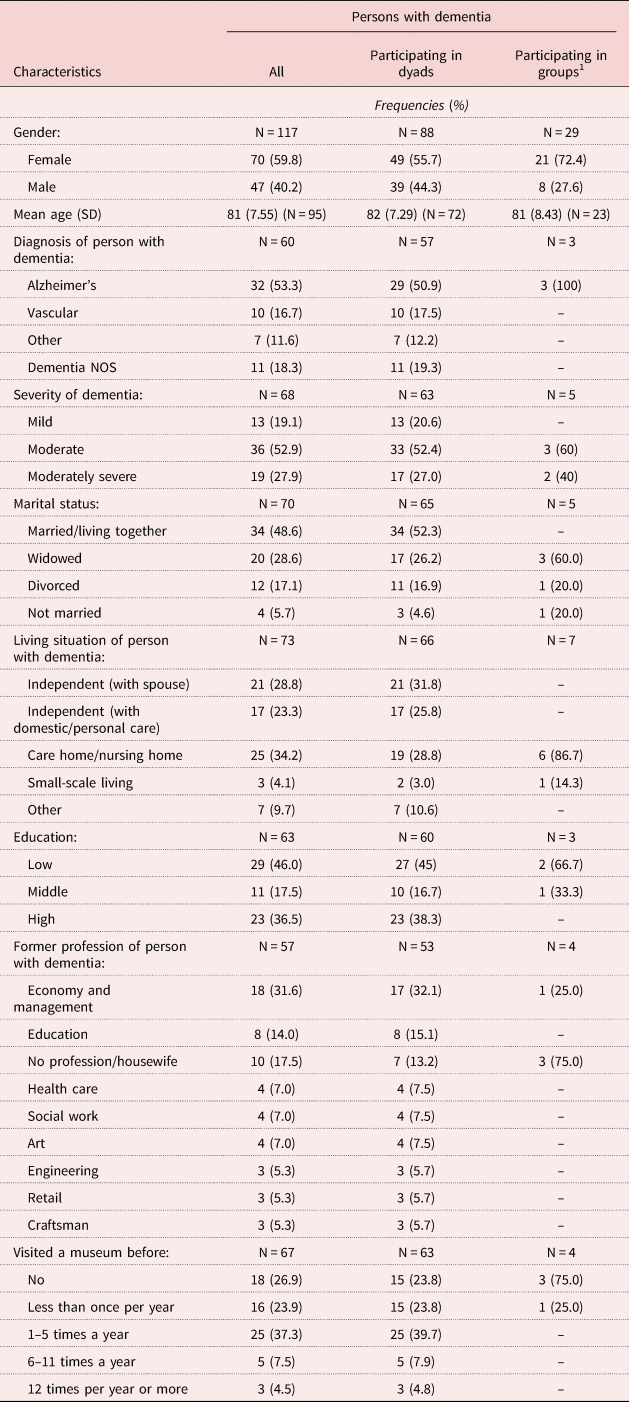
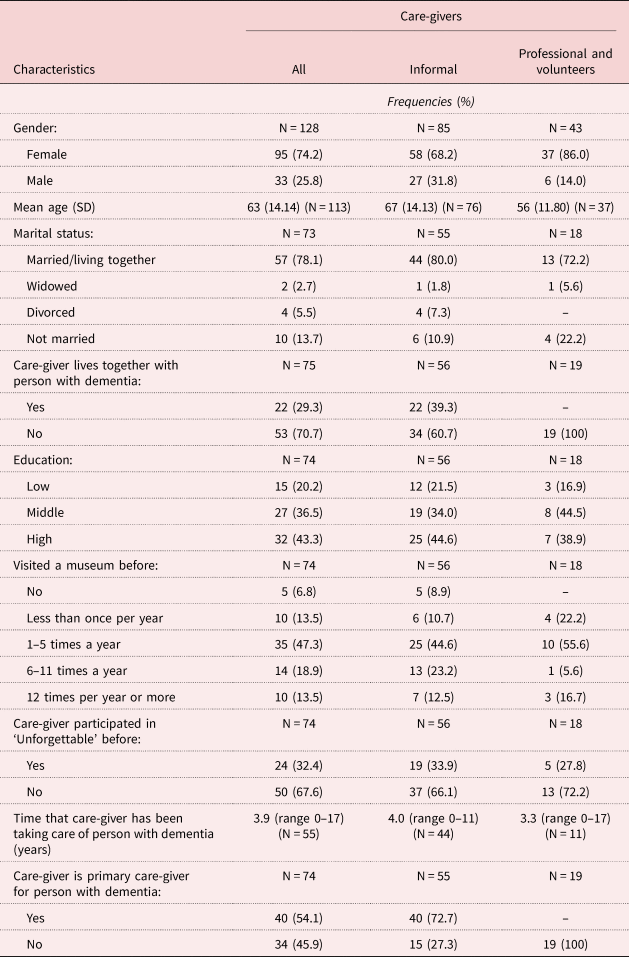
The vast majority (73.1%) of the 67 people with dementia and of the 74 care-givers (93.2%) who answered this question had visited a museum before. An overview of the background characteristics of the participants can be found in Tables 1 and 2.
Background characteristics of people with dementia
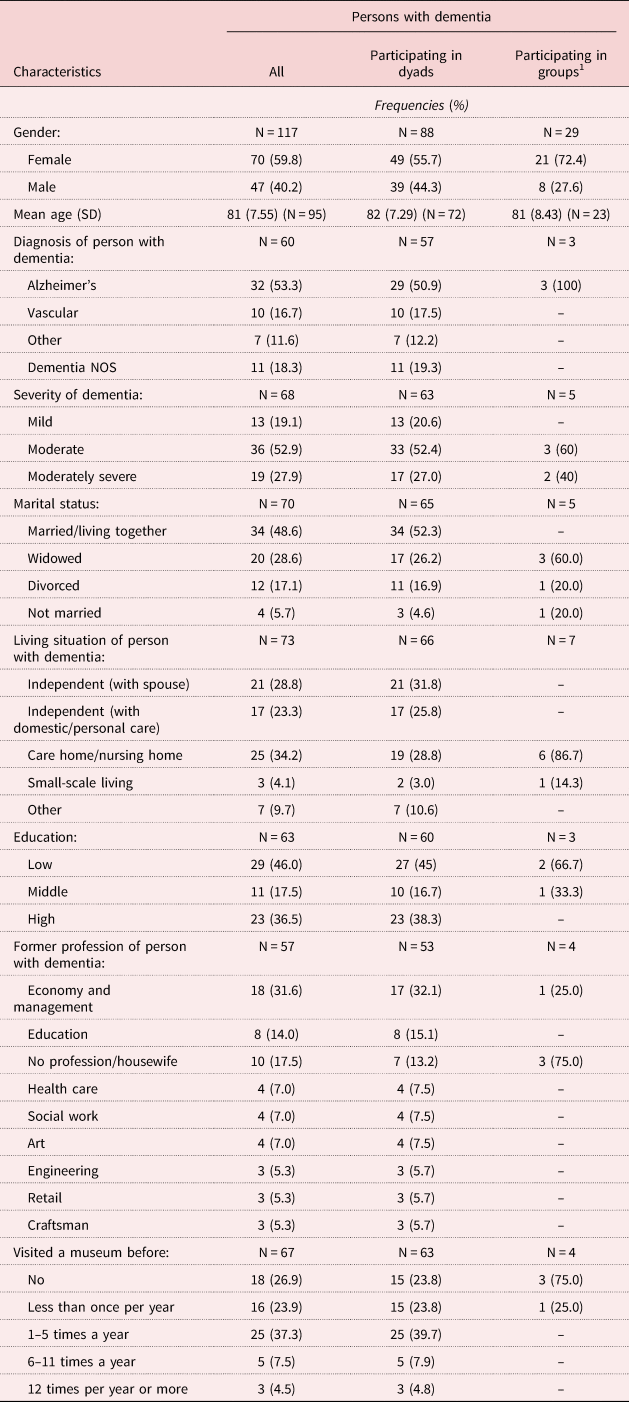
Notes: SD: standard deviation. NOS: not otherwise specified. Totals may not equal 100 per cent due to rounding. 1. From care facilities.
Background characteristics of informal and professional care-givers
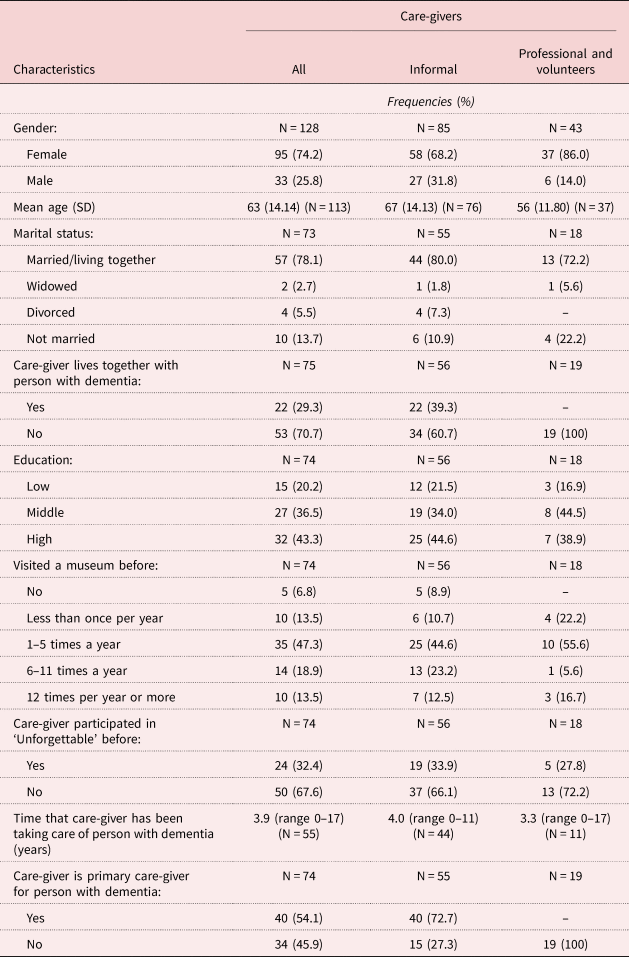
Notes: SD: standard deviation. Totals may not equal 100 per cent due to rounding.
Regarding the care-giver characteristic ‘experience of caring in the last month’, nearly all of the 54 informal care-givers indicated that they enjoyed nice moments together with the person they cared for (96%). Also, 89 per cent said that caring for the person with dementia made them feel good. About half of the informal care-givers (49%) reported getting closer to the person since they cared for them, while 74 per cent said they learned to be happy with the little things in life by caring for the person with dementia, and 80 per cent learned new things about themselves through caring; 63 per cent of the informal care-givers got to know new people in the last month as a result of caring for the person with dementia.
Experience and appreciation of the ‘Unforgettable’ programme and association with background characteristics
An overview of the answers to the structured questions of the take-home questionnaire is presented in Tables A and B in the online supplementary material. For all questions that showed at least some variation in answers by respondents we investigated whether these answers were associated with background characteristics. We checked if their background characteristics were related to overall satisfaction with the programme and answers to the questions ‘was there anything bad about your museum visit?’ and ‘did your contact with the person with dementia change during the programme?’ (only for care-givers). Below the results are summarised descriptively.
Experience of the programme
Of the 52 informal care-givers, 40.4 per cent said their contact with the person with dementia changed; of the 17 formal care-givers, the percentage was 29.4 per cent. Some explained this was because they appreciated doing this activity together:
The return of interest and therefore a stronger sense of shared experience of the tour. (Informal care-giver)
The answer to the question ‘did your contact with the person with dementia change during the programme’ appeared to be linked with the years of caring for the person with dementia (p < 0.01, FET). The longer people had been caring for the person with dementia, the more likely it was that they experienced a different type of contact during the tour. No relationship was found between the answer to this question and other care-giver characteristics.
It was found that 26.9 per cent of the 52 informal care-givers and 29.4 per cent of the 17 formal care-givers were surprised by the reaction of the person with dementia, which changed their perceptions of the person with dementia for whom they cared. One informal care-giver explained being surprised:
By his concentration and interest. Nowadays he quickly loses interest in doing things.
After joining the tour, 22 out of 55 (40%) people with dementia indicated that they were inspired to undertake other activities together with their care-giver; 35 (51.5%) care-givers would also like to do other activities, like visit other museums or go to a concert. They also mentioned going to the zoo, painting and going out for a walk.
Besides a better mood (N = 13; 24.1%), being tired (N = 7; 16.4%), being more talkative (N = 4; 6.2%), having a better appetite (N = 3; 4.6%), being more active (N = 3; 4.6%) and having more problems sleeping (N = 1; 1.5%), the people with dementia did not report any changes in themselves after the tour. Besides a more positive mood that was mentioned seven times (9.2%) in the open-ended question regarding changes in the person with dementia, five care-givers (6.6%) mentioned that the person with dementia was tired after the tour. The tiredness appeared to be related to the answer to the question ‘was there anything bad about your museum visit?’ (p = 0.000; FET): five of the seven people with dementia (71.4%) who reported being tired after the tour also mentioned something unpleasant about their museum visit, such as the group being too large or the duration of the tour being too long. The care-givers did not see much change in the person with dementia's appetite and speech after the tour (see ‘Changes in mood and behaviour’, in Table B in the online supplementary material). According to their care-givers, 26 per cent (N = 13) and 23 per cent (N = 3) of the persons with dementia joined by informal and formal care-givers, respectively, did show an improved mood after the museum visit. It was difficult to measure changes in sleep after the tour as most of the participants filled out the questionnaire the same day.
Appreciation of the programme
The answers to the questions regarding the appreciation of the programme in the take-home questionnaire were predominantly positive. Most of the persons with dementia and the (in)formal care-givers enjoyed the museum visit (a lot) and the majority of the participants reported that they would like to do the tour again. The persons with dementia and care-givers rated the programme with a mean score of 8 on a scale from 1 to 10. Overall satisfaction with the programme was not related to background characteristics, neither for persons with dementia nor care-givers.
Elements of the programme that were most appreciated by the persons with dementia were: social interaction (N = 10), looking at art (N = 6), the clear explanation of the guide (N = 5), the engagement of the guide and hosts (N = 3) and the museum in terms of the building (N = 3). The elements that were appreciated most by the (in)formal care-givers were: the engagement, kindness and motivation of the guide and hosts (N = 20), the social interaction (N = 10), the clear explanation of the guide (N = 8), the friendly welcome (N = 6), the good pace during the tour (N = 6), seeing the reaction of the person with dementia (N = 5) and the small group (N = 3). The following quotes explain the appreciation of the participants:
Changing topics. Discussing personal opinions! (Person with dementia)
Looking at beautiful art, together with others. (Person with dementia)
Being addressed as a person. (Person with dementia)
Seeing how my mother makes contact with others and seeing how careful she is. (Informal care-giver)
Looking at art in a quiet and, for my husband, inviting environment and sharing that moment with others. (Informal care-giver)
My mother was stimulated to look at the images and she associated lovely with it, it was very activating. (Informal care-giver)
It was very nice to hear what everyone noticed in an artwork. (Informal care-giver)”
The answers to the question ‘Was there anything bad about your museum visit?’ can be summarised in the following themes that were mentioned at least three times by the care-givers: poor accessibility of the museum; poor accessibility of the toilet and some unrest during the tour because of noises; technical problems (e.g. lift out of order); and/or a tour guide having difficulty creating a calm atmosphere. There were no negative factors mentioned three or more times by the persons with dementia; duration too long and chaotic beginning of the tour were mentioned twice. Highly educated care-givers were more likely to say that there was something bad (negative/unpleasant aspects of the visit) than care-givers with less education (χ2 = 13.00; degrees of freedom (df) = 2; p < 0.01). No relationships were found between the other background characteristics of the care-giver and the answer to this question. For the people with dementia, the answer to the question ‘Was there anything bad about your museum visit?’ was not associated with their background characteristics.
The vast majority of the participants (people with dementia and care-givers) responded positively to the question ‘Did you think the tour was stimulating/informative?’
You also hear other people's views. (Person with dementia)
I would like to do it more often: it is good to focus on something that centres on your own feelings and to share them with the group. (Informal care-giver)
Everyone was involved and addressed individually. The interactivity was nice. (Informal care-giver)
Most people with dementia did not make suggestions to improve the programme. Some would like the group to be smaller. A smaller group was also mentioned by the (informal) care-givers. In addition, they suggested creating a calmer atmosphere:
Smaller group, having a large group made it chaotic. The start in the restaurant was chaotic because of the environment. (Informal care-giver)
Mood and background characteristics
In general, the participants started the guided tour in a good mood: the median score on the SFAS scale increased significantly from 4 (somewhat happy) before the guided tour to 5 (very happy) after the tour, for both persons with dementia (N = 95) and the care-givers (N = 104) (p = 0.02 and p < 0.01, respectively).
Regarding the results about associations between the person with dementia's and care-giver's background characteristics and their change in mood, we found a significant association (H = 6.01; df = 2; p = 0.05) between change in mood of the person with dementia and their diagnosis: after the tour, a more positive mood was more often found in people with another or unknown type of dementia (N = 12; 66.7%), compared to six people (25%) diagnosed with Alzheimer's and three people (37.5%) with vascular dementia. A significant association (U = 620.50; z = −2.21; p = 0.03) was found between change of mood of the person with dementia and the type of care-giver (formal or informal) with whom he or she joined the tour: those attending the tour with an informal care-giver were more likely to improve their mood (N = 26 individuals; 44.1%) compared to those who attended with a formal care-giver (N = 8; 27.6%). No associations were found between the other characteristics of the persons with dementia and their changes in mood after the museum tour.
For the care-givers, we found that the older they were the more their mood improved (rho = 0.26; p = 0.01). We also found a relation between the type of care-giver (informal or formal) and changes in mood (U = 839.00; z = −2.65; p = 0.01): the informal care-givers more often experienced an improved mood (32; 45.6%) compared to formal care-givers (7; 20.5%). No associations were found between the other care-giver characteristics and changes in mood.
Discussion
This paper reports on the results of a user evaluation study of the ‘Unforgettable’ museum programme for people with dementia and their care-givers which was carried out within the framework of an implementation study into this programme in 12 Dutch museums. The evaluation investigated the participants’ perspective, which resulted in information that may optimise the guided museum tours for people with dementia and their care-givers. Moreover, analysis of the background characteristics of participants provides insight into which of these might influence the experience of participants.
The ‘Unforgettable’ programme was originally developed for people with dementia and their informal care-givers living at home. However, this study has shown that the programme also appeared to attract others, such as community-dwelling people with dementia accompanied by formal or voluntary care-givers (e.g. from a day care facility or Meeting Centre), and groups from long-term care facilities with formal as well as voluntary and informal care-givers. Looking at the reported ‘positive care experiences’ by care-givers who joined the ‘Unforgettable’ programme, we found higher scores than reported by De Boer et al. (Reference De Boer, Oudijk, van Groenou and Timmermans2012) who studied a broader sample of care-givers of different patient groups, including people with dementia. One possible explanation for these higher scores could be that the museum programme selectively attracts people with a more positive attitude towards caring. An alternative explanation could be that the experiences during the ‘Unforgettable’ programme positively influenced the care-givers’ answers on the PES. Further study of this difference would be interesting.
Overall, the ‘Unforgettable’ programme was very positively evaluated by the participants. Comparable results were found for similar programmes such as ‘Meet Me at MoMa’ (Mittelman and Epstein, Reference Mittelman, Epstein, Rosenberg, Parsa, Humble and McGee2009) in New York and the ‘here:now’ programme of the Frye Museum in Seattle (Burnside et al., Reference Burnside, Knecht, Hopley and Logsdon2017). Social connection is often found to be one of the most important elements of art programmes (Camic et al., Reference Camic, Baker and Tischler2016; Burnside et al., Reference Burnside, Knecht, Hopley and Logsdon2017). The ‘Unforgettable’ programme is no exception: social interaction and meeting others appeared to be key factors in the appreciation of the programme by both people with dementia and their care-givers. Social engagement is recognised as one of the most important components of wellbeing of older adults (Cherry et al., Reference Cherry, Walker, Brown, Volaufova, LaMotte, Welsh, Su, Jazwinski, Ellis, Wood and Frisard2013) and social health (Dröes et al., Reference Dröes, Chattat, Diaz, Gove, Graff, Murphy, Verbeek, Vernooij-Dassen, Clare, Johannessen, Roes, Verhey and Charras2017). Recent research has shown that older adults with cognitive impairments are significantly less likely to be socially active than older adults without cognitive impairments (Johnson et al., Reference Johnson, Whitlatch and Menne2014). Art can be seen as a facilitation tool for expressing emotions (Wang and Li, Reference Wang and Li2016). Moreover, art often reflects generic life themes and experiences which are recognisable for a broad public, while it is generally accepted that people can have different opinions about the aesthetic value of it and that it can evoke different feelings. The open atmosphere that is created by the guides during the tours can contribute to a safe environment in which participants feel free to speak openly about their emotions and feelings. Museum programmes such as ‘Unforgettable’ can therefore be seen as a valuable addition to other activities that stimulate social interaction for people with dementia.
The people with dementia appreciated the art in general and the museum building itself. The latter finding supports the added value of joining an activity in a community building rather than an activity in a long-term care facility or at home. This is also in line with the findings of Brieber et al. (Reference Brieber, Nadal and Leder2015) that artworks are seen as more interesting in a museum than in a laboratory. Another important aspect of the programme mentioned by the persons with dementia as well as the care-givers was the role of the guide and hosts. Personality, especially kindness and involvement, and the guide's knowledge of art were very much appreciated. Chancellor et al. (Reference Chancellor, Duncan and Chatterjee2014) also found the role of the art therapist to be critical in creating a comfortable environment for people with dementia. Poor accessibility of the museum and of the toilet were mentioned as negative aspects of the museum visit. To improve the tour, the participants recommended smaller groups and a calmer atmosphere during the tour.
In contrast to the persons with dementia, the care-givers did not specifically mention looking at art or the museum building. For them, seeing the reaction of the person with dementia was what they appreciated most. Care-givers’ changed perceptions about the person with dementia were also found in the study of Camic et al. (Reference Camic, Baker and Tischler2016). We may therefore conclude that the positive evaluation by the care-givers may not specifically be attributed to the art or the museum itself. However, the programme seems to fit the needs of a specific group of care-givers who enjoy going to a museum. In our study, participants could apply for the study themselves, they were not randomly selected.
The overall satisfaction of both the people with dementia and the care-givers did not appear to be related to their background characteristics. However, more-educated care-givers were more likely to be critical about the museum visit. Previous experience with museums did not appear to be a precondition for enjoying the ‘Unforgettable’ programme. Moreover, enjoying the programme was not limited to people in the mild or moderate stage of dementia living at home, as it also appeared to be valued positively by people with moderately severe dementia living in long-term care facilities.
Besides mood improving and being tired, the participants with dementia did not report changes within themselves after the tour. People with dementia who reported being tired after the tour were more likely to have experienced something bad about the museum visit, such as the group being too large or the duration of the tour being too long. The care-givers did not report much change in behaviour after the tour either, although some also noticed tiredness in the person with dementia. A different type of contact with the person with dementia was experienced more often by carers who had been a care-giver for a longer period of time.
The positive experience and appreciation of the ‘Unforgettable’ programme were reflected in the improved mood of both the persons with dementia and the (in)formal care-givers, as measured by the SFAS. This positive impact is in line with outcomes of other studies into museum programmes, such as ‘Meet Me at MoMA’ (Mittelman and Epstein, Reference Mittelman, Epstein, Rosenberg, Parsa, Humble and McGee2009) which also reported improved mood, and the ‘Artful Moments’ programme in Canada (Hazzan et al., Reference Hazzan, Humphrey, Kilgour-Walsh, Moros, Murray, Stanners, Montemuro, Giangregorio and Papaioannou2016), which reported decreased stress experienced by the participating care-givers. For the people with dementia, we found a significant association between their change in mood and the type of care-giver they joined the tour with; people with dementia attending the programme with an informal care-giver were more likely to experience improved mood. This might be explained by the person with dementia's familiarity with that person. The familiarity of a social environment has been shown to promote involvement in activities (Phinney et al., Reference Phinney, Chaudhury and O'Connor2007). Also, people with types of dementia other than Alzheimer's disease or vascular dementia were more likely to have an improved mood. This latter finding may be explained by the very good mood of the people with Alzheimer's disease at the start of the tour (ceiling effect). Concerning the care-givers’ change in mood, we found that older care-givers and informal (as compared to formal) care-givers experienced more improvement in mood. This difference between informal and formal carers might be explained by the fact that the mood of formal care-givers was already very good before the start of the tour. No associations were found with other background characteristics of people with dementia or care-givers.
Limitations
This study had some limitations. First, participants of the ‘Unforgettable’ programme were self-selected and the vast majority of them had previous experience of art, which makes it impossible to generalise the outcomes to groups of people with dementia in general and people without experience of art. Also, this self-selection of people to participate in the programme might have resulted in bias because they might have had a positive attitude to this intervention beforehand and may have been more inclined to give positive feedback afterwards; or, for them, just taking part in research may have resulted in giving positive feedback (Hawthorne effect). Second, almost half of the participants did not return the take-home questionnaire. These were relatively more people who joined the tour in a group from a care institution or as professional or voluntary care-givers. A lack of time of the professionals, or the fact that the participants were asked to return the questionnaire within three days after the tour, could be reasons for not filling out the questionnaires. By offering the participants the possibility to choose between filling out the questionnaires themselves at home or a (telephone) interview by one of the researchers one day or a few days after the tour, a higher response rate could possibly be achieved. The length of the questionnaire, especially the one for the care-giver, could be another reason for not returning the questionnaire. To improve feasibility, we had mainly questions with up to three answering possibilities, which could have had a negative effect on the sensitivity. The same holds for the easy-to-administer five-response SFAS questionnaire that we used. For future studies, a good trade-off needs to be made between the length of the questionnaire and answering possibilities, on the one hand, and the feasibility of filling out the questionnaire, on the other. The number of times people participated in the ‘Unforgettable’ programme could be an indicator of (dis)satisfaction. However, as the ‘Unforgettable’ programme was not set up as a series of museum tours, information on the participation frequency after having participated in the museum tour for the first time was not collected. Moreover, we used a one-group design: the lack of a control group makes it difficult to determine whether the appreciation of the programme and the improvements in mood of people with dementia and care-givers were specifically related to the art and the art programme itself or to other factors. The appreciation, experience and mood of the participants in the museum activity were not compared to the appreciation, experience and mood of participants in other non-art activities. So it remains unclear if the outcomes are specific for the museum programme. The qualitative data, however, suggest that the majority of the participants indeed highly appreciated the guided tours and had relatively few suggestions for improvement. For future research, it would be interesting to investigate the added value of art programmes, including the duration of the effect on mood, compared to other (social) activities for people with dementia. Because of the explorative character of our study no multiple testing correction was done when calculating the associations between the user experience and appreciation of the programme and their background characteristics. Our aim was to explore potential associations with background characteristics that could be further investigated in future studies.
The fact that data in this implementation study were collected in different museums with very different collections all over the Netherlands can be seen as an advantage. However, this did make the evaluation of the appreciation of the museum tour programme complex. The numbers of participants who visited the different museums were too small to investigate the effects of these variations. Finally, most of the participants in this study were diagnosed with Alzheimer's disease and/or vascular dementia, so there were too few people with other types of dementia to investigate fully the differences in appreciation of the programme and impact on mood by diagnostic sub-groups of people with dementia. As people with different types of dementia have different disabilities, it would be interesting to focus future research on how different sub-groups appreciate the guided museum tours and what adaptations might be necessary to meet the needs of these sub-groups.
Scientific and societal impact
The results of this study can stimulate and support other museums to set up similar programmes and thus promote the further dissemination and availability of museum programmes for people with dementia and their care-givers; both for those living in the community as well as in long-term care facilities. Based on the findings of our study, we recommend museums to implement the ‘Unforgettable’ programme, while explicitly taking into account the participants’ experiences and suggestions, such as small groups and a calm environment, in their implementation plan. Insight into what aspects the participants appreciate more or less can help to improve art programmes for people with dementia and their care-givers, which is likely to increase the benefit for its users. The most appreciated aspects mentioned in our study, such as the social interaction and the engagement of the well-informed guides and hosts, may also help to explain the positive impact of museum programmes. The positive experiences with the ‘Unforgettable’ programme may encourage people with dementia and their informal and formal care-givers to participate in the programme.
Conclusion
In this exploratory study, we demonstrated that the ‘Unforgettable’ programme is experienced and evaluated positively by its participants, i.e. both people with dementia and informal and formal care-givers. Furthermore, we found some background and environmental factors that were related to the appreciation, experience and changes in mood. Taking notice of these may help further improve museum programmes for people with dementia and carers. We recommend investigating whether our study findings are confirmed in larger, preferably randomised controlled trials.
Supplementary material
The supplementary material for this article can be found at https://doi.org/10.1017/S0144686X19001089
Author contributions
R-MD and FJMM were involved in the conception, design, analysis and interpretation of data and in revising the article; IH was involved in the collection, analysis and interpretation of data and in drafting the article; DLG was involved in the interpretation of data and revising the article. All authors approved the version to be published.
Acknowledgements
The authors would like to thank all participants and collaboration partners in the project.
Financial support
This work was supported by the Gieskes Strijbis Fonds, VSBfonds, Stichting Hofje Codde en Van Beresteyn and mental health charity Stichting tot Steun VCVGZ.
Conflict of interest
The authors declare no conflicts of interest.
Ethical standards
The local Medical Ethics Review Committee reviewed the study protocol and information letters, and stated that the study was not subject to the Medical Research Involving Human Subjects Act.