Introduction
Environmental non-governmental organizations (ENGOs) have become highly visible in decision making from local to global levels since the 1970s. An increasing body of research examines how ENGOs participate in policy making, either indirectly (e.g. via lobbying or campaigns) or directly (e.g. by helping governments to design and implement environmental regulations) (e.g. Betsill and Corell, Reference Betsill and Corell2001; Corell and Betsill, Reference Corell and Betsill2001; see also Chayes and Chayes, Reference Chayes and Chayes1993: 204; Raustiala, Reference Raustiala1997; Finnemore and Sikkink, Reference Finnemore and Sikkink1998; Roberts et al., Reference Roberts, Parks and Vásquez2004; von Stein, Reference von Stein2008; Böhmelt and Betzold, Reference Böhmelt and Betzold2013).
The general expectation in this literature and also in policy circles is that ENGOs play a major role in pushing governments towards more ambitious environmental policies at all political levels.Footnote 1 For example, ENGOs can enhance procedural legitimacy by promoting greater transparency and better representation of otherwise marginalized societal interests in policy formulation and implementation (see Gemmill and Bamidele-Izu, Reference Gemmill and Bamidele-Izu2002; Steffek and Ferreti, Reference Steffek and Ferretti2009). Moreover, transboundary environmental problems have become more complex and more severe. ENGOs then help monitor state commitments, facilitate signaling between governments and constituents, or provide expertise and policy advice to governments in areas characterized by uncertainty over cost efficiency, political feasibility, and ecological impacts of particular policy options (e.g. Raustiala, Reference Raustiala1997, Reference Raustiala2001).
In turn, according to the resource exchange perspective (Lehmbruch, Reference Lehmbruch1977; Baccaro and Simoni, Reference Baccaro and Simoni2008; Dür, Reference Dür2008; Christiansen et al., Reference Christiansen, Norgaard, Rommetvedt, Svensson, Thesen and Öberg2010), ENGOs gain influence over policymakers, which allows them to shape policy outputs according to their own preferences. Hence, both types of ENGO functions are presumed to act in the same direction, namely towards making the resulting policies ‘more environmental-friendly’, thus more acceptable to citizens and, in turn, making vote-seeking policymakers more willing to adopt such policies (Risse-Kappen Reference Risse-Kappen1994, Reference Risse-Kappen1995; Keck and Sikkink, Reference Keck and Sikkink1998; Biermann and Gupta, Reference Biermann and Gupta2011; Bernauer and Betzold, Reference Bernauer and Betzold2012; Dryzek, Reference Dryzek2012; Bernauer and Gampfer, Reference Bernauer and Gampfer2013). At the international level, Roberts et al. (Reference Roberts, Parks and Vásquez2004: 39) conclude that ‘the number of [E]NGOs in a nation appears virtually synonymous with its likelihood to participate in environmental treaties’. At national levels, Binder and Neumayer (Reference Binder and Neumayer2005) show that ENGO strength is systematically associated with better environmental performance of states. Thus, ‘most scholars agree that [E]NGOs do make a difference’ (Gulbrandsen and Andresen, Reference Gulbrandsen and Andresen2004: 54).
The overall conclusion from this research, which attributes at least part of the trend towards more stringent environmental policies to ENGO influence, seems quite convincing both theoretically and empirically. We build on this research and add to it by examining the possibility that ENGO influence is contingent on specific types of political system characteristics. The existing research controls for political system characteristics in an additive sense, that is by including some political system characteristics in explanatory models in which ENGOs are the key independent variable. However, this research neither theorizes on nor empirically examines whether the impact of ENGOs might depend on particular political system characteristics.
Analysing contingent effects of ENGOs is useful from a theoretical point of view and empirically. Theoretically, it helps overcome a rather surprising disconnect between two distinct literatures. First, there is the traditional literature on interest groups, non-governmental organizations, and social movements in comparative politics or political sociology (e.g. Kitschelt, Reference Kitschelt1986; Keck and Sikkink, Reference Keck and Sikkink1998; Della Porta and Tarrow, Reference Della Porta and Tarrow2004; Snow et al., Reference Snow, Soule and Kriesi2004; Dryzek, Reference Dryzek2012), which has emphasized political opportunity structures. Second, there is the political economy literature on public goods provision that offers well-developed arguments connecting democratic political system characteristics with variation in levels and types of public goods provision (e.g. Bueno de Mesquita et al., Reference Bueno de Mesquita, Smith, Siverson and Morrow2003; Persson and Tabellini, Reference Persson and Tabellini2003).
Empirically, this paper addresses an analytical challenge in the existing literature on ENGOs and their impact on environmental policy making. This challenge derives from the possibility that the same democratic political system structures that may create more opportunities for the formation, activities, and influence of ENGOs are also, on their own, conducive to better environmental policies. This leaves us with the possibility that the additional (marginal) impact of ENGOs on policy making could actually be smaller than presumed. Recent research by Bernauer et al. (Reference Bernauer, Böhmelt and Koubi2013) points to this by arguing that the effect of ENGOs on international environmental cooperation is contingent on levels of democracy, and that, paradoxically, the influence of ENGOs may be smaller in democracies than in non-democracies. The main reason is that democracies tend to pursue better environmental policies anyway, which implies that the additional (marginal) effect of ENGOs in democracies is smaller relative to non-democracies. The empirical findings in that paper are generally in line with our arguments developed here.
We pick up on the latter idea and unpack the ‘black box’ of democratic systems to examine whether and how particular forms of democratic government and electoral rules could mediate the influence of ENGOs on environmental policy. Specifically, we argue that presidential systems with a plurality electoral rule per se tend to provide more environmental public goods, which leads to a smaller marginal impact of ENGOs. Conversely, parliamentary systems with a proportional representation electoral rule are likely to provide fewer environmental public goods, which allows for a larger marginal impact of ENGOs. We find robust empirical support for these claims in analyses that focus on the ratification behaviour of 75 democracies vis-à-vis 250 international environmental agreements in 1973–2002.
Theoretical framework: outline
ENGOs are usually mass membership organizations, representatives of voters, and, thus, they shape public opinion and signal electoral preferences to policymakers (see Böhmelt and Betzold, Reference Böhmelt and Betzold2013). Through their diverse activities, ENGOs may have considerable influence over both policy development processes and their outcomes (Corell and Betsill, Reference Corell and Betsill2001; Corell, Reference Corell2008). A large part of the literature examining ENGOs and their activities documents the strategies used by these organizations to influence environmental politics, and assesses the extent to which these strategies are effective (for a more comprehensive discussion, see Betsill, Reference Betsill2006). First and with regard to the typology of strategies, most scholars distinguish between insider and outsider strategies (Beyers, Reference Beyers2004; Betsill, Reference Betsill2006). The former refer to a set of activities that seek to affect policymakers directly via the provision of expert advice or policy analysis. Corell and Betsill (Reference Corell and Betsill2001: 87) emphasize here that ‘the provision of knowledge and information is the key ENGO resource for influence’ (see also Gerdung, Reference Gerdung2004; Betsill and Corell, Reference Betsill and Corell2008). The latter aims at creating pressure from the outside by shaping public opinion (e.g. Gulbrandsen and Andresen, Reference Gulbrandsen and Andresen2004; Betsill, Reference Betsill2006).
Against this background, the more general literature on interest groups, non-governmental organizations, and social movements, which has strong roots in comparative politics and political sociology, highlights the importance of political opportunity structures (e.g. Kitschelt, Reference Kitschelt1986; Risse-Kappen Reference Risse-Kappen1994, Reference Risse-Kappen1995; Keck and Sikkink, Reference Keck and Sikkink1998; Della Porta and Tarrow, Reference Della Porta and Tarrow2004; Snow et al., Reference Snow, Soule and Kriesi2004; Dryzek, Reference Dryzek2012): groups’ and activists’ impact on policy making is expected to vary, depending on whether specific properties of a political system provide more (or fewer) opportunities for them to form, operate, and gain access and influence in political decision-making processes.Footnote 2 Interestingly, political economy research as another stream in the literature inter alia provides us with well-developed arguments on democratic system characteristics and variation in public goods provision, but does not consider opportunity structures, and how they might affect interest groups and non-governmental organizations (e.g. Bueno de Mesquita et al., Reference Bueno de Mesquita, Smith, Siverson and Morrow2003; Persson and Tabellini, Reference Persson and Tabellini2003). This work has primarily focused on the analysis of direct effects of political system characteristics on levels of public goods provision, such as environmental protection. The distinctions between presidential and parliamentary systems, on the one hand, and proportional and plurality electoral rule, on the other hand, both of which are also salient in the comparative politics literature (e.g. Lijphart, Reference Lijphart1984, Reference Lijphart1999; Boix, Reference Boix1999; Powell, Reference Powell2000), have been at the center of attention in this context. We connect these two literatures to construct an argument on how ENGO influence may vary depending on specific political system characteristics.
Our starting point is that environmental policy making can be conceptualized as a problem of public goods provision, where the public good to be generated is meant to serve very large parts of a given society. Examples include clean air and water, as well as policy instruments such as international environmental agreements whose purpose is to enable or facilitate the provision of public goods. We link this outcome variable to political system characteristics, that is presidential vs. parliamentary systems and plurality vs. proportional electoral rule. The number of effective political parties, which varies systematically across these system characteristics, will also play a role in our theoretical setup. Afterwards, we bring ENGOs into the explanatory model to identify under what types of political system conditions ENGOs are likely to have a larger (or smaller) marginal impact on environmental public goods provision.
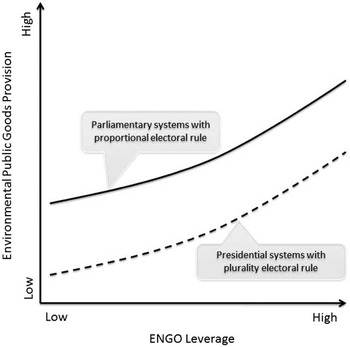
Figure 1 illustrates the expectations derived from our theory. It is indicated that increasing ENGO leverage, which we define as the capacity to exert influence, has a positive effect on environmental public goods provision in all types of democratic political systems. They also suggest, however, that the ENGO impact is larger in parliamentary systems with proportional electoral rule than in presidential systems with plurality voting. In the following, we develop the theoretical model step-by-step.
The expected marginal environmental non-governmental organization (ENGO) impact in different political systems.

Democratic forms of government, electoral rules, and public goods provision
A large body of the existing literature accounting for variation in (environmental) public goods provision focuses on the broad distinction between democratic and non-democratic systems (e.g. Congleton, Reference Congleton1992; Payne, Reference Payne1995; McGuire and Olson, Reference McGuire and Olson1996; Lake and Baum, Reference Lake and Baum2001; Neumayer, Reference Neumayer2002; Fredriksson et al., Reference Fredriksson, Neumayer, Damania and Gates2005; Ward, Reference Ward2008; Bernauer et al., Reference Bernauer, Kalbhenn, Koubi and Spilker2010). Some work also offers more nuanced explanations that concentrate on variation within the two broader system types (e.g. Lizzeri and Persico, Reference Lizzeri and Persico2001; Milesi-Ferretti et al., Reference Milesi-Ferretti, Perotti and Rostagno2002; Rogowski and Kayser, Reference Rogowski and Kayser2002; Bueno de Mesquita et al., Reference Bueno de Mesquita, Smith, Siverson and Morrow2003; Persson and Tabellini, Reference Persson and Tabellini2003; Scruggs, Reference Scruggs2003; Fredriksson and Millimet, Reference Fredriksson and Millimet2004a, Reference Fredriksson and Millimetb; Fredriksson and Wollscheid, Reference Fredriksson and Wollscheid2007; Bernauer and Koubi, Reference Bernauer and Koubi2009; Fredriksson et al., Reference Fredriksson, Matschke and Minier2010; Cao and Ward, Reference Cao and Ward2011; Fiorino, Reference Fiorino2011; Ward and Cao, Reference Ward and Cao2012). Bernauer and Koubi (Reference Bernauer and Koubi2009), for example, distinguish presidential and parliamentary systems and find that the former perform better than the latter in providing for cleaner air. Moreover, Fredriksson and Millimet (Reference Fredriksson and Millimet2004a) study the impact of electoral rules and report that democracies with proportional electoral systems have stricter environmental policies than democracies with plurality voting (see also Fredriksson et al., Reference Fredriksson, Matschke and Minier2010).
Following this literature, we use democratic political system type and electoral rule as the principal explanatory variables in our baseline model accounting for variation in environmental public goods provision. We then bring in the effective number of political parties before integrating ENGOs into this framework. Two key characteristics of democratic political systems, which are very prominent in the comparative politics literature, serve as our starting point: the form of government (presidential vs. parliamentary systems) and the type of electoral rule (plurality vs. proportional electoral rule) (e.g. Lijphart, Reference Lijphart1984, Reference Lijphart1999; Boix, Reference Boix1999; Powell, Reference Powell2000). We focus on these two characteristics, because there is strong agreement among scholars that they have important implications for policy making and public policies. The existing literature has produced contradictory theoretical arguments in this respect, however.
Bueno de Mesquita et al. (Reference Bueno de Mesquita, Smith, Siverson and Morrow2003) rely on their selectorate theory and claim that different forms of democracy are characterized by different sizes of the winning coalition. They argue that presidential systems and plurality electoral rules, which require a large winning coalition, provide more public goods than parliamentary and proportional representation systems, which require a smaller winning coalition. The reason is that, in order to survive politically in presidential systems with plurality rule where the winning coalition is large, leaders have to implement policies that benefit a very large part of society; and public goods typically provide such widespread benefits.
In contrast, Persson et al. (Reference Persson, Roland and Tabellini2000) and Persson and Tabellini (Reference Persson and Tabellini1999, Reference Persson and Tabellini2004) argue that legislators of the majority coalition form the government and determine public policy in parliamentary systems. To sustain their electoral support, they need to promote the joint interests of their voters and, hence, concentrate government spending on public goods. Moreover, Persson and Tabellini (Reference Persson and Tabellini1999, Reference Persson and Tabellini2004) claim that the size of the minimal coalition of voters required to win an election is larger in proportional representation than in ‘winner-takes-all’ (plurality) systems, because a party needs around 50% of the national vote rather than 25%. Consequently, it is argued that parliamentary systems with proportional representation are likely to provide more public goods (see also Austen-Smith, Reference Austen-Smith2000; Lizzeri and Persico, Reference Lizzeri and Persico2001; Milesi-Ferretti et al., Reference Milesi-Ferretti, Perotti and Rostagno2002; Persson and Tabellini, Reference Persson and Tabellini2003).
The empirical evidence for these competing claims is also characterized by ambiguity. For instance, Rogowski and Kayser (Reference Rogowski and Kayser2002), Bueno de Mesquita et al. (Reference Bueno de Mesquita, Smith, Siverson and Morrow2003), and Bernauer and Koubi (Reference Bernauer and Koubi2009) find that presidential systems provide more public goods. On the other hand, Persson and Tabellini (Reference Persson and Tabellini1999, Reference Persson and Tabellini2003) obtain evidence that presidential regimes tend to spend less on public goods; and Persson and Tabellini (Reference Persson and Tabellini2004: 27) report that parliamentary systems exhibit larger welfare spending than presidential democracies. With respect to electoral rules, Persson and Tabellini (Reference Persson and Tabellini1999, Reference Persson and Tabellini2003) find that plurality-voting systems lead to a lower supply of public goods, while proportional representation systems are likely to spend more on public goods according to Milesi-Ferretti et al. (Reference Milesi-Ferretti, Perotti and Rostagno2002) or Fredriksson and Millimet (Reference Fredriksson and Millimet2004a, Reference Fredriksson and Millimetb). We submit that the theoretical and empirical ambiguity just discussed might be reduced if we consider the competitive situation policymakers face, which is reflected in the political party system and, in particular, in the effective number of parties (Laakso and Taagepera, Reference Laakso and Taagepera1979).Footnote 3
The effective number of parties and public goods provision
We follow the common assumption that parties structure themselves, develop electoral strategies, and shape policies to maximize their vote shares (Downs, Reference Downs1957). Hence, depending on the form of government and the type of electoral rule, parties emerge and develop in distinct ways that allow them to meet the electoral imperative of vote maximization.
Presidential systems with plurality voting rule are likely to be characterized by fewer effective parties, in many cases two-party systems. In contrast, parliamentary democracies with a proportional election rule usually have more effective parties. Duverger (Reference Duverger1972), for instance, contends that the nature of the electoral system shapes the party system. He argues that ‘a majority vote on one ballot is conducive to a two-party system and proportional representation is conducive to a multiparty system’ (Duverger, Reference Duverger1972: 23; for a critique of this claim, however, see Riker, Reference Riker1976, Reference Riker1982). This means that plurality systems support fewer parties and are designed to bestow government control on a single party, which is also a characteristic of presidential democracies (Taagepera and Shugart, Reference Taagepera and Shugart1989; Lijphart, Reference Lijphart1999). Because the likelihood of a coalition government is rather small in such systems, political parties must maximize their vote share to implement their desired policies. With fewer parties, vote-maximizing locations in the political space are typically near the center, that is the median voter (Downs, Reference Downs1957).
Conversely, proportional representation systems support more parties, which raises the chances for coalition governments that are usually characteristic of parliamentary systems. Still, parties with smaller vote shares have the possibility to influence government policies. A larger number of political parties also limits their spatial mobility and results in vote-maximizing positions of some parties away from the political center (Downs, Reference Downs1957).
Moreover, with regard to the form of government, presidential systems favour a structure with fewer parties as well. The underlying argument focuses on the instability of political decision making and ideological polarization (Mainwaring, Reference Mainwaring1993). Presidential systems typically lack mechanisms for assuring that the executive has a majority in the legislature. As a result, these systems are more prone to minority governments and to status quo bias, that is ‘legislative deadlock’ (Mainwaring, Reference Mainwaring1993: 200). The form of government thus shapes ‘the equilibrium number of parties’ (Persson et al., Reference Persson, Roland and Tabellini2007: 2) as this deadlock becomes increasingly unlikely with fewer parties in the system. In addition, due to the dominance of the executive (see also Lijphart, Reference Lijphart1999: 138), presidential systems are frequently also characterized by high entry barriers for new parties, which keep radical parties out of the party system (Mainwaring, Reference Mainwaring1993: 200). This makes a multiparty system unlikely.
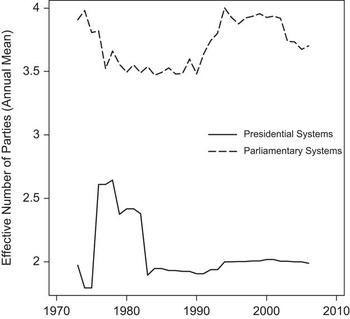
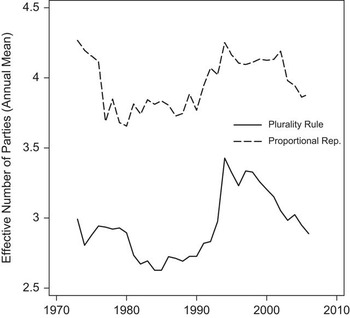
Empirical studies show that presidential and plurality rule systems indeed have fewer effective parties. For example, Persson et al. (Reference Persson, Roland and Tabellini2007) find that proportional representation rule leads to a more fragmented party system and, hence, a larger effective number of parties (Lijphart, Reference Lijphart1999: 165ff; see also Boix, Reference Boix1999). To further corroborate these results, which are important for our argument, we take data from the Comparative Political Data Set (Armingeon et al., Reference Armingeon, Weisstanner, Engler, Potolidis, Gerber and Leimgruber2011). These data comprise annual information for 23 democratic (OECD) countries between 1960 and 2009, including information on the effective number of parties as specified by Laakso and Taagepera (Reference Laakso and Taagepera1979). We calculated annual mean values of this variable for presidential vs. parliamentary systems and plurality vs. proportional systems, and plotted curves for 1973–2006.Footnote 4 Figure 2 and 3 summarize the findings. Evidently, the effective number of parties is higher in parliamentary systems and in systems with proportional electoral rule. Using t-tests, we can also reject the null hypothesis of equality for both curves in either figure.
The effective number of parties by the form of government (1973–2006).

The effective number of parties by electoral rule (1973–2006).

The relationship between the effective number of parties and the provision of public goods can now be placed into the context of our prior argument on political system type, electoral rule, and public goods provision. We argue that presidential systems with plurality voting are likely to provide more (environmental) public goods, because electoral competition in these systems takes place among fewer parties. In contrast, since parliamentary and proportional representation systems are associated with a higher effective number of parties, they are likely to provide fewer (environmental) public goods.
The underlying logic for these claims is the following: systems with fewer parties create stronger incentives for competing political leaders to offer goods from which a very large part of the selectorate can benefit, that is (environmental) public goods. On the other hand, in systems with several or many parties that compete for political power, rival political leaders are more likely to cater to particular segments of the selectorate, both within election districts and nationally. Incentives to produce public goods are thus weaker (Chhibber and Nooruddin, Reference Chhibber and Nooruddin2004: 163; see also Cox, Reference Cox1997; Persson and Tabellini, Reference Persson and Tabellini1999). In the words of Chhibber and Nooruddin (Reference Chhibber and Nooruddin2004: 162), ‘the ability to win elections with lower percentages in multiparty environments decreases the incentives for a party to mobilize support across all social groups to the same degree when it faces only one other competitor’.Footnote 5
ENGO influence contingent on political system characteristics: hypotheses
The final step in our theoretical framework brings ENGOs back into the model. We argued above that presidential systems and plurality rule are associated with fewer effective parties. This structure creates stronger incentives for policymakers to provide more (environmental) public goods – relative to parliamentary and proportional systems, which tend to have more than two effective parties. When adding ENGOs to this framework, we can derive empirical implications concerning the marginal impact of ENGOs on states’ environmental public goods provision contingent on democratic system characteristics.
As discussed, ENGOs are likely to influence environmental policy making and its outcomes by contributing to procedural legitimacy in terms of greater transparency and improved representation of otherwise politically less influential societal interests. They also provide knowledge and expertise that may help policymakers to design and implement more efficient and effective policies. These two types of ENGO contributions, which are well documented in the literature (e.g. Betsill and Corell, Reference Betsill and Corell2008; Bernauer and Gampfer, Reference Bernauer and Gampfer2013), are likely to enhance public support for more ambitious environmental policies and to encourage vote-seeking policymakers to adopt such policies.
For the reasons mentioned, the net impact of ENGOs is therefore likely to be positive across different types of democratic political systems. That said, it is likely to differ in strength depending on those political system characteristics that affect public goods provision independent of ENGO influence. In countries whose political system characteristics are more conducive to more ambitious environmental policies, the relative impact of ENGOs will be smaller; on the other hand, it will be larger in countries whose political system characteristics are less conducive to environmental policies. This argument builds on Bernauer et al. (Reference Bernauer, Böhmelt and Koubi2013) who show that the marginal impact of ENGOs on countries’ participation in international environmental agreements is likely to be weaker in democracies, which tend to pursue better environmental policies anyway. Hypotheses 1 and 2, as well as Figure 1 above, summarize these theoretical expectations.
Hypothesis 1: Presidential systems with plurality rule provide per se more environmental public goods. This implies that the additional (marginal) effect of ENGOs on environmental public goods provision in such systems is likely to be smaller – compared with parliamentary systems with a proportional electoral rule.
Hypothesis 2: Parliamentary systems with proportional rule provide per se less environmental public goods. This implies that the additional (marginal) effect of ENGOs on environmental public goods provision in such systems is likely to be larger – compared with presidential systems with plurality rule.
Research design: dependent variable and methodology
While our theoretical arguments are quite generic and can apply to a wide range of environmental public goods, systematic empirical testing requires a somewhat narrower focus. We decided to concentrate on countries’ choices with respect to joining (or not joining) international environmental agreements. Future empirical work will have to explore whether our theoretical arguments are also relevant to other forms of environmental public goods provision.
Specifically, our dependent variable measures countries’ ratification behaviour vis-à-vis a wide range of global environmental agreements. The reasons for focusing on this outcome variable are the following. First, it may, of course, be the case that some international environmental treaties are rather weak in terms of their ambition level, or that particular countries join agreements without being able or willing to fully implement the commitments set forth therein. This means that environmental treaty ratification may be a somewhat incomplete measure for the level of environmental public goods provision by a given country. Nevertheless, formally engaging in a legally binding international environmental agreement still constitutes a strong signal on the part of government that it is committing to more ambitious environmental policies relative to the status quo (see also Martin, Reference Martin1993; Fearon, Reference Fearon1998; Leeds, Reference Leeds1999; Schneider and Urpelainen, Reference Schneider and Urpelainen2013). At the very least, treaty ratification is regarded by many scholars as a reasonably clear sign of governmental attempts to engage in environmental public goods production (e.g. Bernauer et al., Reference Bernauer, Böhmelt and Koubi2013). Leinaweaver (Reference Leinaweaver2012: 3–4), for instance, notes that environmental treaty ratification ‘greatly resembles what would be involved with the provision of other public goods’. He also notes that ‘the ratification of these treaties represents a binding pledge at the international level and domestic groups may view this favorably because they recognize that domestic institutions do not bind the leader very firmly, while international ones, as weak as they are, may provide a more credible binding constraint […] compliance with ratified treaties may be assumed as highly likely meaning that the promised environmental goods will be provided’ (Leinaweaver, Reference Leinaweaver2012: 15).
Second, international environmental treaty ratification is a clearly observable event that can be reliably measured over long time periods and for many countries. Our approach also allows us to take into account such state behavior vis-à-vis a very wide range of environmental policies that are covered by existing treaties.
The data for our dependent variable are taken from Bernauer et al. (Reference Bernauer, Kalbhenn, Koubi and Spilker2010). Following the definition of ratifications in that study, different legal expressions of formally joining a treaty, for example accession, are treated as equivalent to ratification. Furthermore, treaties that may somewhat deal with environmental issues only at the margins, but whose key purpose is not the environment were dropped from the data. The data also omit agreements that were open for ratification before 1973Footnote 6 and only include treaties that are open for ratification to all countries globally (i.e. in principle, any country in the world must have the opportunity to ratify an agreement; this excludes treaties that have a purely regional scope only). Since we are interested in how variation in democratic institutions influences the presumed positive effect of ENGO leverage on environmental public goods provision, we also dropped countries that are not defined as democracies according to the disaggregated democratic regime type data (Beck et al., Reference Beck, Clarke, Groff, Keefer and Walsh2001) described below, as well as those states that have a democracy value of less than +7 according to the polity2 variable from the Polity IV data (Marshall and Jaggers, Reference Marshall and Jaggers2013). The polity2 item, ranging in [−10; +10] with the minimum pertaining to fully autocratic states and +10 representing ‘perfect’ democracies, captures a state’s level of democracy along three dimensions: ‘the presence of institutions and procedures through which citizens can express effective preferences about alternative policies and leaders. Second, the existence of institutionalized constraints on the exercise of power by the executive. Third, the guarantee of civil liberties to all citizens in their daily lives and in acts of political participation’ (Marshall and Jaggers, Reference Marshall and Jaggers2013: 14; see also Vreeland, Reference Vreeland2008).
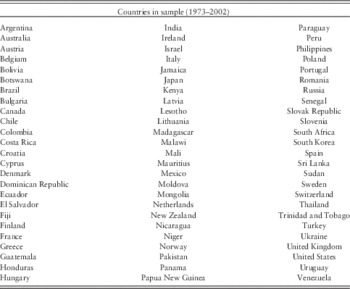
The unit of analysis is the agreement-country-year, that is each international environmental treaty is paired with each democracy that could potentially ratify it in a given year. An international environmental agreement enters the data as soon as it becomes open (available) for ratification; and each agreement-country pair remains in the data until the year when a given country ratifies this agreement.Footnote 7 Due to these criteria, the data set used to test our theoretical argument covers 75 democracies and 250 international environmental treaties between 1973 and 2002.Footnote 8 Table 1 lists the democracies in our sample.
Countries (democracies) in sample, 1973–2002

The choice of statistical method – logistic regression models – derives from the binary nature of our dependent variable (1 if a given country ratifies a given international environmental agreement; 0 otherwise). Robust standard errors are clustered on each agreement-country pair to account for intra-group correlations or other forms of cross-sectional heterogeneity. Furthermore, we control for temporal dependencies by including a ratification-years variable and different sets of cubic splines (Beck et al., Reference Beck, Katz and Tucker1998). This approach acknowledges that a country’s propensity to ratify an international environmental agreement might depend on corresponding choices in previous years.
Research design: core explanatory variables
The two hypotheses focus on three explanatory variables, that is ENGOs, the form of government, and the type of electoral rule in democracies. First, we measure ENGOs and their potential for political leverage by the number of national ENGOs registered in a country (Fredriksson and Ujhelyi, Reference Fredriksson and Ujhelyi2006).Footnote 9 The data for this variable (ENGO Leverage (ln)) are taken from Bernauer et al. (Reference Bernauer, Böhmelt and Koubi2013) and were originally coded from information for 1973–2006 in the archives of the International Union for Conservation of Nature (IUCN). The IUCN considers itself as ‘the world’s largest and most important conservation network’, with a ‘mission to influence, encourage, and assist societies throughout the world to conserve the integrity and diversity of nature’ (IUCN, 2006). Its members include national and international ENGOs, government agencies, and scientists from 181 countries. While the organization’s network extends to most countries in the world, the IUCN is essentially an umbrella organization where membership is not mandatory and ENGOs do not necessarily have to register. The data we use may thus omit some ENGOs, but this measurement approach seems more systematic and efficient than collecting ENGO data from other sources. We also believe that the IUCN’s large network of relationships with non-governmental organizations allows us to generate a reasonably valid and reliable proxy for the potential political leverage of ENGOs (see also Bernauer et al., Reference Bernauer, Böhmelt and Koubi2013).Footnote 10
Having said that, the number of ENGOs from the IUCN data is obviously not a perfect proxy for ENGOs’ capacity for political influence. For instance, there may be many ENGOs registered in a country, but all of them might be small and weak. Another possible objection is that in some cases fewer groups might mean that the environmental lobby is better organized and, hence, better able to exert political pressure (Fredriksson and Ujhelyi, Reference Fredriksson and Ujhelyi2006: 18). Following Fredriksson and Ujhelyi (Reference Fredriksson and Ujhelyi2006), we examined the own effect of our ENGO variable on treaty ratification as a positive finding here would cut against this objection. In fact, we obtain robust evidence for such a relationship (see also Bernauer et al., Reference Bernauer, Böhmelt and Koubi2013). In line with that, the ENGO variable’s positive correlation with measures like population or GDP per capita also suggests that a larger number of ENGOs reflects a higher – and not a lower – ability to organize political action (Fredriksson and Ujhelyi, Reference Fredriksson and Ujhelyi2006: 18). Furthermore, note that we replaced the ENGO data used for the main analysis with data from an alternative source. The robustness checks with these alternative data are reported in the appendix (Supplementary Material), and the main results uphold.
Second, the type of democratic government, that is either presidential or parliamentary, is measured with data from the 2010 edition of the World Bank’s Database of Political Institutions (Beck et al., Reference Beck, Clarke, Groff, Keefer and Walsh2001). According to this data set, countries in which the legislature elects the chief executive are parliamentary systems. Systems with presidents who are elected through popular vote, either directly or by an electoral college (whose only function is to elect the political leader), and where there is no prime minister, are classified as presidential. We created a dichotomous variable (Presidential System Dummy) that receives a value of 1 in case a country has a presidential system and the value of 0 if a country has a parliamentary system. Systems that are not classified as either parliamentary or presidential, or those cases that are categorized as ‘mixed regimes’, are omitted from the analysis.
Third, we operationalize the type of electoral system also with data from the World Bank’s Database (Beck et al., Reference Beck, Clarke, Groff, Keefer and Walsh2001). Plurality systems are identified on the basis of voting institutions in which legislators are elected using a ‘winner-takes-all’ rule. Conversely, proportional representation systems are coded if candidates are elected based on the percentage of votes received by their party, and/or if the World Bank’s ‘sources identified the respective electoral system as proportional representation’ (Beck et al., Reference Beck, Clarke, Groff, Keefer and Walsh2001). Similar to the democratic government form variable, we created a binary variable that takes on the value of 1 for plurality systems (Plurality Voting Dummy) and 0 for proportional representation systems. Mixed electoral systems are omitted.
Finally, to model the effects of ENGO Leverage (ln) conditional on the moderating variables of Presidential System Dummy and Plurality Voting Dummy, we also consider multiplicative terms between (1) ENGO Leverage (ln) and Presidential System Dummy; (2) ENGO Leverage (ln) and Plurality Voting Dummy; (3) Presidential System Dummy and Plurality Voting Dummy; and (4) ENGO Leverage (ln) and Presidential System Dummy and Plurality Voting Dummy. In other words, we model a three-way interaction that we interpret below via the simple slope difference tests (Dawson and Richter, Reference Dawson and Richter2006).
Research design: control covariates
We use a wide range of control variables, most of which are also used in Bernauer et al. (Reference Bernauer, Kalbhenn, Koubi and Spilker2010)Footnote 11 and other similar studies (Congleton, Reference Congleton1992; Frank, Reference Frank1999; Fredriksson and Gaston, Reference Fredriksson and Gaston2000; Neumayer, Reference Neumayer2002; Beron et al., Reference Beron, Murdoch and Vijverberg2003; Murdoch et al., Reference Murdoch, Sandler and Vijverberg2003; Roberts et al., Reference Roberts, Parks and Vásquez2004; Fredriksson et al., Reference Fredriksson, Neumayer and Ujhelyi2007; von Stein, Reference von Stein2008). First, we include a country’s membership in international organizations (IO Membership), using the number of international organizations of which a country is a member in a given year (Pevehouse et al., Reference Pevehouse, Nordstrom and Warnke2004). A more extensive membership in international organizations (IOs) should increase the likelihood of states ratifying agreements that ‘lie outside the scope of specific IOs they have joined at some prior time’ (Bernauer et al., Reference Bernauer, Kalbhenn, Koubi and Spilker2010: 514).
We also consider a country’s trade openness, measured as the ratio of the sum of exports and imports to GDP (Trade Intensity). This variable reflects the actual and perceived economic conditions and levels of insecurities associated with the vagaries of the global market that might affect the chances to unleash changes in states’ environmental policies (Böhmelt and Vollenweider, Reference Böhmelt and Vollenweider2014). According to Bernauer et al. (Reference Bernauer, Kalbhenn, Koubi and Spilker2010: 518), the ‘tradeoff between gains from a cleaner environment and losses from lower exports is more adverse for more open economies’. Hence, we expect a negative impact of trade openness on treaty ratification. The data are taken from Gleditsch (Reference Gleditsch2002).
Third, we add a variable counting the total number of states in the international system that already ratified the international environmental agreement in question (Number of Countries Ratified). In addition, our estimations incorporate variables capturing the percentage of countries from the same region (Percent of Region Group Ratified) and the same income group that already ratified the international environmental agreement in question (Percent of Income Group Ratified). The variables Number of Countries Ratified, Percent of Region Group Ratified, and Percent of Income Group Ratified are lagged by 1 year. The rationale behind these variables pertains to international policy diffusion, that is a mechanism that ‘occurs when government policy decisions in a given country are systematically conditioned by prior policy choices made in other countries’ (Simmons et al., Reference Simmons, Dobbin and Garrett2006: 787).
Fourth, we include income, measured as the log value of GDP per capita (GDP per capita). We also include the squared value of this variable in light of the claims of the Environmental Kuznets Curve (Seleden and Song, Reference Seleden and Song1994; Grossman and Krueger, Reference Grossman and Krueger1995): the environment is a relatively low priority for states in the early stages of development, but it becomes a higher priority as development increases.
The state of the domestic environment may also influence ratification behaviour. Since we lack a composite index that reliably measures the quality of the environment at the domestic level, we use the log of SO2 emissions per capita (SO 2 per capita) as a proxy (Bernauer et al., Reference Bernauer, Kalbhenn, Koubi and Spilker2010: 529). Arguably, these kinds of emissions are a very common form of air pollution and, thus, might reflect the overall domestic environmental quality reasonably well.
Finally, we include the log of GDP (GDP). The reason for considering this last control is that it captures the economic size or power of a state. More powerful countries might be particularly reluctant to join international agreements as this could constrain their sovereignty and autonomy in global governance (Bernauer et al., Reference Bernauer, Kalbhenn, Koubi and Spilker2010: 529).
Empirical findings
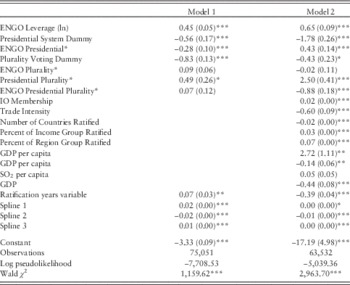
Table 2 summarizes the main results of our empirical analysis. Model 1 focuses on the core explanatory variables, while Model 2 includes the control covariates in addition. The table entries are simple logit coefficients for which only the signs and the standard errors can be interpreted directly. With regard to the constitutive terms of the three-way interaction, however, note that we cannot even interpret the signs or standard errors (Braumoeller, Reference Braumoeller2004; Brambor et al., Reference Brambor, Clark and Golder2006). Hence, we employ slope difference tests (Dawson and Richter, Reference Dawson and Richter2006) to evaluate our theoretical argument, that is we computed the difference in the average marginal effect of the ENGOs variable conditional on Presidential System Dummy and Plurality Voting Dummy.
Results from logistic regression models

Standard errors clustered on country-treaty pair in parentheses.
*Significant at 10%; **significant at 5%; ***significant at 1% (two-tailed).
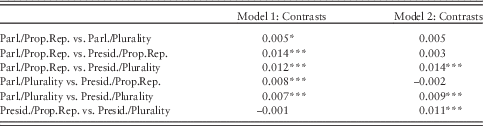
Table 3 shows that the impact of ENGO Leverage (ln) does indeed vary along the two moderating variables. Most of the differences in the average marginal effects are statistically different from each other and consistent across the model specifications. The only exceptions that point to strictly opposing directions according to the models are ‘Parl./Plurality vs. Presid./Prop.Rep.’ and ‘Presid./Prop.Rep. vs. Presid./Plurality’, whose effects apparently depend on estimation specifications. Nonetheless, the results shown in Table 3 offer strong support for our argument that the marginal ENGO effect is likely to vary across forms of government and the type of electoral rule in democracies. Note that one of the largest differences between the slopes is observable for the comparison of the ‘most extreme’ combinations that we explicitly seek to study via our hypotheses: ‘Parl./Prop.Rep. vs. Presid./Plurality’. Hence, regardless of model specifications, Table 3 shows that the impact of ENGOs is stronger in parliamentary systems with a proportional representation rule than in presidential democracies with plurality voting. In sum, these slope difference tests provide some initial support for our two hypotheses.
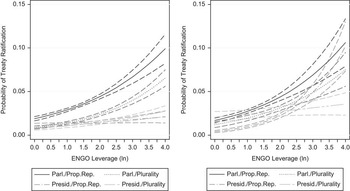
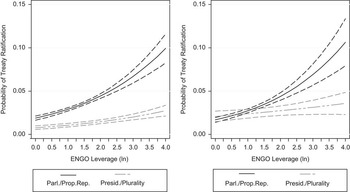
To examine the effect of ENGOs conditional on the two moderating political system variables in greater depth, we calculated the predicted probabilities of ratification at different levels of ENGO Leverage (ln) according to the different scenarios outlined in Table 3. Figures 4 and 5 depict the findings: while Figure 4 covers all four scenarios, Figure 5 omits the theoretically less relevant cases and focuses on the pair-wise comparison of ‘Parl./Prop.Rep. vs. Presid./Plurality’. These figures indicate that the impact of ENGOs on countries’ participation in international environmental agreements is on average stronger in parliamentary than in presidential democracies. This finding is in line with our theoretical argument, which holds that presidential systems tend to provide more public goods – including environmental ones – than parliamentary systems, and that the marginal impact of ENGOs should, therefore, be smaller in presidential systems.
The impact of environmental non-governmental organization (ENGO) leverage – conditional on democratic system and electoral rule. Note: The left panel pertains to Model 1. The right panel pertains to Model 2. The dashed lines indicate 90% confidence intervals.

The impact of environmental non-governmental organization (ENGO) leverage – conditional on democratic system and electoral rule. Note: The left panel pertains to Model 1. The right panel pertains to Model 2. The dashed lines indicate 90% confidence intervals.

Comparisons of differences in simple slopes of ENGO Leverage (ln)

Bonferroni correction employed for P-values.
*Significant at 10%; **significant at 5%; ***significant at 1% (two-tailed).
Similarly, the ENGO effect is smaller in plurality voting systems, relative to proportional representation systems. Finally, when looking at democratic government type and electoral system in combination, we find again that the results are in line with our theoretical expectations: as shown in Figure 5, the effect of ENGO Leverage (ln) is noticeably stronger in parliamentary systems with proportional representation rule than in presidential democracies with plurality voting. These effects are not only statistically significant, but also substantively relevant. For instance, the probability of ratification in the average agreement-country pair increases by about 10% when around 80 ENGOs are present in a parliamentary system that relies on the proportional representation rule. However, this probability drops to about 2.5% at the same level of ENGO leverage in a presidential system with plurality voting. Ultimately, our empirical analysis provide robust empirical support for our arguments that presidential systems with a plurality electoral rule per se tend to provide more environmental public goods, which induces a smaller marginal impact of ENGOs. Conversely, parliamentary systems with a proportional representation electoral rule are likely to provide fewer environmental public goods, but this allows for a larger marginal impact of ENGOs.
Coming to our control variables, the effects of IO Membership, Trade Intensity, Percent of Income Group Ratified, Percent of Region Group Ratified, and GDP per capita as well as its square term are all in line with results reported in the existing literature on environmental treaty ratification. Membership in IOs significantly increases the likelihood of ratification: when moving from the minimum to the maximum value of this variable, the probability of ratification increases by about 1.5%. The same positive impact can be observed for the percentage of countries in the same region and income group that have already ratified an environmental agreement. When moving from the minimum to the maximum of Percent of Income Group Ratified, we observe an increase in the likelihood of ratification by about 11%. The impact of Percent of Region Group Ratified is even stronger as it increases the likelihood of treaty ratification by almost 57%. Hence, it appears that more regionally based networks have a stronger influence.
We also find evidence for a curvilinear relationship between GDP per capita and the probability of ratification, which reflects the patterns predicted by the Environmental Kuznets Curve literature (Seleden and Song, Reference Seleden and Song1994; Grossman and Krueger, Reference Grossman and Krueger1995). In our model, the turning point when growing income reverts from decreasing the likelihood of treaty ratification to promoting it is located at around $3318. Trade intensity reduces the likelihood of treaty ratification, although this effect is substantively small. When moving from the minimum to the maximum value of this variable, the probability of treaty ratification decreases by only around 1.3%.
In contrast to, for example, Bernauer et al. (Reference Bernauer, Kalbhenn, Koubi and Spilker2010), we find that ratification by the average country becomes less likely when a larger share of all other countries has already ratified (about 1% when increasing Number of Countries Ratified from its minimum to its maximum value). One potential reason for this difference could be that our sample excludes non-democratic countries, while Bernauer et al. (Reference Bernauer, Kalbhenn, Koubi and Spilker2010) examine all states globally. Finally, the impact of a country’s economic power is negative and just significant, while domestic environmental conditions as captured by SO2 per capita do not seem to affect the likelihood of treaty ratification substantially.
To assess the robustness of our findings, we used other statistical approaches, and also re-ran the models using alternative data for the ENGO variable and data for the effective number of parties. These robustness checks are summarized in the online appendix (Supplementary Material). The findings from these alternative model specifications support the results reported here.
Conclusion
The existing literature offers useful theoretical arguments and empirical evidence on whether and how ENGOs may influence environmental public goods provision. But it provides only limited insights into whether and in what respect the influence of ENGOs on governments’ environmental policies may be contingent on particular characteristics of the political system.
In this paper, we developed a theoretical framework in three steps. First, we connected fundamental political system characteristics, that is the form of government and the type of electoral rule, with levels of public goods provision. Second, we added a characterization of the nature of electoral competition to this model, as expressed by the effective number of parties. Third, we placed ENGOs into this setup. The impact of ENGOs on the provision of environmental public goods – measured by countries’ ratification behavior vis-à-vis 250 international environmental agreements – was then conceptualized as being contingent on democratic government type and electoral rule.
This theoretical approach for explaining the impact of ENGOs on environmental public goods provision connects two hitherto separate streams in the literature: the comparative politics literature on interest groups, non-governmental organizations, and social movements, which highlights the importance of political opportunity structures; and, second, the political economy literature, which inter alia offers arguments on the provision of public goods as a function of political system characteristics. Our empirical findings offer strong support for the argument that the impact of ENGOs is likely to be stronger in parliamentary systems with a proportional representation rule, relative to presidential systems with plurality voting.
From a normative perspective that places hope in ENGOs to push governments towards more ambitious environmental policies, our results offer quite good news. First and foremost, our research suggests that ENGO lobbying efforts are not without any effect. In fact, while the ENGO effect differs significantly across political system types, it remains positive even in those democratic systems where we expect the effect to be weaker. By identifying such an overall net impact of ENGOs, our study complements the existing literature, which offers such evidence in more idiosyncratic form for specific environmental policy areas, countries, and points in time. That said, given the differences in ENGO influence across political system types, ENGOs might also try to make their lobbying more effective by identifying in the first place those democratic system types that may be more open towards their preferences and positions.
Further research building on the work reported in this paper could focus on several issues. First, as noted above, ratification of international environmental treaties is an important, but clearly not the only proxy for levels of environmental public goods provision. Future research could thus test our arguments on additional data. Major data gaps will have to be overcome to that end, however. For instance, the Environmental Performance Index, one of the most popular multi-country measures of environmental performance, is available only for a limited number of years and, to some extent, changes composition over time. Also, its components measuring policy stringency are much less elaborated than its components on environmental quality or polluting behaviour. In any event, to the extent that available data allow it, it will be interesting to explore whether contingent ENGO effects differ across policy output and environmental outcomes. Recent work suggests, for instance, that democracy has a positive effect on the willingness of countries to commit to more ambitious environmental policies, but that the ‘words-deeds’ gap is particularly large for such political systems (e.g. Bättig and Bernauer, Reference Bättig and Bernauer2009; see also Aichele and Felbermayr, Reference Aichele and Felbermayr2012).
Second, we have used the arguably best available data on ENGOs, given our needs for data that cover many democracies and a reasonably long time-period – with one dataset used for the main analysis, and an alternative dataset used for robustness checks (see Supplementary Material). These data are somewhat incomplete, though, and using the mere number of ENGOs as a proxy for ENGOs’ political leverage does not take into account differences in the distribution of political leverage across ENGOs within a country. Ideally, future data collection efforts should fill this gap and try to construct more sophisticated measures using information on membership size and resources of ENGOs.
Finally, while our quantitative setup has the advantage that we are able to identify a general pattern under which conditions ENGOs might exert an influence on environmental politics, we cannot claim causality. Put differently, our work can show that associations or correlations exist between our key variables of interest, but it would be misleading to interpret the ‘marginal impact’ in this paper as causal. Hence, it could be useful to conduct more qualitative research, stakeholder surveys, or network analyses of ENGOs and governmental actors in a set of countries that differ with respect to political system type and electoral rule. Such work could seek to identify in greater detail whether, in the self-assessment of ENGOs and from the perspective of government actors, the (aggregate) marginal impact of ENGOs on environmental policy making is in fact larger in parliamentary systems with proportional electoral rule.
Acknowledgements
The research for this paper was carried out as part of the Swiss NCCR research programme ‘Challenges to Democracy in the 21st Century’ (http://www.nccr-democracy.uzh.ch). The authors thank four anonymous reviewers and the journal’s editors, Donatella Della Porta and B. Guy Peters, for helpful comments. Supplemental information, the data set, and the replication files referred to in the text can be obtained from the authors on request.
Supplementary material
To view supplementary materials for this article, please visit http://dx.doi.org/10.1017/S175577391400006X.