In 1895, the Critic published an anecdote about two young ladies discussing the popularity of George Du Maurier's novel Trilby (1894):
“What is this ‘Trilby’ everybody is talking about?” asked one of these. “Oh,” replied the other, “it's a book – a novel.” “They say it is awfully bad,” said the first young person. “Yes, I've heard so; but it isn't so at all. I read it clear through, and there wasn't anything bad in it. I didn't like it either; there is too much French in it.” “French?” commented the first young woman; “well that's it, then – all the bad part is in French.” “I hadn't thought of that,” mused the other one, “I suppose that's just the way of it.”Footnote 1
The dialogue provides an illuminating glimpse into the controversy surrounding the publication of Trilby, a novel that brazenly celebrates a heroine who possesses “all the virtues but one” – chastity (35; pt. 1). Although Trilby was successful enough to inspire a spate of songs, literary parodies, and stage adaptations, its depiction of Paris's bohemian underground flouted mainstream Victorian values. The Connecticut Magazine charged Du Maurier with inspiring “comparative indifference” to sexual virtue, and readers everywhere worried that young people, like those depicted in the above vignette, would be unable to distinguish virtue from vice after reading the novel (“A Free Lance” 105).
But the conversation between the two young women is far more than a commentary on Victorian sexual mores. For these young readers, what is “awfully bad” about the book is not the loss of Trilby's virginity (which is actually recounted in English) but the narrator's tendency to shift constantly between English and French. Their inferences betray a fear of French decadence, of the foreign tongues they struggle to comprehend, and of Du Maurier's unsettling penchant for intertwining the languages of different cultures. The real controversy surrounding Trilby, it would seem, was not the issue of sexual but rather of cultural purity.
There is, then, something unwittingly insightful about the verdict these young ladies pass upon Du Maurier's story. The concern Victorian readers expressed about Trilby stemmed in large part from its bold attempt to elide differences between British and French culture. Trilby O'Ferrall, a Scotch-Irish girl raised in the Latin Quarter, was the very antithesis of the virtuous English maid featured in so many British sentimental novels. In Trilby, the Victorian reader was not merely asked to forgive the sexual indiscretions of a wayward British girl but to regard them as commonplace and therefore pardonable within the Parisian underworld she inhabits. Embracing such a heroine – one who fails to meet the standards of the only English matron featured in the novel – was akin, in the eyes of many, to a betrayal of English national character. Du Maurier's representation of the bohemian Latin Quarter thus speaks to more far-reaching and contemporary concerns about the integrity of national values within an increasingly global world.
Though Trilby has largely been written off as a hackneyed, sentimental account of the author's youth, its treatment of cross-cultural encounters within bohemian Paris – a space often supposed to be (as one of its characters claims) “away from the world” – helps to lay bare the tension between the nation-state and globalization that has dominated recent conversations both within and beyond the academy (134; pt. 4). If bohemia is typically regarded as an oppositional or counter-cultural community, in Du Maurier's novel it also becomes an unexpected site of political transformation that helps to close the gap between self and other, citizen and barbarian, the nation and the world. In Trilby, a bohemian subculture that rejects mainstream institutions and appears to be in many ways aloof from politics emerges paradoxically as both the end and origin of civic order.
Such a claim proposes an unlikely and productive alliance between the aesthetic and the political. According to Tanya Agathocleous, cosmopolitanism is not always “reducible to an elitist pose or an apolitical withdrawal from the world” but rather promotes the very political and social engagements it is presumed to eschew (127). In imagining cosmopolitan connections, she explains, Victorian writers exhibit an attention to form that is analogous to and at times explicitly calls upon aesthetic discourses: they instantiate, that is to say, a kind of “aesthetic cosmopolitanism” (127). In this essay, I pursue a kindred line of inquiry, but whereas Agathocleous focuses primarily on the convergence of cosmopolitan and aesthetic discourses (particularly those that directly invoke the British Aesthetes), my own argument treats a particular figuration of artistic subculture – bohemia – as a vital testing-ground for nineteenth-century attitudes toward global interconnectedness. For Du Maurier, the bohemian lifestyle not only overlaps with nineteenth-century cosmopolitanism in compelling ways but actually serves as a wellspring for the production and theorization of cosmopolitan discourse.
In the following pages, I posit Du Maurier's urban subculture as a contestatory field where several different visions of the world – nationalism, universalism, and cosmopolitanism – vie for supremacy. In bohemia, these political concepts are most compellingly articulated through artistic performances, from the provincial aesthetic of the painter, Little Billee, to the universal but finally exploitive aesthetic expressed through Svengali's musical compositions. What emerges from this struggle is a form of cosmopolitanism defined by a spirit of mutability and productive play. In Du Maurier's account, cosmopolitanism is always aspirational, continually and recursively reshaping the individual's orientation to the rest of the world as she encounters and accommodates new forms of cultural affiliation, patriotic attachment, and global awareness. Such an aspirational cosmopolitanism might seem to posit an all too simple solution to the ungainly challenge of global cohesion, presuming ingenuously that to imagine a world of harmonious transnational connections is enough to make such connections attainable. In Trilby, however, we see a different kind of aspirational cosmopolitanism come to the fore, one that admits and even embraces struggle. By turning to Victorian subculture as a source of political insight, Trilby transports the question of transnational engagements onto a cultural terrain that is not bound by the fixed categories and rituals of mainstream society. Here, at the interstices of culture, aspirational cosmopolitanism becomes a far more supple and politically meaningful concept.
In pursuing this line of argument, I take my cue from Ulrich Beck's Cosmopolitan Vision (2004), which contends that nationalist and cosmopolitan sensibilities should not be treated as contrary, but rather as interconnected and mutually constituting. For Beck, cosmopolitanism “reveals not just the ‘anguish’ but also the possibility of shaping one's life and social relations under conditions of cultural mixture. It is simultaneously a skeptical, disillusioned, self-critical outlook” (3). Like Beck, I do not wish to claim that cosmopolitanism promises the effortless foreclosure of global conflict or to deny the equivocations and clashes it inevitably engenders. Indeed, it is precisely because cosmopolitanism can assume so many different, elusive, and even embattled forms that it can facilitate the penetration and transformation of the otherwise fixed boundaries between nations. In Trilby, then, bohemia becomes the generative nucleus of cosmopolitan discourse, a counterculture that – though often imagined to be a throng of radicals with little interest in civic order – is absolutely crucial to navigating the distance between cultures.
The Kingdom of Bohemia
The term “bohemian” first emerged in early nineteenth-century France, where artistic subcultures were pejoratively compared to the gypsies then emigrating from Eastern Europe. Deemed alien, exotic, unrestrained, and at least figuratively from another world, the bohemian shared many of the stigmas attached to racialized others in the nineteenth century. In an 1862 article “The Literature of Bohemia,” the Westminster Review described the bohemian as “a certain kind of literary gypsy, no matter in what language he speaks, or what city he inhabits” (32). In the popular imagination, the bohemian was eccentric, unstable, morally bankrupt, and alarmingly resistant to centralized political or legal authority. According to Elizabeth Wilson, bohemianism is a distinctly modern phenomenon, which expresses the evolving role of the artist within the context of a newly industrializing world. Adopting a strictly oppositional rhetoric, Wilson contends, “the bohemians created and participated in a social milieu created against the dominant culture, as the artist made a startling transformation from paid ideologue to violent critic of society in the unfamiliar world of ‘modernity’” (2). Made up of young people who would grow old, vagrants who would discover a new home, and insurgents whose cause invariably shifted over time, bohemianism has understandably become synonymous with a kind of quixotic rootlessness and instability. Like the gypsy, the bohemian shrugs off his cultural origins and remains unyoked to any single national tradition – a man or woman without a country, common to all places and loyal to none.Footnote 2
But despite its reputation as a kind of political limbo, bohemia has always retained distinctly political affiliations. On the most basic level, the term “bohemian” calls to mind Bohemia, the geographical province that became an economic anchor for the Austro-Hungarian Empire during the second half of the nineteenth century. Bohemianism thus invokes at once nomadism and the nation, exile and belonging, isolation and expansion. Even setting aside its compelling etymological origin, bohemia has never been simply an oppositional culture that gainsays the dominant paradigm, for while bohemia rejects the mainstream, it often helps to provide a much-needed critical perspective on normative values.Footnote 3 The bohemian is neither “away from the world” nor in any normal sense part of it. For the bohemian, detachment thus becomes a new form of engagement with the world. As Amanda Anderson notes in The Powers of Distance (Reference Anderson2001), “‘the view from nowhere’ is always actually a view from somewhere, a somewhere determined not only by the social and cultural identity of the author but also by historical and cultural horizons more broadly construed” (5). While self-consciously operating beyond the reach of mainstream culture, bohemia's reliance on the mainstream for the raw material of its aesthetic productions also gives it roots; it constitutes in every sense a “view from nowhere” that is culturally and historically situated.
In this respect, bohemia would seem to corroborate Anderson's notion of “cultivated detachment,” a critical outlook she associates not only with cosmopolitanism but with any attempt to negotiate between the situated view and the desire for critical objectivity (5). At the same time, the political hybridity of bohemia suggests a provocative modification of Anderson's theory of critical distance. So far from entering into “a dialectic between detachment and engagement, between a cultivated distance and a newly informed partiality,” bohemia represents a synthesis of the two and a critical posture that simultaneously resists and instantiates civic order (Anderson 6). In this sense, it is perhaps less appropriate to think of bohemia as a space of “cultivated distance” than as a space where the very concepts of cultivation, judgment, and community can be challenged, reinforced, or reinvented.
In the bohemian community of Trilby, then, we encounter not merely a group of British expatriates who casually reject their homeland, nor yet a gathering of enlightened citizens of the world. Instead, the novel focuses on how the British bohemians aspire, through participation in a multinational community, to cultivate what Beck terms “inclusive differentiation,” a political orientation that rejects “the either/or logic” of nationalism in favor of a “both/and logic” that recognizes the similarities and differences among apparently distinct national traditions (4–5). Their success depends on a kind of “cultivated distance” from their native land, but it is a form of detachment that does not simply tolerate cultural difference or depend upon it as a foil for British national identity. Over the course of the novel, the Britons must instead learn to recognize the shifting contours of their national affiliations and of their relations with the rest of the world.
At the outset, Trilby seems to privilege national identity as the strongest and most basic form of association in bohemian Paris: patriotic attachments are exalted, fixed, and enduring. The novel's central characters hail from Scotland and England, and together the men provide a partial profile of the nineteenth-century Briton as titled, intrepid, chivalrous, and morally righteous. Taffy is described as a robust Yorkshire man and “Man of Blood,” a veteran of the Crimean War who wears Piccadilly weepers and paints idyllic scenes from English folklore: “nothing but King Arthurs and Guineveres and Lancelots and Elaines, and floating Ladies of Shalott” (4, 20; pt. 1). Sandy (a.k.a. “the Laird of Cockpen”) is a large, “canny Scot” (6; pt. 1), whose efforts to communicate in French are constantly marred by his inimitable Dundonian accent (83; pt. 4). The last member of this crucial triumvirate is Little Billee who, we are repeatedly told, is “a respectable-brought-up young Briton of the higher middle class” (106; pt. 3).
It is Little Billee, the youngest of the group and the only bona fide artistic genius, who best illustrates Du Maurier's suspicion of unconditional patriotic attachments. Little Billee's upbringing has been incredibly provincial, and he in many respects embodies the isolation and insularity of his island nation: “he had never been to any school, and was innocent of the world and its wicked ways; innocent of French especially, and the ways of Paris and its Latin Quarter. He had been brought up and educated at home, had spent his boyhood in London with his mother and sister” (8; pt. 1). That Little Billee “had never heard any music of Chopin's before, nothing but British provincial home-made music” bespeaks the blinkered worldview of an upper middle-class England that aspires, even in the heart of London, to a kind of parochialism (12; pt. 1).
In this spirit, the Britons create a microcosm of their homeland within Paris that allows them to partake of bohemian raillery while never straying far from British middle-class values. Du Maurier catalogues their sentimental British feasts at great length:
so they would betake themselves to an English eating-house in the Rue de la Madeleine (on the left-hand side near the top), where they would renovate their strength and their patriotism on British beef and beer, and household bread, and bracing, biting, stinging yellow mustard, and heroic horseradish, and noble apple-pie, and Cheshire cheese . . . (28; pt. 1)
On special occasions, after returning to their own apartments, the men “would lay the cloth English-wise,” and the Laird “would cook the onions and beef into a savoury Scotch mess,” effectively creating a British boarding house within Paris (29; pt. 1). In Paris, the Englishmen romanticize their native land: “And then a discussion would arise between Taffy and the Laird on the immortality of the soul, let us say, or the exact meaning of the word ‘gentleman,’ or the relative merits of Dickens and Thackeray” (28; pt. 1). Distance and sentimentality seem to accentuate the men's appreciation for their homeland, and their patriotic rhapsodies give the reader special insight into what constitutes their distinctive Britishness.
Yet if Trilby to some extent glorifies the patriotic bonds of the British bohemians, it ultimately insists that those bonds are refined and constructively challenged by the multinational community they inhabit. Du Maurier goes to great lengths to describe bohemia as a cultural crossroads, where a variety of national identities collide and commingle. On the very first page of the novel, we find the Britons seated in their studio amidst a chaotic hodge-podge of cultural artifacts, including “Dante's mask, and Michael Angelo's alto-rilievo of Leda and the swan,” “copies of Titian, Rembrandt, Velasquez, Rubens, Tintoret, Leonardo da Vinci,” “a little Theseus, a little Venus of Milo, a little discobolus”, “a large Persian praying rug,” and “two mustard-pots (English and French)” (3–4; pt. 1). The curious mass of relics marks the studio as a space devoted to the celebration of art, unconcerned with the order and utility of a traditional home, and situated at the imaginary nexus of Renaissance Italy, classical Greece, Spain, the Netherlands, Persia, Britain, and France.
This multinational backdrop is complemented by the novel's global cast of characters. After introducing us to the three Englishmen, the narrator observes that “others dropped in – French, English, Swiss, German, American, Greek” (24; pt. 1). A good portion of the novel's middle is devoted to a detailed catalogue of these guests, who are carefully classified according to nationality. Hence, we encounter in almost breathless sequence, “Trilby's especial French adorer” Durien (93; pt. 3), “Vincent, a Yankee medical student” (94; pt. 3), “the Greek, a boy of only sixteen” (95; pt. 3), “Carnegie, fresh from Balliol” (95; pt. 3), “the yellow-haired Antony, a Swiss” (96; pt. 3), and numerous French acquaintances from across the social spectrum.
Superimposed against the multinational landscape of Paris, one might expect the Britishness of the novel's central characters to become all the more prominent, and this has indeed been a popular approach among scholars of Trilby. Jonathan H. Grossman has suggested that the contemporaneous publication of Trilby and the 1895 trials of Oscar Wilde contributed to a “cultural rage that momentarily polarized – indeed froze – identities as well as identifiable viewpoints for much of the society” (538). The troubling hybridity of the Jewish Svengali is thus consistently contrasted in Grossman's account to the British artists, who preserve their English purity despite their immersion in bohemian Paris. For Grossman, Du Maurier's critique of aestheticism in the novel is implicitly nationalist: “With a loud and seemingly present voice, punctuated everywhere with exclamation marks, Trilby announces itself as thoroughly English. The healthy replacement for aestheticism's purple prose and Wilde's brilliantly unsettling epigrams” (530).
Sarah Gracombe's insightful reading of Trilby takes more seriously the novel's suggestion that “homeopathic doses” of foreignness might actually enrich English culture. In the end, however, Gracombe stresses Du Maurier's ambivalence toward the introduction of foreign influence onto the English cultural landscape. Seen this way, the “conversion” of Trilby from a bohemian grisette to an English girl is an event the novel ostensibly endorses as it “cheerfully, light-heartedly upholds the bourgeois norms of Englishness” (Gracombe 106). Both Grossman and Gracombe, then, to some extent accept an oppositional model of cultural influence, one that presents the reader with an impossible choice: either embrace a static and circumscribed Englishness or fall victim to the unmanageable exoticism of foreign influence.
Such approaches do not, however, account for the curious allure of Trilby and her eccentric habits, the tragic results of her English education, or the gradual “conversion” of the novel's British characters to a more cosmopolitan outlook – one that, I shall argue, is sensitive to the mutability and contingency of diverse cultural affiliations. Du Maurier's cosmopolitanism does not simply pit Englishness against French aestheticism, Jewish mysticism, or any other cultural orientation. While Trilby does acknowledge the apparent fixity of cultural identities, I depart from Grossman and Gracombe in arguing that the novel ultimately seeks to complicate rather than to reinforce those categories. So far from conceding to bourgeois normativity, a brief residence in bohemia empowers the novel's British characters with a kind of double vision that blurs the borders between different national cultures without abandoning them altogether.
Despite their staunch commitment to middle-class English customs, as bohemians the Britons cannot long remain in the embrace of traditional values. In the Latin Quarter, the word “gentleman” loses all meaning, social visits are unregulated, and money is more a matter of necessity than a marker of social status. In Du Maurier's bohemia, poverty is a badge of honor, and the rules of British social hierarchy are eagerly abandoned in favor of undiscriminating social equality:
And you hobnobbed with models, male and female, students of law and medicine, painters and sculptors, workmen and blanchisseuses and grisettes, and found them very good company, and most improving to your French, if your French was of the usual British kind, and even to some of your manners, if these were very British indeed. (25; pt. 1)
As the narrator wryly suggests, Paris is not merely a momentary escape from English convention. Despite the fact that Little Billee's mother regards the social freedoms of Paris as a contaminating influence, they in fact constitute a kind of cultural education that amends and refines the Britons’ worldview. Because of it, they can retire to London drawing rooms to celebrate “Zola or Guy de Maupassant and Pierre Loti” and “exult in beautiful English over the inferiority of English literature, English art, English music, English everything else” (165; pt. 5). Living and working against the grain, the bohemians are able to attain the critical distance forbidden to native inhabitants of either country, alternately extolling its assets and censuring its weaknesses.
All of this is to say that bohemia, in Du Maurier's figuration, is a space that recognizes distinctions among national cultures without accepting those distinctions as permanent or inflexible. In a sense, Du Maurier's bohemia hearkens back to Matthew Arnold's description of “free play” in “The Function of Criticism at the Present Time” (1865). Arnold felt that intellectual curiosity and the dynamic synthesis of opposing viewpoints was crucial to the cultural advancement of any modern nation. England, he claimed, was a nation of practical minds, more interested in partisan politics than in “the free play of the mind . . . without which a nation's spirit, whatever compensations it may have for them, must, in the long run, die of inanition” (Arnold 35). In order to rescue English culture from such a fate, Arnold famously recommends that the critic “dwell much on foreign thought” and allow new ideas to permeate Britain's borders (49). The idea led Arnold to be regarded by some as “‘the most un-English of Britons,’ the most cosmopolitan of islanders” (Henley 90).
Yet in the end, such a theory of transnational exchange approaches nearer to Du Maurier's description of bohemia than to the kind of rootless globalism with which Arnold is sometimes associated.Footnote 4 Like the Arnoldian critic, the Britons escape the rarified atmosphere of English thought “streaming in upon us from all sides,” embracing “a knowledge of Greek, Roman, and Eastern antiquity, and of one another” without losing their attachment to Britain itself (Du Maurier 51; pt. 2). For Du Maurier, the spirit of playful and reckless abandon is essential to the bohemian experience, and he repeatedly invites the reader to laugh at and along with his main characters. If the bohemians occasionally seem whimsical and inconsistent, the “playground” of bohemian Paris also yields unexpected rewards for them and serves as a platform for developing a more critical and balanced view of their experiences at home and abroad (Du Maurier 30; pt. 1).
Trilby's “Mother Tongue”
Of course, the Britons are only transient dwellers in bohemia, and though they are able to alternate between different cultural perspectives in compelling ways, it is the novel's eponymous heroine, Trilby O'Ferrall, who best exemplifies Beck's principle of inclusive differentiation. From the beginning, Trilby is described as a cultural hybrid who merges national affiliations that are normally assumed to be in conflict. Trilby embodies, that is to say, a kind of cultural hybridity that reflects the “both/and” logic of cosmopolitan bohemia. She is the orphaned daughter of a genteel Irishman who “had entered holy orders” but left the Church when he began drinking to excess (37; pt. 1). Trilby's mother was “the famous tartaned and tam-o’-shantered barmaid at the Montagnards ÉCOSSAIS, in the Rue du Paradis Poissonnière” (37; pt. 1). A “Highland lassie of low degree,” she supported her husband and Trilby solely on her earnings from the seedy Scotch establishment until she died giving birth to a second child (37; pt. 1). As the daughter of Irish and Scottish parents, Trilby already embodies a complex national heritage, one that renders her a dual subject of the realm. The fact that she has grown up entirely in Paris, and that her parents come from both genteel and working-class backgrounds, would seem to render her virtually unclassifiable according to the traditional markers of class and national identity.
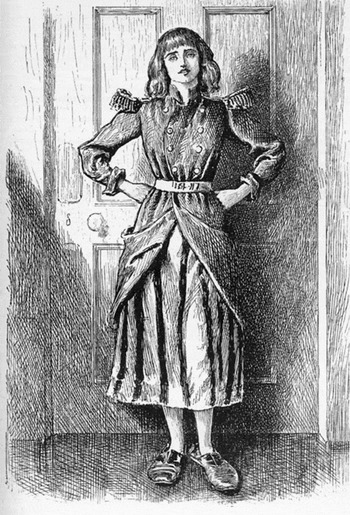
Trilby's hybridity is likewise articulated in her physical attributes, which are mismatched and irregular. Her countenance “could scarcely be called quite beautiful at first sight, since the eyes were too wide apart, the mouth too large, the chin too massive, the complexion a mass of freckles” (13; pt. 1). Perhaps the most striking aspect of Trilby's physical appearance, though, is the “strange medley of garments” in which she first appears before the Englishmen. She is
clad in the grey overcoat of a French infantry soldier, continued netherwards by a short striped petticoat, beneath which were visible her bare ankles and insteps, and slim, straight, rosy heels, clean cut and smooth as the back of a razor; her toes lost themselves in a huge pair of male slippers, which made her drag her feet as she walked. (12–13; pt. 1)
Trilby's hermaphroditic costume brazenly gainsays social convention, and the narrator repeatedly calls attention to this bold act of gender bending by noting that she “would have made a singularly handsome boy” (13; pt. 1). The very first words Trilby utters – her name – unequivocally mark her as an icon of cultural hybridity: “She said this in English, with an accent half Scotch and certain French intonations, and in a voice so rich and deep and full as almost to suggest an incipient tenore robusto” (13; pt. 1). Both French and English, both masculine and feminine, Trilby is a kind of changeling, who embodies the playful indeterminacy of the bohemian life (Figure 6).
George Du Maurier, “Wistful and Sweet.” Engraving for Trilby, from Harper's New Monthly Magazine 88 (Jan. 1894): 175.

Indeed, for many readers (and certainly to the young women quoted at the beginning of this discussion), Trilby's most distinguishing feature is her voice, and it is her use of language that reveals the most about her relationship to national identity. Trilby's French is “quite French French – of the most colloquial kind. Her accent was not that of the Comédie Française, nor yet that of the Faubourg St Germain, nor yet that of the shop, or the pavement. It was quaint and expressive – ‘funny without being vulgar’” (19; pt. 1). In other words, Trilby's French is also a reflection of the diverse venues and social circles of bohemian Paris. Trilby cannot be restricted to a single subject position, and it is perhaps this that makes her language so charming to the Britons, despite the fact that it lacks the polish of high society. Trilby's English is inflected with a curious mixture of French and Scotch, so that every word she speaks in her “mother tongue” reminds the reader of her hybrid origins (Du Maurier 60; pt. 2). For Trilby, English represents a sense of home without signifying a specific place or time: “It awoke all manner of tender recollections, sweet reminiscences of her childhood, her parents, her old home – such a home as it was – or, rather, such homes; for there had been many flittings from one poor nest to another” (60–61; pt. 2). Trilby's love of the English language stems from its loose affiliations with the many places she has once called home: it represents a sense of cultural rootedness, even as it calls to mind the various physical spaces that have been home to her over the years. Trilby's distinguishing quality is precisely this ability to reconcile her sense of national attachment with a more elastic understanding of her place in the world. She is able to be both English and French, both British compatriot and cultural other.
Nowhere is this more clearly illustrated than when Trilby reflects on the moral implications of modeling “for the altogether” (15; pt. 1). When Little Billee, who has fallen in love with Trilby, finds her posing naked at the studio, he is ashamed and heartbroken. He flees the room and leaves a perplexed Trilby to account for his sudden disappearance:
At first she wondered in French: French of the Quartier Latin. She had not seen Little Billee for a week, and wondered if he were ill. She had looked forward so much to his painting her – painting her beautifully – and hoped he would soon come back, and lose no time. (82; pt. 3)
When Trilby contemplates Little Billee's disappearance in French and from the perspective of the broadminded Latin Quarter, it is simply unaccountable and disappointing. Adopting an English point of view, though, she finds herself suddenly conscious of and constrained by the conventions of British sexual practice:
Then she began to wonder in English – nice clean English of the studio in the Place St Anatole des Arts – her father's English – and suddenly a quick thought pierced her through and through, and made the flesh tingle on her insteps and the backs of her hands, and bathed her brow and temples with sweat. (82; pt. 3)
By inhabiting Little Billee's subject position, Trilby is able to fully understand, sympathize with, and even share his mortification. What is remarkable about Trilby's meditation on the event is not her sudden revelation that she has fallen short of English standards of virtue; it is the fact that she empowers the reader to adopt a kind of double vision that legitimizes two fundamentally opposed verdicts on her behavior. This is, in the end, what her British friends most adore about Trilby; however jarring her motley costume and muddled accent may seem at first, they symbolize her capacity for seeing the world from multiple perspectives.
Trilby's uncanny ability to move among the various iterations of her cultural makeup render her an object of universal sympathy and a conduit for understanding and accepting cultural otherness. Her British companions regard her as both familiarly British and strangely other. Whether or not Trilby is to be held accountable for her sexual indiscretions is not the question: Trilby's chief virtue in the novel is her power to navigate such a question and to cast a critical eye on the limitations of a strictly nationalist worldview. In this sense, Trilby becomes a vehicle for the kind of “hybrid talk” described by Homi Bhabha in The Location of Culture (Reference Bhabha1994). According to Bhabha, a colonizing power comes to regard the product of its influence, the colonial hybrid, as at once familiar and alien, compatriot and stranger, “resemblance and menace” (123). The result is a shift from viewing the world in terms of a strict colonizer-subject hierarchy to discerning its many shades of gray and overlapping power relations. To acknowledge the attractions of cultural hybridity is not, in this case, to defend colonial influence or, as Peter van der Veer has argued, to endorse a multicultural ideal that has always as its justification and ends a distinctly Western understanding of civilization. In Trilby, hybridity is a cultural byproduct of globalization that has a destabilizing effect on the institutions of cultural power and helps to undermine the possibility of a fixed and homogeneous English identity. For Trilby, cultural hybridity is an empowering corrective to the nationalist cultures with which she engages, and she continually shifts the terms of discussion so that what constitutes “civilization” remains always an open question.
Still, Van der Veer's insistence that we cast a skeptical eye on the tendency to glorify multiculturalism is compelling; cosmopolitanism can, after all, become a kind of tyranny even (or perhaps especially) when the desire to engage with other cultures is motivated by the idea of a “moral mission” (Van der Veer 17). It is no coincidence that the question of moral purity gained such traction in the public reception of Trilby. If Trilby's hybridity presents cultural admixture as a source of virtue, Du Maurier presents as positively untenable the dogmatic nationalism of the novel's “respectable-brought-up old Briton[s] of the higher middle class” – the narrator and Little Billee (106; pt. 3).
In the case of the former, Trilby's aptitude for crossing cultural boundaries is countered by the narrator's profound discomfort with the variety of languages he is obliged to navigate while recounting her story. From the first page of the novel, the reader is compelled to move between French and English, and the languages are unapologetically mingled throughout the narrative. Although existing scholarship tends to treat the narrator as indistinguishable from Du Maurier, the narrator's plainly specious rhetoric invites the reader's skepticism. So far from serving as a mouthpiece for the author, the narrator of Trilby embodies the very rigid, middle-class Englishness that the novel critiques and ultimately seeks to reform. At first, the narrator adopts a Trilby-like facility with language, offering occasionally to translate for the reader. But as the story proceeds, the narrator becomes more and more hostile to the cultural difference that language signifies. This is especially the case when he comes to describe Trilby's sexual indiscretions. Claiming that he has “never penned a line which a pure-minded young British mother might not read aloud to her little blue-eyed babe,” the narrator indulges in a brief aside celebrating language's power not to facilitate but to arrest transnational dialogue (36; pt. 1):
Would indeed that I could duly express poor Trilby's one shortcoming in some not too familiar medium – in Latin or Greek, let us say – lest the Young Person (in this ubiquitousness of hers, for which Heaven be praised) should happen to pry into these pages when her mother is looking another way. (36; pt. 1)
If the narrator begins the novel luxuriating in a multilingual bohemia, he becomes curiously tongue-tied when forced to explain why Trilby will not win the approval of “the pure-minded young British mother.” At first, he considers concealing this portion of the story in Latin or Greek, languages he assumes young ladies will be unable to penetrate. But carried away by his own puritan train of thought, the narrator then enters into an extended diatribe against the teaching of classical languages, which he regards as “highly improper languages, deservedly dead – in which pagan bards who should have known better have sung the filthy loves of their gods and goddesses” (36; pt. 1). If Trilby moves freely between languages and the cultural worldviews they represent, the narrator (like the young women who think that “all the bad part is in French”) regards foreign languages as capable of contaminating young minds with dangerous ideas, regardless of whether or not his readers actually understand those languages.
Tantalizing young people with access to strange and forbidden knowledge, foreign tongues become a symbolic threat to the integrity of the reader's patriotic attachments, but a threat that the narrator's own line of reasoning proves to be innocuous. By coding Trilby's indiscretions in a language that he regards as virtually synonymous with sexual indiscretion, the narrator only calls attention to the untenability of his own narrative tactics, which simultaneously conceal and invoke sexual content. As the narrator attempts to recount Trilby's story, his desire to insulate young readers from the world beyond England's borders paradoxically requires that he expose them to that world. In working through his own tortuous reasoning, the narrator's desire to circumvent the issue of Trilby's sexual purity leads him ironically to dwell on the issue at great length. In this moment, Du Maurier thus invites the reader to question the perspective of the “respectably brought-up old Briton of the higher middle class” who has to this point served as a narrative anchor (107; pt. 3).
In like manner, Little Billee's preoccupation with the “sorrow and shame” he ascribes to Trilby's behavior reveals far more about his own narrowly British worldview than about Trilby's moral character.Footnote 5 Despite the early “dreams of medieval French love and wickedness and crime” that first draw him to Paris, Little Billee remains staunchly committed to his provincial English origins (7; pt. 1). Having been shielded from the wickedness of the world by a doting English mother, Little Billee espouses an almost compulsive desire for purity from the very beginning of the novel. This impulse is rendered literal when the Jewish musician Svengali surprises Little Billee in the bath:
“Himmel! Why the devil are you doing that?” he asked, in his German-Hebrew-French.
“Doing what?” asked Little Billee, in his French of Stratfordatte-Bowe.
“Sitting in water and playing with a cake of soap and a sponge!”
“Why, to try and get myself clean, I suppose!”
“Ach! And how the devil did you get yourself dirty, then?”
To this Little Billee found no immediate answer, and went on with his ablutions after the hissing, splashing, energetic fashion of Englishmen.” (46; pt. 2)
If Svengali's question at first draws attention to his disregard for moral and bodily hygiene, it also indicates a healthy skepticism of a British standard of moral purity that requires the Briton to indulge in daily “ablutions” to cleanse himself from an evil he is unable to identify. Little Billee cannot explain what has made him dirty – he knows only that British custom requires him to embrace purity as an intrinsic good.Footnote 6 Svengali inclines perhaps too much in the opposite direction, as we shall see, and yet his query cuts right to the heart of Little Billee's hypocrisy.
Despite his professed enthusiasm for Paris's sordid underbelly, Little Billee identifies nearly everything that is non-British as unclean. Little Billee's limited knowledge of French consistently compels him to seek solace in the British value system he knows so well – as Arnold suggests, to “willingly assert its ideal perfection, in order the better to secure it against attack” (38). Thus, when he overhears a conversation between Trilby and a group of Frenchmen, he presumes it to be full of vulgarity: “He felt it to be of a very slangy kind, because he couldn't understand a word of it, and he hated slang. All he could make out was the free use of the tu and the toi, and he knew enough French to know that this implied a great familiarity, which he misunderstood” (31; pt. 1). Later, when Trilby begins to sing “little songs with slang words Little Billee hadn't French enough to understand,” he has a similar reaction: “from the kind of laughter with which the points were received by the ‘rapins’ in Carrel's studio he guessed these little songs were vile . . . and he knew that pang of disenchantment and vicarious shame” (44; pt. 2). Little Billee's empathy, unlike that of Trilby, is not the result of viewing the issue from different perspectives. On the contrary, it stems from a dogged adherence to British standards of cultural purity. Whereas Trilby's cosmopolitan double vision empowers her to understand Little Billee's disappointment in her, Little Billee possesses a curiously myopic worldview that only allows him to project his own values onto Trilby.
As his desire to see the world falls back upon an austere and sanctimonious chauvinism, it thus becomes difficult to distinguish Little Billee's hunger to see the world from “the discriminatory perspectives of an older form of globalization – colonization” (Breckenridge, et al. 5). Although Little Billee's love of Paris may begin as a genuine desire to be enriched by a foreign culture renowned for its art, it evolves into a kind of political tyranny when that world impedes his search for clarity and challenges his self-proclaimed distaste for “human inconsistency” (34; pt. 1). Trilby, the very picture of inconsistency, thus poses a special problem for Little Billee. In order for him to come to terms with Trilby and his affection for her, he must eradicate her inconsistencies and transform her into a modest English maid. When we first encounter Little Billee he longs to explore bohemian Paris and its manifold wonders, but in the end his “longing was a longing that Trilby could be turned into a young lady – say the vicar's daughter in a little Devonshire village” (34; pt. 1). Under the tutelage of the Englishmen, Trilby undergoes what Elaine Showalter describes as a gradual process of Anglicization (xviii). The men allow her to perform simple domestic tasks for them (mending, cleaning, cooking) and “lent her books – English books: Dickens, Thackeray, Walter Scott,” which she eagerly devours (64; pt. 2). As Trilby becomes more English, she loses that distinctive hybridity that characterizes her at the beginning of the novel. She is “no longer slangy in French” (88; pt. 3), has become “thinner, especially in the face, where the bones of her cheeks and jaws began to show themselves,” “lost her freckles,” “let her hair grow,” and “her mouth, always too large, took on a firmer and sweeter outline, and her big British teeth were so white and regular that even Frenchmen forgave them their British bigness” (90; pt. 3). From the narrator's point of view, Trilby's transformation would seem to be a positive one: “She grew more English every day; and that was a good thing” (64; pt. 2).
Yet the narrator, as I have argued, is hardly to be taken as an objective or reliable authority on such matters. Indeed, Trilby's transformation carries with it considerable costs. By converting Trilby into a respectable young woman who “might have been the daughter of an English dean,” Little Billee signals his inability to move beyond his parochial British upbringing (70; pt. 2). Far from being a positive development, his importation of British bourgeois values into the once cosmopolitan space of the studio signals the imminent eclipse of bohemia and its spirit of free play. Moreover, while Trilby reforms her conduct in the presence of her British friends, it is by no means certain that her conversion is complete, permanent, or preferable: “But enter a Frenchman or two, and a transformation effected itself immediately – a new incarnation of Trilbyness – so droll and amusing that it was difficult to decide which of her two incarnations was the more attractive” (64–65; pt. 2). At times the narrator seems to suggest that it is Trilby's eccentric conflation of cultural identities that the Britons find most appealing. As she uses “her knife and fork in the dainty English way,” the narrator observes, “it seemed quite odd (though very seductive) to see her in a grisette's cap and dress and apron” (64; pt. 2). Trilby is always herself, always at home, in these moments of translation, and it is this – her frank rootedness in multiple cultures, rather than her lack of affiliation with any – that constitutes that remarkable “Trilbyness” for which she is known.
With the disappearance of her cultural hybridity, Trilby becomes, in the words of Joseph Bristow, “practically lifeless” (170). This process is brought to a head when Little Billee proposes to complete Trilby's conversion by marrying her. Their union is prevented by Little Billee's mother who, deeming Trilby to be both morally and socially inferior to her son, asks her to break off the engagement. As good as her word, Trilby flees the Latin Quarter, and Little Billee returns to Devonshire to recover from the shock of her disappearance. The attempt to remake Trilby in the image of English femininity thus precipitates the end of bohemia and the liberal spirit it embodies. With the collision of bourgeois and bohemian values, we witness the extinction of Trilby's real virtue: the possibility of a world in which the individual can balance rooted experience against a cosmopolitan spirit of productive play. Little Billee's attempt to transform Trilby into an English lady inaugurates this process, and Mrs. Bagot's sudden arrival in bohemia completes it. The “pure-minded young British mother” whose moral anxieties the narrator so desperately seeks to assuage thus becomes one of the chief instigators of the novel's tragic outcome – the death of Trilby and of the bohemian paradise she represents.
Curiously, though the Britons endeavor to transform Trilby into a proper English maid, it is the novel's British characters who undergo the most dramatic conversion. When Mrs. Bagot, Taffy, and the Laird insist that Trilby's past renders her unfit to be an Englishman's wife, Little Billee suddenly realizes the hypocrisy of his own attempts to convert Trilby:
Damn social position! . . . we've often said so – over and over again. An artist's life should be away from the world – above all that meanness and paltriness . . . all in his work. Social position indeed! Over and again we've said what fetid, bestial rot it all was – a thing to make one sick and shut one's self away from the world. (134; pt. 4)
The novel's starkest caricature of English provincialism, Little Billee finally comes to reject the “Englishman's belief in the infallible efficacy of gentle birth,” so that it is no longer Trilby's eccentricities that appear unclean to him but rather the “fetid, bestial rot” of English middle-class values (35, pt. 1; 134, pt. 4). In the end, Little Billee evolves into a true bohemian, who longs to inhabit a world apart and embrace a more flexible, cosmopolitan value system. By the novel's conclusion, even Mrs. Bagot becomes a convert, and her final revelation that Trilby was “more sinned against than sinning” casts serious doubt on the parochial British values the narrator initially celebrates (274; pt. 8).
This is not to suggest that Du Maurier's objective is simply to lampoon British moral standards. In the end, he is far more concerned with pointing out what happens when a young patriot fails to translate among different cultures and attempts to paint the world in the colors of his native land. Despite his professed “scorn of all received interpretations,” Little Billee cannot leave behind a deep-seated fidelity to his mother country; torn between stanch patriotism and a lingering fascination with cosmopolitan Paris, he experiences a kind of emotional paralysis that cripples his personal relationships and his aesthetic vision (34; pt. 1). The ultimate outcome of a strictly nationalist worldview is, in this novel, precisely the kind of “inanition” and atrophy predicted by Arnold.
Lost in Translation
Perhaps the most tragic outcome of Little Billee's departure from Paris is that it allows Svengali to become Trilby's warden, impresario, and tormentor. Using his extraordinary power of mesmerism, Svengali transforms Trilby into a cataleptic, if celebrated and profitable singer. Svengali undeniably invokes a range of alarming anti-Semitic stereotypes and the greater part of the scholarship on Trilby has consequently focused on the Jewish question. As Jonathan Freedman notes in The Temple of Culture (Reference Freedman2000), the scholarly preoccupation with Svengali's villainy and his embodiment of an odiously anti-Semitic stereotype has made it difficult for many readers to account for the genius of his artistic productions: why, after all, would Du Maurier choose to instill in this depraved character the power to create music of unspeakable beauty?Footnote 7 Freedman offers one possible answer, suggesting that Svengali embodies “that powerful image of doubleness, the Jew,” and in so doing inspires “middlebrow” Victorian audiences to confront their own ambivalence about engaging with high culture (90). But while Svengali's cultural makeup undeniably characterizes him as shifty and unstable, in the end he seems to embody less a kind of doubleness than a chaotic amalgam of cultures. Combined with his mysterious origins and the “vague cosmic vision” expressed in his musical arrangements, Svengali's Judaism helps to articulate a universalism that is both seductive and treacherous (24; pt. 1). In effect, Svengali becomes a counterpoint to Little Billee's abiding respect for the integrity of traditional borders. Whereas Little Billee's art depends on his talent for accurately drawing the forms and outlines of real life – his “quick, prehensile, aesthetic eye” instructing him “what the shapes and sizes and colours of almost every bit of man, woman, or child should be (and so seldom are)” – Svengali's art obliterates recognizable shapes, categories, and cultural affiliations (15; pt. 1). Although Svengali's performances are alluring to his audiences, they preclude civic order and, as we shall see, that aspirational cosmopolitanism that is crucial to any kind of transnational community.
However disturbing the stereotype might be to the modern reader – and it is disturbing – Svengali's Judaism also contributes importantly to Du Maurier's articulation of global interconnectedness in Trilby. One of the most popular critiques of Britain's Jewish population in the nineteenth century maintained that Jews were divided in their loyalties, making a national home in Britain but retaining deeper ties to a global, Jewish diaspora. By this logic, the British Jew could only ever be a partial subject of the realm with a partial and uncertain commitment to the national community. As Eleanore Kofman puts it, the nineteenth-century Jew “represented rootless and unstable ubiquity . . . As a group, Jews were less than national and thus insufficiently attached to the nation and the land. On the other hand, they were more than national and hence threatened the nation's transcendent, universal status” (89). Svengali's Jewish identity is an important component of his background, marking him as more culturally “other” than any other character in the novel. Just as Svengali repeatedly disrupts the harmonious gatherings of Trilby's bohemian circle, so too does his Jewishness signify a power to disrupt patriotic attachments. Svengali's Judaism becomes nearly indistinguishable from his embodiment of a domineering universalism that seeks to obscure all forms of cultural difference.Footnote 8
Whereas scholars tend to align Svengali's villainy with his Jewish blood and Du Maurier's crass anti-Semitism, it is worth noting that it also expresses Svengali's first-hand experience of cultural persecution. If Svengali becomes fixated on the destruction of national culture, it is largely as a response to the sort of tyranny we have already seen at work in Little Billee's Anglocentric worldview. Svengali becomes meek and anxious whenever he finds himself in the presence of Taffy, “the huge British Philistine, the irresponsible bull, the junker, the ex-Crimean, Front-de-Boeuf, who had always reminded him of the brutal and contemptuous sword-clanking, spur-jingling aristocrats of his own country – ruffians that treated Jews like dogs” (245; pt. 7). Svengali's cowardice, self-interest, and animosity certainly call Du Maurier's own cultural prejudices into question, and yet the recognition that his “life had been a long, hard struggle” also renders Svengali an object of the reader's sympathy (245; pt. 7). In this moment, we see Svengali's hostility to the Britons not as a sign of innate misanthropy, but rather as a response to cultural intolerance.
All of this is to say that Svengali embodies an undifferentiated universalism that is in every way contrary to Little Billee's dogged fidelity to English nationalism. Svengali is a sinister character, as worldly and calculating as Little Billee is provincial and naïve. If Little Billee is the very picture of English purity, Svengali seems to embody a kind of ungovernable chaos. The first time we encounter Svengali, he is described as “shabby and dirty,” with “thick, heavy, languid, lustreless black hair” falling to his shoulders and a “beard of burnt-up black” covering his chin (11; pt. 1). Like Trilby, Svengali thrives on obscuring distinctions between cultures. He is German, but his family hails from Austria and Poland, and he has studied music across the Continent. In effect, Svengali is a kind of honorary gypsy whose origins are deliberately muddled: as we eventually learn, his real name is Adler, not Svengali, and his apprentice Gecko is appropriately described as “a little swarthy young man – a gypsy, possibly (11; pt. 1).
This cultural rootlessness is similarly reflected in Svengali's language. Svengali's speech pattern invokes his Eastern European origins, much as Trilby's English reflects her upbringing in bohemian Paris. He speaks “fluent French with a German accent and humorous German twists and idioms,” occasionally colored by Yiddish phrases (11; pt. 1). But while Trilby's language consistently recalls the distinct cultures to which she belongs – “an accent half Scotch and certain French intonations” – Svengali's accent is a strange muddle of dialects that can only be described in terms of its power to distort.Footnote 9 According to the narrator, his speech is marked by an arbitrary transposition of letters that resists the formal constraints of the French language: “I will translate him into English, without attempting to translate his accent, which is a mere matter of judiciously transposing p's and b's, and t's and d's, and f's and v's, and g's and k's, and turning the soft French j into sch, and a pretty language into an ugly one” (23; pt. 1). Svengali's speech pattern renders the French language virtually unrecognizable, an early sign of his disdain for markers of national attachments.
Certainly, the novel features other characters whose accents mark them as strangers in Paris, but Svengali's use of language is especially noteworthy because it reveals his penchant for eradicating cultural difference, a desire that is most powerfully reflected in his musical performances. In an effort to surpass Little Billee's quaint rendition of “Ben Bolt,” for instance, Svengali transforms the American ballad into an overpowering spectacle. With Gecko accompanying him, he
turned it and twisted it, and went from one key to another, playing into each other's hands, Svengali taking the lead; and fugued and canoned and counterpointed and battledored and shuttlecocked it, high and low, soft and loud, in minor, in pizzicato, and in sordino – adagio, andante, allegretto, scherzo – and exhausted all its possibilities of beauty. (21; pt. 1)
Svengali renders the words of “Ben Bolt” essentially meaningless as he explores nuances “undreamt of by whoever wrote the words and music of that unsophisticated little song” (21; pt. 1). By elevating the popular ballad into a “vague cosmic vision” Svengali divests it of its national associations and makes it his own (24; pt. 1).
In a sense, Svengali's musical improvisations approximate the principle of “Anders-streben,” which Walter Pater describes at length in “The School of Giorgione” (1877). According to Pater, art seeks always “a partial alienation from its own limitations” so that “form and matter, in their union or identity, present one single effect to the ‘imaginative reason’” (105, 109; pt. 3). Music, Pater famously notes, most nearly fulfills this goal, and it is to some extent this marriage of form and content that Svengali's music accomplishes. His compositions are overpowering, in large part because they explore the manifold “possibilities of beauty,” combining apparently distinct moods and techniques into a single, unified composition.
Pater's principle of Anders-streben thus applies as much to Svengali's artistic practices as to his views on culture. Just as his art refuses to be constrained by the limits of form, Svengali refuses to honor the constraints of national identity and frees his audience from those constraints as well. But whereas Svengali regards all languages as reducible to an undifferentiated torrent of impressions, Pater is more respectful of the boundaries that exist between different art forms. Pater writes: “It is the mistake of much popular criticism to regard poetry, music, and painting – all the various products of art – as but translations into different languages of one and the same fixed quantity of imaginative thought” (“School” 102). Although an art form may push against the limitations of its medium, aspiring to embody new meanings, forms, and possibilities, it is never entirely subsumed within a universal aesthetic: each form of art thus “brings with it a special phase or quality of beauty, untranslatable into the forms of any other” (Pater, “School” 102). While Pater emphatically supports breaking down traditional boundaries to create a “unity of culture” – a world of “no fixed parties, no exclusions” – he also resists the notion of a homogeneous cultural inheritance (“Two Early French Stories” 20–21). As Michael Potolsky has noted, Pater criticizes “the nationalist insistence on a unified canon founded on a vernacular language, promoting instead an international canon based on linguistic, cultural, and formal hybridity” (216). In the end, Svengali is less interested in moving between cultures than he is in leveling all distinctions between them. Accordingly, we might regard Svengali's music as a perversion of the Paterian aesthetic it at first seems to celebrate.
The political connotations of Svengali's art become especially apparent in the transformative effect it has on Trilby. The Trilby we encounter at the beginning of the novel has a striking voice – one that, I have noted, is especially remarkable for its eccentric variety – but she is ironically tone deaf. After leaving the artist's studio, Trilby falls into the hands of Svengali who hypnotizes her and, while she remains under his thrall, gives her voice the discipline it lacks in waking life. Svengali plays upon Trilby like an instrument, divesting her of her newly acquired Englishness and leaving in its stead “Loud and shrill and sweet beyond compare . . . ‘a wonder, a world's delight!’” (218; pt. 6). Trilby, or “La Svengali” as she is now known, is in a very real way a “world's delight”: she becomes void of any cultural subjectivity and loses all of the playful hybridity she once embodied. While mesmerized, the singer Glorioli remarks, Trilby is “bête comme un pot. I tried to talk to her – all she can say is ‘ja wohl’, or ‘doch’, or ‘nein,’ or ‘soh!’ not a word of English or French or Italian, though she sings them, oh! but divinely!” (170; pt. 5). As “La Svengali,” Trilby loses nearly all awareness of cultural difference and, deprived of her distinctive capacity for moving between dialects, conflates all language into a series of monosyllabic responses. Trilby's very correspondence reflects her universal appeal: “it was endless, in English, French, German, Italian – in languages quite incomprehensible (many letters had to remain unanswered)” (270; pt. 8). The narrator's parenthetical remark speaks volumes: the congress between Trilby and her audience is so expansive that it obviates the possibility of any real cross-cultural dialogue. Her correspondence, like her audiences, devolves into a Babel-like chatter that proves untranslatable and unproductive.
Trilby's London performance, the night her British friends first see her on stage, epitomizes her newfound power for transforming patriotic attachments into Svengali's universalist aesthetic (24; pt. 1). At the outset, the scene is peppered with signs of English patriotism: “Little Billee looked round, and recognized many countrymen and countrywomen of his own. . . . In the imperial box were the English ambassador and his family, with an august British personage sitting in the middle, in front, his broad blue ribbon across his breast and his opera-glass to his royal eyes” (208; pt. 6). Little Billee's attention quickly shifts, however, from these symbols of national power to the evening's musical program, “a somewhat incongruous bill of fare,” consisting of “an overture of gypsy dances,” French nursery rhymes, and Robert Schumann's “Nussbaum” (208; pt. 6).
The overture of gypsy dances signifies the advent of Svengali's rootless universalism and the imminent collapse of the patriotic composure described by Little Billee. Like Svengali's improvisation of “Ben Bolt,” Trilby's performance is a source of infinite variety. Her singing is alternately slow and fast, loud and soft, comic and tragic. In performing even the most common nursery rhyme, Trilby “exhausted all its possibilities of beauty” (21; pt. 1). Under Svengali's tutelage, Trilby transforms well-known songs with strong national affiliations into universal refrains:
It was as if she said: “See! what does the composer count for? Here is about as beautiful a song as was ever written, with beautiful words to match, and the words have been made French for you by one of your smartest poets! But what do the words signify, any more than the tune, or even the language? The ‘Nussbaum’ is neither better nor worse that ‘Mon ami Pierrot’ when I am the singer; for I am Svengali.” (213; pt. 6)
Just as Svengali manipulates the French language with his idiosyncratic inflections, so too does he divest French compositions of their cultural resonances. In Svengali's hands, the French nursery rhyme and the German composition become more or less indistinguishable, their words and cultural origins effaced by his all-consuming art. Herr Blagner (presumably a thinly veiled caricature of Richard Wagner) takes issue with Svengali for precisely this. According to Blagner, Svengali brazenly places “Mozart and Beethoven, and even himself, on a level with Bellini, Donizetti, Offenbach – any Italian tune-tinkler, any ballad-monger of the hated Paris pavement!” (221; pt. 6). Svengali's penchant for mingling Italian, French, and German compositions is, in Blagner's eyes, an insult to his countrymen, an unpatriotic gesture that risks conflating high and low forms of art.
But if Blagner's rhetoric is insidiously xenophobic, Trilby's transformation into La Svengali poses a very real threat to the civic order. When women hear her sing, Herr Kreutzer reports, they “all vent mat, and pulled off zeir bearls and tiamonts and kave zem to her – vent down on zeir knees and gried and gissed her hants” (170; pt. 5). Lord Witlow reports that “all the fellows went mad and gave her their watches and diamond studs and gold scarf-pins. . . . but I was as mad as the rest – why, I gave her a little German-silver vinaigrette I'd just bought for my wife” (171; pt. 5). While Trilby's voice would seem to realize a universal ideal that is freeing to the audience, in the end it only enslaves them to the avarice of Svengali, who uses il bel canto to mesmerize all who attend his performances. Trilby is essentially a false idol who represents not the bringing together of cultures but rather a Babel-like pandemonium.Footnote 10
In effacing cultural boundaries, Svengali's art thus becomes a disorienting and crippling act of deconstruction that results only in mass hysteria. The moment finds a suggestive corollary in Immanuel Kant's “A Perpetual Peace” (1795), which despite endorsing the creation of an international “league of peace” also admits the perils of a “superior power that melds [nations] into a universal monarchy” without respecting national sovereignty; “after it has uprooted the soul of good,” Kant writes, “a soulless despotism finally degenerates into anarchy” (14, 24; pt. 1). As the audience surrenders to Svengali's “cosmic vision,” they become an undifferentiated mass, blind to the hysterics of their neighbors and recklessly relinquishing tokens of personal and pecuniary value. The spectacle of La Svengali thus demonstrates the vital importance of cultural differentiation to the attainment of any kind of coherent transnational community. For Du Maurier, connections with others depend on a perpetual and at least partially unfulfilled yearning to understand those who are different. It is that aspiration to understanding that Trilby both embodies and inspires in her friends; it is such an aspiration that Svengali's monopolizing influence over the audience renders impossible.
Order is only restored with Svengali's death and Trilby's return to her natural state, which occurs during a concert in London. Having awakened from Svengali's spell on stage, Trilby officiously silences the orchestra, attempts an a capella rendition of “Ben Bolt,” and is greeted by jeers from the audience. In this moment, the singer regains her dynamic ability to shift between English and French, her buoyancy, and her distinctive Trilbyness. Though she fails in her performance of “Ben Bolt,” there is something nonetheless extraordinary about Trilby's voice, which is “so full of hurt and indignant command, that the tumult was stilled for a moment” (250; pt. 7). The Trilby we glimpse here is neither Little Billee's English maid nor Svengali's universal goddess, but rather “some being from another world – some insulted daughter of a race more puissant and nobler than ours” (250; pt. 7). If she cannot sing in tune, her voice is enough to arrest the chaos that her sudden transformation has brought about. Here, Trilby's resistance “to artificial melodic laws and limitations and restraints,” her failure to distinguish one note from another, does not represent her lawlessness so much as a cosmopolitan liberality of spirit. In the eyes of the three Britons, “this last incarnation of Trilbyness was quite the sweetest, most touching, most endearing of all” (261; pt. 7).
Convalescing after her ordeal Trilby becomes a true cosmopolitan icon. Her fame and news of her illness are proclaimed “all over Europe . . . mourned and discussed and commented upon in every capital of the civilized world” (269; pt. 8). So extensive is her celebrity that, as the narrator puts it, “She might have been a royal personage!” (269; pt. 8). The epithet is especially appropriate, for it signals Trilby's restoration to her proper role at the center of cosmopolitan bohemia. If the beginning of the novel repeatedly features Trilby occupying a model throne, she now occupies a sickbed surrounded by her bohemian friends, and this haven becomes quite literally “A Throne in Bohemia” (Figure 7). It is here that Trilby is able to reconstitute the lost world of cosmopolitan “free play” that was interrupted by Little Billee's Anglocentrism and Svengali's universalist aesthetic.
George Du Maurier, “A Throne in Bohemia.” Engraving for Trilby, from Harper's New Monthly Magazine 89 (Aug. 1894): 352.
Appropriately, it is Svengali who finally brings Trilby's life to an end. Trilby receives a package containing a photograph of Svengali and accompanied by “no message of any kind, no letter of explanation” but that “seemed to have travelled all over Europe” (282; pt. 8). Once again transfixed by Svengali's gaze, Trilby sings one last song and dies soon after. What is perhaps most significant about Trilby's death is that it is instigated by a portrait of unknown origins, the “postmarks on the case” bespeaking a globalism that generates far more confusion than it resolves (282; pt. 8). In death, however, Trilby's cosmopolitan community reunites for one last time, and at her funeral we glimpse for a brief moment the rekindling of that dynamic hybridity that made everyone fall in love with Trilby in the first place. In addition to Little Billee, Mrs. Bagot, the Laird, Antony, the Greek, and Durien, the ceremony is attended by “very many other people, noble, famous, or otherwise, English and foreign; a splendid and most representative gathering” (287; pt. 8). The heart of this community is bohemian Paris, but that original community has expanded since the beginning of the novel, the most important outcome of Trilby's “world-wide fame” (271; pt. 8). In the end, Svengali's captivated audience is converted from a hysterical crowd into a reverential community of mourners, one united not by patriotic or transcendent human values but rather by a shared aspiration to honor the memory of its lost cosmopolitan icon.
* * *
In part, Du Maurier's novel illustrates the point Pheng Cheah and Bruce Robbins make in the influential volume Cosmopolitics (Reference Cheah and Robbins1998) – that cosmopolitanism can assume many different forms and cannot always be clearly dissociated from patriotic attachments: “Difficult as it may be to make a plural for ‘cosmos,’ it is now assumed more and more that worlds, like nations, come in different sizes and styles. Like nations, worlds too are ‘imagined’” (2). Such global ambitions, however, can prove self-defeating when they remain bound by traditional political vocabularies. A blinkered nationalism, like that of Little Billee, not only precludes seeing the nation “as in itself it really is”; it also risks provoking foreign cultures into a distrust of and distaste for national ideologies (Arnold 40). Svengali's universalist aesthetic, however, precludes either the need or desire for connections with other cultures. Rather than an aspiration to understanding, he promotes a homogeneous community that is just as restrictive as the one imagined by Little Billee. Trilby's cosmopolitanism triumphs precisely because she refuses to fix herself at either extreme, maintaining instead a respect for the flexibility, permeability, and transformative potential of national borders.
To some extent, then, it seems as though Du Maurier is endorsing a middle ground. According to Sarah Gracombe, the dangers of foreign influence (embodied in the figure of Svengali) force Du Maurier to strike a middle course that “upholds the bourgeois norms of Englishness” and brings about a final “conversion of the bohemian world into a safe domestic space” (106). “In a world full of hybridity and ‘admixtures,’” Gracombe writes, “Du Maurier makes moderation a coping strategy” (107). While I agree that Du Maurier avoids offering clear prescriptions for the political conditions he describes, it would be going too far to conclude that he is simply defaulting to a course of moderation. In the first place, these “bourgeois norms of Englishness” are, as I have demonstrated, one of the chief targets of Du Maurier's critique in the novel. Bohemia constitutes an important site of cultural critique and production, which (despite the fact that the novel's British characters eventually leave Paris) is never definitively eclipsed.
Rather than thinking of Du Maurier's novel as a concession to the dangers of foreign influence, I propose that it illustrates the struggle cosmopolitans undertake as they confront a world that continues to treat the nation-state and the global community as distinct and opposing forces. Under such pressures, bohemia does not present a middle course but rather a world apart (“away from the world,” as Little Billee observes) where one can not only strike a balance between the two but also actively confront the variable and mutually constituting relations between them. In Du Maurier's novel an aspirational cosmopolitanism emerges as the only one capable of sustaining a productive (and productively critical) community. In the end, Du Maurier gestures toward a dynamic slippage between cosmopolitan and patriotic attachments. The figure of Trilby thus affirms one of the central claims of the recent collection Cosmopolitanism (Reference Breckenridge, Breckenridge, Pollock, Bhabha and Chakrabarty2002). As the editors of that volume suggest, cosmopolitanism “catches something of our need to ground our sense of mutuality in conditions of mutability, and to learn to live tenaciously in terrains of historic and cultural transition” (Breckenridge, et al. 4). In this spirit, it is certainly tempting to treat Du Maurier's apparent equivocation as an instance of the free play so characteristic of the Victorian bohemia he depicts.
Ironically, then, the young women who suspected that “all the bad part is in French” provide evidence of the narrowly nationalist outlook that Du Maurier's novel satirizes. In condemning the moral impurity of Trilby, they articulate less an anxiety about sexual perversity than a fear of exposure to Continental literature. But if anything, Trilby's confounding hybridity only sets her virtue in greater relief: her innate goodness seems to transcend national distinctions, and to draw strength from her cosmopolitan ethos. Despite the irregularity of her physical attributes, she is proclaimed to be the most charming woman any of the Englishmen have encountered. Despite – or perhaps because of – her unparalleled eccentricity, Trilby continues to be “met on her entrance by friendly greetings on all sides” (31; pt. 1).