Positive thinking is defined as the desire to have good things, hope for the future, and expect positive consequences (Dumitrache, Windle, & Herrera, Reference Dumitrache, Windle and Herrera2015). Positive thinking helps people face their problems effectively, and it is a valuable strategy to help one cope with difficulties such as depression (Bekhet & Garnier-Villarreal, Reference Bekhet and Garnier-Villarreal2017). Positive thinking may cause increased lifespan, lower rates of depression, lower levels of distress, increased immune levels, better psychological and physical wellbeing, better cardiovascular health and reduced risk of death from cardiovascular disease, and better coping skills during hardships and times of stress (Grezo & Sarmany-Schuller, Reference Grezo and Sarmany-Schuller2015; Luger, Cotter, & Sherman, Reference Luger, Cotter and Sherman2009; Rozanski, Bavishi, Kubzansky, & Cohen, Reference Rozanski, Bavishi, Kubzansky and Cohen2019; Xie et al., Reference Xie, Wang, Zhao, Lei, Niu and Wang2018).
Behaviours are divided into explicit and covert behaviour. Explicit behaviours are behaviours that are observable and measured by someone other than the person doing the act. There are observable behaviours such as brushing, exercising, or eating fruits and vegetables. Covert behaviours are behaviours that are not observable or able to be recorded by other than the person doing the act; hence, it is called private behaviour, and positive thinking is a covert behaviour. So positive thinking is a covert behaviour that can affect one’s mental health (Glanz, Rimer, & Viswanath, Reference Glanz, Rimer and Viswanath2015; Liau, Barriga, & Gibbs, Reference Liau, Barriga and Gibbs1998). One of the things that can affect the physical and mental health of adolescents is positive thinking (McLaughlin, Reference McLaughlin2016).
Adolescents’ health issues are a concern for their health status in the future. Adolescence is a transition from childhood to adulthood (Conversano et al., Reference Conversano, Rotondo, Lensi, Della Vista, Arpone and Reda2010; Ghahremani, Nazari, Changizi, & Kaveh, Reference Ghahremani, Nazari, Changizi and Kaveh2019). According to the definition of the World Health Organization, adolescents are individuals in the age group of 10–19 years old (Sayers, Reference Sayers2001). In general, health problems increase between preadolescence and adolescence (Dehghankar, Panahi, Kekefallah, Hosseini, & Hasannia, Reference Dehghankar, Panahi, Kekefallah, Hosseini and Hasannia2019; Rask et al., Reference Rask, Munkholm, Clemmensen, Rimvall, Ornbol, Jeppesen and Skovgaard2016), and the root of health problems in adulthood is related to the adolescence stage, especially from 11 to 18 years (McLaughlin, Reference McLaughlin2016).
Various studies have showed that positive thinking is related to the enhancement of learning, academic achievement, an increase in educational motivation, increased self-esteem, better social networks/social supports, and reduced antisocial behaviours and drug abuse in adolescents (Dumitrache et al., Reference Dumitrache, Windle and Herrera2015; Hamedi Nasab, Asgari, & Ayati, Reference Hamedi Nasab, Asgari and Ayati2015; Mavioğlu, Boomsma, & Bartels, Reference Mavioğlu, Boomsma and Bartels2015; Patton et al., Reference Patton, Tollit, Romaniuk, Spence, Sheffield and Sawyer2011). The results of a study by Souri and Hasanirad (Reference Souri and Hasanirad2011) among Iranian medical students showed that positive thinking increased their psychological wellbeing.
Gender is an influencing factor in positive thinking. According to the results of various studies, a significant difference between girls and boys in positive thinking has shown that the level of positive thinking in girls is higher than in boys (Bagana, Raciu, & Lupu, Reference Bagana, Raciu and Lupu2011; Shaheen & Jahan, Reference Shaheen and Jahan2014). Various studies in Iran have also examined the positive thinking of high school students (Moradi, Rashidi, & Golmohammadian, Reference Moradi, Rashidi and Golmohammadian2017; Rashidi Kochi, Najafi, & Mohammadyfar, Reference Rashidi Kochi, Najafi and Mohammadyfar2016). However, the factors influencing positive thinking of this group of people have not been identified. To design and implement more effective intervention programs, it is necessary to identify the key variables that affect positive thinking in adolescents. So, this study was performed to investigate the factors affecting and predicting the positive thinking of male high school students in Iran.
Theoretical Background
Positive thinking is a mental process. The theory of planned behaviour (TPB) provides a useful framework for predicting and understanding health behaviour (De Leeuw, Valois, Ajzen, & Schmidt, Reference De Leeuw, Valois, Ajzen and Schmidt2015). One of the useful social-cognitive theories that can be used to examine positive thinking is TPB. Icek Ajzen proposed TPB in 1985. This theory was developed from the theory of reasoned action, which was proposed by Icek Ajzen and Martin Fishbein in 1980 (Glanz et al., Reference Glanz, Rimer and Viswanath2015).
The TPB includes constructs of attitude, perceived behavioural control (PBC), subjective norms, intention, and behaviour (Table 1; Ajzen, Joyce, Sheikh, & Cote, Reference Ajzen, Joyce, Sheikh and Cote2011). According to the TPB, if people evaluate the suggested behaviour as positive (attitude), and if they think their significant others want them to perform the behaviour (subjective norms), and if people feel that they have the power to do the desired behaviour (PBC), this results in a higher intention (intention), and they are more likely to do so (behaviour; Ajzen et al., Reference Ajzen, Joyce, Sheikh and Cote2011; Ghasemi, Nazari, Vafaei, & Fararouei, Reference Ghasemi, Nazari, Vafaei and Fararouei2017; Sharma, Reference Sharma2016).
Characteristics of constructs of the TPB

Method
Study Design
This cross-sectional study was performed on male high school students (14–17 years old) in Shiraz, Iran. Power calculation indicated that the minimum sample size was 367 subjects for an 80% chance of a p value < .05.
In this study, the sampling method was multistage. At first, the city of Shiraz was divided into four districts — north, south, east, and west. From each district, two schools were selected randomly (eight schools). Then one class was randomly selected from each school and enrolled in the study. The inclusion criteria were being a male high school student and a resident of Shiraz city, willing to participate in the study, and with written consent obtained from the parent/guardian of the student. Before the study, the aims of the study were explained to the students, and informed consent was obtained. They were also assured that their information would be kept confidential by the research team. Then the questionnaires were completed by the students based on a self-report without the presence of school personnel.
Measuring Tools
Data were collected using a questionnaire. This questionnaire consisted of two sections, including demographic characteristics and positive thinking based on the TPB (Jafari, Ghahremani, Keshavarzi, & Kaveh, Reference Jafari, Ghahremani, Keshavarzi and Kaveh2016).
Demographic section
This questionnaire included questions such as age, birth order, education level of parents, occupation of parents, habitant, number of siblings, number of friends, and so on.
Section of Positive Thinking based on the TPB
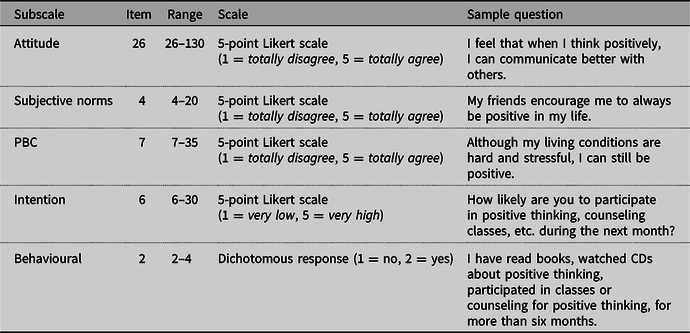
This questionnaire has 45 items (lowest score = 45, highest score = 219), and five constructs of the TPB (attitude, subjective norms, PBC, intention, and behaviour) were used to design this questionnaire. Information on the TPB questionnaire is presented in Table 2.
Characteristics and dimensions of the Questionnaire of Positive Thinking based on the TPB

Validity and Reliability of the Instrument
The validity and reliability of the questionnaire were confirmed by a previous study (Jafari et al., Reference Jafari, Ghahremani, Keshavarzi and Kaveh2016).
Statistical Analyses
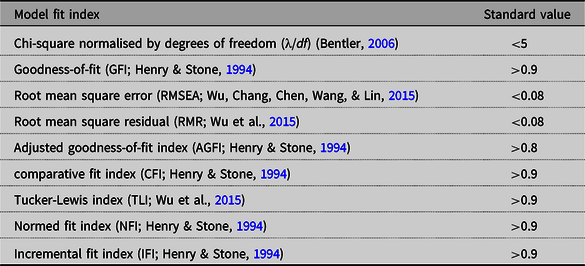
Descriptive and inferential analysis (univariate and multiple logistic regression models, Pearson correlation) was performed using SPSS software V.20. A Pearson correlation test was used to investigate the relationship between the constructs of the TPB. For logistic regression, initially the variables were entered into univariate regression, and then those with a significant level lower than .2 were entered into multiple regression (Jewell, Reference Jewell2003). The level of statistical significance was considered as p < .05. In this study, a path analysis was conducted to investigate the direct and indirect effects of TPB constructs on positive thinking behaviour. First, the maximum likelihood estimation was used in all the models. The following various fit indices were measured to ensure that the acceptability of each model fit the data adequately. Standard fit indices for path analysis are presented in Table 3.
Standard fit indices for path analysis

Results
Descriptive Statistics
In this study, the mean (SD) age of students was 14.92 (0.85). The education level of most of the students’ parents was a diploma or lower than a diploma. Results showed that 70.3% of fathers (n = 255) were self-employed, and 88.3% of mothers (n = 319) were housewives (Table 4). Other demographic information is shown in Table 4.
Frequency distribution of demographic factors

Theory of Planned Behavior (TPB)
Based on the results of this study, the mean (SD) constructs of attitude, subjective norms, PBC (perceived behavioural control), intention and behaviour were 92.1 (13.91), 14.96 (3.66), 23.87 (4.92), 20.88 (4.40) and 2.81 (0.81), respectively.
Logistic regression
Results of multiple logistic regression analysis showed that variables of the number of sisters with an odds ratio (0.434), number of friends with an odds ratio (0.720), and attitude with an odds ratio (1.098) had a significant relationship with the intention of positive thinking (Table 5). Based on the results, only the constructs of subjective norms with an odds ratio (1.086) and intention with an odds ratio (1.198) had a significant relationship with positive thinking behaviour (Table 6).
Results of logistic regression analysis of demographic variables and constructs of TPB in relation to intention of positive thinking

Results of logistic regression analysis of demographic variables and constructs of TPB in relation to positive thinking behaviour

Path Results
The final model fitting indexes in Table 7 showed the appropriation of the final model (p = .12). The final model is shown in Figure 1. The TPB determined 36% of the variance for intention and 20% of the variance for students’ behaviour about positive thinking (Figure 1). The results of this study showed that the constructs of attitude, subjective norms, and PBC had a positive effect on intention. Attitude was the most effective construct (p < .001) and indicated about 80.37% of the total effects on behaviour. Based on the results, only attitude had an indirect effect on intention. The constructs of attitude, subjective norms, and PBC had an indirect effect on behaviour and indicated about 19.62% of the total effects on behaviour (Table 8).
Characteristics of the indices obtained in the path model

The results of path analysis based on the TPB (*p < .05, **p < .001).

Direct and indirect effects of TPB constructs

Discussion
This study aimed to determine the power of the TPB in predicting the intention and behaviour of students’ positive thinking. According to the path analysis results in this study, the TPB can predict intention and students’ positive thinking, and the model-fitting indexes showed the appropriation of the final model. In the present study, all the constructs of the TPB showed a significant statistical relationship with intention. This means increasing a positive attitude, social support, and PBC will increase the intention to perform positive thinking behaviours.
The results of this study showed that the intention construct had a significant relationship with positive thinking behaviour. This means increasing one unit of intention will increase the behaviour of students’ positive thinking. Results of a study by Andrykowski and Burris (Reference Andrykowski and Burris2010) showed that constructs of TPB could predict 23.9% of variances for seeking mental health services. The results of various studies have shown that constructs of attitude, subjective norms, and PBC predicted 41% and 29.6% of people’s intention variances to get help from psychologists (Schomerus, Matschinger, & Angermeyer, Reference Schomerus, Matschinger and Angermeyer2009; Smith, Tran, & Thompson, Reference Smith, Tran and Thompson2008).
In this study, attitude was one of the most powerful constructs in predicting the students’ positive thinking intention. It had both direct and indirect effects on intention and behaviour of positive thinking. This means increasing one unit of attitude will increase the intention and behaviour of students’ positive thinking. Attitude had a significant and direct effect on subjective norms and PBC. Results of the Andrykowski and Burris’ (Reference Andrykowski and Burris2010) research showed that attitude was the critical construct of the TPB to search for the mental health resources in patients. Results of a study by Bohon based on the TPB on the intention of American students showed that attitude was the most important construct in predicting people’s intention (Bohon, Cotter, Kravitz, Cello, & Fernandez y Garcia, Reference Bohon, Cotter, Kravitz, Cello and Fernandez y Garcia2016). A study by Bohon et al. (Reference Bohon, Cotter, Kravitz, Cello and Fernandez y Garcia2016) found that the obstacles against searching for mental health care are related to negative beliefs and attitudes towards mental health services. Results showed that attitude has a significant correlation with the subjective norms and PBC (Bohon et al., Reference Bohon, Cotter, Kravitz, Cello and Fernandez y Garcia2016).
In this study, the subjective norms had a direct and significant effect on intention. Moreover, it showed an indirect and significant effect on male students’ positive thinking. This means increasing one unit of subjective norms will increase the intention and behaviour of students’ positive thinking. The teenage period is critical in life, and during this time, teenagers make their decisions based on the opinions of others, especially peers, and are greatly influenced by them (Albert, Chein, & Steinberg, Reference Albert, Chein and Steinberg2013; Tomé, Matos, Simões, Diniz, & Camacho, Reference Tomé, Matos, Simões, Diniz and Camacho2012). Results of the Piko study showed that social support, especially parent support, had an influence on teens’ positive thinking and reduced their negative thinking (Piko, Luszczynska, & Fitzpatrick, Reference Piko, Luszczynska and Fitzpatrick2013).
In this study, the PBC showed a direct and significant effect on intention. Moreover, it had an indirect and significant effect on positive thinking behaviour. This means that increasing one unit of PBC will increase intention, and behaviour, of students’ positive thinking. PBC is a cognitive resource that can be used to improve one’s health condition (Görgens-Ekermans & Steyn, Reference Görgens-Ekermans and Steyn2016). The PBC is related to the level of positive thinking, and the higher the sense of PBC in people, the lower the reports of depression, and they can create a balance between their work and lives (Chang, Wang, Li, & Liu, Reference Chang, Wang, Li and Liu2011). People with high PBCs have higher positive thinking, self-esteem, positive sense, and more intention to acquire health information (Karademas, Kafetsios, & Sideridis, Reference Karademas, Kafetsios and Sideridis2007). The study results of Prokopcáková showed that the students who have a greater sense of PBC over their behaviours have a negative relationship with pessimism and anxiety (Prokopcáková, Reference Prokopcáková2015).
The results of this study showed that the constructs of attitude, subjective norms, and PBC could predict 36% of intention variance of positive thinking in students. Intention had a direct and significant relationship on behaviour and finally determined 20% of positive thinking behaviour variance. One of the significant points in this model is intention. Many people may intend to do something but never do it for various reasons, so the predicting value of the intention is more than the behaviour. The intention is one of the variables in predicting behaviour. If people have a positive attitude towards a behaviour, and the subjective norms are consistent with their perspective, and they have high PBC, these factors can increase the likelihood to do so.
Limitation and Implications
This study was only conducted with boys, which could reduce the generalisability of the results. In this research, information was collected by self-report and may be accompanied by some error; due to this limitation, it would be better to exercise caution in generalising the results. In future studies, it is suggested that similar studies be conducted, including both genders, to allow comparisons between them. It is also suggested that similar studies be conducted with other groups such as parents and teachers because they play an essential role in the students’ viewpoints and attitudes. It is also recommended that similar studies be designed and implemented based on other models and theories to determine other factors affecting this field.
Conclusion
According to the obtained results, the TPB can be used as a useful model to predict the intention and behaviour of male teens to select a positive thinking style. Since attitude is one of the most powerful constructs in predicting positive thinking intention in male teen students, it would be better to pay more attention to this construct in educational programs to improve the mental health status of male high school students.
Acknowledgments
We express our gratitude to the vice-chancellor Shiraz University of Medical Sciences, teachers, students and all the people who provided the opportunity to do this research.
Conflict of interest
None.
Ethical approval
To collect the data, after obtaining the necessary confirmation from the relevant authority and obtaining the code of ethics (IR.SUMS.REC. 1392.S6719). All procedures performed in studies involving human participants were by with the ethical standards of the institutional and national research committee and with the 1964 Declaration of Helsinki and its later amendments or comparable ethical standards.
Informed consent
Informed consent was obtained from all individual participants included in the study.