Introduction
There are approximately 46.8 million people worldwide living with dementia. This number is expected to reach 131.5 million by 2050 (Prince et al., Reference Prince2015). Unpaid caregivers, in particular immediate family caregivers (partners and offspring), play an important role in caring for community based older people living with dementia by providing as much as 40 or more hours of care per week (AIHW, 2012). Family caregivers suffer from poor psychological and physical health due to the requirements of their role in caring for older people with dementia at home (Johansson, Reference Johansson2014). Therefore, it is essential that caregivers have access to a range of support provided by the formal care system, such as community care, residential care, specialist dementia care, and respite support (Shanley et al., Reference Shanley2012; Johansson, Reference Johansson2014; Phillipson et al., Reference Phillipson, Jones and Magee2014). Previous research has found that formal care services can help family caregivers to maintain their caregiving role and improve both the caregivers’ and care recipients’ health outcomes (Morhardt, Reference Morhardt2011; Phillipson et al., Reference Phillipson, Jones and Magee2014). Greater use of services has also been shown to delay institutionalization of the care recipient (Eagar et al., Reference Eagar2007; Parker et al., Reference Parker, Mills and Abbey2008). Despite the different types of formal care resources available in the community, it is not uncommon for family caregivers to frequently fail to access these services, or report unmet service needs (Winslow, Reference Winslow2003; Greenwood and Smith, Reference Greenwood and Smith2015).
In most developed countries, the major formal care support available to community based older people with dementia and family caregivers is respite care that is broadly divided into in-home and out-of-home services (Biegel et al., Reference Biegel, Bass, Schulz and Morycz1993). In-home respite services include overnight care and personal care services (Health Outcomes International, 2011), whereas out-of-home respite care services cover outings or excursions of up to one day, day care in a community day center, and overnight care in a house, cottage or residential care facility (O'Connell et al., Reference O'Connell, Hawkins, Ostaszkiewicz and Millar2012). Provision of services for community based people with dementia and family caregivers is largely achieved through home care packages. Care packages allow access to respite, home support services (housekeeping tasks), personal care (showering, dressing, and mobility), care coordination, and case management. Many developed countries now deliver dementia cares packages based on a "Consumer Directed Care" (CDC) model (Tilly and Rees, Reference Tilly and Rees2007). The aim of the CDC initiative is to give the consumer (caregivers) more control over their care package and more choice in the services they receive.
Studies have identified various factors that affect family caregivers’ access and/or use of formal care services. Research has determined significant factors or predictors associated with family caregivers’ unmet service needs, such as ethnic background, education level, and psychological health (Black et al., Reference Black2013). A recent review demonstrated that stigma (health beliefs about dementia), financial concerns, low confidence in the quality, trustworthiness, and effectiveness of services (service beliefs), being unwilling to access and use services (caregiving beliefs), misunderstandings about dementia (thereby regarding formal care services as unnecessary or irrelevant), and a lack of information on available services impede the use of respite care by dementia family caregivers (Phillipson et al., Reference Phillipson, Jones and Magee2014). An earlier review reported barriers preventing dementia family caregivers accessing commuting-based long-term care services, such as the lack of service resources, family financial concerns, difficulties in obtaining diagnosis, and problems in obtaining social security aids in a timely manner (Morhardt, Reference Morhardt2011).
Although several studies have examined barriers to service use, there has been less research evidence about facilitators of family caregivers’ access to and/or use of formal care services. A recent review reported that positive past experiences of support and services facilitated future use of services by male caregivers (Greenwood and Smith, Reference Greenwood and Smith2015). In addition, the research investigating caregivers more generally has reported that a central contact point facilitates access to formal care services by family caregivers (Hochgraeber et al., Reference Hochgraeber, Von Kutzleben, Bartholomeyczik and Holle2015). Finally, over the last 10 years the nature of the aged care service industry has changed substantially, and so it is important to gain an understanding of the barriers and facilitators experienced by family caregivers in the current service delivery climate and whether or not these are different for spouse or offspring carers. The aim of this study was to examine the barriers and facilitators to accessing and using formal care services by family caregivers of individuals living with dementia in the community, and to identify the experiences of both offspring and spouse carers in their role as caregiver to a family member with dementia.
Methods
Participants
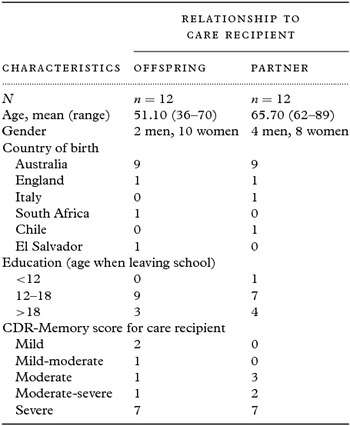
Twenty-four family caregivers of people living with dementia, who were living in the community within a metropolitan area, participated in this study. Table 1 presents the demographic characteristics. Participants were included if they were conversationally fluent in English, and were caring for an immediate family member (spouse, parent, or sibling) who was still living within the community and who had dementia. Participants were excluded if the care recipient had a form of cognitive impairment not related to dementia.
Participant information

Procedure
The university ethics department granted approval to conduct this study. An interview guide was developed based on advice from aged care professionals and a thorough review of previous research. The questions were designed to elicit caregivers’ perspectives of their needs and the barriers and facilitators in relation to accessing services and support. Questions were focused on the caregiver's experiences with care packages, respite, home-care services, support groups, planned activity groups, and other types of services available to caregivers (e.g., What kinds of support would be helpful for you to better manage your needs?). The Clinical Dementia Rating (CDR) scale (Morris, Reference Morris1997) was used to assess the level of care required by the care recipient. Participants were recruited via community advertising and by our research partners who provide community aged care packages. After 24 interviews (12 partner and 12 offspring caregivers), no new themes emerged from the data and theoretical saturation was achieved. On average, the interviews lasted 1 hour and they were conducted at the participants’ home by a female psychology graduate who had experience in interviewing and counseling. All interviews were audio-taped with participants’ consent and transcribed verbatim.
Data analysis
The interview transcripts were analyzed systematically using thematic analysis (Attride-Stirling, Reference Attride-Stirling2001; Braun and Clarke, Reference Braun and Clarke2006). This method involved identifying, analyzing, and reporting patterns and themes within data (Braun and Clarke, Reference Braun and Clarke2006). Thematic analysis is a procedure for organizing and describing trends in the data while also capturing the richness of the data with specific detail. We adopted the approach to thematic analysis recommended by Braun and Clarke (Reference Braun and Clarke2006), which involved six phases of data analysis. In Phase 1, the researchers read and re-read the transcripts to familiarize themselves with the data. In Phase 2, the researchers then developed a list of codes to denote any feature of the data that was interesting or noteworthy. During this process an inductive approach was used in which the coding was strongly linked to the data. Two full transcripts were independently coded by three researchers and a good level of inter-rater agreement was found. The remaining transcripts were coded by two researchers and the third researcher was involved to assist where there were discrepancies. In Phase 3, the data were then examined by all three researchers for overarching themes and patterns. At this stage, thematic maps were created to visually represent the patterns in the data. Themes were developed based on patterns identified within the thematic maps. Phase 4 involved the revision of themes until all codes were included in a coherent pattern within each theme. In Phase 5, the researchers developed clear definitions of each theme. Finally, in Phase 6, the researchers agreed upon quotes from the data that were representative of the themes that they were demonstrating.
Results
Two domains were used to organize the results: barriers and facilitators. In the domain of "barriers" the themes were (1) finding information about relevant services or support, (2) poor quality of the services, (3) mistrust of services, (4) the inflexibility of services, (5) caregivers’ beliefs as barriers, and (6) resistance by the care recipient. Within the domain of "facilitators" the themes were (1) effective communication with the care recipient, (2) having an "expert" point of contact, and (3) caregivers’ beliefs as facilitators. It was also important to examine the barriers and facilitators that were relevant to specific services and types of support.
Barriers
Finding information about relevant services
All caregivers discussed their needs for ongoing information about available services and support. This need was crucial; however, it was often unmet. The inaccessibility of information about relevant services and support was a significant issue for almost all caregivers. Caregivers did not know where to look for answers to their questions about services or how to gain access to information that was relevant to their situation. For many caregivers, this was a source of great frustration.
Online they referred to a couple of places, when I rang them they actually Googled the same thing that I had Googled, so they were just telling me what was already it was online. . . .then I phoned a few agencies – I still wasn't convinced and I wasn't getting sort of straight answers, it's hard to explain, it's sort of difficult to. . . [Interviewer: Difficult to navigate?] Yes. . . like you're on a wild goose chase. Daughter 10
Caregivers often described situations where they knew that a service was available, yet they anticipated that due to the difficulties in trying to find and access information they felt it was not worth the hassle or frustration.
And they – all they really do is they just give you a phone number to ring somebody else. Now that's not the response you want, right? You want to be able to go somewhere and say, “well listen, I want short term respite for this period,” and I want somebody to be able to give me a quality service. Husband 1
Caregivers agreed that online or phone help options were a quick and easy source of information. However, these needs were only partially met because the caregivers felt that the information was non-specific, unhelpful, and the service did not feel personal.
Yeah I just think in crisis time where you go and when I – when I expected to ring that line, I expected to get more than just a directory, that's basically all it was. Daughter 10
Some caregivers expressed the need for financial or legal guidance in regard to caring for the person with dementia. However, this information was not accessible and those who did pursue it, found it arduous.
Yes that would help [financial guidance]. I mean I've probably now, pretty much got to the bottom of it, but only through a lot of hard work and reading and research, which takes up more of my limited time. Son 1
Financial supports, such as the caregiver's allowance, were crucial in allowing caregivers to continue the caregiving role. Other forms of assistance, such as taxi vouchers and companion cards, were also facilitators of getting out of the house and spending enjoyable, quality time with the care recipient. However, in regard to all aspects of financial support and guidance, caregivers were largely unaware of their options and did not know where to access this information.
The more you delve, the more there is assistance out there, but you don't know what it is. . . And I think if you talk to any of the carers that I've come across, we all feel exactly the same way. There isn't an easy way of finding the help that's available. Wife 7
Poor service quality
A common barrier to in-home care was the poor quality of the service provided. Caregivers described issues around the lack of consistency in caregivers who came to their house, and felt that frequently changing care staff was upsetting or disruptive to the person with dementia. In some cases this was a deterrent to using this service again.
It's about routine and consistency; they've got to appreciate that. And they mentioned there, in their catalogue perfectly, we cater for people with dementia, we have special staff that will, we will, that will you know like do their part. But special staff is fine but consistency with those special staff, that's very important. . . with someone with dementia a lot of different faces is not good. Daughter 7
It's a matter of not changing the carers over so you've got different carers. This carer can't come – she's been there today; she can't come next week so rather than have a different person in and upset mum, forget it – we'll do what we have to do. Daughter 9
Caregivers also had concerns about the level of training of the care staff and their ability to provide care for the person with dementia. Caregivers felt worried about leaving their parent or partner with care staff who were not specifically trained in caring for a person with dementia.
I cannot feel safe leaving my mother. It wasn't even mentioned that my mother's level 5 high risk, she's a wanderer. . .they didn't even mention that to the [in-home respite] caregiver, is that pathetic. So you've got to be sure that the people that you're sending are decent people, are you giving me, am I going to go up the road to Coles and be stressed and thinking to myself, oh god. . . You know that is supposed to be a break for everybody, that's supposed to be a time that we can do something, but this thing's just not working. So it's just been one frustration after the other. Daughter 7
The poor quality of respite facilities was another significant barrier for caregivers in utilizing respite services. Similarly, some caregivers were reluctant to use the service provided by planned activity groups due to the poor quality of the activities and lack of benefit to the person with dementia.
I've tried a number of different areas for – just trying to chase up a respite – short term respite, which is what I'm looking for. Maybe one or two days, or a week, or maybe even two weeks as a possibility. But when I went – and I went and had a look at a couple of them – when I went there they were atrocious. You wouldn't – I wouldn't – I just couldn't – I couldn't do it to her, I couldn't put her in this - in that environment. And it wasn't the fact that it was going to cost me a lot of money – I was happy to pay for that. But the environment was just atrocious. Husband 1
The activity group for my husband does nothing – why he go there? For him to do nothing? No! Better he doesn't go. We don't need "respite," we need good activities that stimulate and are enjoyable for my husband to go – not just sit there with other people with dementia who can't talk to anyway. What kind of outing is that? Wife 3
Lack of service quality was a key issue across other services and also the primary reason that caregivers did not utilize services for cleaning and other household tasks, and the provision of ready-made meals that were available to them through their care package.
What we need if help is "effective" help – what I mean is that they give you homecare. It's terrible, they don't clean properly and they always want to have a cup of tea before they start and this takes too much time. By the time they have to leave (you know they only have certain time here), they don't finish. Wife 3
They are just purely terrible, terrible meals. The majority of them consist of a slushy stew and rice, sausages and rice, something else and rice, more and more and rice and rice and rice and rice. And we were getting quite constipated with those. Husband 3
Mistrust of services
Many caregivers spoke at length about the distrust they had toward the care options available, such as respite, in-home care, and long-term care. Several caregivers had negative experiences that prevented them from utilizing respite or in-home care again. For example, some caregivers felt that their parent or partner had been injured or neglected when they were previously in respite facilities.
In the last 17 years we've only had about, I don't know, Mum in respite three or four times and out of sheer desperation, and we suspect that something has happened in one of them because she said once when I said we were going to organise it again, “no they hit you in there”. When we brought her home one time she was so compliant for about 10 days. She just sat in her room in the chair. Didn't ask for a single thing. Didn't want a drink, didn't – which was very unusual for her. Daughter 3
Mum was quite distressed, I don't think they gave her the meds. It's a lot of doubts in my mind and then she told them she wanted to come home so they gave her black garbage bags to put her clothes in and let her wait at reception. I said in my notes, no matter who's on shift you should look at the file and say “oh no she's not due to go home, lets distract her and calm her down.” And I'm not racist but they use people with English as their second language – they can't understand you and you can't understand them. So what chance has that person with dementia got to communicate that they're not well? Daughter 6
Some caregivers also avoided utilizing in-home care services because they did not like to have strangers stay at their home with the care recipient while they were not there.
And another thing that I struggle with, until you get to know people is strangers in the house. I mean I'm a fairly private person but I have to have a lot of people in the house. I've had physios, OT – look in the last 17 years I've had countless. I couldn't even tell you how many people I've had to open my home too. Not every one of them I felt completely comfortable with – so that's been a hard thing to deal with. Daughter 3
The changes brought about by CDC were also a significant source of frustration and mistrust among several caregivers. Some caregivers had lost faith in the system.
So, I think they put a fancy name, consumer directed, and it was just an excuse for cutting packages. Son 1
The system to a large extent that I've tried to access, has failed. And each time that system fails you just acknowledge the fact that okay, that you're in this on your own, and if you're going to fix it, you've got to fix it yourself, because there just aren't processes and systems in place to address what you need. Husband 1
The inflexibility of services
Caregivers discussed the importance of care packages in sustaining their ability to care for their family member. However, caregivers’ needs were often only partially met due to the limitations of the packages. For example, caregivers discussed the inflexibility of packages as a major barrier to having their needs met. Packages were too restrictive in terms of service options and the ways in which available services could be used.
I wish I could employ my own people who would fit in more and someone who's ethnically suitable too – our people would be just as good as their people. Why can't I get someone like we – we've got a Greek friend whose husband passed away and she would happily have done it but she has to work. I can't ask her to, and I can't afford to pay her out of my pocket but I can't use the Government money, I have to use who they tell me. So all of that's really an issue. Daughter 3
It isn't always easy to go out. . . I have a carer for three hours so I have to plan who I'm going to go with and whatever. Everything has to be done sort of in advance. I can't do anything spontaneously and I have that deadline whereby I have to be home by 4:00pm. Wife 8
All caregivers who discussed CDC were not satisfied with the service and changes within their care packages. The most common reason for the dissatisfaction was that their package had become more restrictive in the services available and how they could be utilized.
I also have a consumer directed care package. . .There's been changes recently and I'm no longer able to use it to pay for respite and I'm no longer able to use it for the main program that [husbands] involved in. It's with [service organisation]. They have supported me from day one and been absolutely amazing but because of recent changes in rules and regulations with the state government I actually can't use my package to pay for those programs. Wife 8
After years of argument and struggles and pleas, I finally gained that role as I am, I do have the consumer direction of [wife's] package. Now, that in principal is good in so far as there are issues now in which I do have control of my life and [wife's] life, rather than being dictated to completely by a service provider. However, that is terrible, as it's turned out, it is realistically very disappointing, because it's so limited, the change has been very, very minimal, but it's still there. Husband 3
Caregivers’ beliefs
Caregivers held many beliefs about the caregiving role that impacted on their service use behaviors. The most common belief was that asking for help was embarrassing or that it was an indication that they were not capable of caring for the person with dementia on their own.
And it's hard to always be asking for help all the time. You feel needy and you feel disadvantaged and I don't want to feel like that with people. I don't want to feel less than the person beside – I don't want to be before them or after them. I'm very happy to be beside people and be their equal but when you've always got your hand up it's like sometimes they're dreading you. Daughter 3
My nature is one of the fact that I am responsible for what happens in our immediate family and our immediate life, and I should be able to fix it. Husband 1
It does, it feels incredibly burdensome and I guess in a way it's really exposing your vulnerability saying we're not doing, like we're doing a great job but we need help. Daughter 1
Caregivers often discussed the ways in which the person with dementia relied on them above all other people. For example, caregivers indicated that no one else understood the person with dementia as well as they did. This was a common reason for not wanting to leave the person with dementia in the care of other people.
I know her needs uniquely better than anyone. Daughter 3
I think the most important function I serve to my mum is I'm her go-to person that she has full trust in that she knows that if I'm there or if she asks me she can rely on me. I think that that's a big thing. And I do help her with a lot of things and I know where things are in the house. Where, I know what's happening in the schedules and who's doing what and, I have the overview of everything but I think the most important function is that I can tell she's relaxed more when she's around me because she knows that I've got everything under control. Daughter 1
Loyalty to the person with dementia and guilt were other reasons why caregivers did not utilize respite care services.
We had friends and he, the husband developed dementia and he had to go into a nursing home and we visited him there and [husband] was horrified and [friend's husband], that's the guy, he was trying to get out all the time. So I really did make a commitment that if anything happened with Ron, this was a long time ago, I would not put him in a nursing home and I don't put him in overnight although that may come at some stage. Wife 6
I'm worried that she'll feel like I'm abandoning her by leaving her there. And I don't think I'd relax whereas I know that if she's with family I wouldn't have an issue. So I think it's me, I don't know. Daughter 8
Most caregivers indicated that a level of self-sacrifice was necessary within the role of caregiver. In some cases, the perceived necessity of self-sacrifice prevented caregivers from considering ways that they could improve their own health and well-being via the utilization of services to reduce their burden.
Well I had seen a psychologist last year but really couldn't, had two sessions there and I really couldn't see any benefit that I could get out of it, because they can't really change your situation. The only way you can just try and change your way of thinking that's like I said to someone recently, there's only three things you can do, my mother will pass away, we can move away physically move away, put her into a nursing home or we pass away and you get out of the - I said it as a joke but I said, “Well you can't, that's the only three, four options you have.” Daughter 4
So I haven't got my life to have any specific needs. My life is looking after him. So there might have been specific needs 7 years ago, but there aren't anymore. Wife 7
Resistance by the care recipient
Many of the caregivers indicated that a key reason for not utilizing respite, planned activity groups, and in-home housekeeping and/or care services was that care recipients were resistant to these services. Caregivers described a range of ways that care recipients were resistant to these services, including not wanting strangers in the house, not wanting to leave the house, responding badly to changes of routine, and not wanting to be away from the caregiver.
Fighting with my mum because she's just a hermit and she doesn't want anyone to come to her house all that sort of thing, it's like we can't be there 24/7. . .I don't know whether it's that generation, I know it's a lot her individually, but they don't want strangers in the house. . . She'd say to the doctor oh I've got a big family they'll all look after me. Daughter 10
Mum thinks I've got a job and we're working because we need the money. So she's more accepting and allows me to go whereas before there'd be a big uproar always about me leaving and she'd be a little bit difficult. Daughter 3
Care recipients’ resistance to services was very common throughout the interviews, and this was largely unresolved. Because caregivers often did not know how to effectively overcome care recipients’ resistance, the solution was usually to avoid utilizing the service.
I'm not against getting support in the house but my wife it ends up arguing every time I suggest that I'll get a cleaner in or do something. Resistance, there's no question about that, that's the major problem I've got in all those things whether it's cleaning the house, meals or whatever it is, it's my wife's resistance to. . . she just doesn't think, appreciate we need that, that support and that's another thing, without ended having an argument about it. Husband 4
Many of the barriers that caregivers experienced were related to a lack of availability of good quality services that were able to accommodate the specific needs of the care recipient, or barriers related to caregiver resistance to services. Although these barriers were ongoing and seemingly insurmountable by some caregivers, other caregivers had managed to overcome barriers and engage with services.
Facilitators
Good communication with the care recipient
Some caregivers had learnt effective ways of communicating with the person with dementia that helped them with their caring role. Caregivers noted that effective communication strategies allowed them to understand when the person with dementia did not feel comfortable in their environment or when they were in any physical discomfort, so that they were able to respond to these issues. This facilitated overcoming resistance by the person with dementia.
Probably the biggest help, I think, I read an amazing book called Contented Dementia and it was all about how it's really the carer's role to change the way they talk and communicate to create a safe and comfortable environment for the person with dementia to thrive and to have a good quality of life. When mum was first diagnosed we were very much frustrated by the condition and frustrated by her behaviour and it was just creating a bad environment for mum and I think being able to accept her condition and find, each of us have now found a way and I have as well, of being able to respect mum and bring out the best in her, make her feel comfortable and talk to her in a way which is very comforting, reassuring, warm. Daughter 1
Effective communication strategies were an important facilitator across many areas including managing behavioral and psychological symptoms of dementia (BPSD), activities of daily living, and utilizing services and support. For example, effective communication skills facilitated the use of respite care within the home and at facilities by allowing the caregiver to inform the care recipient in a reassuring way.
She was going to a respite and she thought that I sent her to. . . an asylum, like a place like a hospital with sick people. And I said, “No mum you are going to school, you're going to learn a lot of different things in there.” And, [she said] “Oh I'm going back to school, that's good, oh fantastic.” And then she said, “Oh alright, let's go.” Even since then she's been going to school, and she's very happy. Son 2
Having an "expert" point of contact
Caregivers often described the value of having one person, or a group of people who they would turn to for advice, information and support. This was often a case worker, an experienced friend, or a formal or informal support network. For example, having a case manager who kept caregivers informed with up-to-date information about their options for services and support was a key facilitator in utilizing services. Several caregivers noted that they used certain services because their case workers helped them to organize it.
One of the things that we do which is really good is every two or three months we meet up with the [case manager]. So she talks to my sister, my brother and I and just checks in with us and we've got a kind of rolling list of things that we're working on as a family to sort of think about mum's needs and that's a good way of checking in, how we're going, what sort of things we've found difficult or what we're trying to achieve and what systems we want to put in place. So it's just like a regular meeting I guess to keep us on track. Daughter 1
In discussing their frustrations with finding information about services and supports, several caregivers suggested that they would like a central point of contact. They described a need for one place that they could contact that would act as a gateway for all the information they needed. Caregivers felt that this would be a facilitator for greater use of services and support.
You haven't got a central point. . .You ring this person, you ring that person, try them, try them, try them. So I'm there juggling like a few balls and . . . in the midst of organising everyone and your own life in upheaval and you've got to get onto these people and you've got to get onto them during business hours and even then you don't particularly always get a straight answer. Daughter 10
Let me give you my idea of Utopia. Utopia for me would be the fact that – in the event that I need access to a service or a group of services, then I would have a single point of contact who would then be able to solve my problem. I don't want to have to go through a plethora of organisations to get to that point. Set up a central register, that, “Here you are – these are the people that we have on this register, these are the services that they need,” and we can access all those services through – again, through a central agency. Husband 1
Caregivers’ beliefs as facilitators
Some caregivers were more likely to utilize services due to the beliefs they had around the caregiving role. For example, some caregivers believed that in order to provide the best care they could for the person with dementia, it was important that the caregiver themselves took regular breaks away from the caregiving role. This mentality was a facilitator of respite use.
I do feel that if I don't have a break I can get to a point where I can get frustrated or run down or stressed and rather than being on my best for my mum, I can be at a point where I'm not, I'm run down and I won't be the best I can be for mum. . .I need that time away just to make sure that I also get recharged and yeah look after myself and my mum and even I go to the gym in the morning before work as well just because I think without that balance I wouldn't be the best I am for mum. Daughter 1
Another facilitator of service use was caregivers’ acceptance that sometimes there was no perfect solution to difficult situations and that compromises must be made.
How do I feel about it? I guess frustrated that I don't have an answer that there isn't a better way of doing it. I suppose I also, I'm learning to be a little bit resigned and say, well I'm doing my best. If that isn't good enough, tough – what more can I do, you know? Unless somebody can point me in the direction of a better way of doing it, I'm doing what I can, so you know. So I'm kind of a bit resigned, you know. And look, things still go wrong and I just say, well that's life, you know, things aren't perfect. Son 1
Discussion
The aim of this study was to examine the barriers and facilitators associated with service and support utilization among partner and offspring caregivers of older people with dementia living in the community. Prominent barriers were: the inability to find information about relevant services or support, the poor quality or mistrust of the services, the inflexibility of services, caregivers’ beliefs about their obligations to caregiving role, and resistance by the care recipient. On the other hand, there were some key facilitators that enhanced caregivers’ ability to access services and gain support. These were: having good communication with the care recipient, having an "expert" point of contact, and having beliefs about the caregiving role that enabled the use of services. These prominent barriers and facilitators were relevant to many types of services and supports.
The current research findings are different from previous research. Common barriers to service use that have been identified in other research are the lack of perceived need of services and the stigma associated with dementia (Brodaty et al., Reference Brodaty, Thomson, Thompson and Fine2005). This was not the case in the current study. In the past 10 years, there has been an increased level of community awareness about the availability of care services, the normalization of service use, and the de-stigmatization of dementia. However, barriers to service use are still present; it is just that the nature of these barriers have changed.
Barriers
The inability to find information about relevant services or support was a significant barrier for caregivers. In many instances, caregivers were time poor and did not want the stress and "rigmarole" associated with trying to find the information or service they required. Not knowing where to find services has been previously shown to be associated with non-use of respite among dementia caregivers (Brodaty et al., Reference Brodaty, Thomson, Thompson and Fine2005; Phillipson et al., Reference Phillipson, Jones and Magee2014). In recent years, the type and level of services available to caregivers has increased. Despite this, it seems that caregivers are still not effectively guided to information about relevant services. The current study was comprised of caregivers who spoke fluent English. If they felt that relevant information was difficult to find and access, then the situation is likely to be even more difficult for caregivers from culturally and linguistically diverse backgrounds. Previous research has found this to be the case (Winslow, Reference Winslow2003; Shanley et al., Reference Shanley2012).
The introduction of the CDC model has potentially exacerbated problems with a lack of information about services. In Australia, the community aged care sector has recently undergone changes to align with a CDC model. The CDC model aims to empower the consumer to have more control over their options for services and individualized budgets. However, a significant problem with this system arises when consumers (caregivers) are not aware of the services available under the CDC model. In order for caregivers to successfully self-direct, they need detailed and understandable information about the types of services they can request. They also need other detailed information about their individualized budgets and the costs of services (Ottmann and Mohebbi, Reference Ottmann and Mohebbi2014; Gill et al., Reference Gill2016). Lack of information may be a reason why caregivers in the current study felt more restricted by the changes associated with the implementation of CDC. Gill et al. (Reference Gill2016) conducted an examination of early perceptions and experiences of CDC in Australia. The researchers found that the introduction of CDC has required significant industry and organizational change and as such, there are currently several difficulties for both providers and caregivers, as caregivers are now expected to take control in self-determining their service (Gill et al., Reference Gill2016). Given that several other countries, including Germany, the UK, Austria, France, the USA, Japan, Denmark, and the Netherlands, also use CDC models of care (Low et al., Reference Low, Chilko, Gresham, Barter and Brodaty2012), it would be worthwhile investigating the extent to which these barriers impact on service use in other countries.
Poor quality of care was a prominent barrier in the current study. This is consistent with previous research that had demonstrated that if the caregiver believes the person with dementia is not being well-cared for and is not gaining any positive experience from the respite, they will be less inclined to use the service (Winslow, Reference Winslow2003; Greenwood and Smith, Reference Greenwood and Smith2015). The current study found this to be the case, not just in regard to respite, but across many domains of service and support, including in-home care services and planned activity groups. The current research and previous qualitative research has indicated that family caregivers often feel that care staff are ill-equipped to deal with the needs of a person with dementia (Winslow, Reference Winslow2003; Gill et al., Reference Gill2016). In order to increase the rate of service usage, family caregivers must feel confident in the ability of staff to provide adequate care and also provide a positive experience for the person with dementia. This suggests that care staff may need greater training in caring specifically for people with dementia. In addition, as suggested by Neville et al. (Reference Neville, Beattie, Fielding and Macandrew2015), it is important that respite services extend beyond relieving the family caregiver and include activities to address the well-being and social needs of the person with dementia.
Beliefs held by caregivers about their role as a caregiver influenced their service use. Some caregivers perceived a duty of care that prevented them relinquishing their caregiving role, even temporarily, for respite. Such thoughts have been demonstrated in previous research as barriers to service use (e.g., Kosloski et al., Reference Kosloski, Montgomery and Youngbauer2001). Bad experiences and poor quality of service are likely to make it more difficult for caregivers to overcome feelings of guilt, obligation, and the thought that no one will care for their relative as well as they will. As was found in the current study, previous research has shown that some caregivers regard their caring role as their natural duty (Conde-Sala et al., Reference Conde-Sala, Garre-Olmo, Turró-Garriga, Vilalta-Franch and López-Pousa2010) and feel that they must provide care to their relative without help from others (Losada, et al., Reference Losada, Montorio, Knight, Márquez and Izal2006). In addition, some caregivers may believe that self-sacrifice and self-neglect are necessary within their role as a caregiver. Such beliefs act as barriers to accessing services as they influence caregivers’ perceptions of their needs and whether or not they seek assistance (Kosloski and Montgomery, Reference Kosloski and Montgomery1994).
Many caregivers experience difficulties in using services due to resistance by the care recipient. Specifically, care recipient resistance prevented in-home care services, respite and planned activity groups from being used. In their literature review of non-service use by dementia caregivers, Brodaty et al. (Reference Brodaty, Thomson, Thompson and Fine2005) found that a common theme across studies was the care recipient's reluctance to accept help from services. A key reason for care recipient resistance may be the fear, misunderstanding, and confusion caused by environmental changes (Eggenberger et al., Reference Eggenberger, Heimerl and Bennett2013). Therefore, as discussed in the facilitators of service utilization below, education for effective communication with people with dementia may assist caregivers to overcome issues of caregiver resistance, while strengthening the relationship between the caregiver and care recipient (Eggenberger et al., Reference Eggenberger, Heimerl and Bennett2013).
Facilitators
Effective communication with the care recipient was a factor that facilitated caregivers’ use of services. Effective communication enabled the caregiver to ensure the care recipient understood and felt comfortable in situations of service provision. Research demonstrates that communication barriers between caregivers and their care recipients with dementia have a significant negative impact on the quality of care and quality of life of the caregiver (Done and Thomas, Reference Done and Thomas2001; Egan et al., Reference Egan, Bérubé, Racine, Leonard and Rochon2010). Unfortunately, caregivers usually do not receive training that enables them to meet the communicative needs of people with dementia. In their review, Eggenberger et al. (Reference Eggenberger, Heimerl and Bennett2013) found that caregiver training in communication skills for people with dementia significantly improved the quality of life and well-being for the person with dementia and also increased positive interactions in different care settings.
Caregivers noted that having an "expert" point of contact such as a case worker who could be called upon for relevant and up-to-date information and guidance was critical to their use of services. In their review, Brodaty et al. (Reference Brodaty, Thomson, Thompson and Fine2005) found that among family caregivers, contact with a social worker was related to greater service use, suggesting that access to a person with professional experience in the service system is important in linking caregivers to available support options. In recent years, the need for expert assistance is likely to be greater given the changes brought about by the CDC model which require caregivers to have a greater understanding of services. Caregivers who are most vulnerable, such as those with a greater level of burnout, stress, and depression, are less likely to be proactive in their research of services. Therefore, there is a clear need for greater emphasis on linking caregivers with the relevant services and support in a simplistic and time efficient manner. As suggested by Phillipson et al. (Reference Phillipson, Jones and Magee2014), it is not enough to just provide information about available services, it is essential to consider the needs of caregivers for assistance to navigate and use the service system.
Some beliefs held by caregivers facilitated their use of services and support. For example, caregivers’ who believed that they were able to give better quality care for the person with dementia if their own well-being needs were met were more likely to use services such as respite. Although there is a lack of research examining facilitators of service use among dementia family caregivers, research has shown that caregivers’ beliefs may be modified to be more constructive to their role as caregiver (Hepburn et al., Reference Hepburn, Tornatore, Center and Ostwald2001). A cognitive behavioral therapy (CBT) approach has been shown to be efficacious in intervention programs aimed at enhancing caregiver health and well-being (Selwood et al., Reference Selwood, Johnston, Katona, Lyketsos and Livingston2007). In this approach, caregivers are educated in techniques from CBT to focus on identifying and modifying beliefs that are unconstructive, and developing new beliefs that allow them to engage in activities that promote well-being, such as respite use (Márquez-González et al., Reference Márquez-González, Losada, Izal, Pérez-Rojo and Montorio2007). Further research that identifies specific beliefs that are facilitators of service use among dementia caregivers is needed in order to inform the development of interventions that adopt a CBT approach.
What do the findings mean for service delivery?
Caregivers in this study wanted a central point of contact who could provide guidance and information about what services were available in their local area, how to access them, and how to determine their eligibility for these services. Many of the barriers discussed by caregivers related to a lack of knowledge about service availability, eligibility, and service access. By having a single point of contact with whom caregivers could discuss their service needs, many of these barriers could be offset. A single point of contact may also help caregivers overcome emotional barriers, and encourage the use of services without feelings of guilt. Positive reinforcement in the form of a knowledgeable service provider could help to foster self-efficacy and provide validation to caregivers who are feeling burdened. This resource could further assist service uptake by providing strategies for caregivers to engage in positive communication with their care recipient to reduce resistance to service use. In the current environment, the most likely candidate to be able to fill this service need is that of the case manager. However, significant changes to the scope of the case manager's role and the level of training they currently receive would be needed for this to be possible.
Limitations
There were some limitations within the current study that should be noted. The caregivers in the current sample spoke English and were largely of Caucasian background. Therefore, cultural differences were not examined in this study and it is unclear whether the findings can be generalized to caregivers from culturally diverse backgrounds. The interview schedule that was developed by the researchers may have influenced the responses of caregivers, in contrast to allowing participants to speak freely without prompting questions. Only participants who responded to the invitation were included in this study. This may have inadvertently excluded caregivers with poorer health or greater unmet needs as they may have been less likely to have the time or motivation to participate. Finally, studies have demonstrated a relationship between care recipient characteristics (behavioral problems) and service usage (e.g., Phillipson et al., Reference Phillipson, Jones and Magee2014). This topic was beyond the scope of the current study. However, future research should examine this relationship.
Conclusions
In recent years, the types and amount of services and support available to family caregivers of people with dementia has increased. However, it is clear that there are significant barriers that prevent caregivers from realizing these benefits. In overcoming barriers to service use, a multifaceted approach is needed. At a personal level, caregivers need more education, information, and guidance that is easily accessible. As suggested by caregivers themselves, a central register with service provision information and options is required. In addition, psychological interventions for caregivers in overcoming thought barriers, utilizing more constructive beliefs, and increasing skills for communicating with people with dementia may serve to decrease burden and increase service use.
Conflict of interest
None
Description of authors’ roles
All authors were involved in the design of the study. A. Macleod conducted the data collection and data analysis, and worked on subsequent drafts of the paper. G. Tatangelo conducted data analysis and wrote the first draft of the paper. E. You worked on subsequent drafts of the paper. M. McCabe worked on subsequent drafts of the paper.
Acknowledgments
We would like to acknowledge our research partners who facilitated this study; Carers Victoria, Villa Maria Catholic Homes and Blue Cross.