Introduction
Sickle cell anaemia is an autosomal recessive, inherited disorder of haemoglobin structure caused by a point mutation in the β-globin chain of haemoglobin. Low blood oxygenation promotes the polymerisation of haemoglobin, which distorts red blood cells into a sickle shape and reduces their elasticity. Consequently, these rigid and abnormally shaped blood cells are unable to deform as they pass through narrow capillaries, leading to vessel occlusion and ischaemia.
A higher incidence of sensorineural hearing loss has been reported in sickle cell subjects.Reference Ajulo, Osiname and Myatt1–Reference Jovanovic-Bateman and Hedreville3 There are case reports of unilateral sudden sensorineural hearing loss (SNHL) in adults and children with sickle cell disease.Reference Whitehead, MacDonald, Melhem and McMahon4–Reference Hotaling, Hillstrom and Bazell6 However, a literature search of the MEDLINE, EMBASE and CINAHL databases demonstrated only one previously published adult case of bilateral sudden SNHL found in association with sickle cell disease,Reference O'Keeffe and Maw7 and no paediatric cases.
The authors present the case of a child with known sickle cell anaemia who presented with rapid onset of bilateral profound SNHL. A vaso-occlusive aetiology was initially suspected, but a thorough history and investigation suggested an underlying autoimmune disorder.
Case report
A seven-year-old, Afro-Caribbean girl with previously normal hearing presented with rapidly progressive hearing loss. The family had initially noticed that the child asked for repetition of words. Over the next two days, she developed increasing difficulty in hearing, worse on the left side. There was also associated mild imbalance. On the third day after her symptoms began, her parents had to write down words for her, and by day five she appeared unable to hear at all. At this time, the patient presented to the otolaryngology department and was found to have cerumen in both external auditory canals. The cerumen was removed but her hearing did not improve. She was subsequently admitted to hospital on day 10 for investigation and treatment. During this period, there was no associated illness. She remained afebrile and pain-free.
The child had a known history of sickle cell anaemia, but with no serious complications and no previous admissions or blood transfusions. She had experienced mildly painful episodes in the past, treated at home with analgesia. She was developmentally normal. Of note was a past history of a single afebrile convulsion at the age of 18 months, which had been fully investigated with no cause found. Her only regular medication was penicillin V prophylaxis and folic acid.
On further questioning, it was noted that the child had been treated for the previous three months for intermittent red eyes. A diagnosis of bilateral anterior uveitis had been made, and she had undergone a course of treatment with topical steroids.
On examination, the child had no dysmorphic features, and the ear, nose and throat examination was normal. Her speech was maintained. She had catch-up saccades on head thrust but no spontaneous nystagmus. Other cranial nerves were intact.
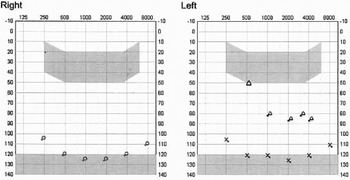
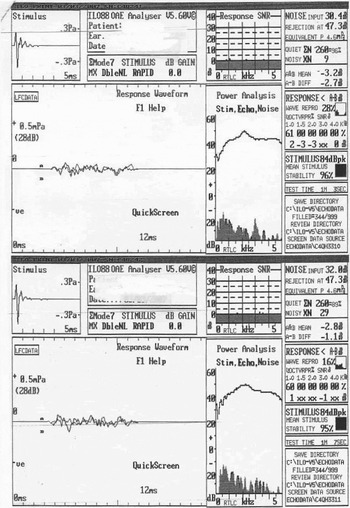
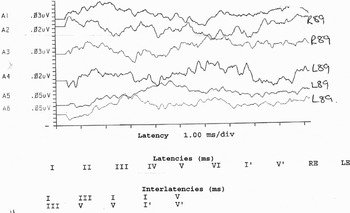
Investigations included pure tone audiometry (Figure 1), which demonstrated no responses at 90 dB bilaterally. Otoacoustic emissions (Figure 2) and auditory brainstem evoked responses (Figure 3) were also absent. Impedance audiometry demonstrated type A tympanograms but absent stapedial reflexes.
Pure tone audiogram, on day 11 after onset of symptoms.

Otoacoustic emissions testing, on day 13 after onset of symptoms.

Brainstem evoked responses testing, on day 13 after onset of symptoms.

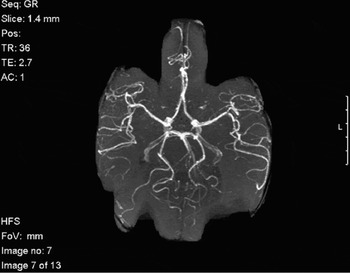
Radiological investigations included a chest X-ray, which demonstrated normal lung fields but evidence of previously undiagnosed avascular necrosis of the proximal humeral epiphysis on the left. Magnetic resonance imaging (MRI) and magnetic resonance angiography of the head and neck (Figure 4) demonstrated no abnormality. Blood tests revealed a haemoglobin level of 7.6 g/dl, a leucocytosis of 30.3 × 10⁹/l, a C-reactive protein (CRP) level of 187 mg/l and an erythrocyte sedimentation rate (ESR) of 4 mm/h. The sickle haemoglobin percentage was 59.7 per cent. All other blood tests were normal, including thyroid function, immunoglobulins, viral and syphilis serology, angiotensin-converting enzyme and autoantibodies. An ophthalmological review confirmed bilateral pan-uveitis and normal intraocular pressures.
Cerebral magnetic resonance angiography image, demonstrating an intact circle of Willis and basilar artery.

In the absence of a confirmed aetiology, empirical treatment was commenced immediately. This included intravenous hydration, acyclovir, prednisolone, folic acid and betahistine at weight-appropriate dosages. Oral antibiotics were instigated and exchange blood transfusion was performed on day 14.
Despite treatment, pure tone audiography performed one month after the onset of symptoms demonstrated no response at audiometer limits, other than to vibrotactile stimulation. The patient was fitted with a hearing aid and referred to the cochlear implantation team.
Twelve weeks after the onset of hearing symptoms, the child received a unilateral cochlear implant.
Discussion
There is no universally accepted definition of sudden SNHL; however, it is characterised by a rapid onset of deafness of cochlear or retrocochlear origin over a period of minutes to several days. Some authors have defined sudden SNHL as a loss greater than 30 dB in three contiguous frequencies, occurring over a period of less than three days.Reference Zadeh, Storper and Spitzer8
The reported incidence of sudden SNHL has been estimated at 8 to 15 per 100 000 population per year.Reference Hughes, Freedman, Haberkamp and Guay9 Both ears appear affected equally, and there is no geographic or sexual predilection. Bilateral loss is rare. One series of 225 cases demonstrated bilateral sudden SNHL in 2 per cent of patients.Reference Byl10 The mean overall age of onset for sudden SNHL is 46 years.Reference Mattox and Simmons11 About one-third of patients awaken with the loss, others discover the problem when they try to use the telephone, or may describe a brief period of fluctuating hearing before deafness. About 50 per cent of patients complain of concomitant imbalance or vertigo. The natural history is variable, with some patients suffering from permanent hearing threshold changes, whilst between 40 and 70 per cent recover some degree of hearing without treatment following the insult.Reference Shikowitz12
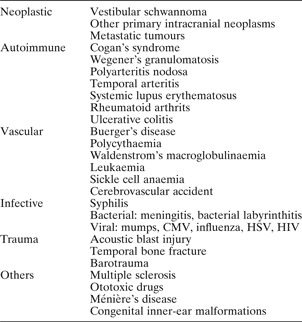
Sudden hearing loss is a symptom representing the end result of various pathologies of the inner ear and central nervous system. Idiopathic sudden SNHL is the most common diagnosis, but underlying causes must first be excluded. The known causes of sudden hearing loss are summarised in Table I. Approximately 10 per cent of patients with Ménière's disease and acoustic neuromas present with sudden hearing loss.
Causes of sudden sensorineural hearing loss

CMV = cytomegalovirus; HSV = herpes simplex virus; HIV = human immunodeficiency virus
The aetiology of idiopathic sudden SNHL is still obscure. Four different theories remain popular: disturbance of cochlear blood flow, viral infections, autoimmune disease and Reissner's membrane rupture.Reference Shikowitz12, Reference Cole and Jahrsdoerfer13
The present case clearly demonstrates the difficulty which can arise in defining the precise aetiology of sudden SNHL. Although the association with sickle cell anaemia initially raised suspicion of a microvascular cause, subsequent scrutiny of the history and investigations suggested an autoimmune aetiology. Bilateral cochlear infarction in the absence of a sickle cell crisis would be highly unlikely, and a raised CRP plus ophthalmological disease are characteristic of Cogan's syndrome. The pathogenesis of these two most likely underlying aetiologies are discussed below.
Cochleovestibular blood supply may be affected by circulatory disorders such as embolic phenomena, thrombosis, vasospasm, and hypercoagulable or high viscosity states, causing a sudden anoxic injury to the cochlea. The blood supply of the membranous labyrinth is predominantly derived from the labyrinthine artery, a branch of the anterior inferior cerebellar artery, or rarely of the basilar artery. The labyrinthine artery enters the internal auditory canal and subsequently divides into the common cochlear artery and the anterior vestibular artery, both end arteries. The cochlea is poorly tolerant of disruption to this blood supply. In 1957, Perlman and Kimura revealed that vascular occlusion of the labyrinthine artery in guinea pigs for greater than 30 minutes led to irreversible loss of cochlear function.Reference Perlman and Kimura14 Suga performed experimental embolisations of cochlear vessels and showed loss of cochlear action potentials within 60 seconds.Reference Suga, Preston and Snow15
Much of the evidence for a vascular aetiology of sudden SNHL comes from histopathological comparison of a few human temporal bones with those from animal models of vascular occlusion to the cochleovestibular apparatus. In 1980, Belal assessed two temporal bones from patients suffering from sudden SNHL and found similar histological findings to those of animal models, including extensive fibrosis and new bone formation.Reference Belal16
Patients with diseases such as sickle cell anaemia and Waldenstrom's macroglobulinaemia have been shown to be at higher risk of developing sudden SNHL than the normal population. Investigation should include coagulation tests, sickle percentage, and computed tomography (CT) or MRI scanning. Conventional angiography is invasive and is rarely indicated in view of the risk of complications. Magnetic resonance angiography is useful for excluding larger vessel (>3 mm) involvement, but visualisation of branches of the cerebellar arteries is limited by poor spatial resolution and breathing motion artefact, and the labyrinthine microvasculature is not detectable. Computed tomography angiography may have a higher resolution but still has limited application in visualisation of cranial microvasculature. Hearing loss in these individuals is usually reversible to some extent with treatment. Fluids and oxygen are required, together with exchange transfusion for sickle cell disease or plasmapheresis for Waldenstrom's macroglobulinaemia. Strokes involving the anterior inferior cerebellar artery are associated with auditory and vestibular symptoms but often also affect cerebellar function. Sudden SNHL following cardiopulmonary bypass has also been reported, most likely resulting from embolic phenomena.
• This paper describes the case of a child with bilateral profound sudden sensorineural hearing loss found in association with known sickle cell anaemia
• Sudden sensorineural hearing loss has a variable aetiology and is rare in children
• Immediate treatment for all possible aetiologies is essential, along with targeted investigations and early referral for cochlear implantation if no recovery is demonstrated
Autoimmune hearing loss may be associated with a systemic autoimmune disease such as Cogan's syndrome, Wegener's granulomatosis, polyarteritis nodosa, temporal arteritis or systemic lupus erythematosus. The pathogenesis of immune-mediated sensorineural deafness and vestibular dysfunction is unclear, but is presumed to include cross-reacting antibodies or vasculitis of vessels supplying the inner ear. True primary autoimmune hearing loss implies that inner-ear proteins are recognised immunologically as foreign by certain immune mediators. Such antigens have yet to be demonstrated.
Cogan's syndrome is a rare disorder affecting young to middle-aged adults (average age of onset 22–29 years). It is generally characterised by a brief episode of inflammatory eye disease, followed by bilateral audiovestibular symptoms which may fluctuate. There are very few reported cases in children. The association was first described by Morgan and Baumgartner in 1934. David Cogan, an ophthalmologist, published a description of five cases in 1945.Reference Cogan17 The classical picture, now known as typical Cogan's syndrome, is characterised by non-syphilitic interstitial keratitis and vestibuloauditory dysfunction. Even though interstitial keratitis is a hallmark finding it is not essential for diagnosis, and, in 1963, the atypical form of Cogan's syndrome was first described.Reference Bennett18 In this condition, inflammation may involve other areas of the eye and result in conjunctivitis, episcleritis, uveitis, scleritis or retinal vasculitis.
Cogan's syndrome may also be associated with a vasculitis, and approximately 10 per cent of patients develop aortitis within weeks to years of onset. One series reported that 12 out of 18 patients (67 per cent) developed bilateral deafness.
The underlying aetiology of Cogan's syndrome is unknown. A microbial basis has been suggested. There are clinical parallels between syphilis and Cogan's syndrome, and an association with Borrelia burgdorferi and chlamydia has been proposed. However, evidence is thus far inconclusive. Post-mortem temporal bone histopathological studies of patients with Cogan's syndrome are characterised by: chronic inflammation, including infiltration of the spiral ligament with lymphocytes and plasma cells; endolymphatic hydrops; degenerative changes in the organ of Corti; and demyelination and atrophy of the vestibular and cochlear branches of the VIIIth cranial nerve.
There are no formal criteria established for the diagnosis of Cogan's syndrome. The diagnosis requires clinical signs of both eye and inner-ear inflammation. Investigation should include audiography, objective hearing assessment and laboratory tests including full blood count, ESR and CRP. Imaging, including MRI or CT, should be performed primarily to exclude cerebellopontine angle tumours and other disorders. Magnetic resonance imaging may show enhancement of vestibular and cochlear structures with gadolinium.
The mainstay of treatment is corticosteroids. These should be administered topically for ophthalmic inflammation, and orally or intravenously for the vestibulocochlear component. Most authors suggest using prednisone 1 mg/kg for two to four weeks, with a subsequent rapid taper for cases of complete resolution and a slow taper for those with incomplete response.Reference Conlin and Parnes19 Gastrointestinal protection with a proton pump inhibitor should be considered. The best outcome occurs in patients in whom therapy is commenced shortly after the onset of symptoms. All patients should be investigated for evidence of aortitis. Patients with bilateral hearing loss who have failed steroid treatment should be considered for cochlear implantation.
Conclusion
In this child, despite a known history of sickle cell anaemia, the most likely cause of hearing loss was autoimmune, probably atypical Cogan's syndrome. However, a cochlear microvascular infarct or ischaemia secondary to sickle cell disease cannot be excluded. This patient demonstrates that a careful history and examination are as essential as targeted investigations in cases of sudden SNHL. The authors emphasise the importance of early empirical treatment for all possible aetiologies, followed by swift referral for cochlear implantation in bilateral cases if treatment is unsuccessful.