Introduction
The genus Cliostomum Fr. was reinstated by Hawksworth et al. (Reference Hawksworth, James and Coppins1980) to accommodate crustose lichens with a green, coccoid photobiont, biatorine or lecanorine apothecia, generally two-celled, hyaline ascospores, and conspicuous purplish brown pycnidia (Gilbert & Fox Reference Gilbert, Fox, Smith, Aptroot, Coppins, Fletcher, Gilbert, James and Wolseley2009). Subsequently the delimitation of the genus was clarified and several additional species added, mainly from the Northern Hemisphere (Gowan Reference Gowan1990; Kalb & Hafellner Reference Kalb and Hafellner1992; Tønsberg Reference Tønsberg1992). In the Southern Hemisphere, Australasian species were treated by Kantvilas & Elix (Reference Kantvilas and Elix1995) and C. flavidulum Hafellner & Kalb was reported from southern South America by Fryday (Reference Fryday2002). All available data for Cliostomum were summarized thoroughly by Ekman (Reference Ekman1997) who also provided a natural delimitation of the genus and an account of the seven accepted taxa with an identification key. Since then, the only changes to the genus, apart from additional records of species already described, are that C. pallens (Kullh.) S. Ekman has been transferred to Biatora (Printzen & Otte Reference Printzen and Otte2005) and C. haematommatis (Keissl.) D. Hawksw., has been added (Hawksworth et al. Reference Hawksworth, Earland-Bennett and Coppins2006). However, as Ekman pointed out (op. cit.), species of Cliostomum are generally inconspicuous and frequently sterile, and hence there may well be additional, overlooked species. Further taxa could also be found amongst the vast numbers of species currently residing in ‘dustbin’ genera such as Catillaria and Bacidia, especially in relatively poorly studied austral floras. Thus it is not surprising that some additional taxa have now come to light; these are treated below.
Materials and Methods
The study is based chiefly upon collections held in MSC, assembled by Dr H. A. Imshaug and his co-workers during several expeditions to various austral regions in the 1960s and 1970s, on the first author's collections from Tasmania held in HO, and on a collection held in E.
Observations of apothecial anatomy were undertaken using light microscopy on hand-cut sections, mounted in water, 10 % KOH (K), Lugol's iodine (IKI) and lactophenol Cotton Blue. Initial measurements of apothecial tissues were made in water, whereas asci, ascospores, paraphyses and hyphae were measured in K. Ascospore measurements for C. praepallidum are based on 120 observations, and are presented in the format: smallest measurement–mean–largest measurement; single outlying values are given in parentheses, whereas those for C. coppinsii are based on fewer observations (c. 10) and presented as typical dimension ranges with outlying values included in parentheses.
Chemical analyses using thin-layer chromatography follow standard methods (Orange et al. Reference Orange, James and White2001), mainly using solvents A and C, and comparison with a range of reliable reference specimens. High-performance liquid chromatography (Feige et al. Reference Feige, Lumbsch, Huneck and Elix1993) of selected specimens was undertaken by Prof. J.A. Elix in Canberra. Nomenclature of ascus types follows Hafellner (Reference Hafellner1984).
The Species
Cliostomum coppinsii Fryday & Kantvilas sp. nov
Mycobank: MB 518029
Cliostomo praepallido (q.v.) simile et item ascosporis latis polarilocularibusque sed ascosporis brevioribus angustioribusque, 12–14(–16) µm longis, 4·5–5(–6) µm latis, et atranorinum, acidum usnicum et acidum sticticum continenti differt.
Typus: Great Britain, Scotland, V.C. 105 West Ross, Loch Maree, Eilean Dubh na Sròine, 18/910.720 [51°41.2′N 5°30.2′W], 15 m., large Calluna stems, 31 May 1999, B. J. Coppins (18562) & V. Giavarini (E—holotypus; HO, MSC—isotypi).
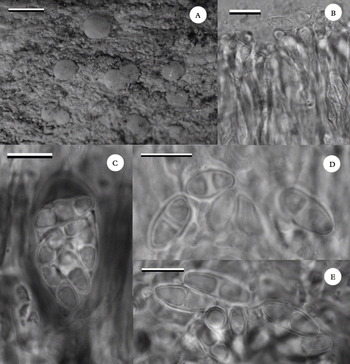
(Figs 1A–E)
Cliostomum coppinsii (Coppins 18562). A, thallus and apothecia; B, paraphyses; C, ascus with ascospores; D & E, ascospores. Scales: A = 1·0 mm; B – E = 10 µm. (A full colour version of this Figure is available at Mycobank: http://www.mycobank.org/MycoTaxo.aspx?Link=T&Rec=518029)

Thallus crustose, effuse, in small patches 1–2 cm across, delimited by a black prothallus where adjacent to other lichens, white to pale cream, generally smooth, continuous or rimose to somewhat granular, sometimes patchy or very thin and inconspicuous, mostly 30–50 µm thick, ecorticate; photobiont a unicellular green alga with cells globose, 9–12(–15) µm diam.
Apothecia biatorine, 0·4–0·8 mm diam., scattered, with a wide base; disc pale yellow, becoming brown when overmature, often lightly pruinose especially towards the margin, plane or slightly convex with age; margin indistinct, paler than the disc but not raised above it. Exciple extending beneath the hypothecium, composed of thin, radiating hyphae, sparingly branched and anastomosing towards the outer edge, end cells not enlarged or differentiated. Hypothecium colourless to pale yellowish, K+ yellowish, 50–90 µm thick, composed of randomly orientated hyphae. Hymenium 60–75 µm thick, colourless, IKI+ blue, overlain and inspersed in the upper part with a layer of minute, pale yellow-brown crystals, K+ yellowish and dissolving. Paraphyses 1·5–2·5 µm thick, generally simple to sparsely branched in the lower part, becoming more branched and anastomosing and unevenly moniliform in the upper part; apices swollen to 2–5 µm, not pigmented. Asci clavate, 35–45 × 12–18 µm, eight-spored, of the Biatora-type: tholus well developed, amyloid, with a conical, weakly amyloid masse axiale with a slightly darker border; ocular chamber short, poorly developed to absent. Ascospores ellipsoid, hyaline, 12·0–14·0(–16) × 4·5–5·0(–6·0) µm, invariably 1-septate, ± polarilocular, with the septum usually 2–3 µm thick.
Pycnidia not observed.
Chemistry. Thallus containing atranorin, usnic acid and stictic acid; K+ yellow, KC−, C−, Pd+ orange.
Etymology. The new species is named in honour of our friend and colleague, Dr Brian Coppins, Edinburgh, who made the only collection of this species and also brought it to our attention.
Remarks. Although known only from a single collection, albeit a rather rich one, the microscopic characters of Cliostomum coppinsii make it clear that it is a distinct species, and we have been unable to find any species resembling it in the taxa described in Catillaria from the United Kingdom or Scandinavia. In the field, C. coppinsii could easily be overlooked for other pale-fruited lecideoid species that occur in the same habitat (e.g., Lecanora symmicta (Ach.) Ach.).However, it can be readily distinguished from other morphologically similar species by its distinctly yellowish apothecia. These recall the apothecia of C. corrugatum (Ach.) Fr. and C. leprosulum (Räsänen) Holien & Tønsberg, but the former has a much thicker thallus and the latter is sorediate, and both also have narrower ascospores and a different thalline chemistry (atranorin and caperatic acid).
The closest relative of the new species appears to be the austral species, C. praepallidum (see below) which has similar, polarilocular ascospores that are rather longer and broader, and a different chemistry comprising atranorin and aliphatic acids.
Distribution and ecology. The single collection of C. coppinsii was made from the ‘leggy’ stems, 5–20 mm diam., of Calluna vulgaris (L.) Hull growing on dryish soil in an open area in a native Scots pine (Pinus sylvestris L.) wood on a small island in Loch Maree in the NW highlands of Scotland. However, it is almost certainly overlooked and should be looked for in this habitat elsewhere in Scotland and NW Europe. The island has good stands of native Scots pine and juniper (Juniperus communis L.), the latter supporting Buellia arnoldii Servít and Lecidella subviridis Tønsberg (B. J. Coppins, personal communication). Other lichen species occurring on Calluna stems with C. coppinsii included Bacidia absistens (Nyl.) Arnold, Melanelixia subaurifera (Nyl.) O. Blanco et al., Odontotrema sp., Parmelia saxatilis (L.) Ach. s. lat. and Usnea hirta (L.) Weber ex F.H. Wigg.
Cliostomum praepallidum (Müll. Arg.) Kantvilas & Fryday comb. nov
Mycobank: MB 518030
Patellaria praepallida Müll. Arg., Miss. Sc. Cap Horn, Lich.: 166 (1888).—Biatorina praepallida (Müll. Arg.) Darb., Wiss. Ergebn. Schwed. Südpol.-Exp., 1901–03 4(11): 48 (1912).—Catillaria praepallida (Müll. Arg.) Zahlbr., Cat. Lich. Univ. 4: 63 (1926); type: Chile, Insula Wollaston, Terre de Feu, ad corticem Drimys winteri, 1882–83, P. Hariot 36 (G!).
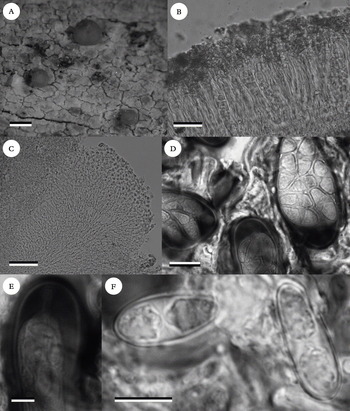
(Figs 2A–F)
Cliostomum praepallidum (Imshaug 51391). A, thallus and apothecia; B, hymenium; C, excipulum; D, ascus with ascospores; E, ascus apex structure; F, ascospores. Scales: A = 0·5 mm; B & C = 25 µm; D & F = 10 µm, E = 5 µm. (A full colour version of this Figure is available at Mycobank: http://www.mycobank.org/MycoTaxo.aspx?Link=T&Rec=518030)

Thallus crustose, effuse, not delimited by a prothallus, pale grey to cream-grey, generally smooth, continuous or somewhat patchy, sometimes very thin and inapparent, mostly 30–80 µm thick, ecorticate; photobiont a unicellular green alga with cells globose, 6–10 µm diam.
Apothecia biatorine, 0·3–1 mm diam., scattered, basally constricted; disc pale pink to pale orange, rather waxy and glossy, epruinose, plane at first, becoming convex with age, at length sometimes becoming multi-divided or with clusters of fused regenerating apothecia and hence appearing ± cerebriform; margin concolorous with the disc, rarely a little paler, slightly inrolled when young, eventually becoming obscured by the disc. Exciple extending beneath the hypothecium, 40–90(–120) µm thick, composed of radiating, heavily gelatinized, highly branched and anastomosing hyphae 1–1·5 µm thick, inspersed with minute, pale yellow-brown crystals that fluoresce in polarized light and dissolve K+ yellowish. Hypothecium colourless to pale yellowish, K+ yellowish, 50–130 µm thick. Hymenium 60–70 µm thick, colourless, IKI+ blue, overlain and inspersed in the upper part with a layer of minute, pale yellow-brown crystals, K+ yellowish and dissolving. Paraphyses 1·5–2·5 µm thick, generally simple to sparsely branched in the lower part, becoming more branched and anastomosing and unevenly ‘knobbly’ in the upper part; apices swollen to 2–5 µm, not pigmented. Asci clavate, 35–50 × 10–18 µm, eight-spored, of the Biatora-type: tholus well developed, amyloid, with a conical, weakly amyloid masse axiale with a slightly darker border; ocular chamber mostly rather short and poorly developed. Ascospores ellipsoid, hyaline, (11–)12–14·3–18 × (5–)6–7·3–9 µm, invariably one-septate, polarilocular, with the septum as much as 3–5 µm thick and the narrow connecting channel clearly evident.
Pycnidia not observed.
Chemistry. Thallus containing atranorin, roccellic acid and norcaperatic acids; K− or very weakly yellowish, KC−, C−, Pd−.
Notes on the type. Patellaria praepallida Müll. Arg, was described from a collection made by Paul Hariot on the French Scientific Expedition to Cape Horn (Müller Reference Müller1888). Hariot's original collection (in G) is extremely small (c. 2 mm2) but has several apothecia and our species is clearly conspecific with it. We have not recognized the specimen in G as the holotype in the hope that there may be a better developed specimen in PC who, unfortunately, did not respond to our requests for information.
Remarks. There are several other lichens, at least in the Tasmanian biota, that bear a superficial resemblance to C. praepallidum and may occur in identical habitats. These include several species of crustose Coenogonium (in the sense of the now disused Dimerella), although these lichens have rather brighter orange apothecia, a trentepohlioid photobiont and Gyalectaceae-type asci. Also somewhat similar are some unpigmented forms of Megalaria melanotropa (Nyl.) D. J. Galloway (syn. Catillochroma melanotropa (Nyl.) Kalb); these have far broader, Megalaria-like ascospores, and careful examination of the apothecia will reveal at least some with hints of the diagnostic greenish epithecial pigment and grey pruina. Thereare also several unidentified species tentatively assigned to Biatora, but these have significantly larger, simple ascospores. Cliostomum praepallidum is the species referred to in numerous inventories for the Tasmanian lichen flora (e.g. Kantvilas Reference Kantvilas1988; Jarman & Kantvilas Reference Jarman and Kantvilas1995, Reference Jarman and Kantvilas2001; Kantvilas et al. Reference Kantvilas, Elix and Jarman2008) as ‘Catillaria sp. 1’ or ‘Catillaria sp.’
Apart from C. coppinsii (discussed above), the Cliostomum species most similar to C. praepallidum is the common and widespread C. griffithii (Sm.) Coppins, which has an identical thallus chemistry to C. praepallidum; furthermore, although C. griffithii frequently has dark-pigmented apothecia (these are never seen in C. praepallidum), it may occur with pale orange to pink apothecia as well. The two taxa are readily separated by their ascospores: in C. griffithii these are (0–)1(–3) septate, never polarilocular and consistently narrower, in that they never exceed 5 µm in width and only occasionally reach 4·5 µm.
Distribution and ecology. Cliostomum praepallidum is an easily overlooked and inconspicuous species that is still poorly recorded. It is known from Tasmania and the extreme south of South America (Argentina and Chile) but is likely to occur more widely in the austral zone. It is part of a very rich assemblage of chiefly crustose species occurring on bark or young branches and twigs in the canopy of cool temperate rainforest or in wet heathland and scrub. In Tasmania, associated species include: Haematomma nothofagi Kalb & Staiger, Hypogymnia tasmanica Elix, Loxospora solenospora (Müll. Arg.) Kantvilas, Menegazzia pertransita (Stirt.) R. Sant., Ochrolechia sp., Pertusaria jamesii Kantvilas, P. novaezelandiae Szatala, Ramboldia laeta (Stirt.) Kalb et al., Tasmidella variabilis Kantvilas et al., Thelotrema lepadinum (Ach.) Ach. and Usnea oncodes Stirt.
Selected specimens examined. Argentina: Isla de los Estados: Puerto Basil Hall, on Punta Passalacqua peninsula N of Puerto Abrigado, open Nothofagus-Drimys forest, on Nothofagus, 1971, H. Imshaug 51391 & K. Ohlsson (MSC); Bahia Flinders, at head of W part of bay, Nothofagus forest, 1971, H. Imshaug (53494, 53519) & K. Ohlsson (MSC).—Australia: Tasmania: Little Fisher River, 41°45′S 146°20′E, 880 m, 1984, G. Kantvilas 434/84 & P. James (BM, HO); same locality, 820 m, 1984, G. Kantvilas 698/84 (BM, HO); W of Tahune Bridge, 43°06′S 146°41′E, 100 m, 2008, G. Kantvilas 360/08 (HO); same locality, 1998, G. Kantvilas s. n. (HO); Pelion Plains, 41°50′S 146°02′E, 890 m, 1992, G. Kantvilas 244/92 (HO); c. 3 km S of Teepookana, 42°13′S 145° 26′E, 220 m, 1990, G. Kantvilas 667/90 (HO); Balt Spur, 43°05′S 147°56′E, 420 m, 1983, G. Kantvilas 161/83 (HO); Anthony Road, 41°50′S 145°38′E, 600 m, 1991, G. Kantvilas 202/91 (HO); Mt Sprent, 42°48′S 145°58′E, 850 m, 1987, G. Kantvilas 132/87B (E, HO); Mt Norold, 43°15′S 146°15′E, 950 m, 1994, G. Kantvilas 17/94 (HO, MSC).
Discussion
With their relatively broad, ± polarilocular ascospores, C. coppinsii and C. praepallidum occupy a rather peripheral position within Cliostomum. All the species previously referred to Cliostomum have narrow ascospores with a high length:breadth ratio, usually around 4·5–5·0, but always >3·2. The two additional species treated here are somewhat anomalous in that they have broader ascospores with a length:breadth ratio of 2·0–2·5 and with a tendency to become polarilocular. However, consistent with the salient characters that define the genus (Ekman Reference Ekman1997), they have biatorine apothecia, an exciple of radiating hyphae with minute crystalline inclusions that dissolve in KOH (not present in C. coppinsii), an unpigmented hypothecium, paraphyses that become rather branched and knobbly in the upper part, and Biatora-type asci. The thallus chemistry, comprising atranorin, along with β-orcinol depsidones and usnic acid (C. coppinsii) or aliphatic acids (C. praepallidum), is also consistent with other species of the genus. Cliostomum is thus the generic placement of ‘best fit’, with the only other option in our opinion being to describe a new genus, chiefly on the basis of the unusual ascospores. Regrettably, no pycnidia could be located on the single collection of C. coppinsii or any of the numerous specimens of C. praepallidum available, as this character may well have provided critical evidence regarding the generic position of the species.
New synonym
Cliostomum griffithii (Sm.) Coppins
in D. Hawksworth et al., Lichenologist 12: 106 (1980).
Catillaria banksiae (Müll. Arg.) Zahlbr., Cat. Lich. Univ. 4: 11 (1926).—Patellaria banksiae Müll. Arg., Bull. Herb. Boissier 1: 47 (1893); type: [Australia, Victoria] corticola, in Banksia serrata prope Cheltenham, [F.R.M.] Wilson n. 632, et prope Sandringham, n. 722 (G!— lectotype, here designated, Wilson 632; G!— syntype, Wilson 722).
The extensive synonymy of this highly variable lichen, which is widespread in the temperate regions of both hemispheres, is given by Ekman (Reference Ekman1997). This includes C. spermogoniatum (Zahlbr.) Kantvilas & Elix, an Australasian taxon that was, with some hesitation, regarded as distinct by Kantvilas & Elix (Reference Kantvilas and Elix1995), chiefly on the basis of a granular-areolate thallus, consistently pale apothecia and unilocular pycnidia. To this list can now be added Catillaria banksiae (Müll. Arg.) Zahlbr., based on an Australian specimen with dark grey apothecia, growing on charred wood. The two syntypes cited by Müller (Reference Müller1893) are in every respect identical, and the larger (no. 632) is here chosen as the lectotype.
In their investigation of C. griffithii in Australia, Kantvilas & Elix (Reference Kantvilas and Elix1995) considered this species an epiphyte of cool temperate rainforest and subalpine woodlands. The ecological amplitude of the species is now known to be far broader: it is common in lowland Melaleuca-dominated swamps, in open eucalypt forest and woodland, and in coastal scrub. Specimens from such more exposed, drier habitats almost invariably have black apothecia, with or without a light dusting of grey pruina.
We acknowledge with thanks the contribution of our good friend Brian Coppins, who kindly allowed us to describe the new species and provided numerous helpful comments on the work. We also thank Jack Elix for confirming our chemical analyses of C. praepallidum. GK acknowledges with thanks the British Lichen Society and Sibbald Trust, which supported his travel to the United Kingdom to advance this work and AMF thanks the US National Science Foundation (NSF) for Awards No. DBI–9808735 and DBI–0237401 (Alan Prather, PI) to Michigan State University that facilitated access to Dr Imshaug's extensive collections.