Recent studies have identified the causal impacts of statutes prohibiting discrimination in contexts such as elections, schools, and workplaces (Chay Reference Chay1998; Cascio et al. Reference Cascio, Gordon, Lewis and Reber2010; Cascio and Washington Reference Cascio and Washington2014). However, despite widespread belief in the efficacy of statutes prohibiting discrimination in public accommodations (Kennedy Reference Kennedy and Grofman2000; Wright Reference Wright2013), including protections for the use of privately provided yet publicly available services such as transportation, hotels, and restaurants, researchers have yet to isolate causal effects from such statutes. In part this is because, unlike statutes prohibiting discrimination in voting, education, and employment, it is not immediately clear what kind of outcome measure one would use to identify the effect of public accommodations statutes. In the US context, this problem is compounded by the omnibus structure of the Civil Rights Act of 1964, which makes it difficult to distinguish the effects of the Act's public accommodations provisions from the effects of its many other provisions.Footnote 1 The lack of any empirical evidence establishing the impact of public accommodations statutes impoverishes the debate over the extension of these statutes to new categories.
We leverage the US Supreme Court's 1883 strike of the public accommodations provisions in the Civil Rights Act of 1875, along with variation in state-level statutes, to identify the impacts of prohibitions on discrimination in public accommodations. The Civil Rights Act of 1875 contained two categories of provisions: those prohibiting race-based discrimination in public accommodations, and those prohibiting race-based discrimination in jury selection. The provisions prohibiting discrimination in public accommodations were struck by the Supreme Court in The Civil Rights Cases (109 US 3 (1883)), while the jury-selection provisions remained in effect. The 1883 ruling thus isolated a change in federal law regulating race-based discrimination in access to public accommodations. We estimate the impact of this repeal on African-American well-being in states without state-level protective statutes, relative to states with such statutes. We use panel data on body weight sourced from the repeated medical exams of United States Colored Troops (USCT) veterans to measure well-being, given previous work establishing that short-term fluctuations in weight correlate with short-term fluctuations in net well-being during conditions of economic scarcity (Fogel Reference Fogel2004; Floud et al. Reference Floud, Fogel, Harris and Hong2011).
Using a difference-in-differences design, supplemented by a series of geographic regression discontinuity (GRD) and placebo designs, we show that African-American body weight in the states unprotected by public accommodations statutes decreased between 2.2 and 4.5 pounds in four years after the Supreme Court's ruling, relative to African-American body weight in the states with state-level protections. These estimates persist with the inclusion of veteran-level and county-level pre-ruling covariates, including pre-ruling within-veteran trends in weight loss, do not diminish in magnitude as we approach the border distinguishing the two categories of states, and are robust to a variety of placebo checks. Our findings suggest that federal public accommodations statutes can mitigate the measurable harms endured by victims of discrimination in public accommodations.
1. Prohibiting discrimination in public accommodations
Public accommodations statutes typically prohibit discrimination against those in defined demographic groups for defined categories of places. For example, the Civil Rights Act of 1875 directed that “all persons within the jurisdiction of the United States shall be entitled to the full and equal enjoyment of the accommodations, advantages, facilities, and privileges of inns, public conveyances on land or water, theaters, and other places of public amusement,” subject only to any limitations “established by law, and applicable alike to citizens of every race and color, regardless of any previous condition of servitude.”
There are a number of pathways through which public accommodations statutes might lead to improved well-being for those in protected categories. Public accommodations statutes might enable increased mobility among those in protected groups, possibly leading to labor market gains. For example, there are reports that the public accommodations provisions of the Civil Rights Act of 1875 helped to secure African-American access to interstate transportation at a time when at least some Southern employers, preferring to restrict the mobility of African-American workers rather than compete on wages, pressured interstate railroad and steamboat operators not to carry African-American passengers (Franklin Reference Franklin1974; Painter Reference Painter1977). The Act may have also helped to secure African-American access to intra-city transportation services, such as streetcars and omnibuses, important services for African-Americans during this period because of their typical residence in outlying districts far from the economic opportunities available in city centers (Foner Reference Foner1973a, Reference Foner1973b; Rabinowitz Reference Rabinowitz1978; Wright Reference Wright1985). African-American access to both interstate and intercity transportation services may have reduced relative costs to pursuing economic opportunities during the 1870s and early 1880s, leading to increased relative wages.
It is also possible that public accommodations statutes lead to increased well-being for those in protected categories by reducing the potentially debilitating stress associated with the humiliation of public discrimination. Stress induced by the experience of racial discrimination has been associated with significant short-term physiological effects, including increased nutritional risk among African-American men (Marmot Reference Marmot2005; Locher et al. Reference Locher, Ritchie, Roth, Baker, Bodner and Allman2005; Williams and Mohammed Reference Williams and Mohammed2009). By reducing the incidence of discriminatory behavior, public accommodations statutes may reduce discrimination-induced stress and thus lead to increased well-being for those in protected categories.
Given the limited nature of our historical data, it is beyond the scope of this paper to adjudicate between these alternative mechanisms. We instead hypothesize simply that federal protections for access to public accommodations have significant positive impacts on the well-being of those in protected categories.
2. Empirical analysis
The Supreme Court's strike of the public accommodations provisions in the Civil Rights Act of 1875, implemented in its ruling in The Civil Rights Cases, 109 US 3 (1883), isolated a change in federal law regulating race-based discrimination in public accommodations, enabling the identification of the effects of that change.
Historians of the period have argued that, because of growing racial conservatism, the public accommodations provisions of the Act were never enforced, and consequently the Act did not improve African-American well-being (Franklin Reference Franklin1974; Gillette Reference Gillette1979; Wright Reference Wright1985, Reference Wright2013; Foner Reference Foner1988). These claims are supported only by anecdotal evidence. Yet, there is at least some qualitative evidence from the period suggesting that African-American well-being in fact increased during the time that the Act's public accommodations provisions were in force, and declined after these provisions were struck in 1883. We report on this evidence in the Supplementary Materials.
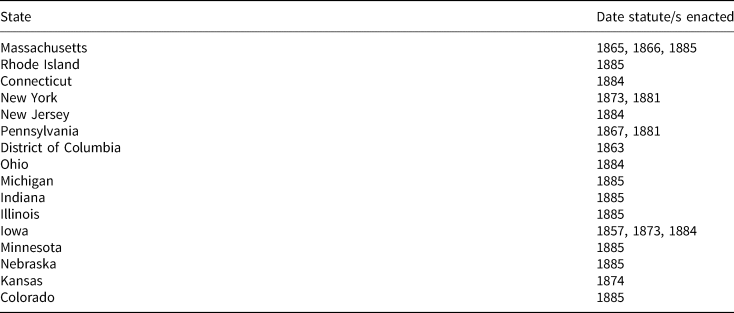
It is possible, however, as historians have suggested, that any observed worsening of African-American well-being after the early 1880s was simply due to increasing racial conservatism, rather than to the Court's 1883 strike of the federal protections against race-based discrimination in public accommodations. We address this concern by leveraging the variation in state-level public accommodations statutes. Many states, generally the more northern states, enacted state-level public accommodations statutes either before or shortly after the Court's ruling in The Civil Rights Cases (see Table 1). In these states, the strike of the Civil Rights Act of 1875 presumably would have had little impact because of the protections offered by these state-level statutes. We can thus use changes in the well-being of African-Americans living in these “control” states to difference out the effects of any national-level events or trends on changes in the well-being of African-Americans in our “treatment” states, namely those lacking state-level public accommodations statutes.

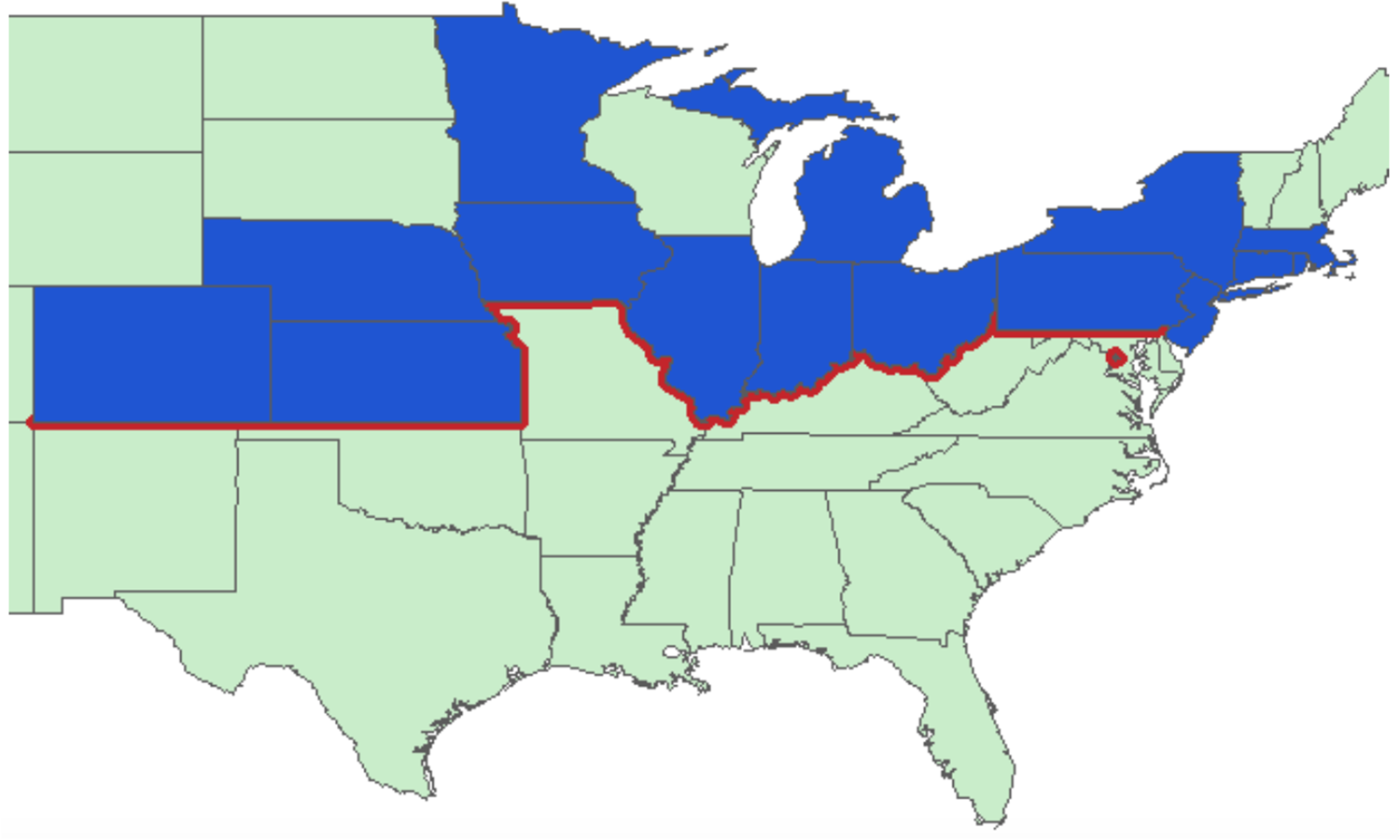
Yet, racial hostility might have been increasing faster in the more southern states, relative to the more northern states that were more likely to have enacted public accommodations statutes. This could have led to relative declines in African-American well-being in the unprotected states, independently of the Court's 1883 strike of federal public accommodations protections. We address this potential threat to inference by treating the primary border between states with and without state-level public accommodations statutes (see Figure 1) as a geographic discontinuity (Keele and Titiunik Reference Keele and Titiunik2015, Reference Keele and Titiunik2016; Keele et al. Reference Keele, Titiunik and Zubizaretta2015, Reference Keele, Lorch, Passarella, Small, Titiunik, Cattaneo and Escanciano2017). Laws change discontinuously across state borders. While agent-based incentives likely lead to sorting across state borders according to pre-existing attitudes, we assume that attitudes are nonetheless more continuous within relatively narrow bandwidths around state borders than the discontinuous changes in laws at those borders.Footnote 2
States with public accommodation statutes (in blue).

States that did not enact public accommodations statutes might also have been less likely to enact statutes providing for other public goods, such as schools, hospitals, sanitation, and roads, during our period of interest. We address this potential problem of compound treatments with two strategies.Footnote 3
First, we use white residents near our border of interest as a placebo group. Variation in racially neutral public goods provision over our period of interest would presumably have affected not only African-American residents near the border of interest, but also white residents. Second, we replicate our empirical specifications during the period that the federal public accommodations provisions remained in effect, between 1875 and 1883. Stable compound treatments at the border distinguishing states with from states without state-level public accommodations statutes would have been in place during this immediate pre-ruling period. If state-level variation other than that associated with public accommodations statutes were driving relative changes in African-American well-being near this border during our period of interest, then we would expect to see similar relative changes near this border during the pre-ruling period.
3. Data
Between 1862 and 1890, Union Army and USCT veterans could apply for military pensions by claiming that a current disability, interfering with their ability to perform manual labor, was directly or indirectly related to their wartime service. One component of the pension application process was a medical examination. Upon receiving a veteran's application, the Pension Bureau would direct the applicant to appear before a board of examining surgeons “at a location near his place of residence” (Logue and Blanck Reference Logue and Blanck2010, 30). Examining surgeons were given a standardized form to complete directing them to report any medical evidence relevant to an applicant's claim of disability, and to provide a recommendation to the Pension Bureau as to whether a claim should be granted, and if so, at what level of support (“Instructions to Examining Surgeons, 1870–1926,” Department of the Interior, Pension Office, Washington D.C.). The form also directed examining surgeons to record basic intake information on all applicants, including weight, height, and age. Many applicants were given multiple exams over time, either because they reapplied after their applications were initially denied, or because they applied for an increase to their current pension. We use these repeated exams to create panel data on veteran weight across our period of interest. To address concerns that those veterans who applied multiple times for pension support over our period of interest were different in some way from veterans who did not reapply for pension support over this period, we show in Supplementary Materials Table 1 that USCT veterans who applied for pension support in both the pre-ruling and post-ruling periods are indistinguishable on observable covariates from those USCT veterans who applied for pension support only during the pre-ruling period.
Fogel (Reference Fogel2004) and Floud et al. (Reference Floud, Fogel, Harris and Hong2011) have found that short-term changes in weight conditional on height may proxy for short-term changes in economic conditions during periods of relative scarcity.Footnote 4 Relative scarcity characterizes the United States in the latter half of the 19th century, when workers spent approximately 50–75 percent of their wages on food (Floud et al. Reference Floud, Fogel, Harris and Hong2011). In fact, weight conditional on height may be a better measure of net economic conditions than real wages or incomes, as the latter may reflect “bribes” paid to compensate workers when mortality risks are high, for example in locations with significant disease prevalence (Fogel Reference Fogel2004). Infectious diseases were rampant in the late-19th century United States, as increases in population density outpaced public health infrastructural improvements, indicating the value of using body weight conditional on height as a measure of individuals’ net welfare during this period (Ibid.).
Following this literature, our design estimates the effect of the 1883 strike of the public accommodations provisions in the Civil Rights Act of 1875 on within-veteran changes in USCT body weight in states with and without state-level public accommodations protections. If the Court's ruling led to relative decreases in African-American wages, relative increases in the amount of effort necessary to secure adequate nutrition, and/or relative increases in discrimination-induced stress in states without state-level public accommodations statutes, we would expect relative decreases in the quantity and quality of nutrition consumed by African-American veterans, and consequently relative decreases in African-American weight conditional on height in these states.Footnote 5
Our data are sourced from a random sample of Civil War veterans’ medical examinations collected as part of the Early Indicators Project.Footnote 6 The Early Indicators sample comprises those members of 332 Union Army companies and 169 USCT companies whose military records could be linked with postbellum pension records.Footnote 7 We first identify those veterans with both pre-ruling and post-ruling exams so that we are able to identify within-veteran changes in weight conditional on height.Footnote 8 Restricting analysis to a panel sample also enables us to assess pre-ruling covariate balance for all veterans in that sample.
For each exam we retrieved latitude and longitude coordinates for the town in which an exam was conducted from the USGS list of populated places for identifiable combinations of town and state.Footnote 9 We computed the shortest distance from each identified set of latitude and longitude coordinates to the border separating those states with state-level public accommodations statutes from those without. County-level measures of local economic conditions were sourced from the 1880 census for each exam with an identifiable geographic location.
Choosing a time period of study poses a tradeoff between the size of our samples and the temporal proximity of the Court's ruling. We report here estimates from an eight-year window bracketing the Court's ruling in The Civil Rights Cases. Estimates are relatively robust to changes in the size of this window. We further restrict our samples to veterans located on the same side of our border of interest throughout this window of 15 October 1879 through 15 October 1887.
Our full USCT sample consists of 424 veterans examined a total of 1230 times within our eight-year study period. For our placebo tests using white Union Army veterans, our full sample consists of 2510 veterans examined a total of 7835 times during our study period. We also construct subsamples using geographic windows of 300 and 200 miles on either side of our border of interest. These windowed subsamples were constructed by averaging the distance to the border across all of a veteran's exams during our sample period. A veteran in our full sample is included in a windowed subsample if the average distance to the border across all his exams during our sample period is equal to or less than the subsample window. Our subsample for the 300 mile window consists of 370 USCT veterans examined a total of 1082 times and, for our placebo tests, 1943 Union Army veterans examined a total of 6113 times. Our subsample for the 200 mile window consists of 297 USCT veterans examined a total of 868 times and, for our placebo tests, 1534 Union Army veterans examined a total of 4833 times. Figures 1 and 2 in the Supplementary Materials map these samples of exams.
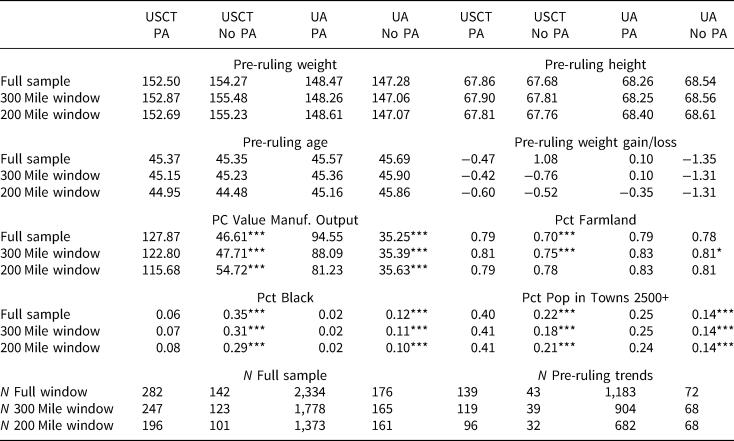
Our first empirical strategy is a simple difference-in-differences approach, which compares changes in weight among USCT veterans in protected states to changes in weight among USCT veterans in unprotected states, across the pre- and post-ruling periods. We first assess balance on a series of pre-ruling covariates constructed by averaging each veteran's recorded weight, height, age, and associated county-level measures of local economic conditions during the four-year period prior to the Court's 1883 ruling. The county-level measures include the percent of the population living in towns greater than 2500 in population in 1880 (Pct Pop in Towns 2500+), the per capita value of manufacturing output in 1880 (PC Value Manuf. Output), the percent of a county's acreage dedicated to farming in 1880 (Pct Farmland), and the percent of the population that is African-American in 1880 (Pct Black). Descriptive statistics as well as the results of tests of differences in means for these pre-ruling covariates are reported in Table 2. We replicate this table for additional pre-ruling measures of the incidence of systemic medical conditions among USCT veterans in Supplementary Materials Table 2.Footnote 10
Pre-ruling covariate balance

*${\rm p}\lt {0}.10$ , **${\rm p}\lt {0}.05$
 , ***${\rm p}\lt {0}.01$
 (two-tailed tests). A Bonferroni correction would lead us to never reject the null that the means of pre-ruling covariates of USCT veterans in states with and without public accommodations protections are not different from each other.
Table 2 shows that, for both the USCT and the placebo Union Army samples, there are no significant cross-border differences in veteran-level pre-ruling characteristics, within any geographic windows. Table 2 in the Supplementary Materials also reports cross-border pre-ruling balance in disease incidence among USCT veterans. We do see significant cross-border differences on all county-level pre-ruling census covariates in the USCT sample. USCT veterans in states with public accommodations statutes are more likely to be located during the pre-ruling period in counties that have higher per capita manufacturing output; a greater proportion of acreage devoted to farmland; lower proportions of black residents; and higher proportions of residents living in towns of at least 2500 in population. However, we also see these same cross-border differences, at generally the same relative magnitudes and significance levels, in our placebo sample of white Union Army veterans. If local economic conditions were driving changes in weight conditional on height over our period of interest, presumably we should see the same patterns in weight conditional on height in both the USCT and the Union Army samples. Our placebo tests using Union Army veterans will allow us to examine this possibility. We also see that the cross-border differences in pre-ruling census covariates are generally decreasing as we approach the border for both samples, suggesting that focusing on veterans closer to the border may reduce the influence of possible confounders.
For a subset of the veterans in our samples we are also able to construct pre-ruling trends in body weight. We do this using a veteran's last two exams prior to the Court's ruling in The Civil Rights Cases, with the constraint that both exams must have taken place during the period that the Civil Rights Act of 1875 was in effect. Importantly, we see no significant cross-border differences in within-veteran pre-ruling trends in weight in either the USCT or the placebo Union Army samples, within any geographic windows. Moreover, the differences that do exist in pre-ruling trends in weight narrow as we approach the border for both samples, again suggesting that focusing on veterans closer to the border may reduce the influence of possible confounders.
These pre-ruling covariate balance tests also allow us to address the possibility of cross-border selection bias in our samples. For example, perhaps doctors had more racially discriminatory attitudes in the more southern states, relative to the more northern states, resulting in higher standards for USCT pension applicants from the former states. USCT veterans with less severe disabilities might then have been less likely to apply for pensions in the states without state-level public accommodations statutes, resulting in systematically less healthy USCT veterans in our sample from these states. However, the absence of any cross-border veteran-level differences among USCT veterans during the pre-ruling period mitigates this concern. Relatedly, perhaps USCT veterans with less severe disabilities in the states without state-level public accommodations statutes took the Court's 1883 strike as a signal that their pension applications would not be treated favorably, and were less likely to reapply for pension support during the post-ruling period, relative to veterans from the states with public accommodations protections. Again, this selection bias might have resulted in systematically less healthy USCT veterans in our sample from the states without state-level public accommodations protections. Again, however, the absence of any cross-border veteran-level differences among USCT veterans during the pre-ruling period at least partially mitigates this concern.
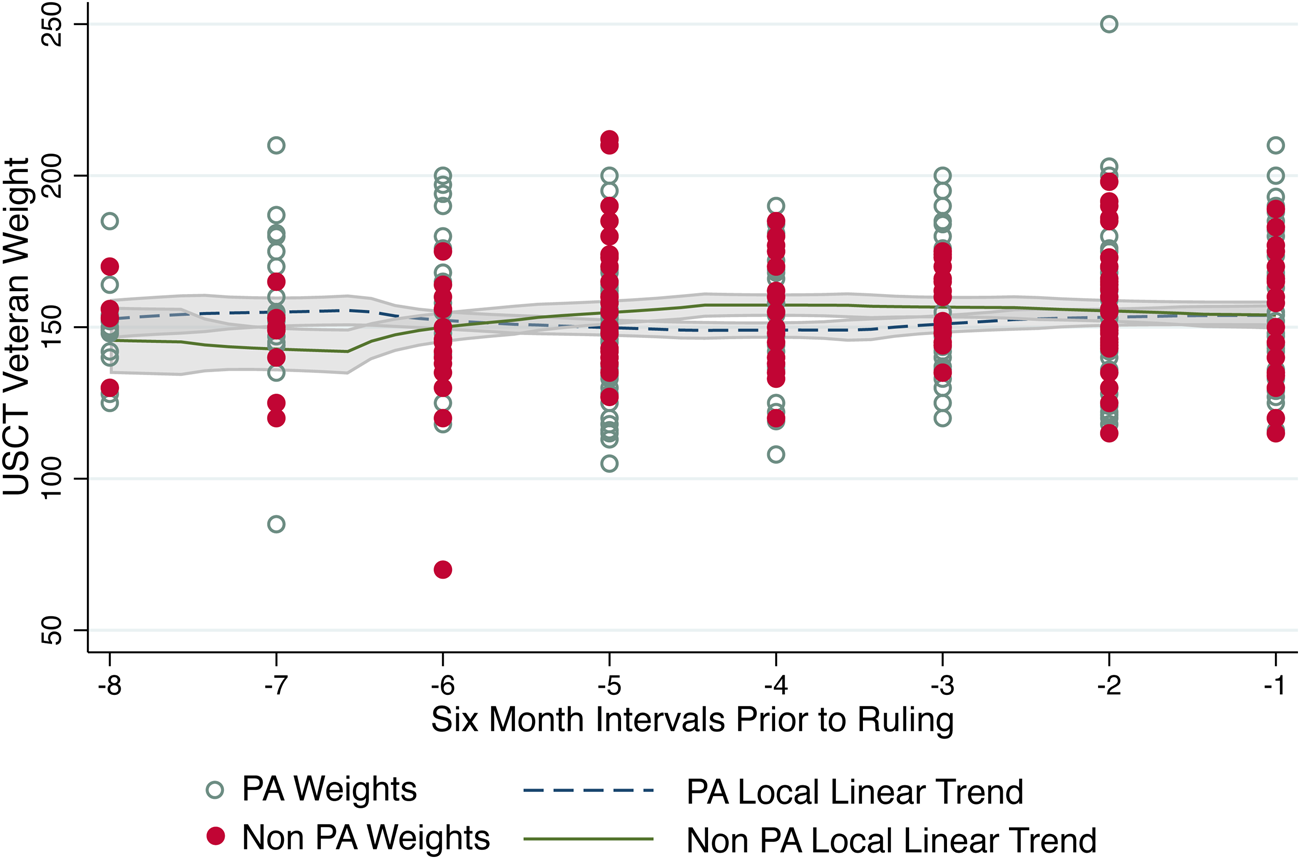
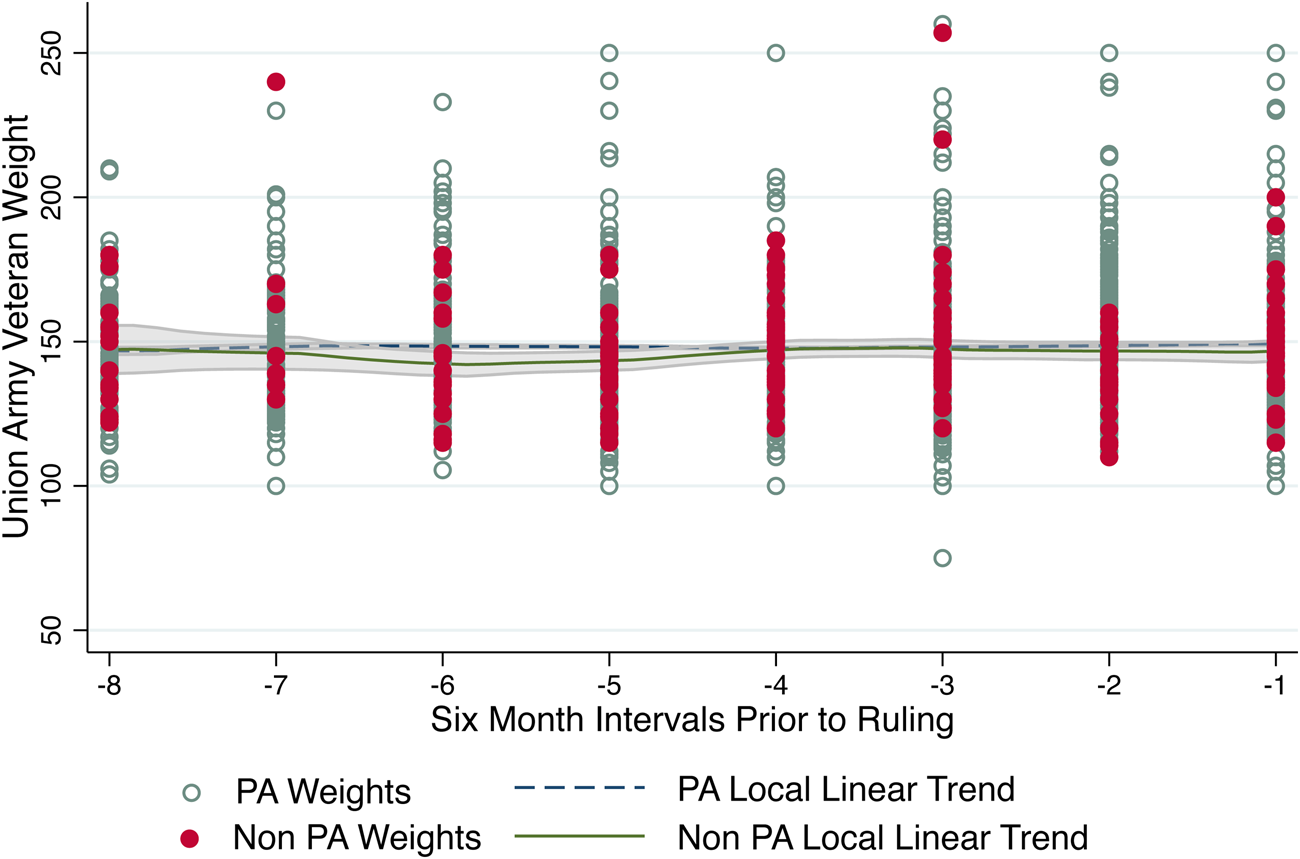
Figures 2 and 3 report trends in average weight for the full samples of USCT and Union Army veterans, for six-month intervals before the Court's ruling in The Civil Rights Cases. Weights for each of our veterans are depicted in scatterplots within each of the six-month bins, plotted separately for treatment and control observations. We also report local linear regression smoothing lines for treatment and control observations, with 95 percent confidence intervals.Footnote 11
Average USCT veteran weight; states with and without public accommodations statutes.

Average UA veteran weight; states with and without public accommodations statutes.

Figures 2 and 3 show that pre-ruling trends in veteran weight, for both the USCT and the UA samples, appear roughly parallel across treatment and control observations. While there is a slight relative dip in veteran weight in the states without public accommodations statutes in the fourth and third pre-ruling years, this dip occurs in both the USCT and the Union Army samples, suggesting the presence of regional trends affecting all veterans. In our later analyses we implement placebo tests using Union Army veterans, allowing us to address whether these regional trends are driving our findings. We also reiterate that Table 2 reports no significant cross-border differences in within-veteran trends in pre-ruling USCT weight, shoring up the assumption of parallel trends within our group of interest. To further address any remaining concerns about parallel trends, we replicate our primary difference-in-differences and GRD models using only the samples of veterans for whom we can condition on pre-ruling trends in weight, although we also note the relative sparsity of these data.
We now turn to a series of empirical models to estimate the impact of the Court's ruling in The Civil Rights Cases on USCT veteran weight.
4. Results
We first estimate a difference-in-differences model of the effect of the Court's 15 October 1883 ruling on USCT weight between 15 October 1879 and 15 October 1887, where outcomes are defined by veteran i in county c in state s during year t, and are assumed to be generated by the following equation:

Non-PA State s is a dummy variable equal to 1 if state s did not have a state-level public accommodations statute in place during our period of interest, and 0 otherwise. Post-Ruling t is a dummy variable equal to 0 if the veteran's medical exam took place between 15 October 1879 and 15 October 1883, and 1 if the exam took place between 16 October 1883 and 15 October 1887. X it is a vector of time-varying individual-level covariates, namely height and age. X c is a vector of the four county-level 1880 census covariates included in Table 2, namely Pct Black, Pct Value Manuf. Output, Pct Pop in Towns 2500+, and Pct Farmland. State fixed effects αs are included to address fixed differences in outcomes by state. Year fixed effects μt are included to absorb year-specific shocks unrelated to the Court's ruling in The Civil Rights Cases. All models are estimated using OLS with robust standard errors clustered on 20 mile intervals from the border distinguishing states with from states without public accommodations statutes.Footnote 12
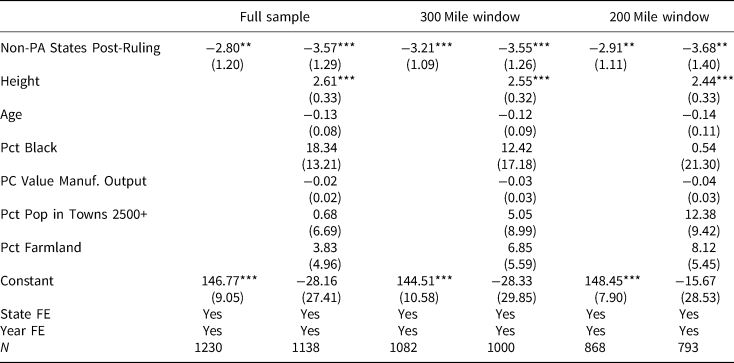
Table 3 reports estimates from Equation 1 for both the full USCT sample and for the 300-mile and 200-mile windowed subsamples. Estimates are consistently negative and significant at conventional thresholds, and become larger in magnitude with the inclusion of individual-level and county-level covariates. After the inclusion of covariates, USCT veterans in the full sample from states without public accommodations statutes are estimated to lose 3.6 pounds post-ruling, relative to USCT veterans from states with public accommodations statutes. Point estimates do not diminish appreciably as we narrow the sample around the border of interest, suggesting that results are not being driven by progressively greater racial hostility in the more southern states.
DiD estimates of effects of The Civil Rights Cases, 1879–1887; USCT veterans

*${\rm p}\lt {0}.10$ , **${\rm p}\lt {0}.05$
 , ***${\rm p}\lt {0}.01$
 .
Table 3 in the Supplementary Materials reports estimates for the same DiD models but with the inclusion of veteran-level fixed effects in addition to state and year fixed effects, a more demanding estimation strategy. Estimates are again consistently negative, although smaller in magnitude than without the inclusion of veteran-level fixed effects, and are significant at the 0.10 level in the models including individual-level and county-level covariates. After the inclusion of covariates, USCT veterans in the full sample from states without public accommodations statutes are estimated to lose 2.2 pounds post-ruling, relative to USCT veterans from states with public accommodations statutes. Again, point estimates do not diminish appreciably as samples are narrowed around the border of interest, suggesting that results are not being driven by progressively greater racial hostility in the more southern states.
Tables 4 and 5 in the Supplementary Materials report DiD estimates for the placebo sample of white Union Army veterans, both with and without veteran-level fixed effects. Estimates are consistently positive and significant across all models, indicating that the estimates for the USCT samples are not being driven by state- or region-level trends affecting both USCT and white Union Army veterans. While it is beyond the scope of this paper to explain the relative increases in the body mass of white Union Army veterans in the states without public accommodations statutes, we note the possibility of a zero-sum tradeoff in access to economic resources that at least partially accounts for the corresponding increases in white well-being in the same states in which we see decreases in African-American well-being over this period.
We also replicate our primary results for USCT veterans from Table 3 after controlling for pre-ruling trends in weight (see Table 6 in the Supplementary Materials). Results are substantively similar. These findings suggest that the negative effect of the Supreme Court's ruling on USCT body weight is not spuriously driven by pre-ruling trends.
There remains the possibility, however, that USCT veteran relative weight loss in states without public accommodations statutes was being driven by racial attitudes that were deteriorating more rapidly in those more southern states. A GRD design will allow us to further isolate the effects of the Court's ruling from trends in more continuously varying racial attitudes (Keele and Titiunik Reference Keele and Titiunik2015, Reference Keele and Titiunik2016; Keele et al. Reference Keele, Titiunik and Zubizaretta2015, Reference Keele, Lorch, Passarella, Small, Titiunik, Cattaneo and Escanciano2017). As reported in Table 2, differences in pre-ruling covariates generally decrease in magnitude as samples are narrowed around the border distinguishing states with and states without public accommodations statutes, suggesting that a GRD may be an appropriate design for these data.
To conduct the GRD we first construct within-veteran first differences in weight by subtracting a veteran's average pre-ruling weight over the four-year period prior to the Court's ruling in The Civil Rights Cases from his average post-ruling weight over the four-year period following that ruling. Table 7 in the Supplementary Materials reports average within-veteran changes in weight both for the full sample and for the 300-mile and 200-mile windowed subsamples. USCT veterans in states without public accommodations are losing weight on average in all samples over our period of interest, while USCT veterans in states with public accommodations are gaining weight on average over the same period. By contrast, white Union Army veterans in states without public accommodations are gaining weight on average in all samples over our period of interest, while white Union Army veterans in states with public accommodations are losing weight on average over the same period.
These within-veteran first differences in weight comprise our outcome of interest in the GRD analysis. The GRD analysis models individual-level weight gain/loss over the eight-year period bracketing the Court's ruling in The Civil Rights Cases, for a veteran i with exams occurring in a vector of counties c, all located in region r, comprising a set of states with or without state-level public accommodations statutes prior to the Court's ruling. Following recommended practice in the GRD literature (Keele and Titiunik Reference Keele and Titiunik2015, Reference Keele and Titiunik2016; Keele et al. Reference Keele, Titiunik and Zubizaretta2015, Reference Keele, Lorch, Passarella, Small, Titiunik, Cattaneo and Escanciano2017), we also divide the border distinguishing these two regions into four segments of equal length, using longitudinal cutting lines to divide the regions r into four subregions s, and include these border segments as fixed effects in the GRD model.Footnote 13
We estimate the following GRD model first for USCT veterans (our sample of interest) and then for white Union Army veterans (our placebo sample):

where Y i csr represents a veteran's weight gain/loss over the eight-year period bracketing the Court's ruling in The Civil Rights Cases; T r indicates whether a veteran is located in a region whose states all have public accommodations statutes during this period (T r = 0), or do not have public accommodations statutes during this period (T r = 1); and X i csr represents the average distance in the veteran's exam locations to the border distinguishing these two categories of states, and contains only units X i csr ∈ [h, h], where −h and h denote the MSE-optimal bandwidths to the left and right of the border, respectively. Our coefficient of interest is thus τ, which is estimated using local linear regression with a triangular kernel (Calonico et al., Reference Calonico, Cattaneo and Titunik2014, Reference Calonico, Cattaneo, Titunik and Farrell2019, Reference Calonico, Cattaneo and Farrell2020). The error term ɛi csr is clustered in 20-mile intervals on either side of the border, with the interval-identifiers increasing in value with distance south of the border. We also report models that implement local quadratic bias correction of the local linear point estimates, and local quadratic bias correction with robust variance estimation (Calonico et al., Reference Calonico, Cattaneo and Farrell2020).Footnote 14
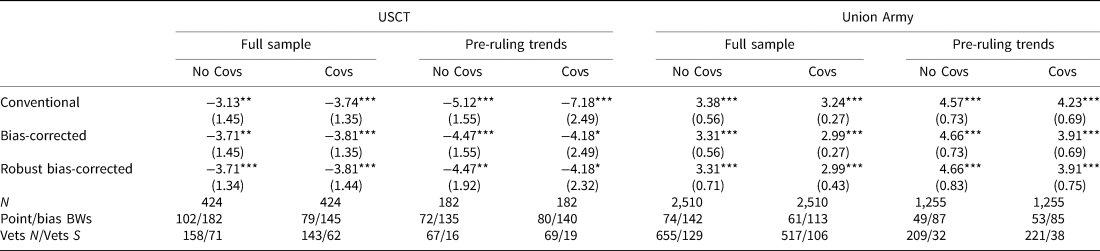
We first report models with no covariates included. We also report covariate-adjusted versions of our GRD estimator, including a vector for individual-level pre-ruling weight, height, and age (Zi csr), a vector for the four pre-ruling county level 1880 census covariates reported in Table 2 (Z′csr), and a vector of fixed effects for the subregions s (λs). We report these models, both with and without covariates, both for the full sample and for the subsamples for which we can compute veterans’ pre-ruling trends in weight gain/loss. For the subsample models, we include a veteran's pre-ruling weight gain/loss in the vector of individual-level pre-ruling covariates. Table 4 reports these estimates for both the sample of veterans for whom we want to draw inferences (i.e., USCT veterans), as well as the sample that we use as a placebo group (i.e., white Union Army veterans).
GRD estimates of veterans’ weight gains/losses, 1879–1887

Estimates of (T r = 1), or a veteran is located in one of the states without state-level public accommodations statutes at the time of the Supreme Court's ruling in The Civil Rights Cases. Local linear point estimators using a triangular kernel; bias-corrected models use a quadratic bias estimator. Optimal MSE bandwidth selection. Robust standard errors clustered on 20-mile intervals from border.
*${\rm p}\lt {0}.10$ , **${\rm p}\lt {0}.05$
 , ***${\rm p}\lt {0}.01$
 .
In all models, USCT veterans located just south of the border distinguishing states with and without state-level public accommodations statutes lose weight in the four years following the Court's ruling in The Civil Rights Cases, relative to their USCT veteran neighbors located just north of this border. Using the robust bias-corrected GRD estimates, this relative weight loss ranges from 3.7 to 3.8 pounds in the full sample, and from 4.2 to 4.5 pounds in the subsample for which pre-ruling trends in weight gain/loss are available (including these trends as a covariate). These point estimates, which are estimated within MSE-optimal bandwidths ranging from 72 to 102 miles north of the border and from 135 to 182 miles south of the border, are significant at the 99–90 percent levels. By contrast, in all models, white Union Army veterans located just south of the border distinguishing states with and without public accommodations statutes gain weight in the four years following the Court's ruling, relative to their Union Army veteran neighbors located just north of this border.
Assuming that racial attitudes are more continuously varying than state laws at the primary border distinguishing states with and states without state-level public accommodations statutes, these GRD estimates suggest that the negative point estimates from the difference-in-differences models are not simply due to increasingly hostile racial attitudes in the more southern states, attitudes that may have been deteriorating more rapidly over time, relative to racial attitudes in the more northern states. The discontinuous weight loss among USCT veterans at the border suggests instead that the relative weight loss we observe in the difference-in-differences models was due to a factor or factors that varied discontinuously at that border. The GRD estimates also confirm that the discontinuous weight loss at the border that we observe among USCT veterans was not being driven by state and/or regional differences affecting all veterans, as white Union Army veterans just south of this border actually gain weight over our period of interest, relative to their more northern counterparts.
5. Robustness
We test the robustness of our findings in a number of ways. First, we address the possibility that our findings are being driven by cross-border migration during the war and/or post-war years, with veterans sorting across the border on unobservables. We first identify (where possible) our veterans’ locations in the 1860 census. Of the 424 USCT veterans in our full sample, only 102 could be located in the 1860 census; these 102 veterans were all located on the same side of the border in the 1860 census, relative to their location during our period of interest. Of the 2510 Union Army veterans in our full sample, all 2510 could be located in the 1860 census; 2464 of these veterans were located on the same side of our border of interest in the 1860 census, relative to their location during our period of interest. We replicate the GRD models for just these samples of 102 USCT veterans and 2464 Union Army veterans. Table 8 in the Supplementary Materials reports these estimates. The GRD estimates are qualitatively similar to those reported in Table 4, suggesting that our findings are not due to cross-border sorting between 1860 and 1887.
Second, we implement placebo tests replicating Equation 1 during the pre-ruling period of 15 October 1875 to 15 October 1883, with hypothetical placebo rulings assumed to have taken place on 15th October of the years 1876–1882, inclusive. During this period the Civil Rights Act of 1875 remained in effect in states both with and without public accommodations statutes, eliminating this legal distinction at the border between these two sets of states. If we find the same patterns in USCT weight in these pre-ruling placebo tests, then it is likely that the observed relative changes in body mass for our actual study period were not due to the Court's ruling in The Civil Rights Cases.
Table 9 in the Supplementary Materials reports DiD estimates of Equation 1 for the pre-ruling placebo rulings, including state, year, and veteran fixed effects in all models. There are no cross-border differences in USCT weight gain/loss in any model. Tables 10 and 11 in the Supplementary Materials replicate these placebo tests for the 300 and 200-mile samples of USCT veterans, again finding no cross-border effects of the placebo rulings.
We also estimate Equation 1 during our main period of interest using as the outcome an indicator for whether a USCT veteran suffers from a systemic medical condition. The presence of a systemic medical condition is measured as an exam-level indicator for whether any one of thirteen different systemic conditions was cited in the examining physicians’ pension recommendation.Footnote 15 These systemic conditions are unlikely to have been affected by a relatively short period of exposure to greater racial discrimination after the Court's 1883 ruling. But, these systemic conditions may have been associated with a much longer period of sustained exposure to more hostile racial attitudes south of our border of interest (Pascoe and Smart Richman Reference Pascoe and Smart Richman2009). Immediate post-ruling relative increases in the average incidence of these systemic medical conditions for USCT veterans in states without public accommodations protections would suggest that any relative changes in body mass over the same period are unlikely to have been caused by the Court's 1883 ruling. Table 12 in the Supplementary Materials reports the DiD estimates for the incidence of these systemic medical conditions, including all covariates, as well as veteran fixed effects, for the full sample and for the 300-mile and 200-mile windowed samples. There are no cross-border differences in the incidence of any of these conditions. These placebo results further suggest that our primary results are not being driven by more hostile racial attitudes south of the border of interest.
Finally, we replicate Equation 1 using only states that enacted public accommodations statutes before the Supreme Court's 1883 strike of the Civil Rights Act of 1875.Footnote 16 Table 14 in the Supplementary Materials reports these estimates for both our primary USCT sample as well as our placebo Union Army sample. Our results are substantively unchanged.
6. Discussion
In the four years after the Supreme Court's 1883 strike of federal protections for African-American access to public accommodations, black Civil War veterans living in states without state-level public accommodations statutes experienced a marked decline in their well-being. We estimate a post-ruling within-veteran weight loss ranging between 2.2 and 4.5 pounds among these black veterans, relative to black veterans living in states with state-level public accommodations protections. These estimates persist with the inclusion of a host of veteran-level and county-level pre-ruling covariates; they do not diminish in magnitude as we approach the border distinguishing the two categories of states; and the estimates are robust to a variety of placebo checks. Taken collectively, these findings suggest that the prohibitions on discrimination in public accommodations contained in the Civil Rights Act of 1875 protected black well-being in states without state-level public accommodations statutes. Black well-being then decreased in these states after the Supreme Court's strike of those federal public accommodations provisions. More generally, these findings suggest that there are indeed tangible harms from discrimination in public accommodations, and that statutes prohibiting this form of discrimination can mitigate these harms.
Research on the relationships between body weight and other health and economic outcomes allows us to interpret the magnitude of these effects. Using the full set of medical exams of Union Army pension applicants between 1870 and 1910, Robert Fogel estimated that the body mass index (BMI) minimizing mortality risk was 24.1 (Fogel Reference Fogel2004). Increases in body mass up to this optimum were also associated with increases in labor force participation and decreases in morbidity risk for a variety of systemic diseases. The average pre-ruling height of the USCT veterans in our sample was approximately 5 feet and 8 inches. At this height, the body weight that would have minimized mortality risk would have been 158.5 pounds. Yet, the average pre-ruling weight of the USCT veterans in our sample was only 153.2 pounds. In other words, the USCT veterans in our sample were already undernourished. Any weight loss would have moved them further away from their optimal weights, increasing their mortality and morbidity risks and likely decreasing their labor force participation. Table 7 in the Supplementary Materials indicates that USCT veterans in the states without state-level public accommodations statutes lost weight post-ruling not only relative to their counterparts in the states with these state-level protections, but also in absolute terms. We can then conclude that the 1883 strike of federal public accommodations provisions by the Supreme Court imposed real health risks on these veterans.
A final important consideration is the extent to which these results for USCT veterans are informative with respect to the broader population of African-American men during this time period. In order to address this point, we compare our sample of USCT veterans to African-American men who took part in the 1900 census.Footnote 17 We source means for African-American men in the 1900 census from the Bureau of the Census report, “Negro Population: 1790–1915” (Department of Commerce, Bureau of the Census 1918); we refer the reader to that report for extensive discussion of errors in reporting and representativeness. Table 15 in the Supplementary Materials reports means for the covariates available in both datasets, namely age, marital status, and home ownership.
Veterans in the USCT sample are slightly older on average than the average African-American man over the age of 18 in the 1900 census. The USCT veterans in our sample are also much more likely to be married and to own their homes, relative to African-American men in the 1900 census. While some of these differences are likely partially driven by the older age of the veterans in our sample, these summary statistics paint a portrait of our veterans as being significantly better off than the average African-American man living in the United States near the time period of interest. While the unrepresentativeness of our sample limits our ability to draw inferences with respect to the broader population, the direction of these differences suggests that our results may be conservative in magnitude; the size of the negative effects that we estimate from the strike of federal public accommodations protections may be smaller than those that would be found in a sample of all African-Americans. We thus cautiously conclude that not only did the 1883 strike of the Civil Rights Act of 1875 have significant negative impacts on the well-being of African-American Civil War veterans, but also that our results may be a conservative estimate of the magnitude of these effects in the broader population at the time.
Supplementary material
To view supplementary material for this article, please visit https://doi.org/10.1017/psrm.2020.11