Introduction
The value in introducing biological control agents for invertebrate pest control has been acknowledged since the late 19th century (Waage and Hassell, Reference Waage and Hassell1982). The remarkably diverse parasitoid wasps (henceforth ‘parasitoids’) have shown a substantial degree of success as biological control agents, yet estimates of global parasitoid species richness remain elusive (Forbes et al., Reference Forbes, Bagley, Beer, Hippee and Widmayer2018), with many species awaiting taxonomical identification. This is likely due to their microscopic size, poorly understood host ranges, and limited associated taxonomic resources, including the under-representation of parasitoids within DNA-barcode databases (Forbes et al., Reference Forbes, Bagley, Beer, Hippee and Widmayer2018; Miller et al., Reference Miller, Polaszek and Evans2021). Understanding the diversity of parasitoids and the role they play within ecological networks can provide insights, not only into biological control, but also into climate change impacts, habitat fragmentation/destruction, and insect conservation (Miller et al., Reference Miller, Polaszek and Evans2021). Parasitoids attack all orders of insects, as well as other invertebrate groups such as molluscs and arachnids, and are often used in biological control programs to manage agricultural pests (Bale et al., Reference Bale, van Lenteren and Bigler2008; DeBach, Reference DeBach1964; Forbes et al., Reference Forbes, Bagley, Beer, Hippee and Widmayer2018; Wang et al., Reference Wang, Liu, Shi, Huang and Chen2019). One important pest species, of which little is known about its associated parasitoids, is the passionvine hopper, Scolypopa australis (Walker) (Hemiptera: Ricaniidae); (henceforth referred to as PVH).
Endemic to Australia, PVH were accidentally introduced to New Zealand (NZ), most likely as eggs overwintering on plant stems in the 1800s (Matheson, Reference Matheson1978; Steven, Reference Steven, Warrington and Weston1990). Already being referred to as a ‘…pest of considerable importance in the warmer North Island districts…’ in a paper by Cumber (Reference Cumber1967), decades later PVH have become an even greater economic pest in NZ, particularly of kiwifruit, Actinidia chinensis (Planch.) (Ericales: Actinidiaceae). PVH are very polyphagous, with their withdrawal of sap causing plant debility, wilting and stunting (Cumber, Reference Cumber1967; Fletcher, Reference Fletcher1979). Both adults and nymphs feed on the phloem of kiwifruit plants and excrete honeydew, which can cause sooty moulds (May, Reference May and Kermode1965; Palmer-Jones et al., Reference Palmer-Jones, Sutherland, Paterson, Harris and Filmer1947); this can reduce marketability of kiwifruit, a major export of NZ (Logan et al., Reference Logan, Allison and Stannard2002). In addition to kiwifruit, PVH are a pest of tutu (Coriaria arborea Lindsay (Cucurbitales: Coriariaceae)), a plant indigenous to NZ. When PVH feed on tutu, picrotoxin from the plant is expelled in the honeydew, which can accumulate on the plant surface (Connor and Fountain, Reference Connor and Fountain2009; Matheson, Reference Matheson1978; Palmer-Jones et al., Reference Palmer-Jones, Sutherland, Paterson, Harris and Filmer1947; Palmer-Jones and White, Reference Palmer-Jones and White1949). Honeybees (Apis mellifera L.) are attracted to the honeydew on tutu plants and will incorporate it into honey (Quirantes-Piné et al., Reference Quirantes-Piné, Sanna, Mara, Borrás-Linares, Mainente, Picó, Zoccatelli, Lozano-Sánchez and Ciulu2024; Watkins et al., Reference Watkins, Joyce, Gould and Perry2018) which, if ingested by humans, can result in death (Matheson, Reference Matheson1978).
In NZ, PVH nymphs and adults are active during the warmer months of the year, with winter spent in diapause in the egg stage (Logan et al., Reference Logan, Rowe and Connolly2017; Matheson, Reference Matheson1978). It is suggested that in NZ, PVH prefer open, wooded areas; an environment provided by gardens, along streams, and disturbed edges of native bush (see supplementary material). PVH are not considered a pest in Australia, with Cumber (Reference Cumber1966) deeming populations to be smaller in Australia than NZ.
Along with other natural enemies, such as mites and lacewings (Cumber, Reference Cumber1967), parasitoids have been recorded attacking both the egg and nymphal stages of PVH. These parasitoids may play a key role in suppressing PVH populations in Australia, contributing to their non-pest status (Hill and Steven, Reference Hill, Steven, Cameron, Hill, Bain and Thomas1989). In NZ there are only two known PVH egg parasitoids, namely Centrodora scolypopae Valentine (Hymenoptera: Aphelinidae) and an Ablerus sp. Howard (Hymenoptera: Azotidae) (Logan et al., Reference Logan, Rowe and Connolly2020). The former, the egg parasitoid C. scolypopae, is present in both Australia and NZ (Valentine, Reference Valentine1966) however little is known about the Ablerus sp.. In Australia, Cumber (Reference Cumber1967) also notes the occurrence of PVH egg parasitism by an unknown scelionid, although it has not been mentioned in the literature since. PVH have not previously been recorded as hosts of Anastatus Motschulsky (Chalcidoidea: Eupelmidae), which are primary parasitoids of the eggs of other insects, though on occasion may be hyperparasitic (Noyes, Reference Noyes2023; Peng et al., Reference Peng, Gibson, Tang and Xiang2020). There is no mention of secondary parasitoids associated with PVH in the literature.
There have been previous attempts at releasing parasitoids for PVH control in NZ, however these were unsuccessful for numerous reasons (Hill and Steven, Reference Hill, Steven, Cameron, Hill, Bain and Thomas1989; Olmi, Reference Olmi2007) and as described in the supplementary material. Understanding the ecology of PVH parasitoids in their native range is therefore an important step in identifying potential biological control agents that could be used in NZ. In this study, we aimed to determine the species of PVH parasitoids (including the existence of any secondary parasitoids) present within Australia, characterise the PVH life stages each parasitoid species is associated with, and estimate parasitism rates and emergence rates. We also aimed to better understand PVH presence and occupancy on plant species, which we used to create a network of ecological interactions across the different trophic levels (plants, PVH, and parasitoids). Field work was undertaken in Victoria, as this Australian state has a similar climatic environment to NZ. Finally, comparisons between the PVH parasitoid species of NZ were made to those reared in the current study to determine any overlap in fauna.
Materials and methods
Field collections (2021–2023)
A total of 77 targeted collections were undertaken on dry, non-windy days from December 2021 to May 2023 in and around Melbourne, Victoria, Australia (fig. 1; Collection data in Supplementary Material). Collections occurred at a total of 36 sites where PVH were suspected to be present based on recent iNaturalist records (iNaturalist, 2021) and from a study by Fletcher (Reference Fletcher1978). In addition, through social media engagement, 10 members of the public provided access to their private gardens for PVH sampling between December 2021 and May 2022 and again between December 2022 and May 2023.
Map of field sites across this study, with those negative for PVH shown as open circles and those positive for PVH shaded as per the proportion of samples with PVH. The circle size is relative to the number of times a site was sampled.

Monitoring at each site varied between 45 and 360 minutes, depending on the size of the area and number of suitable host plants present (Collection data in Supplementary Material). Once at a site, areas and/or plants were targeted for sampling based on their suitability for supporting PVH populations; namely, areas with known PVH plant hosts, wind sheltered areas, humid areas (including proximity to waterways or irrigation), plants with dead/dying stems of a suitable diameter for PVH egg laying, areas comprising of woody plant matter or understory, and/or plants endemic to NZ or Australia. At each site, an individual plant that was sampled was considered a ‘sampling point’. The stems, leaves and other plant parts were visually inspected for any PVH life stage. If located, nymphs were collected by tapping the plant over a tray, with dislodged individuals transferred to re-sealable bags with leaf matter and paper towel. Eggs, if present, were collected by removing dead stems/twigs with secateurs where eggs were located (through visual inspection of fibre tufts (Matheson, Reference Matheson1978)). These twigs were placed in re-sealable bags. All bags were inflated and transported to the laboratory. When collected in tandem, eggs and nymphs were separated in the field and placed in separate bags. Data was recorded for all plants, whether PVH was present or not. This included collection date, location (GPS), collector, sample ID and plant species/genus. Although not collected, the count of adults at each sampling point was recorded, allowing the ratio of observed adults to nymphs to be calculated.
Field work undertaken between December and February primarily aimed to collect PVH nymphal stages similar to the method of Gerard (Reference Gerard2004). Field work undertaken between February and April (i.e., the late Australian summer and autumn) primarily aimed to collect eggs laid during the preceding summer (henceforth referred to as ‘new eggs’). Between May and June, field work aimed to collect eggs that had been laid during the preceding summer but had been exposed to the elements for longer (henceforth referred to as ‘old eggs’). On occasion there could be overlapping presence of eggs from the recent summer and from summers of previous years (Cumber, Reference Cumber1967; Matheson, Reference Matheson1978). These were differentiated based on the fibre tuft colouration (described within the ‘PVH eggs’ section below). Sites that yielded PVH and/or PVH parasitoids in year 1 were resampled in year 2.
Laboratory work
Host plants
Non-grafted black passionfruit plants (Passiflora edulis Sims (Malpighiales: Passifloraceae)) were placed within a bugdorm (W24.5 × D24.5 × H63 cm, Australian Entomological Supplies Pty Ltd., Bangalow, NSW, Australia) in a controlled temperature (CT) room maintained at ∼20°C with a 16:8 L:D photoperiod, which is appropriate for both PVH and associated parasitoid development (Gerard, Reference Gerard2004). Plants were watered sparingly once a week.
PVH nymphs
In the laboratory, PVH nymphs and eggs were dealt with separately. Initially, for nymphs, larger collections (>20 individuals) from each sampling point were collectively added to a bug dorm with a passionfruit plant. However, this method hindered our ability to check for signs of parasitism and so, after 4 weeks of sampling the method was changed. Thereafter, ≤10 nymphs from a single sampling point were stored in Petri dishes in year 1 and in cups in year 2. For the Petri dish method, 1% agar was mixed with a fungicide (to reduce/eliminate fungal pathogens) and added to 60 mm Petri dishes (Corning, New York, USA). The stem of a passionfruit leaf, selected to fit within the Petri dish, was pressed into the agar and the lid was lined with filter paper. Twice a week, the agar and leaves were replaced to avoid the risk of fungal contamination. For the cup system, water was added to a clear plastic cup (6 cm × 8 cm), within which another cup was stacked. The internal cup was modified to have a 1 cm-diameter hole in the bottom centre and a 1.5 cm length of soft plastic tubing (6–7 mm internal diameter) inserted and sealed with clear all-purpose silicone (Parfix, Newtownards, UK). A single passionfruit leaf was placed into the top cup with the stem inserted in the tube and into the water within the bottom cup. 250 μm aperture mesh was stretched across the lid and secured with an elastic band. All Petri dishes and cups were placed in a CT room maintained at ∼20°C with a 16:8 L:D photoperiod. Nymphs were assessed every 2–3 days for signs of parasitism, by observing the external development of the larvae of dryinid parasitoids.
If parasitism was observed within a Petri dish or cup, the parasitised nymph was transferred to a fresh Petri dish containing 1% agar and a single passionfruit leaf, as described above. Once the parasitoid pupated externally from the PVH nymph, the leaf matter or filter paper on which the pupa was adhered to, was trimmed. The pupa, attached matter, and nymphal case were then transferred to a Petri dish without agar solution. This was undertaken to minimise fungal infections by reducing the humidity.
PVH eggs
PVH eggs were separated based on the discoloration of the fibre tuft at the egg site. Eggs with whiter ‘cleaner’ looking fibre tufts were considered new eggs, with old egg fibre tufts more discoloured. Twigs with eggs were trimmed to fit within a 50 ml falcon tube (Corning, New York, USA), with old and new eggs kept in separate tubes. The unsealed tube opening was covered with 250 μm aperture mesh secured with an elastic band. Tubes were stored vertically in a bugdorm in a CT room maintained at ∼20°C with a 16:8 L:D photoperiod.
From March 2022, collections of new PVH eggs were halved for each site, with half kept in the CT room at the conditions described above. The other half were placed within 90 mm Petri dishes lined with filter paper and sealed with Parafilm (Bemis, Sheboygan Falls, Wisconsin, USA). Petri dishes (one per sampling point) were placed inside bugdorms within a shade-house in Melbourne, which mimicked environmental conditions in the field. From April 2023, all PVH eggs in the shade-house were kept in 50 mL falcon tubes instead of Petri dishes; the change in storage conditions was due to the lack of emergence of PVH in 2022. All eggs kept within the shade-house were washed with cold water once a week (to simulate rainfall) and allowed to air dry for 30 s before being returned to each Petri dish or tube. This further mimicked field conditions, with humidity and temperature found to affect egg development (Gerard, Reference Gerard1985; Matheson, Reference Matheson1978).
Parasitoid emergence and identification
Parasitoids were reared from PVH nymphs and eggs between April 2022 and September 2023. The date of emergence was recorded, and each parasitoid was transferred to its own Eppendorf tube containing 100% ethanol. If several parasitoids emerged simultaneously, a common scenario from egg collections, each parasitoid was numbered and tubed separately. For nymphal parasitoid emergence, the nymphal stage was identified and recorded, and the nymph case and empty pupa were stored together with the parasitoid in 100% ethanol.
All parasitoids were examined under a Leica M125 microscope with CLS 100 LED light system (Leica, Wetzlar, Germany) and wherever possible identified morphologically using taxonomic keys and reference to relevant literature (Goulet and Huber, Reference Goulet and Huber1993) (Table S1). In the case of nymphal parasitoids, we were able to identify specimens to the species level through morphological work alone, however for the egg parasitoids, given the wide diversity of parasitoid species and the limited taxonomic information published, we also undertook genetic analyses.
At least a single specimen of each egg parasitoid morphospecies (except for Anastatus sp. 1 for which there was only one specimen) was included in our genetic work. DNA was extracted non-destructively from individual wasps using the DNeasy® Blood & Tissue kit (Qiagen, Hilden, Germany). Samples were initially incubated in 180 µl ATL buffer and 20 µl proteinase K for 12–14 h before removing the lysis buffer and proceeding with DNA extractions according to the manufacturer’s instructions. Following DNA extractions, each specimen was returned to their original tube and stored in 100% ethanol.
For each sample, the COI region was sequenced using Sanger sequencing. The PCR primers contained a (5ʹ–3ʹ) universal M13 adaptor sequence and the marker specific primer sequence (Table S2). Reactions contained 2 µl DNA, 1× KAPA Plant PCR buffer, 25 mM MgCl2, 0.3 µM each primer, 0.2 U KAPA3G Plant DNA Polymerase (Kapa Biosystems, Massachusetts, USA), and nuclease free H2O in a final volume of 30 µl. Reaction conditions were as follows: one cycle at 95°C for 3 min; 40 cycles at 95°C for 20 s, 48°C for 15 s, 72 °C for 30 s; and one cycle at 72°C for 1 min. Following PCR, samples were sent to Macrogen (Seoul, South Korea) for PCR product purification and sequencing.
Sequencing chromatograms were examined and processed with Geneious Prime 2023.1.2 software and identified using the National Center for Biotechnology Information (Genbank) blast (https://blast.ncbi.nlm.nih.gov/Blast.cgi) and Barcode of Life Data (BOLD) systems (https://boldsystems.org/index.php). New sequences were deposited on GenBank (Accession numbers PQ349848 to PQ349854) and combined with 17 published sequences for phylogenetic analysis. Sequences were aligned with Muscle v5.1 (Edgar, Reference Edgar2004) implemented in Geneious Prime 2023.1.2 (Kearse et al., Reference Kearse, Moir, Wilson, Stones-Havas, Cheung, Sturrock, Buxton, Cooper, Markowitz, Duran, Thierer, Ashton, Meintjes and Drummond2012). A phylogenetic tree was constructed with a neighbour-joining model applied to a genetic distance matrix with the Tamura-Nei2 model implemented with 1,000 bootstrap replications in Geneious Prime 2023.1.2.
NZ specimens
Eleven samples of parasitoids previously reared from PVH in NZ by David Logan (Table S3) were examined in this study to compare the parasitoid fauna between Australia and NZ. The NZ parasitoids were reared from two locations in Auckland, and three locations in the western Bay of Plenty in the North Island. A combination of morphological identification and genetic work (on a subsample of individuals) was undertaken, as outlined in the ‘Parasitoid emergence and identification’ section above.
Data analysis
Parasitism and emergence rates
To assess the total parasitism rate of PVH nymphs and the total parasitoid emergence rate from PVH egg and nymphs, we used a variation of the binomially distributed generalised linear model described by Kéry (Reference Kéry2010). Parasitism (P) and emergence (E) were modelled as:
 \begin{equation*}{{\text{P}}_i}\sim{\text{Binomial }}({{\text{C}}_i},{\text{ N}}i)\end{equation*}
 \begin{equation*}{{\text{E}}_i}\sim{\text{Binomial }}({{\text{C}}_i},{\text{ N}}i)\end{equation*}
where Ci is the number of successful parasitism or emergence events observed from PVH samples collected at plant genus spatiotemporal replicate i and Ni the total number of nymphs collected, or the total number of parasitised eggs or nymphs tracked from PVH samples collected at plant genus spatiotemporal replicate i. The linear predictors were specified on the logit-probability scale as:
 \begin{equation*}{\text{logit}}\left( {{{\text{C}}_i}} \right) = {\text{par}}\end{equation*}
 \begin{equation*}logit\left( {{{\text{C}}_i}} \right) = eme\end{equation*}
where par and eme were given non-informative priors, specified as Normal ∼(0, 0.001).
The total number of PVH eggs was not counted in the field and thus the total egg parasitism rate could not be determined; however, it could be calculated at a sampling point level. This was achieved by dividing points positive for parasitism by the total number of points sampled.
Occupancy models
To assess egg, nymph and adult PVH occupancy, we used a variation of the single-species detection-occupancy model described by Kéry (Reference Kéry2010). ‘Plant genus’ was the unit of analysis for drawing inferences on PVH occupancy and the repeated spatio-temporal samplings constituted the unit of detection replication. Plant genera with less than three surveyed individuals positive for PVH were excluded from this model.
The occupancy (Z) and detection (Y) levels were specified as:
 \begin{equation*}{{\text{Z}}_i}\sim{\text{Bernoulli }}\left( {{{{\psi }}_i}} \right)\end{equation*}
 \begin{equation*}{{\text{Y}}_{i,j}}\sim{\text{Bernoulli}}\left( {{{\text{p}}_{i,j}}} \right)\end{equation*}
where Ψi is the probability that PVH occurs at plant genus i and pi,j the probability of PVH being detected at plant genus i at spatiotemporal replicate j. The linear predictors were specified on the logit-probability scale as:
 \begin{equation*}{\text{logit}}\left( {{{{\psi }}_i}} \right) = occ\end{equation*}
 \begin{equation*}{\text{logit}}\left( {{{\text{p}}_{i,j}}} \right) = det\end{equation*}
where occ and det were given non-informative priors, specified as Normal ∼(0, 0.1).
Abundance models
To assess nymph and adult PVH abundance and how they varied between plant clades, we used a variation of the Poisson distributed generalised linear model described by Kéry (Reference Kéry2010). Sampled plant genera in which no PVH were observed were removed from these analyses, meaning PVH abundance was only estimated from plant genera found to host PVH in this study. Only clades with a minimum of 30 plant genera (lilioids, superasterids and superrosids) were included in the plant clade model to ensure high diversity of genera for comparability. Abundance (A) was modelled as:
 \begin{equation*}{\text{A}}\sim{\text{Poisson }}\left( {{{{\lambda }}_i}} \right)\end{equation*}
where λi is the expected PVH count on plant genus i. The linear predictors of the models assessing variations between plant clades were specified on the log-scale as:
 \begin{equation*}{\text{log}}\left( {{{{\lambda }}_i}} \right) = alpha\left[ {{\text{clad}}{{\text{e}}_j}} \right]\end{equation*}
where cladej is an integer indexing the plant clade treatments (1 = lilioids, 2 = superasterids, and 3 = superrosids); and alpha the plant clade treatment-level fix effects, which were assigned to non-informative priors, specified as Normal (0, 0.001).
Bayesian inference implementation
Model parameters were estimated under Bayesian inference, using Markov Chain Monte Carlo simulations to draw samples from the parameters’ posterior distributions. Models were coded and run in JAGS (Plummer, Reference Plummer2003), which was accessed through the R package jagsUI (Kellner, Reference Kellner2018). Three chains of 5,000 iterations were used, with the first 500 in each chain discarded as burn-in. Chains were visually inspected, and the values of the Gelman-Rubin statistic verified lower than 1.1 to confirm acceptable convergence levels (Gelman and Hill, Reference Gelman and Hill2006).
Tritrophic interactions
We assembled a tritrophic ecological network to illustrate the interactions between plants, PVH and their associated parasitoids. First, we organised the data into a plant order by PVH life-stage matrix, with cell values representing the number of times each PVH egg, nymph and adult were associated with plant species within a given order. Where the identity of a plant order was unclear, the sampling point was removed. If a sampled plant order had no PVH, it was not included in the model due to a lack of PVH occupancy. We then used the software Circos (Krzywinski et al., Reference Krzywinski, Schein, Birol, Connors, Gascoyne, Horsman, Jones and Marra2009) to visualise this matrix as a bipartite quantitative network, grouping the plant orders by their corresponding phylogenetic clades. Finally, we mapped the parasitoid species identified in this study to their associated PVH life stage, grouping the parasitoid species by their corresponding taxonomy.
Results
PVH parasitoids
Identification
A total of 230 hymenopteran parasitoids were reared during this study. Parasitoids were reared in high numbers from public gardens, private gardens and a park situated beside a river. All sites had an abundance of vegetation, with a mix of plants ensuring there were suitable hosts for PVH and floral/extrafloral nectar for adult parasitoids to feed on. Parasitoids were reared from a total of 42 sampling points across 15 sites. Of these, 198 (86%) were reared from PVH eggs. The remaining 32 were reared from PVH nymphs, with three parasitoids reared from 1st nymphal instars, 16 from 2nd instars, 11 from 3rd instars, and two from 4th instars.
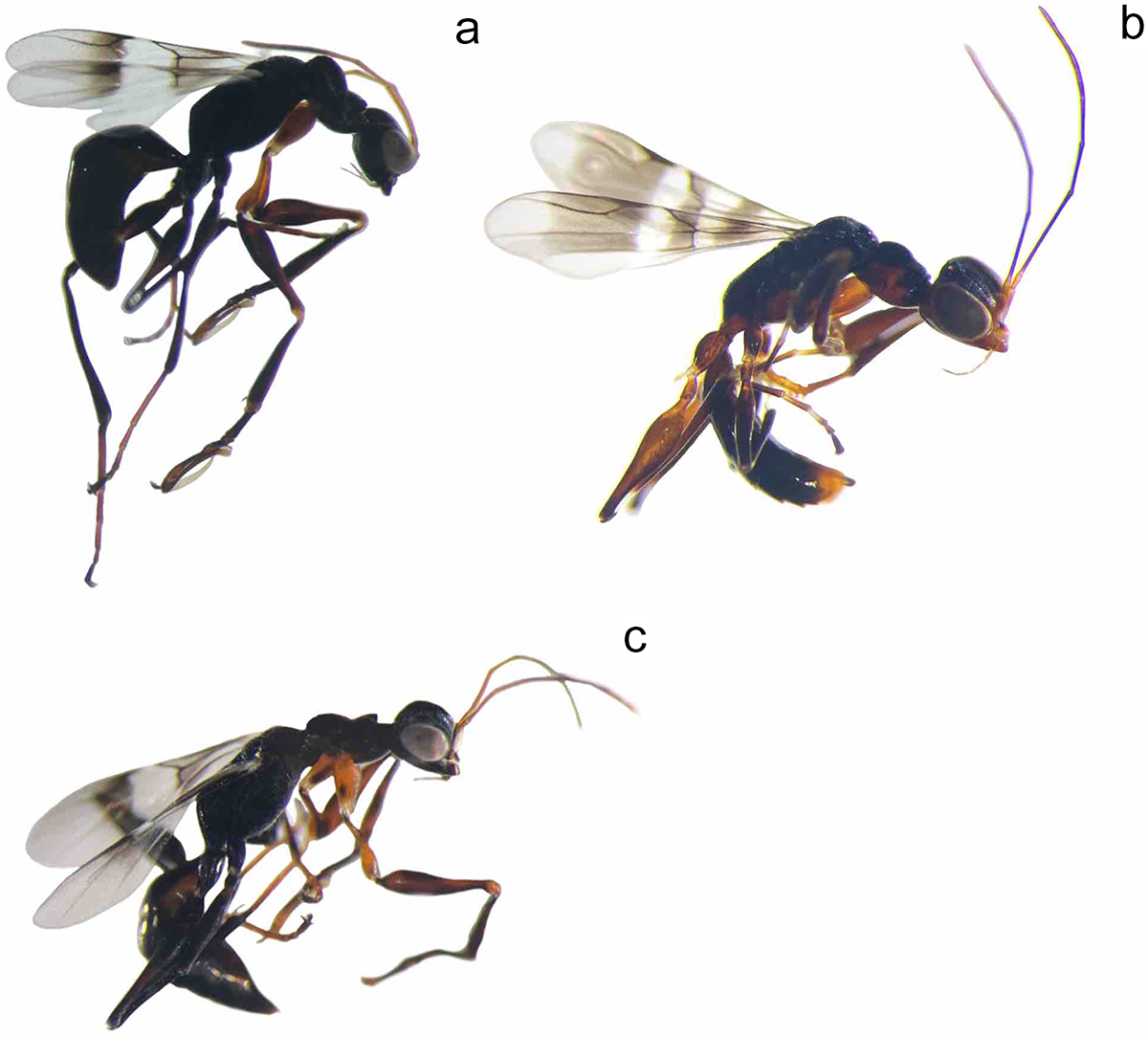
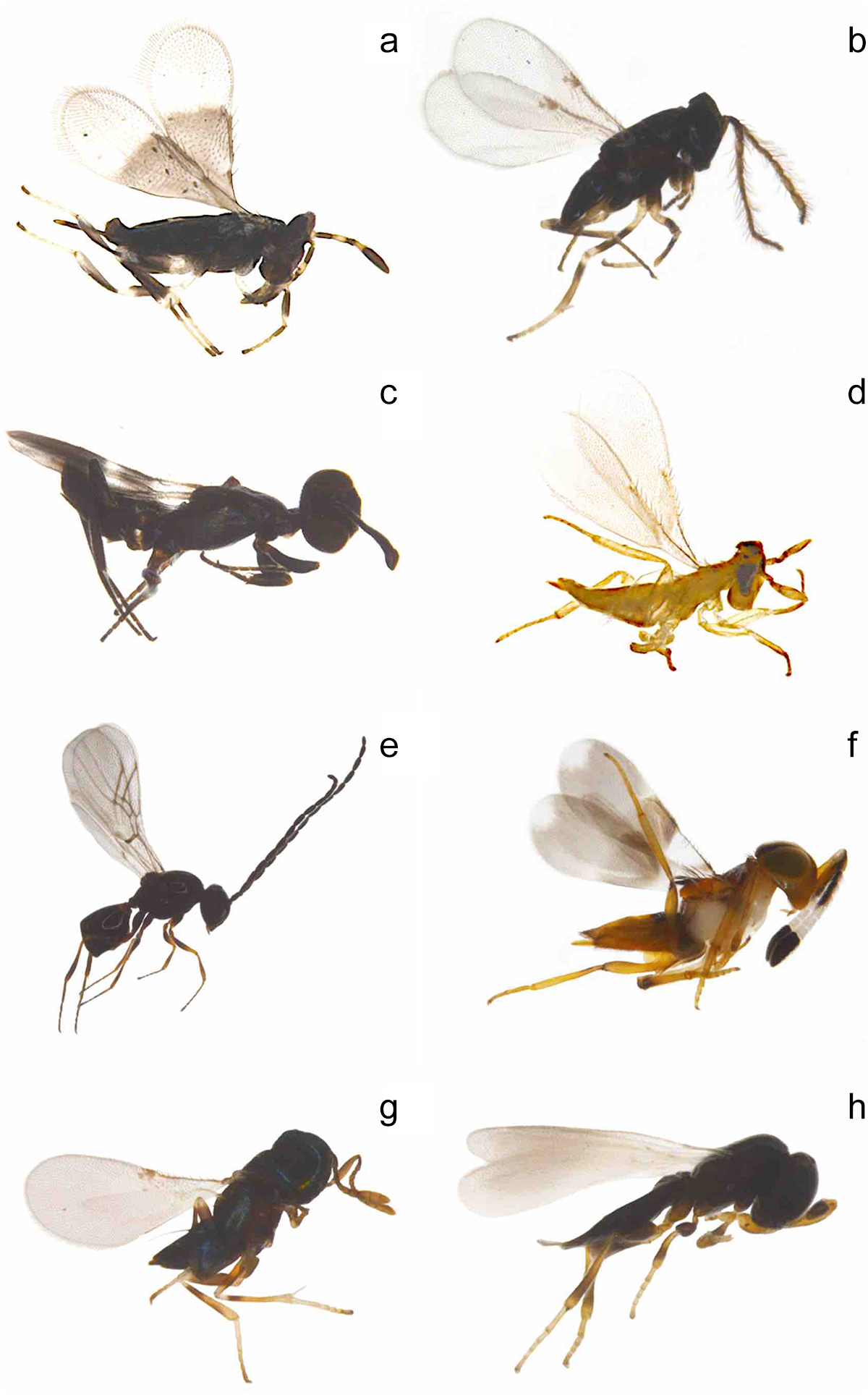
A total of 10 parasitoid species and morphospecies were reared during this study (table 1; figs. 2–3). Three species were identified from PVH nymphs; Neodryinus nelsoni Perkins (Hymenoptera: Dryinidae) were reared from all nymphal instar stages (fig. 2a), while Dryinus koebelei (Perkins) (Hymenoptera: Dryinidae) and Neodryinus koebelei Perkins (Hymenoptera: Dryinidae) were reared from 1st, 2nd and 3rd nymphal instar stages only (fig. 2b and c, respectively). Seven parasitoid morphospecies were identified from PVH eggs (fig. 3). All of these were reared from old eggs, with no parasitoids emerging from new eggs (Table S4).
Adult dryinid nymphal parasitoids of PVH: Neodryinus nelsoni (female (a)); Dryinus koebelei (female (b)); and Neodryinus koebelei (female (c)).

Egg parasitoids of PVH: Ablerus sp. 1 (female (a) and male (b), respectively); Anastatus sp. 1 (c); Centrodora sp. 1 (d); Figitidae sp. 1 (e); Cheiloneurus sp. 1 (f); Ooencyrtus sp. 1 (g); and Platygastridae sp. 1 (h).

Summary table of all PVH parasitoids reared in this study

For a subset of egg parasitoids, COI regions were sequenced using sanger sequencing. PVH parasitoids sequenced within this study were deposited on Genbank and provided with accession numbers (fig. 4, Table S5). Comparing these data to published sequences on GenBank and BOLD and in turn creating a phylogenetic tree, we found matches at the family or genus-level for all our morphological identifications (fig. 4, Table S5). However, not a single COI sequence matched to any published species due to the paucity of data available on these databases. Nonetheless, the COI sequence data corroborated all specimens of Ooencyrtus sp. Ashmead (Hymenoptera: Encyrtidae) sequenced in this study to be a single species. This was important to clarify as sexual dimorphism occurs in Encyrtidae, with antennal structure often differing (Xi et al., Reference Xi, Yin, Zhu, Guerrieri and Zhang2011).
COI phylogenetic tree of PVH egg parasitoids. Sequences include those reared from eggs as well as published sequences in GenBank and BOLD. Those with accession numbers represent the specimens sequenced from the present study.

Parasitism and emergence rates
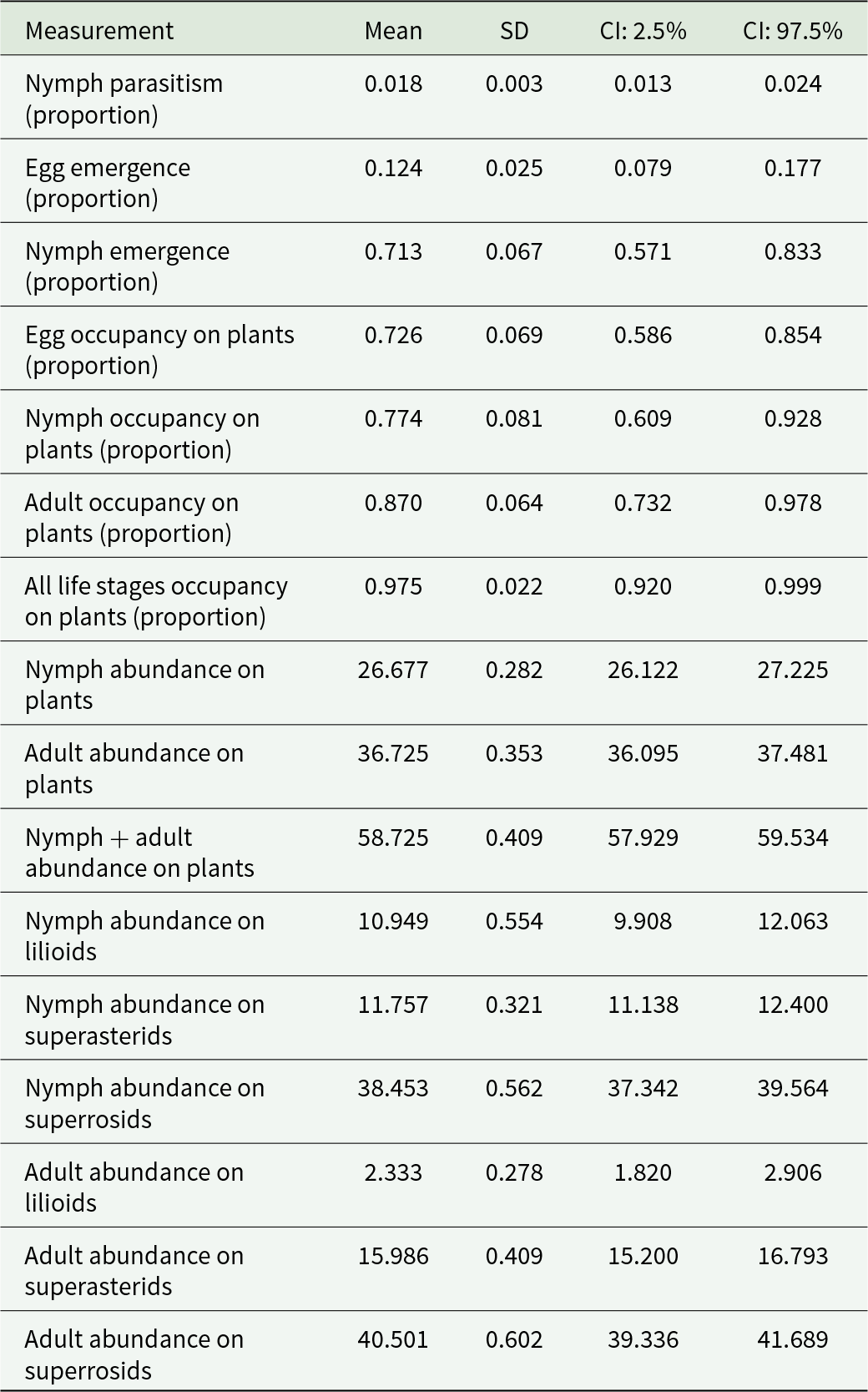
Model estimates indicated that nymphal parasitism rate was very low, at 1.8% on average across all samples (table 2). Across all sampling points, PVH nymphs were collected at 124 points, but only 22 of these resulted in nymphal parasitoids, indicating 17.7% of sites with PVH nymphs observed nymphal parasitism. Nymphal parasitoid emergence rate was on average 71.3% (table 2). PVH eggs were collected at 183 points, of which 22 resulted in egg parasitoids. This suggested that egg parasitism was present at 12.0% of the sampling points where PVH eggs were present (Table S4). Parasitism rate of PVH eggs ranged from 0.3% to 37.4%, with a mean of 6.1% (Table S4). Model estimates indicated that the emergence rate of eggs was on average 12.4% (table 2).
Model outputs for parasitism and emergence rates of PVH parasitoids, and occupancy abundance of PVH life stages on host plants. SD = standard deviation; CI = credible interval

Comparison to NZ parasitoid fauna
Prior to this study, two species of PVH parasitoids were recorded from NZ (Centrodora scolypopae and Ablerus sp.) (Table S3). The Ablerus sp. from NZ was found to be likely the same species as those reared in Australia during this study. Morphologically the two species matched, however, this could not be confirmed genetically because DNA quality issues with the NZ specimens hindered sequencing attempts. Centrodora sp. individuals reared from PVH in Australia were sequenced, and the COI sequences compared with that of the Centrodora scolypopae from NZ. A bootstrap value of 100 supported the separation of these taxa into different species. Both taxa clustered with other published Centrodora specimens confirming the identity of the genus was correct (fig. 4).
Plant hosts and PVH
The 143 plant genera sampled in this study consisted of nine plant clades, namely superasterids (156 sampling points), superrosids (139), ferns (81), lilioid monocots (63), basal eudicots (29), magnoliids (8), commelinid monocots (7), gymnosperms (6) and alismatid monocots (5). PVH (of any life stage) were detected on all nine plant clades (fig. 5). PVH were detected on 102 of 156 superasterids sampled (65.4%), 110 of 139 superrosids (79.1%), 39 of 81 ferns (48.1%), 35 of 63 lilioid monocots (55.6%), 23 of 29 basal eudicots (88.5%), six of eight magnoliids (75.0%), four of seven commelinid monocots (57.1%), two of six gymnosperms (33.3%), and three of five alismatid monocots (60.0%). Of these plants, PVH eggs were recorded on 66 plant genera (46.2%) and PVH adults on 85 plant genera (59.4%). PVH nymphs were recorded on 66 plant genera, (46.2%) with most found on Asplenium, Wisteria, Acacia and Lespedeza. These plant genera only accounted for 5.5% of all sampling points yet 47.4% of all recordings of PVH nymphs.
Plant-herbivore-parasitoid tritrophic network of interactions between plant orders (green nodes), PVH life-stages (eggs: beige node; nymphs: Orange node; adults: red node) and PVH parasitoid species (images). In the quantitative plant-herbivore network, the chord width reflects the number of times a given PVH life-stage was recorded on a plant species belonging to a given order. Plant orders are grouped by phylogenetic clade and parasitoids wasps by superfamily.

There was no significant difference in the presence/absence of different PVH life stages, with eggs found on 72.6% of all plants sampled, nymphs on 77.4%, and adults on 87.0% (table 2). Estimates from the PVH abundance models indicated that more adults (mean 36.8; ranging from 0 to 1000) were sampled than nymphs (mean 26.7; ranging from 0 to 1000) when considering all plant hosts (table 2). Estimates of PVH abundance by plant clade indicated that more nymphs (mean 38.5) and adults (mean 40.5) were sampled from superrosids than from lilioids (nymphs: 11.0; adults: 2.3) and superasterids (nymphs: 11.8; adults: 16.0) (table 2). PVH nymph abundance was on average 3.5 times higher on superrosids than on lilioids, and adult abundance 17.4 times higher.
Ecological network
The tritrophic ecological network indicated that egg, nymph and adult PVH are distinctly generalist, interacting with most of the wide range of studied plant orders and clades (fig. 5). In contrast, parasitoid species and superfamilies were found to be distinctly specialised to either the egg or nymphal life stages of PVH. The network also showed that plants from the order Polypodiales (in the clade of ferns) hosted the largest proportion of PVH nymphs and adults, whereas plants from the order Sapindales (in the clade of superrosids) hosted the largest proportion of PVH eggs. Approximately half of the documented plant-PVH interactions were between PVH eggs and their host plants. The remaining interactions were equally divided between PVH nymphs and their host plants and PVH adults and their host plants (fig. 5).
Discussion
PVH parasitoids
Prior to this study, only three egg parasitoids and one nymphal parasitoid had been recorded parasitising PVH. Building upon this, we discovered eight new PVH parasitoids; six additional egg parasitoids (across multiple families) and two additional nymphal parasitoids (in the family Dryinidae). These new species are N. koebelei and D. koebelei, and the following morphospecies: Anastatus sp. 1, Centrodora sp. 1, Figitidae sp. 1, Cheiloneurus sp. 1, Ooencyrtus sp. 1, and Platygastridae sp. 1. It is unfortunate that many of the parasitoids reared in this study were unable to be identified to species level due to incomplete taxonomic keys and very limited published barcodes. Work is being undertaken with Andrew Polaszek at the Natural History Museum, London, to describe these species.
Dryinidae are found in all zoogeographical regions and are parasitoids of Hemiptera: Auchenorrhyncha (Martins and Domahovski, Reference Martins and Domahovski2022; Olmi et al., Reference Olmi, Perkovsky, Martynova, Contarini, Bückle and Guglielmino2020). Of the dryinid parasitoids reared during this study, only N. nelsoni had been recorded parasitising PVH previously (Guglielmino et al., Reference Guglielmino, Olmi and Bückle2013), with this species also known to parasitise Flatidae, Nogodinidae and other Ricaniidae (Guglielmino et al., Reference Guglielmino, Olmi and Bückle2013). Thus, it was unsurprising that this species was reared during this study. However, D. koebelei and N. koebelei have previously only been found to parasitise Flatidae (Guglielmino et al., Reference Guglielmino, Olmi and Bückle2013), making this study the first record of these species parasitising a member of another family.
Secondary parasitoids (hyperparasitoids) are natural enemies of Dryinidae, with the chalcid families Eulophidae, Eupelmidae and Torymidae all known to parasitise Neodryinus (see Virla et al. (Reference Virla, Moya-Raygoza and Guglielmino2023) for a comprehensive list of references). Hyperparasitoids of N. nelsoni include a Mesochorus sp. (Ichneumonidae: Mesochorinae), Aphobetus silvifilia (Pteromalidae: Eunotinae) and an unidentified eupelmid (Eupelmidae: Eupelminae) (Guglielmino and Olmi, Reference Guglielmino, Olmi, Robillard, Legendre, Villemant and Leponce2016). No dryinid hyperparasitoids were reared in our study suggesting secondary parasitism of PVH nymphs is minimal in and around Melbourne. In contrast, hyperparasitoids affected an attempt to rear dryinid species in quarantine in NZ (Hill and Steven, Reference Hill, Steven, Cameron, Hill, Bain and Thomas1989).
Centrodora scolypopae was first found to parasitise PVH eggs in NZ in 1962 (Charles and Allan, Reference Charles and Allan2004; Cumber, Reference Cumber1966; Valentine, Reference Valentine1966). This species is usually univoltine, overwintering in diapause as a prepupa and once photoperiod conditions are suitable, pupating in synchronisation with PVH appearance in mid-summer (Gerard, Reference Gerard2004). Although C. scolypopae has been recorded in Australia (Valentine, Reference Valentine1966), based on our morphological and molecular work, it was determined that the Centrodora specimens reared in the current study were not C. scolypopae. The species collected in our study could be described as follows: No longitudinal stripes on the mesoscutum, the entire body pale yellow in colour, and the linea calva present on the forewing. Twelve species of Centrodora are known in Australia (Noyes, Reference Noyes2023) yet complete taxonomic keys for this genus are unavailable, hindering identification attempts. The other egg parasitoid known to parasitise PVH in NZ is an Ablerus species, an introduced member of the Azotidae family (Logan et al., Reference Logan, Rowe and Connolly2020). Although initially thought to be a hyperparasitoid of C. scolypopae (Harcourt, Reference Harcourt1995), it is now considered a primary parasitoid of PVH (Charles and Allan, Reference Charles and Allan2004). Whereas C. scolypopae is a sexual species with a slight female-biased sex ratio (Gerard, Reference Gerard1985), the Ablerus species in NZ is thelytokous and multivoltine (Charles and Allan, Reference Charles and Allan2004). See Polaszek (Reference Polaszek1991) for more information on both genera. Efforts were taken to identify the Ablerus specimens in this study by comparing specimens with those collected in the early 1900s by Alexandrè Girault at the Queensland Museum (from an in-person visit) and the Western Australia Department of Agriculture (from images). Of the 40 Ablerus specimens compared, none were found to match the specimens reared in this study or those collected from NZ, suggesting Ablerus sp. 1 is likely to be an undescribed species.
Only one specimen of the Anastatus sp. was reared and therefore no genetic work was undertaken. Morphological identification failed to place it to species level. It could be described as follows: Forewing with complete hyaline cross band, profemur with sharp tooth, mesosoma completely dark, mesoscutum with anterior half coriaceous to pustulate and posterior half mesh-like reticulate. Due to the rarity of this species being reared, further investigation was deemed unwarranted given the suggested poor ability to control PVH. Taxonomic keys were unavailable for Australian Ooencyrtus and Cheiloneurus species, and thus morphological identification to species was not possible without viewing holotypes. In Australia, the Platygastridae are extremely poorly studied with many species still undescribed (Austin et al., Reference Austin, Johnson and Dowton2005). Without access to the specimens reared by Cumber (Reference Cumber1967), we were unable to ascertain if the ‘unknown scelionid’ was the same species as that reared in the current study, described here as a ‘Platygastridae sp. 1ʹ.
Multiple parasitoid species were found to parasitise either PVH egg or nymphal stages and this has applied ecological implications. The likelihood of identifying biological control candidates for PVH is thus increased, given there are more species to select from. Although parasitism rates were found to be reasonably low for PVH nymphs, parasitoid emergence rates were very high. Parasitism rates for PVH eggs were higher than for nymphs, however emergence rates were comparatively low. Of the three nymphal parasitoids, N. nelsoni may be the most suitable candidate for PVH biological control in NZ, given it was reared from PVH collected from 14 different plant genera. However, this species can host switch across insect families (to Ricaniidae), which is also the case for D. koebelei and N. koebelei. This has important implications when considering the introduction of new biological control agents into a country. A suitable candidate should ideally be host-specific (Babendreier et al., Reference Babendreier, Bigler and Kuhlmann2005; Barratt et al., Reference Barratt, Howarth, Withers, Kean and Ridley2010). Issues with hyperparasitoids and low emergence of parasitoids would also need to be addressed if an introduction is to be considered (Guglielmino and Olmi, Reference Guglielmino, Olmi, Robillard, Legendre, Villemant and Leponce2016; Hill and Steven, Reference Hill, Steven, Cameron, Hill, Bain and Thomas1989; Olmi, Reference Olmi2007). There are further issues to contend with for some of the parasitoids reared within this study and overseas. For example, superparasitism has been observed in populations of C. scolypopae, with progeny from the first oviposition suppressing the development of later individuals (Gerard, Reference Gerard1992).
Plant hosts and PVH
PVH has been found on mainland Australia from Queensland to Victoria and has also been found in the state of Tasmania (Matheson, Reference Matheson1978), as shown in the supplementary material. Cumber (Reference Cumber1966) listed over twenty genera of host plants in NZ for PVH, with Fletcher (Reference Fletcher1979) noting a new plant host (Aegiceras corniculatum (L.)) in Australia over a decade later. The current study found plants from the clade of ferns hosted the largest proportion of PVH nymphs and adults. Similar to the findings from the current study, Logan et al. (Reference Logan, Allison and Stannard2002) found PVH nymphs and adults on different host plants surveyed in NZ, with both commonly found on ferns and plants native to NZ, particularly the pepper tree (Piper excelsum (G.Forst.) Miq. (Piperales: Piperaceae)), mahoe (Melicytus ramiflorus J.R.Forst. & G.Forst. (Malpighiales: Violaceae)), silver/black tree ferns (Cyathea spp. Sm. (Cyatheales: Cyatheaceae)), and Hangehange (Geniostoma ligustrifolium A.Cunn. (Gentianales: Loganiaceae)). In the current study, plants from the clade of superrosids (flowering plants) hosted the largest proportion of PVH eggs. This large clade of flowering plants may be suitable for PVH adults to lay eggs because of the nectar the plants provide as a food source, although no such research has determined this. Logan et al. (Reference Logan, Allison and Stannard2002), during a no-choice test, found PVH laid more eggs per female on a superrosid (wineberry, Aristotelia serrata (J.R.Forst. & G.Forst.) W.R.B.Oliv. (Oxalidales: Elaeocarpaceae)) than on other species of fern. Plant host preferences by PVH life stages could thus be attributable to the varying requirements of each stage, such as ovipositing females seeking suitable sites to nurture their offspring’s development (Borthwick-Taylor, Reference Borthwick-Taylor2023). PVH eggs are typically laid on dead twigs, likely for stability (Matheson, Reference Matheson1978), while nymphs likely need protection and growing leaves for high nutrition (Matheson, Reference Matheson1978), matching more closely with the adults’ needs.
The comprehensive list of plant hosts (and clades across which they span) outlined in this study and in the Cumber (Reference Cumber1966) and Logan et al. (Reference Logan, Allison and Stannard2002) papers, illustrates the extremely polyphagous nature of PVH. To the best of our knowledge, no other studies have drawn comparisons between PVH presence and plant hosts in the field. Furthermore, although some research has been undertaken looking into associated parasitoids and host plants, no tritrophic networks have ever been developed for PVH.
Conclusions and next steps
A much greater diversity of parasitoids was reared from PVH in this study than has previously been catalogued. Given the limited research previously undertaken on PVH, the host plant range, presence/absence and occupancy data, and tritrophic network developed here should be valuable for future studies on PVH. It is important to note that this study spanned only two seasons. As such, sampling over multiple years is recommended to determine if the results found here are more broadly representative of the ecology of PVH and its parasitoids. The 2021/22 season was particularly wet in and around Melbourne, potentially making the environment more suited for entomopathogenic fungi and less so for successful parasitism. Additionally, this study was confined to a small geographical region of Australia. Future studies would benefit from sampling over a much larger spatial area and including other plant clades in order to determine the full host range of potential parasitoids. Furthermore, there is great value in the improvement of taxonomic and molecular resources for identification of parasitoids, and PVH parasitoids in particular.
Supplementary material
The supplementary material for this article can be found at https://doi.org/10.1017/S0007485325000082.
Acknowledgements
We would like to acknowledge the members of public who provided access to their land, in addition to those who collected specimens on our behalf. We extend our gratitude to Lilia Jenkins, Tara Jalali and Karyn Moore (Cesar Australia) for their assistance with rearing parasitoids and to Alex Slavenko (Cesar Australia) for his mapping assistance. We thank Haylo Roberts (Cesar Australia) for his assistance with the genetic work, and Massimo Olmi (Tropical Entomology Research Center, Italy), Andrew Polaszek and John Noyes (Natural History Museum, London) for their assistance with parasitoid identifications. We extend our gratitude to Melinda Moir and Pia Scanlon (Western Australia Department of Agriculture) for providing Ablerus images and Geoff Thompson and Karin Koch (Queensland Museum) for assisting with the inspection of Ablerus specimens. We thank Parks Victoria for permitting us access to areas for sampling and Agriculture Victoria staff at AgriBio (including Lixin Eow and Linda Semeraro) for their provision of equipment for parasitoid photography. Results were obtained under the terms and conditions of permit AA-0000780. Finally, we thank Zespri International Ltd and the NZ government program A Lighter Touch – Horticulture New Zealand (a-lighter-touch.co.nz) for co-funding this project.
Competing interests
The authors declare none.