Because of its high digestibility and dietary characteristics, goat milk is recommended for feeding children, adults, the elderly and individuals with allergies to bovine milk (Miller and Lu, Reference Miller and Lu2019). Due to its high fat and protein content, goat milk has a higher industrial yield and is suitable for producing dairy products such as cheese and yogurt. However, goat milk with excellent physicochemical and microbiological qualities is necessary to obtain high quality added-value products that meet consumer expectations. The population of psychrotrophic microorganisms in raw chilled milk is important since they cause spoilage by producing thermo-resistant enzymes and can multiply at refrigeration temperature (7°C). Among the psychrotrophs, the genus Pseudomonas spp. is the one most associated with the spoilage of dairy products. Lipases hydrolyze milk triglycerides, releasing short-chain fatty acids and glycerol, causing sensory defects such as rancid, soapy and oxidized tastes and odors, which are accentuated in matured products. Some strains of Pseudomonas spp. can produce a specific extracellular caseinolytic protease called aprX that can degrade κ-casein, α-casein, and β-casein. The main defects caused by this protease are increased viscosity, sedimentation, gelling, fat separation and bitterness, especially in ultra-high temperature (UHT) milk (Zhang et al., Reference Zhang, Bijl, Svensson and Hettinga2019).
The species P. fluorescens, P. putida and P. aeruginosa are the most isolated from milk and milking environments. These species cause deterioration of milk and milk products and are pathogenic (Pereira et al., Reference Pereira, Luiz, Bruzaroski, Poli-Frederico, Fagnani and Santana2019; Quintieri et al., Reference Quintieri, Fanelli and Caputo2019; Longhi et al., Reference Longhi, Correia, Bruzaroski, Poli-Frederico, Fagnani and Santana2022; Bruzaroski et al., Reference Bruzaroski, Correia, Devara, Poli-Frederico, Fagnani and Santana2023). There is research on the frequency of Pseudomonas spp. in goat milk (Scatamburlo et al., Reference Scatamburlo, Yamazi, Cavicchioli, Pieri and Nero2015), but when compared to studies in bovine milk, there is still a lack of information on the subject, especially when the milk is destined for the production of dairy products. This study aimed to determine the frequency of P. fluorescens, P. putida and P. aeruginosa in raw goat milk stored at 4 and 9°C and to evaluate the spoilage potential and capacity of these species. In addition, the presence of the aprX gene in the isolated strains was also investigated.
Materials and methods
Sampling
The raw goat milk used in this study was acquired from three dairy farms (South region of Brazil) that market this milk. The samples were representative of one milking and were transported in the original plastic containers in a thermal box (7°C) to the microbiology laboratory (UNOPAR). Each sample (one per property) was divided into two sterilized bottles, which were stored at two different temperatures: (a) 4°C/72 h, simulating the temperature used in the milk tank in Brazil goat dairy farms; (b) 9°C/72 h, simulating the maximum temperature allowed by Brazil's law for receiving bovine milk in the processing industry since Brazil's legislation for goat milk only establishes the maximum temperature for receiving frozen milk in the processing industry. The milk storage time (72 h) was determined considering that goat milk production is lower than cow milk and remains stored longer before processing.
Pseudomonas spp. isolates
After 72 h of storage, aliquots of raw milk samples stored at 4 and 9°C were plated separately on Pseudomonas base agar supplemented with cetrimide, fucidin, cephaloridine – CFC (25°C/48 h) to obtain Pseudomonas spp. isolates. After incubation, one plate from each milk sample collected and incubated at each temperature was selected and all its colonies were isolated. The selection criterion was the number of colonies less than 250 and the size of the colonies suitable for testing for spoilage potential and capacity. The obtained isolates were stocked in brain heart infusion (BHI) broth and kept at −80°C for further molecular confirmation and evaluation of spoilage capacity and potential.
Spoilage capacity and potential
The lipoproteolytic spoilage capacity (presence or absence) and potential (size of lipolytic and/or proteolytic halos on agar) of the isolates under psychrotrophic conditions were evaluated by plating them on milk agar (10% skim milk powder – proteolysis) and tributyrin agar base (1% FDO81-5VL – lipolysis), both incubated at 21°C for 72 h (Frank and Yousef, Reference Frank and Yousef2004). Isolates that produced halos ≤2 cm (proteolytic) and <1.5 cm (lipolytic) were classified as low spoilage potential and those that produced halos >2 cm (proteolytic) and ≥1.5 cm (lipolytic) were classified as high spoilage potential.
Genus and species identification and aprX gene search
To confirm the genus Pseudomonas, the species P. fluorescens, P. putida, and P. aeruginosa, and the presence of the aprX gene, the isolates had their DNAs extracted by thermal lysis and polymerase chain reaction (PCR) was carried out. The protocols with the conditions of reactions and primers used in the PCR are described in online Supplementary Table S1.
Statistics
The influence of the milk storage temperature (4 and 9°C) on the spoilage potential (lipolytic and proteolytic) of Pseudomonas spp. was carried out by Wilcoxon test. To evaluate the predominance between the spoilage potentials (lipolytic and proteolytic) at the same storage temperature (4 or 9°C), and the predominance of the spoilage potentials among the species within the same storage temperature, the Mann-Whitney test was carried out. All the analyses were performed at 5% significance using the Statistica 13.0 program.
Results and discussion
Frequency of Pseudomonas spp. in raw chilled goat milk
A total of 184 isolates belonging to the genus Pseudomonas were obtained from the raw goat milk samples, 50% (92) from milk stored at 4°C and 50% (92) from milk stored at 9°C. Pseudomonas fluorescens was the most frequent species, representing 77.1% (71) of the isolates at 4°C and 64.1% (59) of the isolates at 9°C (online Supplementary Table S2). According to the literature, this is the most frequent species in raw refrigerated milk and milking environments of both bovine and goat milk. Pseudomonas fluorescens is a regular contaminant of ready-to-eat food and shows a wide range of growth temperatures. Most of these bacteria can show distinct enzymatic extracellular proteolytic, lipolytic and phospholipolytic activities (Scatamburlo et al., Reference Scatamburlo, Yamazi, Cavicchioli, Pieri and Nero2015; Bruzaroski et al., Reference Bruzaroski, Souza, Pasquim, Fagnani and Santana2020; Ramos and Nascimento, Reference Ramos and Nascimento2020).
Pseudomonas putida was the second most frequent among the species surveyed in this study, present in 6.5% (6) of the isolates at 4°C and 17.3% (16) of the isolates at 9°C (online Supplementary Table S2). This species, which has high lipoproteolytic potential, has also been isolated and described by other authors in bovine (Pereira et al., Reference Pereira, Luiz, Bruzaroski, Poli-Frederico, Fagnani and Santana2019; Longhi et al., Reference Longhi, Correia, Bruzaroski, Poli-Frederico, Fagnani and Santana2022) and goat (Scatamburlo et al., Reference Scatamburlo, Yamazi, Cavicchioli, Pieri and Nero2015; Ramos and Nascimento, Reference Ramos and Nascimento2020) raw milk samples.
Pseudomonas aeruginosa was isolated only in the milk samples stored at 4°C, with a frequency of 4.3% (4) (online Supplementary Table S2). The type of sample, incubation temperature, and other species present can influence the speed of multiplication of Pseudomonas spp. including P. aeruginosa (Ramos and Nascimento, Reference Ramos and Nascimento2020). P. aeruginosa is an important pathogenic microorganism, because of several virulence factors and biofilm forming capability, as well as antimicrobial resistance. In goats, it is one of the main microorganisms studied, because it is a causative agent of mastitis, generating economic problems due to production losses and treatment costs, and can even cause death of the animal. It has been underestimated as a foodborne pathogen in various food groups such as water and milk (Li et al., Reference Li, Gu, Huang, Zhong and Peng2023).
The influence of storage temperature on the spoilage potential and capacity of Pseudomonas spp.
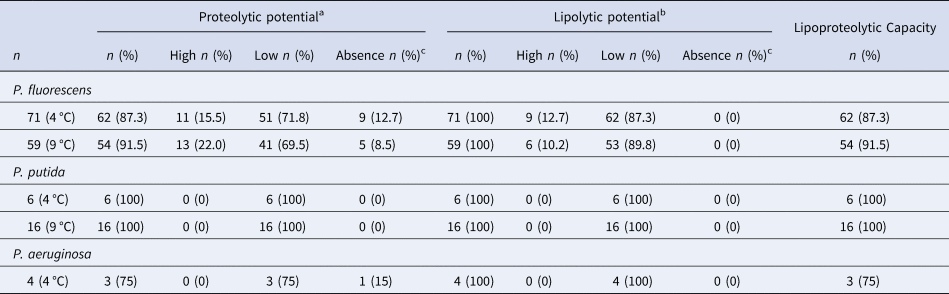
Pseudomonas fluorescens expressed the highest lipoproteolytic potential among the Pseudomonas species investigated (P < 0.05) at both milk storage temperatures. The isolates were characterized as predominantly proteolytic (P < 0.05), this being the only species that showed high proteolytic and lipolytic potential (halos >2 cm and ≥1.5 cm, respectively) among the species surveyed (Table 1). A total of 87.2% (62) and 91.5% (54) of the P. fluorescens strains isolated from milk stored at 4 and 9°C, respectively, showed proteolytic and lipolytic (lipoproteolytic) capacities simultaneously (Table 1).
Proteolytic (milk agar 10%) and lipolytic (tributyrin agar base 1%) potentials and lipoproteolytic capacity of P. fluorescens, P. putida and P. aeruginosa isolated from raw sheep milk stored at 4 or 9°C for 72 h

a High = halo > 2 cm, low = halo ≤ 2 cm.
b High = halo ≥ 1.5 cm, low = halo < 1.5 cm.
c Halo absent.
All isolated strains of Pseudomonas putida showed lipoproteolytic capacity and a predominance of protease synthesis, regardless of storage temperature (Table 1). Although Pseudomonas aeruginosa was isolated only from milk stored at 4°C, 75% (3) of the strains showed lipoproteolytic spoilage capacity, but this was slower than that observed for the other species investigated (Table 2). In addition, one isolate of P. aeruginosa showed no proteolytic capacity.
Influence of the storage temperature of raw goat milk (4 or 9°C) on the lipolytic and proteolytic spoilage potentials (halo diameter in cm) of P. fluorescens, P. putida and P. aeruginosa

*Differences exist (P < 0.05) where the same superscript is not shared. Lower-case letters in the same row within a single species, Mann–Whitney test. Capital letters in the same column, Wilcoxon test. Greek letters in the same row and the same temperature, Wilcoxon test.
Thus, the results of the present study indicate that most Pseudomonas spp. isolated in goat milk express the ability to produce proteases and/or lipases, which can maintain their activity even after heat treatments. Also, since the storage temperature of raw milk did not affect the spoilage potential of Pseudomonas fluorescens and Pseudomonas putida (P > 0.05: Table 2), regardless of storage temperature there will be a predominance of a proteolytic microbiota. These results emphasize the importance of low Pseudomonas populations and hygiene when obtaining milk. According to Bruzaroski et al. (Reference Bruzaroski, Souza, Pasquim, Fagnani and Santana2020), the refrigeration temperature of raw milk from small ruminants is important to control the multiplication of psychrotrophic microorganisms, since higher populations are observed in milk stored at 9°C when compared to the one stored at 4°C.
It should also be noted that despite the low lipolytic potential of the Pseudomonas spp. isolated from goat milk in this study, lipolysis is of concern in high fat products (cream, butter, and mature cheeses), which are more susceptible to lipolytic than proteolytic degradation, with consequential sensory and texture defects. In cheese curds, lipases are adsorbed to fat globules, unlike proteases, which are largely excreted in the whey (Munsch-Alatossava et al., Reference Munsch-Alatossava, Käkelä, Ibarra, Youbi-Idrissi and Alatossava2018).
The lower temperature (4°C) favored the presence of Pseudomonas spp. with the aprX gene. All Pseudomonas putida strains isolated from milk stored at 9°C showed the aprX gene and were able to express proteolysis in the in vitro test. The aprX gene was amplified in 98.30% of Pseudomonas fluorescens isolates and in all Pseudomonas aeruginosa isolates. Nevertheless, isolates from these last two species were found to contain the aprX gene, but lacking the proteolytic capacity in vitro (online Supplementary Fig. S1). The expression of the aprX gene can be influenced by the storage temperature and isolates of the same species can express this gene or not at different temperatures (Scatamburlo et al., Reference Scatamburlo, Yamazi, Cavicchioli, Pieri and Nero2015).
In conclusion, the two storage temperatures of raw goat milk (4 and 9°C) did not affect the proteolytic and lipolytic spoilage potential of Pseudomonas fluorescens and Pseudomonas putida strains, which were predominantly proteolytic. However, it influenced the frequency of Pseudomonas aeruginosa, which was isolated only in raw milk chilled at 4°C. All the isolated strains (P. fluorescens, P. putida, and P. aeruginosa) showed a high frequency of the aprX gene. Pseudomonas fluorescens was the most frequent species, and the only one to have strains with high proteolytic and lipolytic potential. Thus, regardless of the storage temperature of raw goat milk, low initial populations of Pseudomonas species are essential for producing quality dairy products with longer shelf life. Therefore, implementing or improving good milking practices to control these microorganisms is necessary.
Supplementary material
The supplementary material for this article can be found at https://doi.org/10.1017/S0022029925000147
Acknowledgements
This study was financed in part by the Coordenação de Aperfeiçoamento de Pessoal de Nível Superior – Brasil (CAPES).