This hypocrisy and resourcefulness are because one cannot directly, truthfully, and explicitly talk in an independent [despotic] government.
Mirza Rahim Khan: The translator1. Introduction
As a form of resistance, translation has often been a battlefield where translators, either overtly or covertly, express criticism of the political or social circumstances in which they live. Depending on the extent of restrictions, resistance takes various forms, from the choice of book to translate, to making subtle or straightforward changes to the source text, to changing the entire narrative.
The case under study here is Mirza Rahim Khan's Persian translation (1885) of Markham's A General Sketch of the History of Persia (herein referred to as History of Persia) (1874). This is an interesting case, in that resistance takes the deceptive appearance of submission and conformity. On the surface, the translator has resorted to self-censorship, understandable given the despotic atmosphere in which he worked. However, a detailed comparison of the source and target texts reveals the translator included, at great risk to his life, his own individual voice in the translation.
The book was written in the middle of the reign of the fourth Qajar king, Naser al-Din Shah (1848–1896),- and its translation into Persian was ordered nine years later, in the thirty-fourth year of his reign. The book is about the history of Iran, including the history of the Qajars until the time of Naser al-Din Shah, who was very anxious to know what westerners thought of his rule.
This study's analysis of the translation shows how the translator—despite explicitly stating in the preface that his is a word-for-word translation, as demanded by the shah—made systematic shifts throughout the book, resulting in a coherent, meaningful, intelligible narrative with a perspective and voice different from the source text. However, while the examples of the translator's manipulations are presented here, they are not much dwelled upon, as it is fairly predictable that a court translator, in spite of all demands and claims, would ultimately conform his translation to his patron's sensibilities.
However, there is evidence complicating the picture, as Mirza Rahim occasionally tried to subtly include his own criticism of the Qajars. Indeed, using textual examples, this article argues that the translator was not simply a yes-man conveying information the shah wished to hear. Rather, the translator managed, at great risk, to include his own veiled criticism of Qajar governance in a way more likely to be taken on board than in the original source text. This, hopefully, sheds light on why the court translators, working—in Booth's terms—“in a liminal state between resistance and complicity,”Footnote 1 insisted they translated word-for-word, as well as illuminating the translators' role as the intellectual elite of a society grappling with and resisting a despotic government in the face of rising modernity.
Thus, this study places Mirza Rahim within the wider context of translation as resistance, as his strategies—despite requiring great courage and risk—were not acts of individual initiative. Rather, his actions were part of a great resistance project involving almost all court translators. Through the analysis of the prefaces of such court translations, alongside a detailed examination of one translation in particular, and through the comparison of the translations to their originals, new perspectives can be gained on how court translators introduced resistance in line with the political mission of translators working outside the court.
2. Theoretical background
In this section, I briefly touch on the theoretical background informing this paper. Until the 1990s, translation—centered around the concept of equivalence—was seen as an act of language transfer and, as such, translators were supposed to produce an equivalent text by preserving the “meaning” or ‘sense” of the source text.Footnote 2 However, translators do not translate in a vacuum. Indeed, from the 2000s onward, translation has been regarded as a “historical event” and translators as agentsFootnote 3 often translating in situations loaded with cultural, ideological, or political tensions.Footnote 4 Thus, they cannot remain neutral in what they translate. This has resulted in a surge of interest in Translation Studies around the question of the translator's agency and in the production of more “agent-aware” studies.Footnote 5 Meaning is a major area where the translator's agency can manifest, and deliberate changes to the meaning of a translated text may well be as old a practice as translation itself. When it comes to translating history books, deliberate changes by the translator may produce a different narrative than that penned by the author.Footnote 6
In addition to the concept of narrative, translation scholars have also used the concepts of “resistance” and “opposition”Footnote 7 to show “how the conscious or unconscious agency of the translator can morph into an activism that serves to forge, protest or protect identities, as well as to oppose or support political or moral positions.”Footnote 8 Further, Christopher Rundle proposed a unique stand towards translation history, whereby the researcher acts as a historian looking at history through the lens of translation. This novel insight, Rundle argued, helps shed light on otherwise neglected parts of history.Footnote 9
3. A brief survey of the historical context
Naser al-Din Shah, who ruled Iran from 1848 to 1896, was the first Persian king to travel to Europe and recount his personal experiences of the modernized western society in travelogues. Naser al-Din Shah introduced newspapers, photography, the telegraph, and railways to Iran, and thus was not unfamiliar with the enlightened absolutism governing the policies and conduct of contemporary European monarchs. Nonetheless, he continued to enhance this modernization as a necessary measure to protecting his power.Footnote 10 Naser al-Din Shah was also considered the most literate Iranian king,Footnote 11 as he wrote poetry, read books in French, and had foreign books or their translations read to him.Footnote 12 In 1871, he established Dār al-Tarjomeh-ye Homāyuni (His Majesty's House of Translation)—later known as Dār al-Tarjomeh-ye Naseri (Naseri House of Translation, henceforth DTN)—under the management of Etemād al-Saltaneh. This royal translation center was active for twenty-five years, until the Constitutional Revolution in 1905. During its lifetime, DTN employed forty-eight translators who translated from eight different languages: French, Russian, English, German, Austrian, Indian, Turkish, and Arabic.Footnote 13
Having passed a troubled childhood due to his parents’ constant quarrels, alongside bearing the “political insecurities” of being crown prince, Naser al-Din Shah came to be known as a “paranoid king” during his nearly half-century rule.Footnote 14 More importantly, Iran's defeat by Russia after twenty-five years of war, which resulted in a great loss of territory under the treaties of Turkamānchāy (1813) and Gulestān (1828), had allowed Russia to make advances in the north of Iran. Britain, too, as a rival to Russia, had advanced from the south, resulting in the Qajar king's loss of Herat under the Paris treaty in 1857.Footnote 15 Pressed between two foreign forces competing to obtain an advantage over Iran, Naser al-Din Shah gradually developed an aversion to foreign governments. When unsatisfied with the benefits they garnered from the Qajar king, such powers did not hesitate to criticize him in articles published in their countries. In his diary, Etemād al-Saltaneh mentions several occasions when Naser al-Din Shah expressed anger about negative comments on his rule printed in foreign newspapers.Footnote 16
These instances culminated in, firstly, the expansion of DTN after twelve years (both in terms of space and the number of translators employed) and, secondly, in the re-definition of DTN's purpose. When DTN was first established in 1871, according to the announcement in Iran, the official government newspaper, it had two purposes: to offer translation services and to teach foreign languages for free.Footnote 17 Clearly, the announcement offers translation and foreign language services for public use. Twelve years later, however, in 1883, Etemād al-Saltaneh stated in Chehel Sāl Tarikh-e Iran dar Dowreh-ye Pādeshāhi Naser al-Din Shah Qajar (Forty Years of the History of Iran at the time of Naser al-Din Shah's Rule) that, due to unprecedented worldwide political changes, it was important to be knowledgeable about other countries’ politics and governments, and therefore now DTN would translate all newspapers, journals, and gazettes published in different languages and be monitored by the shah himself.Footnote 18 Thus, DTN began serving only one customer, the shah, informing him of political news from across the world.
The shah's paranoid obsession with foreign media criticism led him to establish the first state Bureau of Inspection (Taftish), which inspected all foreign mail, including newspapers, posted to Iran. Every day the shah studied the foreign mail brought to him by the head of Iran's Post Office.Footnote 19 This was followed by the establishment of the first Bureau of Censorship in the Ministry of Press and Publishing, which was responsible for approving all material to be published or translated.Footnote 20 Even before its establishment, no book or newspaper would be published without the shah's approval.Footnote 21
4. About the translator and the author
As a DTN translator who translated solely from English, Mirza Rahim Ibn-e Hakim al-Mamālek (1856–1885, henceforth Mirza Rahim) was the eldest son of Mirza Ali Naqi Khan Hakim al-Mamālek, Naser al-Din Shah's private valet and physician. Mirza Ali also translated, but Etemād al-Saltaneh was not satisfied with the quality of his translations.Footnote 22 At seventeen, Mirza Rahim accompanied his father on the shah's first trip to Europe and, while in England, the shah permitted Mirza Rahim to enroll at the London International College. Soon after finishing his education in 1878, Mirza Rahim returned to Iran and began his job as a court translator. The shah bestowed Mirza Rahim with the title “Farzaneh” (The Wise) due to his wisdom and intelligence, but he was not favored by Etemād al-Saltaneh. Indeed, Etemād al-Saltaneh expressed his dislike in his diary, calling Mirza Rahim names on the day he ordered the translation of Clements Markham's History of Persia. Footnote 23 Mirza Rahim died a year after completing the translation at the age of thirty.
Markham's History of Persia, published in London in 1874, consists of twenty chapters, beginning with the Pishdādiāns—the first Iranian dynasty, pre-dating the Achaemenids—and ending with the Qajar dynasty, up to the twenty-fifth year of Naser-al-Din Shah's rule. The Persian translation only included chapters XIV–XX, on the Qajar dynasty. Clements Markham, as attested in his preface, did not “possess the advantage of a knowledge of the Persian language,” and was thus dependent on the works of European writers on Iran.Footnote 24 In the preface, Markham offers a praise for Iran, referring to it as a “land of many glorious memories.” But when he turns to the description of the Qajar era, Markham's]tone shifts, confirming the shah's worst fears.Footnote 25 In addition, on several occasions, as shown below, Markham drops his objective tone to deplore the country's current wretched status, which he attributes to the mismanagement of the Qajar kings.
5. Sources used
There are two manuscript copies of the translation: one written by the translator himself on plain paper and the other an illuminated copy, which was presented to the king. Fortunately, the translator's handwritten copy, to which I gained at the Tehran University Library, access, includes both his first copy and later revisions. The revisions are of a various nature: sometimes the translator has made factual corrections and sometimes he has written better equivalents with no change in meaning. In most cases, however, revisions take the form of deletions and additions. In such instances, the first translation is usually faithful to the original while the revised translation represents a different meaning, showing the translator's change in opinion prior to submitting the text to be illuminated and presented to the king. These “second thoughts” help us better understand the translator's stance and voice.
The illuminated copy of the translation was published twice, in 1985 and 1988, with the second edition adding an introduction by the renowned Iranian studies scholar Iraj Afshar. In this introduction, Afshar briefly refers to the translator's manipulation of the text, but without giving any examples or explanation. Moreover Afshar seems to assume that all revisions made by the translator were meant to praise the king and his dynasty in order to avoid any possible harm:
The translator has carefully observed the manner and formal tone of speech prevalent in the court of Naser al-Din Shah … and obligated himself to follow the customary expediencies. He has added, wherever deemed necessary, titles and laudatory comments and attributes such as “generous” or “just,” and has not refrained from adding laudatory words… in order to remain free from any accusation.Footnote 26
However, as a careful, word-by-word comparison of the translation with the original shows, the translator's praise of his patron is a deceptive appearance, as he has actually—at great personal risk—exerted his agency wherever he found the opportunity, as discussed later in detail.
Ruznāmeh-ye Khāterāt, written by Etemād al-Saltaneh, the shah's private interpreter and Minister of Press and Publishing, is another source used in this study. It contains memories from fifteen years of Naser al-Din Shah's rule, providing valuable information about the government, social, and political conditions at the time.Footnote 27 This is an important source because, as Etemād al-Saltaneh claims, it contains the thoughts he “did not dare to utter.”Footnote 28 He, of course, alleges that nobody but himself was aware of its existence in his lifetime.Footnote 29 Other sources employed here are the Yearbooks, which provide important information about official translators working for the state translation institute, and the FANKHA index,Footnote 30 a comprehensive catalogue of Persian manuscripts. The scanned versions of the manuscripts were accessed through the National Library of Iran and Majles-e Showra-ye Islami Library.
6. Translator's preface
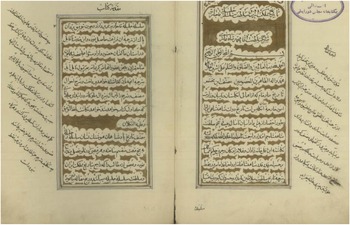
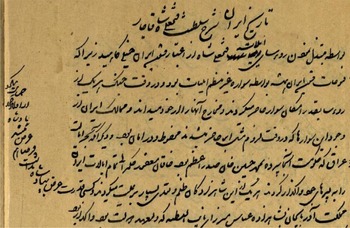
In the translator's preface (See picture 1), Mirza Rahim first introduces the book and its writer, and then notes the shah's order to translate the section pertaining to Qajar rule and his intent to translate other sections if they are approved. The preface ends with a description of the outline of Markham's book. In the annotation to his preface, Mirza Rahim emphasizes that he translated according to the strict order of the shah, and also apologizes for any lack of fluency in his sentences, which he attributes to his compulsion to closely follow the writer's diction and syntax. In the annotation, Mirza Rahim states:
Before I begin, and in this short space, it is incumbent on me to mention that, in translating this book, following the order of His majesty, the omnipotent, for whom our souls may be sacrificed, I have not deviated from the word-for-word method, and have strictly avoided embellishment, adding nothing to the text and omitting nothing from the words of the writer, who has freely and boldly and sometimes out of animosity spoken his intentions. For His majesty's purpose in ordering this translation was only to be informed of the content of the book. Therefore, the translator humbly asks for the forgiveness and forbearance of the wise and knowledgeable men of this land and asks them to excuse the awkward sentences of this translation and do not hold this poor humble translator accountable for any shortcoming, for my duty has been but to obey His majesty's order to render the writer's words.Footnote 32
Mirza Rahim's preface in the illuminated copy presented to the ShahFootnote 31

7. The translator's loyalty to his patron
Generally speaking, the translator's claim to have translated word-for-word proves true, but only where the writer has described places. Indeed, nearly all parts of the source text on the Qajar shahs, even parts describing their appearance, underwent shifts of some kind. These changes, on the whole, represented the shah's desired narrative. Markham's History of Persia narrates the lives of four Qajar kings, beginning with Agha Mohammad Khan—the founder of the dynasty—and continuing on to Fath-Ali Shah, Mohammad Shah, and finally Naser al-Din Shah, during whose long reign the book was written and translated.
To examine the shifts, chapters XIV to XX were thoroughly examined and compared word-by-word to Mirza Rahim's translation. The shifts fall into two general categories, deletions and additions, one or two examples of which are given below. Deletions can be divided into the following four groups, with potential overlap:
• References to the cruelty and negative traits and weaknesses of the Qajar kings;
• Negative remarks about the appearance of the Qajar kings;
• Comparisons between the Qajars and other dynasties;
• Incapability of the Iranian army.
Deletions range from a single word to an entire paragraph, the longest segment eliminating 141 words. Apart from single words, a total of 1095 words have been deleted. The first major case of which is the deletion of the writer's preface itself. It may seem justifiable to not translate this part, since the translation only includes the Qajar section, but the translator likely had a stronger justification for this exclusion, as the preface included negative references to the Qajar kings and positive, nostalgic references to the history of Persia before the Qajars. The following is an example:
In later times we are dazzled by the magnificence of the Sassanians and the Khalifahs, delighted by the beauties of Persian poetry, and filled astonishment at the conquests of Jengiz and Timur; while we dwell with pleasure on the revived glories of ‘Abbas the Great, and deplore the present misgovernment of modern Persia.Footnote 33
There are three instances where the Qajars were described as the cause of dishonesty among Iranian peasants; indeed, the peasants would actually be honest and kind people if saved from the oppression of their rulers. It is to be noted that, during the Qajar period, peasants suffered the cruelty of their landlords and governors, who imposed heavy taxes on them.Footnote 34 In the following example, the translator has omitted any mention of the British showing kindness of Iranian peasants and having their kindness reciprocated (omitted parts are underlined):
Source text (henceforth ST): Sir Harford Jones relates that the peasants on the road, who had formerly experienced acts of kindness from him, invariably brought him some trifling present when passed: either a favorite kid, or a cream cheese and fresh butter made by their wives, and they always refused payment. Lady Shiel praises their kindness, attention, and most respectful conduct; and Mr. Fraser, who formed a most unfavorable opinion of all Persians, admits that the peasantry, when removed from the malign influence of their rulers, possess independence and honesty.Footnote 35
سِرحارفردجونز انگلیس که به ایران سفر نموده بود نوشته است که رعایای ایران همه مهربان هستند و لیدی شیل زن وزیرمختار نیز از ایشان تعریف زیاد نوشته است .Footnote 36
Back translation (henceforth BT): Sir Harford Jones, of England, who has travelled to Iran, has written that all Iranian subjects are kind. Also, Lady Shiel, the minister's wife, has spoken highly of them.
In the following example, the negative adverb “cruelly,” referring to Agha Mohammad Khan, and the positive adjective “chivalrous,” referring to the last prince of the Zand dynasty, are both omitted in the Persian translation, thus imparting different images of both the founder of the Qajar dynasty and his rival:
ST: On the death of Karim Khan, Agha Muhammad escaped to Mazandaran; and, after more than ten years of war, he captured Kirman, and cruelly murdered his chivalrous rival, Lutf ‘Aly Khan.Footnote 37
چون كريمخان در شيراز رحلت نمود آقامحمدخان  به مازندران شتافته و در آنجا از جهت خود قشونی فراهم نمود و پس از مدت ده سال جنگ و جدال آخرالامر شهر کرمان را مسخر کرد و لطفعلی خان زند را که داعیه ٔ سلطنت داشت به قتل رسانید.Footnote 38
BT: After Karim Khan passed away in Shiraz, Agha Mohammad Khan hastened to Mazandaran and prepared an army for himself and after ten years of war, he finally seized Kerman and killed Lutf-Ali Khan Zand, who claimed the throne.
While the deletions are primarily removing negative attributes associated with either the Qajar kings or the Persian army, the additions seem to either explicate, justify, or tone down the described events. For example, while referring to the death of Agha Mohammad Khan Qajar, who was murdered by two of his servants, the translator uses the term shahid (martyr), which suggests a sacrifice within the religious doctrine.Footnote 39
A total of 2374 words have been added to the translation, disregarding the pompous titles of the kings, which are absent from the original but were obligatory in the Qajar era. Some examples of such additions follow (added words are underlined):
ST: He then proceeded to murder his relations.Footnote 40
و بعضی از اقوام خود را که مخرب سلطنت و دولت بودند به هلاکت رساندند و مملکت ایران را منظم کردند.Footnote 41
BT: And he killed some of his relations who were a threat to the throne and country, bringing order back to Iran.
This addition serves to justify the horrific murders Agha Mohammad Khan committed to attain the throne. In another historical development, the violent confrontation of the Qajar government with Babism—a newly emerged religion that broke with Shia’ Islam, bringing its own laws, teachings, and practices—resulted in Babi massacres. In the following instance, the translator clearly attempts to justify the murders by adding the Qajar's perspective:
ST: His doctrines were composed of Pantheism and the wildest Socialist principles.Footnote 42
عقاید باب این بود که اموال و زنان مردم به یکدیگر حلال و مباح است و هر کسی می تواند اموال دیگری را صرف نماید و با زن دیگری هم بستر شود و در حقیقت مذهب میرزاعلی محمد لامذهبی و وحشیگری بود و عقاید او خیلی شبیه بود به عقاید سوسیالیست های فرنگستان . … شاهنشاه تاجدار در دفع جماعت بابیه که مخرب دین و دولت بودند همت گماشتند و آخرالامر میرزاعلی محمد باب را که سردسته این لامذهبان بود دستگیر نمودند در شهر تبریز به حکم اعلیحضرت شهریاری او را گلوله باران کردند و مملکت ایران را از آلایش وجود او بپرداختند.Footnote 43
BT: Bab [founder of Babism] professed that men could, legitimately, exchange their women and properties and that it is religiously permissible for everyone to use other people's properties and sleep with their wives; in fact, Mirza Mohammad Ali's religion professed pantheism and savagery; his doctrines were very similar to those of foreign socialists…. His majesty the king made an attempt to repel the Babis, who were a threat to the religion and government, and at last Mirza Mohammad Ali Bab, leader of this pagan sect, was arrested and executed by order of His majesty in Tabriz and the country of Iran was freed from the filth of his existence.
8. The translator's veiled criticisms
In this section, instances of the translator including his own criticisms of the Qajars are examined, revealing his voice in disguise. As the first and final drafts of the translation show, these changes were made as “afterthoughts.”
ST: The Kaim-Makam, however, was imprisoned and murdered in June 1835.Footnote 44
First Draft (henceforth FD):
لکن قائم مقام را محبوس نموده به قتل رساندند.Footnote 45
Back translation of the first draft (henceforth BTFD): However, they imprisoned and murdered the Kaim-Makam.
Final Draft (henceforth FLD):
ولکن قائم مقام را محبوس نموده به قتل رساندند. رسم سلاطین سابق قاجار آن بود که هر وزیری که به ایشان خدمت می کرد در بدو امر او را به مقامی رفیع برکشانیده و عاقبت از وی وحشت کرده به قتلش می رساندند.Footnote 46
Back translation of the final draft (henceforth BTFLD):
However, they imprisoned and murdered the Kaim-Makam. This was customary for former Qajar kings to, in the beginning, promote to high ranks any minister who served them, but, fearing him, eventually murdered him.”
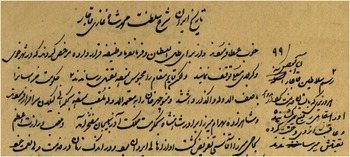
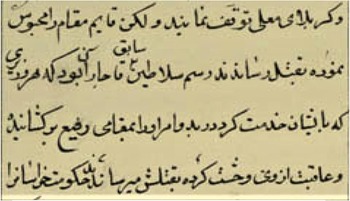
It is to be noted that Kaim-Makam, who served as the grand vizier of Mohammad Shah Qajar from 1834 to 1835, was murdered on the shah's orders in 1835. In the above case, the translator added, in the first draft (see the margin of Picture 2), the underlined sentence to the translation. Aware of the great risk involved in adding this daring comment about Qajar kings, the translator cleverly excepted the present king by limiting his comment to “former” Qajar kings. Interestingly, the word “former” has been added to the translation as a second afterthought (see Picture 3). This comment clearly shows the translator's sympathy for Kaim-Makam, a great Iranian official and man of letters, whom the Czech orientalist Jan Rypka described as an “uncommonly intelligent young man,” “incorruptible, noble and loyal.”Footnote 47
An insatance of Mirza Rahim's “afterthought” in the first draft

Mirza Rahim's “after-afterthought” in the final draft

Mirza Rahim's longest addition regards the murder of Amir Kabir, another Qajar prime minister, where two pages of around 500 words are translated into ten pages of approximately 1500 words. In Markham's perspective, Amir Kabir was one of the most able Persian ministers, but the Shah became jealous of his power and the courtiers hated his integrity and his monitoring of financial affairs. He was hence dispossessed of his office, sent to Kashan, and tricked to death by the treachery of a group of court assassins. He was succeeded by Mirza Agha Khan, who was skilled at flattery and constantly lied to the shah. The shah, like his predecessors, killed the minister who helped him to the throne.Footnote 48
Now, let us compare the above narrative with that of the translator, who included that Amir Kabir was an enemy to the courtiers because he had cut their access to the court's riches. So, they slandered him and successfully poisoned the shah's opinion, to the extent that he dispossessed Amir Kabir of his office. When Mirza Agha Khan was appointed prime minister, he feared the shah might change his mind and return Amir Kabir to Tehran, so he hatched a plot to kill Amir Kabir. Mirza Agha Khan asked the Russian ambassador to intervene in support of Amir Kabir, giving substance to the lie that Amir Kabir was plotting to take the throne with Russian help. Throughout, the shah was reluctant to do what he finally did, and for which he was so sad and sorry, always mentioning the great works Amir Kabir had done during his service.Footnote 49
As is clear from the above summary, the translator, through his extensive additions, went to great lengths to present a sympathetic picture of Amir Kabir, but in a way so as not to incite the shah's rage. Mirza Rahim did this by cleverly appealing to the Shah's emotions and trying to acquit the shah of the horrible act he committed.
ST: Just in the same way we may dwell upon the past history of Iran; the age of Rustam and his heroes, the precepts of Zoroaster, the gorgeous line of Sassanian Kings, the age of Poets, the restored magnificence of ‘Abbas, and finally the stream of history brings us down to the naked deformity of the Kajar rule and the desolation of modern Persia.Footnote 50
FD:
همان قسمی كه در تصور تاريخ انسان مبهوت می شود از قصه های رستم و افراسیاب و پهلوانان ایران و نصایح و دین و قانون زرتشت و سلاطین باحشمت ساسانیان و عهد شعرا و اقتدار صفویه و عظمت شاه عباس کبیر رشته تاریخ انسان را می کشد به وضع حالیه و سوء سلطنت قاجاریه و ظلمت و خرابی مملکت ایران .Footnote 51
BT: Just in the same way, one gets astonished by the stories of Rustam and Afrasiyab and Iran's heroes, the precepts of Zoroaster, the gorgeous line of Sassanian Kings, the age of Poets, the restored magnificence of ‘Abbas to the present condition and misrule of the Kajar kings and the desolation of Iran.
FLD:
و تاریخ این مملکت مشهور هر چه نزدیک تر می شود از آن آثار و علامات و بزرگی ها و از قصه های رستم و افراسیاب و نصایح و مواعظ حکما و قصاید و اشعار شعراء و دین و آیین زرتشت و حشمت ساسانیان حتی اقتدار سلاطین صفویه و عظمت شاه عباس کبیر هیچ چیز نمی بیند و به هر طرفی می نگرد جز ظلمت و خرابی و فقر و فاقه اهالی چیزی مشاهده نمی شود و حیرت می کند که سلاطین سلسله ٔ جلیله ٔ قاجاریه چرا به هیچ وجه درصدد تعمیر و تحصیل عظمت گذشته ٔ این مملکت برنیامده اند و به اسلاف خویش تأسی نکردهاند.Footnote 52
BTFLD: As the history of Iran draws nearer, it witnesses nothing of the great achievements of the past, of the stories of Rustam and Sohrab, of the sermons of the wise men, of the odes of poets, of the teachings of Zoroaster, of the glory of the Sassanian kings, of the power of Safavid kings and the greatness of King Abbas; everywhere it looks, all it witnesses is desolation and poverty, wondering why the kings of the great dynasty of Qajar have never sought to restore the glorious past of this country and have not followed the examples of their predecessors.
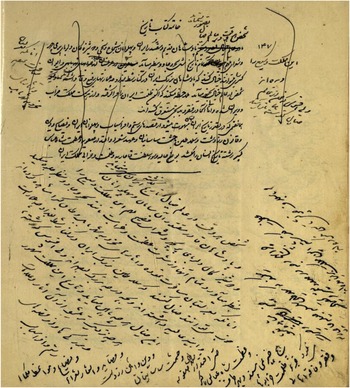
The above case is the last part of the writer's conclusion to the chapter on the Qajar era. Here, Mirza Rahim expands on the writer's view of Iran's glorious past and laments its present status, adopting a softer tone intended to rouse the shah's patriotic sentiments and encourage him to follow the example of his predecessors. The translator first presents an almost faithful translation of the original. In the editing process, however, as shown in the edited version (see Picture 4), he makes certain changes, some editorial, some substantive. But as the changes proliforated, he rewrote the entire paragraph. The translator has, understandably, omitted the writer's phrase “the misrule of the Kajar kings.”
An instance of Mirza Rahim's changing the content of an entire paragraph in the first draft

In the following passage, Markham writes of the shah's sons who, as governors of different provinces, were cruel and unjust to the people.
ST: …and by placing his sons in the government of every province of Persia, excepting Irak, which was held by Muhammad Hussain Khan, he delivered them over to misrule and tyranny.Footnote 53
FD:
هریک ازین شاهزادگان ظلم و تعدی بسیار به رعیت می کردند.Footnote 54
BT: Each of these princes committed many acts of oppression against the people.
FLD:
هریک ازین شاهزادگان ظلم و تعدی بسیار به رعیت می کردند و کسی قدرت عرض به پادشاه نداشت فرضاً عرض هم می شد پادشاه از اولاد خود حمایت می کرد.Footnote 55
BTFLD: Each of these princes committed many acts of oppression against the people and no one dared to report to the shah; if they did, the shah would support his sons.
The above case presents another example of the translator's voice and daring criticism of the king and his sons. In this instance also (see the margin of Picture 5), the translator added the comment in the edited version.
Another instance of addition to the first draft source text

On three occasions where the writer disparages Persian nobles, the translator clearly places the blame on the shah:
ST: The government of Persia being a pure despotism, and the highest nobles being liable, at the caprice of the sovereign, to be put to death, robbed, or even beaten, few fine qualities can be expected from a Persian courtier, and the throne is surrounded by fulsome flattery.Footnote 56
FL:
دولت ایران سلطنت مستقل است جان و مال تمام اهل مملکت به اختیار شخص پادشاه می باشد شاهنشاه ایران قادر است که هریک از اعاظم و بزرگان را به قتل برساند و اموال ایشان را ضبط نماید بزرگان ایران اکثر بی سواد و بی تربیت هستند اشخاصی که دور پادشاه هستند همه کاذب و مفتن می باشند.Footnote 57
BTFLD: Iran's government is an independent sovereignty. The life and death and riches of all countrymen are at the shah's mercy. The king of Iran is able to kill any noble or dignitary and seize his wealth. Most of Iran's nobles are illiterate and rude. Those who surround the shah are all liars and seditious characters.
The above case is interesting in that the translator has, uncharacteristically, exercised no self-censorship when the writer made a strong statement against the shah and nobles. Clearly, this is because Mirza Rahim agreed with the writer's criticism of the shah. However, the translator has been careful not to be too offensive, as he translated “pure despotism” to “independent sovereignty,”Footnote 58 which is rather vague. What does he mean by “independent”? Independent of what? Presumably he refers to the shah's absolute power; he cannot be challenged by any individual or foreign government. If this assumption is correct, the word “independent” in this context suggests criticism of the type of government: a king who is not accountable for his acts, free to kill his own people and seize their wealth.
ST: Under such a degrading system the nobles are the mere slaves of a despot with all the qualities of insolent menials, cunning, selfish, cowardly, and avaricious.Footnote 59
FLD:
از وضع این چنین سلطنت مقتدر واضح است که بزرگان مملکت مثل غلام زرخرید هستند و در
حركات و گفتار خود بايد به ملاحظه رفتار كنند و هر كس به خيال آن باشد که مال و منالی برای خود تحصیل نماید در این صورت خلف قول و رشوه و فتنه لازم و ملزوم با این کار است .Footnote 60
BTFLD: Under such a powerful system, it is obvious that the nobles in the country are like bondsmen; they must exercise caution as to what they do and say. And if anyone wishes to acquire some fortune for himself, he has to resort to bribery, treachery, and hypocrisy.
As the back translation shows, the translator used two contradictory adjectives to avoid direct criticism of the shah. On the one hand, he translated “despot” to moghtader (powerful), which has strong positive connotations. On the other hand, he translated “slave” to zarkharid (literally, a person purchaed with gold coins to act as a slave). Also, while the original sentence is highly critical of Persian nobles, the translator acquits them of any possible fault, attributing their wrongs not to their characters but to the government.
ST: The Persian nobles are very handsome, hospitable, and highly polished in their manners; but deceitful and haughty. Their bad qualities however, are the fault of the wretched government under which they live.Footnote 61
FD:
بزرگان ایران همه مؤدب و مهمان نواز هستند لیکن بیشتر از ایشان متکبر و کاذب و حیله ساز می باشند و این کذب و حیله برای آن است که در سلطنت مستقله، به راستی و درستی کار پیش نمی رود و مجبور هستند که دروغ بگویند.Footnote 62
BT: The nobles of Iran are all polite and hospitable, but most are arrogant, lying, and deceitful; and the reason for this deceit and dishonesty is that, in an independent government, they can achieve nothing if they are truthful and honest, so they are forced to tell lies.
FLD:
بزرگان ایران همه مؤدب و مهمان نواز هستند لیکن بیشتر از ایشان متکبر و مختلف القول و مدبر می باشند و این تزویر و تدبیر برای آن است که در سلطنت مستقله به راستی و درستی و بی پرده سخن نمی توان گفت .Footnote 63
BTFLD: The nobles of Iran are all polite and hospitable, but most of them are arrogant, hypocritical, and resourceful. This hypocrisy and resourcefulness are because one cannot directly, truthfully, and explicitly speak in this form of independent government.
Here, too, by using the positive adjective “resourceful” and adding the adverbs “directly, truthfully, and explicitly,” the translator emphatically justifies the actions of Persian nobles. What he says about the restraints imposed on nobles applies equally to translators, and thus appears to be speaking his mind; metaphorically speaking, the sentence is a distress message put in a bottle and thrown in the ocean, hoping future generations will find it.
9. Discussion
As the examples above show, the changes the translator made to the source text are of two kinds: those made to conform to Naser al-Din Shah's sensibilities (as an accomplice, to use Booth's term) and those made to criticize him (as a form of resistance). The former are not isolated, local changes; they are made systematically to affect the entire narrative. The translator's purpose was to shift the source text's generally negative image of Qajar kings into a positive one in the translation by presenting a narrative different from the original. The latter changes, however, were made to insert the translator's individual voice, an issue addressed in this section.
Our translator, being the son of the shah's special physician and valet, must have been fully aware of the shah's intolerance of any form of criticism. Moreover, perhaps feeling somewhat indebted to the shah for his permission to study abroad and his father's position in the court, Mirza Rahim may have felt obliged to conform to the shah's wishes. Moreover, it was not only the shah's wrath that Mirza Rahim had to avoid, but Etemād al-Saltaneh's as well. Time and again, Etemād al-Saltaneh mentions in his diary that he raged over translators who disobeyed his orders; in some cases, he even burned their translations.Footnote 64 Thus, to avoid the wrath of both the shah and Etemād al-Saltaneh, the translator likely resorted to self-censorship by making changes to the source text.
The question that arises here, then, is why the translator insists in the preface that his is a word-for-word translation of the source text? Mirza Rahim is not the only DTN translator to explicitly claim to have done a word-for-word translation. Out of 210 books identified as translated by DTN translators, 113 were found to have either prefaces, endnotes, or both. In thirteen cases, translators pointed out their method of translation, eleven of whom emphasized using a word-for-word translation method. Making explicit reference to their method seems to have been routine in DTN's first phase of activity (i.e., from its establishment in 1871 to its expansion in 1883).Footnote 65 In fact, a general pattern can be observed in the prefaces: they begin with a praise of God followed by an introduction to the book, subsequently they state the translation's commissioner (usually the shah), give a dedication to the shah, and explain the reason/benefit and method of translation, and end with an apology for any shortcomings on the part of the translator as well as an expression of humility.
For example, Mirza ‘Issā Garusi, a French and Arabic translator for DTN, included the phrase “word-for-word” in the title of his translation of Safarnāmeh-ye Doctor LartehFootnote 66: Tarjomeh-ye Taht Al-lafz-e Safarnāmeh-ye Doctor Larteh (A word-for-word translation of Dr. Larte's travelogue).Footnote 67 Additionally, in the endnote to his translation of Hārmān's Travelogue, Mirza ‘Issā Garusi says: “[I] tried my best to do a correct word-for-word translation.”Footnote 68 Further, in the preface to the Charles Juliet Travelogue, he asserts that he strictly followed the author's style.Footnote 69 Mādrus/Mārdrus Khan, a French and Russian translator for DTN, also often mentions that his translation is “equivalent to the original” or exhibits “no difference from the original.”Footnote 70 Following the style of the original is also mentioned by Ali Bakhsh Mirza in the endnote to his translation of the first volume of Tārikh-e Hayāt-e Faublas Footnote 71:
All throughout the translation, I have purposely kept the French idiom; they often leave the utterance unfinished as a rhetorical trope, leaving it to the appreciation of the listener or reader to finish it.Footnote 72
Mirza Hossein Shirazi, a DTN Indian and Arabic translator, in his preface to History of India, goes even further in his claim of following the writer's footsteps, translating him not only word-for-word but letter by letter. Shirazi justifies this method not through reference to the shah's order, but by referring to a hadith from the Prophet. He likens the original text and its translation to Children of Israel and Muslim Ummah, quoting the Prophet as saying that whatever has happened to the former will happen to the latter.Footnote 73
We also know from historical cases that some dreadful consequence awaited if the shah was displeased with the translation or if the translator chose the wrong book for translation. For instance, Yusef Khan Mustashār al-Dowleh, a writer, intellectual, and diplomat, was jailed and tortured—losing his eyesight by being constantly beaten on the head with the book he translated—for writing/translating Resaleh-ye Yek Kalameh (Discourse on One Word, 1869).Footnote 74 By “One Word,” Mustashār al-Dowleh meant “The Law,” and this book was a combination of articles from the French Constitution and Declaration of THuman Rights.he writer's purpose was to show to clerics and statesmen that such laws were not contradictory to Islamic teachings and the only way to advancement was to follow them.
Additionally, Mohammad Hossein Foroughi (known as Zakā al-Mulk), manager and one of the key translators at DTN, had to hide in a stable for a week after he published an article on a subject forbidden by the shah, fearing he might be executed.Footnote 75 Even Etemād al-Saltaneh himself, whose entire life was devoted to serving the shah as a translator, interpreter, head of DTN, and Minister of Press and Publication, was no exception. In the last years of life, he translated Madame Mont Pansier (a seven-volume book on French history), sending a copy to the shah after the translation of each volume was complete and receiving no criticism or negative feedback. But when the book was published and distributed, the shah ordered all 705 copies be withdrawn from bookstores.Footnote 76
Another interesting case concerns the translation of The Bronze Statute or, the Virgin's Kiss (1883) by W. M. Reynolds, which was translated by Mirza Hossein Shirazi in two phases: the first volume appeared in 1894, when Naser al-Din Shah was still alive, while the second and third volumes only appeared fourteen years later in 1908, after the Constitutional Revolution harkened more social and political freedom. He called the book Kashaf al-Asrār (Secrets Exposed), as it was meant to expose secrets against the despotic system. In the preface to the second volume, the translator mentions that, in the despotic circumstances of the times, he was unsure how to translate the book to avoid retribution. Thus, he goes to Amin al-Dowleh (the head of the State Great Council at the time of Naser al-Din Shah) for advice. This is the advice he receives:
This excellent book is against the idea of despotism and is, in other words, against the current monarchy in Iran, even though the trend in the world tells us that unless the kings quit obstinacy and tread on the road of justice, their nations will not rise from the abyss of abjectness to the apex of excellence. You are thus well advised if you do not throw caution to the wind, consider the time's circumstances and do not risk exposing the secrets and recklessly tearing the veil of despotism; express yourself, as far as possible, in a veiled language and using metaphors and ironies and all forms of verbal ornaments hide your intention in a way that fulfils the shah's expectations and is in accord with the time's exigencies.Footnote 77
Returning to the question raised above, one possible answer is that DTN translators were not really addressing the general reader; instead, the shah was their first and most important reader. Thus, by emphasizing their word-for-word translation method—which, in fact, they may not have used—they meant to please the shah. Flattery was very common at the court because the shah himself encouraged it. For example, as far as translations were concerned, the shah would become enraged if he did not like the content, ingencourag self-censorship on the part of the translators. In this context, Mirza Rahim showed great courage in retaining the writer's criticism in the translation and adding his own criticism to the source text. The shah was very senstiive to the criticism and ridicule by foreign governments, which is why he demanded word-for-word translations. Mirza Rahim was well aware of the shah's tendency and knew that he was more likely to hear the criticism of foreigners. It is thus evident that Mirza Rahim's claim of word-for-word translation, far from being factual, was meant to mislead the shah into believing that these were the writer's exact words.
Given the despotic atmosphere in which the translator was working, self-censorship is understandable, but how can we explain the translator's inclusion of his own voice in the translation? The answer lies in the fact that two groups of Monavvar al-fekrān (enlightened thinkers), as they called themselves, emerged in the Qajar period as a result of the encounter between Iran and the West. In Chomsky's word, the two groups can be described as compliant and dissident, Footnote 78 or the “well-wishers of the government” and the “Degar-Andish,” literally “politically other.”Footnote 79
The two groups had two things in common: first, all except Amir Kabir were translators working either within the court and/or DTN or outside the court and/or Iran; and second, both groups pursued the common goal of modernizing Iranian society through introducing reforms in the political, economic, and educational spheres, resulting in the people's greater well-being and awareness.Footnote 80 The methods the two groups used, however, were different. While the dissident group, who clearly stated the need for fundamental change, were often oppressed by the shah, forced to live in exile or jailed and tortured, compliant intellectuals—like Etemād alSaltaneh—had an official position within the government . Such intellectuals hoped to influence the shah indirectly, make him aware of the consequences of his policies, and one effective way to achieve this was through translation. Etemād al-Saltaneh, for instance, constantly tried to balance between what the shah approved and what he thought was good for the country. In his diary entry dated 18 April, 1890, he writes: “I took the trouble to translate Madam Du Barry to admonish His majesty and make him understand what causes the fall of a monarchy; but, alas, it had the opposite effect. The shah approved of Louis XV's wrongful deeds.”Footnote 81
10. Concluding remarks
This study presents an interesting historical case: it is a narrative written by three different narrators—the writer, the translation's patron, and the translator himself—with different interests. Mirza Rahim's translation can be seen as a “historical event,” which—following Rundle—sheds light on a previously neglected part of translation and Iranian history. It was previously thought (even according to the history scholar Iraj Afshar) that Naser al-Din Shah's court translators, fearing the consequences of disobeying the shah's explicit orders, translated in a way to please him. In contrast, however, this study shows that Qajar translators at the time of Naser al-Din Shah's reign, while emphasizing their loyalty to the author's words and making major changes to the source text to please the shah, also dared to express their own dissident voice. The rare opportunity to access the translator's first draft made it possible to uncover Mirza Rahim's inclusions prior to presenting his translation to the shah. Moreover, the study shows that a reassessment of Persian translations from the period under study is warranted, especially those in whose prefaces the translators insisted on their word-for-word method. Finally, it is hoped that this interdisciplinary study will enhance a dialogue between disciplines of history and translation studies.