

Introduction
Over the past decade our increased understanding in the biology of breast cancer (BC) has been paralleled by the successful development of novel agents and combinations that dramatically expanded the therapeutic armamentarium and improved patient outcomes (Ref. 1). A large-scale characterisation effort refined the molecular taxonomy of the disease, reclassifying BC into multiple molecular and clinical entities each one carrying a specific set of molecular alterations and a different spectrum of sensitivity to hormone therapy, chemotherapy and molecular targeted agents (Refs Reference Perou2, 3). Having taken a more detailed look at the biology of the disease it is shedding light on previously unexplored oncogenic hits and gene–gene interaction networks. If, on the one hand, this has added a further level of complexity to the biology of BC, on the other hand the pipeline of potential targetable alterations and candidate biomarkers for patient stratification and treatment assignment is expanding.
Among emerging oncogenic signals, compelling evidence pinpointed the multifaceted tumour-promoting avenues mediated by the transcriptional co-activator with PDZ-binding motif (TAZ) and Yes-associated protein (YAP) (Ref. Reference Johnson and Halder4). Operatively, TAZ and YAP are placed in the context of the Hippo pathway, an evolutionary conserved regulator of tissue growth whose perturbation has been connected with tissue overgrowth and tumorigenesis in animal models (Refs Reference Justice5, Reference Xu6, Reference Pantalacci7, Reference Udan8, Reference Wu9, Reference Jia10, Reference Tapon11, Reference Harvey12, Reference Hamaratoglu13, Reference Camargo14, Reference Zhao15, Reference Wu16, Reference Zhang17, Reference Zhou18, Reference Fernández19, Reference Sansores-Garcia20). Importantly, with the exception of neurofibromin 2 (NF2), that is mutationally inactivated in some tumours (Ref. Reference Harvey, Zhang and Thomas21), somatic or germline mutations in Hippo core pathway components have uncommonly been reported in human cancers, even including the whole-exome sequencing analysis carried out by The Cancer Genome Atlas Network (Ref. 3). Thus, at least in principle, TAZ/YAP activation is driven either by functional events disrupting Hippo-mediated control or by Hippo-independent crosstalk with other perturbed pathways or functions.
Upstream components of the Hippo pathway operate an inhibitory phosphorylation of both TAZ and YAP, preventing their nuclear translocation and then hindering the TAZ/YAP-mediated transcriptional programme (Refs Reference Zhao15, Reference Dong22, Reference Huang23, Reference Lei24). Preclinical evidence broadened this biological frame by elucidating how TAZ and YAP activation is controlled by a series of input, spanning from cell junctions to extracellular cues and metabolic pathways (Refs Reference Piccolo, Dupont and Cordenonsi25, Reference Hong and Guan26). Independently from the stimulus, the activation of the Hippo transducers TAZ/YAP in cancer cells has been tied to a wide array of protumourigenic functions, such as epithelial-to-mesenchymal transition (EMT) and cancer stem cell (CSC) fate decision (Ref. Reference Piccolo, Dupont and Cordenonsi25).
In this review, we discuss the mechanisms governing TAZ and YAP function, their biological roles in BC, and early evidence linking them to clinical outcomes of BC patients. We will finally discuss clinical strategies for investigating TAZ/YAP as prognostic/predictive biomarkers and therapeutic targets in the clinical setting.
Mechanisms of TAZ and YAP activation
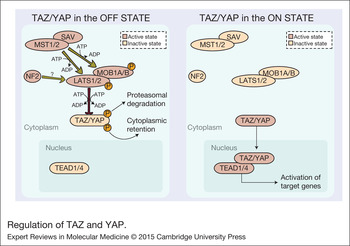
Discovered in Drosophila melanogaster, Hippo was later recognised as a conserved regulator of tissue growth in the animal kingdom. For simplicity, hereafter we refer to the mammalian nomenclature. Hippo functions the same as other signal transduction pathways with a ‘vertical’ architecture, as illustrated in Fig. 1. However, as detailed in this paragraph, TAZ/YAP activity is not necessarily driven by Hippo kinases, as Hippo-independent mechanisms of TAZ/YAP regulation have been elucidated. Thus, TAZ/YAP activation should not be equated with Hippo signalling.
Regulation of TAZ and YAP. The Hippo core module is composed by kinases (MST1, MST2, LATS1, LATS2) and adaptor proteins (SAV1, MOB1A, MOB1B). When the Hippo signalling cascade is active, LATS1 and LATS2 operate an inhibitory phosphorylation of TAZ and YAP, leading to their cytoplasmic retention and proteasomal degradation. NF2, which lacks kinase activity, is a further activator of LATS1 and LATS2. When the Hippo signalling cascade is not active, TAZ and YAP are not phosphorylated and translocate to the nucleus where they interact with TEAD1-TEAD4 and other transcriptional partners (i.e. SMAD and RUNX), inducing target gene expression.

The core Hippo module encompasses the following: two serine/threonine kinases known as sterile 20-like kinase 1 (MST1) and 2 (MST2), large tumour suppressor 1 (LATS1) and 2 (LATS2), the scaffold proteins Salvador homologue 1 (SAV1), MOB kinase activator 1A (MOB1A) and 1B (MOB1B). In the ‘on’ state, MST1/2 bind to SAV1, forming an enzymatic complex that phosphorylates and activates LATS1/2 kinases and the MOB1A/B regulatory subunits of LAST1/2. In turn, LATS1/2-MOB1A/B phosphorylates TAZ and YAP, preventing their interaction with TEA domain-containing sequence-specific transcription factors (TEAD1 to TEAD4) and other transcriptional partners such as SMAD and RUNX proteins. In this manner, MST1/2 and LATS1/2 orchestrate TAZ/YAP nuclear exclusion, cytoplasmic retention and proteasomal degradation (Refs Reference Zhao15, Reference Dong22, Reference Lei24, Reference Liu27, Reference Zhao28). Thus, Hippo is defined as a tumour suppressor pathway whose main function consists in negatively regulating the homologous oncoproteins TAZ and YAP.
Multiple upstream regulatory branches intersect the Hippo pathway at different levels of the signal cascade, either acting as activators of core kinases repressing TAZ/YAP, or by sequestering TAZ/YAP in physical complexes independently on the activation of core kinases. For an excellent overview of the mechanisms controlling TAZ/YAP activation the reader might refer to (Ref. Reference Piccolo, Dupont and Cordenonsi25). Briefly, whether the functional organisation of Hippo resembles that of other canonical signal transduction pathways, its activation does not seem to be chiefly reliant on soluble ligands, even though exceptions have been described as discussed below. Indeed, regulatory forces mostly emanate from mechanisms involved in cell–cell adhesion and apical–basal polarity. Overall, junctional and apicobasal polarity factors, key elements of the physiological architecture of epithelial tissues, block TAZ/YAP nuclear activities (Ref. Reference Piccolo, Dupont and Cordenonsi25). Disruption of these controllers, a hallmark of cancer cells where adhesive properties are altered or defective, relieves the inhibitory effects on TAZ/YAP. A third regulatory branch involves the actin cytoskeleton and Rho GTPase and defines the role of TAZ/YAP in mechanotransduction (Ref. Reference Dupont29). In this molecular framework, TAZ/YAP acts as nuclear relays for mechanical signals conveyed by changes occurring in extracellular matrix and cell geometry. Through this process mechanical and physical cues are converted into biochemical stimuli that mediate adaptive responses to external forces. A further level of regulation of TAZ/YAP involving RHO GTPases derives from the mevalonate pathway (Ref. Reference Sorrentino30), a key metabolic route mediating a wide array of cellular processes ranging from protein prenylation to steroid biosynthesis. These two types of input have elegantly been combined in a unique equation. Accordingly, geranylgeranyl pyrophosphate, a major metabolite produced in the mevalonate cascade, is essential for the correct membrane localisation and activation of Rho GTPases. These, in turn, inhibit TAZ/YAP phosphorylation favouring their nuclear accumulation. Finally, TAZ/YAP have been integrated in the Wnt pathway as components of the β-catenin destruction complex (Ref. Reference Azzolin31). This indicates that the connection existing between Hippo and Wnt is deeper than previously thought as these two pathways share common regulatory mechanisms. In greater detail, in the absence of Wnt ligand-mediated stimulation TAZ/YAP are sequestered in the cytoplasm where they play a crucial role in β-catenin degradation. Conversely, stimulation with Wnt ligands disassembles the β-catenin destruction complex, leading to the release of TAZ/YAP. The molecular implication of this interaction is twofold seeing that, under these conditions, both the β-catenin-mediated and the TAZ/YAP-dependent transcriptional programs are activated.
Overall, multiple layers of TAZ/YAP regulation exist which depend on different factors such as the spatial and tissue context, the interactions of cancer cells with the surrounding environment, and the availability of growth factors. Nevertheless, whether, on the one hand, we have acquired elements on the modalities through which TAZ/YAP are engaged, the biological outcomes they elicit, and the molecular networks in which they operate, on the other the molecular outputs of their activation remain largely enigmatic as few target genes have been identified so far (e.g. Axl, CTGF, Cyr61, amphiregulin) (Ref. Reference Piccolo, Dupont and Cordenonsi25).
Oncogenic activities mediated by TAZ and YAP in BC
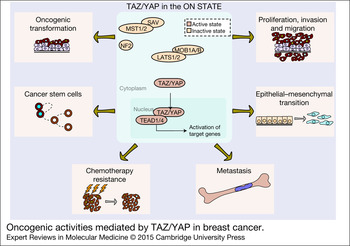
TAZ/YAP overexpression is commonly observed in BC and appears to be a shared trait across the spectrum of intrinsic subtypes. Indeed, elevated levels have been reported in Luminal subtypes, in the HER2-positive background including both Luminal B and HER2-enriched tumours, and in triple-negative BC (Refs Reference Bartucci32, Reference Vici33, Reference Lehn34, Reference Min Kim35, Reference Kim36, Reference Skibinski37). At the preclinical level, TAZ/YAP have been described as central players of multiple cancer-associated features such as proliferation and cell survival, migration and metastasis, resistance to chemotherapy, EMT and CSCs (Fig. 2). Given the tight connection existing between EMT, CSCs and therapeutic resistance, they are discussed separately in the next section.
Oncogenic activities mediated by TAZ/YAP in BC. Activation of TAZ and YAP in BC is associated with multiple tumor-promoting functions including oncogenic transformation, proliferation, migration and metastasis. TAZ also promotes EMT, chemotherapy resistance and sustains self-renewal of CSCs.

The role of TAZ in oncogenic transformation of non-neoplastic mammary cells was originally described in MCF10A cells (Ref. Reference Chan38). Overexpression of TAZ in low-expressing MCF10A cells was associated with the acquisition of a spindle-shaped, fibroblast-like morphology and conferred increased migratory and invasive properties compared with control cells (Ref. Reference Chan38). From a mechanistic perspective, this activity was later associated with the interaction of TAZ with TEAD transcriptional factors, as knocking down TEADs expression suppressed TAZ-mediated transformation (Ref. Reference Chan39). Importantly, neoplastic transformation stemmed from disrupting canonical Hippo-mediated control, as elucidated by using a TAZ-mutated form refractory to Hippo kinase phosphorylation. The concept that TAZ activation elicits tumorigenic and proliferative effects in a Hippo-dependent manner was further enforced in an independent report exploiting LATS1 knockdown (Ref. Reference Zhao, Zhi, Zhou and Chen40), and in addition to studies investigating nephrocystin proteins, known cilia-associated proteins, that inhibit Lats1-mediated TAZ/YAP phosphorylation (NPHP4) (Ref. Reference Habbig41) or compete with 14-3-3 for TAZ binding (NPHP9), thus constraining 14-3-3-mediated TAZ cytoplasmic retention (Ref. Reference Habbig42). Next, a coordinated program involving TAZ/YAP, TEADs and TGFβ-induced signals was described as a route cancer cells use to overcome the repressive effects of TGFβ in early oncogenic phases (Ref. Reference Hiemer, Szymaniak and Varelas43). Interestingly, in a screen of transcription factors TAZ was identified as able to promote a luminal to basal lineage switch, as confirmed by the fact that its depletion in basal and myoepithelial cells promoted luminal differentiation (Ref. Reference Skibinski37). Analogies with TAZ in terms of transforming potential were also reported for YAP. In MCF10A cells YAP overexpression led to a series of alterations mirroring tumourigenic transformation including EMT, inhibition of apoptosis and anchorage-independent growth (Ref. Reference Overholtzer44). Likewise, YAP overexpression promoted tumour formation and growth in luminal-type BC (Ref. Reference Wang, Su and Ou45). Even though in an independent study YAP hyperactivation was not sufficient to trigger mammary hyperplasia and oncogenic growth of the normal breast epithelium, YAP inactivation exerted tumour- and metastasis-suppressive activity in a mouse model of oncogene-induced BC, raising the hypothesis that cooperating genetic events are necessary for generating a neoplastic phenotype (Ref. Reference Chen46). Finally, a non-cell-autonomous path requiring the activation of the epidermal growth factor receptor (EGFR) signalling machinery was also described as a mechanism of TAZ/YAP-driven cellular proliferation (Refs Reference Zhang47, Reference Yang48). The EGFR ligand amphiregulin was indeed designated as a TAZ/YAP transcriptional target stimulating EGFR-expressing neighbouring cells.
Multiple evidence linked TAZ/YAP to BC metastasis. Knockdown of TAZ expression in BC cell lines reduced cell migration and invasion (Ref. Reference Chan38). Importantly, TAZ has been implicated in BC-associated metastatic bone disease, partly through its interaction with hypoxia inducible factor-1α (Ref. Reference Bendinelli49). A pro-metastatic role was also envisioned for YAP and associated with its interaction with TEADs (Ref. Reference Lamar50), and with loss of the BC metastasis suppressor leukaemia inhibitory factor receptor (LIFR) and the correlated defective activation of the Hippo kinases MST1, MST2 and LATS1 (Ref. Reference Chen51).
The involvement of YAP in the context of cancer-associated fibroblasts (CAFs), one of the major stromal cell types cohabitating the tumour microenvironment, deserves to be mentioned. CAFs are known for the vicious relationship they weave with cancer cells, ultimately encouraging tumour growth, angiogenesis and metastasis (Ref. Reference Madar, Goldstein and Rotter52). YAP activation was found to be required for maintaining the CAF phenotype and their tumour-promoting functions through a self-reinforcing positive feedback loop with the extracellular matrix (Ref. Reference Calvo53). Thus, in the domain of tumour–stroma interplay, YAP-mediated tumour-enhancing properties operate through mechanotransduction.
It is worth mentioning, however, that controversies exist on the oncogenic role of YAP. On the one hand, it appears prominent in some tumours, such as KRAS-driven colon, lung and pancreatic cancer, where YAP compensates for loss of oncogenic KRAS (Refs Reference Shao54, Reference Kapoor55). On the other hand, a tumour-suppressive role was envisioned owing to its interaction with the p53 family member p73 and its negative regulation operated by AKT (Refs Reference Basu56, Reference Matallanas57, Reference Strano58, Reference Yuan59, Reference Danovi60, Reference Levy61, Reference Strano62). Accordingly, YAP was found to physically interact with, and stabilise, p73 in a process leading to transcription of proapoptotic target genes (Refs Reference Matallanas57, Reference Strano58, Reference Yuan59, Reference Danovi60, Reference Strano62). In 2008 Yuan et al. (Ref. Reference Yuan59) prompted by previous evidence of frequent loss of heterozygosity at 11q22.2, (Refs Reference Carter63, Reference Gudmundsson64, Reference Hampton65, Reference Winqvist66) reported on loss of YAP by immunohistochemistry in BC. Functionally, authors designated YAP as a tumour suppressor, whose silencing protected BC cells from anoikis, increased migration, invasiveness and tumorigenic potential. Similar conclusions were recently drawn by Yu et al. (Ref. Reference Yu67). Using multiple BC cells lines authors demonstrated that miR-200a enables cancer cells to evade anoikis and metastasise by targeting YAP (Ref. Reference Yu67). Overall, a divergent role was described for YAP in BC. We believe that more focused investigations considering each of the intrinsic subtypes are warranted to solve this puzzle, ideally exploiting primary cancer (stem) cells instead of cancer cell lines.
TAZ/YAP and BC stem cells
Since 1997, we have witnessed increasing experimental evidence describing the existence of a rare population of cancer cells endowed with unique phenotypic and functional traits, namely: expression of markers common to stem and progenitor cells, ability to self-renew, differentiate and, more importantly, to regenerate the parental tumour when delivered to the murine background (Refs Reference Bonnet and Dick68, Reference Al-Hajj69, Reference Ricci-Vitiani70, Reference Eramo71, Reference Singh72, Reference Todaro73, Reference Prince74, Reference Li75, Reference Collins76, Reference Gao77). Commonly defined as CSCs, this cellular subset has gained attention also owing to their intrinsic resistance to widely used anticancer agents. The discovery of CSCs has spurred an intense debate on the origin and evolution of cancer, mostly centred on the incompatibility of the CSC-centric model, the so-called ‘hierarchical model’, with Darwinian principles of evolution, widely applied to cancer biology and condensed in the ‘clonal evolution model’ (Ref. Reference Greaves and Maley78). The growing body of knowledge on CSCs, along with technical improvements, has smoothened most of the supposed differences between the two models, allowing one to combine CSCs and clonal evolution. The joining link was the discovery of clonal evolution in the CSC pool (Refs Reference Dieter79, Reference Piccirillo80, Reference Anderson81, Reference Notta82) and the description of a series of stimuli coming from, or related to, the tumour microenvironment able to install the CSC phenotype in non-CSCs (Refs Reference Mani83, Reference Li84, Reference Hjelmeland85, Reference Todaro86). The process allowing to overtake the concept of a ‘fixed’ state of CSCs, defined as ‘dynamic stemness’, was observed when cancer cells undergo EMT (Ref. Reference Mani83), or when they are exposed to hypoxia (Ref. Reference Li84), low pH (Ref. Reference Hjelmeland85) and cytokines (Ref. Reference Todaro86).
Considering the well-established role of the Hippo signalling pathway in regulating tissue-resident stem cells (Ref. Reference Mo, Park and Guan87), it is not surprising that TAZ/YAP were also tied to CSCs (Refs Reference Bartucci32, Reference Cordenonsi88). Breast CSCs (BCSCs) are characterised by the immune-phenotype CD44+/CD24−/low (Ref. Reference Al-Hajj69), and a first level of functional characterisation lately revealed they are reliant on self-renewal-related pathways such as Hedgehog and Notch (Ref. Reference Maugeri-Saccà, Zeuner and De Maria89). Cordenonsi et al. were the first who showed that TAZ sustains self-renewal and tumour-forming ability of BCSC, whereas TAZ activation in non-BCSCs conferred them stem-like traits (Ref. Reference Cordenonsi88). The model proposed, connecting TAZ to EMT and BCSCs, envisioned that EMT delocalises Scribble, a cell polarity determinant, from the cell membrane alleviating its inhibitory effects on TAZ via a defective activation of Hippo kinases, ultimately promoting the onset of CSC-associated features. Our group recently added a further layer of evidence on how TAZ influences the biological behaviour of BCSCs (Ref. Reference Bartucci32). By using molecularly characterised patient-derived xenografts generated with BCSCs and their differentiated counterparts, we clarified the involvement of TAZ in the metastatic process. In an orthotopic mouse model created for recapitulating the clinical course of the disease silencing TAZ expression in BCSCs severely impaired the generation of distant metastasis, whereas its overexpression in differentiated BC cells increased their metastasis-forming ability. Moreover, TAZ depletion in BCSCs increased paclitaxel- and doxorubicin-induced cell death, thus supporting previous findings generated with commercial cell lines delineating the involvement of TAZ target genes, Cyr61 and CTGF, in paclitaxel resistance (Ref. Reference Lai, Ho, Hao and Yang90). More recently, the connection existing between TAZ and BCSCs has been further strengthened by independent reports, and correlated with its interaction with established inducers of the CSC phenotype such as hypoxia-inducible factor 1 and extracellular cues (Refs Reference Li91, Reference Xiang92, Reference Chang93, Reference Frangou94).
Collectively, the studies discussed above point to TAZ/YAP as a novel BCSC-related signal. Therefore, understanding whether and how they interact with other established CSC pathways holds the potential to develop effective CSC-focused therapies, even considering that putative anti-CSC compounds are either undergoing clinical development or have already entered the therapeutic arena (Refs Reference Maugeri-Saccà, Vigneri and De Maria95, Reference Maugeri-Saccà, Bartucci and De Maria96).
Clinical implications: TAZ and YAP expression in BC
The heterogeneous nature of BC has long fuelled clinical studies focused on risk stratification and target characterisation at an individual patient level. Under this wave, in the first decade of the microarray era, a number of multigene classifiers were initially identified and applied to the clinical setting to improve risk stratification (Ref. Reference Reis-Filho and Pusztai97). A decade later, these same tools are not fully collocated into routine clinical practice (Ref. 1). This is mainly because of the lack of prospective validation and unclear gain in precision over the assessment of standard molecular and pathological features. Hence, the search for novel biomarkers combining precision, reproducibility and economic sustainability, along with a streamlined identification–validation path, is a field of intense investigation.
TAZ and YAP expression have been documented in different BC intrinsic subtypes, albeit to a various degree, and early clinical evidence suggests an association with patient outcomes (Refs Reference Bartucci32, Reference Vici33, Reference Lehn34, Reference Min Kim35, Reference Kim36, Reference Skibinski37, Reference Cordenonsi88). In a first analysis, seven BC gene-expression datasets pertinent to 993 primary tumours were interrogated for retrieving pathway-related signatures associated with high grade (poorly differentiated) BC (Ref. Reference Cordenonsi88). Enrichment analysis revealed that the only signature significantly over-represented in G3 tumours, but not in G1 tumours, registered TAZ/YAP activation. The TAZ/YAP signature also correlated with the onset of metastasis and overall survival. An independent analysis of the TCGA dataset suggested that TAZ mRNA expression was higher in basal-like tumours compared with luminal tumours, negatively correlated with protein levels of luminal biomarkers (GATA3, oestrogen receptor and androgen receptor) and positively associated with protein levels of basal biomarkers (Ref. Reference Skibinski37). High TAZ expression was also linked to poor survival outcomes in patients with basal-like tumours, but not in other intrinsic subtypes (Ref. Reference Skibinski37). Conversely, in a series of 99 non-metastatic BC patients where TAZ was evaluated by immunohistochemistry we showed an association between high TAZ expression and aggressive biological features such as HER2 and Ki67 positivity (Ref. Reference Bartucci32). Coherently, at the preclinical level TAZ was found highly expressed in ErbB2-driven mammary tumours (Ref. Reference Serrano98). In our study higher TAZ expression correlated with disease-free survival (51.7% of recurrence-free patients in the TAZ-positive group versus 78% of recurrence-free patients in the TAZ-negative group; P = 0.014) (Ref. Reference Bartucci32), but we did not observe any clear molecular subtype-specific interaction between TAZ levels and survival outcomes. Next, an increased TAZ expression was seen when comparing the primary tumours with their matched metachronous metastases (Ref. Reference Bartucci32). Increased expression or activation (nuclear localisation) during the metastatic cascade was also observed by comparing primary BC and bone metastases (Ref. Reference Matteucci99). Finally, in a clinically focused study we showed that in non-metastatic BC with HER2 overexpression/amplification a TAZ-based score generated by combining staining intensity and cellular localisation (nuclear versus cytoplasmic) predicted pathological complete response (pCR) after neoadjuvant chemotherapy and trastuzumab (Ref. Reference Vici33). Although this association was significant in the Luminal B, HER2-positive subgroup (P = 0.03) and in a subset of HER2-positive tumours co-expressing high levels (≥50%) of both oestrogen and progesterone receptors, the same association was not observed in the HER2-enriched subtype, where the pCR rate was unaffected by TAZ expression. Albeit preliminary, these results contain three important implications. First, we previously used Luminal B-derived CSCs and xenografts to describe the role of TAZ in therapeutic resistance (Ref. Reference Bartucci32). Thus, hints were provided on the reliability of our preclinical model in identifying potential biomarkers. Secondly, landmark neoadjuvant studies told us that pCR is less frequent in hormone receptor-positive tumours (Refs Reference Baselga100, Reference Untch101, Reference Gianni102). Predictive biomarkers are therefore particularly needed in this setting. Thirdly, an association exists between pCR and long-term outcomes (Ref. Reference Fumagalli103). Thus, biomarkers developed in the neoadjuvant setting might also provide prognostic information related to recurrence and survival.
As preliminarily discussed, the role of YAP in BC is a matter of debate. Some hints to address this topic come from clinically oriented studies. Low YAP1 mRNA expression in luminal A BC was correlated with worse outcome, but an opposite trend was observed in oestrogen receptor-negative tumours (Ref. Reference Lehn34) The hypothesis of a potential different significance of YAP expression across the spectrum of intrinsic subtype is further supported by the higher levels described in metaplastic carcinoma compared with triple-negative BC (Ref. Reference Min Kim35). Moreover, a higher cytoplasmic YAP expression was reported in HER2-positive BC compared with other molecular subtypes, even though these differences were not significant when considering nuclear expression (Ref. Reference Kim36). Intriguingly, YAP expression was more marked in the stromal compartment of luminal B and HER2 type BC than in triple-negative BC, rising the hypothesis of a different biological relevance of YAP in sustaining tumour-promoting functions of CAFs, as outlined above, in relation to the intrinsic subtype (Ref. Reference Kim36). In this case series, nuclear YAP expression in tumour cells was correlated with shorter survival outcomes (Ref. Reference Kim36).
In concluding this overview on TAZ/YAP-based prognostic and predictive biomarkers in BC, we would like to draw the reader attention to some strategies that, in our opinion, may help overcome important drawbacks, ultimately driving forward this as young as promising field. Firstly, from both preclinical and clinical studies it is increasingly clear that TAZ/YAP might function differently, if not oppositely in the case of YAP, in different molecular subtypes. Adequately sized studies, including pilot studies, with a clear focus on each BC subtype would be beneficial to advance our knowledge and avoid wasting resources in fruitless studies. A second hurdle relates to the use of standardised operative procedures for TAZ/YAP assessment and quantification. It might seem intuitive focusing on nuclear localisation, as it mirrors activation. However, immunohistochemistry captures a snapshot and lacks dynamicity. In our opinion, ignoring cytosolic expression is potentially misleading. To this end, exploratory studies evaluating matched pre- and post-treatment samples, i.e., diagnostic biopsies and residual diseases following neoadjuvant therapy, may provide a more exact idea of the changes occurring under pharmacological pressure. Indeed, we have already clues on increased TAZ expression arising during the natural history of the disease (Refs Reference Bartucci32, Reference Matteucci99). This was also the logic behind our study (Ref. Reference Vici33), where we considered both cytosolic and nuclear expression to build a composite score. Finally, concomitant assessment of TAZ/YAP, their targets, and Hippo-dependent and independent mechanisms, ideally considering both the tumour and its surrounding stromal compartment, may provide clues on the environment where TAZ/YAP are more commonly activated, and increase the precision in assessing associations with the outcomes explored. Once these nodes will be solved, time will be mature to embark in prospective studies with validation purposes aimed at bringing to routine clinical practice TAZ/YAP-based biomarkers for risk stratification and treatment assignment.
Research in progress and conclusion
Compelling preclinical evidence converge on the same message: TAZ/YAP is involved in breast carcinogenesis at a multiple levels. As this makes them suitable candidates for a wave of clinically oriented studies with biomarker identification/validation purposes and/or envisioning their therapeutic targeting, potential clinical approaches are discussed in the last section.
The neoadjuvant setting represents the ideal platform to search for novel biomarkers. The advantages are multiple. Developing predictive biomarkers in this setting might provide information on (neo)-adjuvant treatment, avoiding to expose patients whose tumours express resistance-related factors to ineffective and toxic treatments. Moreover, by using a short-term endpoint such as pCR the more challenging task of predicting the likelihood of developing a metastatic disease can be approached, given the established relationship between pCR and disease-free survival/overall survival (Ref. Reference Fumagalli103). Thus, candidate biomarkers developed in the pre-surgical setting hold the dual potential of being both prognostic and predictive. In the realm of biomarker research, a more granular hypothesis stems from the concept that TAZ/YAP operates in the context of bone metastases. The underlying biological dynamics is that TAZ/YAP-expressing tumours might be characterised by an increased ability to adapt to, and progress within, the bone microenvironment (Refs Reference Bendinelli49, Reference Matteucci99). We envision that TAZ/YAP expression might affect the onset and number of skeletal-related events, defined as a collection of medical conditions correlated with the progression of bone metastases encompassing pathologic fractures, surgery or radiotherapy to bone, spinal cord compression and malignant hypercalcaemia. The studies described above suggest that manipulating TAZ, and perhaps YAP considering that both tumour-promoting and tumour-suppressing functions were described, may be beneficial for treating BC patients. Even though TAZ/YAP modulation was achieved with a number of compounds or substances (Ref. Reference Johnson and Halder4), we will focus on those potentially meeting the requirements for proof-of-principle clinical trials. Porphyrin compounds were identified as the most potent hits inhibiting TEAD–YAP association in a high-throughput screening of Food and Drug Administration (FDA)-approved drugs (Ref. Reference Liu-Chittenden104). In particular, verteporfin, which is used in the clinical setting as a photosensitiser in the treatment of macular degeneration, resulted effective in delaying tumour progression in a mouse model of liver cancer (Ref. Reference Liu-Chittenden104), as further confirmed in a model of Gq/11 mutated uveal melanoma (Ref. Reference Yu105). Another cell-based screening carried out to examine compounds affecting the subcellular localisation of YAP identified the G-protein-coupled β-adrenergic receptor agonist dobutamine, used in patients with acute heart failure, as effective in inducing YAP cytoplasmic translocation (Ref. Reference Bao106). This effect was described as Hippo-independent, since knocking down LATS1 and LATS2 did not affect dobutamine-induced YAP phosphorylation. Next, the tyrosine kinase inhibitor dasatinib, which is used for treating haematological malignancies, resulted effective in inhibiting YAP (Ref. Reference Rosenbluh107). Again, this occurred independently on the modulation of Hippo kinases and was correlated with the dasatinib-mediated inhibition of YES1, which in turn interfered with the assembly of the YAP-β-catenin-TBX5 complex that drives proliferation of β-catenin-dependent colon cancer cells. Statins, a class of widely prescribed cholesterol-lowering medications that inhibit the mevalonate pathway, deserve a final mention. At the preclinical level these compounds emerged as potent modulators of TAZ/YAP (Refs Reference Sorrentino30, Reference Wang108). Geranylgeranyl pyrophosphate, an intermediate of the mevalonate cascade, is essential for proper activity of Rho GTPases; these, in turn, inhibit TAZ/YAP phosphorylation in a LATS1/2-independent manner promoting their nuclear accumulation. By blocking HMG-CoA reductase, the rate-limiting enzyme of the mevalonate pathway, statins suppress the metabolic control of TAZ/YAP. Prompted by this evidence we decided to clinically test the ability of statins to modulate TAZ/YAP in a pre-surgical window-of-opportunity study in early BC patients who are candidates for elective surgery (available at ClinicalTrials.gov ID: NCT02416427). This trial design relies on the treatment-free window between diagnostic biopsy and surgical resection to explore the biologic effects of a drug. In this case, the aim is to assess the ability of statins to modulate TAZ/YAP, and whether this leads to a reduction in aggressive molecular features when comparing matched pretreatment biopsies and post-treatment surgical specimens.
To sum up, thus far, clinical data related to TAZ and YAP derive from exploratory, retrospective analyses mostly embedded into wider preclinical studies. However, looking at these data from a different angle the message conveyed is that TAZ/YAP deserves further and more thorough clinical investigations.
Acknowledgements and funding
We thank Tania Merlino, Ana Maria Edlisca and Giuseppe Loreto for technical assistance. This study was supported by Italian Association for Cancer Research (AIRC) Investigator Grant to RDM.
Conflicts of interest
None.