

1 INTRODUCTION
Economic transformation, immigration, and sociopolitical events such as exploration and conquest not only catalyze language contact (Thomason, Reference Thomason2001: 16–18), but also have a heavy hand in shaping the local ecologies of languages in contact. As we discuss further below, Orchid Island has had its fair share. Language ecology, defined as the complex sociopolitical and individual psychological settings where particular linguistic forms emerge, develop, and evolve (Haugen, Reference Haugen1972: 325; Sasse, Reference Sasse1992a: 12; Mufwene, Reference Mufwene2001: 15–19), impacts social motivations for sound change and the associated social meanings which mold seemingly similar sound changes into localized products across different communities.
1.1 A Review
Studies of vowel variation in linguistically isolated communities like Orchid Island suggest that although small island varieties are susceptible to environmental change, the trajectory and outcome of sound change are hardly predictable. We review a few of these cases below.
Martha’s Vineyard : The ongoing change in (ay) and (aw) centralization in Martha’s Vineyard English showcases how localized (centralized) variants took on symbolic values to enact an islander–mainlander boundary (Labov, Reference Labov1972a: 1–42). These changes in the 1960s have now largely been decentralized as a sign of conformity to, rather than distance from, the mainland English variety in the face of fast-growing reliance on tourism (Blake & Josey, Reference Blake and Meredith Josey2003).
Ocracoke Island : Like Martha’s Vineyard, with rising dependency on the tourism industry, Ocracokers show a gradual replacement of island forms (raised/backed (ay) ([ʌɪ]) and glide-fronted (aw) ([ɛɪ]~[ɜɪ])) by unraised mainstream variants (Wolfram & Schilling-Estes, Reference Wolfram and Schilling-Estes1995; Schilling-Estes & Wolfram, Reference Schilling-Estes and Wolfram1997, Reference Schilling-Estes and Wolfram1999; Schilling-Estes, Reference Schilling-Estes1997).
Smith Island : In contrast, tourism is not a big business for Smith Islanders. Hence, even though they have been coming into increasing contact with mainlanders, most of this contact takes place on the mainland, not in the home community, thus providing some amount of insulation from mainland speech (Schilling, Reference Schilling2017). The distinctive glide-fronted (aw) has thus been sustained over the years among middle-aged and younger islanders to project their islander identity (Wolfram & Schilling-Estes, Reference Wolfram and Schilling-Estes1995; Schilling-Estes, Reference Schilling-Estes1997; Schilling-Estes & Wolfram, Reference Schilling-Estes and Wolfram1997, Reference Schilling-Estes and Wolfram1999; Schilling & Wolfram, Reference Schilling and Wolfram2016; Schilling, Reference Schilling2017).
Lumbee Native American English : The Lumbee formerly showed varied patterns of (ay) variation: (a) the monophthongal variant [a:] typical of many varieties of southern American English; (b) a backed/raised variant [əɪ] characterizing traditional Lumbee speech; and (c) the [aɪ] variant which typifies many non-southern American English varieties. Increasing contact with neighboring ethnic groups saw the Lumbee lessening their linguistic heterogeneity. That is, the distinctive backed/raised [əɪ] is being supplanted by the widespread southern [a:] among younger Lumbees, bringing them more closely in line with surrounding white and black speakers (Schilling-Estes, Reference Schilling-Estes2000, Reference Schilling-Estes2002). In addition to dialect contact, Schilling-Estes adds that the decreasing linguistic heterogeneity within the Lumbee community may be due to increasing social pressure to present themselves as a unified ethnic entity in opposition to outside groups (i.e. Lumbee vs. non-Lumbee).
Midwestern Pennsylvania-German speech islands : Innovative monophthongal (ay) ([æː] or [ɛː]) variants spread between two Midwestern Amish communities: Holmes, Ohio and Kalona, Iowa (Keiser, Reference Keiser2001, Reference Keiser2009). This phonetic innovation is then used as a kind of identity marker by the Midwestern Amish to separate themselves from Eastern Amish groups.
These cases underscore the idea that linguistic isolation need not be demarcated only by geographical lines. Rather, sociological, economic, cultural, and technological remoteness, together with dialect perception and attitudes (Haugen, Reference Haugen1972; Montgomery, Reference Montgomery2000), all operate to create insularity that helps reinforce localized features when languages are threatened or are under hegemonic linguistic pressure (see also Ramírez-Cruz, Reference Ramírez-Cruz2017; Schilling, Reference Schilling2017).
1.2 Yami Patterns
Yami, an endangered Austronesian language spoken on Orchid Island in Taiwan (Map 1), has two distinct patterns of (ay) and (aw) production: innovative variants (raised [əɪ] and [əʊ], as in vahay [vaʁəɪ] ‘house, home’ and araw [aɻəʊ] ‘sun, day’) that show strengtheningFootnote 1 ; and older variants (unraised [aɪ] and [aʊ], as in vahay [vaʁaɪ] ‘house, home’ and araw [aɻaʊ] ‘sun, day’) that show weakening (Lai & Gooden Reference Lai and Gooden2016b, Reference Lai and Gooden2017). Rau, Chang & Dong (Reference Rau, Chang and Dong2009) and Lai & Gooden (Reference Lai and Gooden2017) suggest that nucleus raising may have developed from a case of change from below the level of consciousness into a case of change from above the level of consciousness, rendering raised variants an ethnic marker which highlights Yami identity (Labov, Reference Labov1972b: 178–180; Labov, Reference Labov2001: 292). These variants have also been shown to be salient geographical markers. However, accounts of this geographic distribution as well as the effects of age, gender, and speaking style on the sound change diverge considerably between previous studies.
Map 1 Distribution of Austronesian languages in Taiwan (The Indigenous Historical Justice and Transitional Justice Committee, the Taiwan Presidential Office, 2017).

The first difference lies in the geographic distribution of word-final (ay) and (aw) variables.Footnote 2 Studies by Rau and Chang (Reference Rau and Chang2006) and Rau et al. (Reference Rau, Chang and Dong2009) proposed a southwest–northeast (SW–NE) division, grouping Imowrod and Iratay speakers (on the southwest coast) into the unraised area, and Yayo, Iraralay, Iranmilek, and Ivalino speakers (on the northeast coast) into the raised area (Map 2). Lai and Gooden (Reference Lai and Gooden2016b, Reference Lai and Gooden2017), however, suggested a south–north (S–N) division since the data analysis showed that Ivalino speakers, in fact, patterned similar to Imowrod and Iratay speakers by overwhelmingly using the unraised variants for both diphthongs (Map 3). Second, there are different reports on the effects of age and gender. Rau et al. (Reference Rau, Chang and Dong2009) found no significant statistical effects of age but reported reliable gender difference (males showed higher rates of nucleus raising than females), whereas Lai & Gooden (Reference Lai and Gooden2016b, Reference Lai and Gooden2017) reported significant age effects only. That is, younger groups used more raised variants than older groups, but we found no gender difference regarding nucleus raising. Third, Rau et al. (Reference Rau, Chang and Dong2009) reported higher rates of raised variants in narratives (story-telling style) than in word-list elicitation. Our analysis (Lai & Gooden (Reference Lai and Gooden2016b), on the other hand, revealed higher rates of nucleus raising in a picture-naming task (word-list style) than in a map task dialogue (conversation style).
Map 2 SW-NE dialect grouping of Yami. Source: The Ministry of the Interior, Executive Yuan, Taiwan, 2017.
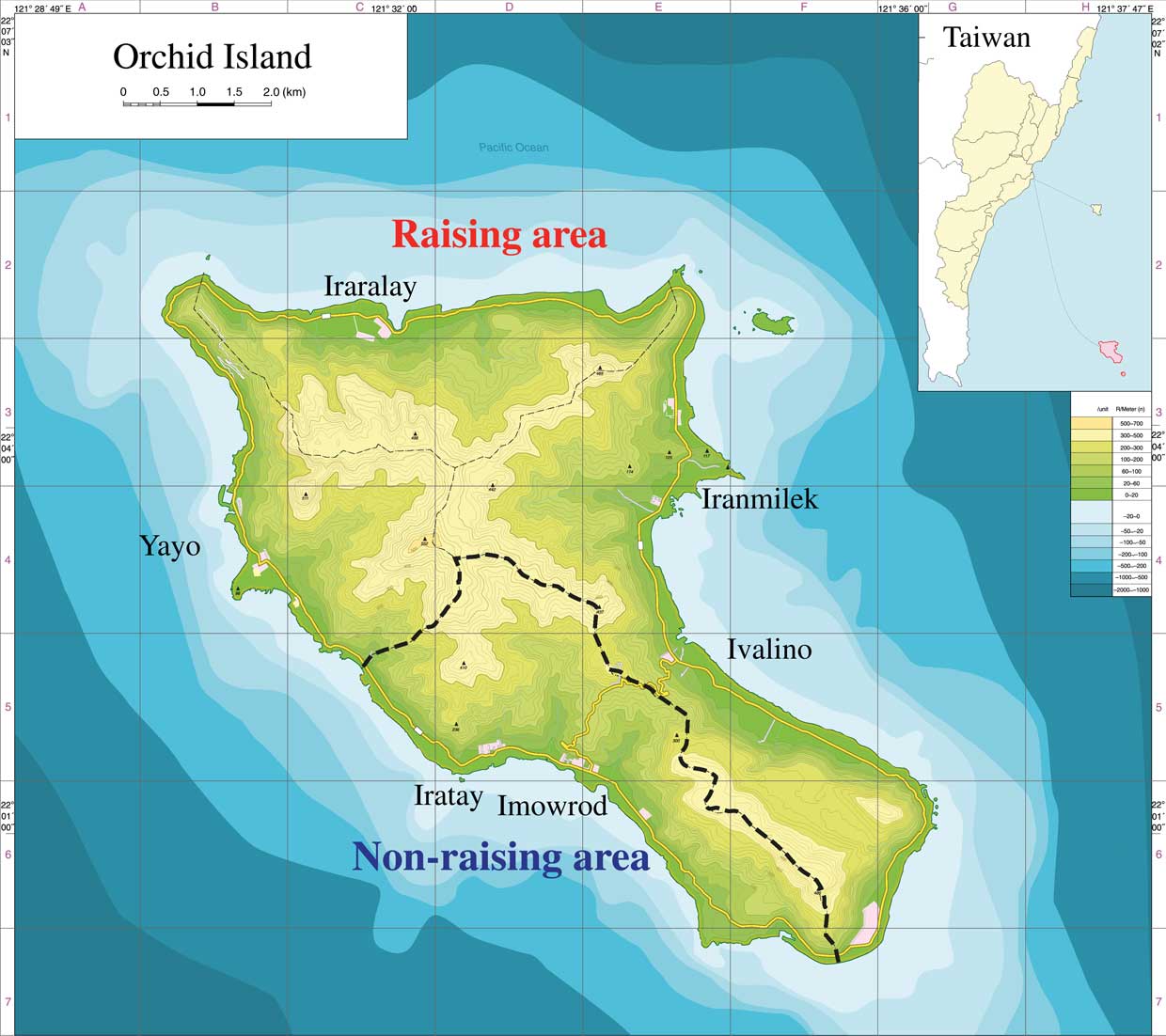
Map 3 Revised S–N dialect grouping of Yami. Source: The Ministry of the Interior, Executive Yuan, Taiwan, 2017.

In this paper, we revisit these findings and provide an acoustic-phonetic analysis of vowel variation using a new set of data from the six villages (Imowrod, Iratay, Yayo, Iraralay, Iranmilek, and Ivalino). We examine the effects of four social factors (age, gender, region, and speaking style) on nucleus raising and discuss potential social significance and language ideologies associated with the raised variants. The discussion of the sound change is contextualized within a language ecology framework and thus seeks explanations from wider social and economic phenomena that have occurred since Orchid Island’s “borders” were forcibly opened. We argue that economic restructuring and sociopolitical tension between Yami and Taiwan societies likely motivate the diffusion of nucleus raising. The raised variants then evolve from regional distinctiveness to an ethnolinguistic identity marker to define “Yaminess” and create a sociopsychological boundary between Yami and Taiwanese (Lai & Gooden, Reference Lai and Gooden2017). That is, we show that the raised forms have shifted in indexical values, moving from geographical markers and emerging instead as indexes of Yami identity. Our findings also support a concentration model of dialect change since the features are becoming more robust, even though Yami as a whole is being threatened (cf. Schilling-Estes & Wolfram, Reference Schilling-Estes and Wolfram1997, Reference Schilling-Estes and Wolfram1999).
Broadly speaking, this paper contributes to the larger discussion on variation in moribund language varieties and to the growing body of research on sociolinguistic variation in lesser-studied (indigenous) languages (Clarke, Reference Clarke2009: 109–128; Romero, Reference Romero2009: 281–297; Stanford & Preston, Reference Stanford and Preston2009: 1–20), thereby broadening our understanding of variation processes from a cross-linguistic perspective.
1.3 Research Objectives
This paper is structured around three specific research objectives. First, we provide further justification for why the S–N dialect classification as presented in Lai & Gooden (Reference Lai and Gooden2016b, Reference Lai and Gooden2017) is preferred over a SW–NE division as presented in Rau & Chang (Reference Rau and Chang2006) and Rau et al. (Reference Rau, Chang and Dong2009). This is a crucial step because clearly defining dialect boundaries is essential to explaining the directionality of linguistic change between communities (Dinkin, 2013). Particular attention was directed toward the speech of Ivalino speakers as they play a pivotal role in this dialect boundary reconfiguration. We show that Ivalinoers, who are largely non-raising, have come into more dialect contact with a raising area due to increased interaction in the new commercial center of Iranmilek.
Second, we provide evidence for age effects on the spread of raised (ay) and (aw) and interpret it as a sound change in progress, manifested by higher rates of raising production among younger speakers (Lai & Gooden, Reference Lai and Gooden2016b, Reference Lai and Gooden2017). Since age often correlates with other social factors, we are also interested in unpacking what external/extralinguistic factors prompt nucleus raising among these younger islanders (Thomason & Kaufman, 1998: 35–39; Thomason, Reference Thomason2001: 1–12; Farrar & Jones, Reference Farrar and Jones2002: 1).
Third, we explore possible social meanings and functions associated with the two diphthongs. As has been well argued (Foulkes & Docherty, Reference Foulkes and Docherty2006; Foulkes, Scobbie & Watt, Reference Foulkes, Scobbie and Watt2010), the objects of sociophonetic variation studies must at least be socially meaningful, and these metalinguistic meanings often evolve around speakers’ language ideologies (Irvine & Gal, Reference Irvine and Gal2000; Wassink & Dyer, Reference Wassink and Dyer2004; Kroskrity, Reference Kroskrity2010). Following this reasoning, we are particularly interested in (a) probing Yami speakers’ language ideologies concerning the two diphthongs; (b) looking into how the islanders’ ideologies concerning (ay) and (aw) have evolved over time; and (c) exploring how speakers’ changing ideologies have continued to reshape the (ethno)linguistic boundaries both within and beyond the Yami community.
1.4 A Social Portrait of Orchid Island
From isolation to post-insularity
Taiwan is a multi-ethnolinguistic society in which Taiwanese Mandarin, Taiwanese Southern Min, Hakka, and more than ten Austronesian languages are spoken.Footnote 3 Yami is one of the indigenous Austronesian languages spoken on Orchid Island, located 56 miles off the southeast coast of Taiwan (Map 1). To date, the island is accessible only by ferry or flight, and these services are easily canceled in case of severe weather conditions.
Despite geographic isolation, the island’s sociohistorical development is tightly linked with that of mainland Taiwan (people from mainland Taiwan are henceforth referred to as “mainlanders”). Available sources suggest that the sociohistorical development of Orchid island can be roughly divided into two major phases: the Japanese Colonization Period (1895–1945) and the Taiwanese leadership period (1945–present) (Tsai, Reference Tsai2009: 33–36; Lai, Reference Lai2011). From the 1890s through the late 1960s, the island was designated as an indigenous reserve so that it virtually existed in isolation (Tsai, Reference Tsai2009: 102–103; Lai, Reference Lai2011). During that period, despite the presence of mainlanders as school teachers, government employees, and soldiers, heavy language and cultural barriers hindered intergroup interaction (Lai, Reference Lai2011). Economically, islanders made a living from small-scale, subsistence farming and/or fishing. From 1967 onward, Orchid Island was opened to the public and integration into wider Taiwan society began. This is particularly true for Imowrod, Iratay, and Yayo villages, where municipal infrastructure and facilities, such as hotels, a post office, a clinic and an administrative center are located (Map 4).Footnote 4 Consequently, these villages are considered to be more modernized and commercialized (Li & Ho, Reference Li and Ho1988; Rau, Reference Rau1995; Rau et al., Reference Rau, Chang and Dong2009; Tsai, Reference Tsai2009: 33–36; Lai & Gooden, Reference Lai and Gooden2016b, Reference Lai and Gooden2017). This commercialization also means frequent contact with Mandarin speakers, so that Yami speakers from these villages have been undergoing rapid language loss and show a higher degree of adaptation to Taiwanese culture compared to speakers in other villages (Li & Ho, Reference Li and Ho1988; Rau, Reference Rau1995; Tsai, Reference Tsai2009: 33–36). In contrast, Iraralay and Ivalino villages, which are far from the main commercial center, are known to preserve the Yami language and traditional housing best (Li & Ho, Reference Li and Ho1988; Rau, Reference Rau1995; Chen, Reference Chen1998; Lin, Reference Lin2007). Anecdotally, comments from islanders suggest that Iraralay speakers are more conservative, less accepting of outsiders and preserve more traditional Yami features that make communication challenging for less proficient Yami speakers. In the past decade or so, Iranmilek village, a place renowned for its beautiful sunrise, coastal scenery, and water sports, has become a “hot spot” for tourists.
Map 4 Distribution of municipal infrastructure and facilities on Orchid Island. Source: The Ministry of the Interior, Executive Yuan, Taiwan, 2017.

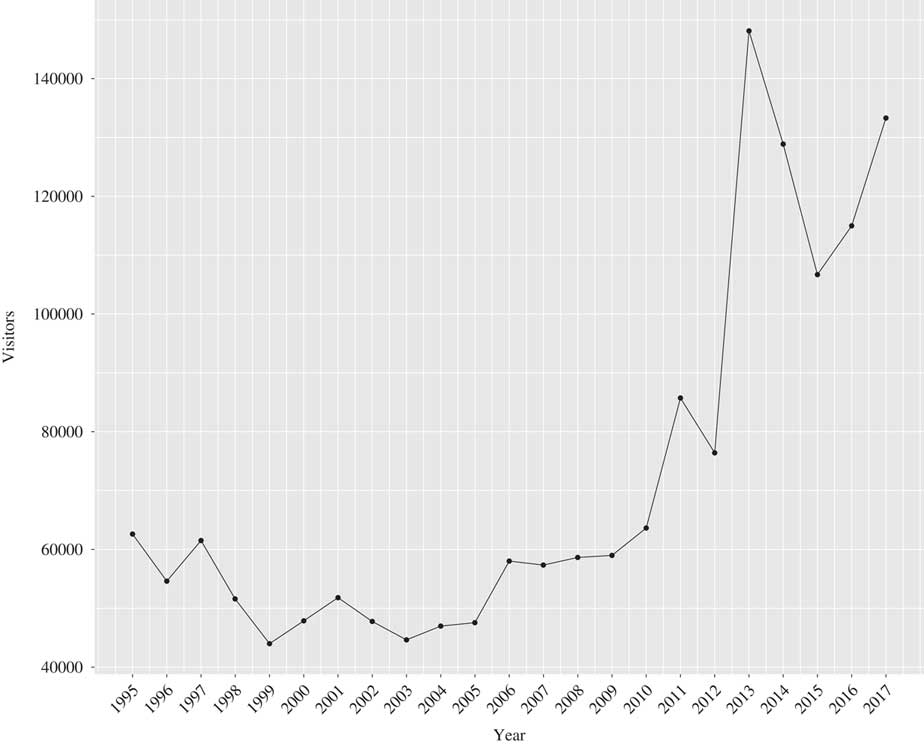
The late 1970s through the late 1990s saw some waning of the local (farming and fishing) economies on Orchid Island and a consequent outward migration of workers to Taiwan. Since the turn of the 21st century however, the island has gradually rebranded itself as a summer vacation spot and tourism has rapidly become the major source of income for most islanders (Figure 1). The tourism explosion has not only slowed the outmigration of young Yami adults, but has also brought an influx of mainlanders to work and live on the island, which has noticeably shifted the demographics of the island. The latest Taiwanese census (2018) reveals that the proportion of non-Yami people has nearly tripled in less than twenty years and now represents 19.8% of the total population.
Orchid Island visitor statistics by year since 1995.

Language contact and sociolinguistic effects
During the Japanese Colonization Period, Japanese was imported to Orchid Island through a compulsory education system beginning in 1923. Considering that the use of Japanese was limited to school settings and that school attendance was low, the linguistic impact on Yami is presumed to be inconsequential and is chiefly reflected in the borrowing of non-basic vocabulary (Lai, Reference Lai2011). Today, Japanese is only sporadically used by speakers over 80 years old (2% of total population). In stark contrast, Mandarin has exerted profound pressure on Yami. As the Japanese Colonization Period came to a close in 1945, the Taiwanese government introduced Mandarin via the education system and simultaneously banned Yami from schools, thereby creating fertile ground for Yami–Mandarin contact. The education system, together with the Mandarin Movement (1946–1987)—a monolingual policy that devalued and prohibited the use of other Taiwanese ethnic languages in public spaces—quickly established community-wide Yami–Mandarin bilingualism. Decades of Mandarin hegemony has thus yielded generations whose Mandarin fluency outstrips their mother tongue proficiency in all parts of Taiwan (Wei, Reference Wei2006). Today, Yami children and teenagers (except those who are from Iraralay) virtually do not speak Yami other than in schools; the language has been offered as a mandatory course on a two-hour-per-week basis on Orchid Island since 2001 to promote language preservation and revitalization.
The current tourism boom has further withered away Yami vitality because Mandarin is the medium of interethnic communication and is considered the key to economic success (Rau, Reference Rau1995). Locals generally agree that only those who are over 50 years old (approximately 1,500 speakers, 30% of total Yami population) can still speak Yami with comfort and confidence. The latest fieldwork survey (conducted by Lai, summer 2017) reveals that currently, there are only a few domains like rituals and religious settings that resist major influence from Mandarin. If language loss continues, not only will it erode Yami–Mandarin bilingualism, but it may ultimately lead to a near elimination of Yami with future generations (Crystal, Reference Crystal2000: 19–21).
2 Methods
2.1 Fieldwork, Participants, and Data Elicitation
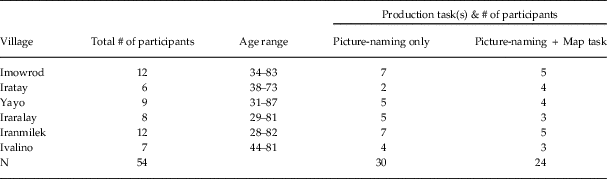
The data described here are recorded elicitations from two studies, yielding a total of 54 participants (23 males and 31 females) who at the time of recording were between the ages of 28 to 88 and resided across the six villages (Table 1). In 2009, 30 participants were recorded as part of Lai’s study on language contact and language shift on Orchid Island (Lai, Reference Lai2011). An additional 24 participants were recorded in 2014 as part of larger projects on segmental (Lai & Gooden, Reference Li-Fang and Gooden2015, Reference Lai and Gooden2016a, Reference Lai and Gooden2016b) and prosodic (Lai, Reference Lai2018) variation in Yami. Participants in study 1 only completed a picture-naming task (word-list style) and participants in study 2 completed both a picture-naming task (word-list style) and a modified map task dialogue (conversation style) (Anderson et al., Reference Anderson, Bader, Bard, Boyle, Doherty, Garrod, Isard, Kowtko, McAllister, Miller, Sotillo, Thompson and Weinert1991). In the picture-naming task, each participant named the pictures (without the captions) appearing on the devices (a laptop in the 2009 fieldwork and an iPad in the 2014 fieldwork). In the map task, the participants worked in pairs—one served as an asker and the other as an instruction-giver and “traveled” across the six villages on Orchid Island to find ten differences between their maps.
Participant profile

In order to gain access to the community, the first author boarded with a Yami family during the summer months of 2009, 2014, and 2017. She worked with members of the family, the Society for Conservation of Lanyu Wildlife and Nature, and three local guides who helped her gain access to community members (especially the more conservative Iraralay village) and served as Yami–Mandarin interpreters during interviews with Yami monolinguals.
2.2 Analysis
Coding
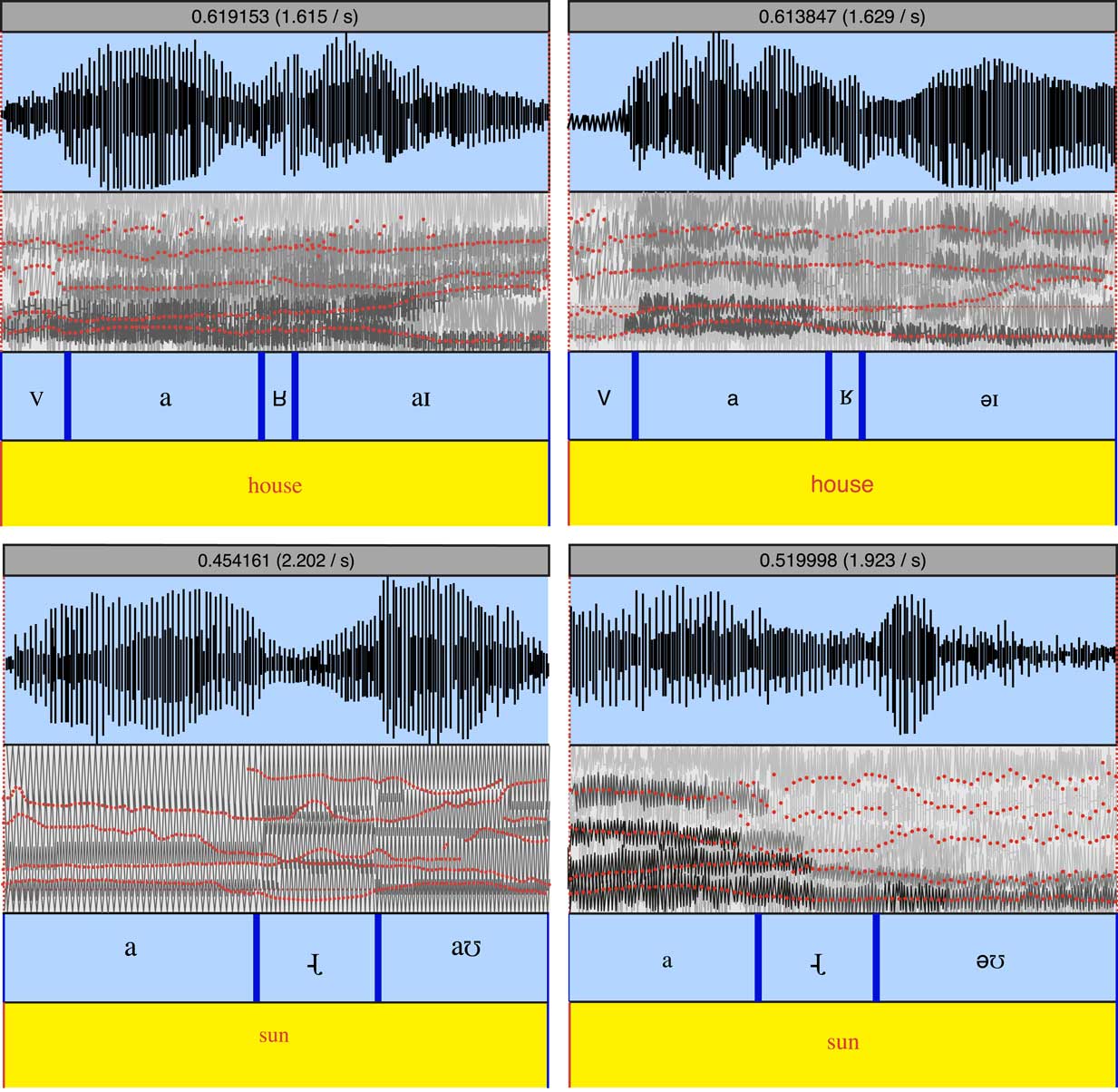
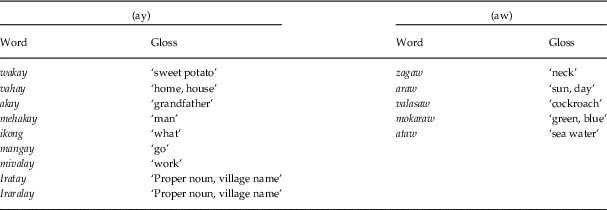
Words containing word-final (ay) or (aw) were extracted (Table 2) and vowels were labeled as raised or unraised using both auditory impression and formant analysis in Praat (Boersma & Weenink, Reference Boersma and Weenink2016, version 6.0.17). Variables realized as [aɪ] or [aʊ] were coded as unraised forms, while those realized as [əɪ] or [əʊ] were categorized as raised forms (Figure 2).Footnote 5
Spectrograms of the (ay) and (aw) diphthongs.

Target tokens

Formant measurements and normalization
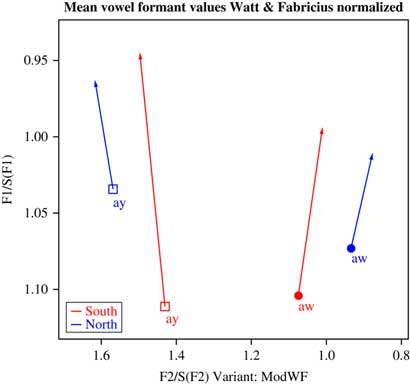
The words were digitized at a sampling rate of 44.1 kHz with 16-bit resolution. For each vowel token, vowel onset and offset were marked at points when both the first (F 1 ) and second formants (F 2 ) ceased transition into and out of the vowel respectively. The frequencies of F 1 and F 2 were extracted and measured for each vowel at 20%, 50%, and 80% of the duration between vowel onset and offset implementing the Vowel Analyzer script in Praat (Riebold, Reference Riebold2013). To facilitate interspeaker comparability, each speaker’s vowel measurements were normalized using the Watt & Fabricius modified method, as it has been shown to perform best for sociophonetic research (NORM Thomas & Kendall, Reference Thomas and Kendall2007; Fabricius, Watt & Johnson, Reference Fabricius, Watt and Johnson2009; Fabricius, Reference Fabricius2008; Flynn & Foulkes, Reference Flynn and Foulkes2011; Watt & Fabricius, Reference Watt and Fabricius2011). Following Di Paolo, Yaeger-Dror, and Wassink (Reference Di Paolo, Yaeger-Dror and Wassink2011), the vowels were plotted so that nucleus and offglide (shown as arrows) would be captured.
Statistical analysis
A variable rule (VARBRUL) analysis was used to determine which of the four social factors considered favored nucleus raising.
(1) Region: based on previous analyses (Lai & Gooden, Reference Lai and Gooden2016b, Reference Lai and Gooden2017), Imowrod, Iratay, and Ivalino speakers were categorized into the South group, whereas Yayo, Iraralay, and Iranmilek speakers were classified into the North group.
(2) Speaking style: target tokens extracted from the picture-naming (word-list style) task were separated from those extracted from the map task dialogue (conversational style). Note that only the 2014 data were examined for this variable.
(3) Age: the age variable was divided into two levels, which reflects the differences in speakers’ life experience and level of education. Participants under 55 at the time of data collection were classified as younger speakers because they correspond to the generation who received a nine-year compulsory education and grew up in the era when Orchid Island started connecting to the outside world. Participants equal to or above 55 at the time of data collection were classified as older speakers because they received a six-year (or less) compulsory education and grew up in the era when Orchid Island was highly socially isolated.
(4) Gender: participants were grouped into males and females.
In the following section, we report results on the factors selected as significant predictors of nucleus raising. In the binomial analysis, a VARBRUL weighting of above .5 indicates a favoring effect for nucleus raising; a weight value below .5, a disfavoring effect; and a value equal to .5, a neutral effect. In cases where the social factors failed to reach level of significance, chi-square tests were performed to show the patterning of (ay) and (aw) variation.
3 Results
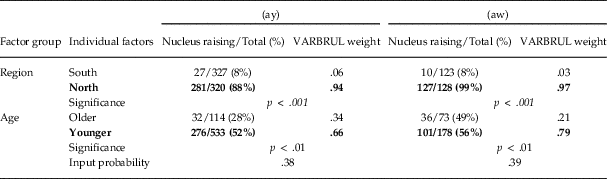
In total, 647 (ay) and 251 (aw) tokens were examined on region, age, and gender factors, and 460 (ay) and 114 (aw) tokens were examined on the speaking style factor. As Table 3 shows, only region and age were selected as significant predictors for (ay) and (aw) raising and these are discussed below.
Frequency and VARBRUL results for nucleus raising

3.1 Region
By examining the vowel variation in each village, we are better positioned to determine the location and nature of the dialect boundary. The VARBRUL results indicate that speakers from the North (Yayo, Iraralay, and Iranmilek villages) had weighting values of .94 for (ay) and .97 for (aw) respectively, suggesting that Northerners strongly favored nucleus raising. On the other hand, speakers from the South (Imowrod, Iratay, and Ivalino villages) had weighting values of .06 for (ay) and .03 for (aw) respectively, indicating strong disfavoring effects on (ay) and (aw) raising (Table 3).
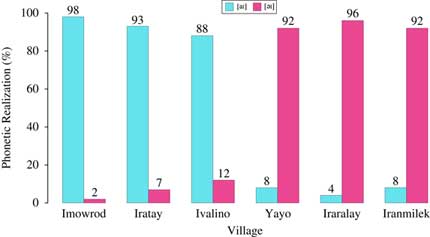
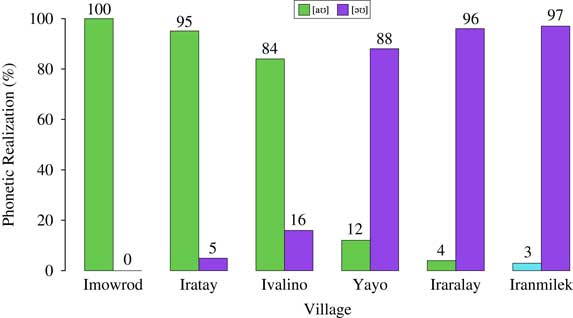
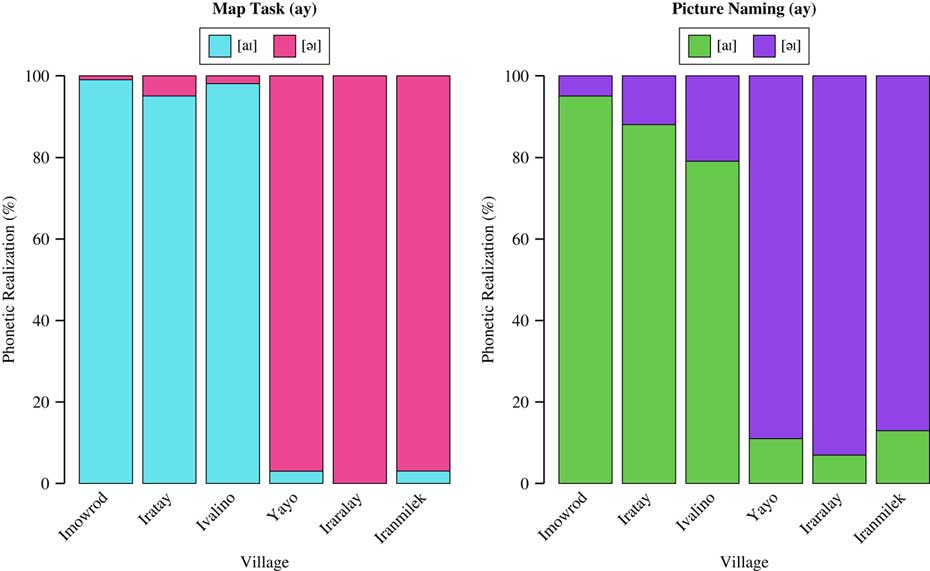
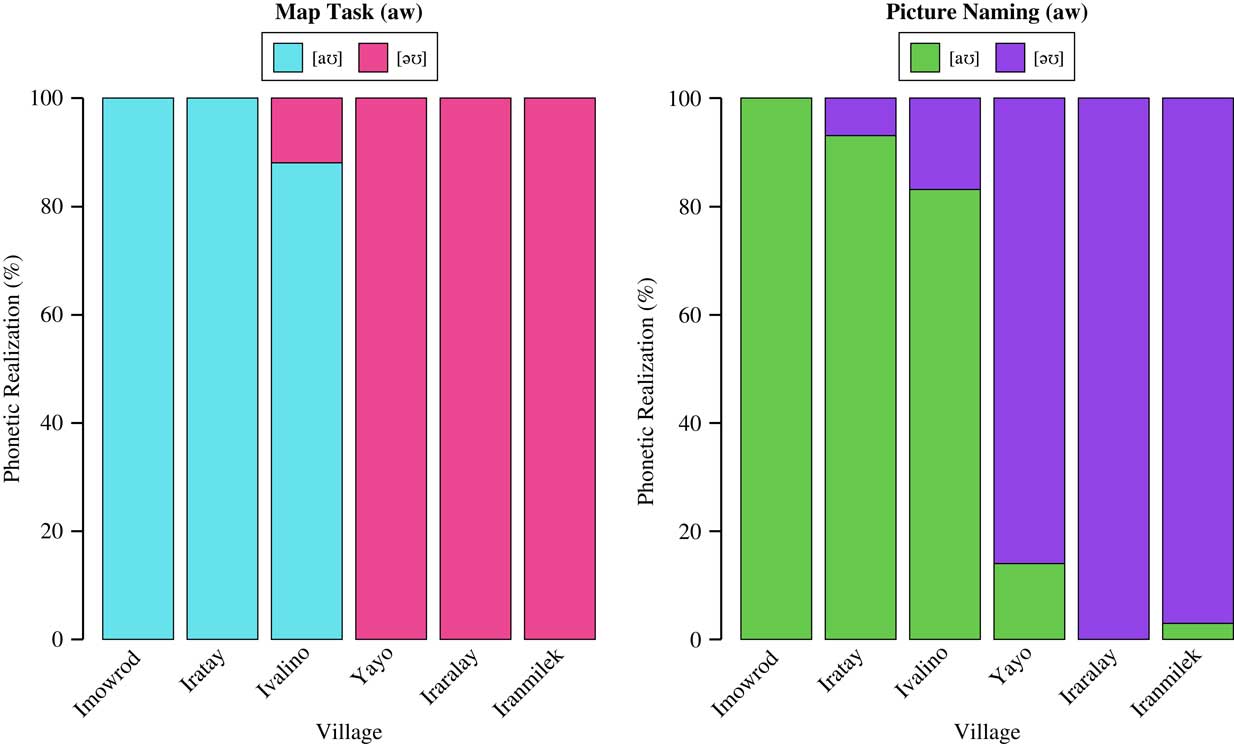
A closer examination (Figure 3 and Figure 4) reveals that within the non-raising dialect region, Imowrod and Iratay speakers predominantly produced the unraised variants for both diphthongs. Ivalino speakers also showed a clear non-raising pattern, but also produced slightly higher percentages of using raised variants for both vowel variables (12% for (ay) and 16% for (aw)). In sharp contrast, within the raising area, Iraralay and Iranmilek speakers constantly produced the raised variants for both diphthongs. Yayo speakers also showed a robust raising pattern, but had a slightly higher rate of raised (aw) use (12%).
Phonetic realization of (ay) by region.

Phonetic realization of (aw) by region.

These results were supported by the acoustic analysis. As appears in Figure 5, nucleus raising (i.e. the arrow tails are plotted higher in vowel chart) was observed in the north dialect (blue arrows) and not in the south dialect (red arrows).
Vowel plotting using the Watt & Fabricius modified method.

3.2 Age
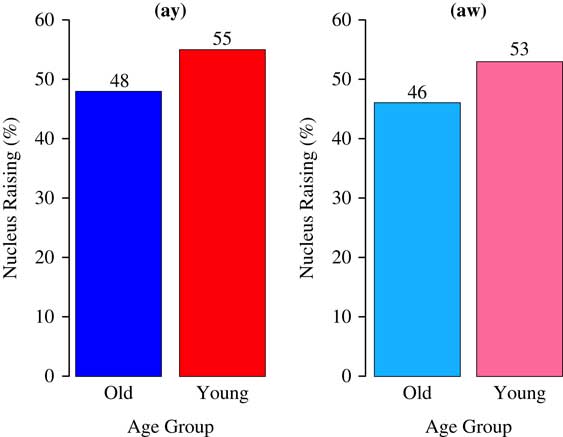
Age was also selected as a significant predictor for nucleus raising. Across all villages, younger speakers (under 55 years old) had values of .66 for (ay) and .79 for (aw), indicating significant favoring effects on vowel raising. Older speakers (55 years or older) had values of .34 for (ay) and .21 for (aw), suggesting strong disfavoring effects on nucleus raising (Table 3 and Figure 6). Increasing use of raised variants among younger islanders suggests that nucleus raising is a change in-progress at the community level rather than simply an instance of age-graded variation. We posit that recent socioeconomic changes have constituted a motivating force for the diffusion of the raised variants to non-raising area and signals an incipient stage of dialect leveling.
Nucleus raising by age.

3.3 Speaking Style
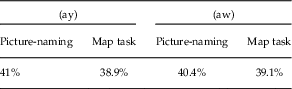
While speaking style as a factor was not selected as a reliable predictor of nucleus raising by the VARBRUL analysis, the chi-square analysis showed a relationship between speaking style and diphthong realization for (ay) (χ 2 (1, N=460)=16.041, p < .001, φc=.187). Overall, speakers used more raised variants in picture-naming (41%) than in map task dialogue (38.9%). No significant relationship between speaking style and realization was found for (aw) (χ 2 (1, N=114)=0.007, p=.934) as speakers showed similar patterns between picture-naming (40.4%) and map task dialogue (39.1%) (Table 4).
Nucleus raising by speaking style

Interesting patterns appear when speaking style and region factors are combined. In the map task, Southerners consistently used unraised variants, while Northerners invariably used raised forms for both (ay) (χ 2 (3, N=460)=345.41, p < .001, φc=.867) and (aw) (χ 2 (3, N=114)=95.167, p < .001, φc=.914)), but showed a bit higher variation in vowel raising in the picture-naming task (Figure 7 and Figure 8). Some points merit highlighting here. First, the results derived from the map task dialogue (conversation style) are more instructive than those from the picture-naming task because it more closely mimics everyday speech. The fact that Ivalino speakers produced high percentages of raised variants in their map task dialogues adds support to our argument that they should be categorized into the Southern dialect group. We will elaborate more on this in the discussion section.
Phonetic realization of (ay) by region and style.

Phonetic realization of (aw) by region and style.

3.4 Gender
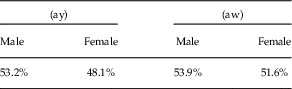
Gender was not selected as a reliable predictor of nucleus raising by the VARBRUL analysis, but the chi-square analysis showed a relationship between gender and diphthong realization for (ay) (χ 2 (1, N=647)=8.299, p < .01, φc=.113). Overall, males (53.2%) used more raised (ay) than females (48.1%). No significant relationship between gender and vowel raising was found for (aw) (χ 2 (1, N=251)=2.126, p=.145) as males (53.9%) and females (51.6%) had a similar amount of nucleus raising (Table 5).
Nucleus raising by gender

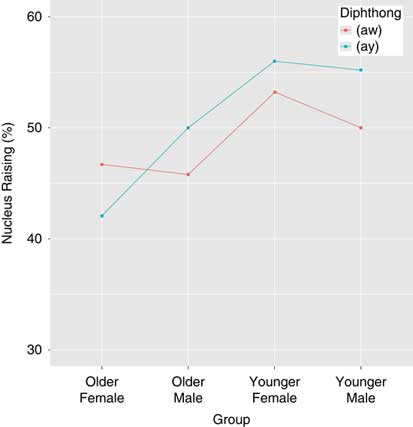
When age is cross-tabulated with gender, groups showed significantly different patterns for (ay) ( χ 2 (3, N=647)=42.846, p < .001, φc=.257) and (aw) ( χ 2 (3, N=251)=8.176, p < .05, φc=.18). Similar to Rau et al. (Reference Rau, Chang and Dong2009), the data analysis showed that younger females led the sound change in nucleus raising for both variables. The patterns produced by older speakers are trickier to interpret because older females preferred raised (aw), while older males favored raised (ay) (Figure 9).
Nucleus raising by age and gender.

4 Discussion
Statistically, northerners as a group and younger speakers displayed significant favoring effects on nucleus raising. These findings reaffirm our earlier suggestion that the appropriate dialect division is a broader S–N one. This separates the nucleus raising northern villages of Yayo, Iraralay, and Iranmilek from the non-nucleus raising villages of Imowrod, Iratay, and Ivalino. Younger speakers in general are at the heart of this sound change. In this section, we provide further arguments in support of the S–N division and offer suggestions for why the spread of nucleus raising is a sound change in-progress and explore possible social meanings and functions.
4.1 Dialect Reclassification: Moving Ivalino Speakers into the Non-raising Area
Results from the production tasks place Ivalino village solidly within the south region, in which the unraised variants dominate. The fact that Ivalino speakers showed a strong non-raising pattern provides crucial support for a S–N classification (Figure 7 and Figure 8). This expands the core non-raising region northward and effectively reshapes the dialect boundary (cf. Map 2 and Map 3).Footnote 6
We can account for the difference in the placement of Ivalinoers in different ways. One possibility is to assume a diachronic change in the vowel system such that Ivalinoers used to have the raised variants but have now shifted to the unraised forms due to heavy contact with Imowrod and Iratay (non-raising area) speakers. This view, however, is questionable for several reasons. First, Ivalino and Imowrod villages are farther apart (7.9 miles), and the round-island road was not completed until 1984 (Tsai, Reference Tsai2009: 34), making dialect contact challenging. A participant recalled that:
(1) [Female, 56 years old, Ivalino]: Inter-village communication was extremely challenging and limited before the completion of the road. To receive civil services, we walked along the reef or tramped over mountains to Imowrod from other villages.
Second, although Imowrod has long been the administrative center of the island, due to continued contact with Mandarin speakers, Imowrod and neighboring Iratay speakers had been suffering from rapid language shift toward Mandarin by the time the road was completed (Li & Ho, Reference Li and Ho1988). Today, only older speakers in these villages still preserve Yami in their oral communication (Chen, Reference Chen1998; Rau & Chang, Reference Rau and Chang2006; Lin, Reference Lin2007; Rau et al., Reference Rau, Chang and Dong2009; Lai, Reference Lai2011). Furthermore, under the raised>unraised hypothesis, we might reasonably expect to see some residuals (raised forms) in older Ivalino speakers’ speech (aged 80 and 81 at the time of recording), yet, this was not seen in the data. Since language behavior does not change overnight (Levey, Reference Levey2008: 32), to verify a raised>unraised hypothesis, there needs to be reasonably strong evidence, such as traumatic sociohistorical events (Grinevald, Reference Grinevald2003), to account for the impetus for a village-wide sound change in Ivalino.
Alternately, we could look to the local administrative divisions and the regional affiliations between Ivalino and Iranmilek villages. The six villages on Orchid Island are integrated into four administrative units. Probably due to geographical proximity, Imowrod and Iratay villages (less than 1 mile apart) are grouped into a single unit, and Iranmilek and Ivalino villages (approximately 1.3 miles apart) are grouped into another. Yayo and Iraralay are on average more than four miles apart from neighboring villages and so each stands as an individual unit (Map 5). Geographical proximity thus brings Ivalinoers and Iranmilekers into more intense contact than with all other villagers. Extralinguistic factors, such as administrative division, frequent intervillage communication, and intervillage marriage, present a temptation to overlook the fact that the linguistic differentiation between Ivalino and Iranmilek is actually fairly stark. This supports the idea that regional affiliations are not always a good indicator of dialect grouping (Dinkin, 2013). We suggest therefore that Ivalino can be seen as a transition area, aligning linguistically with the non-raising area, but geographically affiliated with Iranmilek, a part of the raising area. The intense daily contact between Ivalinoers and Iranmilekers thus very likely triggered the southward spread of the raised forms from Iranmilek (core) to Ivalino (peripheral) (Map 3). This is reflected in the linguistic outcomes that within the non-raising dialect region, Ivalino speakers produced slightly higher percentages of using raised variants for both vowel variables than Imowrod and Iratay speakers (Figure 3 and Figure 4).
Map 5 Administrative division of Orchid Island (blue lines) and inter-village distance (black lines). Source: The Ministry of the Interior, Executive Yuan, Taiwan, 2017.

4.2 Sound Change in Progress: The Role of Economic Transformation
The diffusion of nucleus raising has gone beyond the intervillage setting, evidenced by the fact that despite geographic origin, younger speakers showed a higher inclination for adopting the innovative, raised forms (see also Lai & Gooden, Reference Lai and Gooden2016b, Reference Lai and Gooden2017). There is strong evidence for contact-induced segmental change in Yami where the voiced alveolar lateral fricative [ɮ] has largely been replaced by the plain lateral [l] among younger speakers due to heavy contact with Mandarin (Lai & Hsu, Reference Lai and Hsu2013; Lai & Gooden, Reference Lai and Gooden2014). However, transfer from Mandarin cannot be the source of nucleus raising as it is difficult to explain why the raised variants are extensively used on the north coast, where Yami is best preserved (Li & Ho, Reference Li and Ho1988; Rau, Reference Rau1995; Chen, Reference Chen1998; Rau & Chang, Reference Rau and Chang2006; Lin, Reference Lin2007; Rau et al. Reference Rau, Chang and Dong2009; Lai, Reference Lai2011), and only sporadically used in the south area, where the speakers are undergoing rapid language shift toward Mandarin.
Instead, we argue that local economic changes and the subsequent intervillage contact are the key to a better understanding of the sound change. Due to rapid development and increasing reliance on the tourism trades, younger islanders now do not conceive of fishing or farming as viable career options, but travel across the island to seek jobs in a wide range of tourism-related services (Lai & Gooden, Reference Lai and Gooden2016b, Reference Lai and Gooden2017). This geographic mobility and increased daily communications contribute to the spread of raised variants throughout the non-raising area. Such expansion diffusion suggests an incipient stage of dialect leveling (Kerswill, Reference Kerswill2003, Reference Kerswill2006; Britain, Reference Britain2004), and if continued, the S–N division may over time become less rigid. This economic restructuring perhaps also explains why age was not selected as a predictor of vowel raising in earlier reports. For example, Rau and Chang (Reference Rau and Chang2006) and Rau et al. (Reference Rau, Chang and Dong2009) collected data sometime between 1995 and 2000—a time that predates the tourism explosion and presented a relatively stable linguistic ecosystem that better secured the “territories” of raised and unraised forms respectively.Footnote 7
Accommodation-based processes do not fully account for dialect leveling either (Trudgill, Reference Trudgill1986: 1–4; Giles & Powesland, Reference Giles and Powesland1997 [1975]; Kerswill, Reference Kerswill2002, Reference Kerswill2003, Reference Kerswill2006; Kerswill & Trudgill, Reference Kerswill and Trudgill2005), as there is an emic perception of Yami as an egalitarian society rather than hierarchically-based (Rau et al., Reference Rau, Chang and Dong2009), as is the case with many rural indigenous communities (Stanford, Reference Stanford2016). This ideology is also reflected in commentary by participants:
(2) [Female, 56 years old, Yayo]: Unless we are mimicking others; otherwise, in such a small, almost everyone-knows-everyone community, there is no need to accommodate to others’ pronunciation.
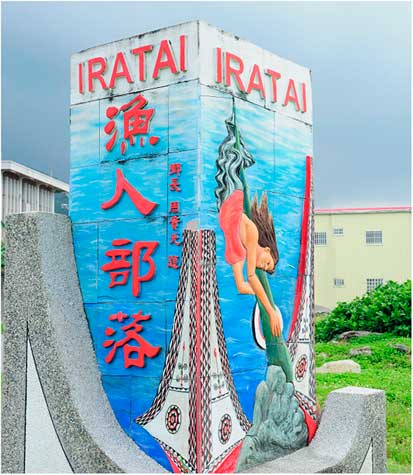
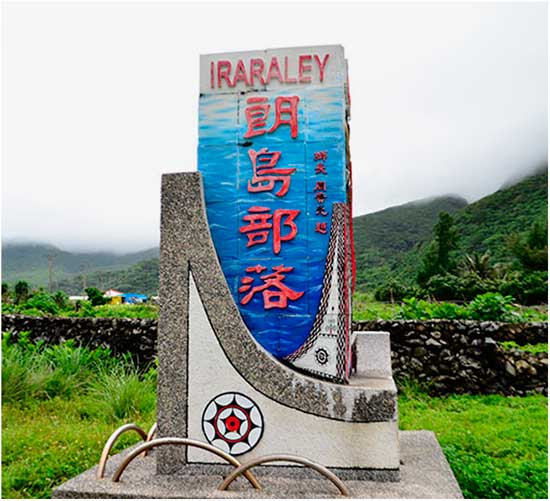
One piece of anecdotal support for this is that the new village signs (approximately 10 years old) are represented using the characteristic dialect features. That is, the non-raised form for IratAY (Figure 10) and raised form for IraralEY (Figure 11). It is therefore hard to argue that speakers are simply shifting to raised variants for social integration or prestige as none of the forms are regarded as superior.
Village sign of IratAI (IratAY) (different orthographic systems co-exist on the island).

Village sign of IraralEY.

4.3 Intergroup Conflicts as a Catalyst of Nucleus Raising
Other than economic change and the resulting dialect contact, the sociopolitical and sociocultural conflicts between Yami and Taiwanese groups, as well as the pursuit of tribal autonomy are contributary ecological factors that potentially accelerate the spread of nucleus raising. It is worth noting that since summer is the busiest tourism season, the first author has had chances for firsthand observation of sociocultural conflicts between islanders and mainlanders/tourists.
Sociopolitical conflicts between the Taiwanese government and the Yami society
The Indigenous House Modernization Project (1966–1979) is one of many conflicts. During that period, locals were forced to demolish their traditional houses and replace them with concrete block ones. The Yami people deemed this act an affront to their culture, but from the government’s perspective, it was an emblem of advancement and modernization for the aboriginal people. An even more notorious example is The Orchid Island Project (1975–1996), a governmental deception that turned a fish cannery into a nuclear waste repository. An older Ivalino speaker commented that:
(3) [Male, 82 years old, Ivalino]: In the 1970s, the government officials and experts conducted field investigations here, claiming that what would be built was a fish cannery to offer job opportunities for the locals. Since the income from farming and/or fishing was low and economic opportunity was severely limited on the island, we would be glad to take advantage of this opportunity to work in the fish cannery. This way we could lead a stable life here and don’t need to be “uprooted” from our homeland to work in Taiwan. However, after months of waiting, the canned factory turned out to be a nuclear waste dumping site. Since then, we have been forced to live with “the unwanted Taiwanese litter” and to live with fear and anxiety everyday.
Even though the government has pledged to relocate the radioactive waste since 2002, its failure to keep its promise has only deepened the Yami’s mistrust of the government (Fan, Reference Fan2006). The Yami anti–nuclear waste movements continue and the islanders’ outrage continues to grow, as expressed below:
(4) [Male, 62 years old, Iranmilek]: Our land, food, and ocean are poisoned; more and more people die from unknown diseases. If the island is a boat, the boat is about to sink. Please save us from danger and fears. Please return our land to us.
The pursuit of indigenous autonomy
The abovementioned top-down government policies are clear manifestations of injustice, lack of recognition, and the exclusion of Yami people from decision-making processes. Many locals experience “a sense of bullying” by the ethnic majority and described themselves as “people of trifling importance” (Fan, Reference Fan2006).
Considering the long-term asymmetrical power relations between Taiwan (dominant, central) and Yami (subordinate, marginal) societies, coupled with global awareness of the need to protect and enhance the rights of indigenous peoples, Yami activists released the Yami Autonomy Declaration in 2000 to pursue self-determination in tribal political, economic, sociocultural, and territorial issues (Lu, Reference Lu2002; Fan, Reference Fan2006). In Lai’s recent fieldwork survey (summer 2017), when asked “What culture(s) do you identify yourself with?” the majority of the participants identified themselves as Yami; only 6 out of the 44 participants declared both Yami and Taiwanese identities.
Tourism as a double-edged sword? Sociocultural clashes with outsiders
With ever increasing reliance on the tourism economies, there are also growing sociocultural conflicts between islanders and tourists. For instance, some tourists have violated cultural norms, damaged and polluted the (coastal) environments, and even invaded local people’s houses as part of sightseeing. Consequently, some islanders are becoming hostile towards tourists and see them as “intruders.” Additionally, although the tourism industry has presented business opportunities for locals, it has also attracted more and more mainlanders to work and live on the island. This further annoys locals, even those who reside in areas where they have frequent contact with outsiders, as one describes here:
(5) [Male, 55 years old, Iratay]: The mainlanders don’t belong to here; they don’t understand our history and culture, but they come here, pretending to be Yami experts to “get a slice of the pie.”
4.4 Evolving Language Ideologies and Boundary (Re)formation: Nucleus Raising as an Ethnic Identity Marker
As discussed above, the presence or absence of nucleus raising indexes authentic regional identity separating Northerners from Southerners. The tourism boom has, however, changed the level of interaction, bringing islanders from raising and non-raising areas into more frequent contact. Two reasons may account for the selection of the raised variants over the unraised ones. First, participants had a near categorical identification of nucleus raising as the most salient dialect difference in Yami. Second, raised forms prevail in the area with higher Yami vitality (Li & Ho, Reference Li and Ho1988; Rau Reference Rau1995; Chen, Reference Chen1998; Rau & Chang, Reference Rau and Chang2006; Lin, Reference Lin2007; Rau et al., Reference Rau, Chang and Dong2009). This has been exploited as a cultural/semiotic resource symbolizing Yami ethnic identity in the wake of sociopolitical and sociocultural conflicts between the Yami and mainlanders (Kroskrity, Reference Kroskrity2000; Schilling-Estes, Reference Schilling-Estes2000, Reference Schilling-Estes2002). The semiotic process of fractal recursivity helps account for how the macrolevel S–N distinction came to be employed as a resource defining “Yaminess” in opposition to Others (Irvine & Gal Reference Irvine and Gal2000), and this ideological stance is clearly reflected in speakers’ commentaries. Similar to the Lumbee case (Schilling-Estes, Reference Schilling-Estes2000, Reference Schilling-Estes2002), if the tensions between Yami and Taiwanese groups continue, Yami speakers from other non-raising areas may quite possibly also adopt the raised forms as an identity marker, i.e. an ideologically-motivated change or a change from above (Milroy, Reference Milroy2003; Labov, Reference Labov2001: 272–275).
It is well known that in situations of language contact, children’s linguistic behavior can be an important measure of the pace and direction of change. The typical scenarios of parent-led and peer-led change do not easily hold for Yami though. Given Yami’s threatened status, there are no parent or peer models in many villages. Instead, we believe that teachers are the key factors shaping children and teenagers’ pronunciation and language ideologies (cf. Kerswill, Reference Kerswill2006). Specifically, to promote language revitalization, Yami has been offered as a required course in schools on Orchid Island since 2001. Although some teaching materials and the Yami New Testament, both of which keep the non-raised spellings, could also have an impact on the direction of sound change, we believe it is the direct spoken model—via the Yami teachers—that influences students’ pronunciation (i.e., reinforces prescriptive norms). Today, the majority of Yami teachers are from Yayo and Iraratay villages, where the raised variants dominate. Since non-Iraralay Yami children and teenagers virtually do not speak Yami outside of schools, Yami teacher’s pronunciation may become the major or even the only input. Under such circumstances, even though students might be aware of dialect differences, they may simply become accommodated to their teacher’s pronunciations, deeming them as the neutral forms—an important process of socialization for school children (Wolfram, Adger & Christian, Reference Wolfram, Adger and Christian1999: 11; Lippi-Green, Reference Lippi-Green1997, Reference Lippi-Green2016). There is anecdotal evidence to support this. When asked about different pronunciations, a young Yami speaker recalled that:
(6) [Female, 20 years old, Iratay]: Different teachers have different teaching strategies. In general, they introduce both pronunciations in the first encounter of a new word. Later on, they may simply stick to the variants they are familiar with.
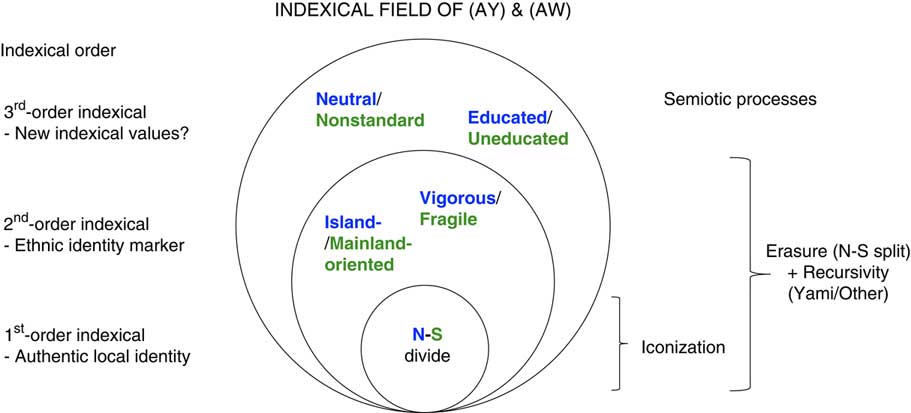
To sum up, the spread of nucleus raising to the non-raising area is not only driven by economic change, it bears multiple indexical values and a complex, interlaced set of semiotic processes about linguistic differentiation which give a window into speakers’ ideological positioning (Silverstein, Reference Silverstein2003; Eckert, Reference Eckert2008, Reference Eckert2012; Johnstone & Kiesling, Reference Johnstone and Kiesling2008; Kiesling Reference Kiesling2011: 106–117; Irvine & Gal, Reference Irvine and Gal2000). As Figure 12 demonstrates, the raised/unraised variants (represented in blue and green respectively) serve as a sociodemographic marker differentiating Southerners from Northerners (iconization). This also constitutes the core/1st indexical order. Due to increasing intracommunity interaction, Southerners show signs of adopting the raised forms. This reduction in linguistic differentiation mimics the Yami people’s stance—aspiration for autonomy from Taiwan. The raised features are thus being utilized as a cultural resource to highlight Yami/islander identity. This constitutes the outer layer/2nd indexical order. In the future, considering the endangered status of Yami, the linguistic forms may only appear in restricted formal settings. We infer that language ideologies that view raised variants as more neutral and “educated” may be added into the outermost layer/3rd order in the indexical field of (ay) and (aw).
Indexical field of (ay) and (aw). Raised variants are represented in blue and unraised variants in green.

The indexicality of raised (ay) and (aw) echoes the three semiotic processes (Irvine & Gal, Reference Irvine and Gal2000). Raised/unraised features serve as a regional identity marker (iconization). Increasing use of raised variants may over time soften the S–N dichotomy to evolve into a new communal system based on a common Yami heritage (erasure). This may subsequently project the local S–N differentiation onto a societal distinction between Yami and Others (recursivity).
Though instructive, speakers’ commentary about Yami by themselves are not always reliable indicators of their ideologies (Wassink & Dyer, Reference Wassink and Dyer2004: 25). As such, to gain a fuller picture of the social meaning of this sound change, future studies should also incorporate perception experiments on the two diphthongs, as social meaning is co-constructed by the speaker and the listener (Campbell-Kibler, Reference Campbell-Kibler2010; Drager, Reference Drager2010). The results would likely reveal listeners’ thoughts and attitudes toward the two forms, and also help to explain observed speech behavior on the production side—a topic not much addressed in dying varieties/languages.
5 Conclusions
This research revisits previous analyses of (ay) and (aw) variation in Yami. We provide robust support for the need to revise the SW–NE dialect division (Rau & Chang, Reference Rau and Chang2006; Rau et al., Reference Rau, Chang and Dong2009), supporting instead a S–N divide. We also suggest that in social dialectology, linguistic boundaries do not autonomously coincide with administrative boundaries. Ivalino speakers, for instance, exhibit a possible case of “mismatching” in which they are linguistically aligned with the non-raising region but socially affiliated with the raising area. Beyond the scope of Ivalino, vowel raising more generally has been transformed into a marker of Yami identity. In addition, although Rau and Chang (Reference Rau and Chang2006) and Rau et al. (Reference Rau, Chang and Dong2009) reported a lack of age effects on the sound change, we treat nucleus raising as a change in-progress led by younger islanders and tie this sound change to the changing language ecology of Orchid Island.
Notwithstanding differences in the local ecologies, the (ay) and (aw) variation occurring on Orchid Island presents an intriguing three-way pattern unseen in island contexts for American English varieties. To be clear, although Orchid Island has been undergoing rapid socioeconomic transformation and the islanders are experiencing overwhelming exposure to Mandarin (a Martha’s Vineyard/Ocracoke-like pattern), the vibrant, raised variants are gaining ground in islanders’ speech (a Smith Island-like pattern) to serve as an ethnic identity marker to highlight the contrast between Yami and Taiwanese/Others (a Lumbee English-like pattern).
This paper also supports the view that winnowing speaker numbers in an endangered/dying language community alone is an insufficient assessment of a language’s vitality. It is identity or attitudinal factors that are paramount in determining the retention or demise of local features (Rau et al., Reference Rau, Chang and Dong2009; Ramirez-Cruz, Reference Ramírez-Cruz2017). These are part and parcel of the language ecology. Based on the present-day sociopolitical and economic relationships between Yami and Others, we predict an increase of raised variants in islanders’ speech to accentuate a strong sense of in-group identity.
Acknowledgments
We would like to show our gratitude to our participants for providing us with invaluable data and to the Society for Conservation of Lanyu Wildlife and Nature for their assistance in participant recruitment, language consulting, and for providing a working space for the first author in the field. We are grateful to the A&S-GSO, A&S-PBC, GPSG, INPAC, and the Department of Linguistics at the University of Pittsburgh for providing travel grants to the Sociolinguistic Symposium 21 (SS21) in Murcia, Spain, June 15–18, 2016 and the Spatial Boundaries and Transitions in Language and Interaction (BTLI): Perspectives from Linguistics and Geography in Monte Verità, Switzerland, April 23–28, 2017. The present article is an extension of the manuscripts presented at these conferences. We would like to extend our sincere appreciation to the anonymous reviewers who provided valuable comments and suggestions from which this study has greatly benefited. Any remaining errors in this paper rest with us.