Introduction
Scholars widely agree that both political parties and interest groups matter for the quality of democratic regimes and that their collaboration is a cornerstone of democratic governance (Allern and Bale Reference Allern and Bale2012; Otjes and Rasmussen Reference Otjes and Rasmussen2017).Footnote 1 Political parties and interest groups share representative functions for citizens’ concerns about the political system. While interest groups can provide political parties with useful resources to obtain votes and governing positions, political parties can help interest groups gain access to political decision making in order to exert their influence. From this viewpoint, parties and interest groups are linked through a mutual relationship, based on the sharing of resources and the establishment of formal or informal channels of communication (see Richardson Reference Richardson1995; Rasmussen and Lindeboom Reference Rasmussen and Lindeboom2013, 264; Fraussen and Halpin Reference Fraussen and Halpin2018). Political parties and interest groups may cooperate or, alternatively, find themselves in a situation where they pursue opposing goals (Heaney Reference Heaney, Maisel and Berry2010, 568). Be that as it may, the interaction between these two political organisations is crucial for understanding the policymaking process, democratic representation and the way they connect citizens to government. Moreover, party–group relations are a ‘privileged locus for understanding the quality, capacity, and resiliency of new democracies’ (Schneider Reference Schneider2004, 15).
Traditionally, most studies tend to evaluate positively the collaboration between party and non-party organisations, especially in the context of (European) party democracies (e.g. Schmitter Reference Schmitter, Gunther, Diamandouros and Hans-Jurgen1995). From this point of view, more structured and regular relations between parties and groups are supposed to relieve the political system and strengthen the system of interest intermediation, thus improving the quality of democracy. However, scholars have also highlighted some negative implications that (more or less) strong relations may entail, such as the mismanagement of public resources, increasing inequalities and the over-representation of specific interests (e.g. Olson Reference Olson1982; Schneider Reference Schneider2004). Despite this inconclusive debate, party–group connections are a key dimension of democratic political systems (e.g. Morlino Reference Morlino1998; Heaney Reference Heaney, Maisel and Berry2010; Katz and Mair Reference Katz and Mair2012).
Yet the kind of relationship between these two political actors and its development over time and in different political contexts have remained an understudied topic in the literature. With a few exceptions (Richardson Reference Richardson1995; Allern Reference Allern2010; Heaney Reference Heaney, Maisel and Berry2010; Thomas Reference Thomas2001; Warner Reference Warner2000), the studies of political parties and interest groups have been either incorporated into larger studies on political representation, or were conducted in the framework of separate (independent) academic strands, treating these political organisations not as complementary but as alternative intermediaries in a democratic system. Moreover, the study of party–group relations has often been developed under the assumption that ‘pressure groups thrive on the weakness of the parties’ (Schattschneider Reference Schattschneider1948, 19), which are seen as ‘superior’ forms of political organisations.
This article argues that a critical literature review is particularly welcome and timely, not only because it is consequential for a number of aspects related to the quality of representative democracies, but also because the literature at the intersection between parties and groups has hindered its progress and prevented it from providing systematic and comparative empirical evidence. While studies of interest group politics were mostly concerned with the analysis of corporatism (especially in Europe, see Mahoney and Baumgartner Reference Mahoney and Baumgartner2008) without taking into account the role of political parties, party scholars seemed to agree on a ‘common wisdom’ that traditionally strong links between political parties and interest groups have been weakening or have faded away (e.g. Katz and Mair Reference Katz and Mair1995, Reference Katz and Mair2018; Van Biezen and Poguntke Reference Van Biezen and Poguntke2014). The increasing distance between political parties and interest organisations – together with declining levels of party membership and a more heterogeneous support base – has been interpreted as a symptom of the so-called ‘party crisis’, specifically with regard to the loss of their intermediation function (Dalton and Wattenberg Reference Dalton and Wattenberg2000; Van Biezen et al. Reference Van Biezen, Mair and Poguntke2012).
The study of party–group relations is certainly one of the fields in political science characterised by fragmentation and disconnection. This lack of dialogue has hindered the advancement of knowledge and the possibility of elaborating generalisations. In addition, basic questions have gone unasked – for example, concerning the representation and mobilisation of new groups – and the overall amount of party–group interactions has been underestimated. Against this backdrop, this article aims to present not only an up-to-date analysis of the research on party–interest group relations, but also to provide a critical literature review of the interactions between party and non-party organisations.
A note regarding the methodology of the literature review is essential. First, we define the scope of the article in time and/or space (see below), as well as in substantive terms (i.e. object of study), thus avoiding lateral excursions and restricting the discussion of the relevant literature. Second, we select key contributions that marked the ‘rediscovery’ of party–group relations, especially in the twenty-first century, on the basis of a qualitative criterion. This means that these studies either improved theoretically this field of research by elaborating new approaches or conceptualisations, or they have provided new comparative data.Footnote 2 Third, through a ‘snowball’ approach, we review the literature cited in these seminal studies by selecting the most cited works (quantitative criterion). Finally, we update these studies by looking at the most recent research (comparative and case studies) on the topic, especially considering the contributions (articles and books in English) published during the last decade (2010–2019). In particular, we discuss key works that have advanced our knowledge on party–group interactions, by innovating theoretically, methodologically or by providing new comparative data.
Our focus is on European countries, thus we exclude the vast amount of empirical works produced in the American context. This choice is due to the huge differences in terms of opportunity structures between the United States and European democracies. First, the federal trait, the specificities of the separation of powers and a high fragmentation of the American governing institutions, determine a system less likely to enhance exclusive relations between parties and groups (Witko Reference Witko, Allern and Bale2017). Second, the characteristics of political representation – namely party primaries, the majoritarian design of electoral institutions and the funding regulations – foster a more direct participation of interest groups in campaigning and their stronger impact on electoral results (Binderkrantz Reference Binderkrantz, Farrell and Schmitt-Beck2008). Finally, there are important differences in terms of both the judicial and media systems, affecting the mobilisation and lobbying strategies of organised interests. Succinctly, the structures of opportunity vary in: the number of access points, the openness of these access points, and the design of political institutions (Mahoney and Baumgartner Reference Mahoney and Baumgartner2008, 1264).
This article is structured as follows. We start with a discussion of the conceptualisation and perspectives of party–group relations. The third section examines the main tendencies of party–group relations over the last decades, while the subsequent section considers the key explanatory factors. The conclusions highlight the main gaps in this field of study and set out some avenues for future research.
Conceptualisation, approaches and typologies
Despite the existence of many different definitions of political parties, conventional accounts view political parties as ‘a team of men seeking to control governing apparatus by gaining office in a duly constitute election’ (Downs Reference Downs1957, 25). More controversial is the definition of what an interest group is. As Baroni et al. (Reference Baroni, Carroll, Chalmers, Márquez and Rasmussen2014) have noted, we can distinguish between two distinct approaches, one based on a behavioural definition and another narrower definition that focuses on organisational characteristics. In order to delimitate our analysis, we adopt the second approach, which considers an interest group as ‘an association of individuals or organizations, usually formally organized, that on the basis of one or more shared concerns, attempts to influence public policy’ (Rasmussen and Lindeboom Reference Rasmussen and Lindeboom2013).Footnote 3
Both political parties and interest groups are commonly seen in the literature as formally organised groups ‘aggregate(ing) individual interests and preferences into collective demands and seek(ing) to influence the form and content of public policy’ (Allern and Bale Reference Allern and Bale2012, 9–10). They serve as distinct channels of representation but cooperate in the electoral, institutional and societal arenas in the attempt to influence public policy. However, while parties compete in elections to gain formal political/governmental power and are usually oriented towards a broader range of policy fields, interest organisations do not contest elections and focus on a narrower range of causes/issues/policy fields (Thomas Reference Thomas2001; Walker Reference Walker1991).
Perhaps the most widely used definition of party–group relations comes from Allern (Reference Allern2010), who understands this notion in terms of personal/institutional contacts; it
consists of links that connect interest organisations to the party’s members, decision-makers and/or decision-making bodies, i.e. links that open up for contact and potentially provide communication about information, know-how, opinions and policy views between parties and interest organisations. Thus, links are those means by which a party and an interest group may communicate such as, for example, corporate membership, joint committees, leadership overlaps or regular elite contact. (Allern Reference Allern2010, 57)
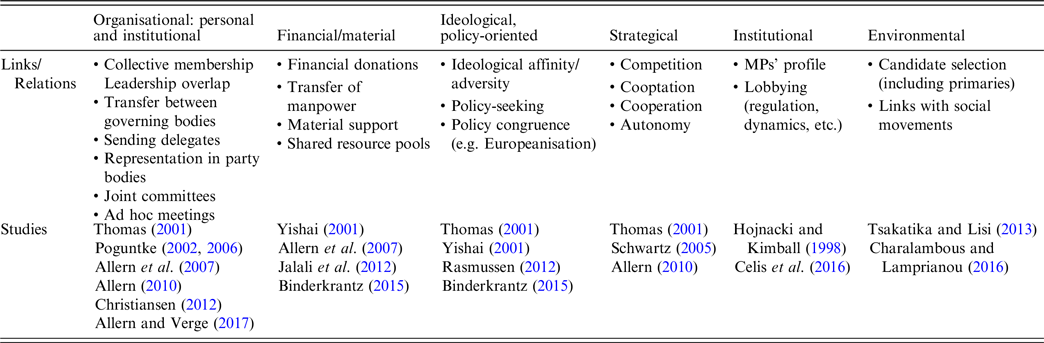
Tellingly, the most comprehensive and/or innovative works of the past two decades (see Thomas Reference Thomas2001; Poguntke Reference Poguntke, Luther and Müller-Rommel2002, Reference Poguntke, Katz and Crotty2006, Allern Reference Allern2010 as well as the special issue published in Party Politics in 2012) have adopted distinct approaches and indicators. These are the studies that have marked the field, either theoretically or empirically, by providing systematic and comprehensive frameworks for the comparative empirical analysis of party–group connections. Though not exhaustive, Table 1 presents a selection of alternative conceptualisations of party–group relations in recent comparative literature. The first approach is associated with the organisational component and it stems from the evolution of distinct party types. This is usually the approach taken from the party perspective, according to which interest groups are subordinated actors who suffer from party pressures. The growing use that political parties make of state resources reinforces this process (Katz and Mair Reference Katz and Mair2018). The recent contribution from Fraussen and Halpin (Reference Fraussen and Halpin2018) is particularly welcome; it starts by considering political parties and interest groups as ‘political organisations’ and thus examines each political actor through the same unified framework. Their main argument is that both types of organisations have been facing similar challenges, particularly regarding the substitution of traditional members for a more professionalised staff, leading to the adoption of new mobilisation strategies, in order to ensure financial and organisational stability. Thus, these organisations are increasingly devoid of volunteers, obliging them to obtain ‘alternative, non-member sources of income’ (Fraussen and Halpin Reference Fraussen and Halpin2018, 28). The authors propose a systematic comparative analysis of new organisational developments shared by both types of organisation, especially in terms of individualisation, disaffection and disintermediation. This approach allows the authors to examine how these changes have affected patterns of participation and representation of contemporary democracies.
Alternative conceptualisations of party–interest group relationship.

Source: Adapted from Allern and Bale (Reference Allern and Bale2012).
Note: The studies included in the table are just an example. The selection is intended to be illustrative of both comparative works and case studies.
The second approach considers the economic interdependence of political parties and interest groups, which is reflected in both the number of financial donations/subsidies from parties to organisations, and the transfer of labour or material resources between the two types of political actors. This perspective is primarily developed and applied to the American context, as organised interests are key players in election campaigns and the mobilisation of citizens (for example in referendum campaigns, e.g. Francia Reference Francia2010; for similar studies in the European context see Allern and Saglie Reference Allern, Saglie, Farrell and Schmitt-Beck2008; Courty and Gervais Reference Courty and Gervais2012; Mach Reference Mach2015). Kitschelt’s (Reference Kitschelt2000) work also follows this approach, by examining the ‘linkages by reward’ through clientelistic ties in Latin American countries.
Acting as channels of representation in contemporary democracies, political parties ally with interest groups that are ideologically close to them and that promote causes congruent with their advocacy. Accordingly, the relationship between the two political actors can be conceptualised in terms of ideological affinity or adversity, or policy congruence. This conceptualisation has a long tradition, especially if we consider the link between left-wing parties and trade unions (see Allern and Bale Reference Allern and Bale2017) or between right-wing forces and the Church (e.g. Warner Reference Warner2000) or even further, in the case of the Confederation of British Industry’s close relationship with the Conservative Party (Grant and Marsh Reference Grant and Marsh1977).
The linkage between political parties and interest groups can be also viewed as a result of a strategic calculation – by both political actors – of all the costs and benefits associated with the relationship (electoral gains, additional resources, organisational support, etc.), or as a struggle for power and control in the political arena (‘who controls whom’). For example, in one of the rare studies of groups’ involvement in electoral campaigns, Allern and Saglie (Reference Allern, Saglie, Farrell and Schmitt-Beck2008) note that organised interests attempt to influence parties through the elaboration of party programmes or the organisation of their own activities.
Interest group studies have focused in particular on the institutional dimension. For example, some works (mostly based on the American experience) have examined the interaction between organised interests and individual legislators, thus exploring how interest groups are able to lobby politicians on specific issues (see Hojnacki and Kimball Reference Hojnacki and Kimball1998). The relation between MPs and interest groups in terms of representativeness is an example of another perspective within the institutional approach (e.g. Celis et al. Reference Celis, Schouteden and Wauters2016; Gava et al. Reference Gava, Varone, Mach, Eichenberger, Christe and Chao-Blanco2016). Some studies also address parliamentary committees, looking at the legislative process and the issue domains where party and group interests meet (e.g. Chaqués-Bonafont and Márquez Reference Chaqués-Bonafont and Márquez2016).
Finally, the environmental dimension is one in which party and groups interact in the societal arena to exchange some types of resources. This conceptualisation relies on the distinction between participatory and environmental linkages (see Tsakatika and Lisi Reference Tsakatika and Lisi2013; Charalambous and Lamprianou Reference Charalambous and Lamprianou2016). While the former arena focuses on organisational mechanisms, the latter considers how political parties and interest groups contribute mutually to mobilise activists and to develop their function of mobilisation, interest articulation and aggregation. From this viewpoint, these ties may develop, for example, a process of interaction for candidate selection or support/competition in the media. Clientelistic linkages (at the collective, not individual, level) may also fall into this category. A crucial element of this type of interaction is the exchange between the group and the party; the actor providing the favour should expect some reward from the counterpart for the effort on its behalf (see Gunther and Diamond Reference Gunther and Diamond2001).
Different approaches have often produced multi-dimensional frameworks to examine the relationship between parties and interest groups. To add to this conceptual confusion, each dimension may be analysed using distinct indicators. For instance, the linkages between the two types of actors can be formal or informal (Kitschelt Reference Kitschelt2000; Poguntke Reference Poguntke, Luther and Müller-Rommel2002), partisan or non-partisan (Binderkrantz Reference Binderkrantz2005), as well as attitudinal or behavioural (Otjes and Rasmussen Reference Otjes and Rasmussen2017).
The lack of a consensual approach to conceptualising party–group relations reflects the general dearth and fragmented character of the academic literature on this topic. These different conceptualisations have led to the elaboration of many different typologies of party–group relations.
In a rare attempt to present a comprehensive framework for analysis, Thomas (Reference Thomas2001, 20–21) elaborated a typology of party–group relations in liberal democracies on the basis of three main criteria: ideology, organisational linkages and strategy. The key linkage types/models are (1) integration/strong partisan mode (parties and interest groups are very close organisationally; (2) cooperation/ideological model (strong connection based on ideology, policy orientation, and historical circumstances); (3) separation/pragmatic involvement model (mutual independence); (4) competition/rivalry model, and (5) conflict/confrontation model (parties and interest groups are involved in open conflict or even confrontation, usually due to ideological cleavages or major disagreements over policy).
The seminal work by Morlino (Reference Morlino1998) on Southern European democracies develops four types of party–group ties: party dominance (or occupation, in its stronger form), symbiosis, neutrality (autonomy), and direct access. This classification partially overlaps with the one elaborated by Mavrogordatos (Reference Mavrogordatos2009), who distinguishes between independence, party dependence, group dependence, and interdependence. A similar classification is proposed by Heaney (Reference Heaney, Maisel and Berry2010), who identifies four main types of party–group relations: ‘co-evolution’ (parties and interest groups establish links through competition or cooperation), ‘discipline’ (when parties or groups try to control the environment), brokerage (a mutual relation based on a network of political actors), and identity (party and groups sharing the same goals). Finally, Verge (Reference Verge2012) uses the criterion of (party) strategy to distinguish between three types of party–group relations: the creation of social organisations, the penetration strategy (parties encourage their members to be involved with interest groups) and collaboration (common spaces of contact and action).
Empirical Findings and Recent Trends
How have party–group relations evolved over time? There is broad consensus in the literature that the strong links established between parties and interest groups during the ‘golden age’ of mass parties – the most notable case being the formal affiliation of trade unions and social democratic parties (e.g. Streeck and Hassel Reference Streeck, Hassel, Addison and Schnabel2003) – have gradually been replaced by looser forms of relations, with no organisational links (Allern Reference Allern2010; Duverger Reference Duverger1954; Katz and Mair Reference Katz and Mair1995, Reference Katz and Mair2018). Women and youth organisations were the most common party allies other than labour groups; further examples include farmers, religious groups, business associations, and so on (Poguntke Reference Poguntke, Katz and Crotty2006).
Over the last decades, the thesis of the weakening of party–group linkages has gained more support, especially in the analysis of mainstream left-wing parties in countries such as Britain (Labour Party, see Quinn Reference Quinn2010), Italy (Democratic Party, see Carrieri and Feltrin Reference Carrieri and Feltrin2016) or Scandinavian social democratic parties (Allern Reference Allern2010; Christiansen Reference Christiansen2012). However, new data collected in the late 1990s–2000s have challenged this common trend.
In a comprehensive volume assessing party–interest group relations in advanced democracies (Britain, France, Sweden and the USA), ‘post-World War II democracies’ (Germany, Italy, Israel and Japan), and ‘transitional democracies’ (Spain, the Czech Republic, Poland, Argentina and Mexico), Thomas (Reference Thomas2001) concludes that there is no clear pattern to the recent developments in the phenomenon. While it is clear that party–group ties are loosening in the case of the countries that have had strong left-wing governing parties and historically strong party–group ties (such as Northern Europe, Britain, Spain and Israel), other countries are characterised by different trends. In Argentina, Mexico, Poland and the Czech Republic, for example, ‘party dominance is being replaced by a new symbiotic connection based on a more equal relationship but not on a movement toward increased independence of either organisation’; on the other hand, the cases of France, Japan and Italy could be described as ‘a combination of increased separation and interdependence’, and the USA as an example of increasing dependence between parties and groups (Thomas Reference Thomas2001, 271).
The fact that there is no linear and unique trend in party–group relations is also clear when we look at recent case studies. In Switzerland, for example, interest groups have traditionally played a key role, but political parties have strengthened their function as gate-keepers vis-à-vis civil society organisations (Mach Reference Mach2015). Based on the Israeli case, Yishai (Reference Yishai2001) observed that the shortage of resources, fragmentation of the party system and decline of established parties forced parties to incorporate society into politics in the search for legitimacy and endorsement. According to this scholar, a new party model – the ‘post-cartel party’ – emerged, with ‘the establishment of both party-affiliated groups and of organisational links with existing associations’ (Yishai Reference Yishai2001, 669).
Recent studies published during the last decade have contributed to qualifying common wisdom by showing that parties have established different kinds of linkage with interest groups and there is no single pattern across or within countries and over time. In her comprehensive analysis of the Norwegian case, Allern (Reference Allern2010) found that political parties have not withdrawn totally from the associational life. Although the most common pattern is indeed one of a fairly distant and fragmented relationship, there is substantial diversity, and some parties have quite strong links to interest groups. Otjes and Rasmussen (Reference Otjes and Rasmussen2017) compared Denmark and the Netherlands and found that interest groups are more likely to establish stronger ties with ideologically aligned parties, with business groups showing distinct types of connection than social organisations.
Diversity also exists within the radical left party family, with the traditional communist parties being more likely to establish strong ties with interest groups (Tsakatika and Lisi Reference Tsakatika and Lisi2013). Focusing on the impact of the crisis on the links between organised interests and radical left parties, Charalambous and Lamprianou (Reference Charalambous and Lamprianou2016) innovated the field by relying on an expert survey, showing that ideological and organisational legacies determined the (little) change experienced in their mobilisation strategies.
In a more methodologically coherent and comprehensive study, Poguntke (Reference Poguntke, Katz and Crotty2006) analysed party statutes for 11 European countries between 1960 and 1989 to capture the substantive difference and strength of two forms of the organisational access of collateral organisations to parties: by representation in party bodies, or by having the right to send delegates (the latter being considered as a stronger kind of linkage). The results show different trends for linkages to external and internal organisations. While external collateral organisations have become less relevant to political parties in Western Europe, internal interest organisations have increased at roughly the same rate. The overall picture, then, is one of declining linkage to external interests offset by the increasing representation of internal interest organisations over the past decades. While the author claims that traditional political parties have managed to maintain relatively stable and close ties with their collateral organisations, ‘their capacity to “deliver” votes and interest aggregation has suffered due to ongoing processes of social differentiation’ (Poguntke Reference Poguntke, Katz and Crotty2006, 403). New parties, on the other hand, are concentrated on the core political organisation, paying less attention to creating the organisational periphery, which results in ‘an increasingly pluralistic system of interaction between organised interests and party politics’ (Poguntke Reference Poguntke, Katz and Crotty2006, 403).
A recent study based on statutory connections confirms that party–group ties are relatively weak and that there is variation both at the country-level and the party-level (Allern and Verge Reference Allern, Verge, Scarrow, Webb and Poguntke2017). Based on the comparison between 19 countries (and more than 100 political parties), these authors found that very few parties have formal (statutory) linkages with interest groups (non-party organisations), and that trade unions tend to display a stronger representation – through representation rights in party decision-making bodies – than business groups. On the other hand, parties are more likely to use party sub-organisations, especially women and youth structures, as a linkage mechanism to connect with social groups.
Explanations of Party–Group Relations
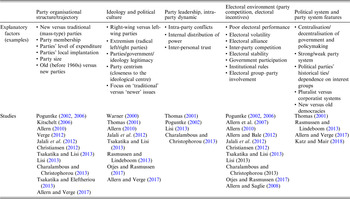
There is also a lack of consensus when we examine the explanations of the type of relationship between political parties and interest groups. As Lizzi (Reference Lizzi2014, 239) observes, ‘few studies offer holistic explanations of the various factors shaping the changes in party–group relations over time and in different countries’. Indeed, when we look at the intensity and variety of party–group linkages (the most common ‘dependent variable’ used in the scholarship considered in this contribution), most studies rely on multidimensional explanations; thus, the causal mechanisms are often complex and multifaceted (for some examples see Table 2).
Political explanations of party–interest group relationship.

Source: Authors’ own elaboration.
Note: The list is not exhaustive and aims at summarising the key explanatory factors presented in the most recent literature.
Broadly speaking, the emphasis on different types of determinants depends on the research design adopted by specific studies. Longitudinal and long-term analyses tend to highlight the importance of societal cleavages (e.g. Katz and Mair Reference Katz and Mair1995, Reference Katz and Mair2018), while comparative works are more likely to focus on institutional explanations (e.g. Allern and Bale Reference Allern and Bale2017; Allern and Verge Reference Allern, Verge, Scarrow, Webb and Poguntke2017; Otjes and Rasmussen Reference Otjes and Rasmussen2017). Indeed, Allern and Bale (Reference Allern and Bale2012, 101) note that parties in different political systems but belonging to the same party family do not share the same type of links with interest groups or do not necessarily have the same type of success in those links. From this viewpoint, state structure (centralised versus decentralised), corporatists arrangements, state funding of parties, legal/constitutional regulation of party and non-party organisations are some of the factors affecting party–group linkages in contemporary democracies.
Recently, scholars have demonstrated that the international context (such as economic globalisation, Europeanisation of policies and external constraints constituted by the requirements at the European and/or international level) also plays an important role in determining political parties’ strategies towards interest groups (Schmitter Reference Schmitter2008; Lizzi Reference Lizzi2014).
However, these widespread systemic factors cannot explain the diversity of parties’ strategies towards organised interests across party families. In other words, parties competing under the same (or similar) structural and institutional conditions may develop different relations with interest groups. From this viewpoint, it is useful to distinguish between the factors shared by both parties and interest groups from the determinants attributed to just one of the two political organisations.
The former group includes rational choice theories and focuses on political actors’ strategic motivations, emphasising the important role of party/group leadership and the use of cost/benefit calculations to define their strategies towards interest groups (Allern Reference Allern2010; Allern et al. Reference Allern, Aylott and Christiansen2007; Binderkrantz Reference Binderkrantz2015; Klitgaard et al. Reference Klitgaard, Binderkrantz and Pedersen2014; Poguntke Reference Poguntke, Luther and Müller-Rommel2002; Quinn Reference Quinn2010; Warner Reference Warner2000). From this frame of reference, inter-personal relations and trust are crucial elements to understand the ties between the two actors. Ideology is another important factor that helps explain party–group relations and that can be applied to both sides of the equation. As noted above, this is an important element that accounts for distinct patterns of party–group linkages across party families (see Celis et al. Reference Celis, Schouteden and Wauters2016).
From the group point of view, some specific attributes are found to shape their engagement with political parties: their development and historical legacies, goals, types, organisational structure and size, partisan origin, group resources, leadership, etc. (see Allern and Saglie Reference Allern, Saglie, Farrell and Schmitt-Beck2008; Binderkrantz Reference Binderkrantz2005, Reference Binderkrantz2015; Rasmussen and Lindeboom Reference Rasmussen and Lindeboom2013; Thomas Reference Thomas2001). Likewise, party organisational structure and party legacy (and history) are also deemed key factors for explaining party–group linkages (e.g. Tsakatika and Lisi Reference Tsakatika and Lisi2013). Examining the linkages – intended as inter-organisational links, overlapping organisational structures or informal (e.g. individual level) ties – between trade unions and social democratic parties, Allern and Bale also suggest that historical legacies are an important explanatory factor, arguing that ‘a longstanding record of statutory links between parties and groups seems to make for stronger links between them today’ (Allern and Bale Reference Allern and Bale2017, 336).
Given the multi-dimensionality of the concept of party–group linkage and its empirical ‘chameleonic’ nature, it is unthinkable to find a theory that may explain cross-country or cross-party variations. From this viewpoint, we concur with Katz and Mair’s (Reference Katz and Mair2012, 108) contention that ‘while focusing attention on one category of explanation (for example, structural change) may be heuristically useful, it will inevitably be incomplete’. Therefore, a more useful way to proceed, we argue, is to pay attention to the conditions and constraints that shape the interaction between the two political organisations. Conditioning is largely invisible to political actors, and its effects are internalised. By contrast, constraints are visible, they remain external, and they encourage party/group organisations to decide the best strategy to pursue their goals. In the following, we provide a few examples – far from being exhaustive – of the mechanisms that may affect party–group relations.
Conditioning may emerge at the societal level, for example through patterns of political participation and mobilisation. When we analyse levels and types of citizens’ involvement in parties or organised groups, there is considerable diversity in time and space (e.g. Morales Reference Morales2009; Lisi Reference Lisi2018). If individuals are willing and able to put forth new demands without relying on traditional channels of intermediation, a new salient cause is likely to trigger a reaction from both parties and interest groups. Another example of context-conditioning is based on media systems. While the media are to some extent neutral reporters of political events or facts, they also inject an independent element into the news (see, for instance, Binderkrantz et al. Reference Binderkrantz, Chaqués-Bonafont and Halpin2016). On the other hand, the government and political parties strive to control the media, which may influence the threats or opportunities perceived by private interests. This means that the relationship between political parties and interest groups is conditional upon the features of interest groups’ media access. There are at least three potential effects that the media system may exert on party–group linkages (see Thrall Reference Thrall2006). The first is related to the notion of ‘agenda setting’, which points to the way specific interests are projected in the public sphere. The second is associated with the legitimacy of party and non-party organisations and the perceptions of citizens in terms of the role these actors (should) play in the political system. Finally, the third refers to the process of mobilisation at the individual or collective level, as well as the way political organisations are able to use media resources to advocate their interests. The existence of such contextual effects has been quite obvious in case studies, but we still lack a truly comparative and systematic assessment of the powerful impact of context in shaping party–group linkages.
Constraints refer primarily to the institutional arena. On the one hand, law regulations regarding the funding of political organisations may lead parties and groups to move closer together or further apart, with implications for both the strategy and the tools adopted. More generally, formal facilitation of party–group relations may be enshrined in Constitutions, such as the provisions to set up consultation procedures between parties and groups in parliamentary committees or negotiations within the policymaking process (e.g. Norton Reference Norton1999; Lisi and Márquez Reference Lisi, Márquez, Fernandes and Leston-Bandeira2019). Scholars commonly accept that interest groups have a strong aspiration to gain access to parliament members, either by an institutional channel (for example parliamentary hearings), or by lobbying campaigns meant to affect the elaboration of legislation or to make policymakers cognisant of constituencies’ preferences on a specific topic (Binderkrantz Reference Binderkrantz, Martin, Saalfeld and Strøm2014; Chaqués-Bonafont and Márquez Reference Chaqués-Bonafont and Márquez2016).
Bolleyer’s (Reference Bolleyer2018) recent contribution has masterfully examined party and interest group regulation and the way the institutional environment – i.e. rules of the game – may affect the (co)existence of political organisations. She considers three ideal types of legal frameworks. The first, whose prototype is Sweden, consists of a ‘voluntarist path’, meaning a more lenient setting for civil society organisations consubstantiated in fewer regulatory constraints and greater openness to different paths to interpret norms. The second is categorised as a ‘functionalist path’ (e.g. United Kingdom) and is somewhat the opposite of the Swedish case, with legislation and regulatory structures that constrain political parties and interest groups, but where the state financial support is narrow. Finally, the main characteristic of the ‘statist path’, as the French case illustrates, is a combination of regulatory restrictions on civil society meant to defend the democratic regime and generous state assistance.
It can be argued that the notion of constraint is reminiscent of the concept of ‘access’ used in interest group studies. In our opinion it may be useful to deploy the notion of a ‘political opportunity structure’ (POS) originally elaborated by Tilly (Reference Tilly1978) and other social movement scholars to analyse how different types of constraints may influence party–group linkages. POS does not only imply the degree of openness/closure of formal political access, but also informal procedures. These properties provide the general setting for the adoption of prevailing strategies and they constrain the relevant configuration of power. The use of this notion also presents the merit of putting on the same level of analysis key actors of interest intermediation, namely parties and groups (and eventually social movements).
The impact of conditioning and constraint on party–group linkages brings us back to our general theme, i.e. the need to avoid a purely party-centred perspective. Consequently, we make the point that not only interest groups, but even parties may be constrained by the context. As Schattschneider (Reference Schattschneider1948, 17) noted a long time ago, parties and interest groups ‘are at once antagonistic and complementary, depending on circumstances’. Although this theme is not a new one and there are now calls for more attention to contextual determinants of party–group relations, the topic becomes more significant when viewed over a longer time-scale or from a more global and comparative perspective.
Concluding Remarks
The main goal of this review article was to provide a clear and concise view of party–group relations. We argue that it is important to understand why and how political organisations interact. Beyond their relevance as actors of interest representation (articulation and aggregation) in modern democracies, party–group linkages may help or hurt the functioning of democratic regimes. By mobilising (or not) citizens and social groups, these political actors play a crucial role in fostering (or reducing) participation and more egalitarian policies. In addition, the relations between parties and non-party organisations have relevant consequences in terms of democratic support and the process of policymaking.
As discussed above, the relations between political parties and interest groups are somewhat ambivalent from a normative point of view. While a strong connection may be healthy for the democratic quality – for example, by fostering participation or more deliberation in the policymaking process – some scholars have a more negative view, especially when private interests may capture or manipulate public resources (e.g. through lobbying or electoral campaigns). Although it is difficult to generalise, we assert that party–group relations are healthy for democratic representation when there is an equilibrium, i.e. when both party and non-party organisations are both ‘receivers’ and ‘transmitters’. In other words, both actors must be active players in the chain of political representation. Democratic quality is likely to be higher when parties and groups play a complementary role in terms of participation, representation and policymaking.
Overall, recent empirical studies find some evidence that parties and organised interests still establish connections and contribute to understanding the conditions under which these ties are stronger (or weaker). Besides the impact of institutional and political factors, group features are important in determining the type of linkages to political parties. Moreover, as our literature review has shown, distinct party families have displayed different traditions in their links to organised interests. The analysis of extreme-right forces shows, for instance, that new digital communicational technologies may increase the interaction between ideologically close party and non-party organisations, thus strengthening their radicalisation and their anti-systemic stances (Caiani and Parenti Reference Caiani and Parenti2013). Nonetheless, in most cases party–group relations have a contingent and pragmatic character, as recently illustrated by the Spanish case (Chaqués-Bonafont et al. Reference Chaqués-Bonafont, Cristancho, Muñoz-Márquez and Rincón2020).
Beyond reviewing research on party–group linkages, this study has also discussed its conceptualisation. We argue that little progress has been made in this field of research for two main reasons. One, the notion of party–group linkages has produced a variety of distinct conceptualisations and typologies, which has made this object of study increasingly confusing. Two, both strands of research have progressed separately, without looking at potential and fruitful exchanges that may innovate and/or deepen our knowledge. Despite a significant amount of theoretical work and a growing body of empirical studies, there are still many relevant avenues to pursue.
It is our contention that this field of research needs to develop a unified approach, which might be particularly fruitful through the analysis of under-studied topics. For example, scholars should take the analyses of political campaigns into consideration. Future studies could investigate the range of policy fields in which party and non-party organisations engage, producing important effects on programmatic stances (see Allern and Bale Reference Allern and Bale2012). Interest groups can partake of activities tracking parties, or develop actions designed to mobilise voters. Party and groups may also interact during the process of candidate selection or supporting specific activities (e.g. party congresses). In addition, American literature suggests that the electoral context affects party–group linkages. For instance, Presidential and Congressional elections imply a higher level of group influence when compared with coalition and multi-member district governments typical of Europe (Dür and De Bièvre Reference Dür and De Bièvre2007). It would be interesting for academics to embark on new in-depth case studies of the role of interest groups in political campaigns and their connections with parties, in particular following the multi-dimensional framework developed by Allern and Saglie (Reference Allern, Saglie, Farrell and Schmitt-Beck2008). Therefore, a first avenue would be to systematically analyse the electoral connections between party and interest groups linkages in a comprehensive and comparative way.
Second, the interaction between political parties and interest groups in the media is likely to deepen our understanding not only of their political alignment and mobilisation strategies, but also of the process of agenda setting and the importance of specific critical junctures (e.g. economic or political crises, elections, etc.). Some studies have already produced noteworthy findings on the role of these political organisations in the media (Binderkratz et al. Reference Binderkrantz, Chaqués-Bonafont and Halpin2016). A more wide-ranging analysis of these specific links, for example including distinct outlets (television, internet, etc.) and new ICT (e.g. social media), would provide a more comprehensive analysis of party-group links. In particular, future research should devote more attention to how political actors use social media (e.g. Twitter, Facebook, etc.), which allow more decentralised, informal and individualised forms of interaction.
A third path is a more detailed examination of party–group relations in the institutional arena. There are several potential avenues for further investigations in this domain. On the one hand, the analysis of the policymaking process and the interaction between parties and groups in the parliamentary and governmental arenas may enhance our understanding on the topic and offer a fresh look at this area. On the other, interest group and party regulation (financial and otherwise) may also emphasise the importance of institutional exchange, for example through the analysis of corporatist arrangements, state funding of parties and legal and constitutional regulation of interest groups (e.g. Bolleyer Reference Bolleyer2018). More in-depth analysis of regulation of political parties and interest groups, namely through formal and informal means, is of paramount importance.
Finally, it would be useful to develop a comparative study of elite networks (Heaney Reference Heaney, Cigler and Loomis2012, 204–209). On the one hand, this type of analysis could lead to the discovery of personal links between parties and groups through leadership overlap. On the other hand, inside these networks we may find a large exchange of information, resources, loyalty, and creation of coalitions; therefore, it might be possible to disentangle different types of informal and other types of relations – from leader or candidate selection to combined efforts on public policy. One of the foremost examples would be lobbying, which has been studied in great detail for the American case and at the EU level but not at European country level (a notable exception is Eichenberger and Mach Reference Eichenberger and Mach2017). ‘Lobbyists play an especially important role in linking political parties and interest groups’ precisely because they are potentially part of the revolving door (Heaney Reference Heaney, Cigler and Loomis2012, 204). Content analysis based on social networks would also enable analyses of attitudinal or behavioural interactions between party and non-party leaders.
A comparison of all these attributes would be a valuable empirical contribution not only to combining the often separate party and group literature, but also to closing the gap between the American and EU cases with country-level analysis. These innovations should enable large-scale, comparative, cross-country research and therefore contribute to resolving some of the most pertinent questions in the field. This would facilitate the consolidation of the theoretical foundation of party–group relations and the analysis of their consequences on representative political systems.
Acknowledgements
This study was supported by the Fundação para a Ciência e Tecnologia (FCT), by a grant within the framework of the project ‘From Representation to Legitimacy: Political Parties and Interest Groups in Southern Europe’ (PTDC/IVC-CPO/1864/2014). Rui Oliveira also acknowledges FCT for supporting the research with an individual doctoral grant (SFRH/BD/128780/2017)
About the Authors
Rui Oliveira is a PhD Candidate in Political Science at Nova University of Lisbon, with an individual doctoral grant from the Portuguese Science and Technology Foundation. He was a research fellow and research assistant in several national and international research projects, has an academic focus on political parties and interest groups, elections, comparative politics, institutions and political representation, and has also published chapters on international cooperation.
Marco Lisi is an Associate Professor in the department of Political Studies, Nova University of Lisbon, and Researcher at IPRI-NOVA. His research interests focus on political parties, electoral behaviour, democratic theory, political representation and election campaigns. He has published several articles in national and international journals. He recently edited Party System Change, the European Crisis and the State of Democracy (Routledge, 2019).