Coronavirus disease 2019 pandemic has crippled nearly every congenital heart surgery programme across the globe and India. Reference Protopapas, Rito and Vida1,Reference Choubey, Ramakrishnan and Sachdeva2 There are different preoperative screening algorithms based on the regional prevalence of the pandemic. These, progressively evolving algorithms, have led to the gradual resumption of congenital heart surgery services. Such protocols include various components like screening for coronavirus disease 2019 active infection with reverse transcription-polymerase chain reaction and immunoglobulin G at varied preoperative times including as early as 48 hours before surgery and subsequently repeated every week in the post-operative period. Reference Bloise, Marcellino and Testa3 Indian and global data suggest that symptomatic coronavirus disease 2019 disease is less common in children than among adults. Reference Gupta, Agrawal and Ish4–Reference Preston, Chevinsky and Kompaniyets6 Despite this, preoperative testing for coronavirus disease 2019 is a part of most universal screening protocols. Reference Wojcik, Rajab, Newman, Jaggers and Mitchell7–Reference Mina and Andersen9 The incidence of asymptomatic infections is less (<1%) in children screened with reverse transcription-polymerase chain reaction, prior to surgical interventions. Reference Adler, Shah and Blumberg10 There have been reports of fewer adverse perioperative outcomes in paediatric surgeries, during the pandemic. Reference Collaborative11 Perioperative outcome data on children with CHD at cardiac interventions and surgeries are scarce. Reference Haiduc, Ogunjimi and Shammus12,Reference Haji Esmaeil Memar, Pourakbari and Gorgi13 Speculation and concerns regarding perioperative outcomes of CHD patients are based on the involvement of the cardio-respiratory system and their hyper-inflammatory response to coronavirus disease 2019. The evolving literature observes a convalescence stage of coronavirus disease 2019, despite asymptomatic or paucisymptomatic presentation. During the coronavirus disease 2019 convalescent phase, in such children, there could be cardiac dysfunction, arrhythmias, hyper-reactive pulmonary vasculature, and exacerbation of myocardial dysfunction. Reference Ley-Vega14,Reference Cuppari, Ceravolo and Ceravolo15 As the pandemic evolves, children requiring cardiac interventions might likely be in a coronavirus disease 2019 convalescent phase. We sought to observe outcomes of coronavirus disease 2019 convalescent children (screened preoperatively for reverse transcription-polymerase chain reaction and immunoglobulin G antibody screening) after congenital heart surgery in a tertiary referral centre for paediatric cardiac surgery during the coronavirus disease 2019 pandemic.
Aim
Observe mortality and post-operative outcomes of coronavirus disease 2019 convalescent-phase children undergoing congenital heart surgery.
Methodology
All consecutive patients, who underwent congenital heart surgeries between October 2020 and June 2021, at a tertiary referral congenital heart surgery unit were enrolled as part of a retrospective, observational cohort, with the waiver of consent by the Ethical committee given the type of study. The demographic information, clinical profile, diagnostic and operative details, and post-operative data were accessed from the archived case files at Medical Records Department. On the day of surgery, the children were classified into two groups, COVID convalescent: those without any symptoms related to coronavirus disease 2019, reverse transcription-polymerase chain reaction positivity 6 weeks prior to surgery and/or coronavirus disease 2019 immunoglobulin G (immunoglobulin G to SARS-CoV-2 S-protein); COVID control: children with negative reverse transcription-polymerase chain reaction and negative coronavirus disease 2019 immunoglobulin G antibody. The neonates were excluded from the study because in utero exposure and perinatal transfer were likely to lead to false-positive coronavirus disease 2019 immunoglobulin G antibody positivity.
The demographic particulars, clinical profiles, intraoperative details, and post-operative outcomes of mortality and organ dysfunctions were compared among the groups. Definitions of post-operative outcomes, infections, and events were defined as per International Quality Initiative Collaboration recommendations. Reference Sandoval, Carreño and Novick16 The impact of coronavirus disease 2019 convalescence on mortality and post-operative outcomes was assessed. Observations of children turning reverse transcription-polymerase chain reaction positive in the post-operative period were made.
Statistical analysis
All the continuous and categorical data are represented as mean with standard deviation and proportions, respectively. The means across groups were compared with, unpaired Student’s t-test for data that was parametric, and the Mann–Whitney test for non-parametric data. For comparison of categorical variables, chi-square test was used. P-value < 0.05 was considered to be statistically significant. Logistic regression was performed with mortality as a determinant factor for coronavirus disease 2019 convalescent status and other clinically relevant contributing factors.
Results
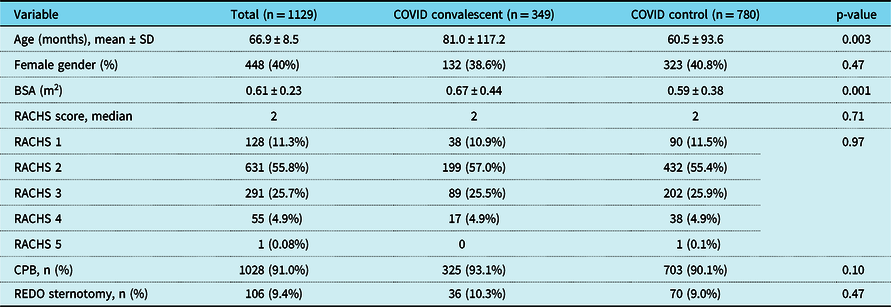
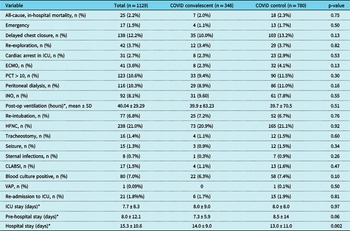
A total of 1129 patients were enrolled for the analysis. Both coronavirus disease 2019 convalescent (n = 349) and control (n = 780) groups were comparable for all preoperative clinical factors except age at surgery and body surface area (Table 1). Control patients were younger and with smaller body surface area than the coronavirus disease 2019 convalescent children. Surgical risk stratification was comparable among groups with a median Risk adjustment for congenital heart surgery score score of 2 (p = 0.71), and there were no differences across categories (p = 0.97). The groups were comparable for their pre-operative stay in the hospital, emergency surgeries, redo sternotomies, and surgeries needing cardiopulmonary bypass (Table 2). Mortalities were not different among groups, including mortalities across Risk adjustment for congenital heart surgery score risk-stratified sub-group categories (p > 0.51) (Table 3). Post-operative ventilation duration, need for extracorporeal membrane oxygenation, peritoneal dialysis, high flow nasal cannula, inhaled nitric oxide, and tracheostomy was comparable across the groups (Table 2). There was no increased requirement for re-exploration to control excessive bleeding in the coronavirus disease 2019 convalescent group. Indicators of extended or super-added infection markers like central line-associated bloodstream infection, procalcitonin more than 10, sternal site infection, ventilator-associated pneumonia, ICU, and hospital stay were no higher in coronavirus disease 2019 convalescent patients. On adjusting for confounding factors for mortality as the outcome in a logistic regression model, coronavirus disease 2019 convalescence had no higher odds of mortality in comparison to control patients (Table 4).
Demographic, clinical, and surgical data

BSA – Body surface area (Mosteller formula); RACHS – Risk adjustment for congenital heart surgery score.
Mortality and post-operative outcomes

ECMO – extra-corporeal membrane oxygenation; PCT – procalcitonin; iNO – inhaled nitric oxide; HFNC – hi-flow nasal cannula; CLABSI – central line associated blood stream infections; VAP – ventilator associated pneumonia.
* Continuous data with significant outliers are measured as median and compared with non-parametric Mann–Whitney test.
Mortality across RACHS score categories

Multiple regression analysis of clinically relevant factors associated with mortality

Age was stratified as per Centre for disease control (CDC) guideline for age stratification for children – Infants (1–12 months), Toddler (1–3 years), Middle childhood (6–11 years), Teenagers (12–17 years) and Grown-up CHD (GUCH; >18 years having CHD).
Post-operative coronavirus disease 2019-positive children (n = 5) were suspected based on stringent contact tracing, testing all children in contact with the suspected patient/parent, testing persistent pyrexia, and children with unexplained low PaO2 adjusted for the lesion and usual post-operative course. All these children required extended oxygen requirement post-cardiac surgery and prolonged length of stay (7–51 days); three children required prolonged ventilation (68–780 hours), one child developed unexpected ventricular fibrillation and was successfully resuscitated. No mortality was observed in this group of patients.
Discussion
Coronavirus disease 2019 convalescence (as defined by children without any symptoms related to coronavirus disease 2019, reverse transcription-polymerase chain reaction positivity 6 weeks prior to surgery and/or coronavirus disease 2019 immunoglobulin G) did not have unfavourable outcomes such as an increased risk of mortality or serious morbidities in children undergoing congenital heart surgery.
Congenital heart surgery programmes were stalled across the world with an increase in waiting periods during the first wave of the coronavirus disease 2019 pandemic. Limited information on outcomes in children undergoing elective congenital heart surgery creates a void to recommence programmes. We thus embarked upon observing the outcomes of coronavirus disease 2019 convalescent children in the perioperative period. As the future of cardiac surgery or any surgery will deal with coronavirus disease 2019 convalescent children (either symptomatic or asymptomatic) presenting for elective interventions and surgeries, understanding the impact of the perioperative procedures and their interactions with the convalescent nature of coronavirus disease 2019 has implications to discuss risk stratification, and focus on high-risk subgroups.
Active coronavirus disease 2019 infections in CHD patients may pose a significant threat owing to direct myocardial injury, myocarditis, acute cardiac failure, the unmasking of intrinsic ventricular dysfunction, and arrhythmias. Reference Dilli and Tasoglu17 In a 58-centre survey concerning the impact of coronavirus disease 2019 on adults with CHD, 1115 patients with a varied spectrum of CHD and coronavirus disease 2019 infection were analysed. With overall mortality of 2.3% in this population, authors suggested a worse outcome in patients with cyanosis, pulmonary hypertension, and previous hospitalisations for heart failure. More importantly, a worse functional stage (higher NYHA, arrhythmia, end-organ dysfunction, and valve disease) was associated with increased infection severity, whereas anatomic complexity did not exhibit any impact. Reference Radke, Frenzel, Baumgartner and Diller18 In another survey of nine European centres interpreting 105 coronavirus disease 2019 infections in children with CHD, with 4.5% observed mortality, the following risk factors were associated with worse outcomes – cyanosis, Eisenmenger’s syndrome, associated systemic diseases of obesity and renal dysfunction. Reference Schwerzmann, Ruperti-Repilado and Baumgartner19 Similar views emerge from another European data of 94 CHD children with coronavirus disease 2019 suggesting lower mortality and without any specific inclination to anatomic lesions but for a worse physiologic stage of the CHD. Reference Cleary, Chivers, Daubeney and Simpson20 Such data do aid in understanding the association of CHD with coronavirus disease 2019, but the exposure to the stress of cardiac surgery, cardiopulmonary bypass, perioperative ventricular dysfunction, systemic inflammatory response, perioperative infections remain elusive. The present study highlights this point with no difference in mortality across various Risk adjustment for congenital heart surgery score surgical categories (p > 0.71). Reference Broberg, Kovacs and Sadeghi21 No differences in outcomes across the complexity and risk-stratified Risk adjustment for congenital heart surgery score groups were noted, in concordance with the non-surgical CHD coronavirus disease 2019 infections. Reference Broberg, Kovacs and Sadeghi21
A multicentre observation across 13 centres from India examined for outcomes of coronavirus disease 2019 in children with CHD suggests higher mortality (15.8% versus 12.4%) in children operated for congenital heart surgery with coronavirus disease 2019-positive status. These data included 686 children negative (mortality 15.8%) and 19 children positive (mortality 12.4%) for coronavirus disease 2019 undergoing surgery, comprising predominantly Risk adjustment for congenital heart surgery score category 2 patients (50%). Reference Sachdeva, Ramakrishnan and Choubey22 Post-operative mortality observed across 24 congenital heart surgery from India reveals a doubled mortality rate in comparison to historic times (9.1% versus 4.3%). Reference Choubey, Ramakrishnan and Sachdeva2 These are preliminary data emerging from the Indian sub-continent serving a contemporary basis for risk stratification of congenital heart surgery during the pandemic. Nonetheless, they fall short of understanding the outcomes of children in the coronavirus disease 2019 convalescent-phase approaching cardiac interventions.
Severe and fatal coronavirus disease 2019 disease is observed less frequently in infants and children in comparison to younger and older adults. Reference Pierce, Preston-Hurlburt and Dai23 This is in contrast with the higher prevalence of infections due to other respiratory viruses. Multiple theories of this phenomenon are described in detail elsewhere. Reference Wu, Xing and Shi24 But a few plausible explanations for age-related differences in severity of coronavirus disease 2019 need to be mentioned. Endothelial resilience to damage reduces with age and so does the susceptibility to excessive coagulation and hyperinflammation. Children are known to have stronger innate immunity explaining efficient clearance of virus and a weaker acquired immunity known for a hyper-inflammation response. Although, reports contradicting this hypothesis surface in literature. Reference Miller, Reandelar, Fasciglione, Roumenova, Li and Otazu25,Reference Riccò, Gualerzi, Ranzieri and Luigi Bragazzi26 Recurrent, concurrent infections with a virus of the human coronavirus family and cross-reactivity with SARS-CoV-2 infections are another postulated theory to protect against severe infection in children. Reference Bansal, Azeka and Neunert27 Recently, immunity generated with live vaccines and their off-target effects in children has been proposed to have beneficial effects, especially BCG, MMR, and OPV vaccines, Reference Goldenberg, Sochet and Albisetti28 though the role of BCG has been narrated as “playing with data” than any robust evidence. Reference Loi, Branchford, Kim, Self and Nuss29 Whether these postulations protect exacerbations with the stress of surgery, inflammation of cardiopulmonary bypass, and super-infections in the perioperative period are questions that solicit compelling research.
Significant cardiac dysfunction or systemic hypotension requiring additional mechanical support in the form of extracorporeal membrane oxygenation was comparable. Pro-thrombotic state in coronavirus disease 2019 convalescent as seen in adults are described in children with MIS-C (a multi-inflammatory syndrome in children) as well. Reference Ruel, Chan and Boodhwani30 Anti-thrombotic prophylaxis is recommended considering the pro-thrombotic risk factors like mechanical ventilation, central venous catheters, immobilisation, obesity, and inherent diseases. Reference Yang, Costa and Racine-Brzostek31,Reference Atalay, Soran Türkcan and Taşoğluİ32 These factors do exist in congenital heart surgery and hence a predisposition to venous and pulmonary thromboembolism and coagulation dysregulation. Anti-thrombotic state and bleeding are common after congenital heart surgery, and cardiopulmonary bypass is a significant contributor. Reference Kotlyar, Grechukhina and Chen33 In the present observation, cardiopulmonary bypass was used in close to 93% of cases and re-exploration rates for significant bleeding were similar in both groups. Overt prothrombotic events were not observed including an increased incidence of cerebrovascular events or seizures in either population.
Pulmonary hypertension, right ventricular dysfunction, and cyanosis are predisposed to increased mortality and morbidity in CHD with coronavirus disease 2019 infections. Respiratory outcomes in coronavirus disease 2019 convalescent patients were not any worse when compared with ventilation duration, need for prolonged respiratory support with high flow nasal cannula, re-intubation, and tracheostomy. All extracorporeal membrane oxygenation was initiated for cardiac indication and conducted with central veno-arterial cannulations.
The control group in the present study had younger and children with smaller body surface area. This being retrospective data, allocation to either group was a natural selection as all consecutive patients in the specified period were enrolled. Nonetheless, age was not a significant factor associated with mortality in the regression model. Immunoglobulin G immune response of children compared to adolescents and adults is variable; nevertheless, a series of 1194 children in New York showed a negative correlation of age with immunoglobulin G response. Reference Falsaperla, Giacchi and Lombardo34 The prolonged ICU stay and hospital stay despite a comparable post-operative course in the control group could be attributed to the younger and smaller children. The mortality among the study population is reflective of the Institutes’ congenital heart surgery outcomes in the previous few years (2018 – 85/2566, mortality = 3.4%; 2019 – 94/2492, mortality = 3.8%) and hence exhibits the consistency of teams involved.
A series of 29 congenital heart surgery at a single centre from Turkey observed high mortality (13.8%), owing to an emergency indication of surgery (55%), predominant neonatal surgery (50% neonates, mean weight – 7.7 kg), and 7.8days of ICU stay. Reference Flannery, Gouma and Dhudasia35 Neonates were excluded from the current observation. Neonates with coronavirus disease 2019 mothers comprise a unique challenge particularly ones requiring interventions for CHD. Vertical transmission of SARS-CoV-2 from mother to fetus though possible is practically remote. Reference Arkhipova-Jenkins, Helfand and Armstrong36 Isolation of newborn or permitting maternal care with breastfeeding has shown inconclusive evidence of any worse outcome, making the decision more ambiguous. Reference Sanil, Misra and Safa37 Maternal immunoglobulin G antibodies transferred to neonates could be the predominant cause of neonatal immunoglobulin G, hence deeming any neonate as “coronavirus disease 2019 convalescent” is not prudent. 38
Post-operative coronavirus disease 2019-positive children were suspected based on stringent contact tracing, testing all children in contact with the suspected patient/parent, testing persistent pyrexia and children with unexplained low PaO2 adjusted for the lesion and usual post-operative course. None of the post-operative coronavirus disease 2019-positive kids needed extended ventilation time, high flow nasal cannula, tracheostomy, re-intubation, or extracorporeal membrane oxygenation. All these children had prolonged length of stay and longer requirement of oxygen, three had extended ventilator requirement, two had reintubation and one had ventricular fibrillation.
Data of antibody kinetics and sampling time after infection are sparse in children, whereas the adult population does show peaking of immunoglobulin G around 25 days and persistent up to 60 days in the majority of patients. These data do suggest the use of immunoglobulin G as a screening tool to rule out convalescence for perioperative testing. Reference Ludvigsson39
Post-coronavirus disease 2019 convalescence with severe coronavirus disease 2019 disease is associated with left ventricular dysfunction in patients followed up to 10 weeks after discharge. Reference Huang and Cao40 These are the population potentially presenting for congenital heart surgery after coronavirus disease 2019 infection – asymptomatic or otherwise. Reference Ley-Vega14,Reference Sanil, Misra and Safa37,38 Long coronavirus disease 2019 is a plausible phenomenon in children and involves continuing symptoms including palpitations, chest pain, fatigue, and dyspnoea. These can emulate exacerbated CHD symptoms, and hence, patients presenting for CHD have to be screened for coronavirus disease 2019 convalescence. Reference Lerner, Robinson and Yang41,42 Coronavirus disease 2019 infection is burdened with uncertain recovery patterns, an unstable inflammatory response system, and unknown sequelae. The need to define such a syndrome is of paramount importance as it is equally pertinent to asymptomatic and non-hospitalised coronavirus disease 2019 patients. Reference Huang and Cao40,Reference Lund, Hallas and Nielsen43 Convalescence state as defined by a phase of time between illness and health – the state most patients would seek healthcare for corrective therapies – this is something we all have to face in near future. Reference Lerner, Robinson and Yang41 The future is convalescence. Reference Lerner, Robinson and Yang41,42
Strength
Present analysis is a distinctive (unparalleled, unique) observation of coronavirus disease 2019 convalescent congenital heart surgery outcomes and compares them with contemporary controls.
Limitation
Retrospective data are known for their missing data, but in the present observation, all data were extracted from the institutional database, and all the mentioned events were recorded across the cohort. A small percentage of patients (<5%) and especially children with the paucisymptomatic presentation may not develop strong and long-standing antibodies, such patients might have been classified to coronavirus disease control group. Reference Ludvigsson39
Conclusion
Children with immunoglobulin G antibodies to SARS-CoV-2 S-protein – deemed as coronavirus disease 2019 convalescent – are not at an increased risk of mortality and worse outcomes after congenital heart surgery. Immunoglobulin G antibody presence on preoperative screening for congenital heart surgery can be used as a screening tool and aids in perioperative decision-making and risk-stratifying.
Acknowledgements
We appreciate the contributions of Dr Ashwini T, Dr Sruti Rao for their invaluable contributions in editing the manuscript, and Mr. Madhu H D, Mrs. Muthulakshmi S for their support in maintaining the PITU database.
Financial support
This research received no specific grant from any funding agency, commercial or not-for-profit sectors.
Conflicts of interest
None.
Ethical standards
The retrospective observational study has been approved by the Institutional Ethics Clearance Committee with a waiver of consent.
The present study is being presented as a Young Scientific Research award session paper at PCSI (21st Annual Conference of Paediatric Cardiac Society of India).