On July 21, 1923, the National Woman's Party rallied at Seneca Falls to observe the seventy-fifth anniversary of the signing of the Declaration of Sentiments. Party chair Alice Paul, who had recently helped win the Nineteenth Amendment, proposed a national Equal Rights Amendment (ERA), arguing that women were “not safe until we have equality guaranteed by the Federal Constitution.”Footnote 1 Only a month later, the nephew of Susan B. Anthony, Daniel Anthony (R-KS), introduced the ERA in Congress. With fanfare, allied members of Congress called hearings before the House and Senate Judiciary Committees and pushed hard for a floor vote on the ERA.
After decades of wrangling, Congress finally passed the ERA in 1972. By then, congressional attention to the ERA looked quite different. Between 1959 and 1971, 414 members of Congress from all fifty states proposed 971 ERAs, announcing their amendment proposals before their constituents, then abandoning these measures. The amendment's ratification campaign stalled, and conservative members began dumping dozens of opposed amendment proposals to restrict abortion access, similarly abandoning these measures after introduction. As Arkansas's Republican Senator Dale Bumpers later admitted, many contemporary amendments were throwaway measures: “Constitutional amendments are palpable nonsense,” he stated, because they are “all crafted for political advantage.”Footnote 2
In the early twentieth century, members of Congress viewed the amendment process as a viable route to revise the Constitution's text. By the late twentieth century, they instead used amendment proposals as a tool to take policy positions before their constituents. What changed?
Political scientists looking to explain Bumpers's cynicism might point to the difficulties of amending the U.S. Constitution. Article V, establishing the formal amendment procedure, contains the most burdensome amendment requirements of any national constitution.Footnote 3 Nevertheless, members of Congress have proposed nearly twelve thousand constitutional amendments since the founding, raising questions about why they engage in such seemingly futile efforts.
We argue that the rise of federal judicial power during the middle of the twentieth century led members of Congress to repurpose Article V as a tool primarily for position-taking. While often pitched in opposition to the judiciary, lawmakers use these Article V amendments not to signal court-curbing threats to judges, but rather to foster connections with allied constituents and social movements. While such constitutional position-taking can be observed as far back as the founding, we identify three shifts in members’ amendment behavior in the mid-twentieth century: (1) an increased frequency in proposing amendments, coinciding with the rise of the Warren Court; (2) an increase in amendments targeting the judicial branch; and (3) a decrease in the dedication of resources and attention to amendment passage.
To demonstrate this behavioral shift in Congress, we offer the first systematic, amendment-level analysis of these nearly twelve thousand proposals, using a new data set to identify their substantive content and link them to individual sponsors and specific political controversies and movements. We use these data to observe congressional behavior over the course of American history. This is substantiated by qualitative case studies demonstrating, at the member and Congress level, a shift in the 1950s in the content and number of amendments proposed, reflecting members’ increasing use of Article V for position-taking. The case studies address polygamy, women's suffrage, the ERA, and same-sex marriage.
Our argument contributes to scholarship on institutional repurposing. We propose that actors within an institution set norms defining the institution's function.Footnote 4 While these norms usually reinforce institutional resilience, under certain conditions they might spur institutional change.Footnote 5 Specifically, when an institution no longer serves some of its constituent actors’ goals, these constituents may reduce their engagement with it, providing an opportunity for others to redefine the institution's norms and purpose. The most important supporting constituencies for Article V have been members of Congress and would-be constitutional reformers outside of Congress, who together defined the norms and practices surrounding its use. As reformers in the mid-twentieth century turned their attention to the federal judiciary as a more expedient venue for constitutional change, members of Congress were able to repurpose Article V to become primarily a mechanism for serving their position-taking aims.
We begin by situating our study of congressional engagement with Article V in the broader literatures on constitutional reform and institutional development, describing the timing and content of congressional Article V amendments and finding that other accounts struggle to explain a shift in this amendment behavior. We then outline our own account of institutional change through institutional repurposing, describing congressional members’ Article V constitutional position-taking, and explain how this behavior reflects institutional developments outside Congress, especially in the federal judiciary. We present our case selection criteria and substantiate our descriptive and analytical claims across four case studies. We conclude by considering the implications of these findings for literatures on institutional and constitutional development and interinstitutional relations.
1. Article V in American Constitutional Development
The formal procedures for amending the U.S. Constitution are laid out in Article V, which holds that:
The Congress, whenever two thirds of both houses shall deem it necessary, shall propose amendments to this Constitution, or, on the application of the legislatures of two thirds of the several states, shall call a convention for proposing amendments, which, in either case, shall be valid to all intents and purposes, as part of this Constitution, when ratified by the legislatures of three fourths of the several states, or by conventions in three fourths thereof, as the one or the other mode of ratification may be proposed by the Congress.Footnote 6
Noting these high barriers to formal constitutional amendment, scholars have deemed Article V “disused,” “comatose,” and “irrelevant.”Footnote 7 Sanford Levinson, for example, has cogently stated that “Article V constitutes what may be the most important bars of our constitutional iron cage.”Footnote 8 The Constitution has only been amended twenty-seven times, with the first ten amendments ratified as the Bill of Rights in 1791. Article V empowers an extraordinary number of actors in the amendment process, including minority factions in either house of Congress and majorities in both chambers of the state legislatures or ratifying conventions of at least three-fourths of the states. The actual number of legislative chambers needing to support an amendment has multiplied as states have been admitted, while the difficulties of securing minority or cross-party support has become less likely because of partisan polarization.Footnote 9 Constitutional reformers have instead turned to judicial interpretation, legislative “super statutes,” and state constitutional revision.Footnote 10
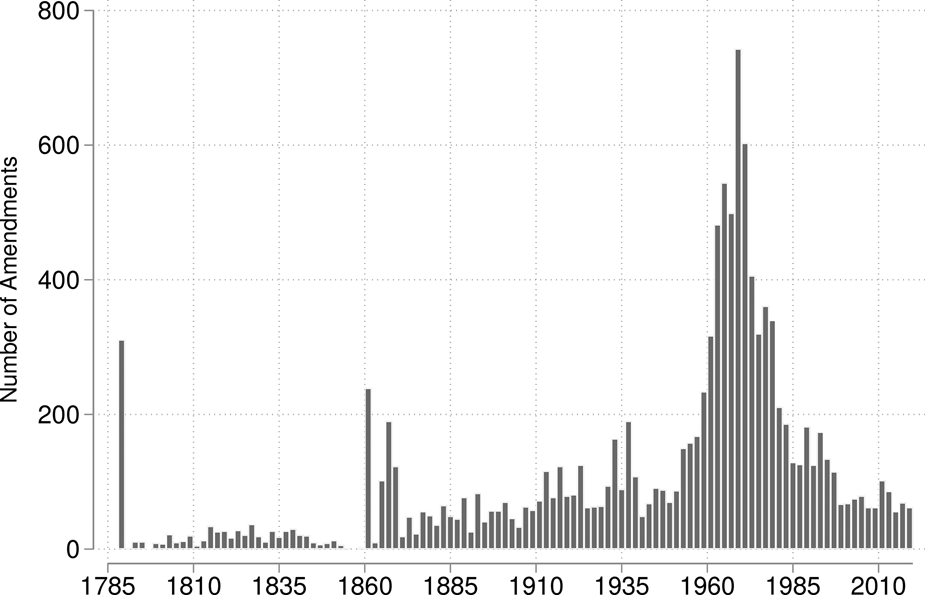
Although these accounts offer promising explanations about the paucity of successful amendments, they fail to explain why, despite such poor prospects for passage, members of Congress have proposed nearly twelve thousand Article V amendments. Indeed, we know little about these so-called failed amendments. Darren Latham, for example, has lamented our capacity to make more general claims about these proposals—and by extension the motives driving congressional behavior—in part because “too much data remains inaccessible or un-obtained thus far.”Footnote 11 To remedy this, we present a data set of all proposed Article V amendments introduced by members of Congress through American history (1788–2020).Footnote 12 Figure 1 tracks the biennial number of constitutional amendments proposed and the notable increase in amendment proposal rate following the New Deal. Members of Congress proposed nearly half of all constitutional amendments in a thirty-year span, between 1960 and 1990, and over 60 percent since 1953.
Number of Proposed Constitutional Amendments, 1788–2020 (2-year bins).

Rebutting scholarly descriptions, our data suggest that Article V is not “disused,” “comatose,” or “irrelevant.” Congressional engagement with Article V significantly increased through the twentieth century even as the demands for coordinated behavior across an increasing number of state and federal legislative bodies increased. Figure 1 shows that members disproportionately used Article V precisely when, in the mid-twentieth century, the rise of judicial power made such behavior seem futile.Footnote 13 Lacking such data, standard accounts of Article V behavior cannot explain this or other trends in congressional amendment introduction.Footnote 14 Some possible explanations can be extracted from the wider literature on constitutional change, but as we will see, many of these presume that the uses of Article V have remained constant across time. After discussing these possible explanations, we develop an alternate explanation, describing how members repurposed Article V.
1.1 Constitutional Crises
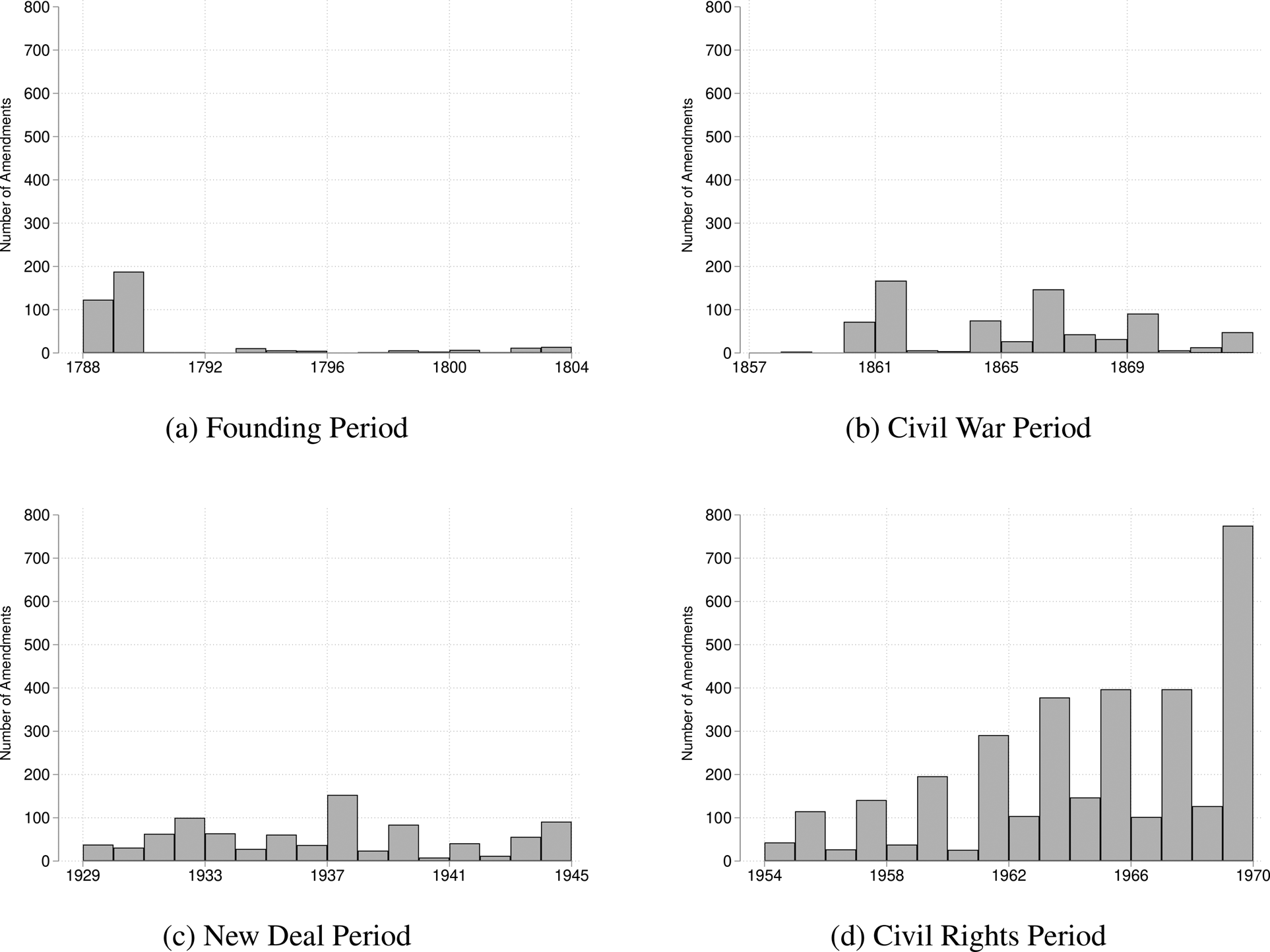
Some scholars, including perhaps most prominently Bruce Ackerman, assert that significant constitutional change—often by way of Article V—occurs during moments of constitutional crises brought on by constitutional inflexibility. These accounts generally emphasize four moments: the founding, when antifederalists and state legislators proposed hundreds of amendments to revise the new Constitution;Footnote 15 the Civil War, when members introduced hundreds of amendments on slavery and Black citizenship;Footnote 16 the Great Depression, when members attempted regulating labor and the economy;Footnote 17 and the civil rights movement, when members and federal judges, pushed by the civil rights movement, began to dismantle Jim Crow.Footnote 18
Our data suggest a relationship between Article V activity and moments of constitutional crisis, per Figure 2. As such accounts would expect, amendment introduction increased during the founding, the Civil War, and the New Deal. The civil rights era generated disproportionate amendment proposal. These, however, came after landmark statutory reforms and Warren Court decisions. Rather than occurring during moment of constitutional inflexibility or failure, civil rights era amendments occurred during a period of successful constitutional adaptation, when federal judicial review and super-statutory reform largely carried the day. Figure 2 therefore shows that in the aggregate constitutional amendments were not proposed mainly in moments of constitutional inflexibility and crisis, per the founding, Civil War, or New Deal, but rather in a period of relatively successful constitutional adaptation during the mid-twentieth century, when federal judicial review and super-statutory reform carried the day.Footnote 19 Moreover, in these years, members increasingly introduced amendments during the first days of a new Congress, normally with little follow-through to secure an amendment's passage. Instead, as Figure 2 suggests, members used Article V to attack the seemingly “settled” issues of the 1964 settling election, suggesting that Article V has retained some enduring utility for opponents of constitutional reform.
Proposed Constitutional Amendments during Crisis Periods.

1.2 Social Movements
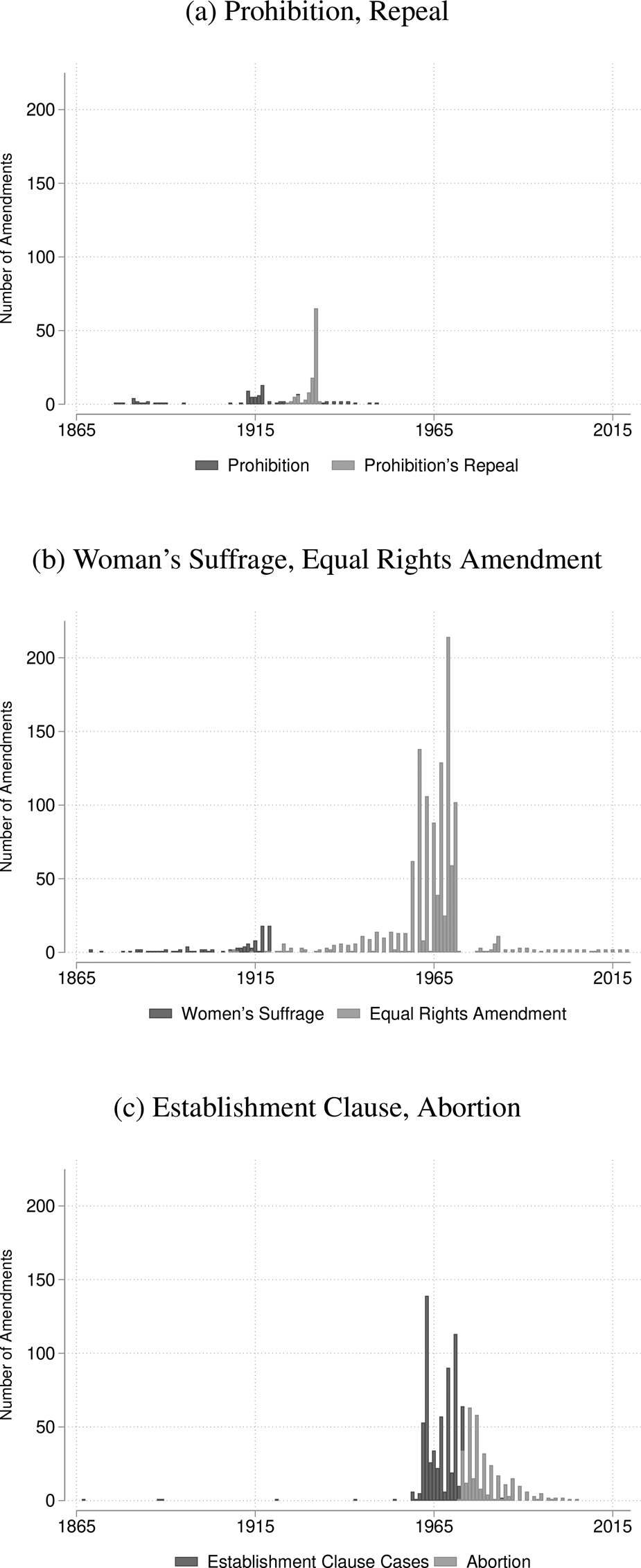
Other scholars note that social reformers have long petitioned Congress for Article V amendments.Footnote 20 Amendments were proposed by abolitionists seeking to ban slavery in the territories and District of Columbia,Footnote 21 prohibitionists seeking to block liquor access,Footnote 22 and women's suffrage advocates.Footnote 23 But our data suggest that members of Congress responded differently to social movement demands over the course of the twentieth century. As Figure 3 demonstrates, the major social movements of the nineteenth and early twentieth centuries successfully pursued constitutional change but did so by generating comparatively little amendment activity in Congress. By contrast, the social movements of the 1960s and 1970s generated disproportionate congressional responses. Figure 3 documents congressional response to petitions from on prohibition, women's suffrage, the ERA, school prayer, and abortion. As the three panels of Figure 3 make clear, members of Congress responded to mass political mobilization in ways that do not correlate with observed Article V behavior. Proposed amendments for prohibition, repeal, and even women's suffrage were comparatively rare when compared to later ERA, school prayer, and abortion amendments. Accordingly, social movement activism alone cannot explain the increase in congressional Article V proposal in the mid-twentieth century as Congress responded quite differently to social movement demands.
Social Movements and Related Amendment Activity in Congress.

1.3 Overturning Judicial Decisions
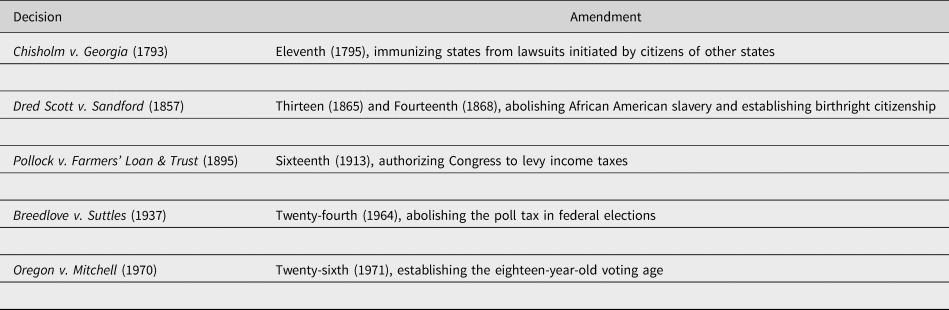
A final perspective argues that members of Congress introduce amendments to reverse federal judges by rewriting the constitutional text.Footnote 24 To this point, at least five of the twenty-seven ratified amendments directly reversed specific U.S. Supreme Court decisions (Table 1).Footnote 25
Constitutional Amendments Overturning U.S. Supreme Court Decisions

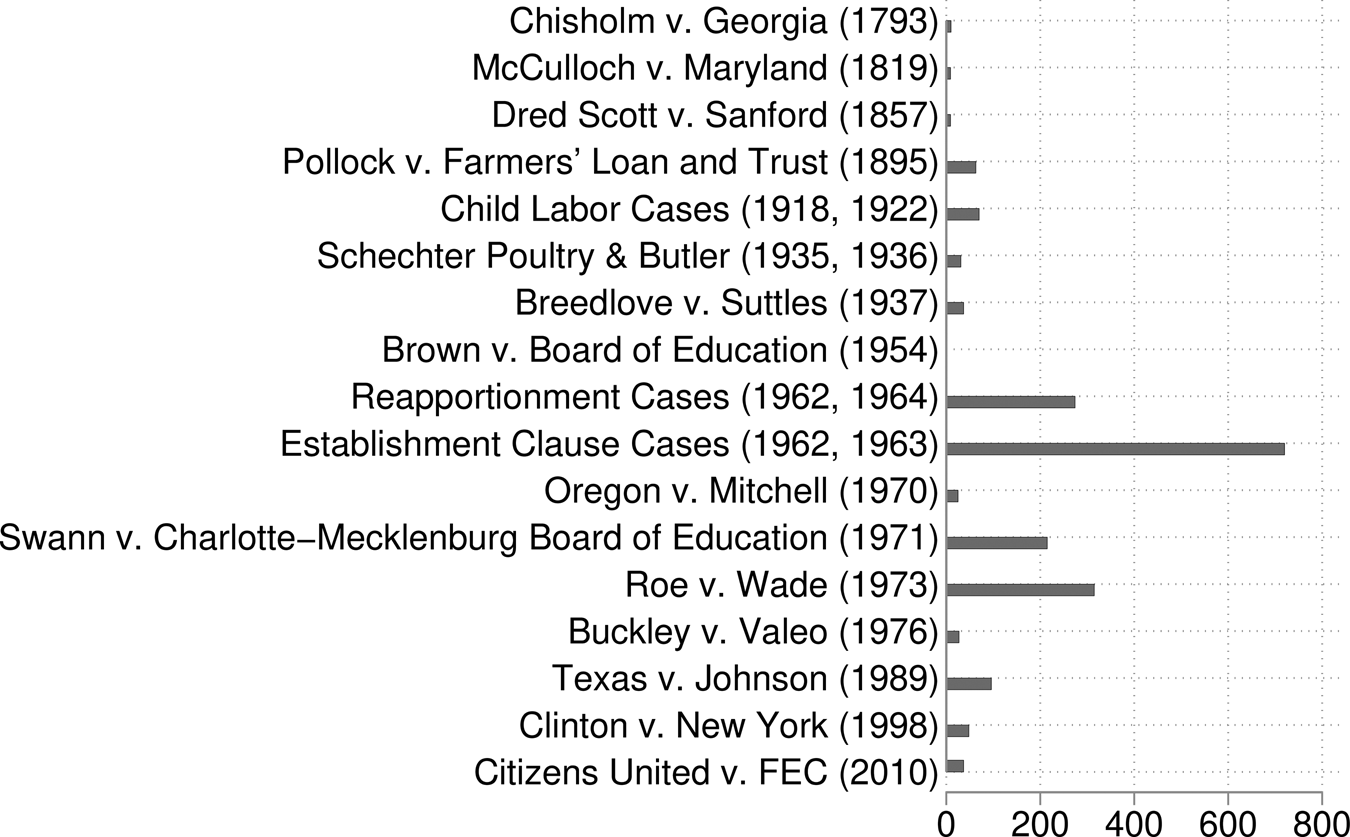
Our data suggest that these successfully ratified amendments are the exception. Figure 4 displays the number of amendments that members of Congress introduced in response to notable Supreme Court decisions.Footnote 26 Some decisions—like the Warren Court's Establishment Clause Cases announced in Engel v. Vitale (1962) and Abington School District v. Schempp (1963)—clearly generated considerable congressional response, not only in the proposal of constitutional amendments but also in other, statutory efforts to restrict the Court.Footnote 27 But many of the other cases listed in Table 1 do not stand out for the intensity of congressional responses. If anything, members were more likely to be active on issues that fell far short of receiving supermajority support, suggesting that the value of amendment proposals rested not in overturning the Court, as court-curbing perspectives sometimes suggest, but as an opportunity for members of Congress to engage in position-taking before constituents, particularly after the mid-twentieth century. This position-taking character of amendment introduction is perhaps most striking in the hundreds of responses to the Establishment Clause Cases.
Proposed Amendments in Response to Notable Supreme Court Decisions.

2. Constitutional Position-Taking and Institutional Change
We describe the mid-twentieth-century shift in Article V politics as an instance of institutional repurposing. Specifically, we argue that congressional opponents of the dominant partisan and policy regime order repurposed Article V as a tool for position-taking to contest New Deal and Great Society constitutional commitments.Footnote 28 The high Article V bars to amendment passage let lawmakers engage in low-stakes, symbolic position-taking before allied constituents and social movements.Footnote 29 The value of Article V for position-taking arises not despite, but because of, its supermajority requirements: The low probability of passage lets members take a position on an issue without concern for the consequences of its realization.
Consistent with standard accounts, like Robert McCloskey's or Keith Whittington's, the repurposing of Article V occurred during the consolidation of the New Deal and Great Society constitutional order, when presidents from both political parties had strong incentives to empower allied Supreme Court justices.Footnote 30 In cases like Cooper v. Aaron (1958), national political leaders allied with the federal courts, reaffirming their supremacy on matters of constitutional interpretation, in the fight against school segregation.Footnote 31 The Supreme Court, stacked with friendly Roosevelt appointees, recast itself as the guarantor of individual rights, including those of “discrete and insular minorities.”Footnote 32 It exercised its authority, though not always in straightforward ways, to foster a rights revolution that granted new and expansive protections for—among other things—free speech, equal protection, and criminal procedure. In doing so, the Supreme Court became a central player in articulating and defining the Great Society constitutional order.Footnote 33
Conservatives rallied against the Court. In the “Southern Manifesto,” Southern lawmakers vowed “to bring about a reversal” of Brown v. Board of Education (1954).Footnote 34 Conservatives also attacked the Court for protecting communists and for decisions restricting public endorsement of religions. But Congress's robust New Deal and Great Society coalition made moot these threats against the Court.Footnote 35
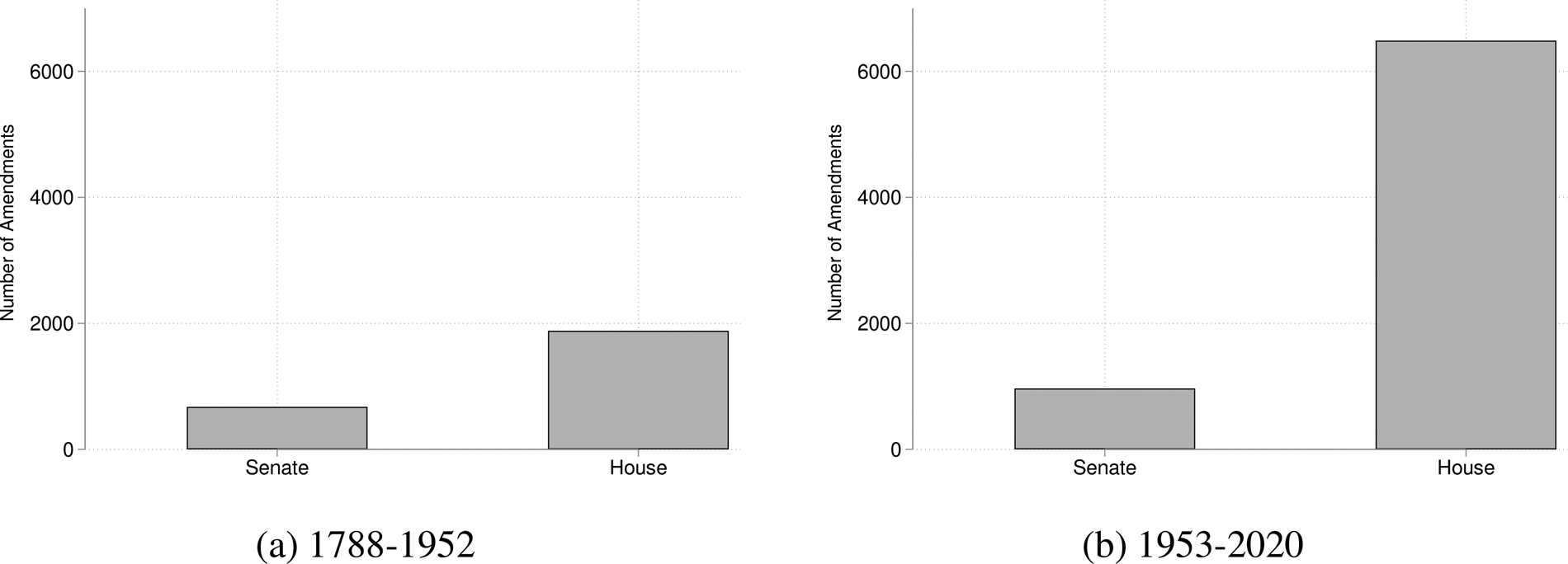
Instead, conservative outsiders turned to Article V. Court-curbing amendments, far short of Article V requirements, were empty threats, unlikely to provoke response from fellow partisans, the Court, or Court allies. Position-taking began with members representing conservative and religious interests. Many Catholics first reacted strongly against the Supreme Court's declaration in Engel v. Vitale (1962) that prayer in public schools was unconstitutional, and many Evangelicals followed suit after the Supreme Court announced its decision in Abington School District v. Schempp (1963) declaring unconstitutional Bible readings in public schools.Footnote 36 Representatives, especially in the House and from Southern districts, repeatedly turned to Article V—indeed, a total of 726 times—to denounce the Supreme Court's decisions in these cases and to propose amendments protecting prayer and Bible readings in public schools. While the school prayer issue ultimately subsided as a controversy within the Catholic and Evangelical churches, conservative members of Congress continued to propose amendments. Members of Congress, as indicated earlier, proposed nearly half of all constitutional amendments in a thirty-year span, between 1960 and 1990 (Figure 1). Figure 5 demonstrates that such behavior was largely driven by behavior in the U.S. House of Representatives, with members introducing over three times as many amendments as before.
Proposed Amendments, by Chamber and Period.

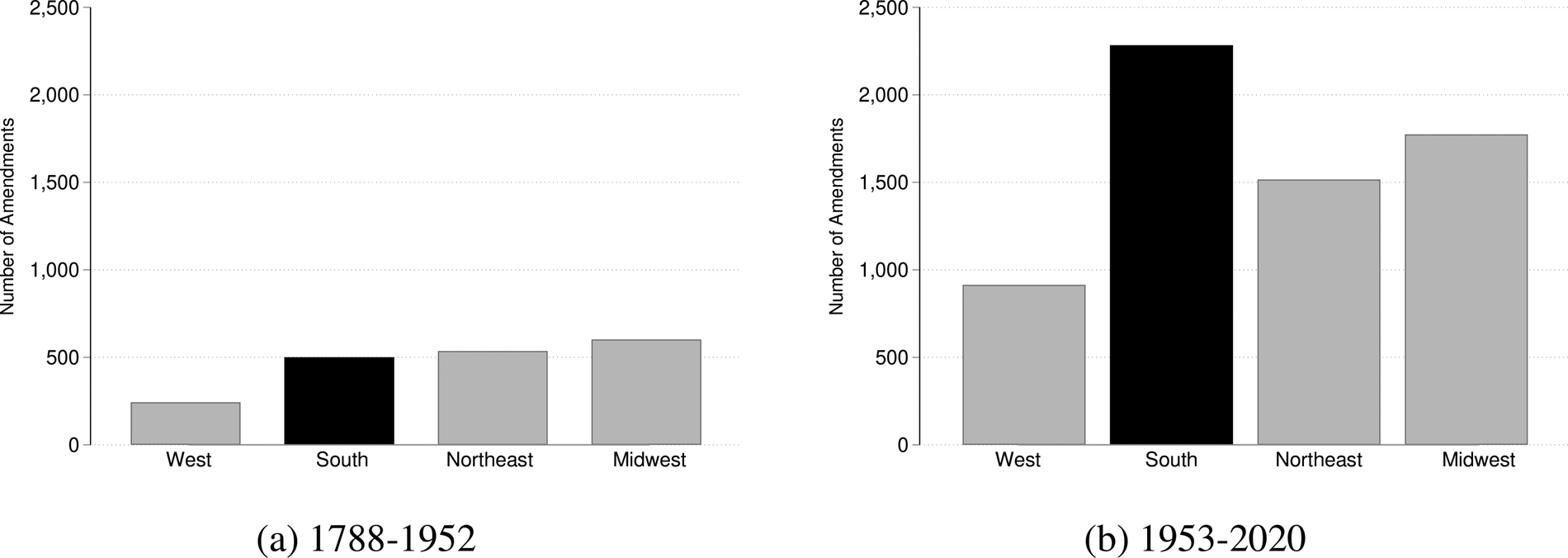
Moreover, while representatives from all corners of the country contributed to the rise in proposed Article V amendments, the trend was driven disproportionately by representatives from Southern states. Figure 6 compares the number of amendments that House members from various regions of the United States introduced during two distinct time periods (1788–1952 and 1953–2020). As Figure 6 makes clear, Southern representatives far outpaced their counterparts from other regions of the United States, even if lawmakers from every corner of the United States were more likely than previously to turn to Article V. We suggest that such behavior is unsurprising, given that religious, Southern, white Evangelicals were among the most ardent opponents of the emerging Great Society constitutional order.Footnote 37 Members representing the South strongly opposed the judiciary's advances with respect to racial desegregation, contraception and abortion, the ERA, and various issues contested under the First Amendment, including limits on worship in the public sphere.
Proposed Amendments in the House of Representatives, by Region and Period.

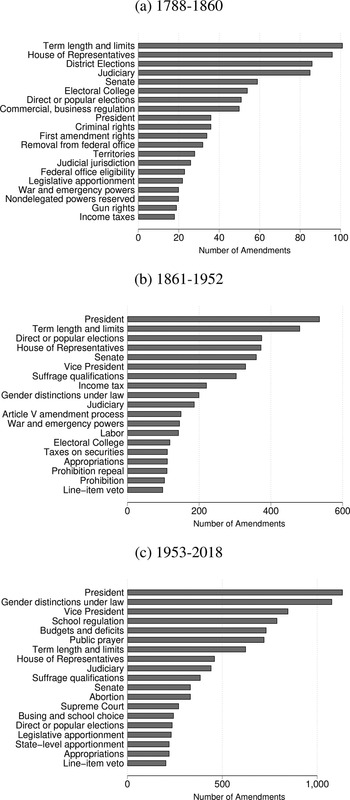
Article V activity also increasingly reflected the Supreme Court's docket. Figure 7 compares content of these proposed amendments across American history, listing the twenty most frequent proposals during three different periods: 1776–1872, 1873–1952, and 1953–2018. During the most recent period, Congress's Article V docket was largely a response to the Supreme Court's behavior in several areas, including the ERA, school prayer and devotional readings, abortion, school integration and busing, equal apportionment, the line-item veto, flag burning, and campaign finance regulation. As the evidence suggests, Congress's amendment agenda had come far more to reflect that of the Supreme Court's during this latter period. While no doubt related to the statutory efforts at court curbing, Article V amendments by the mid-twentieth century appear to be less a sincere effort to assert a congressional role in constitutional interpretation than a means for position-taking, directed not at the Court but at electors and social movements.Footnote 38
Most Frequently Proposed Amendments, by Period.

Amendment proposals gave conservative members a low-stakes tool to present their positions to their constituents or social movements on controversial constitutional issues. While informed constituents might recognize that a constitutional amendment had little prospect for passage, for the many ill-informed constituents, an Article V amendment might have signaled a more intense position on a weighted issue, a proposal to engage in higher lawmaking by invoking Congress's traditional amendment power. To the courts, such signals likely rang hollow, if they were received at all, and perhaps only reaffirmed the weakness of their opposition.Footnote 39
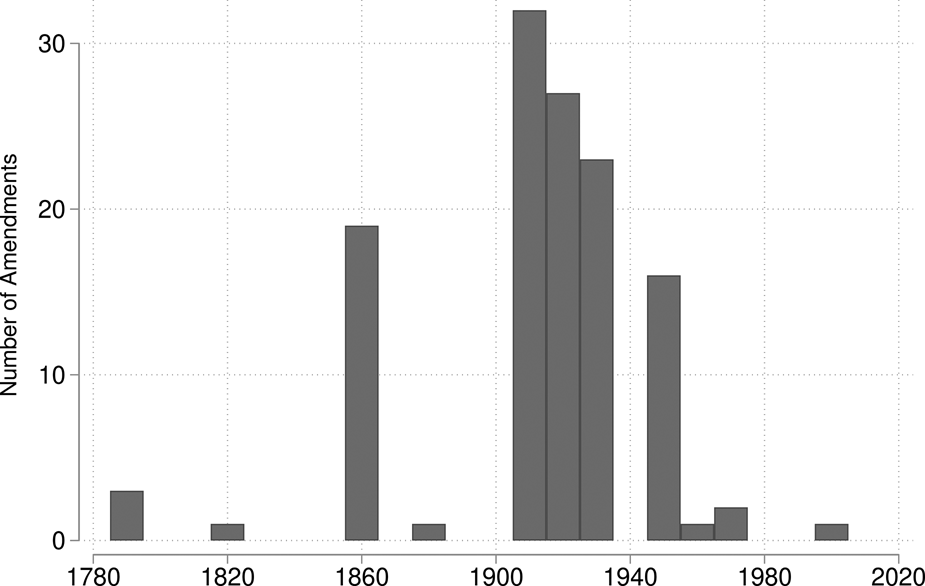
Congress had already begun to abdicate the role of constitutional reform to the Court. One way of illustrating this shift is to look at changes to Article V itself (Figure 8). In prior eras, members sincerely sought to pass amendments, and periods of heightened amendment activity often saw efforts to lower the Article V bars to passage. During the 1860s, members of Congress blocked by these barriers often sought to reform or wholly replace Article V. Early in the twentieth century, progressive members sought to remake the Constitution by first remaking Article V. But during the mid-twentieth century, members did not take seriously the prospect of changing Article V. Rather, members embraced Article V as it was. Rather than thinking of this as an acquiescence to Article V's high barriers, we suggest that it is more appropriately understood as reflecting the transformation of how members of Congress defined the purpose of Article V. Amendment proposal was associated less with a low-probability but high-reward strategy of building a national reputation as a successful constitutional reformer and more with a low-risk and low-effort effort to signal interest and solicitude. Those seeking structural reform petitioned Congress less, now looking to the judiciary to determine constitutional meaning.
Proposed Changes to Article V, by Decade.

Congress's decision to use Article V to foster stronger relationships with constituents and social movements has some theoretical basis. In his famous declaration that “policies determine politics,” for example, Theodore Lowi argued that lawmakers’ pursuit of certain policies encouraged different kinds of political engagement.Footnote 40 Lowi would have characterized the kinds of rights-based, ideological, and status policies at the heart of the Supreme Court's docket during Chief Justice Earl Warren's tenure as “redistributive” policies that encouraged interest-group organization and bargaining.Footnote 41 Unable to control the Supreme Court's agenda, conservatives in Congress fostered a reactionary movement to counter the rights-based policies that dominated Washington during this period. While more research is necessary to test more thoroughly the application of Lowi's argument, it provides at least an initial way to understand the decision to repurpose Article V.
Finally, as Figure 1 demonstrates, members of Congress have retreated somewhat from Article V since the 1990s. We hypothesize that this decline has occurred largely for two reasons. First, it is driven in part by the removal of the ERA from the country's constitutional agenda. Second, conservatives have decreased their overall commitment to Article V because a conservative regime increasingly exercised influence through the federal judiciary since the 1970s. Conservative stacking of the federal judiciary encouraged conservative reformers to affirm the courts as the definers of constitutional meaning.Footnote 42
3. Institutional Repurposing and Article V Position-Taking
We offer four case studies to illustrate changing congressional behavior under Article V, drawing in each case on our data set. The four cases are the antipolygamy amendment, the women's suffrage amendment, the ERA, and the Federal Marriage Amendment (FMA). These chronologically ordered cases let us track several phases of Congress's Article V activity, especially as it relates to the judiciary. Judicial power was at its lowest in the polygamy and women's suffrage cases, at least outside of economic regulations; the judiciary became increasingly powerful during the long fight over the ERA, and by the time of the FMA, the judiciary had become the authoritative institution for determining constitutional meaning. We accordingly expect that in later periods, member amendment behavior will be more likely to engage the judiciary.
These four cases allow two paired comparisons, letting us focus on the calculations of members of Congress and social movements within broadly similar issue domains.Footnote 43 First, in the case of the antipolygamy amendments and the FMA, traditionalist religious groups petitioned Congress for an Article V amendment to expressly override state or territorial marriage laws. Neither amendment was ratified. While position-taking was evident in both cases, by the time the FMA was introduced, the dominance of the judiciary had made Article V an attractive mechanism for congressional position-taking against the judiciary, with few members engaging in the coalition building needed for FMA passage.
The cases of the women's suffrage amendment and the ERA provide our second pairing. These cases overlap in terms of substantive issue areaFootnote 44 and in development: While the women's suffrage movement and the movement for gender equality were not identical, early ERA proponents—many former activists for suffrage—adopted the successful strategy of lobbying Congress for a national amendment. And in both cases, members may have engaged in position-taking before enfranchised women, given that many congressional supporters of the women's suffrage amendment represented women enfranchised under state law.Footnote 45 But the ERA case also proves distinct—the long campaign for the ERA occurred across the shift we identify, thereby providing important within-case variation to further test our argument. We expect that members of Congress would have responded to the ERA movement in different ways before and after the mid-twentieth-century shift in judicial power.
Another value to the case study approach is that it allows us to descriptively illustrate that what we argue has been a critical change in congressional engagement with Article V, and to connect this at the micro-level of individual behavior to concurrent institutional developments in the other branches. There is no historically consistent quantitative metric by which legislative position-taking can be distinguished from sincere legislative policymaking efforts. We rely instead on secondary and congressional sources to qualitatively evaluate whether congressional Article V behavior was dedicated to amendment passage or to position-taking intended for constituent voters and social movements. While movements might genuinely be interested in constitutional revision, we are also interested in whether their strategies to achieve this would focus on Article V or see alternative institutions as a more attractive route.
To make these evaluations, we look at congressional dedication to legislative resources after amendment introduction and whether members responded to movement demands or initiated amendment activity on their own. Among the most valuable resources for individual members of Congress are time and attention; greater congressional committee hearing or floor time and attention from a specific member on a specific amendment roughly indicate sincere congressional interest in advancing the issue rather than mere position-taking. Thus, we use floor records and committee hearings to evaluate whether individual members were acting more as policy entrepreneurs, genuinely looking to advance an amendment, or simply engaging in low-cost position-taking. For example, if during a hearing, a member repeatedly engaged witnesses or other members on the legal or policy intricacies of a proposed amendment, or if we have evidence that they sought not just to indicate support but to expend the effort to push an amendment to consideration and to help shape its contours in ways that make it more likely to pass, this would suggest genuine behavior.Footnote 46 In contrast, amendment introduction and perhaps a short supportive speech placed in the Congressional Record's Appendix would indicate less costly position-taking activities. The more time and attention an individual member spent on a particular amendment, the more likely that the member was genuinely concerned with passage.
The pattern of amendment initiation is similarly informative. The historical record can provide evidence about the degree to which a movement was genuinely committed to an Article V amendment, as well as evidence about the degree to which members of Congress—in introducing such amendments—were responding to explicit movement or constituent demands, were repeated legislative champions of passage, or were themselves taking the initiative to provoke public opinion or gain movement favor with an eye toward reelection. We pay particular attention to these factors in the following case studies.
3.1 Polygamy
Our first case, addressing the congressional campaign for an antipolygamy amendment in the 1870s, 1880s, and 1890s, suggests that in the late nineteenth century, members of Congress proposed Article V amendments to address gaps in the Constitution's text, sometimes in response to social movement pressure. While it is difficult to demonstrate that members proposed these amendments in earnest—good faith and bad faith congressional behavior can sometimes look similar—members’ willingness to spend legislative resources, their investment in interlocking statutory and constitutional antipolygamy measures, and their willingness to address antipolygamy amendments across several committees suggest that these members took seriously the work of prohibiting polygamy by Article V amendment.
With Reconstruction, members of Congress began considering legislation implicating the states’ traditional prerogative to regulate health, safety, morals, and welfare, proposing Article V amendments structuring racial, social, and gender and marriage relations, the latter in addressing Utah's petitions for admission to the Union. Some Utahans, especially those associated with the Church of Jesus Christ of Latter-day Saints, maintained the practice of having multiple wives in ways that were broadly condemned throughout the rest of the country, particularly by mainline Protestants. Congress, under Article IV, could make “all needful Rules and Regulations” for the Utah Territory, and so responded to Utah's statehood petitions in 1860, 1872, and 1882 by passing various antipolygamy acts, including the 1862 Morrill Anti-Bigamy Act, criminalizing polygamy, the 1874 Poland Act, limiting Utah probate court jurisdiction, the 1882 Edmunds Act, banning polygamist cohabitation and jury service, and the 1887 Edmunds-Tucker Act, limiting polygamist voting and officeholding. In Reynolds v. United States (1879), the federal courts upheld the enforcement of these statutes against a free exercise challenge, demonstrating an interbranch federal consensus to constrain the territory.
But, as Utah grew in population during this period, members anticipated Utah statehood, after which the Constitution would grant them no power to statutorily regulate Utahan marriage. A contemporary congressional report noted: “A national law for marriage and divorce is plainly unauthorized by the Constitution. In order to remove this difficulty,” the report concluded, an Article V amendment was needed “to give Congress power to pass uniform laws on these subjects.”Footnote 47 Members of Congress recognized that their statutory authority to ban polygamy outright would stop at the state line after statehood, and that future actions to criminalize polygamy would require an Article V amendment.Footnote 48
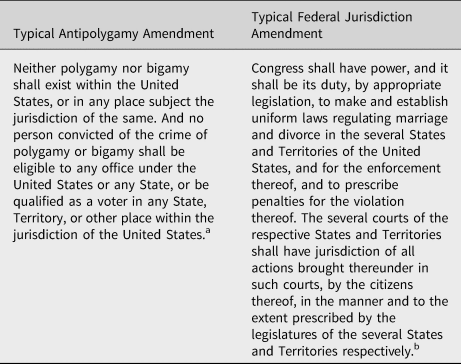
At this point, constitutional efforts to end polygamy began in earnest. Protestant social reformers had already been pushing parallel state constitutional polygamy bans in the mountain West, attempting to quarantine the issue to Utah.Footnote 49 But Utahans would likely reject such a provision after statehood.Footnote 50 Antipolygamists thus began petitioning Congress for an amendment to bind the states and territories, mirroring the tactics of parallel, allied moral reform campaigns like abolition, temperance, and women's suffrage. These social reformers encouraged members to redouble their constitutional efforts, noting the failure of federal statutes. Congress responded by introducing fifty-two polygamy-specific amendments and many more amendments to establish federal jurisdiction over marriage more generally (Table 2).Footnote 51
Two Types of Antipolygamy Amendments

a H.R.J. Res. 166, 47th Congress, 1st Sess. (1882).
b H.R.J. Res. 80, 48th Congress, 1st Sess. (1884).
The two different types of amendments offered two different ways to skin the same proverbial cat. But the material differences between them were constitutionally consequential and implicated jealously guarded constitutional interests. The federal jurisdiction amendments, for example, sought to cement federal authority over citizenship and police powers in new, peripheral Western states. Some members framed these proposals as attempts to impose a uniform national marriage standard. In December 1887, for example, Oregon Senator Joseph Dolph (R-OH) held “the only effectual remedy for the existing undesirable state of affairs is to transfer the power to legislate upon this subject to the Federal Government, so that throughout the States … there may be uniformity.” But Dolph acknowledged that an amendment was necessary because the “power to legislate concerning marriage and divorce in the States has not been conferred by the Constitution upon Congress, and therefore the States have the exclusive power to legislate concerning them.”Footnote 52 A variety of constituents favored increased congressional authority in this area, including groups concerned more with regulating divorce and interstate marriage conflicts and probate issues, and less with polygamy.
In contrast, some antipolygamists in Congress opposed a blanket federal amendment defining marriage beyond polygamy. Some Southern states rejected federal interference with their antimiscegenation laws.Footnote 53 Tennessee Congressman Nicholas Cox (D-TN), for example, entered his objection to an amendment that granted Congress the authority regulate marriage more generally and instead noted that legal safeguards already existed: There “is not a State in the Union that has not a statute against bigamy, and men are punished continuously for it.… I am against the [federal amendment].”Footnote 54 Dedicated antipolygamists thus proposed narrowly targeted amendments to draw support from members skeptical of federal authority, hoping to build the supermajority coalition needed for passage.Footnote 55
Members of Congress dedicated institutional resources to build coalitions and ultimately to adopt amendments. The Congressional Record from this period featured regular floor debate about the practice of polygamy not just in Utah but in other Western states; the risks it posed to women, the country, and Christian civilization; and the failures of criminal prosecutions to curb the practice. The House Judiciary Committee held repeated hearings on the matter, amplifying the voices of reformers who made the case for federal action and in ways that allowed lawmakers to look for common ground and coalition building, even if no winning coalition ultimately materialized.
Finally, in contrast to the FMA, as we shall see, congressional leadership never allowed any of these amendments to reach the floor in either house for a final vote. Perhaps somewhat counterintuitively, we interpret this final piece of evidence as supporting the conclusion that members were working seriously to build a coalition to support an amendment. Members earnestly sought passage, but were unwilling to risk derailing the antipolygamy amendment and campaign on a premature, failed floor vote, a tactic mirrored by suffragettes,Footnote 56 who long withheld their amendment from a floor vote until passage was likely. Antipolygamist members’ repeated hearings, their willingness to build a diverse coalition, and their caution and hesitance in floor strategy suggests sincerity, rather than posturing for the record through hasty or ill-considered floor votes. When the passage coalition failed to solidify, antipolygamy amendments faded, wholly disappearing from Congress's amendment agenda after 1924.
Even though the antipolygamy amendments never reached the requisite thresholds established under Article V, in other respects the effort resembled successful constitutional amendment campaigns. Antipolygamists mirrored prohibitionists, who initially sought to regulate or ban interstate liquor shipment through the 1890 Wilson Act and 1913 Webb-Kenyon Act. As the federal government struggled to enforce the acts in noncompliant states, prohibitionists instead sought a federal amendment to clearly authorize Congress to enforce prohibition in “wet” states. Like the antipolygamy campaign, members of Congress dedicated similar resources to consider the constitutional wisdom of prohibition. This corroborating evidence suggests that although antipolygamists did not have the necessary level of support, many members worked sincerely for an amendment to suppress Western polygamy.Footnote 57
The antipolygamy amendment demonstrates several important points for our thesis. First, it suggests that late nineteenth-century members understood Article V as a tool to address gaps in the Constitution's text, sometimes in response to pressure from social reformers. Second, members’ attempts to prohibit polygamy through both Article V proposals and repeated passage of antipolygamy statutes suggests that these amendment proposals were part of an earnest, larger congressional campaign to expand regulatory power in the states and territories. Finally, members did not use Article V antipolygamy proposals to signal protest against the Supreme Court. On the contrary, members proposed Article V amendments to reaffirm the Reynolds decision in the face of Utahan noncompliance. The Reynolds decision, upholding Congress's 1862 Morrill Act, suggests that the Court and Congress worked as allies in extending federal authority in the Western territories, the latter through Article V proposals.
3.2 Women's Suffrage
Women's suffrage is one of the most important examples of a movement-organized effort to amend the Constitution. While some members used suffrage amendments as mere position-taking tools, most members coordinated with organized suffragettes to secure amendment introduction, debate, and passage. This sincere Article V activity responded to movement organizing and was concentrated among its close allies, who pursued it across repeated Congresses, followed movement strategy, and dedicated time and attention to passage. This case thus exemplifies Congress's quintessential, though older, role under Article V as the primary redrafter of the Constitution.
Early congressional advocates of the suffrage amendment shared ideological, personal, regional, and political commitments to the movement.Footnote 58 Of the sixteen amendments introduced in Congress between 1870 and 1893, for example, half were sponsored by the same three sympathetic Republican congressmen—Henry W. Blair (R-NH), Thomas B. Reed (R-ME), and John Daugherty White (R-KY, later Prohibition and Progressive).Footnote 59 Blair—the main, early proponent of a federal prohibition amendment—had long understood Article V as a tool to address moral reformers’ petitions. Reed was an active supporter of civil rights enforcement and women's suffrage, and his daughter Katherine Reed Ballentine became an important suffrage leader in the West. White was married to Alice Harris White, secretary of the Louisville Equal Rights Association, and his sister was Laura R. White of the Kentucky Equal Rights Association and the first woman certified as an architect in the United States. Among Reed's first acts upon election to the 47th Congress was to propose a House Select Committee on Woman Suffrage. Reed's advocacy for women's suffrage, and his role as a party leader, led Susan B. Anthony to ask him to introduce the amendment in 1887, with instructions about how the movement wanted it done, and with a clear reminder that the party relied on women's advocacy and activism and would gain by doing more.Footnote 60 As Western states and territories enfranchised women, Western members followed.Footnote 61 Between 1900 and 1910, ten amendments were introduced, all but one from members representing Western states, and most coming from Colorado and Wyoming, which had already enfranchised women; outspoken allies of the suffrage movement, Franklin Wheeler Mondell (R-WY) and John Franklin Shafroth (Pop/D-CO), were especially active in introducing amendments. Suffrage victories in Washington and California, followed by Oregon, Arizona, and Kansas, further expanded Congress's pro-suffrage Western bloc.
Moreover, some members of Congress served as agents of the suffrage movement. Supportive members, like the entrepreneurial Benjamin Butler (R-MA, later a Democrat), regularly introduced suffrage petitions, and at movement leaders’ behest, called hearings for suffragist testimony and committee meetings to draft amendments.Footnote 62 Active members like Butler or those in the West backed suffrage, anticipating electoral gain, and engaged in some position-taking. But, in contrast to later twentieth-century campaigns, these members dedicated congressional resources to debate and passage.
Movement strategy informed congressional Article V behavior. Into the 1890s, the basic pattern of amendment proposal was one in which women's suffrage delegates associated with Anthony and Stanton's National Women's Suffrage Association (NWSA) petitioned members and pushed allied members to introduce amendments and call hearings to showcase NWSA testimony.Footnote 63 Pro-suffrage members of Congress invested substantial time and attention to the cause. Perhaps most notable was the formation in the 1880s of a Senate Select Committee on Woman Suffrage and a short-lived select committee in the House. The creation of a select committee served both the position-taking goals of some members and the aims of suffragettes hoping to skirt the opposed Judiciary Committees.Footnote 64 In 1886, the committee reported that the “unqualified success[es]” of women's suffrage in some local elections, territorial enfranchisement, as well as “petitions … from all parts of the country” validated a national amendment. Blair proposed one the following year, which was soon defeated, with Southerners citing the threat to white supremacy. A similar sequence of events was repeated in subsequent years, but after a final favorable committee report in 1893, Congress largely ignored subsequent petitions and amendments. The Senate Select Committee was initially more hospitable to suffragists than the Judiciary Committee, providing supportive members with resources for disseminating movement arguments and their own positions. Opponents complained that the select committee's hearings were “one-sided,” and in the 47th Congress, the minority report complained that the committee had failed to even debate the issue, simply hearing from several eminent ladies” and then voting.Footnote 65 It had nonetheless resulted in favorable reports and an amendment being placed on the congressional calendar and ultimately voted on.
Congress's willingness to invest time and attention varied as its own role in securing suffrage varied, suggesting a causal relationship. Between the 1870s and the 1890s, when the National American Women's Suffrage Association (NAWSA) pressed Congress for federal constitutional reform, Congress took those efforts seriously, as demonstrated by the evidence above. The primary alternative to an Article V amendment was enfranchisement at the state level, pursued by the new American Women's Suffrage Association (AWSA).Footnote 66 The two wings of the suffrage movement had originally divided over the merits and wisdom of pursuing federal constitutional reform via Article V. But when a reunified NAWSA was organized in 1890 and the movement turned its focus on revising state constitutions, congressional engagement—at least by supporters of suffrage—flagged.Footnote 67 After a brief flurry of introductions immediately following NAWSA's organization, the number of amendments introduced per Congress dropped to the level of the preceding decade.Footnote 68 Had members of Congress continued to seek the position-taking benefits, we might expect to see similar levels of engagement with Article V. But this is not what we found. Moreover, as the newly organized NAWSA turned toward the states, the Senate select committee came to be chaired by the minority party (at the time a common way of distributing resources to senators without seriously undermining majority agenda control) and often by opponents of suffrage such as Lee Overman (D-NC). So long as the suffrage movement concentrated on the states, the committee served as little more than a place for suffragists to speak without taking up the time of the Judiciary Committee rather than a site for seriously deliberating upon and reporting an amendment.
When the suffrage movement retrained its focus on Congress, however, pro-suffrage members also redoubled their efforts. In 1912, Alice Paul revived the NAWSA's congressional committee, which she and Lucy Burns reorganized as the independent Congressional Union with an explicit call for members to introduce and support Article V amendments. NAWSA President Carrie Chapman Catt, who had earlier complained that proposed state referenda were being blocked by the most “ignorant, most narrow-minded, most un-American voters,” such as “negroes in the South and the Indians in the West and the Chinese in California and the riffraff who to-day are piling into our nation, and are quickly enfranchised,”Footnote 69 now joined Congressional Union Chair Medill McCormick in petitioning for a national amendment before the “higher court of the Congress.”Footnote 70 Later, the 62nd Congress saw seven amendments introduced, more than the previous three Congresses combined. Three of these proposed amendments came from the usual states of Colorado and Wyoming, while two more came from the recent suffrage states of Oregon and California, and one from Socialist Victor Berger. A joint hearing of the Senate Judiciary and Woman Suffrage Committees was held, and in the next Congress the Senate select committee chair passed to a member of the majority party, Charles S. Thomas (D-CO), who announced his intention of “do[ing] some effective work for the extension of suffrage to the women of the country.”Footnote 71 After years of simply holding and publishing the hearings and years of being chaired by opponents of suffrage from the minority party, a select committee chaired by a majority party member and supportive of suffrage again began favorably reporting amendments to the chamber.
New hearings were held to considerable attention. The 63rd Congress saw even more amendments introduced, including joint ones by Shafroth and A. Mitchell Palmer (D-PA) that would require each state to call a referendum on the petition of 8 percent of the state electorate, hoping to jumpstart state campaigns. This proposal was successfully advanced to a vote: Despite broad Western support, the proposal failed against near uniform Southern and much Northeastern resistance, 35 to 34 in the Senate and then 174 to 204 in the House. Still, the following Congress saw even more amendments introduced, and a concerted effort was begun by the movement and congressional allies to invest further congressional resources and create a House select committee on the belief that this would be—like the again-active Senate select committee—more favorable than the Judiciary Committee.
In 1916, NAWSA, which had fully accommodated white supremacy and nativism in its efforts to build a larger base, formulated what became known as the “Winning Plan,” a targeted strategy that focused on Article V.Footnote 72 To circumvent opposed congressional leadership, the NAWSA would build electoral and interest-group support in Eastern and Southern states—including suffrage limited to the primary or presidential elections—with the goal of the interstate electoral supermajorities needed to pass and then ratify a national amendment: “We do not care a ‘ginger snap’ about anything but that Federal Amendment” she explained. “When thirty-six state associations … enter into a solemn compact to get the amendment submitted by Congress and ratified by their legislatures; when they … [run] a red-hot, never ceasing campaign in their own states designed to create sentiment behind the political leaders of these states and to aim both these forces at the men in Congress as well as the legislatures, we can get the Amendment through.”Footnote 73
In 1917, Arkansas extended the primary suffrage to women, though the state effectively curtailed the primary to white voters.Footnote 74 This was followed by Rhode Island's extension of presidential suffrage, and full voting rights in Oklahoma, South Dakota, and New York. NAWSA, reassembling in Washington in December 1917, asked Congress “to submit the Federal Amendment before the next congressional election,” warning opposed members and leadership of “a compact of State associations” ready to campaign to “effect change in both Houses of Congress sufficient to insure passage.” Members of Congress, mainly from the West, proposed thirty-five federal amendments in the 65th and 66th Congresses alone, increasing by a third the total number of women's suffrage amendments introduced since the Civil War. In 1918, a federal amendment passed the House but was defeated by two votes in the Senate. In June 1919, another amendment, reported from the newly established House Select Committee on Woman Suffrage, was passed by both chambers; it would be ratified quickly by a few Midwestern and Mid-Atlantic States, followed by the West, New England, and then narrowly in Tennessee.
Reformers alternately pressured and skirted Congress. When the movement petitioned for a federal amendment, some members, particularly in the West, admittedly engaged in electoral position-taking through amendment introduction.Footnote 75 But other members demonstrated a genuine desire to coordinate with the movement for passage. The latter predominated: Amendments were introduced primarily by movement allies as part of coordinated campaigns, the timing of their introductions largely tracked the strategic choices made by the movement, while the successful pursuit of select committees and repeated efforts to dedicate congressional time and forums to the movement provided a mutually beneficial set of resources for both movement actors and members of Congress.
In contrast to later examples, we note here that the women's suffrage movement pursued its cause almost entirely without any recourse to the courts, at least in pursuit of its central aim. To be sure, there were a few “wildcat” lawsuits, but they were quickly rebuffed, and moreover, there is little evidence that suffragists placed much emphasis on this as a strategy.Footnote 76 In other words, despite serious disagreements over strategy, there was no sustained effort to use the federal judiciary as a vehicle for establishing women's right to vote as an implication of the existing constitutional text.
These patterns are consistent with the direction of the causal relationship pointing from the suffrage movement's genuine interest in a national amendment to the subsequent Article V activity of members of Congress. As we discuss below, this pattern would reverse with the rise of the Warren Court, as social movements increasingly saw the courts as a viable and more attractive avenue for constitutional revision, and as members in turn repurposed Article V so that its position-taking opportunities came to dominate. It would become a way of signaling member support without investing serious resources for achieving the purported ends, similar to the congressional activism on suffrage in the first decade of the twentieth century but occurring even more at the initiative of Congress.
3.3 Equal Rights Amendment
The congressional campaign for an Equal Rights Amendment (ERA), stretching from 1923 to the early 1980s, spans the mid-twentieth-century shift we found in Article V politics. Through this case study, we demonstrate a change in members’ Article V behavior. Initially, members of Congress, following the example of the Nineteenth Amendment, worked with the National Woman's Party in calling hearings to publicize, debate, and promote the ERA. By the late 1960s, feminist mobilization popularized the ERA, and members proposed nearly a thousand ERAs, now as throwaway position-taking measures. The ERA passed Congress in 1972, but conservative countermobilization blocked ratification. Facing backlash to the ERA and the Supreme Court's decision in Roe v. Wade (1973),Footnote 77 members of Congress stopped proposing position-taking amendments in support of the ERA; ERA proposals declined; and conservatives now pitched position-taking amendments reversing the federal courts’ recognition of privacy, abortion, and workplace gender nondiscrimination rights. The ERA case thus tracks members’ repurposing of Article V from a tool to address social movement needs to one of position-taking intended for constituents and against the courts, particularly by conservative members.
It is hardly surprising that the movement for the ERA largely followed the script of the women's suffrage movement. The leadership of the two movements overlapped considerably. Buoyed by the Nineteenth Amendment's ratification, National Woman's Party (NWP) head Alice Paul in 1921 proposed amending the Constitution to forbid gender discrimination under law. NWP Research Secretary Sue Shelton White, reviewing diverse state-level gender laws, drafted a nationally applicable “blanket” equal rights bill without exemptions for state-level women's working hours and wage protections. NWP Lawyer's Committee chair Gail Laughlin, the first president of the National Federation of Business and Professional Women's Clubs, backed the amendment, claiming this protectionist state legislation belittled women. According to Nancy F. Cott, Paul's NWP then turned to nationwide lobbying of “legislators, governors, and presidents” and “persuad[ing] the leadership of large organizations and federations” for a federal amendment. Daniel Anthony (R-KS) and Charles Curtis (R-KS) introduced the amendment in Congress to great fanfare in early December 1923.Footnote 78 The NWP followed up by lobbying Congress aggressively for ERA passage. Alva Vanderbilt funded a new NWP Capitol Hill headquarters to aid lobbying, and adopting Congressional Union tactics, Paul's NWP promised to rally voters against opposed incumbents.
Those members of Congress sympathetic to the ERA—at least for a time—behaved largely as they had toward the Nineteenth Amendment by dedicating substantial resources to develop a supportive coalition. On December 10, 1923, Kansas Senator Charles Curtis submitted the ERA before the Senate Judiciary Committee, beginning protracted, divisive hearings on the amendment's phrasing. The NWP and the League of Women Voters (LWV) took serious interest in the draft's language, as consequently did members of Congress, expecting that this amendment might pass on the heels of the Nineteenth. In a 1932 House hearing, Representative Louis Ludlow (D-IN), citing the efforts of newly enfranchised women and mobilized “members of the Woman's Party,” proposed the ERA as the natural sequel to the franchise: “Equal rights is the corollary of equal suffrage. Without equal rights, equal suffrage is incomplete.” Nor were these hearings simply used to showcase evidence in support of the ERA; rather, they engendered serious debate on amendment wording, reflecting competing goals between the NWP and labor unions. In these 1929 hearings, senators questioned ERA proponents on the measure's public support and economic policy implications. ERA opponents also testified. Labor advocates, for example, framed the ERA as a threat to state-level women's labor protections. Before the Senate Judiciary Committee, Melinda Scott of the United Textile Workers explained: “The National Woman's Party does not know what it is to work 10 or 12 hours a day in a factory; so they do not know what it means to lose an eight-hour day or nine-hour day law. The working women do know.” Senator Thomas Walsh (D-MT) agreed: “We have passed all manner of laws in the various states to protect women—factory laws, for instance, hours of labor, etc. I can see no sense in a constitutional amendment that will wipe these laws off the books.” Labor organizers turned members of Congress against the ERA. Through the 1930s, ascendant pro-labor members rejected the amendment, recognizing ERA passage as a serious threat to labor laws and the unions at the center of the emerging Democratic coalition.Footnote 79 These protracted hearings suggest that members of Congress saw the proposed amendment as a real threat to existing labor group concerns and, in their amendment behavior, responded to group interests.
New Dealers, ascendant in Congress and the executive, blocked the ERA. In hearings, New Deal members detailed how the ERA might undo existing labor laws. Labor Department Women's Bureau Director Frieda Miller warned a 1945 Senate hearing the ERA would strike “directly at the right of the states to exercise [their] power” in protecting female workers. The American Federation of Labor declared its opposition, and Eleanor Roosevelt, Carrie Chapman Catt, and Labor Secretary Francis Perkins also warned Congress against an ERA. One ERA cleared the Senate in 1950, amplifying the threat of passage. In the House, the long-serving pro-labor House Judiciary Chair, Emanuel Cellar (D-NY), used his prerogatives to repeatedly blocked ERA proposals from leaving committee. Celler's action changed ERA proposal behavior. Facing insurmountable New Deal and feminist opposition, members of Congress pitched a handful of now-symbolic ERA proposals to start each Congress, with none clearing the House. In total, Congress heard 187 ERA-related proposals between 1930 and 1959.Footnote 80 Although these amendments suggested an increasing level of urgency, these members decreasingly followed through on such amendments. In fact, the number of hearings began to decline as the number of amendments increased. Congress held hearings on the ERA, as already mentioned, first in 1929 and then again in 1932 and 1945. But as the amendment stalled in the House Judiciary Committee, position-taking amendments proliferated and the pro-ERA movement saw few paths to passage.
The movement's fortunes turned unexpectedly when Title VII of the 1964 Civil Rights Act invalidated special protective legislation. Congresswoman Martha Griffiths (D-MI) drafted Title VII, and House Democrats backed the entire bill, including Title VII, which passed the Senate. When the Labor Department held that the 1963 Equal Pay Act nullified state gender-specific wage laws, states repealed protective legislation and unions abandoned opposition to the ERA. The United Auto Workers backed the ERA, as did the National Organization of Women, which won a 1969 Equal Employment Opportunity Commission decision overturning remaining state protective legislation. Group interests increasingly aligned in favor of the ERA.
Members of Congress followed, dumping ERA amendments in batches—nearly 1,000 in total between 1959 and 1971—in the first days of each session, mainly as position-taking ploys. The sponsors of these bills were likely using them to attract women voters, with little follow-through to ensure passage. But, in contrast to other members, who sought only to engage in position-taking, Griffiths crusaded to actually pass an ERA. Like early ERA proponents, she invested procedural effort in securing passage, gathering the 218 signatures needed to discharge an ERA bill from Celler's House Judiciary Committee for a floor vote. Griffiths's effort to secure passage was earnest and solitary, but also increasingly successful. The House floor vote carried 352 to 15 in 1970. The bill stalled in Senate Judiciary hearings, but in the following session, the House Judiciary Committee backed the ERA in novel televised public hearings. Representative Bella Abzug (D-NY) warned members against opposing the ERA and alienating the “oppressed majority” of female voters. Celler, a veteran leader, learned this personally, losing his Democratic primary to Elizabeth Holtzman (D-NY), a 31-year-old ERA proponent who won by mobilizing pro-ERA interest groups and voters. The ERA passed the House 354 to 24 on October 12, 1971, and then in the Senate 84 to 8 on March 22, 1972, albeit with a seven-year deadline. Within two months it had been ratified by eighteen states, twenty-two by the end of the year, and thirty-three by the early 1974, five short of the required three-fourths of states.Footnote 81
Opponents quickly countermobilized. The Supreme Court in Reed v. Reed (1971), Frontiero v. Richardson (1973), and Craig v. Boren (1976) applied intermediate scrutiny, a standard below the ERA's, against legal gender distinctions, and in Roe narrowed grounds for restricting access to abortion.Footnote 82 These transformative decisions, cementing the Court's role in addressing gender discrimination, mobilized conservatives. Phyllis Schlafly's STOP ERA and her Schlafly Report mailer sowed confusion and misinformation about ERA-related judicial activism, conjuring the specter of increased abortion, expanded female military service, and gender-neutral bathrooms.Footnote 83
As Schlafly campaigned in New York, one New York woman explained her skepticism of the federal judiciary and the ERA: “I didn't know what the ERA meant, but I thought it was a women's libber type thing—how they don't want men to have their own clubs, they don't want Mother's Day.” New York State Senator Richard Schermerhorn agreed: “My wife is not equipped to earn her own way. . . . If the ERA had passed, she could have lost my retirement benefits, my Social Security benefits, everything. These issues would be up to the courts, and I don't trust the judges. I don't want to put the lives and rights of women in the hands of some freaky judge.” Opponents of the ERA successfully linked the measure to progressive judicial activism.Footnote 84
As the ERA became a public burden, members of Congress stopped issuing position-taking proposals in support of the ERA. The earnest, stalwart proponents of the stalled federal ERA instead focused their efforts on the state constitutions, which posed lower bars to amendment. They met some success translating the failed federal amendment into state constitutional reform, and by 1976, eighteen states ratified gender-equality provisions. But Schlafly similarly tarred these state clauses as radical measures, and Christian lobbies used abortion and same-sex marriage concerns to defeat state ERA referenda in Iowa in 1980, Maine in 1984, and Vermont in 1986.Footnote 85 Conservative members of Congress, appealing to newly mobilized Christian constituents, used Article V to take positions against the ERA. In 1983 ERA reintroduction hearings, conservative members linked the ERA to abortion and judicial activism. Senator Orrin Hatch (R-UT), for example, argued that the ERA would let federal judges subject abortion restrictions to strict scrutiny: “We are talking about standards of review that could turn this country upside down. I do not think that the majority of the people in this country are willing to turn everything over to the Supreme Court of the United States, or over to the Federal judiciary in general.” He instead proposed a position-taking amendment to take these issues from the “courts and return them to the representative branches of government.” Court-curbing and abortion amendments proliferated—members of Congress, having never considered an antiabortion amendment, proposed 269 such measures between 1972 and 1983, unloading and abandoning dozens of proposals at the start of each session. Most of these amendments sought to overturn Roe and weaken the federal judiciary. The ERA, an electoral liability, was no longer an effective position-taking measure, disappearing from Congress's Article V agenda. Only a handful of committed members of Congress proposed ERAs: From 1972 to 2020, eighteen members of Congress proposed only sixty-three ERAs.Footnote 86
The struggle over the ERA, spanning six decades, tracks how members of Congress repurposed the Article V mechanism. Initially, Paul and the NWP clashed with labor unions and the LWV, forcing members of Congress to earnestly debate revising the Constitution's text. Protracted hearings suggest that members, taking cues from social reformers and labor interest groups, took seriously the ERA's phrasing and implications. As labor opposition dissolved in the 1960s, members proposed nearly a thousand ERAs, now as symbolic position-taking proposals intended for constituents. As constituents turned against the ERA, though, members abandoned these proposals for position-taking by making antiabortion and court-constraining amendments. The ERA case demonstrates a shift in members’ use of Article V, from a mechanism for earnest constitutional debate and revision to one for position-taking for constituents in the late twentieth century.
3.4 Federal Marriage Amendment
Finally, our study of the FMA further demonstrates contemporary Article V position-taking. Starting in 2003, Republicans repeatedly introduced the FMA to restrict state and federal marriage to heterosexual couples. Conservative members, courting religious voters, donors, and groups, repeatedly pitched these court-curbing FMA proposals at election time but did little to secure passage, in contrast to the similar but statutory Defense of Marriage Act (DOMA). Consistent with our argument, congressional behavior toward the FMA suggests that Article V still offers utility to members of Congress, not in their roles as authors of the Constitution but instead as a position-taking tool that fosters relationships with constituents and social movements.
The federal and state governments had long denied equal rights to lesbian, gay, bisexual, and trans persons.Footnote 87 During the 1970s, however, Evangelical Christians began organizing electorally, especially against those few municipalities, like Miami and West Hollywood, that sought to protect lesbians and gay men from discrimination. Religious leaders like Jerry Falwell, Pat Robertson, and later James Dobson condemned those who “promoted homosexuality as a lifestyle” and communicated a larger message of failing personal responsibility and moral corruption as the source of social instability and decline.Footnote 88
Same-sex marriage had largely stayed off the agenda for religious conservatives—and gay-rights groups—until a series of uncoordinated lawsuits challenged state-level prohibitions on same-sex marriage. In the central case Baehr v. Lewin (1993), a decision by Hawaii's Supreme Court declared such prohibitions on same-sex marriage a violation of the state's constitution. While Hawaii's legislature would ultimately overturn the decision with a constitutional amendment of its own in 1998, these developments took time. In the interim, Baehr raised the prospect that other states would be forced to recognize same-sex marriages under the U.S. Constitution's Full Faith and Credit Clause, requiring that states respect “the public acts, records, and judicial proceedings of every other state.”Footnote 89
Conservatives moved to action. In 1995, Representative Bob Barr (R-GA) first considered though never formally proposed a constitutional amendment establishing that there was “no right of homosexual marriage.”Footnote 90 He originally considered the idea of a constitutional amendment “to sound the alarm” in response to the Hawaii decision and his ultimate fear that “six justices have transformed the law on marriage and the family.”Footnote 91 But Barr ultimately saw federal legislation as a more direct path to preempt judicial action on the question of same-sex marriage. In 1996, Representative Barr and Senator Don Nickles (R-OK) introduced versions of what would become the DOMA to respond to the issues raised by Baehr. Specifically, DOMA contained two key provisions. First, for the purpose of federal law, it defined marriage as referring exclusively to a relationship between persons of the opposite sex. Second, it withdrew each state's obligation to provide full faith and credit to marriages between persons of the same sex performed in other states.
In contrast to the FMA, Congress dedicated considerable time and energy to DOMA. Starting in May 1996, senators regularly commented on the bill, noting their concern about the Hawaii Supreme Court decision and the need to clarify the definition of marriage for the purpose of federal benefits.Footnote 92 Senators submitted various amendments for consideration before referring the bill to the Senate's Judiciary Committee, which held two different hearings featuring a wide range of testimony. Similarly, the House Subcommittee on the Constitution heard testimony from three different panels, totaling twelve witnesses from across the political spectrum, including a Colorado state lawmaker, Marilyn Musgrave, who had successfully led a drive to outlaw same-sex marriage in Colorado that would propel her election to the House, where she would later introduce the FMA in 2003. The House subsequently debated the bill over two separate days in July. DOMA ultimately passed the House (342–67) and Senate (85–14) by large margins.
Aside from expressing conservative opposition to same-sex marriage, DOMA had additional political advantages for Republicans. Although the parties were not completely polarized on the issue of same-sex marriage, the issue proved far more divisive for Democrats than Republicans. Only one Republican voted against DOMA in the House, and the Republican caucus unanimously supported the bill in the Senate. By contrast, sixty-five Democrats voted against DOMA in the House, and fourteen Democratic senators registered their dissent in the Senate. The Clinton White House stalled for as long as it could, hoping to avoid taking a position on same-sex marriage. Clinton dithered on vetoing DOMA, alienating gay supporters during an election year,Footnote 93 but ultimately signed the bill, a fact he later advertised to conservative Democrats on Christian radio stations.Footnote 94 Equivocation on this internally divisive issue aliened Democratic voters.
Republicans thus pushed same-sex marriage as a wedge to split off and capture conservative Democrats. Judges again provoked religious conservative anxieties in 2003 when, in Lawrence v. Texas (2003), the Supreme Court overturned a Texas antisodomy law.Footnote 95 In his dissenting opinion, Justice Scalia implied that the majority's reasoning could extend the Fourteenth Amendment to protect same-sex marriage.Footnote 96 Subsequently, in Goodridge v. Department of Public Health (2003), the Massachusetts high court recognized a state constitutional right protecting the marriage rights of same-sex couples.Footnote 97 Although DOMA, if constitutional, shielded other states from recognizing the Massachusetts decision, these developments nonetheless renewed efforts to limit or forestall judicial behavior especially where conservatives could not prevail via referenda.
Some conservative academics had already begun work on an FMA. Princeton Professor Robert George, Yale Law School's Robert Bork, Harvard's Mary Ann Glendon, and Notre Dame's Gerald Bradley, working under the auspices of the Ethics and Public Policy Council, a conservative Washington, DC, think tank, drafted an accompanying FMA. Matt Daniels, the Massachusetts Focus on the Family's policy council chief and founder of the Alliance for Marriage, enlisted congressional staffers to revise the FMA's text.Footnote 98 Representative Ronnie Shows (D-MS) even introduced a version of the FMA in 2002, but the matter was quickly referred to the House's Judiciary Committee, where it stalled.Footnote 99 But the events of the following summer caused social movement conservatives and members of Congress to reconsider the FMA, even if for different reasons.
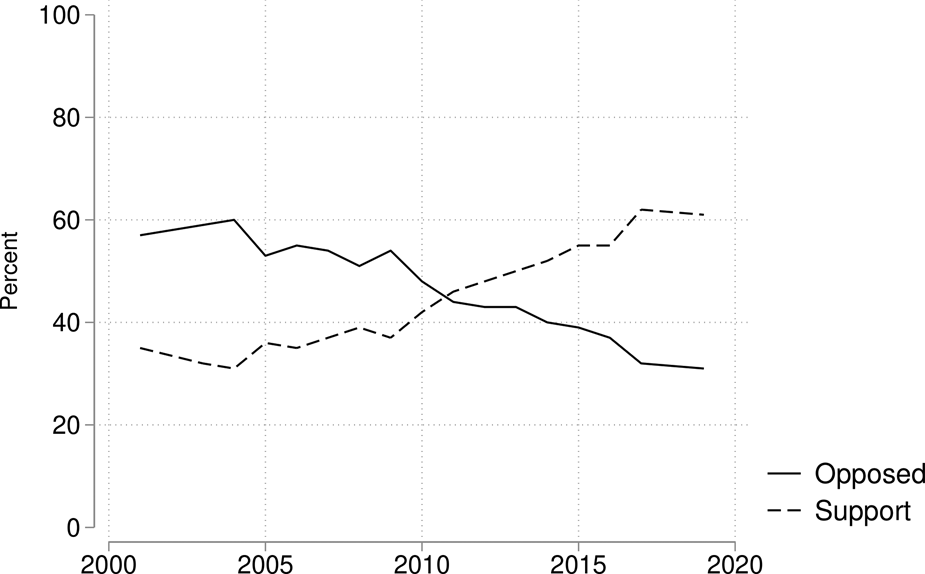
In the aftermath of Lawrence and Goodrich, Evangelical leaders planned their response. In a June 2003 strategy meeting, Focus on the Family's Jim Dobson noted how same-sex marriage might mobilize conservatives. But some conservatives doubted the effectiveness of using Article V, since it had failed to restrain the Warren and Burger Courts. Ken Connor and others recommended focusing instead on judicial appointments and waging the battle against same-sex marriage in front of sympathetic judges.Footnote 100 Others, like Dobson, advocated an Article V amendment. After all, public opinion decidedly pointed in their favor. As Figure 9 demonstrates, a substantial proportion of Americans opposed same-sex marriage in 2003 (59 percent) and in 2004 (60 percent). State-level constitutional amendments prohibiting same-sex marriage were regularly adopted in both red and blue states during this period.Footnote 101 Conservatives therefore had strong evidence that they could rely on public sentiment to mobilize conservative political views.
American Attitudes on Same-Sex Marriage, 2001–2019.

Proponents of an Article V strategy carried the day. The Alliance for Marriage approached Colorado Republican Marilyn Musgrave to sponsor the FMA in the House of Representatives. Her efforts in leading the FMA campaign would likely earn constituent support. And yet even on her motivations, Musgrave was clear to cast her position not as anti–gay rights, but rather as antijudiciary: “We've got a judiciary that's just out of control,” Musgrave said in defense of the FMA.Footnote 102 But few were under any illusion that the FMA would meet the necessary requirements in Congress, much less in the states. As one member of the Arlington Group, a low-profile coalition of conservative religious leaders who championed the FMA, put it when debating different language of the FMA, “Since none of the language [in the FMA] is likely ever to become law . . . the major benefit of an amendment is making the issue in the public.”Footnote 103
Congress's treatment of the FMA reflects a similar assessment. Musgrave's amendment reached the House Committee on the Judiciary, where unlike Shows's, the committee held limited hearings, inviting former Supreme Court nominee Robert Bork and the leading Christian advocate Jay Sekulow, to argue on behalf of the FMA. But thereafter congressional action in support of the FMA was limited. Trent Franks (R-AZ) spoke in defense of the FMA, claiming national support was “growing rapidly.”Footnote 104 Even if Franks's assessment had been correct, growing national support did not translate into serious congressional behavior. Members did not offer amendments to assuage addressable concerns related to the FMA. Nor was there any serious effort by members to make the case for its merit or urgency. As late as February 2004, congressional Republican leaders and President George Bush remained unconvinced of the need to pass the FMA. Conservatives had already passed DOMA, evidently constraining federal courts. But some worried that such federal action was itself vulnerable to judicial oversight. National Republican Senatorial Committee Chair George Allen of Virginia declared: “Until you know the lay of the legal analysis [with respect to DOMA], it's hard to know what is the appropriate legislative response.”Footnote 105 Even throughout the summer, for example, Republicans leaders like John McCain of Arizona and Susan Collins of Maine identified DOMA as sufficient protection, refusing to consider the FMA unless or until the federal courts declared DOMA unconstitutional.
But when President Bush, saddled with record budget deficits, a poor economy, and the controversial Iraq War, saw his polling numbers decline heading into the 2004 election, he revealed what had already been obvious to the Arlington Group. Bush needed the FMA to secure and mobilize his electoral base. He turned to conservative Evangelical voters, many of whom may have stayed home on Election Day in 2000. Citing the threat that judges and local officials posed to “the most fundamental institution of civilization,” Bush called on Congress to adopt the FMA.Footnote 106 While gay-rights “Log Cabin” Republicans refused to endorse Bush in 2004, new Evangelical voters more than counterbalanced the loss.Footnote 107
By June, Republicans began claiming DOMA was itself vulnerable to reversal by activist judges. The Senate moved first to consider the FMA in mid-July, holding three days of debates. But the matter never reached a vote, with fifty senators voting against cloture, preventing a vote. Without Senate support, House FMA support was largely symbolic, as leadership offered Republican members the chance to vote on the FMA in late September. The FMA garnered support from a majority of House members—227 to 186—though it fell well short of the necessary 290 votes required under Article V. During the same period, the House also considered the Marriage Protection Act, which proposed to strip the federal courts of jurisdiction to consider same-sex marriage. While the vote was roughly similar, 233 to 194 in support, the vote was taken without a quorum present.Footnote 108
Republicans’ wager to support the FMA proved largely successful, at least in the short term. Bush's support for the FMA likely contributed to his election victory in Ohio, the election's tipping-point state. Exit polls demonstrated a decided shift in his favor over his 2000 results, with older, less-educated, and more-religious voters supporting him at higher rates than before. The Ohio Campaign to Protect Marriage, for example, mobilized new, rural, conservative voters and contacted Democrats in the state's Black churches. Organizations like the Ohio Campaign distributed millions of church bulletins, circulated twenty-five mailers, and organized millions of get-out-the-vote calls linking the FMA and opposition to same-sex marriage to the president's campaign.Footnote 109
The FMA and analogous state-level bans drove turnout for Bush and other Republicans.Footnote 110 Dobson's Focus on the Family, and its political arm Focus Action, mobilized its network of more than 100,000 pastors in ten states to preach on issues like the FMA, organizing signature drives to place similar issues on the ballot, sponsored rallies, and broadcasting over the airwaves. He campaigned heavily in support of various members of the House of Representatives across the country and condemned Senator Arlen Specter and minority leader Senator Tom Daschle for failing to support his Evangelical causes and blocking federal judicial appointments. While Specter survived, Daschle lost. Nor was Dobson alone. Other Evangelical leaders, like Ralph Reed, mobilized hundreds of thousands of volunteers in support of traditional values during the 2004 election season. One Republican operative commented that he “had never seen anything like it.” The proposed FMA proved incredibly valuable for conservative Republicans in Congress. For them, evidence from the 2004 election demonstrated a clear strategy worthy of replication in subsequent elections. They deployed a similar playbook in the 2006 midterm elections, reintroducing the FMA as part of the Republican “American Values” agenda in the lead-up to the election. House leaders removed the proposed amendment from the Judiciary Committee and brought it to the floor for a vote, seemingly undermining any effort to build a genuine supporting coalition. While support for the FMA declined, the proposed amendment still resonated with energized, conservative voters. Congress behaved similarly with respect to the Marriage Protection Act.Footnote 111
In the case of the FMA, the value of Article V lay not in its historic charge of placing Congress at the forefront of constitutional redrafting. Rather, Article V led lawmakers to mobilize voters in response to actions taken by judges. The FMA posed little threat to same-sex marriage when Congress first considered the matter in 2004, and its prospects only dimmed in subsequent years. And yet conservative members of Congress kept invoking Article V as a tool for position-taking and electoral mobilization.
4. Conclusion
In this article, we describe a shift in congressional use of the Article V process, detailed through an original data set of all 11,969 proposed Article V amendments and paired case studies of Article V amendment proposals. These case studies show how members of Congress repurposed Article V, once a means to revise the constitutional text often in response to social movement demands, into a tool for electoral position-taking intended only for constituents and social movement actors, often in response to federal judicial rulings.
Consider the antipolygamy amendment and FMA. Through the nineteenth and into the mid-twentieth century, members of Congress looked to Article V to remedy constitutional flaws. Congress, for example, in granting Utah statehood, effectively voided a prior federal statute outlawing polygamy in the Utah Territory, letting Utah juries acquit polygamists. In a series of hearings, members debated and proposed an Article V amendment to let Congress prohibit polygamy in Utah and across the West. Although the antipolygamy amendment never cleared high Article V thresholds, the episode illustrated a nineteenth-century pattern in which members of Congress proposed Article V amendments to revise the constitutional text in response to social movement demands, in this case from mainline Protestants. In contrast, Republican leaders introduced the FMA mainly to let members take a high-profile position against gay marriage to better mobilize constituent Evangelical voters and interest groups.
Article V is now a mechanism for members to take positions on constitutional issues. While members always engaged in some Article V position-taking, this behavior became increasingly pronounced during the twentieth century. We trace this change to the rise in judicial power after the New Deal; with constitutional reformers turning toward the Court, members of Congress effectively repurposed Article V into a tool for announcing policy positions to constituents and interest groups, often in response to judicial decisions. The contrasting cases of the antipolygamy amendment and FMA, both failed and thus forgotten, like the Nineteenth Amendment and ERA, demonstrate how members of Congress repurposed Article V without ever changing the constitutional text.
In repurposing Article V as a position-taking tool, members of Congress have potentially encouraged and revitalized popular constitutional debate. This is perhaps counterintuitive. Prominent scholars have suggested that the ascendance of the Supreme Court during and after the Warren Court years have let federal judges monopolize constitutional interpretation; some of these scholars advocate taking constitutional interpretation away from the courts. Complicating this, we suggest that the rise of judicial activism in the Warren Court years spurred a reactionary, robust popular constitutional debate on how to constrain or override the federal courts. That is, the backlash to modern judicial activism encouraged popular engagement with the Constitution's Article V amending process. This is perhaps not the grassroots, bottom-up activism described and advocated by some scholars of popular constitutionalism; nonetheless, this elite-led, member-driven repurposing of Article V encouraged widespread public awareness of contentious constitutional issues like abortion, same-sex marriage, and flag burning in the late twentieth century. Since contemporary congressional polarization and party parity discourage formation of the bicameral supermajorities needed for amendment passage, we expect that members will continue to use Article V primarily as a position-taking tool. How the public responded to this priming, though beyond the scope of this article, merits further study.
Our account opens other several directions for future research. First, we find that proponents of the antipolygamy amendment, the women's suffrage amendment, the ERA, and the FMA each drafted their amendment in response to state statutory or constitutional reform. The extent to which social movement actors and members of Congress invoke Article V amendments not only against federal courts, but also against or alongside state constitutionalism merits further study. Second, in the introduction, we posit that antebellum members of Congress understood Article V as a tool to address flaws in the constitutional text, and that post–Civil War members reconceived this process also as a means to address mounting social movement demands. While we offer passing evidence for this mid-nineteenth-century shift through our data and case studies, detailing this shift falls beyond the scope of this article. Third, we suggest that Congress has not abandoned Article V, but rather has repurposed Article V as a tool for position-taking against the federal courts. Given conservative capture of the federal courts over the past decades, we might expect conservative members of Congress to abandon Article V position-taking against the judiciary specifically. Finally, given that members’ repurposed Article V as a tool to voice constituents’ constitutional views, we might take Congress as an actor in interbranch struggles to establish constitutional meaning. Scholars interested in durable shifts and long conflicts over constitutional interpretation would do well to study how Congress has repurposed Article V.
In conclusion, our account provides a new lens for understanding widespread and longstanding frustrations with Article V. Many scholars portray Article V supermajority requirements as a barrier to national constitutional reform, one that encourages social movements and political elites to look instead to judicial decision making or super-statutory reform. On this view, Article V is effectively a dead letter as a mechanism of constitutional revision. While we recognize the difficulty of Article V ratification, we suggest that Article V is better understood as a repurposed institution, with a constituency that continues to use it. Paradoxically, the difficulty of Article V ratification makes Article V an attractive mechanism for members of Congress to take positions in opposition to the federal judiciary, encouraging popular constitutional debate while discouraging formal constitutional revision.
We use a historical institutionalist approach to explain how Article V, a seemingly static and unchanged institution, has been repurposed by congressional actors responding to institutional developments located elsewhere in the constitutional structure. This lets us reframe existing debates in the court-curbing literature, which tend to emphasize either interinstitutional conflict or members’ individual efforts at reelection. We show instead that members’ choices about both whether to engage in Article V and, more directly, how to engage with Article V are contingent upon broader institutional changes in the relative capabilities and political authority of the different branches, and not simply the specific configuration of preferences between those branches.
Acknowledgments
The authors would like to thank Jörg Broschek, Sally Friedman, Ran Hirschl, Tom Keck, Carol Nackenoff, Julie Novkov, Emily Zackin, and the anonymous reviewers for their helpful feedback.
Competing interests
The authors declare none.