I. INTRODUCTION
The workhorse among titanium alloys, Ti-6Al-4V is an actively researched material due to its numerous applications in the aerospace, automotive, and biomedical industries. Reference Banerjee and Williams1 These applications necessitate, amongst other properties, high specific strength, fracture toughness, fatigue, and corrosion resistance. Whereas, the coarse microstructure and strong crystallographic texture of as-cast Ti-6Al-4V ingots are a major limitation and thereby, warrants secondary processing, Reference Kobryn and Semiatin2 significant microstructural refinement is achieved through boron modification. Reference Roy, Suwas, Tamirisakandala, Miracle and Srinivasan3 Boron addition in hypoeutectic quantities (typically ∼0.1 wt%) enhance most of the mechanical properties of Ti-6Al-4V alloy. Reference Tamirisakandala, Bhat, Tiley and Miracle4−Reference Sen, Gopinath, Datta and Ramamurty7 These improvements are attributed to formation of TiB particles, which surround the prior β-grain boundaries and increase stiffness of the alloy. Reference Tamirisakandala, Bhat, Tiley and Miracle8 Boron modified alloys have also shown significant improvement in secondary processing response of Ti-6Al-4V alloy, whether in the β Reference Roy, Suwas, Tamirisakandala, Srinivasan and Miracle9 or (α + β)-phase fields. Reference Roy and Suwas10–Reference Roy and Suwas17
Following these findings, the interest in boron modified Titanium alloys in general, and Ti-6Al-4V in particular, has increased over the time. Despite significant advances in various mechanical and thermo–mechanical aspects, little attention has been directed towards the dynamic properties of boron modified alloys. The only available study from Sen and Ramamurty Reference Sen and Ramamurty18 have used dynamic mechanical analysis (DMA) to estimate the elastic modulus of Ti-6Al-4V alloy with varying boron content. This study has not, however, shed any information about the dynamic properties like loss tangent or dynamic modulus of these boron modified alloys. Unlike this, dynamic properties of Ti-6Al-4V alloy have been explored in more detail. For example, Mishra and Asundi Reference Mishra, Asundi, R.I. Jaffee and H.M. Burte19−Reference Mishra, Asundi and A.F. Belov21 have reported very low damping at ambient temperature but sharp peak at −28 °C for Ti-6Al-4V alloy due to stress induced twin boundary sliding following the phase transformation. Addition of 2.5 wt% Mo (Ti-6Al-4V-2.5%Mo) increases damping dramatically for this alloy following heat treatment at 860 °C due the large volume fraction of α″-phase. Reference Ito, Moriguchi, Nishimura, Nagai, Hiromoto, Daikoku, Ueda, G. Lutjering, U. Zwicker and W. Bunk22 Subsequent ageing at 100–200 °C for 1–5 h decreased damping due to the decomposition of metastable α or β-phases. Reference Hiromoto, Daikoku, Ueda, Ito, Moriguchi, Nagai, G. Lutjering, U. Zwicker and W. Bunk23
The designing of structural components exposed to in-service dynamic loading requires knowledge about the vibration-absorbing capacity of the material to be used. This is an important piece of information since high damping materials can suppress vibrations and attenuate wave propagation so much so that the structures can be stabilized against resonance and self-feeding conditions like flutter. Reference Farkas and Jármai24 Considering the potential for boron modified alloys to replace Ti-6Al-4V for structural applications in critical industries, the study of dynamic properties is essential. Additionally, the effect of TiB-phase on dynamic properties in boron modified alloys merits attention since the introduction of any secondary phases is a proven method of enhancing damping capacity. Reference Zhang, Perez, Wong and Lavernia25 The objective of the present study is to systematically evaluate the effect of boron addition to the dynamic properties of Ti-6Al-4V alloy. Towards this end, DMA has been used to analyze the damping behavior and modulus changes in boron-modified as well as unmodified alloys. To further elucidate the effect of secondary processing and resultant microstructure, a comparison was made between the as-cast and β-forged Ti-6Al-4V and Ti-6Al-4V-0.1B alloys.
II. EXPERIMENTAL
A. Materials and processing
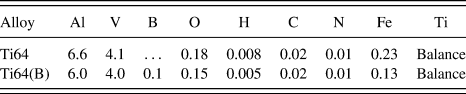
The material used for this study, Ti-6Al-4V (hereafter referred to as Ti64) and with hypoeutectic 0.1 wt% of Boron (hereafter referred to as Ti64(B)), has chemical composition as specified in Table I. The alloys were used in the as-cast condition (hereafter Ti64(B)-C and Ti64-C) and after β-forging (hereafter Ti64(B)-F and Ti64-F). Casting of alloys was carried out by induction skull melting using graphite mold under identical conditions at Flowserve Corporation, Dayton, OH. Boron was added to the melt as elemental powder and cast ingots were subjected to a standard hot isostatic pressing treatment at 900 °C and 100 MPa for 2 h. Measurement of β-transus yields a value of ∼1040 °C for Ti64 and ∼1020 °C for Ti64(B). Reference Roy, Tungala and Suwas26 Open die forging was performed in the β-phase field (1100 °C for both alloys) at an initial strain rate of 1 s−1. Height reduction during forging was equal to a true von-Mises strain of 2.48 which is similar to that applied in a previous work involving β-extrusion of these two alloys. Reference Roy, Suwas, Tamirisakandala, Srinivasan and Miracle9
Chemical compositions (in wt%) of the two alloys.

B. Microstructural characterization
Microstructures of the two alloys in as-cast and β-forged condition were characterized by scanning electron microscopy (SEM) (QUANTA 200, FEI, The Netherlands) in back-scatter electron (BSE) mode. For the as-cast specimens, the SEM images were captured from the horizontal surface of the original ingots. For the β-forged alloys, vertical surfaces perpendicular to the forging direction in the mid-thickness region was examined. This cutting and surface selection scheme for SEM observation of β-forged alloys is equivalent to that used for (α + β)-compression tested specimens in Ref. Reference Roy, Madhavan and Suwas13. The examination surfaces were metallographically polished and finished by electro-polishing. The electrolyte was composed of 600 mL methanol, 360 mL butoxyethanol, and 60 mL of perchloric acid. The samples were etched with a custom made solution containing 5% HF, 10% HNO3 and water for 30 s.
C. Dynamic mechanical analysis (DMA)
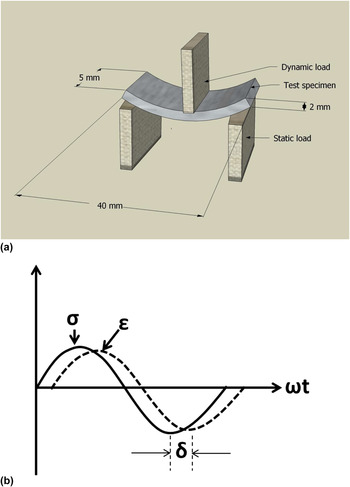
Cuboidal specimens of 40 mm length, 5 mm width, and 2 mm thickness were prepared from the as-cast and β-forged alloys using electro-discharge machining (EDM) and then subjected to dynamic cyclic loading to measures the time-dependent anelastic response. A schematic of the DMA is shown in Fig. 1(a) which consists of a three-point bend test-setup using 40 mm clamps (Gabo Eplexor 500N, NETZSCH GABO Instruments GmbH, Germany). A static load is maintained throughout the test while a smaller oscillatory dynamic load is applied over this. One cycle of deformation comprises the dynamic load translating from the uppermost position through the lowermost position and back to the initial upper position [Fig. 1(b)]. The resultant displacement is measured using a displacement transducer. Due to material anelasticity, a time lag exists between the applied stress and resultant strain. Reference Nowick27−Reference Zener30 Mathematically, the dynamic stress and dynamic strain are given by:
 $$\sigma = {\sigma _0}\exp \left( {{\rm{i}}\omega t} \right)\quad ,$$
 $$\varepsilon = {\varepsilon _0}\exp \left( {{\rm{i}}\left( {\omega t - \delta } \right)} \right)\quad ,$$
where σ0 and ε0 are the applied stress and resultant strain amplitudes, respectively; i is the imaginary unit; ω is the angular vibration frequency, and δ is the phase difference between the dynamic stress, σ and dynamic strain, ε. The phase difference δ is used to calculate the dynamic modulus, known as the complex modulus (E*) and is given by:
 $$E^ * = {\sigma \over \varepsilon } = {\sigma \over \varepsilon }\left( {\cos \delta + {\rm{i}}\sin \delta } \right)\quad .$$
Schematic of (a) DMA setup and (b) time dependence of stress and strain under cyclic loading.

The quantity tan δ, also known as the ‘loss tangent’, represents the damping capacity of any material. Reference de Batist and R. de Batist28,Reference Blanter, Golovin, Neuhäuser and Sinning29,Reference Puškár31 High tan δ values indicate a high ratio of energy dissipated to energy stored, therefore signifying for a high damping capacity. The complex modulus and loss tangent usually exhibit inverse variation with each other.
The DMA tests were carried out at room temperature by systematically varying the key dynamic parameters, viz. number of loading cycles, frequency of oscillatory loading, and amplitude of applied load. Time-variation of E* and tan δ have been studied under a constant dynamic loading frequency of 10 Hz and oscillatory strain amplitude of about 2 × 10⁻³. The effect of oscillatory loading was studied by varying the frequencies within 1 to 100 Hz at fixed strain amplitude. Next, to evaluate the effect of strain amplitude, the specimens were subjected to a strain oscillation between 0.1 × 10⁻³ to 6 × 10⁻³ at a reference loading frequency of 10 Hz. Limited testing was also carried out at a loading frequency of 87 Hz in the strain amplitude range of 0.1 × 10⁻³ to 3 × 10⁻³.
D. Hardness measurement
The dynamic test conditions were further supplemented by microhardness measurements (ZHVµ micro Vickers hardness tester, Zwick/Roell GmbH, Germany) before and after the DMA tests to quantify the alteration in strain hardening due to cyclic loading. The measurements were made from the horizontal surfaces of DMA specimens using the Vickers's indenter at a load of 5 kg-f and dwell time of 15 s. A minimum of 15 indentations were taken throughout the surface to meet statistical reliability. The average hardness (in Hv) was recorded and the error was expressed as the standard deviation of the measured dataset.
III. RESULTS
A. Microstructures of as-cast and β-forged alloys
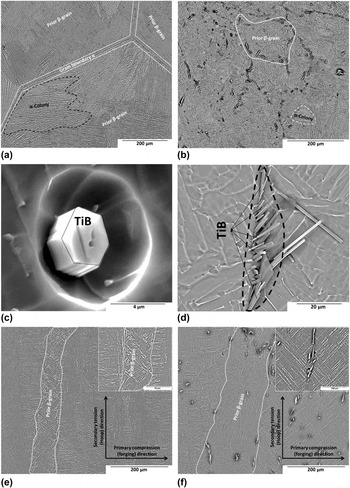
The starting as-cast microstructure for Ti64 and Ti64(B) are both characterized by typical Widmänstatten α/β colonies as a result of slow/furnace cooling from above the β-phase field [Figs. 2(a) and 2(b)]. Comparing the microstructures of the two alloys at different length scales (prior β grain and α colony size), the refinement due to boron modification is evident. While the prior β-grains are >1000 μm for Ti64, they are ∼200 μm for Ti64(B); similar size difference occurs for α-colonies which are ∼300–500 μm for Ti64 and <50 μm for Ti64(B) [marked in Figs. 2(a) and 2(b)]. The unmodified alloy also contains quite thick grain boundary α-allotriomorphic phase along the prior β-grain boundaries [marked in Fig. 2(a)] which are not that omnipresent in boron modified alloy. Rather the latter alloy contains TiB particles along most of the prior β boundaries [marked in Fig. 2(b)]. One such hexagonal TiB single crystal is shown in Fig. 2(c). These particles form as a cluster during solidification due to boron rejection by growing β-nuclei as the eutectic temperature is crossed [Fig. 2(d)]. Further details on the as-cast microstructural features and their formation mechanisms are discussed in Ref. Reference Roy, Suwas, Tamirisakandala, Miracle and Srinivasan3.
SEM BSE micrographs showing the microstructures of (a) Ti64-C and (b, c, and d) Ti64(B)-C in as-cast condition and (e) Ti64-F and (f) Ti64(B)-F in β-forged condition.

SEM micrographs of the two β-forged alloys (Ti64-F and Ti64(B)-F) show pancake shaped prior β-grains on the vertical surface sections having a wide distribution (50–500 μm) of width/thickness [Figs. 2(e) and 2(f)]. The grain boundary α-phase is absent in the β-forged microstructure of the two alloys. Further, the TiB particles align along the tensile (hoop) direction in Ti64(B)-F [Fig. 2(f)]. These particles, however, do not decorate the prior β-boundaries in Ti64(B)-F as they do for Ti64(B)-C and are randomly present within the β-grains that are formed after β-forging. This suggests that the β grains that form during β-forging are different than that originally present in as-cast Ti64(B) alloy. The identification of prior β grains in either Ti64 or Ti64(B) alloys are difficult, particularly in the length direction. Length measurement is thus erroneous and no quantitative comparison is attempted between either the as-cast and β-forged alloys or boron modified and unmodified alloys. Overall however, the β-forged microstructure of Ti64 alloy appears somewhat refined compared to as-cast condition while Ti64(B) alloy apparently does not respond to microstructural refinement after β-forging.
These β-forging results can be compared to those obtained for β-extrusion of the identical alloys in Ref. Reference Roy, Suwas, Tamirisakandala, Srinivasan and Miracle9. The β-grain refinement for the two alloys indicates dynamic recrystallization during β-forging while alignment of TiB particles along Hoop tensile direction is caused by rigid body rotation. Unlike β-extrusion; however, the alloy Ti64 does not produce any shear bands after β-forging. Another difference appears at the room temperature α-phase microstructure. After β-forging, both the alloys show acicular α/β-needles forming basket weaved structure [Figs. 2(c) and 2(d) insets]. This is again opposed to the β-extruded alloys showing Widmanstätten (α + β)-colony microstructures. Both these differences can be attributed to a better heat extraction during open die forging compared to canned β-extrusion process. Heat extraction ensures faster cooling from β-phase field which is why basket weave α-microstructure is more probable than Widmanstätten (α + β)-colonies. Reference Lütjering32 Adiabatic conditions due to friction between workpiece and tooling and poor thermal conductivity of Ti-6Al-4V are the most likely factor to cause shear banding during β-extrusion Reference Semiatin and Lahoti33−Reference Semiatin and Lahoti35 ; these factors are somewhat mitigated in open die β-forging process.
B. Dynamic mechanical analysis (DMA)
1. Effect of number of loading cycles
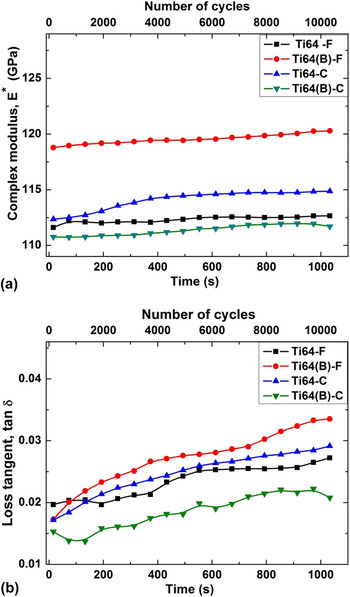
The effect of loading duration on the dynamic variables (complex modulus, E* and loss tangent, tan δ) is shown in Fig. 3 keeping all other parameters constant (frequency = 10 Hz, strain amplitude = 2 × 10⁻³). It appears that the loading time or alternately, the number of loading cycles has little effect on the complex modulus. The E* modulus stays nearly constant over 104 cycles, as shown in Fig. 3(a). For the unmodified alloys, both the as-cast (Ti64-C) and β-forged (Ti64-F) conditions exhibit quite similar moduli initially. With 0.1% B addition, the E* modulus reduces by nearly 3% in the cast material (Ti64(B)-C) as compared to the as-cast unmodified alloy (Ti64-C). After β-forging; however, the complex modulus increases by about 6% for boron modified alloy (Ti64(B)-F) compared to its β-forged unmodified counterpart (Ti64-F). On the contrary, the loss tangent shows strong time-dependence; irrespective of either in as-cast or in β-forged condition, tan δ increase with continued cyclic loading for the two alloys [Fig. 3(b)]. The increase is most prominent for Ti64(B)-F, where the loss tangent rises by nearly 50% between 500 and 10,000 loading cycles. Overall, the results suggest that the lag between applied stress and resultant strain gradually increases with continued loading irrespective of boron addition or β-processing.
Effect of loading duration on (a) complex modulus, (b) damping of as-cast and β-forged alloys.

2. Effect of loading frequency
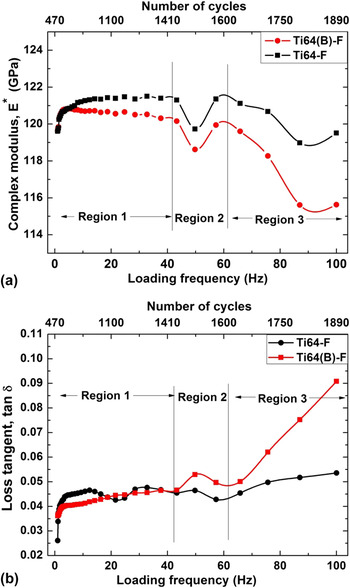
Loading frequency is found to have a stronger effect on dynamic properties than the loading time which is evident from a marked difference in E* and tan δ at low and high frequencies [Figs. 4(a) and 4(b)]. For clarity, only Ti64-F and Ti64(B)-F results are compared; the difference between the as-cast alloys Ti64-C and Ti64(B)-C is similar in nature, but lesser in magnitude. The frequency domain can be divided into three broad regions; a low frequency regime from 1 Hz to 40 Hz (region 1 in Fig. 4), intermediate regime from 40 Hz to 60 Hz (region 2 in Fig. 4), and high frequency one from 60 Hz to 100 Hz (region 3 in Fig. 4). In region 1, E* decreases gradually which is more prominent for Ti64(B)-F than Ti64-F [Fig. 4(a)]. A corresponding increase occurs for tan δ in Fig. 4(b). In region 2, a trough in E* for both materials in Fig. 4(a) corresponds to the well-defined tan δ peak centered at 50 Hz in Fig. 4(b). Similar to that observed in region 1, the damping tan δ peak is more prominent for β-forged boron modified alloy [Fig. 4(b)]. The end of this peak corresponds to the beginning of region 3 in the 60–100 Hz domain wherein an increase in loading frequency results in a rapid decrease of E* [Fig. 4(a)] and a corresponding increase in tan δ [Fig. 4(b)]. At the highest frequency (∼100 Hz), the improvement in damping is exceptionally high for Ti64(B)-F (tan δ = 0.091) which is nearly double than that for Ti64-F (tan δ = 0.053).
Effect of loading frequency on (a) complex modulus, (b) damping of β-forged alloys.

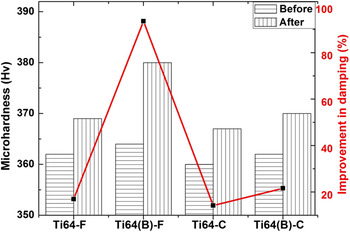
The appearance of a damping tan δ peak in region 2 and a drastic change in dynamic properties afterwards in region 3 may possibly be associated with an internal relaxation. Reference Blanter, Golovin, Neuhäuser and Sinning29 As a further confirmation, the effect of this internal relaxation on the static mechanical response of the two alloys is determined by microhardness measurements before and after the DMA tests. Figure 5 shows a superposition of the hardness and the improvement in damping (defined as the change in tan δ before and after the damping peak [i.e., between region 2 and region 3 in Fig. 4(b)]). The boron modified alloy in both as-cast and β-forged conditions shows superior damping properties than their counterparts in unmodified alloy. The improvement in damping is always associated with a corresponding increase in hardness. For example, while Ti64(B)-F shows hardness increment of 15 Hv and increase in damping of 93%, Ti64(B)-C shows an increment of 8 Hv and increase in damping of only 21%. The correlation suggests that the changes in dynamic and static mechanical properties are a function of boron addition and β-processing.
Increase in hardness before and after the DMA test and improvement in damping after the damping peak (i.e., between region 2 and region 3 in Fig. 4).

3. Effect of strain amplitude
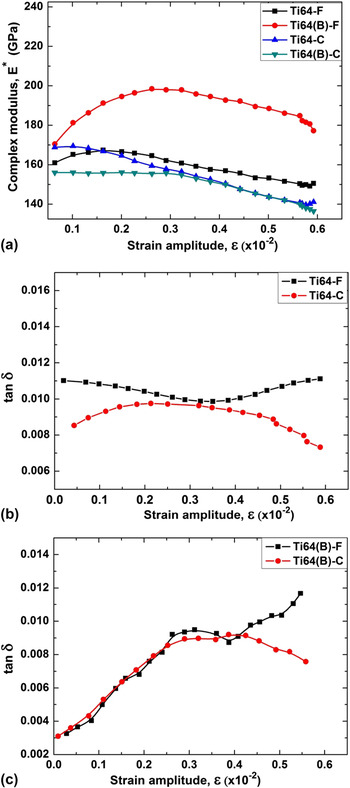
The variation of dynamic properties (E* and tan δ) with strain amplitude is even more complex than that with the loading frequency or time. The relative change in E* at static strains between 0.1 × 10⁻³ and 6 × 10⁻³ and a loading frequency of 10 Hz shows quite similar trends for the unmodified alloys in as-cast (Ti64-C) or β-forged (Ti64-F) condition [Fig. 6(a)]. For boron-modified alloy, E* increases for Ti64(B)-F alloy compared to its unmodified counterpart Ti64-F alloy, whereas it reduces for Ti64(B)-C alloy as opposed to Ti64-C alloy. This trend is qualitatively similar to that obtained under the loading cycles variation mode [Fig. 3(a)]. However, there is a weaker strain-amplitude dependence in the former case; after the β-forging of the two alloys, E* increases till 0.2 × 10⁻² to 0.3 × 10⁻² strain, following which it keeps reducing till the end. In case of the two cast alloys, there is no visible increase in E* modulus with increasing strain which again suggests a strong influence of β-processing on the dynamic modulus.
Variation in (a) complex modulus, and (b,c) damping with increasing strain amplitude at constant frequency of 10 Hz for unmodified and boron modified alloys.

On the contrary, the variation of damping response (tan δ) with strain amplitude is influenced strongly by boron-modification and only weakly by β-processing. As evident from Figs. 6(b) and 6(c), both Ti64(B)-F and Ti64(B)-C alloys show an increase in damping with increasing strain amplitude at a loading frequency of 10 Hz compared to Ti64-F and Ti64-C alloys, respectively. Individually, the damping of Ti64-F and Ti64-C exhibits minor variation while Ti64(B)-F presents a larger and more consistent increase in damping with strain amplitude. In absolute terms however, this increase in damping with strain amplitude is an order of magnitude lower than that obtained with increasing loading frequency [Fig. 4(b)]. This suggests that the damping in boron modified alloy (Ti64(B)-C and Ti64(B)-F) is influenced by loading frequency to a greater extent than it is by the strain amplitude, at least within the strain range evaluated (up to ∼6 × 10⁻³) in the present study.
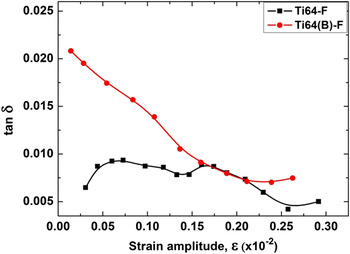
To further assess the effect of strain amplitude at higher frequency regime, strain amplitude was varied between 0.1 × 10⁻³ and 3 × 10⁻³ at 87 Hz loading frequency (Fig. 7), corresponding to the region 3 in Fig. 4. These tests were limited to Ti64-F and Ti64(B)-F alloys since much stronger strain and frequency dependence were observed for them than the corresponding cast alloys. The variation in tan δ at this frequency suggests a reduction in damping of Ti64(B)-F with increasing strain amplitude as opposed to the observations made from Fig. 6(b). The variation of tan δ for Ti64-F at 87 Hz is, however, inconsistent without any clear trend. Overall, a combined frequency-strain amplitude effect dictates the dynamic properties in Ti64 and Ti64(B) alloys. Additionally, the complex modulus is influenced by β-forging, while damping by boron modification to a greater extent.
Variation in damping of β-forged alloys with strain amplitude at 87 Hz.

IV. DISCUSSIONS
The inherent mechanism of energy dissipation and damping during dynamic loading is anelasticity which can be broadly defined as the nonelastic, irreversible response of any material system to the applied load. Reference Nowick27−Reference Zener30 Several factors contribute to this irreversible energy loss for crystalline materials, e.g., thermo–elastic and defect damping.
A. Thermo–elastic damping
The thermo–elastic damping considers the mechanical deformation being coupled with changes in temperature; for example, compression causes an increase while tension causes a decrease in temperature for a simple beam. Reference Nowacki36 Under dynamic loading, a temperature gradient therefore sets up between the tension and the compression sides of the beam. The resulting heat flow can cause energy dissipation, and may act as a potential source of damping. The classical formulation for thermo–elastic damping by Zener for simple vibrations in thin, rectangular beams is appropriate for the specimen geometry and test-setup used in this study. Reference Zener37−Reference De and Aluru39 The Zener formulation relates damping to loading frequency, elastic modulus, and thermal properties as:
 $${Q^{ - 1}} = \left( {{{{\alpha ^2}T} \over {\rho {C_{\rm{p}}}}}} \right)\left( {{{E\omega \tau } \over {1 + {{\left {\omega \tau } \right}^2}}}} \right)\quad ,$$
where Q −1 is the damping capacity, α is the coefficient of thermal expansion, T is the ambient temperature, ρ is material density, C p is the specific heat, E is the Young's modulus, ω is the angular frequency of loading, and τ is the relaxation time. For the first mode of vibration, the relaxation time is given by:
 $$\tau = {{{b^2}} \over {{\pi ^2}{\rm K}}}\quad ,$$
where b is the specimen thickness and Κ is the thermal diffusivity. For any given material, the first term in Eq. (4),
 $\left( {{{{\alpha ^2}T} \over {\rho {C_{\rm{p}}}}}} \right)$
is constant which therefore makes the second term,
 $\big( {{{E\omega \tau } \over {1 + {{\left( {\omega \tau } \right)}^2}}}} \big)$
vs. Q
−1 plot a straight line. In the loading frequency range used for the present study, Q
−1 ≈ tan δ, so that the experimental and computed damping can be compared directly. Considering the dynamic loading conditions, E* is used in place of E as a first approximation. The expected linear relationship between
 $\left( {{{E\omega \tau } \over {1 + {{\left( {\omega \tau } \right)}^2}}}} \right)$
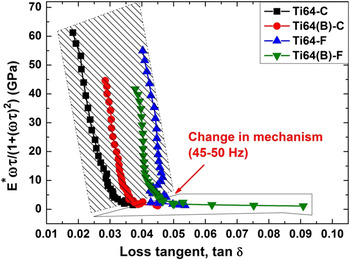
vs. tan δ is followed for all four alloys (Ti64-C, Ti64(B)-C, Ti64-F, and Ti64(B)-F) in the low tan δ regime (shaded area in Fig. 8). At higher tan δ values, the frequency term
 $\left( {{{E\omega \tau } \over {1 + {{\left( {\omega \tau } \right)}^2}}}} \right)$
becomes independent of tan δ (unshaded portion of Fig. 8). The transition between these two regions is sharp and occurs at loading frequencies between 45 and 50 Hz. This frequency actually corresponds to the damping peak (region 2) in Fig. 4, confirming a change in damping mechanism in this regime. It can thus be inferred that thermo–elastic damping is the prominent damping mechanism in region 1, but not in region 2 and region 3.
Verification of frequency-dependent thermo-elastic damping in unmodified and boron-modified alloys.

The damping peaks in region 2 may represent a relaxation event occurring in the 45–50 Hz frequency regime. Such relaxations are often described by the functional form shown in Eq. (4), in which case the peaks are termed as ‘Debye peaks’. Reference Blanter, Golovin, Neuhäuser and Sinning29 The Debye peak centre depends on the relaxation time (τ). A physical basis for this relaxation, as originally proposed by Zener, Reference Zener30 is the anelasticity at grain boundaries. The grain boundaries attempt to slide under the applied stress which is restricted by triple boundary junctions, thus generating a back-stress. Reference Blanter, Golovin, Neuhäuser and Sinning29 The opposition between these two forces (applied stress vs. anelastic back stress) causes damping in the material. Since the relaxation is boundary-controlled, relaxation times, and hence peak centres, should ideally vary with grain size. In the present study; however, the four alloys (Ti64-C, Ti64(B)-C, Ti64-F, and Ti64(B)-F) exhibit considerable differences in grain sizes, although exhibiting a (nearly) common centre for the respective relaxation peaks. This suggests that only boundary anelasticity may not be the sole relaxation event in region 2 (45–50 Hz) frequency range.
Blanter et al. Reference Blanter, Golovin, Neuhäuser and Sinning29 suggests that the evolving defect structures may also be associated with frequency dependent relaxation which is likely to cause measurable changes in the microhardness. In this regard, the increase in microhardness (Fig. 5) after loading at higher frequencies (region 3, >50 Hz) is indicative of such a change in the defect structure. Further, a correlation exists between the increase in microhardness and corresponding improvement in damping, as is apparent from a comparison between Ti64(B)-C and Ti64(B)-F alloys. This suggests that changes in defect structure may influence damping in region 2 and region 3 (discussed posteriori). However, there is no clear way to distinguish between the relaxation peaks caused by pure anelastic effects and that from the defect structure changes. Reference Blanter, Golovin, Neuhäuser and Sinning29 It is, therefore, prudent that the Debye-type relaxation peak observed in region 2 (Fig. 8) represents a transition from thermoelastic damping (purely anelastic) to defect damping (structural change) and is likely to contain contributions from both.
B. Defect damping: role of TiB particles
In the absence of thermo–elastic damping, the next to consider is the damping due to various microstructural defects e.g., grain boundaries in crystalline materials which may act as viscous interfaces between the grains thereby generating internal friction. Reference Blanter, Golovin, Neuhäuser and Sinning29 Also important to consider are the secondary phases (precipitates or dispersions) in multicomponent systems which may influence damping by providing additional interfaces, Reference Everett40 by increasing the dislocation density, Reference Arsenault, Shi, Feng and Wang41−Reference Zhang, Perez and Lavernia43 or by interacting with dislocations and/or grain boundaries. Reference Zhang, Perez, Wong and Lavernia25 Even the presence of fine Ti3Al precipitates has been shown to enhance damping in Ti-6Al-4V alloy. Reference Lee, Lee and Lee44 In Mg–SiC systems, additional interfaces from secondary SiC-phases drastically improved damping capacity relative to the base Mg-alloy or AZ91 alloy. Reference Roy, Kannan, Suwas and Surappa45,Reference Gu, Zhang, Qiu and Gu46 This was attributed to the slip between the matrix–reinforcement interfaces wherein a reduction in damping with increase in loading frequency was observed since longer cycle times had favored interfacial slip.
In connection to the above mentioned sources of defect damping, the presence of TiB precipitates in Ti64(B) alloy may similarly contribute to high tan δ values. The difference in dynamic properties between Ti64(B)-F and Ti64(B)-C, however suggests that the damping mechanism/s is/are sensitive to the microstructure (grain morphology, arrangement of TiB particles etc.) in the first place as much as it does on the TiB particles themselves. The present study also shows that with increasing loading frequency, the damping capacity in Ti64(B) alloys increases either in as-cast condition or after β-forging [Fig. 4(b)]. Since interfacial damping is predominant only at elevated temperatures as per Ref. Reference Gu, Zhang, Qiu and Gu46, interfacial slip between TiB-phase and Ti-6Al-4V matrix is an unlikely damping mechanism for Ti64(B) alloy.
The secondary contribution to damping may come from an increase in dislocation density due to the difference in thermal expansion between the TiB particles and the matrix. Reference Zhang, Perez, Wong and Lavernia25 This may result in large residual strains, which can form additional dislocation networks and increase the number of dissipation sources, thus increasing the overall damping. A similar accumulation of residual strain and additional dislocation around TiB particles have indeed been noticed during high temperature deformation of boron modified alloys. Reference Roy, Sarkar and Suwas47 Ti-6Al-4V alloy matrix and TiB particles are, however, characterized by similar thermal expansion coefficients which is one of the prime grounds for in-service replacement of unmodified alloy with boron modified Ti-6Al-4V. Reference Ravi Chandran, Panda and Sahay48 Also, in Ref. Reference Roy, Sarkar and Suwas47, residual strain accumulation is primarily caused by deformation mismatch between hard TiB and softer Ti-6Al-4V matrix due to imposed straining. No significant difference in dislocation density is, therefore expected for unmodified and boron modified alloys due only to the thermal expansion mismatch.
C. Dislocation damping
Altogether, TiB-induced interfacial or thermal expansion damping does not seem to be a viable candidate to explain the damping mechanism/s of Ti64(B) alloys (as-cast or β-forged). Considerable variation of dynamic properties with either loading frequency or strain-amplitude although occurs only for boron modified alloys, Ti64(B)-C or Ti64(B)-F [which is absent for the unmodified alloys, Ti64-C or Ti64-F, comparing Figs. 6(b) and 6(c)]. This does suggest contribution from the interaction between dislocations and various microstructural interfaces and/or TiB particles to the energy dissipation.
Reference Zhang, Perez, Wong and Lavernia25,Reference Gu, Zhang, Qiu and Gu46
To evaluate this possibility, the Granato and Lucke model is used for the boron modified alloys.
Reference Povolo49−Reference Granato and Lücke51
According to this model, the dislocations are analogous to strings and precipitates are considered as points pinning this string. On application of dynamic load, the string vibrates about the pinning points which is a source of dissipation and causes damping. The magnitude of damping increases with increasing vibration amplitude. As the applied strain amplitude increases, the dislocation unpin at certain points (weaker precipitates) and increases the vibration amplitude locally.
Reference Teutonico, Granato and Lücke52
Increase in strain amplitude causes an increase in damping. The damping capacity, Q
−1, which is again equivalent to tan δ can be resolved into a frequency-dependent part (
 $Q_{\rm{f}}^{ - 1}$
) and a strain-dependent part (
 $Q_{\rm{a}}^{ - 1}$
) as
Reference Granato and Lücke50,Reference Granato and Lücke51
:
 $$Q_{\rm{f}}^{ - 1} = {{cL_{\rm{e}}^{\rm{4}}\rho {f^2}} \over {{{\vec b}^2}}}\quad ,$$
 $$Q_{\rm{a}}^{ - 1} = {{d\rho } \over {L_{\rm{e}}^2\varepsilon }}\exp \left( {{{d'} \over {{L_{\rm{e}}}\varepsilon }}} \right)\quad ,$$
where f is the loading frequency, ε is the strain amplitude, L
e is the effective length of pinned dislocation, ρ is the dislocation density,
 $\vec b$
is the Burger's vector, and c, d, d′ are material constants.
As the dislocation pinning length, L
e increases, both
 $Q_{\rm{f}}^{ - 1}$
and
 $Q_{\rm{a}}^{ - 1}$
increase and damping improves subsequently. As explained in Sec. III. A, β-forging has a significant effect on the microstructure of both Ti64 (microstructural refinement) and Ti64(B) (alignment of TiB particles) alloys compared to the as-cast condition. Preferential alignment of TiB particles towards the β-forging direction may in turn influence the distribution of precipitates and alter the dislocation pinning length for Ti64(B) alloy. In (α + β)-alloys like Ti-6Al-4V, the slip transfer and passage of dislocations occur without much hindrance between α and β phases which are associated with Burger's relationship.
Reference Suri, Viswanathan, Neeraj, Hou and Mills53
The effective interface for dislocation interaction in that case is only the α-colony boundary with large misorientation. In as-cast Ti64(B)-C alloy, because of the coarse Widmanstätten α-colonies, the effective pinning length L
e is large for Ti64(B)-C compared to the basket weaved microstructure after β-forging in Ti64(B)-F alloy. Thus the Widmanstätten α-colonies are more efficient to impede dislocation motion, and as a result, damping should not theoretically improve with β-forging. This is what has been observed for the unmodified alloys; not much difference occurs in the dynamic properties between as-cast Ti64-C and β-forged Ti64-F alloys. However, opposite trend is observed with either loading frequency (Fig. 5) or strain amplitude [Fig. 6(c)] variation for the boron modified alloys; in either case, damping improves for Ti64(B)-F as a result of β-forging as oppose to Ti64(B)-C.
This discrepancy is possibly related to the additional contribution from the arrangement of TiB-particles after β-forging to the damping properties of Ti64(B)-F alloy. In as-cast Ti64(B)-C, the TiB particles are regularly arranged at prior β-boundaries; β-forging breaks this network and results in a more random arrangement of these particles, often inside the prior β-grains. This factor can increase the dislocation pinning length, L e for Ti64(B)-F as compared to Ti64(B)-C due to TiB-dislocation interaction so that the damping finally improves for the former alloy. This is in agreement with ageing studies on Ti-6Al-4V, where it was observed that precipitation in regular microstructural arrangement causes little improvement in damping for Widmanstätten microstructures. Reference Lee, Lee and Lee44 This change in arrangement of TiB due to β-forging is also likely to influence microhardness since the mechanical response of any two phase system depends on the distribution of individual phases. Reference Hosford54 Ti64(B)-F alloys with regular arrangement of TiB particles offering more dislocation pinning centres should result in greater difference between the microhardness before and after the DMA tests compared to Ti64(B)-C alloy.
Equation (6) also indicates that
 $Q_{\rm{f}}^{ - 1} \approx \tan \,\delta$
has strong frequency dependence which explains the increase in tan δ at higher loading frequencies (>60–70 Hz) for the two alloys after β-forging [region 3 in Fig. 4(b)]. Since the number of pinning points are more for Ti64(B)-F than in Ti64-F (due to additional contribution from TiB particles), the increase in tan δ is higher for the former alloy. It has also been suggested that as the dislocations unpin, they may loop around the pinning points, eventually become Frank–Reed or Orowan sources.
Reference Zhang, Perez, Wong and Lavernia25
Consequently, the dislocation density (ρ) in Eq. (6) increases with continued frequency variation further contributing to frequency-dependent damping. In the present study, a significant hardness increase was indeed observed for all the alloys after the frequency variation tests, particularly for Ti64(B)-F. This increase indicates additional dislocation density after DMA tests which may have caused the observed increase in damping. If now the region 2 in Fig. 4(b) is revisited, more prominent damping peak for Ti64(B)-F seems justified due to the defect damping contribution from additional pinning points (regularly arranged TiB particles) and resultant higher dislocation density than either Ti64-C, Ti64-F or Ti64(B)-C.
Next, strain amplitude and damping share a complex relation, determined by the exponential and pre-exponential terms in Eq. (7). The general increase in damping with strain amplitude for both as-cast and β-forged boron modified alloys at 10 Hz, as seen in Fig. 6(c), may result from an increase in either L
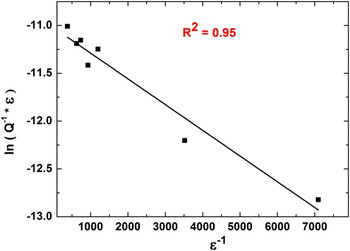
e or ρ with continued straining. Damping at 87 Hz; however, shows reversed strain-dependence, i.e., tan δ reduces with increasing strain, apparently contradicting the Granato–Lucke theory. The decrease is more pronounced in Ti64(B)-F than for Ti64-F alloy. To verify whether dislocation damping is still active at such high loading frequency of 87 Hz,
 ${\rm{ln}}\left( {Q_{\rm{a}}^{ - 1}\varepsilon } \right)$
is plotted against ε−1 for the alloy Ti64(B)-F (Fig. 9). As per Refs. Reference Zhang, Perez, Wong and Lavernia25 and Reference Zhang, Perez and Lavernia43, a reasonable linear dependence (adj. R
2 = 0.95) between
 $\ln \left( {Q_{\rm{a}}^{ - 1}\varepsilon } \right)$
with ε−1 signifies for dislocation damping, assuming all other factors (e.g., L
e or ρ) constant. This indicates that dislocation damping is still active at 87 Hz, although overshadowed by secondary mechanism/s which possibly limits the increase in damping with strain amplitude.
Verification of strain-dependent dislocation damping in boron modified alloy at 87 Hz.

This secondary mechanism most likely stem from the presence of TiB precipitates in the boron modified alloy microstructures since the unmodified alloys do not show any clear trend in Fig. 7. One of the possibilities is the interaction between TiB precipitates and prior β-grain or α-colony boundaries. Since viscous behavior is associated with boundaries, grain boundary relaxation during cyclic loading is an obvious source of energy dissipation and damping. Reference Nowick27 In boron modified alloys, the discontinuous TiB precipitates can interfere with the movement of boundaries, and therefore can affect the relaxation process, ultimately leading to a reduction in damping at 87 Hz. Reference Zhang, Perez, Wong and Lavernia25,Reference Zhang, Perez and Lavernia43 As to why the interference from TiB is inoperative at lower frequencies [Fig. 4(b)], is not fully understood at the moment, but it may likely that easier boundary relaxation at longer loading cycles negates the hindrance caused by TiB drag. At higher frequencies, the natural resistance to relaxation (due to lesser time for relaxation) could be complementary to the pinning by TiB precipitates.
A critical note about the role of TiB particles in defect damping is that the nano-scale precipitates (e.g., precipitate strengthened Ni-superalloy or Al alloys) are far more effective for dislocation interaction compared to nearly micron sized TiB precipitates [Fig. 2(c)] due to the smaller average spacing for the former. Reference Ardell55 The volume fraction of these TiB particles is previously reported by Sen and Ramamurty Reference Sen and Ramamurty18 to be around 0.5 ± 0.2 for hypoeutectic Ti-6Al-4V-0.1B alloy. The spacing between these particles is often in the submicron range because they form as a cluster at the prior β-boundaries for the Ti64(B) alloy [Fig. 2(c)]. Overall, the relatively large TiB particles may produce weaker dislocation interaction relative to the nano-scale precipitates otherwise form in precipitation hardened system. They can, however, be still effective for pinning dislocations and influencing damping as indicated by Sen and Ramamurty. Reference Sen and Ramamurty18 This is possibly due to their large volume fraction which helps them behave like the reinforcing phase in composites or dispersion hardened systems for damping purposes. Important to note that in SiCp reinforced Mg/AZ91 alloy wherein SiC-particles was even larger than the TiB particles in the present study, the former was found effective for dislocation pinning and damping due to their high volume fraction. Reference Roy, Kannan, Suwas and Surappa45 It may also be mentioned that Granato–Lucke theory appear to be valid in systems with large micron-sized precipitates in Mg–Zn–Al casting alloys, as illustrated by J.H. Jun. Reference Jun56
As far as the present study is concerned, relatively small increase in hardness does indicate that the dislocation-TiB particle interactions are relatively low (Fig. 5). Nevertheless, the precipitates can weakly pin dislocations at low stresses. At higher stresses, the dislocation may get unpinned easily, thus causing the weak strain amplitude dependence of damping. However, at low stress, increasing frequency results in faster vibration of the dislocation about pinned points (as per Granato–Lucke model) and results in increase in damping.
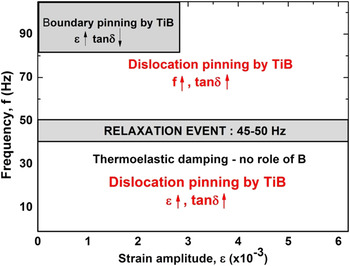
Overall, boron modification to the Ti-6Al-4V alloy influences the dynamic properties through different mechanisms operative at different loading conditions. This is summarized in Fig. 10, where various damping mechanisms are shown in the frequency–strain amplitude window. At frequencies between 1 and 45 Hz, damping increases with increasing strain and TiB precipitates influences dynamic properties through dislocation damping. This is accompanied by thermo–elastic damping irrespective of boron-modification. At slightly higher frequencies, relaxation occurs signifying for the damping peak observed in Fig. 4. From this point onward, increase in loading frequency causes significant increase in damping due to dislocation damping from TiB precipitates alone which is highly frequency-dependent. For strains in the range of 0.1 × 10⁻³ to 3 × 10⁻³, high frequency loading (around 87 Hz) is associated with an additional TiB-boundary interaction mechanism which results in an inverse strain amplitude dependence. This suggests that the improvement in damping is path dependent. Directly loading boron modified alloys to 87 Hz frequency is not as effective as subjecting them to increasing frequencies, particularly through the damping peak occurring around 50 Hz before reaching 87 Hz.
Schematic map showing various damping mechanisms operative in boron-modified alloy.

V. CONCLUSIONS
In the present study, the effect of boron on room-temperature dynamic properties of Ti-6Al-4V alloy in as-cast and β-forged conditions is studied by varying number of loading cycles, frequency of loading, and strain amplitude. The following conclusions have been drawn:
-
(1) Boron addition of 0.1 wt% results in lowering the complex modulus (E*) and increasing the damping (tan δ) by nearly two times relative to the base Ti-6Al-4V alloy.
-
(2) The improvement in damping is attributable to the TiB precipitates in the first place, which influence damping through dislocation pinning (at all frequencies) and grain boundary pinning (at high frequencies). These effects are more prominent after β-forging than in as-cast condition due to random arrangement of these particles in the later microstructure.
-
(3) Damping increases with strain amplitude at low frequencies (10 Hz) but reduces at high frequencies (87 Hz). The magnitude of these changes is although smaller than that obtained by increasing the loading frequency.
-
(4) A damping peak is observed in the 50 Hz frequency range, and cycling through this range results in the most significant improvement in damping (21% for as-cast and 93% for β-forged alloys).
ACKNOWLEDGMENTS
The authors acknowledge Indian Institute of Science, IISc Bangalore for providing the required research facilities. The materials used for the study were originally provided by Dr. Dan Miracle of AFRL and Dr. S. Tamirisakandala of FMW Composites. The authors are thankful to Late Sri Sasidhara Pandit from IISc, Bangalore for his assistance in conducting the DMA tests and Mr. Kishora Shetty of Hindusthan Aeronautics Ltd. (HAL), Bangalore for helping with β-forging of the alloys.