Introduction
The consumption of rice, the staple food for two thirds of the earth's population (Zhou et al., Reference Zhou, Kevin, Stuart and Blanchard2002), has increased significantly in the last decade due to rapid growth in both its popularity and the human population (Tuley, Reference Tuley1991; Blakeney, Reference Blakeney, Henry and Kettlewell1996; Childs, Reference Childs and Champagne2004). Despite this, rice production has fallen over the last three decades in response to the declining availability of water and land (Childs, Reference Childs and Champagne2004). These forces in combination are likely to bring about serious food shortages (Sakamoto and Matsuoka, Reference Sakamoto and Matsuoka2008). Attempts to improve existing crops may not meet the increasing demand for food (Upadhyaya et al., Reference Upadhyaya, Zhu, Eamens, Dennis, Yang, Yu, Ramachandran and Pan2003) and wild species may be required to either increase the gene pool for germplasm improvement or for the development of new cultivated crops (Prescott-Allen and Prescott-Allen, Reference Prescott-Allen and Prescott-Allen1988).
Processed foods and alcoholic beverages such as beer, rice wine, sake and vinegar commonly use rice as an ingredient, while animal feed is derived from material deemed not suitable for human consumption including the whole rice plant, low-grade paddy rice, broken grain, hulls and bran (OECD Environment 2004). Starch derived from rice is used in many non-food applications such as adhesives, coatings, pharmaceuticals, fillers and viscosity modifiers (Fitzgerald, Reference Fitzgerald and Champagne2004). Rice bran, rice straw and the hulls and husks are used for a wide array of purposes including microbial and growth media, fuels and building materials (Maclean et al., Reference Maclean, Dawe, Hardy and Hettel2002).
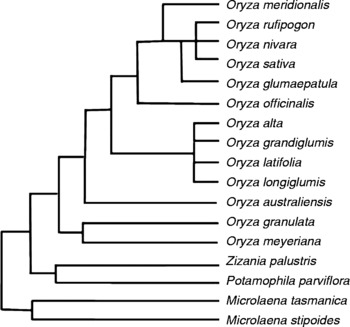
Despite great diversity within the plant kingdom, the majority of human food is derived from just 20 or so plant species (Vietmeyer, Reference Vietmeyer1986). Cultivated rice is in the subfamily Ehrhartoideae of the Poaceae family; within which is found wheat, corn and barley (Gould and Shaw, Reference Gould and Shaw1983; Heywood, Reference Heywood1993; Khush, Reference Khush, Singh, Singh and Khush2000; Oelke, Reference Oelke, Wrigley, Croke and Walker2004; Vaughan, Reference Vaughan1994). The genus Oryza is one of 12 genera within the tribe Oryzeae (Fig. 1), and of the 22 Oryza species, only Oryza sativa and Oryza glaberrima are cultivated (Vaughan, Reference Vaughan1994). The Oryza grow in diverse environments, have various grain shapes and colours with unique textural characteristics (Maclean et al., Reference Maclean, Dawe, Hardy and Hettel2002; Zhou et al., Reference Zhou, Kevin, Stuart and Blanchard2002; Childs, Reference Childs and Champagne2004; Wilkinson and Champagne, Reference Wilkinson, Champagne and Champagne2004; Wrigley, Reference Wrigley, Wrigley, Croke and Walker2004). Two species from the genus Zizania (Zizania palustris and Zizania latifolia), which are closely related to Oryza, are used as whole grains for human consumption (Vaughan, Reference Vaughan1994).
The relationship between members of the Ehrhartoideae (adapted from Ge et al., Reference Ge, Sang, Lu and Hong1999; Kellogg, Reference Kellogg2009). Oryza spontanea was not included in either of these studies.

Understanding wild rice species may assist the development of more productive rice varieties and hybrids. In order to utilize wild rice resources in plant breeding programmes, it is first necessary to determine whether appropriate grain quality attributes exist in wild rice species by exploring and cataloguing their grain morphology. Because there are regional differences in consumer preference for particular rice quality types, there are no universally accepted rice quality parameters (Juliano, Reference Juliano1985; Lyon et al., Reference Lyon, Champagne, Vinyard and Windham2000; Zhou et al., Reference Zhou, Kevin, Stuart and Blanchard2002). However, classification of rice grains by morphological characteristics is useful, especially when a new cultivar is being developed for a defined market (Bergman et al., Reference Bergman, Bhattacharya, Ohtsubo and Champagne2004).
The objective of this study was to describe the grain morphology of a range of wild rice species in comparison to cultivated rice. The seed colour and general appearance was observed by light microscopy and classified according to the USDA rice breeder classifications (Adair et al., Reference Adair, Bollich, Bowman, Jodon, Johnston, Webb and Atkins1973; Cruz and Khush, Reference Cruz, Khush, Singh, Singh and Khush2000).
Materials and methods
Plant materials
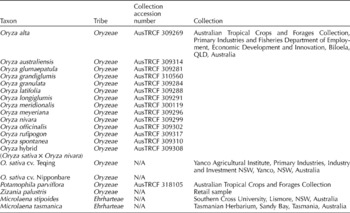
Plant materials were obtained from a number of sources (Table 1). Wild Oryza species and Potamophila parviflora were sourced from the Australian Tropical Crops and Forages Collection (AusTRCF), Primary Industries and Fisheries Department of Employment, Economic Development and Innovation (Biloela, QLD, Australia; www.dpi.gov.au/auspgris/). Oryza hybrid is a cross between Oryza nivara and O. sativa (interim designation used in GRIN for Oryza hybrids that lack an acceptable binomial http://www.ars-grin.gov/cgi-bin/npgs/html/taxon.pl?318042). Commercial Oryza cultivars O. sativa L. cv. Teqing and O. sativa L. cv. Nipponbare were sourced from the Yanco Agricultural Institute, Primary Industries, Industry and Investment NSW (Yanco, NSW, Australia). Seeds of Zizania were bought from a local supermarket (Lismore, Australia). Seeds of Microlaena stipoides were collected from Southern Cross University (Lismore, NSW, Australia). Seeds of Microlaena tasmanica were sourced from the Tasmanian Herbarium (Sandy Bay, Tasmania, Australia).
Species studied and their source

Light microscope
Eight kernels from each species were examined using an Olympus Stereo Microscope SZ60 to record seed colour with and without husk. Images of two grains from each species were captured at 10 × magnification with an Olympus digital camera Model # DP12-2 attached to the microscope.
Length and width measurement
Twelve kernels in the husk were chosen from each species and scanned with a CanoScan 8000F scanner. The kernels were then individually manually dehusked and scanned again. Scanned images were used to measure their length and width in millimetres by Image Pro software (Image Pro-® Plus V 4.1). Three measurements were taken for each kernel and averaged.
Seed classification
Seed size and shape were measured according to the scale of Adair et al. (Reference Adair, Bollich, Bowman, Jodon, Johnston, Webb and Atkins1973) and Cruz and Khush (Reference Cruz, Khush, Singh, Singh and Khush2000). Seed size was defined by the length of a kernel in its longest dimension and was categorized as very long (>7.50 mm), long (6.61–7.50 mm), medium (5.51–6.60 mm) and short ( ≥ 5.50 mm). Kernel shape was defined by the length: width (L/W) ratio and ranges from slender (3.0), medium (2.1–3.0) and bold ( ≥ 2.0).
Scanning electron microscope
Seeds were manually dehusked and fixed by soaking for 24 h in 10% buffered formalin. Fixed seeds were then rinsed three times with distilled water, 30 min each. Rinsed seeds were then dehydrated by a standard series of ethanol washes: 25, 50, 75 and 95%, each for 20 min, and then three 100% washes of 30 min each. Samples were immediately dried using a Polaron E3100 Critical Point Drier.
Seeds were mounted on aluminium stubs and then gold coated for 30 s at 35 mA. Images were recorded on a Leica Leo 440 Stereoscan Scanning Electron Microscope (SEM) with the probe current at 20 pA, EHT at 10.00 KV and a working distance of 15 mm. Images of the outer surface of seeds were taken at a magnification of 1.80 K.
Results
Seed size
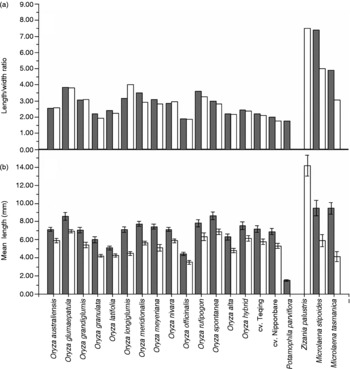
The average width and length of the grains of individual species were classified according to the scales of Adair et al. (Reference Adair, Bollich, Bowman, Jodon, Johnston, Webb and Atkins1973) and Cruz and Khush (Reference Cruz, Khush, Singh, Singh and Khush2000) (Supplementary Table S1, available online only at http://journals.cambridge.org and Fig. 2). Seeds from ten species were short, seven were medium, two were long and one was very long. Among the species classified as short, P. parviflora was the shortest at 1.50 mm in length while Oryza officinalis was the second shortest at 3.50 mm. The medium range was bounded by Oryza meridionalis, which was the shortest at 5.65 mm, and Oryza rufipogon, which was the longest at 6.32 mm. There was little difference between the two species categorized as long (Oryza glumaepatula 6.93 mm and Oryza spontanea 6.85 mm). Zinzania palustris was the only species, which fell into the very long category having a length of 14.14 mm.
Length and length/width ratio of the grain of rice and its wild relatives.  , husk; □, dehusk.

Seed shape and colour
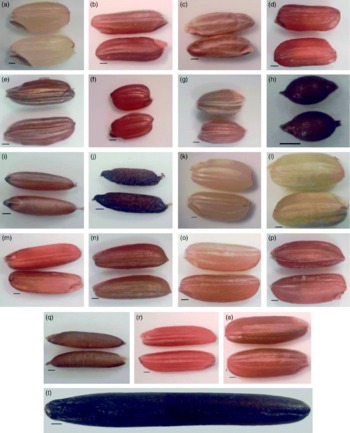
Of 20 samples, 9 had a medium shape, 7 were slender and remaining 4 fell into the bold category (Supplementary Table S1, available online only at http://journals.cambridge.org). Seed colour varied between pale pink and red/brown (Fig. 3). The commercial O. sativa cultivars were white/pearl in colour.
Light microscope images of dehusked seeds of rice and its wild relatives. (a) Oryza sativa cv. Nipponbare, (b) Oryza grandiglumis, (c) Oryza meyeriana, (d) Oryza latifolia, (e) Oryza alta, (f) Oryza officinalis, (g) Oryza granulata, (h) Potamophila parviflora, (i) Oryza longiglumis, (j) Microlaena tasmanica, (k) Oryza hybrid, (l) O. sativa cv. Teqing, (m) Oryza rufipogon, (n) Oryza meridionalis, (o) Oryza nivara, (p) Oryza australiensis, (q) Microlaena stipoides, (r) Oryza glumaepatula, (s) Oryza spontanea and (t) Zizania palustris.

Seed coat
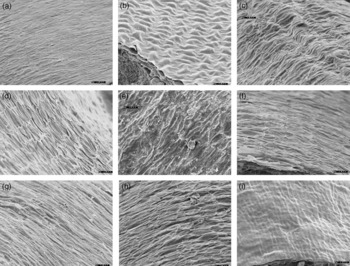
A variety of seed coat patterns were observed using SEM (Fig. 4). For example, the outer seed coats of Z. palustris and O. glumaepatula were flatter and less crinkled than all other species. Many different wrinkled patterns were observed ranging from dense (O. sativa cv. Teqing and O. nivara) to moderate (Oryza alta, Oryza longiglumis and Oryza grandiglumis). In comparison, a wave-like pattern was observed for O. officinalis and O. meridionalis. The seed coat of M. stipoides was different to all other rice relatives with a striated rather than wrinkled appearance. No images were recorded for P. parviflora because its tiny grain size precluded dehusking.
Representative images of outer seed coat of rice and its wild relatives. All images were taken using 1.80 K magnification. (a) Oryza glumaepatula, (b) Oryza meyeriana, (c) Oryza sativa cv. Teqing, (d) Oryza australiensis, (e) Oryza meridionalis, (f) Oryza spontanea, (g) O. sativa cv. Nipponbare, (h) Oryza alta and (i) Microlaena stipoides.

Discussion
In addition to starch physiochemical properties and cooking quality, consumer preference is also influenced by rice grain size, shape and colour. Rice breeders must take all these parameters into consideration when developing a new variety (Adair et al., Reference Adair, Bollich, Bowman, Jodon, Johnston, Webb and Atkins1973; Blakeney, Reference Blakeney, Henry and Kettlewell1996; Vidal et al., Reference Vidal, Pons, Brunnschweiler, Handschin, Rouau and Mestres2007). Results from this study revealed that although seed morphology varies between the genera, both seed size and seed shape of all of the species studied fall within the standard O. sativa classification scale used by rice breeders.
The grain size of O. meridionalis, Oryza australiensis, O. rufipogon, O. nivara and M. stipoides falls in the medium category, and their similarity to conventional cultivated rice suggests they have commercial potential. The grains of O. alta, Oryza granulata, O. officinalis and P. parviflora are categorized as short with a bold shape similar to O. sativa cv. Nipponbare, suggesting that their size and shape would not be an impediment to them competing with or complementing current commercial varieties of O. sativa. The grains of the remaining species fall into the slender shape category being short, medium or long. An acceptable L/W ratio for rice grain is between 2.5 and 3.0, provided the grain length is greater than 6 mm (Kaul, Reference Kaul1970). In this study, we have found the L/W ratio of the majority of wild species either falls into this range or is greater than the range, and only four were greater than 6 mm in length.
Geographical variations in the preferences for grain size and shape are well described with long grain rice being preferred on the Indian subcontinent, medium grains in Southeast Asia, while short grain rice is consumed in many parts of north Asia (Juliano, Reference Juliano1985; Cruz and Khush, Reference Cruz, Khush, Singh, Singh and Khush2000; Wrigley, Reference Wrigley, Wrigley, Croke and Walker2004). As the wild rice relatives possess grains with shapes and sizes which fall within the conventional ranges (i.e. medium, short and long), they would most probably be attractive to a wide range of consumers and have potential commercial value.
The grains of P. parviflora were very small, the smallest among the species examined, ranging from 1.34 to 1.65 mm in the hull. Quinoa, a pseudo cereal from South America, has a diameter of 1–2.6 mm, and in spite of its tiny size, is a highly nutritive source of starch (Taylor and Parker, Reference Taylor, Parker, Belton and Taylor2002). Given this precedent, P. parviflora has the potential to lead to a new nutritive grain for human consumption.
The red, black, purple and pink pigments in rice are anthocyanins present in the pericarp (Ryu et al., Reference Ryu, Park and Ho1998; Ichikawa et al., Reference Ichikawa, Ichiyanagi, Xu, Yoshii, Nakajima and Konishi2001; Wang et al., Reference Wang, Tseng, Lin, Yang, Yu, Ramachandran and Pan2003; Abdel-Aal et al., Reference Abdel-Aal, Young and Rabalski2006; Patindol et al., Reference Patindol, Flowers, Kuo, Wang and Gealy2006). Anthocyanins have antioxidant properties, which have positive human health benefits including suppression of tumour cell growth (Koide et al., Reference Koide, Kamei, Hashimoto, Kojima and Hasegawa1996). Diverse colours were observed in the wild rice grains (Fig. 3) and although the preferred colour of commercial cultivated rice is pearl white, interest in coloured rice is growing (Bergman et al., Reference Bergman, Bhattacharya, Ohtsubo and Champagne2004). Red rice is now being used in Japan in noodles, cakes and alcoholic beverages (Itani and Ogawa, Reference Itani and Ogawa2004), while the coloured Zizania species are used in soups, vegetable-based side dishes, dehydrated mixes and frozen foods.
Seed coat morphology of the wild Oryza does not follow the grouping of Maclean et al. (Reference Maclean, Dawe, Hardy and Hettel2002), who grouped the Oryza into four complexes, i.e. Oryza ridleyi, Oryza meyeriana, O. officinalis and O. sativa complexes. A wide variety of seed coat patterns were observed suggesting they may differ by their bran and hull properties. Although wide variation in wild rice grain morphology was observed, both size and shape fell within the standard rice breeders' classification scale suggesting these species have potential to enrich and extend the gene pool for rice breeding programmes. Analysis of the physiochemical properties of these species may confirm their potential as whole grain foods.
Acknowledgements
The authors wish to acknowledge the assistance of Agnelo Furtado and Maxine Dawes, Southern Cross University, Sally Dillon of the Australian Tropical Crops and Forages Collection, Yanco Agricultural Institute and Tasmanian Herbarium. The Grain Foods CRC provided the funds for the project.